Quis custodiet ipsos custodes? Hibbs on The Film.

We're a week or so from the real release of the WATCHMEN film. I've seen it. This is INCREDIBLY FUCKINGLY SPOILERY, so you must absolutely NOT read it if you don't want your watching experience potentially ruined.

Seriously, I almost felt I should hold it until actual release. So don't go below the jump unless you understand the ramifications of your actions.

Friday night... well, no Saturday morning, there was a IMAX screening of WATCHMEN, at WonderCon, roughly a week before the film is generally released.

They decided to be clever by having it at 11:55 PM (five minutes to midnight being a theme in the book, y'see), but, of course, with the various multiple levels of security to get in, and the desire to fill each and every seat in the place ("Who has an empty seat next to them, please raise your hand. No, only one person raise their hand") it didn't start until, ugh 12:30 or so.

Dave Gibbons gave a quick intro which was worth the price (or time) of admission by itself, kinda -- who doesn't want to watch WATCHMEN without Dave Gibbons standing there with you?

I managed to stay awake pretty much through the entire thing (though I started to nod off a little in the prison break sequences -- but I caught myself, and adjusted my seating until it was uncomfortable, so I could stay awake) -- we finally got out at like 3:30 am, ugh.

So, here's a review:

Overall, I did not like it.

It's utterly slavish to the comic in places -- amazingly astonishingly incredibly faithful. Then, in the same scene, completely absolutely and totally unfaithful. Obviously I get why having Rorschach vs The Psychiatrist being a single scene (instead of the 3-4 in the original) "needs" to be done for time reasons, but I don't understand why having, say, Dan and R's first encounter doesn't have R stealing all of his sugar so he can eat it through the rest of the film: that doesn't take any screen time, it is just incidental character movement that can happen while delivering dialogue. It isn't like you need, or want, to cut to a tight shot of him doing it.

All in all, the film is the Reader's Digest version: if it can plausibly be cut, it probably is. For example: the news vendor and The Kid are in the film, but they don't have a single line of dialogue. The Intersection is there, but nothing occurs on that spot. All in all I'd guess that roughly half the book makes it to the screen.

Its weird because I wish the film was actually worse, so I could honestly HATE it -- I walked out feeling totally disappointed, but not in a "stay the fuck away!" sense.

And it made me want to see the 6 hour version (that doesn't exist), kind of, but also afraid that would be just as wrong.

I was distracted by:

Rorschach's moving mask. It was distracting, and didn't really look right to me, with everything focused purely on the face (it goes around his entire head, after all) I also thought the "texture" of the mask was wrong.

Jon's massive cock. It is pretty big, alright, and you notice it in every scene it is in.

The Two Silk Spectres, anytime they had a scene together. Mom looked younger than the daughter, damn it! And neither of them was particularly a good actress.

The stupid scaled-up super-heroic nonsense. I'm not talking about the slow-mo jumping scenes in the trailer, actually most of those are out of context, and in the film they look pretty decent -- but things like The Comedian punching through solid concrete. With bare hands. When he's 70 and about to die. Everytime a non-Jon, non-Adrian character did super-heroey things, I wanted to die inside.

Dan's lack of those owl-wings hairs in the front. That's like Superman not having the spit-curl "S"!

The not beginning and ending the movie with the same image, damn it. Those images are there, but a few minutes to either side, weird!

But, really, the biggest problem with the film is I feel like they Didn't Get It, for several reasons. Namely:

1) It fetishized the violence. This is a seriously violent movie. Most of that violence is in the comic, but it is very very different in a comic than in a movie -- especially when the movie tends to use that speed-up, then slow-mo down technique for the action. Movies also have sound effects (you can hear shit breaking and tearing, yes), which the comic resolutely did not have.

2) It fetishized the heroes. Jon is built nearly like Ah-nold (and/or John Holmes, depending on the angle). Dan doesn't look like a broke-down middle-aged man. Everyone has Batman-Style fake muscles and all that. Only Rorschach fit my idea of being what he should be: being nearly-shockingly puny in size compared to the others.

3) Most of the "world building" is thrown out the window -- cigarettes aren't any different (not that we see ANY in the world, but still), nor do there appear to be cheap electric cars or any of that. OK, there's still a Gunga Diner, I guess, OK.

4) Dan and Laurie are explicitly still super-heroes at the end -- they even talk about taking Archie out. Yikes, NO.

5) The Final threat isn't the giant squid attacking New York for that 9/11 moment, but "'Dr. Manhattan' attacks the WORLD", yet only with Tricky Dick leading the change. Like, OK, lets assume Jon does go nuts and kill people... what the fuck could you POSSIBLY do to band together to stop him? That works even less as an ending, thematically. Esp. when Dan has that dumb fucking ass line about "We'll be OK as long as everything thinks Jon is still watching" or whatever.

No, no, no, and no. Have you ever READ the book, guys?

Here's what gets me: this is very much a perfect adaptation of WATCHMEN in several ways -- there are places where you're going to go "Ooh, NAILED it", but they go far enough from theme and incident that the human-ness in the story is a distant second to the spectacle and a literal read of the plot.

As I've said: no one reveres WATCHMEN for its plot -- it is its construction and characterization* that we marvel at.

I hope this does well enough that another 10 million people will seek out the book, I can tell you that, but I also sorta hope it doesn't make back its production costs, because hacking out a WATCHMEN II is actually almost possible with the new ending.

At the end of the day, I might say this was much like the film version of V FOR VENDETTA -- it entertained me reasonably well in the moment of watching it, but I walked out of the theater thinking they had misunderstood the fundamental philosophic underpinnings of the original work.

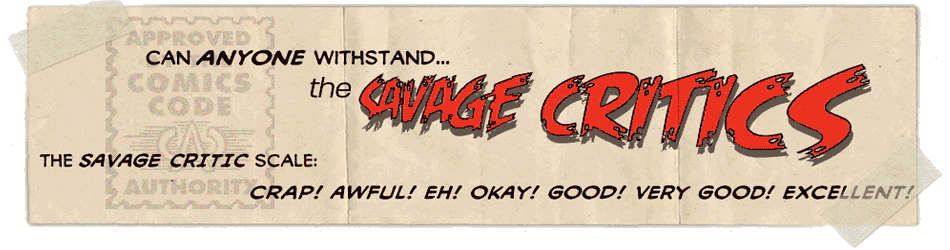
That opening sequence of "the times they are are a-changin'" with the semi-moving photos and the history of the world really made me think that maybe they made a version of WATCHMEN that while not-the-comic, was also pretty good -- that's a nice opening. But as the film went on and on, I thought it had less and less heart, and I was pretty disgustipated by the end of the film. On the Critic Scale, I'd absolutely call the overall thing an EH.

I can also say this: there's no reason that I could see to really see it on IMAX. Should be just fine on a normal-sized screen. This isn't like THE DARK KNIGHT, where there were IMAX-filmed scenes that demand that viewing. In fact, maybe just maybe that added to my sense of "Why all the spectacle?" because the shit was 100 feet high. I honestly might have liked this better on a television screen, really.

So, when you see it, what did YOU think?

-B

* = (Yes, Mr. Lester, that's more exact)


Flying Thompson's Gazelle of The Yard

A final word on my 2008 report on BookScan. Under the jump for everyone who is tired of this topic (which is probably most sane and rational people)

As a prominent retailer in a prominent market, who has a long-running soapbox on the retailing of comics, I do a fairly large number (3-6-ish) of interviews any given year, whether it be for various podcasts or newspaper features or whatever about the comics industry. Pretty uniformly, “what’s the size of the market?” is one of the primary questions that rises.

We have a paucity of real, viable data in this business. Other industries appear to have whole sub-industries designed just to analyze sales data. I guess the need to categorize, to define, to find out our parameters is one of the things that make us human.

In comics, we have exactly one public source of information: Diamond’s charts. They present data in a somewhat broken fashion. eg: they don’t include Diamond UK, until recently it topped out at 100 books (and not all that long ago, it topped at 100 comics, as well), and it also favors items that arrive at the beginning of the month’s cycle over those that arrive at the end of the month. There’s probably two or three more ways they aren’t properly reflecting the real market activity as well.

We understand these limitations, and, hopefully most people when they construct premises of market activity bear those limitations in mind.

We have no public data about any other sales in comics with the last remaining exceptions of those publishers (Just Marvel and Archie, I think at this point? John Jackson Miller, correct me if I am wrong here?) who still ship via a certain US Postal Service regulation and have to provide some sketchy (and, I've been told, often made up my some intern) sales information. We will, very occasionally, get some sort of vague public statement, usually rendered anecdotaly -- most recently probably Paul Levitz's comment that WATCHMEN was in the 1 million copies sold range in 2008 -- but certainly nothing that one can construct any kind of real understanding of anything at all, based upon just that.

Seven years ago I was told about BookScan, and that there WAS data being gathered on sales outside the DM. It wasn't public though, so I pushed and I pushed and I pushed at several dozen people, and I found a few sources that were willing to leak it to me once a year. And I thought if I was interested in this, other people probably were too. Given that it generally gets more commentary than anything I write the whole rest of the year, combined, I think this is justified.

Like any information stream, it is only useful to the extent that you look at it for what it is. As I understand it, BookScan is an accurate report of what sold through at the venues which report to BookScan. Those venues are, for the most part, the large chains, the major websites, the largest of the independent bookstores (Powell's, etc.) This isn't, by any means, any place that books can be or are sold, and it doesn't include libraries, schools, book clubs, strip clubs, gas stations, residences, warehouses, farmhouses, henhouses, outhouses or doghouses.

But, within the venues that it DOES represent, it represents 100% of the sales during the year-to-date.

I believe that I have been scrupulous about stating and restating this, and I even think that I've done some damage to the readability of the article by bending over backwards to say "of those reporting to BookScan" or some variant of that over and over again.

What I believe is that if the charts say that "Love & Rockets: New Stories #1" sold 719 copies, then, yeah it is a factual statement that from the day of its release to 12/31/2008 that Borders, B&N, Amazon, et al. sold under 800 copies in those venues, during that date range. (I put it that way because, of course, as a guy who runs a POS system, mistakes get made by clerks all of the time, so there's always going to be SOME kind of unavoidable "fudge factor"; but that factor is probably under 10% of the total)

That doesn't mean that xxxx copies were not placed into the distribution channel. That does not mean that xxxx copies won't eventually sell. That does not mean that xxxx copies didn't go into non-retail channels. That does not mean any of a whole host of things. It just means that from date of release to 12/21/2008, Borders, B&N, Amazon, et al sold under 800 copies of that item. Nothing more, nothing less.

Now if you (generically "you", not specifically so) want to believe that this datum holds no/limited value, I won't try to stop you. But I will choose to disagree.

WHY do I think it has some value? Because of pundits like (as Dirk says) Balan Bavid Boane, or one-name internet trolls who lurk in threads everywhere who like to insist things similar to "The Direct Market is a dying and useless system that is no better than a cancer upon the heart of all comics everywhere"

Tom has an excellent point that "no one in a position of any importance at any company has to my knowledge ever seriously dismissed the still-crucial Direct Market as a place to sell comics." So this much, at least, is down to my failure to differentiate between the light and the heat, as it were -- but I want these memes to die the dog's death that they deserve (and lets add "If only comics were anthologies printed on cheap newsprint, the audience would come flocking back" too, please)

But, yes, I'm guilty of falling prey to the heat. C'est la guerre.

And so for that, please let me apologize.

I do think there's some conflation going to among "legitimate" pundits -- I don't buy the argument that because [whatever] is still on sale in specific channels that it moots the snapshot nature of a BookScan list; those items are also still on sale in the DM as well after all, and we'll never know the final long-term sales of any book ever until after that book is no longer in print. I don't buy the argument that we should count library sales (or whatever) on [whatever] if we're not counting the same channels for [something else] -- and since we're unlikely to ever have that kind of clarity within our lifetimes, we work with what we DO have.

But, at the end of the day, BookScan is what it is, and, as far as I can tell there's no legitimate disagreement that BookScan is what it is: "100%" of the sales, within the date range presented, to the specific venues that report to BookScan.

Each year I try to remove more of my biases, and more of my silly shit from the analysis -- no one seemed to notice that this year I didn't have the last 4-5k words be about a comparison to the DM, like the previous five years! I don't think I'll ever be able to 100% remove those biases 100% of the time, because I'm human (and I think comparisons are largely inevitable). But I'm working on it, really I am!

Whether I succeed or not, I do firmly and fundamentally agree with this statement of Tom's: "Right here, right now, additional markets aren't just desirable, they're necessary. For many people the ability to operate in multiple markets is the difference between publishing and not publishing, and has been for several years now. For some folks, every single market of any value is the difference between making a modest living and making no living at all. For certain companies and titles it's the difference between existence and extinction."

In some ways, it is like what I say about Periodicals versus Perennials in the DM -- the periodical comic books provide the cash flow; the book format perennials provide the long term profit. DM orders tend to be of great significance as an upfront thing, and they're not returnable, and they tend to pay within 30 days from the Bank of Diamond -- basically No Risk/Quick Pay. Other markets are riskier, returnable, and generally slower to pay -- but as a long term investment may be very profitable if you get that big hit.

Either way, that's where I won't quibble with Tom even a little: all markets are needed, all venues are valid, all sales are good.

Anyway, just because I'm feeling silly, here's how I felt a little earlier in the week when reading Dirk's comments:


If you're going to WonderCon on Friday...

2:00-3:00 Everything You Wanted to Know About Comics Retailing—But Weren't Afraid to Ask!— Join ComicsPRO board members Joe Field (Flying Colors Comics, Concord) and Brian Hibbs (Comix Experience, San Francisco) for a free-wheeling exploration of the world of comics specialty retailing. Field and Hibbs are two of the industry's most vocal leaders dedicated to improving the profession of comics retailing. Get the inside scoop on ComicsPRO, Free Comic Book Day, the new edition of Tilting at Windmills and the proverbial more! Room 232/234

Hope to see you there!

-B

Your QuickLink for the Day: Trailer to Spiegelman's Be A Nose.

Speaking of symbolists, I got an email just this morning from the McSweeney's people talking about their next book, Art Spiegelman's Be A Nose, "a triple dose of unexpurgated Spiegelman sketchbooks from years past—you get 1979, 1983, and 2007, all in actual-size hardbound editions and wrapped in a really neat ski-gogglelike strap."

They include a link to the trailer they've created to the book which you can see here. (I'd embed the sonuvabitch, but I'm afraid I'd break the formatting since we've got a width limit here on the blog). I thought you might like to check it out...

Working on a review or two, although they're staggering a bit much more than I'd like. They'll be up here sooner or later, I'd like to think.


Best of the 00s: Black Hole

In case you missed my first post, I'm going to devote most of my writing at The Savage Critics to an ongoing project of making a list of the decade's best comics and graphic novels (at least that's the plan for the first year). I had planned on starting with Black Hole and announced my intention to do so at my blog; little did I know that Sean was also planning to look at Black Hole for his inaugural review at this very site! But Sean caught my comment and we convened, deciding that we would both review Black Hole, and then compare notes in a subsequent post.
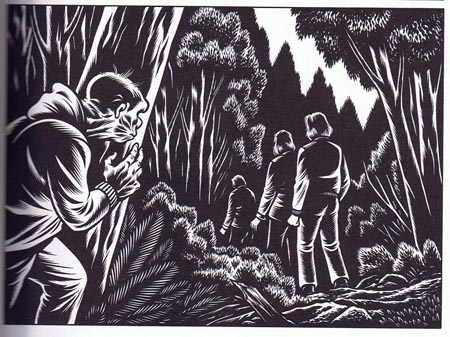
Why did we both want to start with Black Hole? I can't speak for Sean (I've made a point of avoiding his post up til now; I'll read it once this is up), but I thought of it as a great way to kick off a column about the best comics of the 00s. Black Hole is generally regarded as one of the great graphic novels of all time, so why wouldn't one consider it for the decade it came out? (Kind of--I realize that half of the original, pamphlet-type issues were published in the 90s, but we'll save any quibbles over that for the comments.) Plus it's a good yardstick for talking about the other comics I'll be covering here--more about that later. The review follows after the break.

Every time I look at Black Hole, the first thing that hits me is the blackness. Outdoor scenes, particularly those in forests, are common in Black Hole, and play a role in the plot and the multiple, shifting layers of symbolism. But when you first crack the book open, you're hit by the blackness of the woods, trees only distinguished by the slightest slivers of light. It's a primeval forest Charles Burns draws, the woods of fairy tales where wolfs and witches lie in wait for young people.

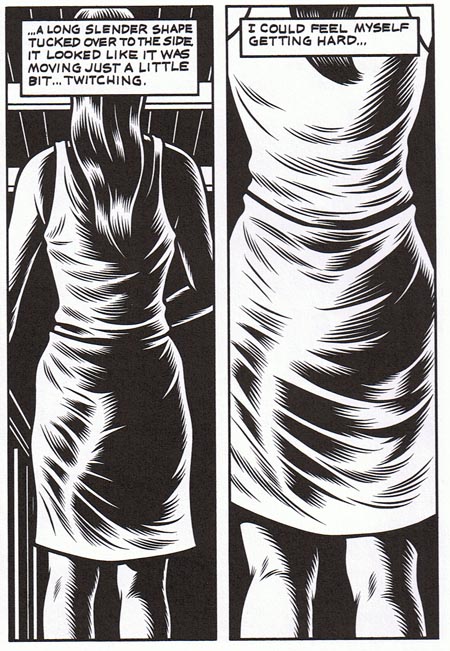
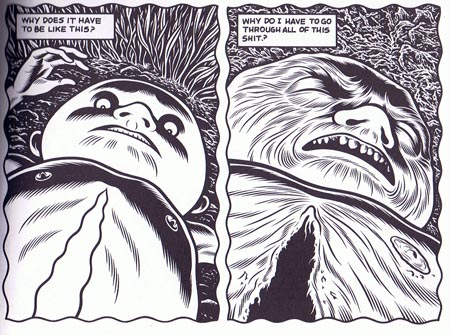
Which is appropriate, because more than anything else, Black Hole is about the mystery and danger of youth. I don't mean to say Black Hole is a murder mystery, although that's certainly an aspect of it. The mystery I'm talking about is the confusion and frustration that comes with puberty and adolescence. That theme is also apparent from the first pages of Black Hole, in which protagonist Keith Pearson cuts a perfect vagina-shaped hole in a frog he's dissecting in biology class. This causes Keith to pass out, but not before triggering a vision which establishes Black Hole's vagina-wound motif and presages many events yet to come.

But back to the forest. Keith and his friends are smoking a joint in a spot they've named Planet Xeno. Keith is transfixed by the natural beauty of the location, ignoring his friend's story that Rob Facincanni, a popular classmate, has fallen victim to "the bug": an ill-defined STD which turns its victims into deformed mutants. Rob, for instance, has a mouth in his chest that occasionally speaks in a high-pitched voice, often speaking truths Rob wouldn't normally reveal. Keith eventually realizes that they're being observed by someone. They leave the spot to look around, and soon stumble upon the tent and possessions of another affected classmate, Rick "The Dick" Holstrom.


Black Hole 1

Rick "The Dick" Holstrom looks on as Keith and his friends leave his campsite. Apologies for the quality of the scan--it's a thick book.

While his friends look through Rick's belongings, Keith wanders around nearby. He finds a shedded human skin, apparently left behind by a female victim of the bug. Keith (wrongly) laments the fact that he'll never know this woman, and is confronted by an especially grotesque sufferer from the disease, who asks (warns?) Keith to "go away." Keith soon realizes that he and his friends are surrounded by the mutated victims of the virus, watching them from within the woods. When he returns to Rick the Dick's campsite, he finds that his friends have trashed it and are ready to leave.

In those first pages, Burns establishes most of the major themes and plot points of Black Hole: (1) Keith's crush on classmate Chris Rhodes, whose skin he found; (2) the distressing nature of sex, both as a source of obscure dread and as the means by which the bug is transmitted; (3) the casual way in which the characters deal with the bug--no one ever speaks of a cure or even treatment, and adults seem to be entirely unaware of it or unconcerned about it; (4) the use of dreams as foreshadowing but also as a way to twist the meaning of previously established symbols or to uncover the true feelings of characters; (5) the role of specific natural locales as symbols of safety and comfort, but also stagnation; and (6) the aforementioned vagina-wound motif (the masculine equivalent being snakes and other phallo-serpentine things).

If that sounds like a lot to unpack, you're right. For those less interested in these themes, Black Hole works as a relatively straightforward narrative--only "relatively" because there's lots of flashbacks and retelling of events from multiple perspectives. That scene in the woods actually takes place around the same time as events from the middle of the book. But it's not hard to figure out what's going on--if you can follow Watchmen, you can follow this--and besides, you have Burns' extraordinary art to enjoy in the process. But even those more interested in Black Hole's surface elements might find themselves pulled in deeper by Burns' heavy symbolism and relatable themes of adolescent anxiety.

(Spoilers follow from this point.)

The story follows the intertwined experiences of Keith and Chris, from their exposures to the virus to their participation in the emerging culture established by victims of the virus (centered around a colony in the woods) to their attempts to escape from their situations. Chris responds more poorly to her circumstances: before infection, she was pretty, popular, and studious (though also a bit of a drinker). She's reluctant to rely on or even socialize with any victim of the bug other than Rob, who infected her in the first place. Her ability to deal with her new circumstances rest entirely in her relationship with Rob; when he is murdered, she essentially breaks down, strongly contemplating suicide at least once. Still, both Keith and fellow outcast Dave Barnes are looking out for her, providing her with the sustenance and knowledge she needs to survive. While Keith is a mostly benevolent figure, however, Dave has actually been manipulating events to pull her towards him, including ordering his friend Rick "The Dick" to kill Rob.

Keith is initially motivated by two occasionally opposing forces: his desire for escape and his desire for Chris. His narration at the beginning of Black Hole suggests this will be the story of how he achieved both goals at the same time, but a trip to buy pot from some college students throws a wrench in his plans. He meets Eliza, a roommate to the students and another victim of the bug; she has a small tail. Rather than revolting him, Eliza's tail (particularly its soft swaying beneath an impromptu skirt) arouses Keith. He's also fascinated by her bizarre art (most of which seems to depict infected mutants) as well as her intriguing maturity ("She knew something. She knew more than I did."). Keith finds himself sidetracked by his growing attraction to Eliza. Yet his compassion for the outcasts, Chris in particular, keeps him grounded in that world as well.


Black Hole 2

Keith follows Eliza down to her room, his gaze lingering on her barely concealed tail.

Burns takes us through three of the major anxieties of adolescence: sexual awakening, socialization, and the transition into adulthood. This vision of adolescence is reinforced by Chris and Keith's mutations--skin-shedding and tadpole-like protuberances, respectively. Though they feel comfort in their "natural" environments (the woods and the ocean), Chris and Keith must escape by metamorphosis, changing from undeveloped juveniles to fully-formed adults.

They approach this problem differently. Chris retreats from the challenge, reverting to a more childlike state; she expresses to Dave her wish to undo all the decisions she had made and return to her "boring" life. When Rob is alive, she sublimates her feelings of abandonment and ostracism into their relationship. After his death, she relies on Keith and Dave to take care of her, fantasizes about her parents doting on her. The final scene sees her floating in the amniotic fluid of the ocean, unwilling to leave the womb: "I'd stay out here forever if I could."

Keith, on the other hand, is anxious to move beyond this stage in his life. He irritates his friends with his restlessness, never satisfied with where he is, worried that "This is it...this is all it's ever going to be." When things get difficult, Keith finds solace in green: marijuana and the woods, where he retreats after a bad acid trip. Still, Keith is proactive in dealing with his sexual anxieties, seeking out Eliza and confronting the queasy mixture of feelings he has for her. He accepts the help of the outcasts, and offers help in return. And after "escaping" with Eliza, he plans to move boldly into adulthood, taking up a job and presumably raising a family (as suggested by his tadpole-like deformities).

A third reaction to the traumas of childhood comes from Dave. Keith and Chris try to escape adolescence by moving forward or backward, but Dave seeks to prolong it. Chris sees the bug as tragic, while Keith seems to accept it as a new, permanent part of his life. Dave, however, embraces it, seeing new opportunities in his outcast status. Bullied, belittled, and ignored before his mutation, Dave's isolation from society allows him to ignore its mores altogether. He abducts, rapes, and kills, aided by his friend Rick (who Dave seems to have some control over--he doesn't socialize with the other outcasts, relying on Dave for food and entertainment). In addition to ordering Rob's death, he also destroys Chris' tent in order to encourage her to move in with him. Unsurprisingly, he confesses that he prefers his new life to his old one. But when Chris runs away, revealing the limits to his power, he responds by killing himself and several of his friends.

Black Hole is something of a period piece--look at those hairstyles!--but there's not a whiff of nostalgia to it. The teenage years are something to be navigated carefully, lest one end up "stuck" in the way Keith fears. The first sexual experiences aren't fun--they're awkward and strange, and lead to unwanted side effects. Friendships aren't bedrocks of solace or support; they're motivated by convenience or lust, with the possible exception of Chris' friendship with Marci. And even that relationship is marred by a lack of empathy and casual cruelties.

Keith seems to do better for himself than the other characters, but even then Burns leaves room for despair. Keith's final dream involves him apparently trying to resuscitate a frog-like baby (metamorphosed from his tadpole/sperm outgrowths?) with the same vagina-shaped scar we saw in the first of the book. His friends then show him a yearbook, pointing out that the hideously deformed character who told Keith to "go away" was in fact a future version him, perhaps suffering from an advanced stage of the bug. Finally, he encounters Chris, apparently consigned to the dump heap of his adolescence, sitting naked among the empty beer cans, old magazines, and other pieces of trash Keith has left behind. Having escaped adolescence, then, Keith is rewarded with an introduction to the traumas of the adult world. His sperm/tadpole protrusions suggest virility, but will his offspring survive? And if they do, will they also be mutants? Will Keith be able to recognize himself in the future, after the rigors of adulthood further transform him? Will he always regret leaving Chris behind, failing to save her when she needed it most?


Black Hole 3

Keith dreams about the future and laments his present (exemplified by the apparent shedding of skin by the baby--a reminder that Chris is somewhere out there alone). Again, apologies for the blurriness.

Still, the dream ends on a positive note. Chris pulls a piece of paper out of her vagina-shaped foot wound, revealing a drawing of a lizard (maybe a horned lizard or "horny toad")--an obvious symbol for Eliza. "See," she says, "It doesn't always have to be bad. Sometimes things work out." No matter what the years ahead bring, Keith will always have his time on the road with Eliza. And even though she lost him, Chris will always have her memories of Rob, buried in the sand of the beach to be dug up later.

It's a complex take on adolescence, one which rejects conventional narratives of triumphant transformation, blossoming through acceptance of one's true nature as an individual rather than a stereotype. The nerds don't win--they end up dead. There's no climactic confrontation, only three escapes (counting Dave's suicide). The book ends with the bug still out there, ready to afflict more teenagers. Burns also takes an unusual approach to mystery. Though he does dwell on the Rob's murder and the discovery of various disturbing artifacts (including a disembodied arm), the more important and satisfying mystery comes from the initiations into adulthood that Chris and Keith must undergo.

These complex themes are expressed largely through Burns' repetition of symbols, all rendered in his sumptuous, distinctive style. Burns is one of the foremost symbolists (capitalize it if you want) in comics, earning a place alongside David B., Art Spiegelman, and Chris Ware. He creates a dark and intriguing world, filled with shadows, grotesqueries, and naked flesh. Black Hole is a pleasure to look at, one of the most beautiful comics I've ever read. It's also a dense, challenging narrative which makes good use of the unique storytelling properties presented by comics as a medium.

Not everything I review in this series will prove the equal of Black Hole --in fact, very little will. But I start here because Black Hole provides a model of excellence to which we can hold up other books. When reading other works, we can consider its complex themes, satisfying density, stunning art, and rich storytelling, and realize the potential for greatness in the medium of comics. We can appreciate Burns' deep ambition and successful realization of his specific vision, and seek out works which attempt (and hopefully attain) the same degree of sophistication. It's a high standard, but a lot of comics were published in the last decade. It's entirely appropriate to start with our expectations high.


Arriving 2/25/2009

At least the reorders are starting to flow again. Adding that to a larger-than-the-last-few-weeks shipment, and, like I thought, it is a big ass invoice this week.

Busy trying to get ONOMATOPOEIA out by tomorrow's deadline. More posting "soon"

A G SUPER EROTIC ANTHOLOGY #99
ANGEL #18
ARCHIE #594
ASTOUNDING WOLF-MAN #13
AVENGERS INITIATIVE #22 DKR
BART SIMPSON COMICS #46
BATMAN GOTHAM AFTER MIDNIGHT #10 (OF 12)
BATMAN THE BRAVE AND THE BOLD #2
BLANK COMIC BOOK
BLUE BEETLE #36
CAPTAIN AMERICA #47
CARTOON NETWORK BLOCK PARTY #54
CONAN THE CIMMERIAN #8
CRIMINAL MACABRE CELL BLOCK 666 #3 (OF 4)
CTHULHU TALES #12
DARK REIGN FILES DKR
DARK TOWER TREACHERY #6 (OF 6)
DOCTOR WHO WHISPERING GALLERY (ONE SHOT)
DR DOOM MASTERS OF EVIL #2 (OF 4)
DYNAMO 5 #20
ELEPHANTMEN #16
ENDERS SHADOW BATTLE SCHOOL #3 (OF 5)
EUREKA #2 (OF 4) CVR A
FANTASTIC FOUR #564
FEAR AGENT #26 1 AGAINST 1 (PT 5 OF 6)
GHOST RIDER DANNY KETCH #5 (OF 5)
GIGANTIC #3 (OF 5)
GREEN LANTERN #38 (ORIGINS)
HULK #10
INCREDIBLE HERCULES #126
JACK OF FABLES #31
JUSTICE SOCIETY OF AMERICA #24 (ORIGINS)
KNIGHTS OF THE DINNER TABLE #148
LEVITICUS CROSS #2 (OF 5)
LORDS OF AVALON KNIGHTS OF DARKNESS #4 (OF 6)
MADAME XANADU #8
MARVEL ADVENTURES FANTASTIC FOUR #45
MARVELS EYE OF CAMERA #4 (OF 6)
MIGHTY AVENGERS #22 DKR
MISTER X CONDEMNED #3 (OF 4)
MS MARVEL #36 DKR
NEW AVENGERS #50 DKR
NINJA HIGH SCHOOL #167
NOVA #22
PALS N GALS DOUBLE DIGEST #129
PROOF #17
REIGN IN HELL #8 (OF 8)
RUNAWAYS 3 #7
SAVAGE DRAGON #145 CVR A
SCOURGE OF GODS #2 (OF 3)
SGT ROCK THE LOST BATTALION #4 (OF 6)
SHE-HULK 2 #38
SKAAR SON OF HULK #8
SONIC UNIVERSE #1
SPAWN #189
STAR TREK COUNTDOWN #2
STAR WARS LEGACY #33 FIGHT ANOTHER DAY PART 2 OF 2
SUPERMAN #685 (ORIGINS)
SWORD #15
TALES FROM RIVERDALE DIGEST #32
TEEN TITANS #68 (ORIGINS)
THUNDERBOLTS #129 DKR
TRINITY #39
ULTIMATE SPIDER-MAN #131
UMBRELLA ACADEMY DALLAS #4 (OF 6)
UNKNOWN SOLDIER #5
USAGI YOJIMBO #118
WAR MACHINE #3 DKR
WAR THAT TIME FORGOT #10 (OF 12)
WASTELAND #24
WILDCATS #8
WOLVERINE FIRST CLASS #12
WOLVERINE ORIGINS #33 DKR
WONDER WOMAN #29
WONDER WOMAN #29 VAR ED
WORLD OF WARCRAFT ASHBRINGER #4 (OF 4)
X-FORCE #12
YOUNGBLOOD #8 OBAMA CVR
YTHAQ FORSAKEN WORLD #3 (OF 3)

Books / Mags / Stuff
ALAN MOORE THE COURTYARD GN COLOR PTG
BAREFOOT GEN VOL 08 MERCHANTS OF DEATH
BARFOOT GEN VOL 07 BONES INTO DUST
BEANWORLD HC VOL 01 WAHOOLAZUMA
CAPTAIN AMERICA TP VOL 03 DEATH OF CAPTAIN AMERICA
COMPLETE PEANUTS 1971-1972 VOL 11
DC SUPERHERO FIGURINE COLL MAG #02 SUPERMAN
EERIE ARCHIVES HC VOL 01
GIANT ROBOT #58
HUMBUG HC (RES)
MMW FANTASTIC FOUR TP VOL 01 VAR ED 02
MOME GN VOL 14
PREVIEWS #246 MARCH 2009
RONINBEBOP SC
SECRET INVASION TP BLACK PANTHER
SECRET INVASION TP RUNAWAYS YOUNG AVENGERS
SHOWCASE PRESENTS SUPERMAN FAMILY TP VOL 03
SKRULLS VS POWER PACK TP DIGEST
STARMAN OMNIBUS HC VOL 02
TALES OF THE GREEN LANTERN CORPS TP VOL 01
TEZUKAS BLACK JACK PX HC VOL 03
TOMARTS ACTION FIGURE DIGEST #175
VIOLENT MESSIAHS TP VOL 02 LAMENTING PAIN
WIZARD MAGAZINE #210 WANTED JG JONES CVR
WOLVERTON BIBLE HC GN
X-MEN LEGACY TP SINS OF THE FATHER

What looks good to YOU?

-B

Favorites: Black Hole

Hi folks! I've decided I'll use my slot as a Savage Critic to talk about my favorite comics of all time. I'm kicking things off with Charles Burns's Black Hole--which, coincidentally, Dick Hyacinth had also chosen to use as the inaugural book for his series on the best comics of the decade. So Dick and I will be tag-teaming on this one: I'm going first, then he'll post his thoughts without reading mine, then we'll check out what the other guy has to say and post responses. Should be a pip. Meanwhile, I've also dug a review of the book I wrote for the geek-culture iteration of Giant magazine out of the archives and posted it on my blog--check it out. And now, without further ado... PhotobucketBlack Hole Charles Burns, writer/artist Pantheon, 2005 368 pages $18.95, softcover EXCELLENT

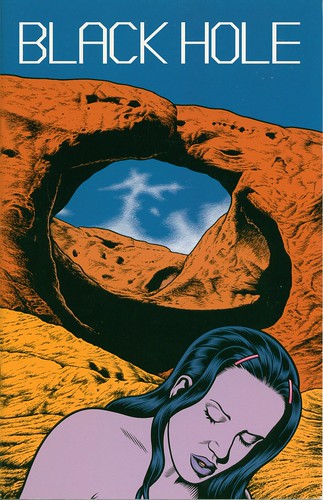
You lose a lot of extremely impressive supplemental material if you purchase or read only the collected edition of Black Hole rather than the individual issues from Fantagraphics (and, earlier, Kitchen Sink). The full-color front and back covers for each issue are probably what stand out in most people's minds, followed perhaps by the almost masochistically detailed endpage spreads, and last but not least those terrific ripped-from-the-hotbox dialogue snippets that accompany Burns's yearbook-portrait openers. I think everyone is probably partial to the one where a guy asks to be cremated if he dies so that his friends can smoke his ashes, but the one from the first issue isn't some nugget of stoner wisdom, it's the premise of the entire book:

It was like a horrible game of tag...It took a while, but they finally figured out it was some kind of new disease that only affected teenagers. They called it the "teen plague" or "the bug" and there were all kinds of unpredictable symptoms...For some it wasn't too bad - a few bumps, maybe an ugly rash...Others turned into monsters or grew new body parts...But the symptoms didn't matter...Once you were tagged, you were "it" forever. 

That quote made it into the collected edition as the back-cover blurb. This one, from the twelfth and final issue, didn't:

It's like tryin' to explain sex to a nun - there's no way you'd ever understand it unless you lived it. I was there, okay? Half my fuckin' friends died out there, man. I never dreamed I'd get out of that shit-hole...but one day I notice the stuff on my face is starting to heal and a couple of months later, I'm totally fuckin' clean...out walking around with all the normal assholes. 

This directly contradicts the quote from the first issue and upends the premise it establishes. Turns out the horror of the teen plague is finite. Turns out everything that happened in the book didn't need to happen, not the way it did, not based on the assumption that nothing was going to change and they'd never get better. Turns out, in other words, that the teen plague was ultimately like being a teenager itself: It sucks, but you grow out of it.

Rereading Black Hole for the fourth time or so, it's easy to see the set-up for this punchline. Keith in the woods during the kegger where he finds out Chris has the bug, peeing on a tree and grumbling to himself, "This is it...this is all it's ever gonna be. It'll never get better...I'll always be like this..." Chris's similarly themed rebuke of her parents: "You don't understand! You'll never understand! Never!" The constant hyperbole the kids use to describe virtually everything even potentially enjoyable: "It was going to be the best day of my life"; "Rob had brought along all kinds of incredible things to eat...black olives, an avocado, french bred, salami, cheese..."; "All right! That's gonna blow your fuckin' mind!"; "It's called Monument Valley--you won't believe how amazing it is!"; and my favorite, "I want to show you how to make the best sandwich in the world." Chris telling Rob "I'll love you forever, no matter what," and Keith and Eliza telling each other the same thing. Chris's repeated refrain "I'd stay here forever if I could"--in Rob's arms, in the icy water looking up at the night sky. Everything is either the best it can possibly be or the worst it can possibly be, and it will never change.

Needless to say that's just about the most accurate depiction of the emotional life of teenagers I've ever seen. It's how I remember high school. It's not terribly far removed from how I remember college. (And to be perfectly honest, when I think of how I look at the world even now, it's within spitting distance of how I live today, which is probably a big part of why this is one of my favorite comics.) But of course, things do change. Bad things usually get better, which is why it's such a goddamn tragedy any time a teenager commits suicide because of a bad grade or a breakup--or when a group of sick kids feels it necessary to drop out of school, run away from home, and in the case of some characters literally throw their lives away. And unfortunately, good things often get worse; parents do understand, at least some of the time, and it's damn hard to tell someone "I'll love you forever, no matter what" and mean it, and two stoners driving across country probably won't be able to find a cozy apartment where he can make an honest living and she can work on her art and they both live happily ever after. That's a tragedy too.

So why remove the quote that points this out, the quote that completes the metaphor? Maybe--and I'm just guessing here; I've interviewed Charles Burns about this book a couple of times but I don't recall asking him about this--he didn't want to give us that escape valve. Maybe he doesn't want us to read this and think, "Silly kids, if only they knew." Maybe he wants to eliminate anything that lessens the number-one effect of the story and the art here: claustrophobia.

Honestly, the claustrophobia of Black Hole is what struck me the most in this reread. Take the panel gutters, for example. Burns employs a traditional method of delineating between real-time action and dreams or flashbacks--straight gutters for the real stuff, wavy gutters for the reveries. But those wavy gutters still create as uniform a grid as ones drawn with a ruler would. Instead of dreaminess, they evoke haziness, like heat waves radiating up from a road or the room spinning when you're cataclysmically wasted. Indeed, the few times the grids do deviate from the norm is when the characters are completely blotto, or completely panicked--even there, panels remain locked in tiers, and the effect is like careening from one side to another when you're too drunk to stand up straight and really, really wish you were suddenly sober again but you're stuck drunk. There's no way out.

Then there's the look of the art itself. Elsewhere I've described it as like immersing yourself in a blacklight poster, which is apt not just because of the subject matter (look and you'll see a few such posters on a few walls, in fact) but because looking at this book can practically give you a contact high. While I read the book this time around, I thought it might be neat to listen to a couple of playlists I recently made of the kind of electronic music I listened to in college, a time when presence of the kind of emotions you find in Black Hole still feels fresh to me, a time when I got stoned pretty frequently listening to that very music. Even though I did this on the commuter train out of New York, I'll be damned if I didn't feel the pressure on my eyeballs, the weight in my limbs, a slight throbbing of the vision when staring at Burns's flawless blacks and the trademark shine effect of his characters' hair. For the first time in his career, I think, style and substance lined up perfectly. It's not for nothing, though, that the use of drugs and alcohol in the book almost always reduces the options available to the characters--most of the time they prevent people from doing what needs to be done or saying what needs to be said, and even during the story's few positive depictions of inebriation, intoxicants are used to push things toward a preordained conclusion rather than open up other possibilities. No minds are expanded.

Maybe the most powerful aspect of the book's claustrophobic effect is its eroticism. True to adolescent love and lust, the desire these characters have to fuck one another is irresistible and all-consuming--it has to be, or else the story couldn't have happened, and virtually every major plot development wouldn't have taken place either. Frequently the very environments where the sex takes place contribute to this feeling. Rob and Chris's fateful liaison takes place in a graveyard. Keith first sees Eliza, nude from the waist down, under the harsh and unforgiving glare of florescent kitchen lights. He first becomes aroused by her when her tail struggles against the restraint of her towel. Their romance is kindled in her bedroom, surrounded by hundreds of her bizarre (and very blacklight) drawings. They first have sex while stoned as fuck, a red scarf draped over the lamp and bathing everything in crimson. The atmosphere is oppressive, but so can be the feeling of being very, very turned on. "That's all it took to get me totally sexed up and crazy," says Keith of his first kiss with Eliza. "I could hardly catch my breath." (Is it worth noting I knew a girl who looked a bit like Eliza back in college? Probably.)

One final motif comes to mind when I think of how Black Hole works to confine and oppress: repetition. I've already mentioned some of the repeated dialogue, and there are any number of repeated visual cues--shattered glass, snakes, holes--and even repeated scenes--Chris floating in the water, those dream sequences. But there are two instances of repetition that stand out to me the most. The first is when Keith angrily leaves his parents' house to avoid watching some lame TV movie with them, only to end up tripping on acid and watching the very same movie at his friend's girlfriend's place. The second, and the most chilling, is Eliza's sexual assault, which is an implied echo of never-directly-described abuse she suffered at the hands of her stepfather--and, as her nightmare at the end of the book indicates, will likely continue to haunt her dreaming and waking life. Even her and Keith's blissful roadtrip escape is just a tour of places she's already been, trying to recapture the happiness she knew long ago. And maybe this more than anything else is why cutting that final reveal that the bug was temporary was the right move: Bad things usually get better, but that doesn't mean they never come back--different, perhaps, but the same in all the ways that count. Sometimes you can break free of something only to spin right back around to it, spiraling inward into that gravitational maw until that bad thing might as well be constant, for all you can truly escape from it.

I mean, the book is called Black Hole.

Black Hole #11 by Charles Burns


The New Tilting is up: BookScan 2008

You can find my look at BookScan 2008 right here.

I'd strongly suggest grabbing the chart and saving it off before Jonah gets a C&D. Tomorrow will likely be too late!

Interested in your thoughts, as always!

Edit: Tom Spurgeon has some good comments here. For the record, Tom is 100% right: look at these with a grain of salt, then a chunk of salt, then an entire salt mine, because, at best, these numbers are just the visible tip of the iceberg.

I really really tried to make this clear throughout the piece: go and count how many times I say something like "to the stores that report to BookScan" or words to that effect. I keep being afraid that I'm hurting the readability with all of the ass-covering I do!

-B

Don't Worry, This Zombie Comic Had a Head Start on the Trend: Jog and a 2/18 comic from half a decade ago

The Zombies That Ate the World #1 (of 8)
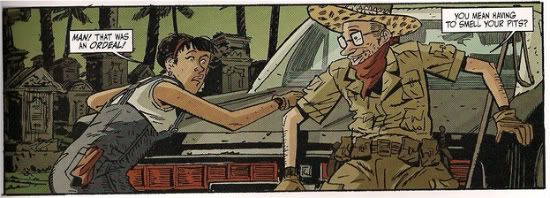
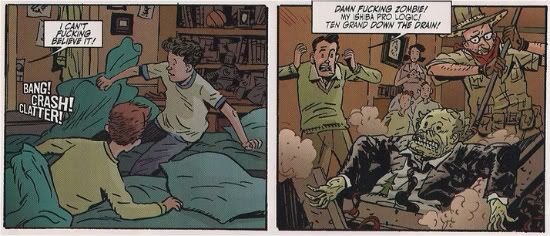
All right! Early aughts nostalgia, coming in fierce! Some of us do still pine for those bygone days of Les Humanoïdes Associés publishing in English, even if our (by which I mean 'my') reading wasn't nearly as extensive as it should have been, and even after that ill-fated partnership with DC.

These days it's Devil's Due releasing the stuff, and they're keeping things pretty conservative - not only are they breaking albums up (and shrinking them down) into $3.50 pamphlets, but they're focusing keenly on material front-loaded with noteworthy North American talent. Indeed, for now (with this and the John Cassaday-drawn I Am Legion), they're devoting their energy to stuff DC started publishing but never got around to finishing. Still, I can't help but pray my dreams of an English-release of that last volume of The Metabarons might finally be coming true.

Until then, there's always stuff like The Zombies That Ate the World, which does boast the participation of Guy Davis, who's maybe head of the class among prolific, idiosyncratic cartoonists working in front-of-Previews genre comics today (John Romita, Jr.'s the only comparable talent I can think of offhand). The project started off as a one-shot deal for the 2002-04 revival of Metal Hurlant, but eventually expanded into four albums' worth of material (and a short animated film), released through 2008. I'm not sure if later volumes form book-length storylines, but this particular issue covers part of the first album, which collects a bunch of the Metal Hurlant stories; as a result, there's no pacing problems from the conversion to the pamphlet format.

Problems with the stories themselves are a different matter. The writer (and letterer) is Jerry Frissen -- also creator of the Image-released Lucha Libre series -- whose premise sees the walking dead more-or-less normalized into human society in the far future. Sure, the occasional bit of flesh still gets chewed, but zombies mostly just amble around looking rotten, powered by whatever instincts they'd developed prior to their deaths; they're perfect prey for the series' anti-hero zombie hunters, deluded nerd Karl and his oafish sister Maggie, who'll procure or dispose of any former human for any seemingly any damn reason, so long as they pay's good.

Social satire is the narrative result, in just about the most unsubtle manner possible - it'll come as no surprise that political correctness comes under fire ("life-impaired," ha!), or that consumerism is duly indicted. Hell, George A. Romero himself contributes a cover blurb! But Frissen's chief humans don't really struggle against anything, which admittedly is sort of the point - Karl and Maggie are just useful cogs in a capitalist machine that's inched ever closer to literal dehumanization by transforming ex-humans (parents, etc.) into burbling items that can be collected or tossed away for a fee.

Frissen underlines this point over and over again, then puts it in bold and repeats it often - see a middle-class fellow spewing quasi-liberal nonsense while obsessing over his zombie father-in-law breaking expensive stuff on the way to living creamtion! Look! Here's a rich guy with a thing for sex with undead models and actresses, women finally within his reach! It's simplistic, shallow stuff, although I'll give the writer a bit of credit for his willingness to let his protagonists be genuinely repulsive at times - Karl in particular has no qualms about diverting a freshly transformed woman to his own bedroom, and Frissen is rightly unsparing in showing the amoral state of his titular zombie/consumerism-eaten world. It's too bad that the scatalogical, infantile and very wooden conversations between Karl and Maggie lack the zest needed to add some real lived-in heft to his emphatic concept.

But that's where Davis comes in, to make it all OKAY. This comic is a classroom-ready example of how inspired visuals can enliven a so-so script, with Davis' impeccable character designs adding a sweetly vulnerable dimension to Frissen's unsparing world. Coupled with Charlie Kirchoff's colors -- warmer and earthier and than Dave Stewart's excellent work in B.P.R.D. -- Davis' drawings reveal a latent humanity to even the meanest human, and afford all those decomposed zombies a hapless air.

It's funny work, but there's pathos too, and it goes a ways toward counterbalancing the script's barking tone, investing it with more believability than such noise would otherwise elicit. It does make me want to see more of this stuff; I haven't read the later Metal Hurlant chapters since they first came out, so I don't recall if the writing settles in, but it certainly might. Good thing we'll get to see the whole span. Here's hoping this latest iteration of Les Humanoïdes in English gives more projects the time to show us how cross-cultural talents can (or cannot) gel.

Late to the Welcoming Party: Chris Reviews some Final Issues

Hey everybody, why are you packing up the soundsystem? Why are they stacking the chairs? There's still some helium left in these balloons, and it's still a holiday weekend in Hawaii -- c'mon guys, I just got here!
Anyway, hello to all. I'm Chris, and alongside fellow newcomer David I work with the Funnybook Babylon gang. I don't do a lot of straight reviews for FBB, so bear with me as I try to remember how those work.

When I was a youth and had no Internet or collected editions to fall back on, I used to love getting last issues out of quarter bins. Last issues were always jam-packed with Things Happening, as creators scrambled to finish their stories, set things up for a new status quo, and just generally try to go Out with a Bang. I may have not known who most of the New Defenders were, but damned if a lot of them weren't killed or turned into stone in New Defenders #152! And Luke Cage was a fugitive from justice, with Danny Rand apparently killed in Power Man & Iron Fist #125! And man, that final issue of U.S. 1 had... well, it had a pretty awesome SPACE TRUCKER cover by Howard Chaykin. They can't all be winners, as we'll see today.

NIGHTWING #153 -- one more issue than the Defenders, take that Marvel! -- is less an ending than a mercy killing. Dick Grayson was supposed to get killed in Infinite Crisis but DC wimped out at the last minute, leaving the book to flounder around and serve as a testbed for Marv Wolfman's Vigilante relaunch, a place to house tenuous tie-ins to other Batman books, and a place for Bruce Jones to write some truly terrible comic books. For the past thirteen issues it's been a place for Peter Tomasi to kind of mill about, waiting for a better writing job.

This is some EH by-the-numbers Last Issue stuff, without the benefit of even getting to set the new status quo. Nightwing moves out of his New York status quo without even saying goodbye to his supporting cast ("It'll be like I was never there.") and returns to Gotham to share a good cry with Alfred about how Batman is Really Dead This Time. I don't know why so many writers feel the need to explicitly reference how Superman and Jason Todd and Donna Troy and Hal Jordan and Oliver Queen and Barry Allen and the Dingbats of Danger Street have all come back from the dead while trying to hammer home how damn important and real THIS fake death is, but Tomasi does that too. We know, these are all dumb fake stories! Nothing lasts forever! Just don't tell us in the middle of the trick.

Then Nightwing recapitulates Batman's origin. Because there might be some readers that don't know Batman's origin. This is the only place Don Kramer's serviceable art really grates, as "Crime Alley" appears to be a well-lit four lane road. The story ends with Nightwing reminding us that he loves Batman a bunch, and is sad that Batman is dead. REALLY DEAD.

But the show isn't over, as the last six pages are given to ORIGINS AND OMENS, a terrible idea in concept and execution. Apparently there's a scarred up Smurf possessed by the evil from The Fifth Element and she is spending the month of February reading a magic book that allows her to see people's origins if DC publishes a book about them. Except sometimes it doesn't even do that. Instead of an "Origin", Tomasi tosses off a quick vignette about Dick hauling his wheelchair-bound friend blindfolded out to a skydiving lesson as her birthday present. Astute readers may recognize the girl, but anyone looking to "Origins and Omens" to provide the introductory information that "Origins" implies is fresh out of luck. I have no idea what any of this was meant to accomplish, save to fill a slot on a production line.

Two mini-series featuring ladies writing lady superheroes also concluded this week, and they had the distinct advantage of containing no Origins and Omens backups. VIXEN: RETURN OF THE LION #5 is a pretty GOOD little story that exists adrift in a bunch of confusing DC Universe lore. G. Willow Wilson and Cafu take Vixen to Africa, and they're culturally literate enough to set the story in a fictional country on the continent, not just Africa, where people speak African. This sounds like a no-brainer if you're not Sarah Palin, but it tripped up everyone involved with last years DC HALLOWEEN SPECIAL, who also thought that young girls growing up in African villages in the 1980s would have a special weakness for Blaxpoitation films.

VIXEN suffers from a lot of problems that aren't really its fault: the rejiggering of the titular heroine's origin and powers might seem less awkward if a separate contradictory storyline hadn't run through the past two years of her Justice League of America appearances, and why the editors felt the need to let us know that the series takes place before Batman R.I.P. but don't bother to put it in context of Vixen's own recent appearances is baffling. There's also a reveal of Evil Mastermind Whisper A'Daire near the end of the fourth issue that adds nothing to the story, and even as a hardcore nerd I don't pretend to know who the hell A'Daire is. Combined with an Amazons Attack-worthy final page reveal that a friendly character is secretly a fire-breathing demon watching over Vixen, this seems to fit into a larger story DC either doesn't plan to ever tell, or they want to keep it a fun secret. These keep VIXEN from being a pleasant self-contained trade to put on the shelf, which I assume was their goal.

Over yon Marvel way, Kathryn Immonen and David LaFuente's PATSY WALKER: HELLCAT is genuinely self-contained, charming and VERY GOOD. I have no idea if Marvel has further plans for Patsy Walker, former supermodel and current magically-inclined defender of Alaska, and I have no idea if all the magical totems and Inuit mystics and Yeti boyfriends they piled into these five issues are culturally insensitive to someone out there, but I had too much fun reading this series to be too concerned. There was a lot of amiable nonsense piled into five issues, and it threatened to devolve into nonsense, but it walked the line in a way that pleasantly reminded me of Grant Morrison's DOOM PATROL. And it did it all without any editor's notes about Secret Invasion or Dark Reign or Ultimatum, so kudos for that!


Two from a bestseller: Jog on some new hit manga

Oh Naoki Urasawa, how many thousands of comics did you move while I was out for coffee? You all know what I'm getting at, right? I think we're at the point now where most readers of this site have at least a passing familiarity with the Urasawa name, a font of manga megahits since the mid-'80s - no less than 100 million copies have been sold, which Japan's Daily Yomiuri helpfully notes is terribly close to one book for everyone in the country.

But just four years ago, Urasawa was nearly unknown in the US; the first I'd heard of him was through an essay by our own Abhay Khosla, who surveyed the artist's works through the still-growing 'scanlation' scene of 2004. All that was legitimately available of Urasawa's stuff back then was a lone out-of-print VIZ compilation of the 1985-88 sentimental comedy/action series Pineapple Army, which Urasawa illustrated from scripts by Kazuya Kudô of Mai the Psychic Girl. It wasn't particularly representative of his body of work.

No, Urasawa had long ago become synonymous with longform suspense manga aimed at a slightly older audience - many forget that even his breakthrough 1986-93 sports manga, Yawara! A Fashionable Judo Girl, was serialized in Big Comic Spirits, a weekly anthology aimed at adult men, and home to the diverse likes of Junji Ito's Uzumaki, Taiyō Matsumoto's Tekkon Kinkreet and Kazuo Koike & Ryoichi Ikegami's Crying Freeman (not to mention the food opus Oishinbo). Urasawa eventually began exercising more authority over story concepts, initiating his 'mature' period with the debut of the cliffhanger-crazed 1994-2002 thriller Monster, which eventually became the first of his works as a writer/artist to appear in English, again courtesy of VIZ, in 2006.

Urasawa hasn't slowed down at all in Japan. His new series, Billy Bat (launched just this past October), turned some heads by pretending to be a full-color funny animal comic for its first two chapters, before revealing itself as the story of a Japanese-American funny animal cartoonist in the 1940s. Heaven knows when a mangaka has released his own rock album in the past year he's well and truly beyond anyone telling him what the hell to do, an attribute that apparently extends to English-language releases of his work - it was allegedly the artist himself that disallowed VIZ from releasing any of his newer works before Monster was published in full, so as to prevent a more experienced version of himself from 'competing' for reader attention.

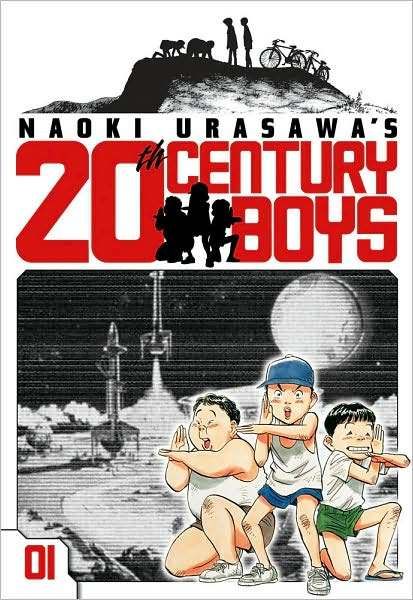
However, it seems attitudes have relaxed, since VIZ has recently released two of Urasawa's newer series to bookstores. Direct Market retailers will have them on Wednesday. 20th Century Boys Vol. 1 (of 24): Friends

Do note that the "of 24" I inserted above is inexact, I admit; the last two volumes of this 1999-2007 saw the title change to 21st Century Boys, with vol. 23 dubbed vol. 1 and vol. 24 serving as vol. 2. Many sources treat it as a discreet 'sequel' series, although it appears to be simply the conclusion to the main series, set off by a hiatus in production. I'm just treating it all as a single 24-book series. Hopefully VIZ has licensed those last two volumes; I suspect we won't want to miss anything.

Lingering fan qualms about its finale aside -- I haven't read it, so don't ask -- 20th Century Boys is generally considered to be Urasawa's magnum opus. It remains visible in the public eye today; the second installment of a six billion yen live-action movie trilogy from director Yukihiko Tsutsumi opened at #1 in Japanese theaters two weeks ago, and an in-joke comedic story-in-the-story just ran in Big Comic Spirits (again the serializing anthology), presumably in support. For a while it was quite the hot item on the English scanlation circuit, and I suspect its readily available breadth did wonders for establishing Urasawa among English readers in the know as an artist to watch.

But even from this very, very introductory 216-page book -- $12.99 with fancy softcover flaps, that kind of release -- the ambition is obvious. Chapter one alone features sequences set in at least four separate decades, with short additional segments possibly taking place adjacent to longer scenes, or maybe dozens of added years in the future or past. You'll turn the page and not even know what country you're in; that kind of sprawl. There's a huge cast that obviously isn't even fully introduced, with many characters appearing in multiple time periods at different ages. The series' title is taken from the T.Rex song, which get covertly played over a lunchroom's speakers in 1973, in the series' opening pages, the first rock music heard by most of those kids. And it's surely no coincidence that Urasawa, born in 1960, was just the right age to hear that song, in that lunchroom, at that very time. Though conceived with a collaborator (editor Takashi Nagasaki), 20th Century Boys stands with the unmistakable poise of an author aiming to address his generation, to take stock of where people his age have been, and where they're going as the age passes. It's a millennial work, heavy on cloudy portent and shaking from cataclysm nerves, but also a grand, funny human story about growing up and then preparing, futilely, to grow old, a personal evolution no less scary than any 2000 A.D. apocalypse. It's also an unabashed pop comic, entertaining as all hell and weird and thrilling and everything.

The more-or-less 'main' character is Kenji, an ex-guitarist (hmmm, know any mangaka who put out a late-blooming rock album?) who's settling in to minding the family store -- not to mention his absentee sister's infant child -- now that he's staring down middle age in 1997 - and god, how many genre comics can you name with a cast that's mostly pushing 40? There's weddings to attend and small regrets to nurse, along with a heaping helping of flashbacks to Kenji & co.'s youth in the 1960s. But strange things are beginning to happen: a troubled boy-turned-science teacher commits suicide out of the blue and high tech professors and students go missing or turn up dead. Nasty disease crops up in foreign locales, and dodgy religious leaders are knifed in public.

Most crucially, a certain symbol starts popping up. It's oddly familiar to Kenji, but we readers are allowed more access than him - it seems someone has literally started a cult around the miscellany of childhood in Kenji's part of Japan, with Kenji's circle of friends. Indeed, the mystery cult leader is addressed by acolytes as only My Friend -- and maybe it's better the series came out this late, so as to skip 1001 John McCain jokes -- espousing wisdom centered around the US moon landings and reciting manga-fed childhood vows to always protect the world. And through the magic of flash-forward, Urasawa reveals that something really did threaten the world, and, moreover, that someone really did save it. Still, you know what they say about manga - it's always the journey more than the destination.

This is a VERY GOOD one, so far. Urasawa's visuals are as clean and appealing as ever, with great little character touches - you'll never mistake this manga for something else. Despite juggling one million characters over a timeline spanning half a century, the storytelling never confuses, although VIZ kindly includes a character chart up front as a courtesy (skip it 'till you've read the story, though!). Even Urasawa's semi-infamous tendency to mash emotional buttons like next week brings the bathos prohibition is kept mostly in check - sure, at one point a childhood outsider can only prove himself to the gang by saving them from certain death, but in this work it seems more a fitting expression of heated childhood emotions -- the impulse to vow to save the world, say -- which grows to a fire in adult retrospect.

Such is the core of Urasawa's work here. You can probably draw some comparison to Stephen King's It or something, wherein childhood trauma forces adults to band together to confront a danger, but the childhoods glimpsed here aren't much more traumatic than usual. It's what people do with the stuff of their childhood that matters, and Urasawa duly presents many views of potential lost, prominence gained, dreams faded and ideals kept alive, even to the point of bringing the most absurd elements of a J-pop childhood to life, even past the threshold of sanity.

Perfect stuff for a comics artist determined to speak for and of his generation, and I can't wait to see how it plays it out.

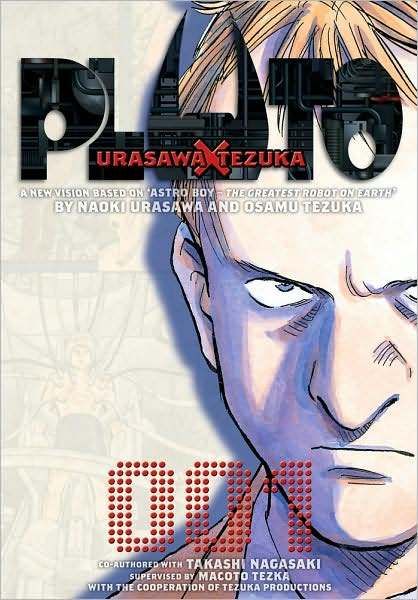
Pluto Vol. 1 (of 8)

Note too that the "of 8" above is an estimate; the Japanese vol. 7 is due to arrive next week or so, and the series is technically still ongoing (in the biweekly Big Comic Original), although it's set to conclude in April, unless something changes. That'll make it Urasawa's newest completed work (2004-09), and easily the shortest of his 'major' projects. But then, it's an odd duck in other ways.

Pluto was initially cooked up in 2003 as part of the celebrations surrounding the in-story birthday of Astro Boy, Osamu Tezuka's famed creation. It's a wildly expanded, thoroughly modified adaptation of a single popular storyline from Tezuka's original, The Greatest Robot on Earth (available in English through Dark Horse's Astro Boy vol. 3), starring a marginal character from the original, who encounters updated, more 'realistic' versions of All Your Favorites. Given the year of its debut, I don't think it's out of line to call it Ultimate Astro Boy - the similarities are many, and I said as much when I did a longish review of a big clump of chapters back in 2005; there's spoilers in there, although some of my guesses at future plot points turned out to be inaccurate. Anyway, I stopped following the scanlations after a while.

I think some damage was done, though. Reading a huge chunk of scans -- like, two and a half volumes' worth -- gives you a very different experience than sticking to the collections (or a serialization for that matter). If you follow that Abhay link above, you'll notice that he didn't think much of Pluto at the time (2004). Frankly, if I'd only had the seven chapters presented in this book (200 pages, $12.99), I wouldn't have gotten a much better impression; I was a bit shocked at how poorly the stuff holds up on limited re-reading.

Now, granted, some of that effect is probably due to my knowing a whole lot of story twists ahead of time, but I was still struck by how slowly Pluto builds. The premise -- with editor Nagasaki now credited below Urasawa as a full-blown co-author (co-writer, I presume), a rather material fact I certainly don't remember seeing in the scans! -- concerns humanoid robot Gesicht, a detective based out of Urasawa's beloved Germany, who takes on an odd murder case that seems to be connected to something much bigger: the systematic destruction of all the world's most powerful robots, a list he's on!

A devil seems to be on the loose, an impossible being that cares not for human laws or robot rules against killing humans, so Gesicht sets out to check up on many mechanical parties of interest, ranging from the mad, murderous Brau 1589 -- impaled-yet-alive like St. Sebastian, imprisoned-yet-dangerous like Hannibal Lector -- to the surviving remainder of the world's strongest robots, including a certain mighty Atom from Japan.

That's really all that goes on here, but the journey isn't nearly as fine as with 20th Century Boys. In fact, if the prior project seemed to somehow keep Urasawa's soppier tendancies down, this one's proximity to Tezuka's special brand of unbridled humanism appears to have driven the artist hog wild, culminating in a 76-page side-story about a blind composer who was abandoned as a child and can't compose and his new robot butler is a war machine that only wants peace and to play the piano but the composer hates him at first and abuses him and the robot goes away and the composer's garden starts to die, but then there's mommy issues and growing friendship and forgotten tunes of childhood innocence and TRAGEDY STRIKES AT A CRUCIAL MOMENT, OH CRUEL CRUEL FATE, OH ROBOTS AND HUMANS AND MUSIC AND DREAMS!!

It's the type of head-spinning melodrama that rarely manifests without the direct participation of Lillian Gish, pushed straight to the brink of camp by the fact that the robot butler has a face like a luchador mask and wears a cape to hide a torso made of knives and guns. Wait, am I making this sound awesome? Eh, I guess it is kind of awesome, taken that far (it'll be something to see how Urasawa tackles the ending of this fucking thing, oh my god), and like I noted back in '05, the artist's sheer skill with visuals is often enough to keep things vivid - a page setting bursts of piano playing against rhythmic panels of robot fighting is a standout.

But I've read a lot of Tezuka since 2005, and I can't help but feel Pluto may be missing something vital about the master's work. Always, even in the most emotionally-charged moments of his most 'important' work, Tezuka had a way of inserting rude, loud humor, brassy slapstick that never failed to accentuate the lightness of being - humans, robots, lions and everything else was connected in that manner, as part of the God of Manga's cosmology of whimsical pictures, the manga (translated literally) he invented.

Pluto, in contrast, is a self-serious work about how serious things are for fantasy robots from children's comics. Tezuka's children's comics were damn serious too, at times, but never only serious. At risk of projecting my Western funnybook perspective too brightly, it all seems especially like certain American superhero comics (maybe even some Ultimate issues) where everyone glowers all the time so as to demonstrate how important and serious the superhero genre can be. Here, Shōnen Manga is Serious Business too, with frowns on nearly every face when tears won't do, and any fleeting smile set against a hopeless, inevitable doom, which is so totally odd for a book with Osamu Tezuka on its cover.

Again though, my reading is skewed. I didn't get anything better than an OKAY impression from this book, although the craft is solid and I readily concede that the shock of the new might give you a better experience. Plus, I'm confident (having not re-read it, ulp) that Pluto does really start to cook very soon, when the suspense mechanics have warmed up and Urasawa gets to unveil his Big Idea for the series - Tezuka's war/peace, man/machine struggle set against the United States' continuing conflict in Iraq!

That's right, get ready to relive all those wonderful memories of weapons inspections and such with Astro Boy and all of his friends! It's still stone-solemn, and prone to some of Urasawa's worse creative instincts, but it has a way of growing on you. I hope it gets under my skin all over again.

With all respect to Chris Butcher...

This is about retailing and distribution and all that stuff, so I'm hiding it under the jump...

Right, so Chris Butcher has written a widely linked panic attack about Diamond "de-listing" over 1000 Viz backlist items.

As near as I can tell, however, he's concerned about a bunch of material that, well, doesn't sell. YES, some of the titles on the list are REALLY FUCKING GOOD COMICS, no doubt about it... but do they SELL is the question?

I also use Baker & Taylor as a source for books, an unlike Diamond's site, B&T has some neat tools on their pages, including real time inventory for not only what is in stock, and what is expected to show, but also for REAL THIRTY DAY DEMAND for those products.

I think that most of us can agree that DRIFTING CLASSROOM was the big "wait, what?!?" on the Diamond de-listing list -- thems some fine comics.

But when I search for DRIFTING CLASSROOM on B&T's inventory, for their west Coast warehouse (they have four: East, West, Midwest, and South) this BOOKSTORE FOCUSED distributor only has inventory on hand for two volumes, and their thirty day demand for ANY of the eleven volumes is... wait for it! ZERO COPIES.

Same thing for GOLGO 13.

Same thing for Tezuka's PHOENIX, pretty much -- 2 of the volumes have single copy demand, wow, big seller.

The secret reality of things is that a huge chunk of things that YOU like, or maybe even things that Butcher or me could sell a bit... don't sell at all well out in "the real world"

Like... you basically can't get ANY Drawn & Quarterly published titles from B&T. WHAT IT IS, and SHORTCOMINGS and maybe 3-4 others, but that's IT. BECAUSE THEY DON'T SELL FOR MOST STORES.

INCLUDING "not comics" stores, guys.

My new TILTING is on Friday, with a look at the 2008 BookScan numbers. While you're waiting for that, take a guess at what the BookScan reported sales for LOVE & ROCKETS NEW STORIES #1 was (remember, they changed TO an annual, spine-d format FOR the putative bookstore market). Write your guess on a piece of paper, and see on Friday how close you were.

-B


The RSS feed thing

I'll be completely honest with you: I know just about nothing about some of the backstagey bits of this site. I've never used a RSS feed in my life and don't really "get" it, because I'm a bitter old curmudgeon.

I only kind of understand how "hits" work, or advertising costs on the web, or any of that stuff -- I don't think I've looked a refer log in something like 5 years, and, while I have permissions to go get our metric information, I never really bother, because I'm more interested in the content than all of that stuff, y'know?

Anyway, long and short, yeah, Kate changed the way the RSS feeds work with the Savage Critic site, and she did it when the new gang came in (and aren't they all doing a great job already? Though... where's Eckert?!?!?), and it was done to try and get our hits up a bit in what I take to be a non-evil way.

We're going to take a look at traffic over the next few weeks, and see what happens with this new scheme, and the new writers, and see how things go. This may or may not be a permanent change, I dunno, but we're going to try it and see what happens.

Feel free to use the comments thread to voice your support or annoyance, but, honestly, you can stop emailing me. What I will say is that any such changes we make like this are aimed at paying the contributors more money for their efforts, and nothing more.

-B

Arriving 2/18/2009

As you're probably not even slightly not aware of whatsoever, Diamond is in the process of moving their main warehouse from Memphis to Olive Branch. What this has meant is that there have basically been no reorders available for the last couple of weeks, as they make the move. Reorders aren't expected to start flowing in earnest until next week's shipment (and maybe not really until the week after)

Of course, as with this kind of thing, mistakes have been made. In my case, for instance, I placed an order for roughly 3 weeks worth of "critical" backstock before the cut-off date for the move. The IDEA was I'd stock up up front to tide me over while Diamond made the move (generally, I'm trying to only have enough inventory on hand for a single week's sales, using "Just in Time" ordering)

Buuuut, Diamond biffed my order. About a third of it came back as "confirmed/canceled" which means that Diamond is pretty sure they have inventory, but they couldn't find it when it came time to pick it. In the world I want to live in (and, in the world I USUALLY live in) you usually only get 1-2 C/C books any given week. Heck, typically Diamond is really good at their business, so I might only get 1-2 a MONTH. But that week, that CRITICAL week, we got about 30-40 lines canceled out.

Of course, when the shipment ACTUALLY arrived... well, another 40% or so of it wasn't in the box at all. Maybe it got shipped to another store, maybe they just lost them... there's no way to know for certain. Missing were such slow sellers as, say, WATCHMEN, which means I'm out of that book a month before the movie hits, yay!

I'm not exactly blaming Diamond here -- that kind of major move is a really big hard deal, but it is really screwing with both cash flow and consumer confidence.

I bring this up to you to observe that YOUR local comic shop may also be feeling this particular pinch: chances are their inventory is probably at the nadir for the year. If it is a well run, well stocked store, YOU MAY NOT BE ABLE TO VISUALLY TELL -- I'm out of a lot of key material right now, but I STILL HAVE thousands of other books to sell... just not (some) of my best-sellers.

A pretty large number of stores don't have terms -- they're on COD and have to pay when UPS shows up, or else UPS takes those comics back away from them.

So, the upshot of this is that if you love your LCS (and hopefully both you do, and they've done things to earn that), the best thing you could do this week is buy an extra comic or TP this week. Is there something you've been vaguely eying, but have been holding off on? THIS is the week to buy it, because next week (before the new books are on their shelves) they're going to have this frighteningly massive bill as three weeks worth of reorders come pouring in at one time, and you'll REALLY help them if they have a few extra dollars in their war chest before that UPS truck shows up.

I don't usually write this kind of pitch, but this is a structural mechanical issue that is going to ding quite a few stores -- especially if they're financially "on the cusp"

(We're not, we have 30 days terms, and I've been building my war chest for a while now, but I know a lot of stores that might be in hot water come next week, so...)

Meanwhile, here's the list of stuff rolling in this week -- pretty much my smallest invoice in 15 years or more...

2000 AD #1620
2000 AD #1621
A G SUPER EROTIC ANTHOLOGY #98 (A) (C: 1-0-0)
AMAZING SPIDER-MAN #587
AMBER ATOMS #1
ANGEL SMILE TIME #2
ARCHIE DOUBLE DIGEST #196
BETTY & VERONICA #240
BIRDS OF PREY #127 (ORIGINS)
BLACK LIGHTNING YEAR ONE #4 (OF 6)
BRAVE AND THE BOLD #22
DARK AVENGERS #2 DKR
DEATH DEFYING DEVIL #3
DYNAMO 5 #0
FIREBREATHER SERIES #4
GHOST RIDER #32
GHOST WHISPERER THE MUSE #3
GI JOE ORIGINS #1
GODLAND #26
GOLLY #4
GREAT UNKNOWN #1 (OF 5)
GUARDIANS OF GALAXY #10
HELLBLAZER #252
INVINCIBLE #59
JUNGLE GIRL SEASON 2 #3
JUSTICE LEAGUE OF AMERICA #30 (ORIGINS)
KABUKI REFLECTIONS #12
MARVEL ADVENTURES AVENGERS #33
MOON KNIGHT #27
MYSTERIUS THE UNFATHOMABLE #2 (OF 6)
NEW EXILES #18
NYX NO WAY HOME #6 (OF 6)
OUTSIDERS #15 (ORIGINS)
POPBOT #8 (RES)
PUNISHER FRANK CASTLE MAX #67
RED SONJA SHE DEVIL WITH A SWORD ANNUAL #2
REX MUNDI DH ED #16
ROBIN #183 (ORIGINS)
SCOOBY DOO #141
SHRAPNEL #2 (OF 5) A CVR SUYDAM (NOTE PRICE)
SIMPSONS COMICS #151
SOLOMON KANE #5 (OF 5)
SPIDER-MAN NOIR #3 (OF 4)
SQUADRON SUPREME 2 #8
STAR TREK LAST GENERATION #4
STAR WARS KNIGHTS OF OLD REPUBLIC #38 FAITHFUL EXECUTION
STORMWATCH PHD #19
SUPERGIRL #38 (ORIGINS)
SUPERMAN BATMAN #55
TANGENT SUPERMANS REIGN #12 (OF 12)
TINY TITANS #13
TRINITY #38
ULTIMATE FANTASTIC FOUR #60
UNCANNY X-MEN #506
VIGILANTE #3
WARRIORS OFFICIAL MOVIE ADAPTATION #1 (OF 5) REG CVR
WHATMEN (ONE SHOT)
WORLD OF WARCRAFT #16
X-FACTOR #40
X-FILES #4 (OF 6)
X-MEN KINGBREAKER #3 (OF 4)
X-MEN LEGACY #221
YOUNG X-MEN #11
ZOMBIE TALES #11
ZOMBIES THAT ATE THE WORLD #1 DAVIS CVR A

Books / Mags / Stuff
CAPTAIN BRITAIN AND MI 13 TP VOL 01 SECRET INVASION
CLASSIC MARVEL FIGURINE COLL MAG #84 SABERTOOTH
CLASSIC MARVEL FIGURINE COLL MAG #85 WINTER SOLDIER
COMIC FOUNDRY MAGAZINE WINTER 2008
COMPLETE TERRY & THE PIRATES HC VOL 06 1945-1945
DC SUPERHERO FIGURINE COLL MAG #03 JOKER
DC SUPERHERO FIGURINE COLL MAG SPECIAL DARKSEID
DIANA PRINCE WONDER WOMAN TP VOL 04
EDEN TP VOL 11 ITS AN ENDLESS WORLD
ESSENTIAL CLASSIC X-MEN TP VOL 03
FALL OF CTHULHU GODWAR TP
GARTH ENNIS BATTLEFIELDS TP VOL 01 NIGHT WITCHES
GEEK MONTHLY MAR 2009
GRENDEL DEVILS REIGN TP
HEAVY METAL SPRING 2009 #122
HIGH ROLLERS TP
JOHNNY BOO HC VOL 02 TWINKLE POWER
JUDGE DREDD MEGAZINE #281
MARVEL ADVENTURES AVENGERS TP VOL 08 DIGEST
MOON KNIGHT PREM HC VOL 04 DEATH OF MARC SPECTOR
NAOKI URASAWA 20TH CENTURY BOYS GN VOL 01
PANTOMIME TP SCAD SEQUENTIAL ART ANTHOLOGY
PLUTO URASAWA X TEZUKA GN VOL 01
SECRET INVASION TP FRONT LINE
SECRET INVASION TP INCREDIBLE HERCULES
SECRET INVASION TP THUNDERBOLTS
SPARROW JIM MAHFOOD HC
SUPERMAN CHRONICLES TP VOL 06
TEENAGERS FROM THE FUTURE SC
ULTIMATE SPIDER-MAN HC VOL 10

What looks good to YOU?

-B

Oh, And My Entire Lower Jaw Is Held In Place By A Flimsy Metal Wire

I'm not sure how I got here either, so hey: we're in agreement, probably for the last time. Tucker Stone's the name, writing about random stuff at The Factual Opinion is the hobby, it turns into a profession at comiXology, and if you like to hold it in your grubby paws, grab a copy of Comic Foundry. If comics aren't your bag, and you want to brush up on your Italian, keep an eye out for upcoming issues of MUSE magazine. (I know!) Otherwise sister, the game plan is simple: I plan to write purely about sexism in comics, or maybe sex in comics, or maybe just some sex I had on top of a pile of comics--whatever the Hibbster says is most popular. Just in case you were wondering, I'll clear up a couple of your concerns: I'm not qualified to be here, my head is kept firmly up my rear end, I'm not as funny as Abhay, not as smart as Wolksie or the Jogster, and yes, most of the time I get finished with a comic and go "Huh, so it had pictures and words in it. They all like this?" But don't worry! Kissing is still your friend, and the Savage Won't Go Changing, until I get fired, which will be RADICAL.

Under the breaker: oh mama, hit the breaker! Hit it with your fist!

The best way to deal with reviewers in my estimation is never to base your decision to read them off whether or not they are smart writers, or funny writers, or interesting writers--"That's a Waste Of Time Right There", as my dad used to say about my existence. No, the best way is to read enough of their stuff to figure out if they are writing reviews that directly agree with your own personal taste. Reviews, and we all know this, are for backrubs and handclaps. When I peruse a review, my main question is always this: Do they have a Hal Jordan toy?

No?!

Then fuck THEM, what kind of "critic" doesn't have a Hal Jordan toy? With that, here's a breakdown of the Savage Critics scale of review, and how I plan to use it. It's provided for you, the Savage Critic fan, to determine whether you want to use your hacking computer skillz to edit the random "Tucker" posts out of your RSS feed. (And I know you know how to do that, cookie puss!)

If it's EXCELLENT, that means it's on the scale of that Gary Panter slipcase that Picturebox put out, which I finally got. I'll still probably burn it, because that's what I do with all my comics eventually, but Hey! Until then! Excellent!

If it's VERY GOOD, that means it could be a super-hero comic with plenty of punching and funny jokes, not jacked up in the coloring process and, because Hey, This Matters To Me, it's got the same art team from the beginning to the miserable end. (Which means all those comics that involve 4 inkers and "replacement" pages don't have a shot. Standards!) The only reason it doesn't hit EXCELLENT is because, and this is petty, but I like conclusions, and I need conclusions, and I don't really enjoy things as fully unless, you know, they have conclusions. Non super-hero comics can be VERY GOOD as well, obviously, but only if they aren't about white people complaining about something, because, and yes, this is petty too, I hate white people.

If it's GOOD, then you must be talking about Junior Bonner, which could have been VERY GOOD if Steve McQueen had been the one on the bulldozer, and if the script had more cursing. Still trumps The Getaway though, which is merely OKAY, because no, you're wrong, Ali McGraw is a terrible actress. (And yes, I told that to her face when she came to my Dynasty fan-fiction forum, held annually at the Tuskagee Holiday Inn. I told her to her dirty Lady Ashley Mitchell face. "You're awful," I said, "and I would know!")

If it's OKAY, then it's probably Optic Nerve. Adrian Tomine is kind of boring, right? Right? Get it? Because he's so boring. No, seriously. Dude makes boring comics. Except for that "Pink Frosting", which is my favorite curbing story that isn't the one that some guy told me about on my first day in high school, right before he punched me in the stomach. TJ! I miss you baby boy. Ever get your grill fixed? But yeah, OKAY will be pretty much reserved for comics that don't have any serious problems from a technical standpoint, but end up not being something I really enjoy because I don't have good enough taste to know what's good for me and am more than willing to chug a can of Pringles just to prove I can.

If it's EH, then it's probably Kingdom Come, because serious comics about Captain Marvel always make me want to cut little strips of skin off my leg to use as a bow on a Christmas present I give to homeless people. In March. Actually, just about everything Alex Ross does is pretty much EH in my book, but sometimes he can find somebody to include words that bring it down to good old fashioned AWFUL.

If it's AWFUL, it could be some "trying to hard" comics, which is pretty much a category that's totally PWNED by that old issue of Detective Comics where Robin yells at everybody for smoking the Floronic Man's magic marijuana concoction. He uses the phrase "Why would you want to 'mess up' your mind? Why would you do that?" To which no one responds "You're the one who fights crime in a red and green unitard, you stupid jerkoff." Most of the time, EH and AWFUL are where a lot of the comics I read live, because even the worst of the bunch can usually still be somewhat readable, and because I only buy comics that I don't like, because I'm a failure at life.

Is that how you use the word PWNED? I hate that word.

If I'm going to rate something CRAP--and I'll probably forget this eventually--it will be something that is made by people who shouldn't be working in comics, simply because what they make is completely incompetent work--sadly, this means most of the Big Two super-hero comics won't end up here, because they can at least draw things like hands and eyeballs that look like some kinda hands and eyeballs, even if it's on the low side of the Platonic "hands and balls" scale. Serial incompetence, is what I'm saying. For instance, the only Marvel thing I've read recently that would go in the CRAP column would be one of those Anita Blake comics, because that was the first time in a while that I'd read something that was actively unreadable, and not in the exaggerated "let's be mean" sense. I mean it was a comic that I was incapable of reading, that my body and mind actively screamed "Stop doing this, this is hurting you" by the middle of the book. (I asked my wife to review it.)

So there we go! Tried to keep it brief, but hey: that's why you aren't supposed to click "Read More" if you don't want to Read More. I'd love to promise you that this is going to be fun, because it totally is, but it's only going to be fun for me.

Man, that's your instrument

Hi, I'm Dick, and I'm really excited about being here since this is one of the first comics blogs I remember reading obsessively (two of the others were Fanboy Rampage and Jog the Blog, so TRIPLE excitement, actually). It really is a great privilege to write on the same site as those folks you see on the sidebar. And now that I have this forum, I can devote my personal blog to my true passions: reviewing frozen food, complaining about video game stores, and posting pictures of disgusting MMA injuries. What I'll mostly be doing here, at least over the next year, is continuing my obsession with year's best lists. Or in this case, decade's best list. Savage Critics will be the home of my ongoing Best of the 00s Diary Thing, in which I'll revisit some of the best comics of the last decade, and look at some for the first time as well, probably. By the end of the year I'll hopefully have a pretty good idea of what I'd put on my own personal best of the decade list. And since I'm such a fiend for discourse, I will encourage all those reading to consider this as well. What are the best comics of the 00s? Should we consider reprints and translations as well as original material? And many other rhetorical questions.

For now (after the break, actually) I'm going to review a couple of things I picked up in one of my rare trips to an actual comic shop, after 10 long hours of flying and running from gate to gate. If only there were a way to avoid flying through O'Hare for the rest of my life. . . .

Jin and Jam #1 by Hellen Jo Preview

Flipping through this, the Taiyo Matsumoto influence leapt off the page--check out those preview pages and it's about as obvious as one could imagine. I considered this a very good thing: a North American comic with such an obvious art manga influence. Don't see that as often as you'd hope or expect; could be interesting.

The Matsumoto connection isn't just heavy influence, it turns out, since the first page includes a quote from Matsumoto's Tekkon Kinkreet (which Jo refers to by its alternate/original English translation title, Black and White). Given the art and the story, you'd want to look at Jin and Jam as a kind of gynocentric Tekkon Kinkreet anyway: a pair of teenage girls, alienated from their surroundings and prone to fits of extreme violence. But by providing that quote from Tekkon Kinkreet, Jo is making explicit that this is, in fact, a commentary on Matsumoto's most famous work. Or maybe it's a commentary on what it's like to be an Asian American teenage girl, using Tekkon Kinkreet as a sort of cipher?

By the end of the book, it looks like Jo's leaning towards the latter. Jin doesn't want to borrow Jam's hoodie because it reeks of fish sauce. Jam is surprised that Jin wants to go to college to escape their unnamed town (presumably San Jose). In the preceding pages, you get as good a Matsumoto pastiche as once could hope for. Like, it's not just the puddles of black ink and leering, grinning faces; this thing is composed like a Matsumoto comic as well. It's precise enough that one might wonder if such a thing is necessary, given that Tekkon Kinkreet is available, but Jo makes clear her intentions to create something beyond a Matsumoto tribute. And I came away from this thinking that Jo might really be on to something; those last five pages suggest great potential in her characters and approach.

There may be more style and potential than substance so far, but this is issue #1, thus implying further material yet to come. Whether or not Diamond's new policies will allow for additional pamphlet-format issues is an open question, of course. Hopefully we'll at least see more of Jin and Jam in an eventual graphic novel, because this is very worthwhile material. Somewhere between EXCELLENT and VERY GOOD on the Savage Critics scale. (EQUIVICATION!~) Certainly those who enjoyed Tekkon Kinkreet should seek it out, but those who admire Jaime Hernandez' work may also appreciate the relationship between Jin and Jam. And by the time Hellen Jo completes Jin and Jam, we may want to place it alongside American Born Chinese and Same Difference in the growing field of comics about the Asian-American experience. So yeah, I really do hope to see a lot more.

Never Land by David Kiersh Preview

Okay, first might I suggest that Bodega (an otherwise excellent publisher, one of my favorite small presses) make sure to put prices on all their publications? There's a UPC, an ISBN, and even contact information for Kiersh and Bodega, but no price! I mean, it's not like this is going to stop me from buying Bodega titles in the future, and I doubt it will have any effect on the ordering policies of the store where I bought it, but it's kind of a strange oversight. Maybe there was a price sticker on the back which peeled off.

As for the book itself, I think David Kiersh is several steps removed from fulfilling the potential he shows here. The first half of the book is strongly reminiscent of Art Spiegelman's Breakdowns-period work. Kiersh's art is sort of like a rounder, softer version of Spiegelman's in the German Expressionist-influenced "Prisoner on the Hell Planet" (especially if viewed in the postage stamped-sized reproduction in Maus). The pacing resembles "Don't Get Around Much Anymore": odd breaks in the captions between panels, a general sense of stillness (see that preview above). The end result is a bit off-putting at times, however. The narrator considers the changing nature of his town and the way place ties into his own memories and regret. That's fine, interesting even, but there's the execution to consider. Again I direct you to that preview--the narrator (angrily!) shedding tears over his aging and the distance he feels from the roller rink of his youth. Kind of a silly image, one that undercuts the effectiveness of the preceding pages.

The second half of the book deals with the narrator's inability to deal with the disappointments of the present (he works in a grocery store) and desire for escape. Hence the title--Kiersh depicts the narrator's escapist impulses in the vernacular of fairy tales. A female Peter Pan flies off with the narrator, stopping to fight a female Captain Hook--Captain Hooker, actually. These fairy tale fantasies are sexualized, leading to criticism from the Peter Pan figure ("You're such a boy" and "You have a perverted sense of humor") .

By the end, the narrator has relocated his escapist tendencies into a relationship with an actual woman (who may or may not be the Peter Pan figure from earlier). This is the point where the comic gets most saccharine; as the narrator and his unnamed companion soar into the sky, the caption reads "But now that I've learned to fly, I want to fly with you . . . to a place where we never have to land." Yeesh.

That's about the size of it: the narrator moves from bittersweet nostalgia to fantasy to rescue by a woman who we don't really know anything about other than that the narrator is in love with her. This kind of story might work with a different sort of execution, but that's not the case here. Kiersh's art is pleasant, even evocative at times, but the dense fairy tale imagery is repetitive and so cutesy as to only add sweetness to an already cloying comic. There are a few images that hint at possible future discord--the Peter Pan lady walks away from the narrator with tears in her eyes at one point--but Kiersh doesn't follow up on it. It's an isolated image in an otherwise jolly montage.

There's a lot to like about Dave Kiersh's art, and there are some promising sequences scattered throughout Never Land. I'm under impression from the dedication that this is a rather personal project for him, but that doesn't really add to my appreciation of this "love conquers all" story. I'd say it's at least an OK for the craft, possibly a GOOD if (like me) you place a premium on such things.

All My Senses Dislocating: Diana on 15/2

NEW SAVAGE CRITICS #1Written by Brian Hibbs Art by Kate McMillan Cover by Blogspot
A new epic begins here! Witness the rebirth of a super-team as Stonetuck, The Hyacinth, Uzumeri Yojimbo, Shan-Ti and Chris Eckert join the Savage Critics! The revelation of Norman Osborn's natural hair color in GOTHAM UNBOUND: THE GREAT PIE HEIST has rocked the universe to its core; as other thrilling secrets come to light, the Savage Critics reunite to unmask the true mastermind behind recent events. Who will live? Who will die? Who will receive the dreaded ASS Rating? Nothing will ever be the same again!

On sale Feb 14 • infinity pg, FC, $0.00 US

Welcome aboard, guys!

And now, a review. ANGEL: AFTER THE FALL #17 brings the "sixth season" of ANGEL to a close. I was never a big fan of the series - David Boreanaz is about as sharp as lime Jello, and the later seasons had an awkward habit of getting all their female characters pregnant, crazy and dead (not always in that order). But I thought it'd be interesting to see what Joss Whedon had had in mind if the show hadn't been cancelled.

As it turns out, ANGEL: AFTER THE FALL makes for an interesting companion to the current "eighth season" of BUFFY THE VAMPIRE SLAYER over at Dark Horse, in that the two series have taken the same premise - continuing the Sunnydale Saga past its conclusion - in very different directions.

BUFFY, for example, suffers from an overabundance of "cool" ideas: whether it's Joss Whedon or Drew Goddard or Steven DeKnight writing, what we get is a rapid sequence of interesting concepts - many of which couldn't have been televised even with a substantial CGI budget - but none of those ideas are explored in-depth. An average story arc of BUFFY THE VAMPIRE SLAYER is so compressed that it just runs from plot point A to plot point B, and I don't think there's enough characterization - Buffy, Willow, Xander and the others are just sort of there.

On the other hand, ANGEL: AFTER THE FALL has spent seventeen issues essentially telling one story: Los Angeles has been sucked into Hell after the events of the series finale, Angel's crew has scattered and the civilian population finds itself hunted in the streets by demons and vampires. Angel himself has become human, at the worst possible time.

Brian Lynch has basically taken the opposite approach to the BUFFY teams: seventeen issues on one storyline, no matter how expansive, is a bit much. In fact, despite the fact that the actual LA-in-Hell bit ended last issue, the emotional denouement in this epilogue still gets co-opted by Angel's ongoing feud with the demon lord Bruge. It wears a bit thin.

All that said, I still think Lynch does a better job with Whedon's characters than Whedon himself in recent months; in this issue, you've got Angel coping with his newfound popularity, a lovely posthumous moment for Fred and Wesley, Spike doing what he does best (and yet, at the same time, Lynch finally, mercifully moves past the juvenile "You Touched My Stuff" Angel and Spike routine), and Gunn... well, no spoilers, but there's some dramatically powerful closure there too.

Odd bit of trivia: both the BUFFY and ANGEL comics, either independently or by design (though how likely is that given that they're being produced by different companies?) have now done away with the whole secrecy angle, exposing the supernatural to the world. So Angel's an LA celebrity, and Harmony has turned public opinion against Slayers simply by being an undead Paris Hilton, etc. It's such a paradigm shift that I have to wonder whether Whedon was planning to do that during either series' run; it would've redefined everything.

So I'm going to go with a GOOD for this epilogue and a high OKAY for the series, because it really did take way too long to get where it was going.

Introduction; a picture of David Bowie by Ross Campbell

Hi everybody! My name is Sean T. Collins and I am now a Savage Critic. Neat, huh? Whilst I gear up for my actual debut as a Critic here, I figured I'd let you know a bit about myself, and then bribe you with something pretty so that you'll like me. INTRODUCTION

For a very long time I've been blogging at Attentiondeficitdisorderly Too Flat, mostly about comics, also about horror, also also about other pop-cultural phenomena I enjoy. I like to consider it the Internet's premier one-stop shop for links to Anders Nilsen's sketchbook, quotes from Clive Barker, and news about sea monsters. You may also have seen me writing about similar things for Maxim, The Comics Journal, ToyFare, The Comics Reporter, and Comic Book Resources, to name a few of my more recent freelance outlets, and I worked for Wizard for several years too, but the blog is probably the best way to get a sense of what I'm about.

In addition to writing about comics, I've actually written some myself, too. You can buy a minicomic called Murder that contains several of them for three measly American dollars; you can read a bunch of them at Top Shelf 2.0 for no money whatsoever. A bargain at any price, I tell you.

Okay, now the bribe portion of the post.

A PICTURE OF DAVID BOWIE BY ROSS CAMPBELL

I like David Bowie a lot, and so when the time came to put together a themed convention sketchbook, rather than select Yoda or Lockjaw or the Teenage Mutant Ninja Turtles, I picked him. Ross Campbell, writer/artist of Wet Moon, Water Baby, and The Abandoned, is my latest addition.

david bowie by ross campbell

I was very, very excited to get a Bowie sketch from Ross at New York Comic Con, but not having anticipated the demand for sketching, he didn't bring a pencil. I loaned him my pen, and he was concerned about not being able to make a mistake, but drew this anyway. It was done entirely without photo reference, which amazes me--he NAILED that Labyrinth hairstyle. As you can see, he wasn't happy with the hand, but he's being entirely too hard on himself.

Hope you liked it, hope you like me. See you on the site!

Then we didn't come to the end: Douglas on GaimanBats, pt. 1

Goddamn: this site just got even more fun to write for. Welcome, Wave Three! I'd be very surprised if the title of "Whatever Happened to the Caped Crusader?"--the story that begins in BATMAN #686--had been created any way other than editorial fiat, as a companion to "Whatever Happened to the Man of Tomorrow?" (Whoever came up with this one apparently failed to notice that there was a joke in Alan Moore's title.) So I agree with Brian and David: points to Neil Gaiman for coming up with a different way to spin it. (More beneath the cut.)
As David pointed out, Gaiman's got a habit, these days, of making sure that we know he's Telling Stories, For He Is a Teller of Tales. A lot of Morrison's parts of Final Crisis were about stories-as-told too, but its narrators provided the surface of the story, or emerged from and sank into its surface (like the false and true Alfreds in 682/683). Here, there's a distinct frame for a pair of embedded stories, and I assume the second half is going to have a couple more. "WHttCC" seems to be about the ways in which the seventy-year Batman narrative might have been unsustainable but wasn't--as a tragic romance (Gaiman kind of gives the game away by citing "The Death of Robin Hood" by name), or a horrible lie (although "the Joker was really Alfred" is a less scary/nagging version of the "the Black Glove is really the guy with the white gloves" payoff that Morrison feinted toward throughout his run).

Still, that's a fun idea for a piece of meta-ish fiction, and it sits fairly gracefully on the page thanks to the updated '40s vibe of Andy Kubert's artwork. (Gaiman barely suggests the period he's dealing with in the dialogue--really just Catwoman's line about "listen[ing] to George and Gracie on the radio.") I like the little circular panel Kubert threw in on one page--you don't see those much in post-1955 comics; I like his designs for everybody's cars, too, especially Two-Face's, and the way he riffs on early Batman artists' designs. Interestingly, Kubert's sketches and pencilled page, seen at the back, are prettier and more interesting than the inked artwork--that Jack Burnley-style sketch of the Penguin has so much life and playfulness in it.

It's an OKAY comic--probably better than that on its own--but something is disconcerting about the way it works within the seventy-year narrative it's addressing. Mostly, it makes me think about how DC's squandered a resource nobody even thought it had until it was gone: the capacity for any kind of actual dramatic closure.

It was once the case that one version of a character could pass on his trademark to another, or even die, and it could be more or less expected to stick. (Was anyone in the '60s demanding that THE FLASH should be turned over full-time to Jay Garrick, the "real" Flash?) But now the DCU has an official mandate that Green Lantern is really Hal, that the Flash is really Barry, that the Legion is really the Levitz-era Legion. No threat of change can be effective any more; the gravitational force of How It Was in '83 is impossible to escape, and growing stronger all the time. Any change, any breakup, any death, any exploded planet will revert to its early-'80s form sooner rather than later. Superman says "pray for a resurrection"; we know one's coming--the only question is when. It seems like some kind of backfiring corporate-psyche-repression that DC's most interesting villain of the moment is literally a furious, bitter fanboy who wants everything to go back to the way it was when he was reading DC superhero comics in the mid-'80s.

This time, there was briefly the pretense--the scantiest veil imaginable--that Batman was ending. (The return of the Batman family of titles was officially announced before this issue even appeared, but it was never even faintly in doubt.) Morrison's "Butler" two-parter was one kind of "final Batman story," and Gaiman's is another. (The O'Neil and Dini stories between them: less so.) THE SANDMAN had a fine string of closing fanfares; why not BATMAN, too?

Because it's not ending--even in the way that the pre-Byrne Superman ended. This story acts like a conclusion, and in fact it'd be a lot more effective if it were the final Batman story: a last curtain call, with all the old favorites coming out for a bow to the audience before it's time to go home. This is a curtain call with all the old favorites coming out for a bow to the audience before they leap back into position for the next scene of the play that never ends.

Where Batman ends--the only way Batman ends--is where you stop reading Batman, which is how Batman has actually had hundreds of thousands of endings: dissatisfaction or boredom, walking out of the theater (past a dark alley?), cutting losses and wondering if it would've gotten better again. That's not what I'm doing yet; I'm already psyched for Morrison's return in June, and the Quitely rumors make me more enthusiastic, and those Rucka/Williams DETECTIVE pages look fantastic. But I also long, a little bit, for the kind of genuine conclusion Gaiman is pantomiming here but is forbidden to give us for real.


Hello! I'm Here to Talk About the Comics. Those Shitty, Amazing Comics.

I'm David Uzumeri, from Funnybook Babylon, and I'm pretty honored to be invited to this pretty elite crew. I'm probably most famous on InterNET for my work annotating Final Crisis and Batman R.I.P., but what you might not know is that I read comics that aren't by Grant Morrison! Hell, I read comics that aren't published by DC - or even by the Big Two! So I'm pretty happy to be here at Savage Critics, and I plan on reviewing my weekly titles (along with other items of interest) fairly regularly. If I seem a bit superhero/genre-centric, that's not because I'm averse to "indie"/mainstream stuff, but more because I'm still reading classics like Love & Rockets and I doubt I'll be contributing much with insightful revelations like "Wow, this Scott Pilgrim book is pretty good!", and I'm still building a reviewer's knowledge base to be able to insightfully criticize that stuff at the level I'd like. But superhero comics? I know those. So let's go.

Batman #686: It's kind of hard not to compare this to Grant Morrison's take, even though they're incredibly different stories; while Gaiman's working at a completely different tone and pace, they share certain idiosyncratic sensibilities that lead to a more supernatural yet methodical, empirical, almost scientific take on the character. Morrison and Gaiman's stories are, behind all of the devils and post-hypnotic suggestions and prismatic funerals (All the Jokers! All the Catwomen!), detective mysteries. And that's what Gaiman's doing here, holding a big fat prismatic funeral for the uber-Platonic-form of the avenging crusader, through the lens of our culture's iteration, Batman. I can't really comment on the ongoing mystery until the next issue, but this certainly raises and holds my interest. I certainly can't let this review go by without mentioning the art - Andy Kubert joins Jim Lee's embellishment team of Scott Williams and Alex Sinclair to do the work of his career, traversing through seventy years of Batman's artistic history and continuity with grace, style and ease. It's not an especially progressive story, nor is it at all high-octane, but it's clever and intelligent and, as sappy as it sounds, it feels like it came from a lot of love on Gaiman's part. More important than all of that, it's in no way a mirror or derivation of Alan Moore's similarly-named ode to the Man of Tomorrow - Gaiman's created his own beast here, a paean to the history and concept of the tortured masked vigilante. It won't change the world, but it's a VERY GOOD Batman story.

The only big caveat I have - and to the book's credit, it's something I didn't even realize until I was in the middle of the article, hanging out with friends about to watch Battlestar, talking about the issue and Gaiman - it's YET ANOTHER goddamn story where a bunch of people stand around telling stories! That was, like, half of Sandman, and utterly killed the pace of Miracleman when Gaiman took over. He gets a lot of mileage out of it, but it's still the same old trick, even though it's done really well - make no bones about it, Neil Gaiman likes to tell stories about people telling stories.

Action Comics #874: First, the art - I've always liked Pablo Raimondi, but I've also never seen him without Brian Reber. Hi-Fi do what would be a fine job on a normal Superman comic, bright colors and clear delineations between objects, but Raimondi's shadowy style acts in complete opposition to that, leading to what looks like, well, kind of ugly art despite what were probably the best intentions of all involved. It's an OKAY comic, certainly better than Robinson's earlier work in the Atlas arc in Superman, but it's far more effective as a section of Geoff Johns's Master Superman Plan than as a single issue. So if you're already invested in that stuff, don't miss this - it's the next episode of the ongoing Superman narrative, and some cool stuff happens. But it's certainly not a jumping-on point or a brilliant piece of work on its own, a byproduct of the nature of serial storytelling.

Thor #600: This is, as Brian's said, probably the best value you'll get in superhero comics for a long-ass time. There's about 42 pages of main story material here, plus about (I haven't counted precisely) eight pages of a backup by Stan Lee and David Aja and then another few pages of Mini Marvels from Chris Giarrusso, who turns in his strongest and funniest iteration of his Mini Marvels concept to date, combining just the right amount of reverence and irreverence for a both funny and accurate recap of Thor's status quo in the Marvel Universe. If this were a shorter book, I'd have qualms with the pacing in the main story - it's a lot of wordless fighting and punching and car-throwing and all that EPIC stuff, but I really can't argue with using the space like this when you have so damn much of it. Straczynski continues his celebrated run here, which has improved much since the first arc of Thor Vs. Real World Issues (did you know Katrina and Darfur are horrible?), and really makes fantastic use of both Norse mythology and the personality of Loki to bring twelve issues of scheming and Asgardian puppeteer-chess to a quick and total climax, changing the status quo of the book. I'm sort of mystified that it didn't get a Dark Reign banner, though, since it's actually a very important chapter in the mega-story of the Marvel Universe and draws a lot from its new status quo. VERY GOOD.

Batman and the Outsiders Special: Really Outsiders #14.5, this is the first issue of Peter J. Tomasi's run on the title and features what's likely Adam Kubert's last DC work, using an all-double-page-spreads (except for the first and final pages) layout style that moves the entire bulk of the advertisements to the back. I'm not entirely sure that the story required this - sometimes the panels even break right in the middle of the page, so it's difficult to tell if you're supposed to read it left to right (you are) or stop at the page fold - but it's strong work, and Dell's inks work better here than the did on his portions of DC Universe: Last Will and Testament.

The story, though... Tomasi's a longtime editor at DC, and he's worked with some of the greats on truly complex storylines (Seven Soldiers, for one). He clearly knows all these characters, but he assumes a little bit too much that you do too, and his Katana scenes skirt dreadfully close to Claremontian cultural simplification where the Japanese are all about RITUALS and HONOR and shit. He doesn't really set up the threat, either - they appear at the end, but there's no real menace, instead they're just slightly creepy generic Hills Have Eyes cannibal monster zombie whatever types. It reads like a book about B-list characters for people who care about those B-list characters and want to see them come back, and while it's alright at that I can't imagine people who picked this up for the Adam Kubert art draw compelled enough to continue following this in the main title with Lee Garbett (who can actually reach a deadline). EH.

Captain Britain and MI: 13 #10: I thought the last arc of this title kind of dragged, but this was just a really, really fun 22 pages, completely embracing the silliness of every concept within - I'm sure everyone's seen the Dr. Doom and Dracula on the Moon teaser by now but it only ramps up from there. In the wake of the recent cancellation rumors, this issue especially leaves me VERY glad that the title is continuing, since Cornell is undoubtedly one of the smartest and most imaginative writers Marvel's employing right now and this issue really found the title's feet in my opinion. It switches from character moments to high-concept insanity basically every scene, and it all flows together remarkably well; additionally, this issue is practically an object lesson to Batman and the Outsiders on how to present characters that the audience doesn't give a shit about and, well, actually provoke some shits being given. I always liked Blade as a cool-looking dude with some sweet swords who stabbed vampires and shit, but I never thought I'd actually start digging him as a real character until Cornell got his hands on him. A VERY GOOD classically Marvel comic.

Young Liars #12: Straight up - I love this comic. I think, with all due respect to Jason Aaron's justifiably-widely-lauded Scalped, it is the best thing Vertigo's putting out right now, full stop. I barely even miss Stray Bullets anymore. I haven't even reread the whole series yet - and when I do, I'm sure I'll have something to say - but I have absolutely no idea what I'm going to read every time I open this comic, yet absolute trust in Lapham that it'll fit into his broader picture. He's a superb storyteller at the top of his game, and this is the dirtiest, sleaziest, funniest, sometimes most touching and definitely most unpredictable comic out there. If you enjoyed the punk-rock viscera of the Amy Racecar scenes in Stray Bullets, or just comics in general that start at an insane tempo and don't let up and thrive off of fucking with reader expectations, then this is really a must-read. I know this is more of a review of the series as a while, but this issue - #12 - really just acts as yet another story that redefines what comes before it; it feels like every issue of Young Liars changes every issue preceding, like the whole structure morphs every time it's informed by an upcoming issue. Completely EXCELLENT.