Oh Comics, how we love thee!

I know we fuss and fight some times. Sometimes we fight about money, some times about even sillier things, but, baby, you have to know that we love you with all of our hearts.

We've been together a really long time, but for us at least, it just gets better with age. We honestly can't think of anyone else we'd rather wake up in bed next to each morning, and, I know, I know, sometimes we flirt with film or television or prose, but always always you're the one foremost in our hearts and minds.

So, this Valentine's Day, 2009, we'd like to rededicate our love to you, and offer you this: The Savage Critics: Wave Three!

Ladies and Gentlemen, to present our newest Savage Critics:

Tucker Stone! Sean T. Collins! Dick Hyacinth! David Uzumeri! Chris Eckert!

Can I get a "Holy shit!!!!"?

Yeah, I think the single finest line-up of comics reviewing talent under one banner (along with my half-assed ramblings) now got even crazily better.

Now that I've posted this, sometime later today (yeah, we planned this with military precision, yes!) you'll see the additions reflected on this page, and the guys will trickle in and post a introductory message. Please join me in welcoming them!

Gentlemen, the Tranya! I hope you relish it as much as I!

Happy Valentine's Day, Comics!!

-B

How to get a link to "Various"

First off: be sure to check in this weekend for big Big BIG news. I'm excited, and I think you will be too...

Here's some stuff I really liked this week:

THOR #600: now this is how all anniversary issues should be done! A meaty lead story that changes up the status quo (not that that status is all that quo, really, being that this is effectively issue #13), and ending on a pretty reasonable cliffhnager that not only makes me begin to think that "Dark Reign" could be potentially interesting and go some where, but that also seems rational and chilling. I might have even liked the lead story enough to praise this comic, but then it adds a gorgeous David Aja-drawn, Stan Lee-written story that DIDN'T suffer from Crazy Stan Overwriting; a lengthy "Mini-Marvels" story that condensing the last 3-ish years of Thor continuity into total hilarity; and five (!) Kirby reprints (all short ones, but still!). All that plus all 600 covers of THOR (and JiM, natch). Dang, what a sweet package, and worth every single penny of the $5 they're asking! VERY GOOD.

BATMAN #686: The first part of Neil Gaiman's imaginary story (but aren't they all?) about the Death of Batman. Not that this one has anything to do with the other couple of Death's of Batman running around lately, but that's hardly the point. Obviously this was pitched to Neil as being a similar ending to an era of BATMAN as Alan Moore's "Whatever Happened to the Man of Tomorrow?" was in SUPERMAN and ACTION, but Neil very wisely went the completely opposite direction with this one. I mean, not only did Frank Miller write as definitive "ending" to Batman as could be had, but I don't think Neil knew what Morrison's plans were when he scripted this.

Instead, Neil goes the other way, and makes this a series of "What Ifs" (more or less) about how the original Batman could have gone sideways, and I thought it was incredibly effective. The only thing that's going to mar this at all is that Andy Kubert's art has delayed the 2nd part back yet another month -- to, as of today, 3/18 -- which is horrifically sad when you think about it. Having the Kubert's exclusive to DC really didn't work out very well, did it? Anyway, this is completely out of continuity, and even more effective because of that. I liked it a lot: VERY GOOD.

INCOGNITO #2: There were some pretty meh reviews of issue #1, but I thought this one completely hit it out of the ballpark. To the point that, maybe, this should have been issue #1. Crisp and lean, and everything you'd want from a super villain driven comic book, including some nice backstory stuff. VERY GOOD.

WALKING DEAD #58: There has been, I think, a little wheel spinning going on in this book lately, but this issue really grabbed me by the balls, mostly by returning to a plot point from issue #1 (or was it #2?), and being COMPLETELY FUCKING CHILLING while doing so. Wow, on top of wow -- this is one of those issues that I think is not going to read as well in the middle of a collection, it's a very stand-alone thought and meditation on the premise of the series. Gotta go with EXCELLENT.

What did YOU think?

-B

Arriving 2/11/2009

1001 ARABIAN NIGHTS ADVENTURES OF SINBAD #8
2000 AD #1618
2000 AD #1619
3 GEEKS SLAB MADNESS #2 (OF 3)
ACTION COMICS #874 (ORIGINS)
AMAZING SPIDER-GIRL #29
AMAZING SPIDER-MAN #586
ANGEL #17
ARCHIE & FRIENDS #128
AVENGERS INVADERS #8 (OF 12)
BATMAN #686 (NOTE PRICE)
BATMAN #686 VAR ED (NOTE PRICE)
BATMAN AND THE OUTSIDERS SPECIAL #1
BATMAN CONFIDENTIAL #26
BETTY & VERONICA DOUBLE DIGEST #168
BEYOND WONDERLAND #5 (OF 6)
BOOSTER GOLD #17 (ORIGINS)
BPRD BLACK GODDESS #2 (OF 5)
BRIT #12 (RES)
CAPTAIN BRITAIN AND MI 13 #10
CARTOON NETWORK ACTION PACK #34
CASTLE WAITING VOL II #14
CAVEWOMAN PREHISTORIC PINUPS #6
DARKNESS #75 BERMEJO CVR A
DMZ #39
DOCTOR WHO CLASSICS SERIES 2 #3
ETERNALS #8
FABLES #81
FIRE & BRIMSTONE #4 (OF 5)
GEARS OF WAR #4
GEN 13 #27
GI JOE #2
GRAVEL #9
GREEN ARROW BLACK CANARY #17 (ORIGINS)
GREEN LANTERN CORPS #33 (ORIGINS)
GRIMM FAIRY TALES #35
HELLBOY WILD HUNT #3 (OF 8)
HEXED #2 (OF 4) CVR A
INCOGNITO #2
LAST REIGN KINGS OF WAR #3 (OF 5) CVR A
MARVEL ADVENTURES SPIDER-MAN #48
MARVEL ADVENTURES SUPER HEROES #8
MARVEL SPOTLIGHT WAR OF KINGS
MARVEL TV GALACTUS REAL STORY
MASQUERADE #1
NEW WARRIORS #20
NIGHTWING #153 (ORIGINS)
PATSY WALKER HELLCAT #5 (OF 5)
PHANTOM GHOST WHO WALKS #0
REBELS #1
SCALPED #25
SIMON DARK #17
SONIC THE HEDGEHOG #197
SPIRIT #26
STAR WARS CLONE WARS #4 (OF 6)
STEPHEN COLBERTS TEK JANSEN #4 (OF 5)
SUPER FRIENDS #12
TERMINATOR SALVATION MOVIE PREQ #2 (OF 4)
THOR #600
THOR #600 DELLOTTO VAR
TITANS #10 (ORIGINS)
TRINITY #37
VIXEN RETURN OF THE LION #5 (OF 5)
WALKING DEAD #58
WOLVERINE MANIFEST DESTINY #4 (OF 4)
WONDERFUL WIZARD OF OZ #3 (OF 8)
X-INFERNUS #3 (OF 4)
X-MEN ORIGINS SABRETOOTH
YOUNG LIARS #12

Books / Mags / Stuff
30 DAYS OF NIGHT TP JUAREZ
ALL STAR SUPERMAN HC VOL 02
ASHLEY WOODS 96 NUDES HC
AVENGERS INITIATIVE PREM HC VOL 03 SECRET INVASION
BATMAN FALSE FACES TP
BATMAN RIP DELUXE EDITION HC
BLAKE & MORTIMER GN STRANGE ENCOUNTER
BONE COLOR ED SC VOL 09 CROWN OF HORNS
CTHULHU TALES TP VOL 03 CHAOS OF THE MIND
DARKNESS ACCURSED TP VOL 01 DIRECT MARKET ED
DC SUPERHERO FIGURINE COLL MAG #01 BATMAN
DC SUPERHERO FIGURINE COLL MAG #02 SUPERMAN
DC SUPERHERO FIGURINE COLL MAG #22 DONNA TROY
DEVILS PANTIES GN VOL 03
DMZ TP VOL 06 BLOOD IN THE GAME
ESSENTIAL AVENGERS TP NEW PTG VOL 01
GRAPHIC CLASSICS VOL 16 OSCAR WILDE
HULK TP VOL 01 RED HULK
IRS TP VOL 02 BLUE ICE
MARVEL ILLUSTRATED TP TREASURE ISLAND
MIXTAPE HC VOL 03
NEW BATTLESTAR GALACTICA BALTAR TP
NOVA TP VOL 03 SECRET INVASION
SAGA OF THE SWAMP THING HC BOOK 01
SFX #179
SHOWCASE PRESENTS AQUAMAN TP VOL 03
SPIKE AFTER THE FALL HC VOL 01
STAR TREK MAGAZINE #16 SPECIAL NEWSSTAND ED
SWORD TP VOL 02 WATER
TOYFARE #140 TRANSFORMERS REVENGE OF FALLEN CVR
VIGILANTE CITY LIGHTS PRAIRIE JUSTICE TP
WELCOME TO HOXFORD TP VOL 01
WONDER WOMAN WHO IS WONDER WOMAN TP
WRITE NOW #20

What looks good to YOU?

-B

Abhay's Brief Note About Scott Pilgrim Volume 5.

In the coming weeks, it’s probable that much will be written about Bryan Lee O’Malley’s SCOTT PILGRIM Volume #5. It is EXCELLENT. This has been said with every installment, but: Volume #5 is the best written, most confidently executed installment of the series yet. Every comic, every success story attracts its share of Grinches-- you know, it’s pretty fun to be that Grinch. But Volume #5 makes me so enormously sad for SCOTT PILGRIM's Grinches. What a terrible fate that must be, to lack the capacity to enjoy this book. You've made terrible choices in life. So: I'm gushy sweaty spazzy about this book, basically-- not a state of mind where anything I can write is well-advised or likely to be helpful to you. But I noticed something in a few other reviews that had bothered me, something that I felt had been overlooked.

Most of those reviews had focused on Volume 5 in light of how it developed the stories of Scott Pilgrim, Ramona Flowers, Kim Pine, Knives Chau, and/or Wallace Wells.

Why aren’t people talking about Young Neil?

Because, holy shit, dude: Young Neil!

* * * * * *

Spoilers, severe spoilers ahead. I know there have been supply shortages and lines and screw-ups at Diamond. I know buying this comic book apparently resembles buying toilet paper in the old USSR in multiple ways for a great many of you out there, and I sincerely don’t want to spoil this episode for anyone. Because there is so very much to spoil. For example: the scene where Scott Pilgrim has sex with a hooker to restore his health and then murders her (just like in video-games!). Don't let anyone spoil that scene for you. Or the scene where Kim Pine takes off her pants and reveals her penis, Shiwasu No Okina style (it’s manga influenced!). Once these scenes are spoiled for you via textual summary, there is no un-spoiling them from your mind.

So, please be certain that I will 100% spoil this comic for you, if you read ahead, even though I’m focusing on Young Neil who you might (incorrectly) think is not a major character in the series.

* * * * * *

SCOTT PILGRIM has never been a series without flaws. For example, in two words: vegan police. And if someone were to tell me that they couldn’t enjoy the series on account of the extent to which it’s saturated in crap culture-- well, I wouldn’t be upset by that. I don't imagine the book’s use of video-game tropes, anime nods, etc. is for everyone, even though I happen to be personally amused by those elements. The most emotional moment of the Vol. 5, the departure of Ramona Flowers, vaguely recalls the worst moments of shitty anime like DNA-Squared or … I don’t even want to know what. Some people might not be able to get past that.

But I think SCOTT PILGRIM fans might agree that anyone complaining too much about those elements is underestimating how relatable the characters are, and as importantly, how there are multiple characters to relate to. In other words, I understand if you don't know what a Super Mario Brother is, but were you really never aimless and selfish in your 20's? Lucky you.

In her book Where the Girls Are: Growing Up Female with the Mass Media (or as most comic book critics call it, The Bible), Susan Douglas discusses how the success of the girl bands of the 1960's can be attributed to how they allowed girls of that generation to "try on" different sexual identities, whether the troubling thrills of dating the bad boy of Leader of the Pack or the hopeful uncertainty of the Shirelle's Will You Still Love Me Tomorrow?

I've always thought SCOTT PILGRIM likely owed its success to that same quality-- that it didn’t merely randomly reflect some temporary spasm of the zeitgeist, that it’s not some fluke of particles colliding in a vacuum, but that its success can be tracked to how SCOTT PILGRIM fills a different vacuum, a vacuum for cartoon characters, modern cartoon characters, that speak to life experiences other cartoon characters can’t and/or historically haven’t.

Younger fans can see themselves in Knives Chau as much as Ramona Flowers, in Wallace Wells as much as Scott Pilgrim. But the true facts are that many of us, maybe even most of us, aren’t the heroes of any story. We face no thrilling battles; our romances are not action-adventures. Our presence or absence makes no difference to the world around us, maybe even the majority of the people around us.

Many of us are Young Neil.

* * * * * *

Volume 1 is the heyday for Young Neil. He's Stephen Stills's roommate, Sex Bob-Omb's only fan (besides Knives Chau). But by Volume 3, it's over. It's all over Young Neil before he even knew it. He’s expelled from his group of friends for offenses he barely knew he committed.

Well, that’s an overstatement: dating a friend’s ex without the proper hesitation or consideration isn’t a minor offense; you know: ignorance of the law is no excuse. But surely he paid for his crimes! Look at the poor guy.

He thought he might get laid, and instead he's ending the night watching a girl who’s all wrong for him randomly crying for reasons he can't guess. At least, when I look at that scene, based on my life experience? She’s crying. I know: the fact he’s drawn with his heart literally on his sleeve is pretty overt, but… the poor son of a bitch.

I re-read the series on Tuesday, in anticipation for Volume 5. What does it say of my life experience that the thing I most related to in the entire goddamn series was Young Neil and the crying girl? Oh, right: it says I need to change my fucking life. Thank you, Internet. You are a comfort as always.

It was my first time through the books since I'd first read any of them. Probably my first time noticing Young Neil as anything besides comic relief. I hadn't paid attention to Young Neil before. But that's sort of the whole point of Young Neil, I think: because neither do his friends. Young Neil is just there. Until he's not. Until finally, in Volume 5, there's Young Neil and he's in a dirty room, completely alienated from the people who he used to think (incorrectly) were his friends, just spending a day getting high and listening to music. Move over, crying girl: I now have a new β€œScene I Relate to the Most” winner.

How did he end up there? It wasn’t that his friends ever sat down and decided to hate Young Neil in the prior books. They just didn’t care. I’ve done to that people. It’s, I don’t know-- it’s easy. And I’ve had it done to me. That was … well, less easy.

* * * * * *

It’s a tough book, the SCOTT PILGRIM Volume 5, with no shortage of bleak scenes for fans who’ve grown attached to these characters. My favorite scene in the book is the bus station scene, and the simplicity of its dialogue-- for me, it called to mind one of my all-time favorite movie scenes, the Bill Murray β€œShe’s my Rushmore” scene that begins the winter stretch of Wes Anderson’s RUSHMORE. There's something so powerful to watching an apology, and yet they seem so precious and rare in our fiction. Why do we always want to watch people fighting? Fights are brief; regrets take longer. What the hell is wrong with us, like, as a species? Tribute must also be paid obviously to Volume 5's sex scene, a sad and wildly un-erotic scene. God, look at it. The last sex, the goodbye sex? It’s a sex scene in silhouette. It’s a sex scene that neither of the characters are actually PRESENT for. Just the shape of them in the technically correct poses. Crikey.

So, no, sir, there’s no shortage of scenes to feel horrible about relating to in SCOTT PILGRIM Vol. 5. But I would argue to you that the final Young Neil scene in the book is not in any way less than those others, is in fact one of the hardest scenes to sit through if you have any affinity for that character (which you should).

* * * * * *

My theory is you don’t become less of an asshole when you get older. You just learn to hide it more. But setting that little future Hallmark card aside…

There’s Young Neil at the end of book 5, angry at Ramona, lashing out at Stephen Stills. And there’s Ramona not even pretending to care. And it’s strange and I don’t understand it. You take any close group of friends, and just add time. It’s as if by some magical clock, everyone wakes up one day and decides to start hurting each other. And I wish I could say I’ve only seen it just the once, or that I knew why it happened. What is that exactly? What is the explanation for that? Why do we so persistently do that to each other?

SCOTT PILGRIM seems to subscribe to the same explanation for it that I had in my 20’s, that ancient Latin graffiti of β€œPenis erectus non compos mentis” (a stiff prick knows no conscience). Stephen Stills betrays Scott Pilgrim’s confidences on account of his crush on Knives; Young Neil’s rejection by Knives didn’t seem to help, etc. Oh, barely legal Asian ladies: is there nothing good you can’t destroy!

But: that's just what I thought in my 20's. I don't think that anymore, though I haven't replaced that hypothesis with anything more considered. It just seems like too pat an answer; I don’t think it explains enough. Even if you could take stiff prick out of the equation, somehow, by some evil voodoo magic, I still maintain that even then, even assuming such a frightening & unpleasant premise, that you’d see that same exact phenomena repeat itself endlessly. What the hell is wrong with us, like, as a species?

Extra-reason why the Young Neil scene is great: volume 4 closes with all of the SCOTT PILGRIM cast around a restaurant table, laughing. Can you see them all together like that after the Young Neil scene in volume 5? The Young Neil scene is great because it makes scenes in earlier books retroactively sad. Goddamn, Young Neil! Goddamn!

* * * * * *

Bryan Lee O'Malley from 2007: "I actually kind of like most of my characters. There’s this character named Young Neil that I kind of don’t like drawing because his hair goes in his eyes. So he has no eyebrows. So it’s really hard to give him facial expressions. So he always looks kind of dopey. Sometimes he has to not look dopey, but maybe I should try writing him so he’s always like that."

* * * * * *

But if Young Neil is an asshole-- and in that final scene with Ramona, he absolutely is, well you can at least see how he got that way, book by book, scene by scene. I would argue that Young Neil in Volume 5 is as sad, as heartbreaking as anything in the book. So much of Volume 5 is about Scott gradually awakening to the fact that as he's had his epic story of growing up, everyone around him has had their own (the shout-out to Jason Kim is especially welcome in that regard). With Young Neil, as much as is the case with Ramona, Kim Pine, whoever, the threat is that Scott might be waking up to that fact too late.

He’ll get a second chance in Book 6, which I look forward to, which I'm eager to read. But many of us don’t have that opportunity; will never have that opportunity. Absent friends. Friends who are no longer tethered to this, our mortal coil. All the people we’ll never see again. And I don’t know how I can end a review of SCOTT PILGRIM Vol. 5 other than saying I’m sorry I’m sorry I’m so sorry.

To Spite One's Face

I don't really have time to do this (I should be working on the BookScan stuff... next column is due in like a week, ugh!), but Lester bugged me about it, and I am also spurred by Chris Butcher's excellent post on the subject.

This is a little "insider baseball" so I am going to hide most of it behind the jump...

Some of this appeared in a post on the CBIA forum, but that's gated and most of you can't see that, so with a little editing, let me start...

One thing that I've always believed is that one of the mighty mighty strengths of the Direct Market was that anyone with a Pen and Paper, and a little talent, could get national distribution and Make a Name for themselves. That's (historically) very different than almost any other media where the barriers to entry are ginormous, and that the majority of both wholesale and retail clients are simply not interested in dealing with anyone who isn't already established. What we in the DM call "the small press" is usually referred to "vanity press" in other media.

I *liked* that the barriers to entry were generally low, because it brought us a regular influx of new talent producing exciting work on a regular basis. Much of that potential is now going to disappear with Diamond's new minimums and reorder rules (Periodical comics WILL NOT be available after 60 days, yikes!)

Part of the problem is probably that post-DC-exclusive Diamond was really really freaked out about being seen as "fair" to everyone (Understandable!), so they accepted a lot of items that were probably not the most rational to accept in the first place, things that WEREN'T ready for Prime Time, or brought nothing new to the market -- that, as much as anything else, has led to the catalog bloat.

PREVIEWS *is* a bloated, horrible beast. Despite Chris' assertion that, for The Beguiling, orders from the "back" of the catalog were higher than Marvel, DC, Dark Horse and Image combined, that's nowhere near the case for me -- most of the "back of the bus" items suck. No, not D&Q or Top Shelf or Fantagraphics or Viz or whomever you want to say... but all of those shitty shitty micro-press books that are NOT marketed or promoted, or anything other than weaker less interesting poorly created knockoffs of things that Front of the Catalog publishers are already doing. No, really, we don't need your shitty zombie comic book. We don't need your adaptation of some William Shatner novel, and we sure as fuck don't need your half-baked superhero universe.

What we DO need is "the next BONE", the "next" STRANGERS IN PARADISE, or CEREBUS or EIGHTBALL or GRENDEL or whatever title you want to fill-in-the-blanks with as a paradigm of slow-build-to-significance item.

Here's the real problem: Diamond's purchasing department. There are some really great guys working there, but they don't really have a great aesthetic judgment. That's not a knock, necessarily, but in 20 years of buying from Diamond I don't believe that they've EVER had a year where they had the entirety of, say, the Eisner nominees in stock at or around the time of the nominations.

I don't believe that Diamond would recognize the "next BONE". Not from hatred or anything, but because they have policies in place to be "fair", that for a decade or more essentially treats all projects as interchangeable widgets.

Those of you who have been doing this for a long time will recall that the late Capital City Distribution used to have actual opinion in their catalogs -- it was common to see "Looks amateurish, be careful", or the opposite in the listings, because THEIR purchasing department was encouraged to share their opinions to help sell more comics (or steer people from lesser work).

That's a GOOD thing. Distributors SHOULD be trying to sell the things they believe in, trying to take books up to their proper next level of sales. Keeping everything carefully neutral is likely to make you less enemies, maybe, but does both your client retailers and your listed publishers a pretty big disservice.

Diamond does have a few "spotlight" indications in the catalog -- "Spotlight" "certified cool", whatever... but they're not applied in what appears to be a rigorous manner, and there's no editorializing whatsoever.

Here's what I might do if I were Diamond: I'd try to hire Bob Shreck to be Czar of the Catalog. Not setting the orders or doing any of that, but going through the submissions to see what has promise and what doesn't. If there was someone there whose aesthetic judgment I implicitly trusted to be the advocate for stocking innovative work, with an eye towards finding and selling the "next BONE", I'd be a lot more enthusiastic towards this new policy.

I don't have any PROBLEM with Diamond wanting to get rid of unprofitable items, any more than I'd have a problem with a retailer deciding not to rack anything that he doesn't think he can sell 3 or more copies of, but I do think that Diamond's historical aesthetic judgment, and stocking support of that judgment, is clearly on the poor side. Diamond is TOO bottom line oriented when it comes to what they sell and support.

What I think is that if you are a guardian at the gate of a medium, there are things that you need to do to help support that medium. Maybe that's Pollyanna-ish, I don't know. But there are things that I carry that don't actually make me any PROFIT, but I carry them because it is what expected in a comic book store (or, at least, a good one in San Francisco).

Let me try this from another angle: Diamond, for maybe a decade there, didn't carry ASTERIX or TINTIN. I believe them when they said that they don't sell very well nationally for Diamond, but I don't think you can actually be a specialty comics distributor and not carry TINTIN and ASTERIX! Even if you only sell 10 copies a year.

I'm virtually certain we're going to lose the "next BONE", the "next SiP"; I'm afraid we won't have a place any longer for the next Dan Clowes of the world.

Heh, I was chatting with someone last week about the real unfairness (TO THE CREATOR!) if this business totally shifted to an OGN model -- how many 22-23 year old kids have the patience and discipline to get through the production of 100+ pages of comics content without reader and market feedback?

I flashed to LIKE A VELVET GLOVE CAST IN IRON, with was originally serialized in EIGHTBALL. This is a DEEPLY FLAWED work -- Clowes just didn't know how to end it, and it shows -- but I've still sold HUNDREDS of copies of this over the years. Knowing Clowes from that time, I suspect that had it been a GN-only work, he would have gotten to the point where it stopped working... and just stopped working on it.

And, flaws and all, I think we'd be poorer for it.

It's all supposition, I know, and I totally hope I am wrong, but I think lack of easy I-can-do-this-out-of-my-kitchen access to the marketplace is really going to come back and kick us in the nuts in ten years.

Some say "Well, BONE would still have happened because it had two things going for it: Jeff & Vijaya!" Yeah, maybe.

Other say, "Aw nertz to you, BONE would just be on the web." Mm, maybe, and maybe it would have continued enough to do the collections, and maybe, maaaaaaybe they still would have gotten the Scholastic deal.

But I'm just not sure about that, I really am not.

And even if they did, I, personally, don't just want to cede all of the sweet long green that we made from BOTH the serialization and collection of BONE. BONE used to sell 50-60 copies an issue for us. That's serious money, even compared to the overwhelming majority of Marvel and DC titles.

Diamond shouldn't be pushing away people from comics -- they should be trying, actively, passionately, enthusiastically trying to find that "next BONE". Because even if you make 100 mistakes trying to get there, it MORE THAN pays off once you find it.

Anyway, yeah, they need to hire Shreck!

-B

...and the rest

I always felt bad for the professor and Mary Ann during that first season of Gilligan's island. I mean, not only were they stuck with a bunch of idiots, but they didn't even rate a mention in the theme song!

Last week I discussed DARK AVENGERS #1, but the whole Avengers franchise just got a semi-reboot, so here's "...and the rest", after the jump!

NEW AVENGERS #49: now I'm certainly hoping there's more to the Luke & Jessica's baby thing, because otherwise that was the single worst dangling plot thread wrap up in history, with absolutely no suspense or energy whatsoever. There's got to be more to this, right? Right? There's no logical reason for the "Jarviskrull" to do what he did, and there's certainly no real motivation in the pages here...

Does the kid even have a name? I just can't remember! I just flipped through the comic again, looking at all of Luke & Jess' dialogue and it's all "the kid" "the baby" "she" and so on. When Tzipora & I talked about Ben, even as an infant, we said his name ALL of the time.

Here's the weird one, too: this issue was solicited with a $3 cover price. It shipped with a $4 one. There's no extra pages. There's nothing special about this issue whatsoever, and NEW AVENGERS wasn't, I thought, one of the new $4 monthlies. Even if it was, it is completely tacky to raise the price after the book has been solicited and ordered.

(Our sales look to be down by ~20% on normal first week sales... though that COULD be post-SECRET INVASION burnout, hard to say so early)

But here's the thing: I don't know what the premise for this book is at this point. I guess, maybe, it is "street level rebels" -- but that's really a dull premise, as most of the post-CIVIL WAR adventures showed... and they don't have the advantage of everyone and their brothers "looking the other way" seemingly every issue - and given they're already presenting "NEW versus DARK!" as the centerpiece of next issue, it confuses me even more where this *or* DARK can go in the next quarter, next six months, next year.

I mentioned in my review of DARK that I was satisfied with the density of the storytelling for the price. I was very much NOT feeling that in this issue -- this just flashed past without any real depth or meaning to it. I can't possibly say anything better than EH, and even that's a LOW "eh".

For $4 a throw, it's got to be a lot better than that!

AVENGERS THE INITIATIVE #21: Christos Gage gets his A-List shot... on a book full of B-list characters! Spending the issue wrapping up a number of plot threads, I thought there was good humor and action chops on display here. I could have gone the rest of my life without seeing "Clor" again, but it was used here to adequate effect. I don't understand, really, how Trauma could take the lightning hit, but not the hammer blow, but that's really quibbly stuff.

Where this is going to end up going as a "Dark Reign" title is still a little unclear, but I'm going to assume that the basic intent of the book being "training ground for heroes" is going to stay effectively intact. It's not a bad premise, really, but there needs to be a core of characters that I really care about to keep it going.

I was amused by "Gorilla Girl's" self-awareness, though, and I'll give this a very high OK, bordering on "good"

MIGHTY AVENGERS #21: Dan Slott takes a step over sideways, and gives me the closest I've read to what I would consider an "Avengers" comic book in... well in four or five years, maybe? Big epic threat, powerful heroes, in-team and internal conflict, all in the Mighty Marvel Style. Now there's a premise I can kind of get behind. Even though this is decidedly "classic" in feel, it also feels really fresh because Marvel hasn't really done a comic like this in a while.

If Slott can keep this level of energy and tone, this could be a really fun ride. It isn't Shakespeare, but it is a return to a tone that's been missing from Marvel books for a while, and it feels like it has a distinct reason for existing, at least so far.

I liked it ($4 cover and all) -- GOOD from me.

What did YOU think?

-B


Arriving 2/4/2009

Happy Groundhog day!

Its all about the Scott Pilgrim this week, baby!

Actually, that just anchors a pretty good week of comics, take a look...

30 DAYS OF NIGHT 30 DAYS TIL DEATH #3
ADVENTURE COMICS #0 (ORIGINS)
AGE OF SENTRY #5 (OF 6)
AGENTS OF ATLAS #1 DKR
AMAZING SPIDER-MAN #585
ANITA BLAKE VH LAUGHING CORPSE #5 (OF 5)
ARCHIE DIGEST #251
ASTONISHING TALES #1
AUTHORITY #7
BAD DOG #1
BANG TANGO #1 (OF 6)
BETTY #178
BLACK LIGHTNING YEAR ONE #3 (OF 6)
BLACK PANTHER 2 #1 DKR
BOYS #27
BUFFY THE VAMPIRE SLAYER #22 CHEN CVR
BUFFY THE VAMPIRE SLAYER #22 JEANTY CVR
CABLE #11
CHRONICLES OF DR HERBERT WEST #3 (OF 6)
COMIC BOOK COMICS #3
CREATURE FEATURE #2 (OF 2)
CTHULHU TALES #11 CVR A
DARK IVORY #4 (OF 4)
DEAD IRONS #1
DEAD OF NIGHT FEATURING WEREWOLF BY NIGHT #2 (OF 4)
DEADPOOL #7 DKR
DYNAMO 5 #19
EL DIABLO #6 (OF 6)
ENDERS GAME BATTLE SCHOOL #3 (OF 5)
EUREKA #1 (OF 4)
FALL OF CTHULHU APOCALYPSE #3 (OF 4) CVR A
FARSCAPE #2
FINAL CRISIS LEGION OF THREE WORLDS #3 (OF 5)
FRANKLIN RICHARDS DARK REIGNING CATS & DOGS
FREEDOM FORMULA #5 A CVR REILLY
FUTURAMA COMICS #41
GRIMM FAIRY TALES #34
HAUNTED TANK #3 (OF 5)
HOTWIRE #1 (OF 5) A CVR PUGH
HOUSE OF MYSTERY #10
I AM LEGION #1 (OF 6) CASSADAY MARTIN CVR A
IMMORTAL IRON FIST #22
INVINCIBLE IRON MAN #10 DKR
JERSEY GODS #1
JONAH HEX #40
KULL #4 (OF 6)
LOCKE & KEY HEAD GAMES #2
LOONEY TUNES #171
MADMAN ATOMIC COMICS #13
MAN WITH NO NAME #7
MIGHTY #1
NEOZOIC #8
OFFICIAL INDEX TO MARVEL UNIVERSE #2
PS238 #37
PUNISHER #2 DKR
RED SONJA #41
REMNANT #2 (OF 4) CVR A
SANDMAN DREAM HUNTERS #4 (OF 4)
SECRET SIX #6 (ORIGINS)
SECRET WARRIORS #1 DKR
SIMPSONS SUPER SPECTACULAR #8
SIR APROPOS OF NOTHING #4 (OF 5)
SOUL KISS #1 (OF 5)
SUPERGIRL COSMIC ADVENTURES IN THE 8TH GRADE #3 (OF 6)
TERROR TITANS #5 (OF 6)
TRINITY #36
WAR OF KINGS DARKHAWK #1
WITCHBLADE #124
WOLVERINE POWER PACK #4 (OF 4)
X-MEN FIRST CLASS FINALS #1 (OF 4)
X-MEN LIVES AND TIMES OF LUCAS BISHOP #1 (OF 3)
X-MEN MAGNETO TESTAMENT #5 (OF 5)
X-MEN NOIR #3 (OF 4)
X-MEN VS HULK #1
YOUNGBLOOD #7
ZORRO #10

Books / Mags / Stuff
08 GRAPHIC DIARY OF THE CAMPAIGN TRAIL GN
ARCHETYPE ART OF TIM BRADSTREET HC
AVENGERS NIGHTS OF WUNDAGORE TP
BEST OF VAMPIRELLA TP VOL 03 MORRISON & MILLAR
BIG SKINNY HOW I CHANGED MY FATTITUDE GN
COMPLETE CHESTER GOULDS DICK TRACY HC VOL 06
ETERNALS TP VOL 01 TO SLAY A GOD
I SAW YOU COMICS INSPIRED BY REAL LIFE MISSED CONNECTIONS (C
IN THE FLESH GN
INDIANA JONES FURTHER ADV OMNIBUS TP VOL 01
JESUS HATES ZOMBIES GN EXP ED (RES)
LEES TOY REVIEW #195 JAN 2009
MARVEL EUROPE TP
MINI MARVELS TP SECRET INVASION DIGEST
MMW AMAZING SPIDER-MAN TP VOL 01 DM ED
MYSPACE DARK HORSE PRESENTS TP VOL 02
NARUTO TP VOL 34
OISHINBO GN VOL 01 JAPANESE CUISINE
PARASYTE GN VOL 06 (OF 8)
PUNISHER MAX TP VOL 11 GIRLS IN WHITE DRESSES
SCOTT PILGRIM GN VOL 05 SP VS THE UNIVERSE
SIMON DARK TP VOL 02 ASHES
SKELEBUNNIES GN
STAR TREK MIRROR IMAGES TP
TANGENT SUPERMANS REIGN TP VOL 01
TINY TITANS TP VOL 01 WELCOME TO THE TREEHOUSE
UNLOVEABLE HC GN

What looks good to YOU?

-B

Finally: Manga you can put in your mouth

Oishinbo A la Carte Vol. 1: Japanese Cuisine
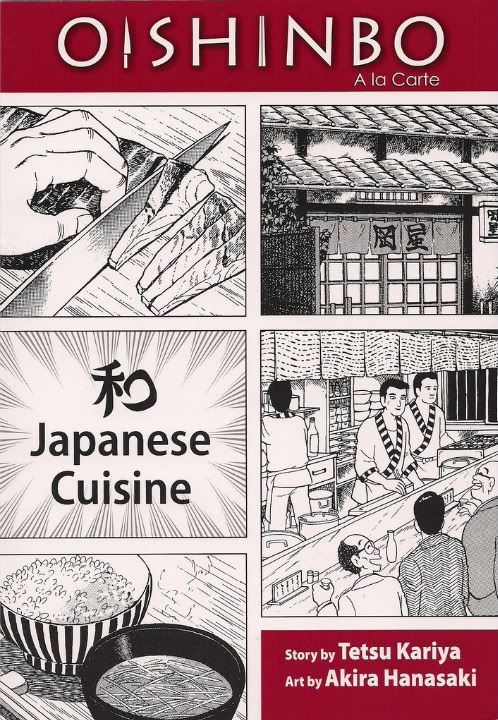
Yeah, you've heard it a hundred times by now: 'manga' as often seen in English -- a youth thing, a bookstore thing, a shōnen/shōjo thing -- is only a fragment of what manga really is. There's always a few non-porn exceptions, sure - most of them take the form of action or fantasy pieces For Mature Readers, with the occasional history of cup noodles or oddball art project slipping through. Astro Boy once filled us in on the story of Anne Frank, so there's always that. But it's still so hard to really get that old joke in Koji Aihara's & Kentaro Takekuma's brilliant satire, Even a Monkey Can Draw Manga, that one day there'd be manga for everything in Japan, up to and including train schedules. That's how omnipresent the stuff is.

So here's VIZ's latest exception, a 276-page, $12.99 peek into the secret world of mainstream manga for adults. And believe me when I say 'mainstream' - Oishinbo (The Gourmet) has been an ongoing series since 1983, and is currently up to vol. 102 (one hundred and two) in Japanese collections. Now, mind you, this English-language release isn't chronological or comprehensive; it's based on a separate Japanese repackaging, the A la Carte series, which itself has racked up 45 volumes since 2005 by sorting various stories from the series' run into themed collections. The very basic theme of this debut English volume (actually vol. 20 of the Japanese series) is Japanese Cuisine. Did I mention it's a comic about food?

Not that big a surprise, I guess - there's been a few English-translated manga involving chefs, your sheer shōnen Iron Wok Jan or the older teen shōjo of Antique Bakery. I've heard a few jokes about the sheer amount of food-related programming on Japanese television (including a 1988-92 Oishinbo anime, which ran for 136 episodes); Iron Chef apparently doesn't scratch the surface. So hey, why not some similar subject matter for an art form that's built up as much mass appeal as television? There's been golf manga and gambling manga, sex tips manga and religious cult manga - many with their own strata of legends, their masters of the form, heroes and inspirations little known outside of Japan.

Oishinbo is the work of writer Tetsu Kariya and artist Akira Hanasaki; neither have been published in English before, save for a few chapters of Oishinbo showcased in the semi-legendary 1990-97 'learn Japanese through comics' magazine Mangajin, although Kariya might also be known to my fellow obsessive compulsives as co-creator with Ryoichi Ikegami of the '70s schoolyard tough guys classic Otoko Gumi (Gallant Gang), which is supposedly more-or-less the ur-series behind Cromartie High School.

Hanasaki's visual style is a slick 'n staid approach that matches photorealistic (and, in all likelihood, photo-traced) backgrounds/items with the sort of airy, arch-mainstream cartoon character designs which, ironically, only ever seem to be glimpsed in North America through 'alternative' works that reference mainstream manga - think the pretty girl drawings in Hideo Azuma's Disappearance Diary, or the 'normal' framing sequence in Takashi Nemoto's Monster Men Bureiko Lullaby. It's certainly not very heavy on tilted panels or speed lines -- though both are present -- and may come off as oddly Western to some readers. Don't be fooled - it's just another aspect of manga!

The plot is the very essence of simplicity giving way to unlimited potential. Young Yamaoka Shirō is a newspaper reporter cum archetypal salaryman's fantasy character: frequently snoozing at his desk or plotting his next trip to the track, but always respected in the end for some superior attribute or another, here specifically an all but peerless taste in food pounded into him by his hated, brutal artist-foodie father, a man of such unflinching standards he worked Yamaoka's dear mother right into her grave and just didn't give a shit.

Now, Yamaoka has been ordered to assemble the "Ultimate Menu" for his paper's 100th anniversary, a quest that'll lead him to do basically nothing but enjoy hundreds of delicious, impossibly high-class meals all around the nation (just like real newspaper reporters!), while pushing him ever-closer into the arms of his lovely partner Kurita -- whom he'll eventually marry (this being a rather long assignment) -- and uncovering the occasional mild peril that's rarely more than one eating-related idea away from resolution. But watch out, Yamaoka - a rival paper is planning their own, cleverly titled "Supreme Menu," and they're staffed exclusively by sneering villains, and their project, dear reader, is headed by none other than Yamaoka's wicked father!!

Naturally it all comes down to consuming lots and lots of presumably expensive food -- money is almost never mentioned, as that would get in the way of the escapism -- in self-contained short stories roughly 25-30 pages in length. This VIZ edition is one of the nice ones with the flaps; it sports a pair of recipes and an extra-long translator's notes section as supplements, so you'll be double-damned sure you know the various cuts of tuna. The stories themselves are a little scattered, perhaps owing to this volume's vague theme, covering everything from rice preparation to sashimi slicing to the value of not smoking. There's stuff to learn, although I couldn't call it educational - most of the pieces are structured like little suspense thrillers, often pitting Yamaoka against his dad in battles of foodstuff wits that'll leave most readers horrified at the prospect of visiting Japan and subsequently being humiliated in public for wrapping rice in seaweed the wrong way.

But, you know, I found this book to be very interesting, not really because the stories are especially thrilling or impressive, or even for any reason directly related to food - no, I was fascinated by the comic's relationship with elitism.

Everything in this manga revolves around characters with incredibly developed taste, and every solution to every problem involves uncovering a superior presentation/preparation of food. Yamaoka may loathe his father, but he's hardly above correcting someone who's "enjoying" their food the wrong way, or standing up at a table to dismiss a meal as insufficient. This is no slobs vs. snobs saga - there's snooty antagonists that get taken down a peg, yes, but only because their hubris has somehow led them to advocate for something less than excellent. Sometimes Yamaoka is bested by his father -- any time Our Hero starts going on about gathering some showy arrangement of "the best" ingredients he's headed for a fall, since Japanese cooking is an unfailingly subtle art -- and while he scowls and pounds his fists it's always with some respect for how correct the old man is.

In other words, the series' stance can be summed up simply: it's best to be elitist, but try not to be too much of an asshole about it.

And you know what? Being an asshole is still better than being mediocre.

Gosh, that's not a sentiment you hear much of in North American comics. You can pick up traces of it in plenty of shōnen action titles - how many young men have raised their hands to the sky and vowed to be the very best there is? The cast of Oishinbo is a bit like that, if less childish - their Ultimate Menu quest is ultimately one of discovery, and even the worst setback, like, say, Yamaoka's father dismissing them all as unworthy to even dine in the presence of a truly great chef for getting their chopsticks an inch and a half too damp, only leads them to vow a greater level of achievement next time. As in, one character goes running off at the end of the story with a ruler, just to make sure.

Why is this? Is everyone mad? Is this a horror comic? Do I ever want to eat in front of other people again?

Quite simple, I think. At their bottom, these stories aren't just about eating or elitism - they're about patriotism. They're about discovering all aspects of Japanese cuisine, and drawing out the gorgeous simplicity and minute sympathies that make Japan itself a wonderful place, of wonderful, rich culture.

Do note the time when this series launched: 1983. The bubble economy was growing so much bigger, and Japan was getting noticed all over the world, especially in the United States. Oishinbo, aimed at older male readers, thus takes a position of intense pride, of showing how Japan deserves to be seen as excellent, to stand with the best.

One story sees a US senator of Japanese descent visit the old country; all the lush meals and local pomp mustered by bigwigs (as neat as it must seem for salaryman readers!) cannot compare to the gentle excellence of the best green tea, prepared beautifully in an aesthetically rich setting, "as if a breeze from a mountain stream has just blown through my body," the soul of Japan. Another sees a young girl raised in France ashamed of eating with chopsticks; she learns that the gentle caress of a meal is far less 'barbaric' than stabbing it with a metal skewer. A famed critic bloviates about the superiority of foreign procedures, but he goddamned learns some respect. And oh, you can just guess what happens when a crew of Benihana-style American-learned chefs-as-performers rolls out; it's not pretty.

Too bad that VIZ couldn't include some information on when these various and sundry stories were first published; I'd have liked to savor the subtle shifts in flavor after the bubble burst and Japan was reaffirmed as only human after all. But, fittingly, it would have to be subtle - there's no ferocious shifts in this taste, this cooking, this kind of mainstream. No, be quiet, and thereby be loud. Eat proud. Eat GOOD.

I don't want to be Left Behind...

Hey, all of the cool kids are doing it, so I might as well join in too! What I thought of FINAL CRISIS #7 after the jump...

I pretty much agree with all of the gang; even Abhay in the comments -- I liked it, I disliked it, I loved it, and I hated it. All at various points, and sometimes even at the same time.

Sure, it's sometimes barely coherent, and you kind of NEED to read the annotations and commentary and interviews to really get all of the points of what's going on. But that's pretty standard for a Morrison comic, really -- I felt the same way about THE INVISIBLES or much of his JLA run, for example. But I always ALWAYS come away with a line of dialogue or an image or a thought that will stay with me, pretty much forever, and that's what a proper piece of art does for you, anyway.

I'm not a good enough of a critic (or, even more properly, a reviewer) to really handle a writer like Grant -- it feels to me like he casually threw out more ideas and concepts in just the last issue alone than pretty nearly the entirety of the non-GM/Johns-written DCU did in the whole of 2007 -- so I'm going to approach the rest of this as a retailer as well as with what my customers having been saying as well.

The major problems with FINAL CRISIS have less to do with the work itself, and more to do both with how it was POSITIONED into the marketplace, as well as its CONNECTIONS TO the DC Universe. None of this is Grant Morrison's fault, or even something he as a creative person should have thought much about.

But FINAL CRISIS wasn't ever positioned as "just a cool big story" or whatever -- it was positioned as the culmination of the narrative thrust of the DC Universe over Dan Didio's tenure. I don't want to go digging through old interviews to find specific lines, but certainly this is the sense that Dan has given over the last, dunno, 18 months or so, or at least I think any reasonable person would agree.

FINAL CRISIS is buried under the expectation of the "Crisis" in the title; it had to bear the weight of having a 52-part weekly lead-in (plus several other series like DEATH OF THE NEW GODS) to the series that ended up contradicting Morrison's story; and it had to suffer from the branding that not only impacted FC itself, but also RIP in BATMAN as well.

None of this is Grant's fault, of course, but it is inevitable that it will color the audience's reception of the work.

Y'know, art is supposed to challenge the audience's expectations. But commercial products are supposed to conform to them. Well, or at least support them.

If you add up all of the comics that are meant to be part of this overall plotline as Didio has positioned it in interviews, starting with that TITANS mini where they killed Donna Troy, through the build up to INFINITE CRISIS, IC itself, 52, COUNTDOWN straight through to FC, you're talking hundreds of dollars - perhaps in the $500 range. If you tried to READ it that way, you'd probably go insane, being given only crayons to write with in your padded cell. Extremely little of it adds up, or builds to anything of real lasting significance.

That's why I think FC was "the last straw" for a really large chunk of my DC readers. I have customers dropping DC titles left and right, and they tell me the reasons are that they're confused about DC continuity, and they feel like they're being sold things that are not what they were told they are.

Of course some commenter will suggest that this is the audience's own fault for not being discerning enough in the first place, and while as a human I might not disagree with you all that much, as a retailer who has to deal with the ultimate financial outcomes of these decisions, I'm not at all enthusiastic.

What FC is, in a lot of ways, is the culmination not of Didio's path, but of Morrison's. If you read this as the capper to an arc that began in ANIMAL MAN, through SEVEN SOLDIERS, and a number of other DCU books that Grant has written, then this reads a whole lot differently. In fact, I think he has utterly reversed the paradigm -- in ANIMAL MAN, Buddy is ultimately shown to be powerless because of his writer, while by FINAL CRISIS, the stand-in for the writers are undone by their own story.

Anyway, this and RIP were just positioned badly, with a tidal wave of expectations that they crumble in the face of. If there's any mistake that Grant himself is guilty of here it is that SUBMIT, SUPERMAN BEYOND and that two-parter in BATMAN are actually plot-essential to the story, but aren't included IN the story. BEYOND especially -- I'm not sure if FC works AT ALL without reading that. But I think all of those have plot points which were critical to have in the main series itself.

You can understand FC just fine without reading REVELATIONS or LoTW (and especially without REQUIEM or the SECRET FILES or whatever I'm forgetting) -- I don't think that is at all true for the other Grant books.

As an individual consumer myself, I'm not going to buy the announced FC collection -- because it doesn't have those in there. And I'm not going to buy a separate "companion" book, just like I refused the buy the split season sets of BATTLESTAR GALACTICA. Maybe maybe when they finally get around to putting out the Whole Schmeer Edition, I might still be interested in it, but who knows if I'll still care by then?

Beyond the EXPECTATIONS, the other prong of the problem is the CONNECTION TO the rest of the DCU. As much as everyone complains about being "forced" to buy umpty-jillion tie-in books, it is really worse when you throw a Crisis in the DCU, and THE REST OF THE DCU DOESN'T EVEN NOTICE.

The DCU will supposedly sync up "over the next few months", is, I believe, the phrasing, but that's really too late.

And I suspect that 98% of the kajillion ideas that Grant threw out there will never be followed up again, unless Grant himself does so.

At the end of the day, I'm personally happy with a comic where Superman destroys the embodiment of evil with a song, then uses the magical-wishing-machine to write us all "a happy ending". Superman is fucking awesome. I'm maybe a little sad he didn't wink at us after doing so, but that's about it. That makes it for me a GOOD comic.

But the retailer in me, who has watched the erosion of his DCU reader-base, and is looking ahead to the next quarter, and the next year, and the next decade, well I think this was AWFUL -- a confusing jumble of great frustration and no immediate follow-through, culminating the last couple confusing jumbles of great frustration and no follow-through.

I love Grant Morrison's DC Universe. I want to read much more that is set in that mold: where epic deeds of heroism are done in astonishing ways by bold & fantastic characters. But I don't see anyone else approaching the DCU that way... least of all the editors.

What do YOU think?

-B


Yes, Me Too: Jeff Also Talks about Final Crisis #7 (and Superman Beyond #2)

For those of you keeping track, I wasn't that big a fan of SUPERMAN BEYOND #1: I admired it, but didn't like it very much and spent a lot of time thinking about why. So when issue #2 came in, I didn't exactly break down the doors of my comic shop to pick it up: I ended up reading it, in fact, right before FINAL CRISIS #7 on Wednesday. And so, for better or for worse, I've got to review the two books together, because my experience of one is hopelessly tied up in the other. Check it out, if you want, after the jump.

To put it plainly, Superman Beyond #2 is really, really clever. I mean, it's absurdly fucking clever: Not only do you have a 3-D comic book in which Superman must be joined with Ultraman, his symmetrical opposite, to travel to the higher reality of the monitors (a plot point that is analogous to the way your eyes work with each other via the 3-D glasses to give you stereoscopic images), but in order to process the big battle of the story properly--Superman battling with Evil and the idea of Superman battling with the idea of Evil are literally the same thing--the part of your brain that experiences the story textually and the part that experiences it metatextually must also work together (again, the way your eyes do with this 3-D process) in order to "get" the full "image." For a certain type of formalist who's also a fan of superhero comics, it's impossible not to love.

And love it I did, so much so that it pretty much overwhelmed all my previous criticisms and won me over.

And yet, the more I think about it, the more I feel those criticisms are still valid: The Monitors are higher-reality beings who have become infected with the disease of story, and Morrison has mapped out a grand little epic for them with fathers and sons, and lost loves, and fallen heroes who create the weapons that will bring them low--combined with the way Batman and Superman's side-stories play out in Final Crisis, it makes me think that Morrison's structural model for this whole event is as much Tolkein's Lord of the Rings, as it is any Crisis or other big superhero event--but Morrison seems to think taking the exposition out of an exposition info-dump makes it less of an info-dump and more a story. It doesn't.

Scott McCloud talked in Understanding Comics about the "blood in the gutters," the moments between panels where the real action takes place and reader closure occurs. (And isn't it possible, by the way, this term at least partially informs Morrison's metaphors of blood and vampirism throughout this book?) Perhaps Morrison feels he can shorthand so much story information and character motivation because the reader will ultimately make all those connections on their own anyway, just as they do the action between panels (and, let's face it, it's not as if the motivations of heroes when the fate of universe at stake is particuarly subtle. To quote Tony Shaloub's character in Barton Fink: "Wallace Beery! Wrestling picture! What do you need, a roadmap?!").

And perhaps this also explains why the response to Final Crisis has been so diametrically opposed on the Internet--you've got those people who provided their own catharsis between the panels and those who didn't, just like you've got those people who fucking love Lord of the Rings and can get all worked up over the saga of Boromir and Faramir and Denethor II, and guys like me that dug all three movies but is still pretty "meh" about the whole thing. I feel like Morrison's shortcutting works better the closer he gets to working with established characters (and probably the closer his take on those character is closer to mine), so that although Superman's motivation--the life of Lois Lane, hanging between heartbeats--isn't any more fully developed in this miniseries than Overman's quest for his sister, or the chick driving the Ultima Thule's for Novu Dox, it still means more to me (thanks to a bajillion years of established continuity) than the others, and even more than the fate of countless imaginary universes at stake. Without that bit of motivation that personally speaks to me--the desire to take on anything to save the person you love--would the cool-as-hell end of Superman Beyond #2 have seemed quite so Excellent to me?

Maybe? Or maybe when you get into the realm where formalist thrills are supposed to deliver your emotional thrills, elegance is as important as ambition. Because Final Crisis #7--as full o' ambition and intelligence as Superman Beyond, if not more so--didn't kung-pao my chicken nearly as much. I can totally see why Graeme and Douglas and Jog and everyone else is turning up, like the Pax Drei at the end of this book, to defend it at this crucial moment of critical analysis, but FC#7 is like issue #1 of Superman Beyond all over again for me. I see a lot of what it's doing--operatic motifs; the fragmentation of the storyline's narration mirroring the fragmenting of linear time at the end of the universe; hell, I even caught the line from "Hair" yelled out by one of the the Supermen analogues that manages to underscore the recurring references to music in this issue as well as point toward the dawning of the new age (of Aquarius?)--but didn't find myself caring particularly much.

Maybe it's because when you do decide your story is going roll at the level of almost pure signifier, that shit has got to roll correct. You can't pull a lumpy-ass space vampire out of the last twenty pages of your tie-in miniseries and have him show up as your ultimate big bad without expecting a certain amount of "umm, foreshadowing, plz?" on the part of your audience. [I can only imagine how baffled I'd be if I hadn't picked up the second issue of Superman Beyond--which I almost didn't.] You can't show the end of the universe being overwritten by Superman firing up the magical Maytag wishing machine, and not expect a certain amount of "Really? That's it?" You can't score an opera that gets shoved on stage with almost no rehearsal and be surprised when people complain that the singing is uneven. (Swap in "miniseries" for "opera" and "art" for "singing," would you?) No joke, I think Morrison has thought out Final Crisis to a level as fine as Moore did Watchmen--there's a concision of commentary in what Morrison is doing with the character of Super-Bat that knocks me on my ass--but do I think Final Crisis is as good as Watchmen? To me, it's not even close--while you can argue that, just as Moore doesn't nail the landing in Watchmen, Morrison doesn't quite hit the mark at FC's finale, it's really all the little misses and fudges and afterthoughts and "well, I gave you everything you need to know about this character in six nouns, two verbs and a very cool adjective, what more do you need?" Internet interviews throughout Final Crisis that keep it from being sublime.

Or maybe it's not a formalist issue at all. The last time I was in CE, Hibbs was talking to a customer about the upcoming film adaptation of Watchmen and said something with which I strongly disagreed: he said, "Nobody loves Watchmen for its plot. They love it for its structure."

Now, structure may be Watchmen's strongest point, but if it wasn't for the characters, I don't think it would've made it beyond a second printing. Rorschach and Dr. Manhattan and John and Laurie and that dude on the Black Freighter--I didn't have decades of experiences with them but Moore gave me reasons to care about them as their stories unfolded, and caring about them is what made the story worth reading for me.

I don't doubt that those who had an exultant experience reading Final Crisis truly did, nor am I saying that they're wrong to do so, even with all their caveats. But I'm genuinely surprised Morrison couldn't get me to care about what happened to the entire cast of the DCU in almost the same number of pages Moore was able to make me care about analogues of barely-known second-stringers. The fault may be mine, or it may be the work's, and it may not be the case several years from now when there's a collected edition with the relevant Superman and Batman crossovers pulled under one cover. And maybe, when the majority of your story takes place in the reader's heads instead of on the page, it should be no surprise when the story absolutely works for some and absolutely doesn't work for others. But for me right now--as a certain type of formalist with a love of superhero comics--good art that jams all the blood into its gutters isn't really much better from bad art that has no blood in it whatsoever. Judging the work on what it delivered, I'd say that Final Crisis #7 was Eh, and the miniseries as whole was OK.

Why I loved Final Crisis

I've been enjoying the online discussion of Final Crisis, especially as the last three parts have been coming out over the last three weeks. But one thing I think is particularly interesting about the reaction to the series is that a number of people who disliked it seem angry about it, or convinced that people who "actually enjoyed" it have somehow been duped. And even though I've been posting notes on every issue, I realized that I haven't actually said much about what I thought of the series since the first issue. I really did enjoy it enormously--as much as I've liked any superhero comic in the last few years. I thought it was problematic in a lot of ways, although I might not say "deeply" as many times as Jog did. But I love a lot of art that's seriously flawed, as long as 1) it's sufficiently ambitious and 2) it does some stuff very well. I found myself looking forward to every issue of Final Crisis, and reading and re-reading it with pleasure. So here's what I liked about it:

*It's incredibly densely packed. There's a lot to mull over in every issue--including a ton of plot--and earlier parts of the story reward re-reading in the context of later ones. A few people have commented that Morrison's writing style here seems like a puzzle or game; I don't think it's that, exactly, just a bunch of cues that let the story unfold in the reader's head. I think #7 is the only issue that's seriously non-chronological, and there the organization works really well dramatically: that opening scene is fantastic (and beautifully timed for a periodical coming out right now), and much more effective than picking up with #6's also-excellent cliffhanger would've been. The outcome of the great big physical fight is a foregone conclusion--by the time we get to it, it's not just past-tense narration, it's literally a bedtime story being told to children ("and no one was hurt").

*Morrison's dialogue is pitch-perfect. He juggles a gigantic cast, but he's great at establishing who they are and how they think about things with just a few lines. (Green Arrow and Black Canary get barely any on-panel time, but their characters and relationship are totally there.) The dialogue also delivers a lot of exposition that doesn't read like anyone's stopping to explain the plot. See, for instance, the conversation between Turpin and the Question in the first issue: "Didn't the Question used to be a guy?" "Lung cancer. From smoking." If you're meeting these characters for the first time, that reads as "you're not the person I was expecting"/"yeah, fuck you too," and also opens up the idea that we're in a setting where characters' identities are roles that can shift from person to person. If you know the Question from his appearances on the Justice League animated series, it clarifies why the Question's a woman here. If you know the characters well already, it's following up on a plot thread from 52, and showing the way Charlie's sensibility has rubbed off on Renee. And, in any case, the conversation sets up the position the Question will occupy by the end of the series--a kind of liaison between the human and superhuman worlds, who's tight with the law-enforcement community but isn't really one of them any more.

Speaking of which:

*It's a massive event comic that's totally self-contained. I realize that could sound odd coming from somebody who's been annotating every little extratextual reference in FC for nine months, but I'm serious: every essential part of the story is right there on the page of Final Crisis and its five Morrison-written tie-ins (Superman Beyond, Resist and the Batman two-parter--and I also think not including Superman Beyond in the collected edition sabotages the project). Everything else is just Easter eggs--and there are a ton of them. But, for example: there are a few sequences (in the first and last issues) involving a caveman. Is it fun to know that this particular caveman had his own series for six issues in the late '60s? Sure--but all you need to know about him for the purpose of this story is that he's a caveman. And, just on an analyzing-craft level, I enjoyed seeing how Morrison introduced all of this story's important characters and ideas for the benefit of readers who hadn't encountered them before.

*The art is mostly really good. (Aside from the dreadful sliver cover for the last issue.) I mean, yes, it would've been nicer to have an all-Jones (or all-Mahnke) project, but I enjoyed the look of almost all of it, and Alex Sinclair consistently hit the color out of the park. The coloring on Superman Beyond, in particular, is just fantastic--even the 2-D scenes stick to a color scheme that looks cool with the glasses on.

*It invites a whole lot of ways of reading it. Sean T. Collins has a really interesting post here about the elaborate light-as-information/darkness-as-dogma motif going on in the series, and how that was ultimately less interesting to him than the "crazy-ass superhero story" aspect. (And under the circumstances, I'm surprised that there wasn't a prominent Lightray analogue in this story.) I also share his frustration with Morrison's "why aren't there right-brain comics?" quote--but I think it'd be fairly on-the-mark if it were phrased as "why aren't there more right-brain superhero comics?"

Another good quote, from amypoodle of Mindless Ones: "the symbolic/thematic reading is just as important to [Morrison's comics] as the literal one." I think that's true, and in Final Crisis those readings bleed together: parts of the story are more or less literally about internal and ground-level struggle against darkness (Batman, Submit), others are grand symbolic treatments of the cosmic "what stories do you tell?" question (Superman Beyond), and they become the same thing by #7. There's a deus ex machina ending, of course, but only in the literal sense; it's been fastidiously set up from the very first scene, with its divinely inspired technology turning will into reality.

*It's totally entertaining, panel-for-panel. Final Crisis tosses an amazing number of fun ideas out into the idea-space of the DCU; you know, if Lord Eye only gets two panels, so what? Somebody else can play with that later. Frankenstein on a motorcycle with a sword in one hand and a gun in the other, quoting Milton as he kills Justifiers, is my idea of quality entertainment. Morrison writes great endings, too--not a surprise coming from the writer of the final scene of We3, the last page of "Batman R.I.P.," the conclusion of his Doom Patrol, etc., but Jesus did this series ever have some killer cliffhangers. The story accelerates steadily, from its police-procedural opening to the insane fireworks of the ending ("what the hell, let's throw in Captain Carrot and his Amazing Zoo Crew. And the Host of Heaven, too"). And when Final Crisis cranks up the volume, it really cranks it up. Superman's entrance in the final scene of #6? It's like having three symphony orchestras in the balcony that you didn't know about suddenly join in with the two playing triple-fortissimo on stage.

*It opens up a lot of possibilities for stories, and doesn't close many off. That's something an "event comic" should do, I think. I don't know which of those possibilities will actually be fulfilled--and even Morrison seems dubious about the prospect--but they're there.


The End Of The End

So, I'm kind of conflicted about FINAL CRISIS #7. As the last issue of a company-wide "event" - Hell, even as a narrative - it feels like a failure, with lots of important plot points either muddy or entirely screwed-up in one way or another. But on an emotional level, as a shameless love letter to superhero comics, it was wonderful; moving, bold and purposeful and entirely successful. Maybe I should call this post "Crisis On Infinite Viewpoints" and get it over with.

To admit my bias early; I love Grant Morrison's superhero work. It's almost always flawed in one way or another, and sometimes to the extent that it's a terrible mess, but it's almost never a boring mess, and every failure can generally be traced back to being too ambitious or taking on too much at once, which is always something to be admired. One of the usual flaws for his superhero stories is his climaxes, which tend to either be of the deus ex machina variety or the "Wait, what the fuck was that" variety; Final Crisis has both, somewhat fittingly, and it's a tribute to Morrison's talent as a stylist that it still managed to work, somehow, despite at times feeling like the work of an overeager seven-year-old ("And then Aquaman came back! And then the Hawks died! Maybe! It's entirely unclear!" Both of which deserved more than just the panel of attention that they got). But then, Final Crisis was always less of what you would expect - or, perhaps, deserve - from a superhero crossover, and closer to something like The Invisibles (or Seven Soldiers, more appropriately), anyway; something less a story than an experience that either works for you or doesn't, with no in-between (By the end of The Invisibles, I didn't care how the story ended as much as I wanted the characters to be okay, if that makes sense; I was so invested in the characters I'd spent years reading about that I would've been equally happy if the final issues had been Grant Morrison stepping into the story and saying "Okay, so they're all going to be all right in the end. I just wanted you to know that" as much as, you know, the actual end of the story he was writing). The idea that Morrison could've been able to bring the story to a successful conclusion purely in terms of plot with only 40 pages was already unlikely, and so it was almost refreshing to see the approach he took.

Was I the only person who was reminded of Secret Invasion's final issue, when reading this? Not only the switch from watching the events "live" to being told what happened by participants after the fact, but also the construction of the issue so that the threat is dealt with by midway through the issue, and everything else was "what happened afterwards" exposition. Those similarities made it easier to compare the two, and draw (jumping to) conclusions about the two companies; while Final Crisis' finale was romantic, upbeat and embracing of the ridiculousness of the superhero genre (I mean, Captain Carrot and his Zoo Crew being part of the heroes that save the universe? Really? And when I saw that, I was actually glad that JG Jones wasn't drawing the issue, because I dread to think how realistic he might have made them), Secret Invasion was all... I don't want to say pointless, but oppressive and never-ending, and without actually achieving anything, or making any greater point beyond "And here is more of the same, our poor heroes." As much as Final Crisis may have made no sense on a plot level, at the end of it, I know what it was about and what it was trying to say; I'm not sure I can say the same of Secret Invasion, beyond "Selling comics." And, yet, maybe that made it a better superhero event book?

In the end, I think Final Crisis was - for me, at least - a Very Good series overall, with a Good, if rushed and overeager, last issue. It makes superhero comics seem full of possibilities again, but considering what is likely to follow, it's probably best not to think about that too much.

I'm not afraid of the dark!

DARK AVENGERS #1: So this is my theory, and it may be wrong.

Marvel has been very good, maybe especially amazingly good about judging the zeitgeist when it comes to their recent big events. CIVIL WAR and SECRET INVASION were both pretty prefect distillations of the nation's feelings at the time of their initial publication, and that's why they resonated so well with the comics audience, and sold so well. That's what pop comics are supposed to do, of course: reflect ourselves back at us so we can know ourselves better. One can argue this is a tradition that goes back to the start of Marvel, as well: what else are most of the original Marvel characters but perfect pictures of America's fears of the Bomb, the commies, the generational changes between "the 50s" and "the 60s"?

So my theory is this: Marvel (and Bendis, one presumes) really really thought that Obama was going to lose the presidency. Maybe this is from liberal self-loathing; maybe it was just playing the odds -- hell, even here in liberal pinko San Francisco, there's very few of my peers who thought the black guy REALLY had a chance.

Storylines are planned months ahead of time, of course. And once you start something down a certain path, it really is hard to change that path in a group-planning environment.

Because I'm not sure how to otherwise really explain DARK AVENGERS #1 coming out the day after the inauguration of our 44th president. Tonally, it's completely wrong. Here's a man who, in his first week, has strengthened the Freedom of Information Act; is doing his initial interviews with "the Muslim world" trying to show them that America is not their enemy; is shutting down Gitmo.

And in DARK AVENGERS #1 a loathsome and insane enemy takes over super-heroic security of the country, installing twisted parodies of some of our favorite heroes as though they were the real thing, and is ruling based on fear and blackmail and psychosis.

Well, fair enough that I have a few conservative friends who might argue that IS the undercurrent of America '09, but I think they're fair from the majority opinion this time around.

I don't want this to become a big political debate or anything, but the dissonance between watching our President speak, and the workings of America in the Marvel universe is pretty breathtaking -- it's like going to the opera and finding out tonight's selection is the Sex Pistol's greatest hits!

So, yeah, I think they were betting on McCain winning this thing. Could be wrong, but that's my theory and I am sticking with it for the moment.

Putting THAT aside, how was the comic itself?

Actually, surprisingly GOOD.

There was some fine storytelling going on here -- everything you might possibly need to know is right there within the pages of the comic itself, and it unfolded organically, as well as with a reasonable amount of suspense. There was a density of storytelling that I haven't gotten from a Bendis comic in some time -- this is a "crowded" book, with lots going on, and a lot of insight into the individual pieces.

This is one of Marvel's new $3.99 monthlies, but if it keeps this density, that might even be a reasonable price to pay.

The art is lovely and moody, the script is strong, what's not to like?

My one concern is two-fold (hm, does that even make sense?) -- this book's premise is a bit too much like that of THUNDERBOLTS (and TBOLTS changes it's premise a little bit, kinda, to match to that), but because of the high profile nature of the title and the characters, I really really don't see how you can get a lot more than a year out of the premise.

At least TBOLTS had places to run after it's big surprising reveal -- those were, largely, minor characters, who were wide open to change, and there were a number of themes of heroism and redemption that could be explored because of that, in several different directions.

DA really doesn't have that option, as I can see it -- not only CAN'T characters like Venom or Bullseye change or be redeemed or become heroic, the audience would really hate them for doing so.

In some ways, DA's premise reminds me (a SMIDGE) of that of THE SHIELD: bad bad people in charge of your security, and they're going to do bad bad things along the way to enrich themselves as well. The problems that I see is that, unlike Vic Mackey, Norman and his psychos are at the top of the food chain, and there's nothing, no chain of command, no leaders above them to reign them in, or hold them back. At best, you've got public opinion, but that's a weak chain for storytelling. What makes something like THE SHIELD so compelling was "How the fuck do the bad guys get away with this, get out of eating the shit sandwich they made... hell, make someone else eat that sandwich?" BUt that's because they were under CONSTANT scrutiny and political forces arrayed against them.

Plus, I really liked Vic Mackey in a way, and his honor, however twisted, that put his family's life as his main goal (even if he fucked it up constantly by being, y'know, corrupt and evil)

Not so with Norman, not so with the rest of the cast -- I don't feel an "in" there, the character to root for, or a path that things can go that won't end up by issue #12 having to be in the same place as the conclusion of THE SHIELD. The Dark Avengers don't seem to have anything to strive AGAINST.

So yeah, flawed premise, hard to see how it can last, completely wrong for the moment in history... and yet I thought it was GOOD, nonetheless. So figure, eh?

What did YOU think?

-B

Arriving 1/28/2009

Just let me finish the order form and ONOMATOPOEIA (both due tomorrow), and I'll get a review up -- tomorrow latest.

Meantime, here's what is arriving this week...

A G SUPER EROTIC ANTHOLOGY #97 (A) (C: 1-0-0)
AMAZING SPIDER-MAN EXTRA #2
ARCHIE #593
ASTOUNDING WOLF-MAN #12 (RES)
AVENGERS INITIATIVE #21 DKR
BATMAN #685 (FOE)
BATMAN GOTHAM AFTER MIDNIGHT #9 (OF 12)
BATMAN THE BRAVE AND THE BOLD #1
BETTY & VERONICA DIGEST #191
BLUE BEETLE #35
BUCKAROO BANZAI BIG SIZE #1
CAPTAIN ACTION COMICS #2 SPARACIO CVR
CAPTAIN AMERICA #46
CARTOON NETWORK BLOCK PARTY #53
CITY OF DUST #4 A CVR LANGLEY
CROSSED #3 (OF 9)
DAREDEVIL #115
DARK TOWER TREACHERY #5 (OF 6)
DEAD AHEAD #2 (OF 3)
DRAGON PRINCE #4 JOHNSON CVR A
ENDERS SHADOW BATTLE SCHOOL #2 (OF 5)
FACES OF EVIL KOBRA #1 (FOE)
FANTASTIC FOUR #563
FERRYMAN #5 (OF 5)
FINAL CRISIS #7 (OF 7)
FINAL CRISIS REVELATIONS #5 (OF 5)
FRINGE #2 (OF 6) (RES)
GALVESTON #3 CVR A
GARTH ENNIS BATTLEFIELDS DEAR BILLY #1 (C: 0-1-0)
GHOST RIDER DANNY KETCH #4 (OF 5)
GLAMOURPUSS #5
GOLEM ONE SHOT
GREATEST HITS #5 (OF 6)
HERO SQUARED LOVE & DEATH #1 (OF 3) CVR A
INCREDIBLE HERCULES #125
JACK OF FABLES #30
JUGHEADS DOUBLE DIGEST #147
JUSTICE SOCIETY OF AMERICA #23 (FOE)
LEGION OF SUPER HEROES #50
MARVEL ADVENTURES FANTASTIC FOUR #44
MARVELS EYE OF CAMERA #3 (OF 6)
MISTER X CONDEMNED #2 (OF 4)
MS MARVEL #35 DKR
NEW AVENGERS #49 DKR
NINJA HIGH SCHOOL #166
NORTHLANDERS #14
NOVA #21
PROOF #16
PUNISHER WAR ZONE #6 (OF 6)
REIGN IN HELL #7 (OF 8)
RUNAWAYS 3 #6
SAVAGE #4 (OF 4)
SAVAGE DRAGON #144
SCOURGE OF GODS #1 (OF 3)
SHE-HULK 2 #37
SKAAR SON OF HULK #7
STAND CAPTAIN TRIPS #5 (OF 5)
STAR WARS LEGACY #32 FIGHT ANOTHER DAY PART 1 OF 2
SUPERMAN #684 (FOE)
TAROT WITCH OF THE BLACK ROSE #54
TEEN TITANS #67 (FOE)
TERMINATOR REVOLUTION #2
TERRY MOORES ECHO #9
TRINITY #35
ULTIMATE SPIDER-MAN #130
UMBRELLA ACADEMY DALLAS #3 (OF 6)
UNKNOWN SOLDIER #4
USAGI YOJIMBO #117
WAR THAT TIME FORGOT #9 (OF 12)
WILDCATS #7
WOLVERINE FIRST CLASS #11
WONDER WOMAN #28 (FOE)
WONDERFUL WIZARD OF OZ #2 (OF 8)
X-FORCE #11
X-MEN WORLDS APART #4 (OF 4)
YOUNG X-MEN #10
ZOMBIE TALES #10 CVR A

Books / Mags / Stuff
BATMAN THE MAN WHO LAUGHS TP
BERSERK TP VOL 27
BONE COLOR ED SC VOL 09 CROWN OF HORNS
CHARLIE BROWNS STRIPED YLLW T/S LG
CHARLIE BROWNS STRIPED YLLW T/S MED
CRIMINAL TP VOL 04 BAD NIGHT
DC LIBRARY SUPERMAN KRYPTONITE NEVERMORE HC
GREEN ARROW BLACK CANARY FAMILY BUSINESS TP
HUNTRESS YEAR ONE TP
JOURNEY TP VOL 02
JUXTAPOZ VOL 16 #2 FEB 2009
MARVEL 1985 PREM HC
ORANGE GN
PIXIE GN VOL 01 (OF 4)
PRESIDENTS OF THE UNITED STATES GN
PREVIEWS #245 FEBRUARY 2009
SECRET INVASION TP FANTASTIC FOUR
SHOWCASE PRESENTS HOUSE OF MYSTERY VOL 03
SKATE FARM GN VOL 01 (IDW)
STAR WARS LEGACY TP VOL 05
STAR WARS VECTOR TP VOL 01 CHAPTERS 1 & 2
STREETS OF GLORY TP
TANTRIC STRIPFIGHTER TRINA GN
TRANSHUMAN TP VOL 01
ULTIMATE SPIDER-MAN TP VOL 21 WAR OF THE SYMBIOTES
VICTORIAS SECRET SERVICE TP
WATCHMEN MOVIE AF ASST #1
WIZARD MAGAZINE #209 WATCHMAN MOVIE CVR
X-MEN PREM HC ORIGINAL SIN

What looks good to YOU?

-B

A long, long time ago...

I can still remember, how the comics used to make me smile... These days it's mostly just yawns or facepalms (or, in the case of FINAL CRISIS #6, both at the same time). I promised Brian I'd step up my contributions to the Savage Critics, which, given that I've had the consistency of Damon Lindelof lately, that's totally fair. Except I then spent two weeks scouring the new releases, looking for anything interesting enough to talk about; hell, I'd settle for some controversial news items, but all I've got is JEFF PARKER'S ON EXILES:
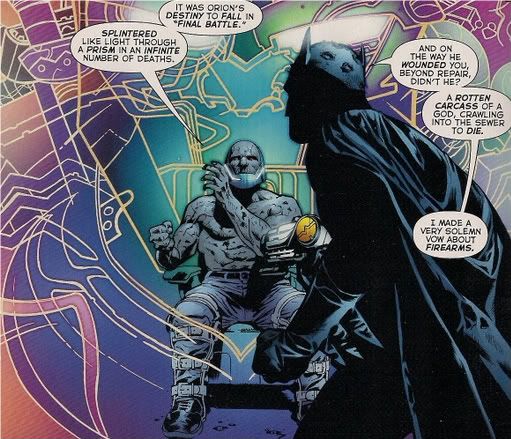


And I seriously doubt anyone cares about that except me.

It may just be that January's a slow month, and the only noteworthy new launches tie into either DARK REIGN or FINAL CRISIS, and I'm pretty much just waiting for them to be over at this point. So rather than analyze a specific issue in depth, I'm going to run some old-school bullet points this week. UNCANNY X-MEN ANNUAL #2: You know, ever since Matt Fraction went solo on UNCANNY X-MEN, the book's felt a bit... flat to me. It's basically turned into a string of unrelated subplots that don't seem to go anywhere: Magneto teams up with the High Evolutionary, then they disappear for six months while Madelyne Pryor resurfaces and starts putting her own team together, only no one seems to care about that because Colossus has gone AWOL and Emma's having a Moment of Angsty Introspection (tm Tom Welling). It all amounts to a rather disjointed Big Picture, which is pretty much the same problem with this Annual - the story's a sloppy mess even by X-Men standards, constantly jumping back and forth to retcon a link between Namor and Emma Frost (ostensibly because of the whole PURPLE REIGN thing), and it's just... I have no idea what Fraction's trying to do here. Maybe it's an attempt to make White Queen-era Emma more sympathetic, but I've had enough frou-frou apologia from the nice folks over at HEROES. And the dialogue... "You're not my prince. Do you always smell like that?" "Yes. Do you?" I say thee EH.

X-FACTOR #39: Peter David gets a cookie for thinking up a rather inventive way out of the whole parenthood storyline. Unfortunately, the end result takes us to a rather conventional place, a place that's become such a tired cliche in the superhero genre that I can't help thinking it would've been a gutsier, more creative move to see things through, so to speak. Even the sharpest character moments, like Siryn's reaction immediately after the Big Twist, are muted because they're so familiar, bordering on tedious. So that cookie has to be, I don't know, bran or something like that. Not as much fun as chocolate chip, but it's OKAY to chew on for a while.

WAR MACHINE #2: Wow. This... really hasn't gotten any better, has it? I mean, I was willing to write the first issue off as a fluke, because I still think of Greg Pak as the guy who wrote PHOENIX: ENDSONG and that cute WARLOCK miniseries with the surprise ending. But this is just... page 7, that splash of War Machine with half of North America's arsenal strapped to his back? That's straight out of the Dark Ages, people. We're talking Rob Liefeld pecs-out-to-there guns-guns-guns Dark Ages. And then on page 17, War Machine... turns into a tank? I have no idea. Though that makes it a nice tie-in to the TRANSFORMERS movie, which was also about stuff getting blown up and not much else. AWFUL, because I can understand Golden Age retro and I can understand Silver Age retro, but why anyone would want to go back to the days of tin-foil radioactive sub-atomic tri-fold variant covers is beyond me.

STARSLIP: Technically not a new release (or, you know, a comic) but I'd like to point out that Kris Straub has just one-upped DC with his latest storyline by: A) destroying the universe, B) permanently displacing his cast into an alternate timeline two years in the past, which means everything you know is not wrong because it did happen and the characters are now scrambling to rewrite history, and C) blowing up the universe actually had a purpose, as it gave Straub an in-story reason to go from this to this. (Okay, that's technically a three-up.) And to top it all off, he's kept me laughing the whole damn way. EXCELLENT.

Graeme Finds Out That Some Wars Are, In Fact, Good For Absolutely Somethin'. Huh.

THE WAR AT ELLSMERE is the kind of book that makes you wonder why its author - in this case, Faith Erin Hicks, who did Zombies Calling a couple of years ago for SLG, which was also a lot of fun - isn't much better known and feted as a "meteoric talent" or "one to watch" or something similar by a hundred bloggers. To spoil the review, let's start with me telling you that it's Very Good, and go from there.


It's a tough book to talk about, because what makes it work so well is the execution as much as anything else; to talk about the plot could make it sound a little too like a less magical, less sentimental Harry Potter (although, I admit, if there was a new "The [Blank] at Ellsmere" book every year, I'd be a happy man) or like too many other stories; a poor girl gets into an exclusive private school on a scholarship and discovers a world of snobbery, cliques and mystery. But Hicks isn't a lazy writer, and for every familiar plot device she uses, she gives it enough honesty and originality to win you over nonetheless (The dynamic between heroine Juniper and lead Mean Girl Emily is more complex than you might expect, and more interesting because of it, for example); for all their familiarity, the characters feel individual and not like stereotypes, and you believe in them.

(Also, the argument can be made that YA fiction - of which this is definitely an example, and in a weird way, the Minx book that never was, although that sounds like more of a backhanded compliment than was intended, especially considering the critical/commercial failure of much of that line. It has much more... energy, perhaps? Enthusiasm? than any of the Minx books, and feels much less studied and focused, in a good way; perhaps it's a good model for what Minx could have been - can get away with a more familiar, simpler story with more familiar, simpler characters. I'm not sure that I completely believe that, but something that I kept thinking throughout the entire book was that it was a perfect book for its target audience, and not in the negative sense.)

All of this is helped considerably by Hicks' art, which has progressed from Zombies Calling towards something simpler, more graphic and immediate - Yeah, I know there've been comparisons to Bryan Lee O'Malley's Scott Pilgrim art, but there are as many differences as similarities, to be honest. It's like a scruffier take on something like Craig McCracken's stuff, but with the occasional surprising note of something unexpected (No-one else will see this, but I swear there's some Dave McKean in there. Some Hope Larson and Craig Thompson, too), but all without seeming too derivative and managing to feel all of its own style, at the same time. If nothing else, take a look at the book for the art alone - especially Cassie talking about trees on pages 63 and 64. It's a wonderful-looking book.

I'm almost suspicious of liking something as much as I did this book; I second-guess myself and wonder if I'm missing some flaw that everyone else will see straight away, or whether I've been lured in by great art and enjoyable story and there's some larger ART point that I've forgotten (That last one I tend to get over pretty quickly), but fuck it: This book isn't perfect (the ending is a little too "THERE MUST BE A SEQUEL") or for everyone; people who want to see Bullseye dress up as Hawkeye and shoot arrows through people might not appreciate it, but who cares? It looks great and warms the heart, while making you smile and worry that everything'll turn out okay. Like I said at the start; it really is very good.

Graeme's 10 Thoughts About Showcase Presents: Brave And Bold Volume 3

1. The title - SHOWCASE PRESENTS: THE BRAVE AND THE BOLD BATMAN TEAM-UPS VOLUME 3 - feels as if DC was trying to win some kind of award for longwindedness; would it have killed them to just call it SHOWCASE PRESENTS: THE BRAVE AND THE BOLD VOLUME 3 instead? I know, they're probably trying to plan ahead for when they do Showcases of the non-Haney/Aparo issues, but still.

2. If, like me, you've been following the series eagerly up until this point, Bob Haney's weird and poetic way with words has not only become normal by now, but also comforting in a way. "The Brave and Bold Beat continues! Miss it never!" Miss it never? It's like Bizarro Stan Lee, but it works.

3. Also wonderful: The operatic, emotional Batman that Haney writes. Never mind the dour, grim Dark Knight people are familiar with, this is a Batman so filled with life that he'll literally shake a fist in the air and swear an oath if needs be... but also one so secure in his manliness that he's got no problem calling Aquaman beautiful at the end of one story.

4. To be fair to Bats, Aquaman is pretty beautiful in that particular story, thanks to Jim Aparo's lovely, lovely art. Aparo's work in this collection is variable; you can see when he's rushed and hacking it out, at times, but there are also some pages that just make you wonder why he's never really gotten his due as an artist. As someone who first came across his work in Batman and the Outsiders, but soon came to consider his Batman as "the" Batman of my childhood, it's somewhat gratifying to see that the preteen me wasn't entirely lacking in taste.

5. Something that's very apparent in black and white: What a magpie Aparo could be, stylistically. There are some very Neal Adams-ish panels in this book, and during the Sgt. Rock issues, some great Joe Kubert-style touches in the inking.

6. The Batman scene in last week's Final Crisis that everyone's not been talking about? Add in some ridiculous narration and that could've easily been the opening to one of the stories in here; the follow-up, of course, would be precisely the same follow-up that Morrison is inevitably going to end up doing himself - Batman lost in either time (the Forever People solution) or the Life Trap (Morrison's Mister Miracle solution), and fighting his way out by being the Ultimate Man. Morrison's Batman was pretty much always Haney's, but a little bit older and grumpier, anyway.

(6.5. I pretty much think that FINAL CRISIS #6 was Good, all of the problems with it, aside; I liked the choppy sense of immediacy that Morrison brings to the writing, the genuine sense of emergency and everything happening at once making it feel like a Crisis, if not necessarily the "Final" one... Whether that's intentional or the result of rewrites, I'm not entirely sure, but it still worked for me; I also like that a lot of it happens off-panel, but not in such a way that you feel completely cheated, or at least, not yet. It's a shame that deadline issues and stupid production mistakes - Since when was Mister Miracle white? How is Hourman in two places at once at the end of this issue? - have killed a lot of this series' momentum, because it's really kind of awesome, in its own way. That said, I still think that it's definitely not the kind of thing that linewide event books are made of, and that it suffers from its more overt attempts to fit into that hole.)

7. Haney's choices for guest-stars is enjoyably B-list, for the most part (Wildcat, Mister Miracle and the Metal Men all appear in more than one story in this collection), and when big-name heroes appear, it's not as fun (Well, with the exception of the Green Lantern story).

8. That Green Lantern story, though... Man. It made me realize how much of this book - and the previous two collections -don't fit into what we now think of as the superhero formula. For one thing, they're mostly devoid of supervillains; lowlife hoods or criminal masterminds, sure, but guys in costumes with superpowers? Not so much. And, as over the top as the emotion may be, there's no angst or soap opera; it's literally "Here we are introducing the concept, here we are dealing with it, now we're done."

9. That economy - and, to be honest, also the way in which you get the idea that Haney might be ripping off whatever the movie or TV show he saw last night may have been (Seriously, how else do you get a story where Batman gets mentally tortured with the latest brainwashing techniques and almost breaks after following Green Lantern once he defects?) - really reminded me of early 2000AD, especially John Wagner and Alan Grant's stuff before they started taking themselves more seriously. On the one hand, they were hacking the stuff out, trying to write as many pages as possible as quickly as possible while still being entertaining, but "hack" is too much of pejorative to use, because the stories are still readable - enjoyable - and successful in what they set out to do decades later. Someone needs to tell me what this kind of thing is called when you're trying not to insult it (Pulpy? No, that's not it, either).

10. If these collections were weekly, they wouldn't come out quick enough for me. Fun, stupid, thrilling and never-really-giving-a-fuck, this book was Excellent.

Arriving 1/21/2009

I'm nearly undrowned, but not quite...

Here's what is shipping this week (And, he said, editing the original post, while Monday WAS a holiday, it was not a UPS holiday, so comics are WEDNESDAY, per usual:

100 BULLETS #99
1001 ARABIAN NIGHTS ADVENTURES OF SINBAD #7
2000 AD #1617
3 GEEKS SLAB MADNESS #1 (OF 3)
AIR #6
AMAZING SPIDER-MAN #584
ANGEL AFTER THE FALL #16
ASTONISHING X-MEN #28
BETTY & VERONICA SPECTACULAR #87
BIRDS OF PREY #126 (FOE)
BLACK LIGHTNING YEAR ONE #2 (OF 6)
BRAVE AND THE BOLD #21
CAPTAIN AMERICA THEATER OF WAR AMERICA THE BEAUTIFUL
CONAN THE CIMMERIAN #7
DARK AVENGERS #1 DKR
DARK DELICACIES #1
DARKNESS #74 KEOWN CVR A
DOCTOR WHO FORGOTTEN #6
DR DOOM MASTERS OF EVIL #1
ELEPHANTMEN #15
EPILOGUE #4
FACES OF EVIL DEATHSTROKE #1 (FOE)
FALLEN ANGEL IDW #33
FINAL CRISIS SUPERMAN BEYOND #2 (OF 2)
GARTH ENNIS BATTLEFIELDS NIGHT WITCHES #3 (OF 3)
GHOST RIDER #31
GIANT-SIZE GRIMM FAIRY TALES #1
GREEN LANTERN #37 (FOE)
GUARDIANS OF GALAXY #9
HACK SLASH SERIES #19 SEELEY CVR A
HELLBLAZER #251
JUGHEAD #193
JUGHEAD AND FRIENDS DIGEST #31
JUSTICE LEAGUE OF AMERICA #29 (FOE)
KNIGHTS OF THE DINNER TABLE #147
LONE RANGER AND TONTO #2
MARVEL ADVENTURES AVENGERS #32
MIGHTY AVENGERS #21 DKR
MOON KNIGHT #26
MYSTERIUS THE UNFATHOMABLE #1 (OF 6)
NEW EXILES #17
PALS N GALS DOUBLE DIGEST #128
PUNISHER FRANK CASTLE MAX #66
ROBIN #182 (FOE)
RUINS #1
SCOOBY DOO #140
SIMPSONS COMICS #150
SPAWN #188
SPIDER-MAN NOIR #2 (OF 4)
SPIRIT #25
SQUADRON SUPREME 2 #7
STAR TREK COUNTDOWN #1
STAR WARS KNIGHTS OF OLD REPUBLIC #37 PROPHET MOTIVE PART 2
STORMWATCH PHD #18
SUPERGIRL #37 (FOE)
SUPERMAN BATMAN ANNUAL #3
TANGENT SUPERMANS REIGN #11 (OF 12)
THUNDERBOLTS #128 DKR
TINY TITANS #12
TRINITY #34
UNCANNY X-MEN ANNUAL #2 DKR
VIGILANTE #2 (FOE)
WAR MACHINE #2 DKR
WEAPON X FIRST CLASS #3 (OF 3)
WOLVERINE ORIGINS #32
WORLD OF WARCRAFT #15
X-FACTOR #39
X-FILES #3 (OF 6)
X-MEN KINGBREAKER #2 (OF 4)
X-MEN LEGACY #220
X-MEN MANIFEST DESTINY #5 (OF 5) CORRECTED COPY
YTHAQ FORSAKEN WORLD #2 (OF 3)

Books / Mags / Stuff
ANGORA NAPKIN GN
ARCHIE NEW LOOK SERIES TP VOL 02 JUGHEAD THE MATCHMAKER
BACK ISSUE #32
BATMAN THE STRANGE DEATHS OF BATMAN TP
BUFFY THE VAMPIRE SLAYER OMNIBUS TP VOL 06
COMPLETE ARANZI HOUR TP
ESSENTIAL WOLVERINE TP VOL 01 NEW PTG
FANTASTIC FOUR VISIONARIES JOHN BYRNE TP VOL 00
FLASH EMERGENCY STOP TP
GANTZ TP VOL 03
GON VOL 07
GORGEOUS AND HUNG SC (A)
HARLEY QUINN PRELUDES AND KNOCK KNOCK JOKES TP
IMMORTAL IRON FIST TP VOL 03 BOOK OF IRON FIST
INDIANA JONES IDOL REPLICA BANK
IRON MAN DIRECTOR OF SHIELD TP IRON HANDS
JUDGE DREDD MEGAZINE #280
JUSTICE LEAGUE OF AMERICA LIGHTNING SAGA TP
JUSTICE LEAGUE OF AMERICA SANCTUARY HC
MISS DONT TOUCH ME GN
PATH OF THE ASSASSIN TP VOL 14 BAD BLOOD
SECRET INVASION TP CAPTAIN MARVEL
SECRET INVASION TP HOME INVASION
SECRET INVASION TP WAR MACHINE
STUART & KATHRYN IMMONENS NEVER BAD AS YOU THINK HC
SUPERMAN SHADOWS LINGER TP
TED MCKEEVER LIBRARY HC VOL 02 EDDY CURRENT
TEZUKAS BLACK JACK TP VOL 03
TOKYO DAYS BANGKOK NIGHTS TP
TOMARTS ACTION FIGURE DIGEST #174

What looks good to YOU?

-B

The New TILTING is up!

Personally, I think I did a really good job this month. You can judge for yourself, by going here.

Dirk Deppey calls the beginning A "feelgood throat-clearing", and I know why he does, but, honestly, a lot of that is the great feelings that Ben's school instills in me for the Future and America.

Like I JUST got back this morning from the school, and Jazz musician Marcus Shelby (who is one of the "Artists in Residence" there) just performed a concert for the kids. In between songs he talked about Obama's presidency, and MLK and Rosa Parks, and all of the first graders and Kinders got up to sing "We Shall Overcome", and I had a genuine lump in my throat.

It is easy to be cynical; but I'm trying to live for Hope these days...

Anyway, go read the column, lemme know what you think!!

-B

You already know what happens, right?

Final Crisis #6 (of 7):

Oh no, he's come for my interest in this series!

Hang on - let me run for a bit. Get that blood flowing. A little Speed Force never hurt! If there's one thing about this issue that really stands out to me, a Grant Morrison tragic, it's how the Doomsday Singularity and its accordant collapse of Earthly reality has resulted in a quantity of infinite Morrisons.

Look! The Atoms are shoving off on an emergency trip to a new reality not unlike the Atom 1,000,000 story in the old DC One Million 80-Page Giant, and the Marvel family is pulling off a depowering stunt not unlike that from the Black Adam climax of 52! You know about Batman this issue, right? His little throwdown with Darkseid evokes both The Invisibles and JLA: Rock of Ages, all while rolling around in Seven Soldiers references (visual and otherwise) and literally concluding Batman: R.I.P. - it's the heart of the storm, after all.

There's a great little joke(?) in that; if R.I.P. was a dark version of Morrison's All Star Superman, the shared-universe Gotham to a fabulously aloof Metropolis, then it's very fitting that Batman's *GASP* *CHOKE* violation of his twin vows against killing and discharging firearms outside of an authorized target range should recall the finale of a crucial All Star influence, Superman: Whatever Happened to the Man of Tomorrow?, in which what happened to the Man of Tomorrow was that he killed a reality-crushing threat and then had to scrub his confirmed capacity for murder away with fast-acting Gold Kryptonite. Morrison's Batman is darker to the end, shooting the essence of evil and dooming himself to a succession of hopeless lives-within-life.

Well, until he gets out. And he will - Morrison says so through a separate allusion: Darkseid's chamber as the Dark Side Club. Final Crisis itself has always functioned as something of a mirror image of Seven Soldiers -- transformed from a set of songs about superhero renewal to an all-out black alert of evil creativity remaking the world into shit and struggle -- so why not have Batman relive (and relive, and relive) Mister Miracle's run-in with the Omega Sanction? Shit, we know he's coming back now, because Mister Miracle is standing around elsewhere in the issue! His whole 'not really dying' thing was the last image of Seven Soldiers! You're wrong - Batman (and Robin) will never die!! It's Lex Luthor's stifled yawn at Final Crisis #1's roast of the Martian Manhunter on a cosmic scale, the enthusiastic shrug of Writers and Time Tailors midwifing the Fifth World from the stuff of innumerable alternate numbers.

Is that guy on the skis still behind me? Oops, shouldn't have lo

There's fundamental problems with Final Crisis #6. Mainly, it's sort of boring and the art isn't very good. It's probably a decent model of how a supercompressed comic can go wrong, devoting mannered attention to uninteresting plot devices while sapping the immediacy of the work's flow. Morrison, for his part, has already promised that the final issue will zip beyond supercompression into something that's "almost a new style." Channel-zapping comics, apparently fit for the televisions surrounding Nix Uotan’s head.

I hope that happens. I certainly thought the frenzied second half of last issue was as good as the series has ever been, with Morrison and his rapidly expanding art team really starting to cook all the DCU's clashy superhero concepts and their planet-spanning peril into a bubbling stew of absurd glee. To switch metaphors, it was very loud and very layered, and merrily discordant in the way a collage of diverse metahuman properties probably ought to be when thrown together by a dire threat. It's the patchwork coat of Seven Soldiers facing an especially tough wash cycle, one that threatens to soak out all the ill-fitting superhero style, all the idealism of the construct. Decadence! Anti-Life!

Unfortunately, this is neither last issue nor next issue, and it isn't terribly keen on universe-shattering metaphors rendered in broad genre strokes, or even much in the way of cacophonic style. In fact, it's the very picture of aesthetic conservatism in Event comics, a deeply formulaic plot-resolution-through-hitting piece, the kind of thing that settles on lining up the subplots and knocking them off with a minimum of fuss (if a maxiumum of space, since there's a lot of field to plow). It could have worked too, I guess, had the series been particularly effective at building up subplots in a traditional manner.

But earlier issues focused Morrison's density of content mainly on burbling, doomy mood, with dozens of flavors of corruption arriving to sour the good world, slowly. Superman's specific plight, for example, was never all that well-tuned as a plot point -- an explosion hits the Daily Planet juuust right, sending Lois Lane into a near-death state that only Clark's frequent attention can preserve, at which point he's whisked away to a tie-in -- but that didn't quite matter, because it mainly functioned as the concept of heroic self-sacrifice fading in luster as a distraction from endemic problems. And when Anti-Life struck, the results tossed the series and concepts into disarray, sometimes strikingly so.

Here, however, the series primarily hones in on specific resolutions to the conflicts facing specific groups of superheroes, few of which prove to be interesting. I imagine the Tattooed Man summoning the mark of Metron to his face in resistance to Anti-Life is supposed to be rousing, but there really hasn't been much done with his character save for a bog-standard redemption arc in a tie-in, to say nothing of the Green Arrow/Black Canary conflict, which leans entirely on the reader's preexisting investment in the characters for even the slightest resonance.

I mean, I'm 12 years old, so I laughed at Talky Tawny ripping a mean tiger's guts out and straightening his bow tie, sure, but the final fate of Bad Mary Marvel amounts to little more than Freddy Freeman puzzling out a (pretty obvious) means of depowering her, then goodness restoring itself via a decent pair of slacks. There's hardly any impact, partially because we're now up to six credited artists, some of which appear more rushed than others and none of which manage much panache in the midst of keeping the story information straight, but also because few of the subplots have to foundation to withstand the focus they're given. It all seems like a lot of flying around over nothing; pages filled up, maybe some pieces being put in place for future storylines.

It's not all dreary, no. Sometimes the flavor creeps though. I liked the first three pages a lot, a perfectly Morrisonian slice of silly high science synching up with superheroic wonder; the feeling it engenders manages to overcome the glaring absence of a pertinent tie-in issue, late in true Final Crisis fashion. These things have power. Style has power. Form. This issue seems so beholden to typical concerns, just far enough off from the series' poise to knock the whole thing down.

I wonder if it can get up? Maybe I can still escape the Black Racer. Maybe I'll think of Batman, and live by his example. Ah, but how am I supposed to embrace the poetic resonance of Bruce Wayne shooting a god with the very bullet that caused the series' first murder, the very kind of weapon that moved Batman to begin, when it's conveyed through a plot apparatus that requires all the legions of Darkseid to have somehow forgotten to check the Caped Crusader's utility belt for dangerous items in all the time he'd been held captive? Kind of a synecdoche for the whole series, that. What kind of asshole world conquerors are these?! Maybe the whole series is really a critique of governmental mismanagement? A little realistic. Let's get going to the next plane. EH.