The old hat routine: Douglas on a couple of 3/25 comics

THE MUPPET SHOW COMIC BOOK #1: I had some conflicting expectations for this one. I would not have expected a comic book based on a TV variety show inspired by stage vaudeville (and notable for excellent puppetry and famous guest stars) to be up to much good. On the other hand, Roger Langridge, who's writing and drawing it, has never to my knowledge made a comic book that's less than worthwhile--I even kind of liked GROSS POINT. It turns out to be VERY GOOD, I'm happy to say, because it reads less like a solid cartoonist servicing somebody else's trademark than like somebody had the bright idea to let Langridge have some fun with the Muppet characters. It's a Roger Langridge comic through-and-through, even within the strictly formulaic confines of the Muppet Show format--a friend pointed out that almost all the Muppets are only seen from the waist up, puppet-style, although Robin the Frog's eyebrows levitate a couple of inches into the air, comics-style. A few sequences (especially the ones involving rhymes) are straight out of Fred the Clown territory. Which is to say dry, bubbly whimsy: there's something at least kind of amusing in nearly every panel.

It's pretty impressive as a juggling act, actually: there's more of a narrative through-line here than there usually was on the TV show, but Langridge manages to cram in a Muppet News Flash, "Pigs In Space," a climactic musical number, a Statler-and-Waldorf routine, and even some guest stars: an aged pair of "Zimmer Twins" (who seem to owe a little to Dave Sim's Mick 'n' Keef). He also nails the Muppet characters' speech patterns so well you can hear their voices--particularly in a Swedish Chef sequence that's arguably even funnier for having its dialogue written rather than spoken:

Schtaij pujt!

JUSTICE LEAGUE OF AMERICA #31: This might be a first: in-story spoilers for a comic that hasn't even been solicited yet. This issue was sold as dealing with "the fallout from FINAL CRISIS," which it does, sort of. But it also follows up on some threads from JUSTICE LEAGUE: A CRY FOR JUSTICE. What's that, you ask? Well, it's the James Robinson-written Justice League series that was announced a year ago, and has now become a miniseries, "coming this July," according to a footnote. Whoops: now we know some of what happens in it.

We also now know what happened in the scenes of FINAL CRISIS where story logic (and visual logic) dictated that Hawkman and Hawkgirl died: they didn't, they just got roughed up a little. Apparently, this was a decision made after those scenes went to press. Dwayne McDuffie posted last month that "I wrote a scene set at their gravesite that I recently had to quickly rewrite into something not very good." He's right; it's not.

As for the rest of the issue, the premise is that the Justice League is failing to accomplish its objectives, which are... Right. So Hal has started another group, to do things more proactively, which is a problem, because the League can't have a situation like, say, Batman with the Outsiders, and... Anyway. Wally, the world's greatest multitasker... Never mind. So they have to disband, because... wait, that was the plot of the end of the previous JLA series... Oh the hell with it. This is not even a story: it's a set of mandated beats to which these characters can't even be tacked without stretching them until they rip. AWFUL.

What I'm Buying

Getting to know you, getting to know all about you! My "Favorites" post series will mostly be focusing on stand-alone book-format titles from throughout the years, and that's a big part of how I experience comics. But I also look forward to Wednesdays for my front-of-Previews fix as much as the next nerd (even if I end up doing things a bit differently once we get there). So I thought it might be fun to take a look at the mostly superhero/"mainstream" titles I'm digging these days. Come flip through my pull list after the jump.

I've got pretty odd and unrepresentative reading habits, I think. I switched to buying only trade paperbacks back in 2004 or so, doing so online for the most part. Working at Wizard, where we got copies of virtually everything for our library, made that pretty easy: I could still read series in their monthly installments and evaluate whether or not it was worth plunking down the money and preordering the tpb. After the Wiz gave me the boot it got a little harder, but I still have enough access to review copies and the like that I'm able to keep up with most series on a monthly basis.

So when I say I buy a book, it's the collections I'm referring to. Virtually always this means softcover--I don't like hardcovers. And that means I can often have a long time to wait before getting a copy of a series I like in my hot little hands, particularly for DC. I'm also particular about exactly what I'll pay for, and even what I'll grab for free. There are series I enjoy fine enough when reading them courtesy of a friendly PR person or a friend or by skimming a copy in the shop that I'd probably only collect if I could snag free trades, and there are also a few series I follow for some reason or other but don't care to own.

Below you'll find lists of all these kinds of books--my whole "mainstream" reading list. "The Buy Pile" is what I'm definitely buying. "On the Bubble" are books I'd happily stick on my shelves if I could grab free or super-cheap copies somehow, but I'm just not sure if I can commit the cash to buying them outright. "Following" means I stay on top of it as best I can, but I'm not interested in hanging on to it for posterity. (Notes in parentheses where warranted.)

So here's how it breaks down...

Marvel: The Buy Pile Agents of Atlas (I assume--I really liked the miniseries and so far so good for the ongoing) Captain America Criminal Daredevil The Immortal Iron Fist (Brubaker/Fraction/Aja era) Incognito Incredible Hercules Invincible Iron Man Omega the Unknown (completed) Powers Ultimate Spider-Man

Lots of Brubaker, a pair of old-school Bendis books, Fraction's Iron Man, and a smattering of titles on the fringes of the modern Marvel Universe, which is where the action tends to be for me these days.

DC: The Buy Pile Action Comics (Geoff Johns era) All Star Superman All Star Batman & Robin, the Boy Wonder (on hiatus or something) Astro City Batman Batman & Robin (when it starts) Ex Machina The Exterminators (canceled/completed) Final Crisis (completed) Final Crisis: Legion of Three Worlds The Flash: Rebirth (when it starts) Green Lantern Superman: New Krypton (crossover event - completed) Superman: Secret Origin (when it starts)

I'm pretty much a Morrison/Johns man. If they gave up writing comics for Lent or something, that would pretty much mean 40 days of no DC books for me at this point. I thought The Exterminators was entertaining and intriguing; haven't finished it yet. Ex Machina I'm hopelessly behind on in the monthlies, but I think I'm all caught up in trade. Astro City is maddeningly infrequent, but when it's there, so am I. Frank Miller has a lifetime pass from me, but I'd think All Star Batman was hilarious even if he didn't.

Image: The Buy Pile Invincible Jack Staff The Walking Dead

Robert Kirkman's two improbable success stories, plus Paul Grist's superhero thing, the second book to earn the "maddeningly infrequent" label on this list.

Dark Horse: The Buy Pile B.P.R.D. Hellboy

I'll buy any and all Mignola-verse titles, including the solo spinoffs like Abe Sapien or Lobster Johnson.

Marvel: On the Bubble Immortal Iron Fist (Swierczynski era) Captain Britain & MI-13 The Stand Thor (Matt Fraction one-shots) Ultimate Wolverine vs. Hulk

I'm putting The Stand here simply because I feel weird putting a book containing a bunch of stuff I wrote on the Buy Pile (I'm Marvel.com's Stand correspondent and a lot of the little features I do on the book end up in the book itself). With post-Aja IIF, I'm a little iffy on the art, though Swierczynski's ideas and tone have been right in line with the Frubaker material everyone loved. With Captain Britain and Fraction's Thor, I can't decide if I like the execution as much as I like the ideas. With Ultimate Wolverine vs. Hulk, Damon Lindelof has earned a lot of credit with me, but I sort of want to see where it goes before deciding whether to pick it up for good.

DC: On the Bubble Action Comics (Rucka era) Green Lantern Corps Superman Superman: World of New Krypton Supergirl

The "New Krypton" crossover hooked me and I'll be buying those trades, which I assume will be collecting the comics involved by triangle number rather than by series. But now that Johns isn't involved directly in them anymore, I'm not sure if I'll be keeping that up. Similarly, I don't think I've ever actually read an issue of Green Lantern Corps that wasn't part of the Sinestro Corps War, but I enjoy the concepts Johns has introduced so much that I'm trying to track down the trades so that eventually I can read them in rapid succession and see what's what.

Marvel: Following Dark Avengers New Avengers Mighty Avengers (Bendis era) Secret Invasion (completed)

I like to keep abreast of what's going on in the Marvel U., and I like a lot of the surface qualities of Bendis's writing even when the ultimate execution is lackluster, so I've been trying to stay on top of these series even though what's actually going on in them holds little interest for me.

DC: Following Final Crisis: Rogues' Revenge (completed) Justice Society of America Secret Six

Rogues' Revenge was kind of like Geoff clearing his throat of the Flash runs that took place between his own once and future tenures on the title, so it's interesting in that regard but not something I feel the need to have on my bookshelf. JSoA is kinda like the Bendis Avengers books in that I'm fond of the writer but not too fond of what he's writing in this particular series. Secret Six features solid writing from Gail Simone and solid art from Nicola Scott, but while I find it fun, it doesn't quite click with me on an emotional level.

So there you have it. As the fella says, what looks good to you?


20 Years of Experience!

First off, the new TILTING AT WINDMILLS is up at Comic Book Resources -- it is all about the ComicsPRO meeting from last week, and also has a look inside Diamond's new warehouse.

But this week's bigger news is that on Wednesday, April 1st, it is the 20th anniversary of Comix Experience.

Whoa. Man, it sure don't feel like 20 years.

On 4/1, we're going to hold a food drive for the San Francisco Food Bank. If you bring a can of food in as a donation, then you will get 20% off absolutely anything in the store.

And, yes, Wednesday is New Comics Day; and, yes, that discount will apply to that week's new comics as well, so, y'know, it is kind of a good deal.

The discount will ONLY be given with a food donation, so do make sure you bring one, otherwise you'll have to run next door to the market and have to buy one, and you'll probably feel a little silly.

Anyway, I do hope to see you there, and I would certainly appreciate it if you can help spread the word. I'd very much like to have the big food barrel all filled up when they come to take it back the next day!

Finally, speaking personally, I know that I will be happy to take any and all donations of 20 year old scotch whiskey, and I'll be just as happy to share it with people who show up as well, so we can drink and have a good time too, as well as helping out a great charity.

Hope to see you there on Wednesday, April 1st, at Comix Experience!

-B

Hey, Kids! Comics! Reviews for March 25

Yeah, OK, so I lied to both you and myself about my scheduling. I'll be better in the future, I promise. I'll also try to be more... savage... in my criticisms, hopefully regarding some books that aren't *too* obvious of whipping boys. (What's the point of making fun of Ultimatum at this point?)

So yeah, comics!

I read some good comics! And some mediocre comics, and even one utterly, completely, fucking terrible comic, which I will review since there were complaints last time I wasn't "savage" enough. Let's see how we roll now, bitches.

New Avengers #51 Daaaaaaaaaaaaaaaaaaaaaaaaaaaaaaaaaaayamn! First: Billy Tan really isn't very good at all, I'm sorry, and he needs to be put on a book more suited to big whiz-bang action sequences than this. It's the same problem David Finch had with working with Bendis (although then again David Finch found a new home with Jeph Loeb) - he just isn't very good at anything other than stuff that's supposed to make you go, "Damn! That shit is BADASS!" If it's not supposed to be badass - they can't draw it. So it's funny that the most BADASS sequences of this issue went to the immensely talented Chris Bachalo, while Billy Tan got to basically draw the Avengers version of chillin' at your bro's crib smoking a spliff and watching the Battlestar finale. But at least we don't have any blatantly repeated panels, so we're a step above last issue.

That said, the writing - I've talked a while ago on FBB about how I feel like Bendis really works better with long-term plotting, where he can drop shit out of nowhere in an issue where you're expecting standard decompression that just surprises the shit out of you. I won't spoil it for obvious reasons, but there's absolutely one of those moments in this issue, and it was unexpected and genuine and really well-done on Bendis's part. As flawed as the art is, I love these characters and Bendis's plans on them so much that I'd honestly pay $3.99 just for a printed copy of the script if I had to. In the grand scheme of things it's a Very Good chapter of a Good comic.

Amazing Spider-Man #589 Welcome to the Web-Heads, Fred Van Lente! HOPE YOU SURVIVE THE EXPERIENCE (of thousands of dorks emailing you asking when One More Day will be undone)

Siqueira does a good job on the art - he's solid but the dude needs to continue developing his own distinctive style - but it's Van Lente who's the star here, rehabilitating the Spot (from the place he left him in the Super-Villain Team-Up: M.O.D.O.K.'s 11 miniseries) and making a certain joke I won't spoil work that absolutely, positively, definitely should have been the dumbest, nerdiest, most unnecessary reference ever. But in the script - it works, and it works really well, especially with Cory Petit's assistance. Other than that, it's another Good issue of Amazing Spider-Man, which has done a pretty admirable job not being a shitty comic despite having so many chefs in the pot, especially considering the lineup of relative winners they've had since "New Ways to Die."

Immortal Iron Fist #24 Another oneshot interrupting the main story that'll probably be collected in a separate trade, but I don't really care, because the book is just brimming with ideas. I've never read D-Swyz's prose work, but I was a fan of his since I read his first issue of Cable - not because it was especially good, but because all of its problems were symptomatic of getting your brain around the medium, not of a lack of talent in the first place. The potential that I saw has been completely fulfilled since, and his work on Iron Fist - perhaps Marvel's most fertile idea-soil of a franchise in a long time - is what's done that. I mean, a pacifist Iron Fist - when Fraction and Brubaker rebooted the character in 2006, they came up with ideas like Iron Fists with guns and stuff, but the... simple complexity... of a pacifist Iron Fist could lead to any number of stories, one of which is told here and perfectly fits in to the recently-established history of K'un-Lun. Very Good.

Incredible Hercules #127, Captain America #48, Daredevil #117 Do you really need me to tell you these books are pretty great?

Oracle: The Cure #1 So, uh, yeah. This was... a comic? Kevin VanHook said he got this assignment "primarily because [he's] a computer geek." Look, I'm used to some technical inaccuracies in comics like this, I can accept them - when you're dealing with macroscale technology like Ultron or a Mother Box, I'm fully willing to accept some sort of superintelligent or divine variable that I can't fathom. But I work dealing with programming and computer logic, and this is some serious bullshit from both mathematical and logical perspectives. The Anti-Life Equation represented as a set of numerical constants transformed into diamonds that when combined blow someone's head off? Are you fucking serious? Kevin VanHook's script is internally consistent and his dialogue is relatively grounded, but there's a certain fetishistic quality to the book - especially in the shower segment drawn by Julian Lopez - that makes it fail on both the personal/microscale and big-ideas/macroscale levels. Awful.

Arriving 3/25/2009

Curse Sir Walter Raleigh, he was such a stupid git!

Yes, I'm soooooo tired from the ComicsPRO meeting: as a Board member, I was up at 7 am most every morning, and asleep at 2am most nights, and I can never ever ever sleep in hotel rooms, so I do a lot of tossing and turning because the pillow isn't the right size or whatever.

I'll have a full write up on the event for TILTING this Friday, but in the short term let me say that I was amazed and impressed by my brethren; on how hard they wanted to work, on how completely professional they were in dealing with controversial issues, on how infectious their enthusiasm was. I strongly believe that more got done this weekend for the future strength and health of this market than any 3 San Diego Comic Cons put together.

But, the rest can wait: here's this week's shipping list...

A G SUPER EROTIC ANTHOLOGY #101 (A)
AMAZING SPIDER-MAN #589
AMBER ATOMS #2
ARCHIE DOUBLE DIGEST #197 (NOTE PRICE)
AVENGERS INITIATIVE FEATURING REPTIL #1
BATMAN BATTLE FOR THE COWL COMMISSIONER GORDON #1
BATMAN GOTHAM AFTER MIDNIGHT #11 (OF 12)
BATMAN THE BRAVE AND THE BOLD #3
CAPTAIN AMERICA #48
CARTOON NETWORK BLOCK PARTY #55
CONAN THE CIMMERIAN #9
CROSSED #4 (OF 9)
DAREDEVIL #117
DARK REIGN ELEKTRA #1 (OF 5) DKR
DARKNESS #76 IRVING CVR A
DEATH DEFYING DEVIL #4
ELEPHANTMEN #17 (RES) (NOTE PRICE)
FANTASTIC FOUR #565
FUTURAMA COMICS #42
GARTH ENNIS BATTLEFIELDS DEAR BILLY #3
GEARS OF WAR #5
GUARDIANS OF GALAXY #12
HACK SLASH SERIES #21 TITUS CVR A
HERO SQUARED LOVE & DEATH #2 (OF 3)
IMMORTAL IRON FIST #24
INCREDIBLE HERCULES #127 DKR
INCREDIBLES FAMILY MATTERS #1 (OF 4)
INDIANA JONES & TOMB OF THE GODS #4 (OF 4)
JACK OF FABLES #32
JUSTICE LEAGUE OF AMERICA #31
MADAME XANADU #9
MARVEL ADVENTURES FANTASTIC FOUR #46
MIGHTY AVENGERS #23 DKR
MS MARVEL #37 DKR
MUPPET SHOW #1 (OF 4)
NEW AVENGERS #51 DKR
NOVA #23
ORACLE #1 (OF 3)
PHANTOM GHOST WHO WALKS #1 SY BARRY CVR
PROOF #18
RUNAWAYS 3 #8
SKAAR SON OF HULK #9
SONIC UNIVERSE #2
SPAWN #190
SQUADRON SUPREME 2 #9
STAR TREK ALIEN SPOTLIGHT TRIBBLES
STAR TREK LAST GENERATION #5
STAR TREK MISSIONS END #1
STAR WARS LEGACY #34 STORMS PART 1 OF 2
STREET FIGHTER II TURBO #5 CRUZ CVR A
SUPER HUMAN RESOURCES #2 (OF 4)
SUPERMAN #686
TAROT WITCH OF THE BLACK ROSE #55
TERMINATOR SALVATION MOVIE PREQ #3 (OF 4)
THUNDERBOLTS #130 DKR
TOP 10 SPECIAL #1
TRINITY #43
UBU BUBU #4
UMBRELLA ACADEMY DALLAS #5 (OF 6)
UNKNOWN SOLDIER #6
USAGI YOJIMBO #119
WAR MACHINE #4 DKR
WAR OF KINGS DARKHAWK #2 (OF 2)
WAR THAT TIME FORGOT #11 (OF 12)
WILDCATS #9
WOLVERINE FIRST CLASS #13
WONDER WOMAN #30
X-FORCE CABLE MESSIAH WAR PROLOGUE XMW
X-INFERNUS #4 (OF 4)
X-MEN KINGBREAKER #4 (OF 4)
X-MEN SWORD OF BRADDOCKS
X-MEN TIMES AND LIFE OF LUCAS BISHOP #2 (OF 3)

Books / Mags / Stuff
AMERICAN JESUS TP VOL 01 CHOSEN
AVENGERS PREM HC HAWKEYE
BACK ISSUE #33
BERSERK TP VOL 28
BOODY BIZARE COMICS OF BOODY ROGERS GN
CLASSIC MARVEL FIGURINE COLL MAG #86 SCORPION
CLASSIC MARVEL FIGURINE COLL MAG #87 LADY DEATHSTRIKE
DAREDEVIL TP LADY BULLSEYE
DC SUPERHERO FIGURINE COLL MAG #04 GREEN LANTERN
DC SUPERHERO FIGURINE COLL MAG #05 FLASH
DC SUPERHERO FIGURINE COLL MAG #06 TIM DRAKE ROBIN
DC SUPERHERO FIGURINE COLL MAG #23 SPECTRE
DC SUPERHERO FIGURINE COLL MAG #24 CREEPER
DESPERADOES TP OMNIBUS
GUARDIANS OF GALAXY TP VOL 01 LEGACY
HO HC
JLA CLASSIFIED CLASSIC ONE THIRD INNER CASE
JUXTAPOZ VOL 16 #4 APR 2009
MARVEL ADVENTURES FF TP DOOMED DIGEST
MOTHER COME HOME HC
MS MARVEL TP VOL 05 SECRET INVASION
SECRET HISTORY OF THE AUTHORITY HAWKSMOOR TP
SECRET IDENTITY FETISH ART OF JOE SHUSTER HC
SECRET INVASION TP AMAZING SPIDER-MAN
SECRET INVASION TP THOR
SHOWCASE PRESENTS AMBUSH BUG TP VOL 01
SIMPSONS COMICS TP VOL 17 HIT THE ROAD
STAR TREK MAGAZINE #17 NEWSSTAND ED
STITCH GN
SUPERMAN BATMAN ENEMIES AMONG US TP
SUPERMEN FIRST WAVE OF HEROES (1939-41) GN
TED MCKEEVER LIBRARY HC VOL 03 METROPOL
TEZUKAS BLACK JACK TP VOL 04
TICK THE COMPLETE EDLUND TP (O/A)
TOMARTS ACTION FIGURE DIGEST #176
WALKING TOUR OF THE SHAMBLES SC NEW PTG (O/A)
WIZARD MAG #211 GOLD ALEX MALEEVE SPIDER-WOMAN CVR

What looks good to YOU?

-B

My Life is Choked with Comics #18 - King Smurf

The Politics of Smurfing

This is the story of the day the Smurfs became terrorists.
***

In 1965, the comics album King Smurf (Le Schtroumpfissime) was released to French-reading audiences. It was drawn by 'Peyo' (Pierre Culliford), the artist and animator who had created the Smurfs (Les Schtroumpfs) in 1958 as impish supporting characters for his Johan et Pirlouit medieval adventure series. It was written with Yvan Delporte, editor-in-chief of Le Journal de Spirou, the Belgian comics magazine in which the story had been serialized.

In 1978, the Belgian publisher Dupuis licensed an English translation of the album to Random House -- sans its original back-up story (Schtroumphonie en Ut) -- for simultaneous release in Canada and the United States. As evidenced by the back cover of the U.S. edition, an entire line of English-language Smurfs books had been released (or at least planned) by that time, although the franchise's prolifigate merchandise had only just begun to materialize stateside, its longstanding smash success in Europe not quite yet gone supernova.

In 1981, the animation studio Hanna-Barbera Productions introduced its wildly popular television adaptation of the Smurfs, which ultimately ran for 256 half-hour episodes, until 1990. It was a cultural force. Most of you reading this can still whistle that damned theme song. Yes you can. R1 dvd box sets began appearing in early 2008, although I suspect many viewers were not aware that the little blue characters were approaching their 50th anniversary, or that it all used to be a comic, or that the comic used to be political, sometimes, owing to its time and place.

King Smurf was adapted into an episode of the animated series in its first season. The edges were smoothed down considerably. But then, the Smurf Village is a secret place, and I expect the comic book Smurfs would rather keep a few things to themselves.

***

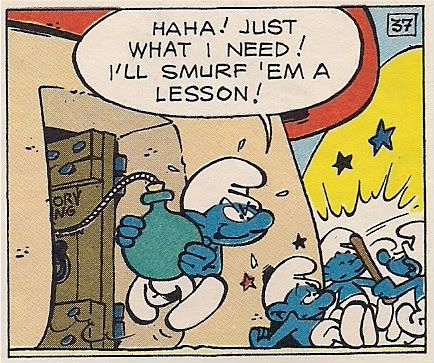
Our tale begins on a beautiful night in Smurf Village. Papa Smurf, who is totally not a Communist, is up late cooking up some alchemical thing for a no-doubt beneficial purpose.

But wait! Papa is fresh out of the suggestively-named herb "Euphorbium," which is crucial to the success of his project! We're never told what exactly Euphorbium does, or how it ran out, but my current theory connects it to the community service obligations that required Papa's appearance in Cartoon All-Stars to the Rescue. Anyway, it's obvious this little ritual to Glycon won't work without it.
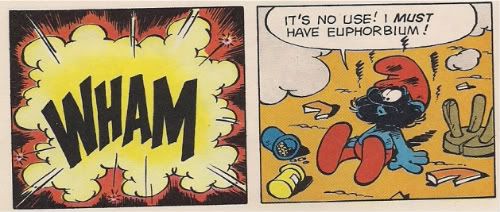
I do think the whole explosive materials in the lab deal is what's known as 'the pistol in act one,' just a heads up.

As such, Papa takes off the next morning to fetch some herb on "the other smurf of the mountains," where I presume the police helicopters cannot navigate. He asks his Smurfs to "be very smurf" while he's gone, at which point a Smurf smurfs in to suggest a round of smurf, but then Brainy Smurf smurfs in like a smurfwit and starts demanding everyone work on restoring a bridge and shit (smurf). The gang isn't terribly enthused about addressing Smurf Village's longstanding infrastructure problems.
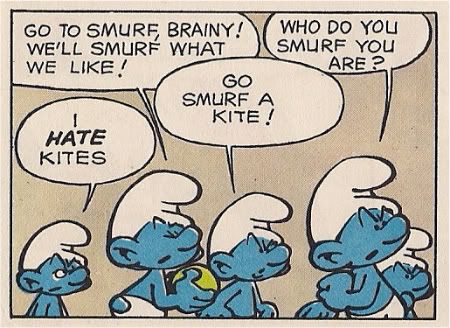
Oh right, "go to smurf," yeah! Did you think me and your elementary school classmates were the only ones to play the 'replace ass with smurf' game? No, I kind of expect that possibility occurred to Peyo approximately three seconds after he and fellow cartoonist André Franquin came up with the Smurf (Schtroumpf) language over dinner, and may indeed have made up the majority of the Schtroumpf-related interactions for the remainder of the week.

You do know the Smurf language, right? And how the different Smurfs have different characteristics, even though they look pretty much the same? Brainy Smurf is slightly more complicated, in that he's both a brain and a total dipshit who's usually wrong about things. He's actually a really good, funny character in this particular comic, a very specific-seeming caricature of (pseudo)intellectual elites as social conformists, trusting in the status quo to reward them for their blustering support while remaining totally clueless to anything outside of their frame of reference.

Naturally, Brainy expects to be hailed leader of the Smurfs, more or less because he figures it's his turn, just for being as brainy as him. This (again) doesn't go over well with the other Smurfs, who eventually opt for their first-ever display of "universal smurffrage." A few kinks in the plan quickly emerge.
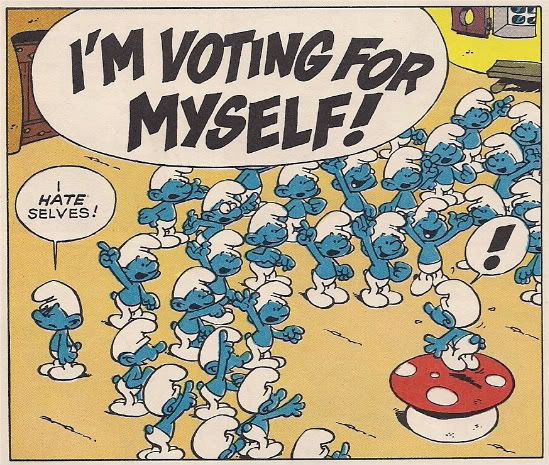
The philosophical profundity in the bottom left corner comes from Grouchy Smurf, who boasts one of the more iconographically questionable origins in comics history, having been a sunny Smurf who was bitten by a bug that turned his skin black and made him violent and sour; more and more Smurfs were bitten and made black, until Papa managed to expunge the blackness from Smurf society, although Grouchy was still grouchy afterwards. This all went down in 1963's The Black Smurfs (Les Schtroumpfs Noirs), not available in English.

Getting back to the story, a lone anonymous Smurf soon arrives at a startling revelation: if he promises people stuff, they'll vote for him! So, when Brainy Smurf finishes boring some other Smurf to tears via assertions of his Papa-approved greatness, Our Smurf zips in and promises to pass a law outlawing bores - success!

Soon Lazy Smurf is promised a Right-Not-to-Work Bill, Harmony Smurf is promised a position as first trumpet in the Big Smurf Band and Vanity Smurf is complimented on his immense physical beauty. Smurf Prime even makes sure to urge Dopey Smurf to vote for Brainy, trusting that he'll somehow screw it up. Speaking of Brainy, the niceties of the political process seem to have escaped him.
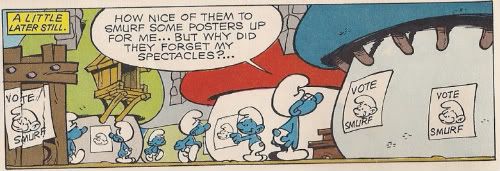
Before long, Smurf (and yes, it's always just VOTE FOR SMURF, since it could be anyone in his position, you see) is having parades in his honor, and delivering hot campaign speeches before inviting the lads out for drinks while Brainy babbles on and on about his status as virtual incumbent to an audience of Grouchy, who hates drinking.

Election day arrives. It's a real nest of vipers, chock-full of thrown-out ballots and rampant fraud; thank heavens there's no appeals in Smurf Village, or we'd still be awaiting the results.
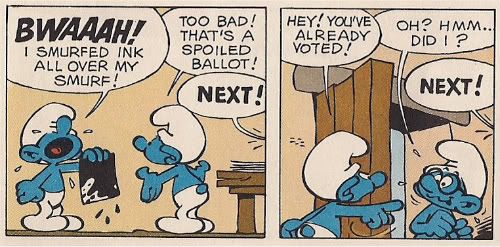
In the end, Smurf-Just-Smurf emerges winner of the farce, with Brainy receiving votes from only himself and Dopey Smurf, who is so phenomenally stupid that he managed to screw up fulfillment of Smurf's intent for him to screw up, paradoxically arriving at the correct result for possibly the first time ever. The total voting population of Smurf Village, by the way, is exactly 100, counting the absentee Papa. I only ask that you dedicate your next trivia night victory to me.

***

If you really want to understand the Smurfs-in-comics, though, just take a look at their feet. Fat, oval lumps, real dinner rolls.

Oh, I'm sure there's some longstanding precident for that look, and it's obviously been used in many places subsequent. But I always associate it with Belgian comics of that period, specifically the tight-knit "Marcinelle school" of Belgian cartooning, named for the town surrounding Dupuis, aesthetically headquartered in the Spirou anthology and bound by blood (and marketing) to always oppose Le Journal de Tintin, home of Hergé and the style that would become known as the ligne claire, the "clear line," after some Dutch guy cooked up a sufficiently catchy name in the '70s.

The Marcinelle school was different, focusing broadly on vigorously cartooned forms and the illusion of movement. Granted, there were several individual departures, including, ironically, the "school's" founder, Joseph "Jijé" Gillain, who eventually developed a distinct oscellation between a clear line-inspired cartoon approach and a polished 'realistic' style, a dichotomy later replicated by his noteworthy pupil, the Frenchman Jean "Moebius" Giraud. But the core identity of the style was nonetheless firm, perfected in the works of André Franquin, the great cartoonist who headed Spirou's flagship series, Spirou et Fantasio, in its mighty golden age.

However, almost nobody in the U.S. has heard of Spirou et/ou Fantasio, whereas everyone over the age of 15 has heard of the Smurfs, and so they are the sealed-in-amber conclusion of the Marcinelle school for many American eyes. And while Peyo was no Franquin, there's something about the uniform chubby roundness of the lil' blue devils that suggests a summary at work, a distillation of accrued cartooning tropes into factory-ready icons, every one perfect, and perfectly ready to adopt specific, isolated attributes: Brainy, Lazy, Grouchy, etc. After all, if you're not going to tend toward realism, as the Tintin school did, you might as well plunge into sheer iconography, the sure symbol of Smurf society.

But that's no secret; it's as plain as your eyes, regardless of your personal awareness as to Papa's seat in Belgian comics history.

No, the mystery is provided by Delporte, who lived until 2007 and wrote a ferocious amount of comics, not to mention his share of scripts for the Smurfs cartoon show. As stated above, though, the Saturday morning iteration tended to be sedate, in spite of the slapstick, while Delporte's Smurf scripts for comics took on an often satirical edge. They were children's comics, sure, but keenly aware of their place in a society owned and operated by adults.

Take, for example, 1973's Smurf Vs. Smurf; I haven't read it (since it's never been translated to English), but Wikipedia's summary suggests that it's a fairly pointed lampoon of the strife between the Dutch-speaking northern region of Belgium (Flanders) and the French-speaking South (Wallonia), as translated to an ongoing Smurf Village argument between the verb-dominant Smurfs (ex: I wanna smurf you like an animal) and their noun-dominant brothers (I wanna fuck you like a smurf). All-out war in the streets soon erupts, leaving Papa to restore peace via the conclusion of the hit comic book and motion picture Watchmen.

I'm serious; the story ends in almost exactly the same general manner as the Alan Moore/Dave Gibbons classic, with Papa fabricating a threat by villain and gourmand Gargamel so as to pretty much scare the warring Smurfs into a state of peace. I sure hope Wikipedia isn't pulling my leg, since there's even apparently an ambiguous ending suggesting that the harmony may be short-lived! No word on whether Grouchy Smurf narrates from a journal kept of the story's events, or if any right-wing publications discover it in the end.

***

But oh, dear readers, trouble soon arrives in the fair Smurf municipality. The freshly-elected Smurfy Smurf hustles into his room to change into a little something he'd obviously been working on for a while: a brand-new footy pants 'n cap combo, forged from pure gold. Or, colored in that manner, unsuccessfully.
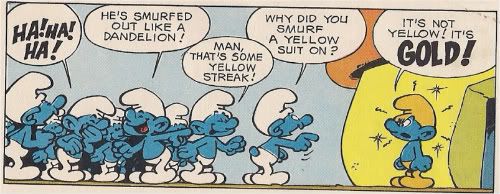
Undeterred, Our Man declares that all shall henceforth refer to him as King Smurf, resulting in highly respectful peals of laughter. No matter: when Harmony Smurf pops into the His Majesty's office to collect on his Big Smurf Band promise, King Smurf gives him a really fancy title (First Chief Head Spokesman), outfits him with a drum, and sends him out to announce that all Smurfs will respect and obey, or face terrible consequences.

This prompts Hefty Smurf (who is strong) to bust into the King's room to kick his ass. But King Smurf knows what desires lurk in a powerful Smurf's heart.
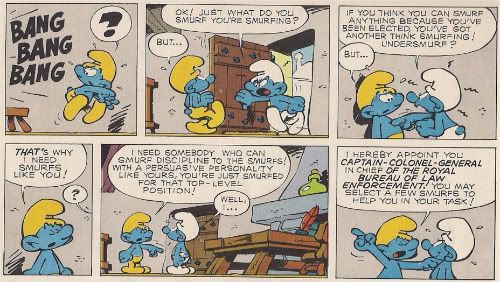
In mere minutes, Hefty has lined up an honor guard of fellow Smurfs, armed with deadly blades. Brainy can't believe he wasn't picked. Tiring of his shabby digs, King Smurf decides to put the rest of the village to work building him a rightly awesome palace. Sensing another authority figure whom he can leap behind, Brainy takes up his tools while the guards round up the rest of the Smurfs. The reign of terror has begun.
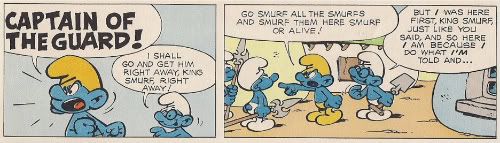
Yes, forced labor is the new rule of the day! Smurfs now live as slaves, worked to the bone under threat of death! The rule of law is useless too, and inequality reigns supreme; poor Jokey Smurf gets hauled before His Eminence for pulling off one of his knee-slapping 'exploding gift' tricks on a guard, and comes face to hideously singed face with the new double standard.
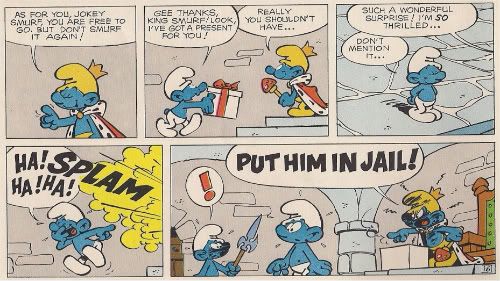
Sending a man to jail for innocently detonating a bomb in someone's face in the name of fun is step #5 or #6 down the road to totalitarianism, as I've personally mentioned to several magisterial district judges, so you can imagine the uproar in the Smurf community following Jokey's arrest and detention. But a march on the palace only leads the Smurfs to be held back at speartip, and the crowd is soon dispersed. Is there no hope left in this town?

Under the cover of night, a shadow falls across a mushroom house. A cloaked figure evades the evening patrol. He knocks on a door, whispers a password, and enters. Then descends. There's friends waiting, under the earth.
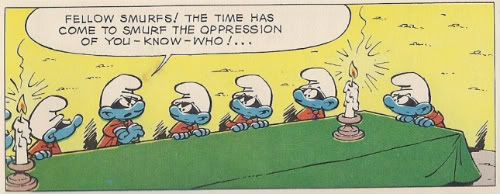
La résistance! De weerstand! A regular White(-Hatted) Brigade! Smurfs should not fear their government - the government should fear its Smurfs!!

No time at all is wasted. The Secret Smurf Society drugs a guard, busts into the prison and runs like hell to the woods beyond the village. Brainy Smurf, no doubt anticipating a change in the winds, happens to be with them, and also manages to be the only one caught. For the remainder of the comic, he'll occasionally get a one-panel cut to his prison cell, in which he'll ponder when his friends will be around to break him out and hail him as a hero. Nobody will ever come.

That's probably the most powerful lesson a young person can take from the Smurfs: don't be an asshole.

***

The politics of King Smurf in particular -- or at least its deep-seated distrust of political mechanisms -- likewise had some probable correlation with the adult life of Belgium surrounding its creation.

After all, both Peyo and Delporte were born in 1928, positioning their individual comings-of-age directly against the German occupation of Belgium during World War II, in which many citizens were shipped away for use as forced labor in the Nazi machine. It's extraordinarily easy to see those rebel Smurfs' covert activities as reminiscent of the many factions of the Belgian resistance, often squirreled away in the woods, spiriting away downed pilots and evading capture to subvert another day.

However, this reading seems insufficient, since neither Belgians nor Smurfs elected Adolph Hitler, who was not specifically a king. No, Belgian had a king of its own, Leopold III, a controversial man in those days of struggle. It had been less than three weeks since the German invasion of May, 1940, when the King of the Belgians announced the nation's surrender, without the approval of the legislature. Compounding the difficulty, Leopold III chose to remain in Belgium under the occupation, while the civil government eventually repositioned itself in London, outside the village of mushrooms, although unsuccessful overtures were made to construct full occupational governance in Belgium.

This resulted in a duly anarchic state of affairs, with the Belgian monarch and legislature-in-exile declining to entirely recognize one another's authority, neither body cooperating with the Nazis and their military government, and various aspects of the resistance -- necessarily separated by language, remember -- sometimes operating to their own ends.

Interestingly, though, from this chaos grew the might of the Marcinelle school, the home of the Smurfs. Imported comics became inaccessible, leaving gaps to be filled; Jijé drew a considerable amount of Spirou's content in those days, including a few off-label episodes of the American comics the magazine was running at the time, like Superman. By the time the war ended, Jijé had the authority to appoint younger artists like Franquin to fill slots, thus seeding the future of Spirou in the trodden dirt of war. Peyo followed several years later, having met Franquin & company as a teenage animator during the occupation.

Still, formative an artistic age as it was, it couldn't have been the best time for instilling pride in civic coordination in a pair of young men, to say nothing of respect for His Majesty, who was deported by the German military government in 1944, and, following the end of the war, settled in Switzerland while the returned Belgian government set about determining whether he was a literal traitor (A: no). His eventual return to the domain in 1950 was marked with violence and civil disoedience, particularly in the Wallonia region, and he abdicated the throne in 1951.

Yet while it's probably not a stretch to position Peyo's & Delporte's vision of governance-as-free-for-all as purely a product of the domestic upheaval which, in its way, brought them to the place they were, there were separate breakdowns going on as the comic itself was drawn, farther away, but still close.

***

King Smurf is on edge after the jailbreak, and his enforcers are attentive to even the slightest departure from the usual. Still, Smurfs sometimes manage to slip away from the village, trusting that their faith won't get them killed by their exiled brothers out in the trees.
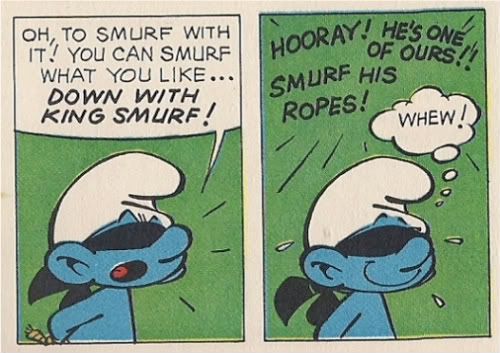
Serious shit those Smurfs are into. Covert activities have been sowing the seeds of discord in the village too:
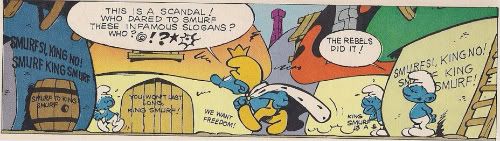
Yes, they're threatening to kill him. Or, I dunno, maybe "Smurf to King Smurf" means "Voter Recall to King Smurf"; I don't even know how you read those things. Is it subtle shifts in the handwriting? A perfect in the 'S' the difference between libel and reverence? Oh the debates I have with my anime hug pillows!

Regardless, King Smurf clearly gets the message, and opts to put a crack forestry investigatory together the only way he knows how: by appealing to everyone's basest instincts.
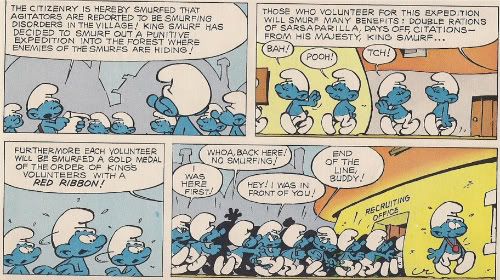
I really do truly love that this comic is aimed squarely at kids. There's no respect for anything at all in here. Not military service, not heads of state, not the fundamentals of democracy... it's great! It's awesome, noisy slapstick paired up with bizarre fits of witty sophistication, all in a crispy pretzel cone of rampant anti-authoritarianism. How could the cartoon get so fucking saccharine? Smurfs have teeth! Shit out in the woods? It bites you.

So, King Smurf leads his decorated fellows out into the forest to smoke out the rebels. What results can best be described as a rib-tickling military quagmire (aren't they all?), with people falling into holes, getting soaked with water and opening strange gifts in the middle of nowhere to unhappy conclusions.
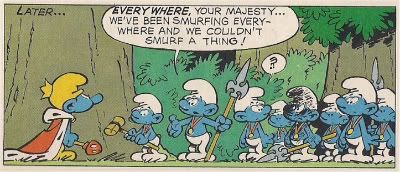
The campaign is a disaster. King Smurf and his men turn tail and retreat as the rebels laugh and jeer. Defections are evident. Still defiant, King Smurf declares that all Smurfs shall now join the military or face jail. A wall is erected around the Smurf Village. Nobody gets in or out.

A message from the other side is delivered.
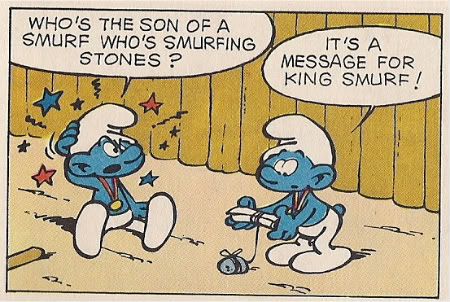
Abdicate, Your Highness, or draw your sword. The King of the Smurfs opts for the latter.

It's time to get down to some serious killing.

***

Belgium's colonialist disposition was in for a shift as World War II ended. For our purposes, some symbolism can be dragged from the work of Hergé, whose Tintin in the Congo contained several unconcerned references to the colony's status as such in its 1931 initial printing, which were removed by the artist in an extensive 1946 revision.

Outside of comics, pressure for Congolise self-government was building as the '50s moved forward; riots erupted in 1959 upon Belgian prohibition of a meeting by the increasingly formidable ethnic association ABAKO, resulting in some allowance for Congolise participation in governance, and the subsequent formation of dozens of political parties.

Events passed with tremendous speed. Plans to transition the colony into independence compressed, and free elections were held in May of 1960. The Mouvement National Congolais-Lumumba performed well, and the formal handover of power occurred on June 30, 1960. However, not a week later, a mutiny broke out against remaining foreign military officers, leading to the entrance of the Belgian army and, by August, the secession of two areas -- the mining-rich province of Katanga, still close to Belgian industry, and the region of South Kasai -- and the intervention of the United Nations. This situation (and I'm wildly simplifying here) also led to prime minister Patrice Lumumba requesting aid from the Soviet Union to press into Kasai, after which strife exploded in the parliment and army chief of staff Joseph Mobutu, with support from the American CIA, ultimately took power in a military coup.

The struggle continued through the 1960s. In 1964, the year King Smurf began serialization, violent rebellions broke out, which again saw involvement by Belgium and the U.S. In 1965, the year the comic was published in a collected edition, Mobutu (who had previously suspended the parliment) launched a second coup and prohibited all political organizations save for his. This was the backdrop for the story's creation and release, in addition to the bloody division of Ruanda-Urundi into Rwanda & Burundi. The motif of elections leading to conflict seems perhaps informed by such current events.

Naturally, the comic's satire isn't directly on point. I speculate. And frankly, a noxious reading is possible from that perspective, a clucking of the tongue at those silly Smurfs thinking they can run things without the undemocratic wisdom of Papa around - my god, can names get any more paternalistic than "Papa"?

Yet maybe I'm wrong to look to the Smurf's feet for their secrets. Maybe the answer to everything is on top of their heads.

Those wilted cone things aren't their skulls, you know; they're Phrygian caps, and I'm not talking gallbladders. I mean headgear of antiquity, used in ancient Greek art as a symbol of foreignness, and in Roman culture as an accoutriment of freedom, worn by freedmen. Sometimes there was a martian connotation; if you should even encounter a Smurf running at you quoting Horace in Latin at the top of his lungs, the meaning will be clear. The caps were later adopted by the American and French Revolutions for their long-built association with liberty. The red cap was preferred, but putting Papa and his Smurfs together gives you something cumulative: the colors of both lands, red, white and blue.

And if indeed the Smurfs, as icons, as drawings, as mentioned above, are a distillation of accrued cartooning tropes, perfectly molded identities upon which endless human characteristics can be imprinted, the widest exposure of the Marcinelle school, grown from the dirt of World War II and wearing liberty caps and fighting in the midst of a democratic collapse in a time of post-colonialist democratic collapse, then - isn't their uniformity especially and awfully human? Isn't there a metaphor at work in these blue gnomes born it seems with freedom atop their brows?

Doesn't everyone want to be actualized? To be in control of themselves? And don't we still fall into groups, communities of desire or necessity, to our benefit and peril?

That's the real conflict of Smurf village, illustrated in King Smurf. To long to stand for yourself, but for individuality to be your downfall, and to become a collective, all again for freedom; resistance, rebellion, subjugation. Liberty atop the brow, all Smurf underneath, just lose Brainy's glasses and shave Papa's beard.

Er, and there's Smurfette, I guess, but she's not in this comic, and that's another story.

***

Thus:
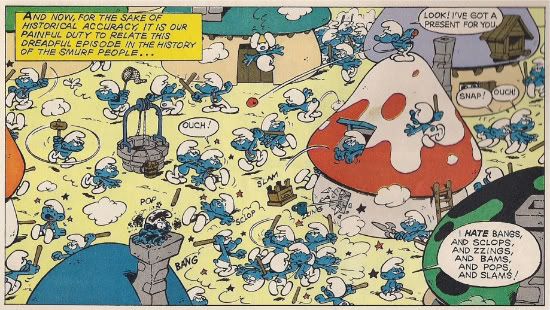
What more needs to be said?

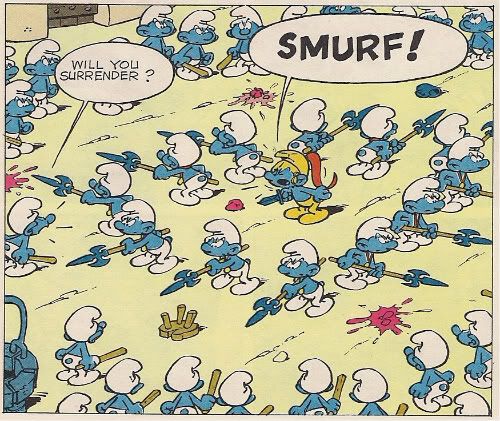
Do note, though, that while the Smurfs hold clubs and rocks and spears and things, and sometimes bite one another's asses, most of the actual warfare goes on via the not-very-deadly tomato, which Peyo nonetheless uses for maximum graphic detail, red on white. It's an impressive balancing act, maintaining an appropriateness for children while getting the point across without a lot of obfusication. I mean:
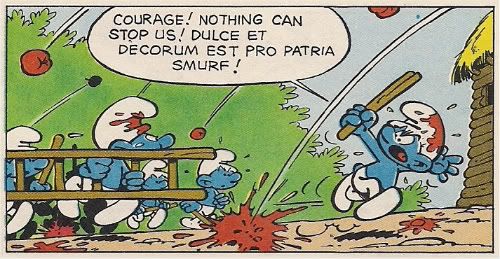
As the battle rages, some hot-blooded patriot gets the bright idea to raid Papa's lab, which we've long ago established contains a lot of explosive materials, no doubt stockpiled for the revolution Papa won't be heading, in that he is not a Communist. The bomb is lit, and chucked into the palace, and in a glorious flash of victory the walls of the oppressor come falling, mostly around Brainy Smurf, who was still locked inside. Ah, he's a big guy, he can take it.

Before long, the war's conclusion is certain. The final press is made. No quarter given. We're gonna see what color a Smurf bleeds. This had to happen. This is how you water a society.
And then, Papa walks in, before anyone's head seriously loses track of its shoulders. He's unhappy to an extent that even a green sack full of Euphorbium cannot counteract, not that he'd ever try that stuff.
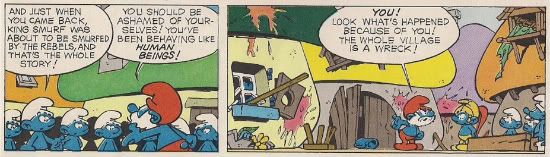
I like the pike driven through the red-stained home on the left; they should have ended more episodes of the Get Along Gang with images like that.

Yep, with Papa back in town, order is soon restored. King Smurf volunteers to clean up the village all by himself, but soon every Smurf is jumping in to help. Everyone is happy, and democracy is rightfully relegated to the scrap heap of bad ideas. I mean, nobody comes out and says that, no, but it's not left unclear that Smurf Village probably won't be seeing another election day for a quite a while; what's the need, with Papa back? I mean it: the comic concludes with the heroes rejecting democracy and it's a happy ending.

All right, ok, but what are the Smurfs? Politically? Like, isn't this a weaselly ending, the whole book talking all sorts of shit about the perils of authority and then spinning around and having the Smurfs just agree with whatever Chairman Papa says?

Jesus, 'Papa' does have that paternalist bite.

Which makes sense, because, on the surface, not as icons, not symbols or allegories, without thinking about it too hard - the Smurfs are children, in the way their audience is children. And surely children need to listen to their parents when it's time to go to bed.

But that's the only authority this comic nods toward as valid. The parent, calling an end to playtime, and scolding the kiddies for acting like "human beings," which we might as well call adults, specifically the adults a child witnesses beyond their parents' adoration. Don't grow up to be like them. Don't make their mistakes.

Someday they'll be old enough to know their parents hold some responsibility. Until then, you know what they can do with the shit stupid robes of those awful motherfuckers?
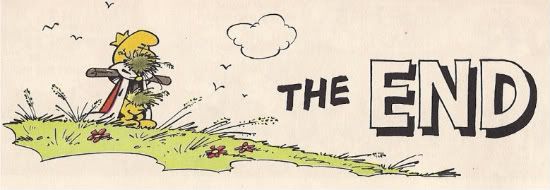
Sadly, this wouldn't be the final conflict to bedevil the good Smurf Village.

***

In 2005, a certain commercial for UNICEF aired on European television.

Produced with the agreement of the family of Peyo, who died in 1992, the short piece depicted happy, dancing Smurfs and their delightful music annihilated by aerial bombing, their shouts of terror giving way the the squeals of Baby Smurf, a future bomb-thrower, an anticipatory gunman aimed, in potential, toward the next village, the next nation, sitting in the center of a heap of blue corpses, their faces blackened in that Marcinelle manner.

Witnessing this terrible scene, it is not difficult to imagine the tiny Smurfling growing to find a mask and wear it, and hide among the trees. This time it won't be tomatoes, and there's no Papa left to stop it.

The ad campaign was initiated to raise money for the rehabilitation of child soldiers in Burundi and the Democratic Republic of the Congo, the former colonies of Belgium.

And history's great burden is that it never does end.

***

Nothing ever seems to end.

February 2009 sales

ICv2 has the latest sales figures up; and they're reporting that GN sales are down by 9%.

Well, OK, but I'm reasonably certain that isn't a function of actual sales in the DM. Actually, it is almost certain that's really a function of Diamond moving their Memphis warehouse in February.

Starting February 4th, Diamond stopped ALL reorders so they could do the move. This was supposed to last for something like 10 days. But, even the "top sellers" didn't start flowing again until the end of the month. As of today, 3/17, they STILL haven't completed the move 100%. According to today's Diamond Daily (Gated, sorry) they've managed to move 17,800 of 20k SKUs -- there's still more than 2000 SKUs they haven't yet reactivated. *sigh*

February was the best of bad choices to move the warehouse -- Feb is usually a "dead" month, by and large -- but we had an unusual number of VERY strong books this February, including, yeah, WATCHMEN as well as things like BATMAN RIP and the 5th SCOTT PILGRIM book.

You wonder why your LCS didn't have SCOTT PILGRIM for most of February? It sure wasn't their fault (well, at least for the stores that know how to order) -- Diamond didn't fill a SINGLE reorder for it for 3-ish weeks!

ICv2 didn't bother to note this, but I'd sure hope that in the official record books Feb '09 gets an asterisk next to it because of the warehouse move (Are you listening John Mayo and John Jackson Miller?) -- given that reorders were effectively nil for 3-ish weeks in February, I think that ONLY a 9% drop should be looked at as a HUGE gain for the month; given the lack of reorders anything less than double digits is probably a positive.

(At Comix Experience, we had our best February in nineteen of them, despite being reorder-less)

There's probably going to be a certain amount of yelling this week in Memphis...

-B

Arriving 3/18/2009

I'm hectic with the ComicsPRO Memphis meeting this week, so here's the list of what we're supposed to arrive...

2000 AD #1622
2000 AD #1623
2000 AD #1624
AGE OF BRONZE #28
AIR #7
AMAZING SPIDER-GIRL #30
AMAZING SPIDER-MAN #588
AMAZING SPIDER-MAN EXTRA #3
ANGEL #19
AZRAEL DEATHS DARK KNIGHT #1 (OF 3)
BAD DOG #2 (NOTE PRICE)
BETTY & VERONICA DOUBLE DIGEST #169 (NOTE PRICE)
BETTY & VERONICA SPECTACULAR #88
BLACK LIGHTNING YEAR ONE #6 (OF 6)
BOMB QUEEN V #6 (OF 6)
CHURCH OF HELL #1
DARK AVENGERS #3 DKR
DEAD #3 KINGDOM OF FLIES
DEADPOOL GAMES OF DEATH
END LEAGUE #7
ENDERS GAME BATTLE SCHOOL #4 (OF 5)
ETERNALS #9
EUREKA #3 (OF 4)
FALL OF CTHULHU APOCALYPSE #4 (OF 4)
FRANK FRAZETTAS FREEDOM FRAZETTA CVR A
GHOST WHISPERER THE MUSE #4
GREATEST AMERICAN HERO #2 (OF 3)
GROOM LAKE #1
HELLBLAZER #253
HOTWIRE #2 (OF 5) PUGH CVR A
INVINCIBLE #60
JUGHEAD #194 (NOTE PRICE)
KULL #5 (OF 6)
LILLIM #1 (OF 5)
MARVEL ADVENTURES AVENGERS #34
MAURA #1
MOON KNIGHT #28
MYSTERIUS THE UNFATHOMABLE #3 (OF 6)
NINJA HIGH SCHOOL #168
OUTSIDERS #16
POTTERS FIELD STONE COLD ONE-SHOT
PUNISHER #3 DKR
RAWBONE #1
RED SONJA #42
SCOURGE OF GODS #3 (OF 3)
SIMPSONS COMICS #152
SPIDER-MAN NOIR #4 (OF 4)
STAR TREK COUNTDOWN #3
STAR TREK CREW #1
STAR WARS KNIGHTS O/T OLD REPUBLIC #39 DUELING AMBITIONS PAR
STORMWATCH PHD #20
SUPER FRIENDS #13
SUPERGIRL #39
TINY TITANS #14
TRINITY #42
TRUE TALES O/T ROLLER DERBY DOPPELGANGER A/T HANGER
ULTIMATE X-MEN #100
ULTIMATUM #3 (OF 5)
UNCANNY X-MEN #507
VIGILANTE #4
VINCENT PRICE PRESENTS #5
WATCHMENSCH
WITCHBLADE #125 BACHALO DANI CVR A
WOLVERINE #71
WOLVERINE ORIGINS #34 DKR
WORLD OF WARCRAFT #17
X-FACTOR #41
X-FILES #5 (OF 6)
X-FORCE #13
X-MEN LEGACY #222
YOUNG X-MEN #12
ZOMBIES THAT ATE THE WORLD #2
ZORRO #11

Books / Mags / Stuff
1001 ARABIAN NIGHTS ADVENTURES OF SINBAD TP VOL 01
ADVENTURES OF BLANCHE HC
AIR TP VOL 01 LETTERS FROM LOST COUNTRIES
ALAN MOORE LIGHT OF THY COUNTENANCE GN
AMERICAN FLAGG DEFINITIVE COLL TP VOL 02 (RES)
BATMAN CHRONICLES TP VOL 07
BATMAN HAUNTED GOTHAM TP
CINEFEX #117 APR 2009
COMPLETE JUST A PILGRIM HC
COURTNEY CRUMRIN TP VOL 04 MONSTROUS HOLIDAY
DRINKY CROWS MAAKIES TREASURY HC
FALLEN ANGEL OMNIBUS TP VOL 01
GEEK MONTHLY APR 2009
GOLDEN AGE SHEENA QUEEN O/T JUNGLE TP 02
HACK SLASH TP VOL 05
ILLUSTRATION MAGAZINE #2 2ND PTG
ILLUSTRATION MAGAZINE #25
JUDGE DREDD COMPLETE CASE FILES TP VOL 12
JUNGLE BOOK HC
LARGO WINCH TP VOL 03 DUTCH CONNECTION
LITTLE NOTHINGS GN VOL 02 PRISONER SYNDROME
LOST CONSTELLATIONS THE ART OF TARA MCPHERSON
LUCKY LUKE TP VOL 15 DALTONS IN THE BLIZZARD
MIGHTY AVENGERS TP VOL 03 SECRET INVASION BOOK 01
MY MOMMY IS IN AMERICA & SHE MET BUFFALO BILL HC
NECRONOMICON TP
NEW MUTANTS CLASSIC TP VOL 04
NIKOLAI DANTE BEAST OF RUDINSHTEIN TP
PLATINUM GRIT TP VOL 01
PLUTO URASAWA X TEZUKA GN VOL 02
POWERS TP VOL 12 COOLEST DEAD SUPERHEROES
PUNISHER WAR JOURNAL TP VOL 04
RED STAR SWORD OF LIES TP VOL 01
RONINBEBOP SC
SOLEIL SAMURAI HC VOL 01 LEGEND
SQUADRON SUPREME TP PRE WAR YEARS
SQUADRON SUPREME TP VOL 01 POWER TO THE PEOPLE
TOR A PREHISTORIC ODYSSEY HC
X-MEN FIRST CLASS TP WONDER YEARS

What looks good to YOU?

-B

Favorites: The Last Lonely Saturday

The Last Lonely Saturday Jordan Crane, writer/artist Red Ink, 2000 Currently available from Fantagraphics 80 pages, softcover or hardcover $8

I find it both impossible and undesirable to separate The Last Lonely Saturday from the pivotal role it played in my life as a comics reader, and thus in my life in general. During the year 2001 I took a job as an editor at the A&F Quarterly, Abercrombie & Fitch's big giant magazine/catalog/softcore porn hybrid publication. My boss there, Savas Abadsidis, was and is a big fanboy, and a chance encounter with a Wizard magazine on his desk, which contained an article teasing an upcoming revamp of the X-Men by Grant Morrison (whom I remembered favorably from my days as a comics reader in high school for Arkham Asylum) and Frank Quitely, led me into Jim Hanley's Universe on 33rd Street to track down the series. This was the first time I'd entered a comic shop to purchase anything that wasn't either an isolated Acme Novelty Library, Savage Dragon, or Frank Miller comic in years--the birth of my modern comics readership. (The rest of the story after the jump...)

Intrigued by the offerings on hand, and empowered by a complete lack of editorial oversight that enabled us to write about anything we wanted in the Quarterly--not to mention Abercrombie's expense account--I made a solemn vow to buy something completely unfamiliar to me every week. Jordan Crane's The Last Lonely Saturday was one of my first such purchases. From there it was a short journey to Crane's anthology NON, his distributor Highwater Books, the Fort Thunder aesthetic in general, and thence all of alternative comics.

None of that was likely to happen if I didn't just love The Last Lonely Saturday to pieces. And that itself might seem unlikely. It's a slight book--many of its 80 pages are endpapers, and the rest contain all of two panels apiece. Dialogue is minimal; the majority of it of it comes from a little boy's triplet proclamations: "It's a man," "Look man run," "Ha ha! Windy!" It has a simple red, white, and orange color scheme. Although a ghost is involved and a character dies, we're pretty far from the violent morality plays that make up much of Crane's recent work.

What The Last Lonely Saturday is is a love story, a romantic fable. To some eyes, it might be a creepy one at that. In the tradition of the Police's "Every Breath You Take," albeit in something of a gender reversal from that song, Saturday could be looked at as a depiction of the role fixation and selfishness, even emotional violence, frequently play in love. But just as the sweeping, insistent, intimate, evocative sound of "Every Breath You Take" make it one of the great love songs regardless of the obsessive lyrics, so too the particulars of The Last Lonely Saturday make it pretty much the best love story in comics form I've ever come across. Crane's character designs are at their most adorable here. His jolly little potato-shaped protagonist, with his rumpled suit and charmingly crinkled brow, looks like the grandpa of our collective unconscious made real. His beloved Elenore's jaunty hairdo, long eyelashes, and high-wattage smile evoke beauty and charm that transcends her cartoony form, while her two lines of flashback dialogue upon receiving flowers from her beau ("Oh sweet heart! They're just lovely!") nail me to the floor with sweetness every time. Everything seems airy--leaves and papers float and twirl in the breeze, the little old man's car jauntily jumps along the road, puffy white clouds are a constant presence in the background--until, at the story's moment of truth, Crane weighs down his line and crumples his art toward the center of the panel. I'm a huge, huge sucker for emotionally devastated old men, so imagine my utter joy when our hero is granted a reunion with his dear Elenore! (Think the video for Blur's "Coffee & TV" and you've pretty much got it.) At that point, it doesn't matter to me how it happened--that it did happen is what's important, and that Elenore understands that is what makes this a great love story, in that it appreciates that what can seem unpleasant to outsiders is, within that world of two, an act of grace. It's an intelligent, moving, beautiful, terrific little comic.

Okay, so you're a rocket scientist: Diana on 3/12

Mr. Kyle Baker, you got some 'splainin' to do. I hate to start reviews with that God-awful cliche "I liked his old stuff better!" but for context's sake, WHY I HATE SATURN still makes me laugh. I say that because I think I picked up and read SPECIAL FORCES expecting the same kind of manic energy you'll find with Anne Merkel and her crazy sister, or with Larry running amok in the streets of New York in I DIE AT MIDNIGHT.

SPECIAL FORCES #4... did not make me laugh.

It may be that I'm just sick of politics-via-comics in general: in a medium where subtlety is the exception rather than the rule, I can't think of many instances where political/military criticism didn't come off as awkward and simplistic, where valid points are submerged under a wave of bile that aspires to be clever and falls far short of the mark (pick a Millar comic, any Millar comic).

Or it may be that SPECIAL FORCES seems to be making contradictory points: on the one hand, Felony and Zone represent an implicit accusation that the United States Army recruited people for the Iraq war who had no business on the battlefield. Baker helpfully attaches news articles describing the recruitment and eventual dismissal of an autistic teenager to demonstrate that there's a bit of truth in this fiction.

On the other hand, these "unfit soldiers" turn out to be as capable (if not moreso) of getting the job done. Doesn't that suggest that the Army was right to enlist them in the first place? If an autistic kid succeeds where entire squadrons of trained soldiers fail (in pretty embarrassing ways), that sends a very different message and doesn't quite match the critical tone Baker's aiming for.

But there's something more essential that's missing here. The situation in Iraq is no laughing matter, and yet I can't help wishing that SPECIAL FORCES had exhibited more of Baker's snark and wit - as it stands, it's pretty much just an EH story that tries to send a message far too aggressively to be successful.

X-MEN: NOIR #4 also came out this week, wrapping up Marvel's first foray into what seems to be a rising Noirverse (although I'm still curious as to how DAREDEVIL: NOIR will distinguish itself from Ed Brubaker's DAREDEVIL: POORLY-LIT URBAN CRIMEFIGHTING WITH FEMME FATALES, CORRUPT COPS AND CRIME SYNDICATES).

This sort of thing can be very tricky to pull off: the last time Marvel tried to import its universe to a different historical period/genre, we got 1602 and its spin-offs, most of which was spent playing Spot The Analogue.

Fortunately, Fred Van Lente avoids this trap by putting together a rather clever string of adaptations: I liked the idea of mutants being swapped out for sociopaths, with the Xavier/Magneto ideological schism taking on a decidedly more realistic dimension. I loved Van Lente's take on Anne-Marie (Rogue) and the resolution to her storyline. The Bolivar Trask/Sentinels prose story ends up with a different moral than you might be expecting.

In fact, the only problem I had with this miniseries is that the X-Men aren't the protagonists: the story's focalized through and narrated by a completely different character (who may or may not be an analogue for a mainstream Marvel figure, it's rather difficult to tell), and that leads us to a confusing last-minute twist ending that didn't really work for me. It's still VERY GOOD, though, and one of the few examples of a cross-genre experiment that successfully adapts superhero characters into other molds and conventions.

Kramers Ergot 7

A lot of comics were the subject of controversy in 2008: Ice Haven, Memin Pinguin (remember that?), that one comic where the dog ate the teenagers. Surprisingly, alt comix anthology Kramers Ergot 7 was arguably the most controversial comic of them all. The issue was not the content (though much of it would scandalize those who were offended by Ice Haven), but the price of the book. Some of the controversy came from those who supported (or who were at least familiar with) the anthology series and its contributors, but who regretted the high ($125) price point. Others came from people who had apparently never heard of the series, or who had little interest in the sorts of comics which had been featured in previous volumes of Kramers Ergot.

By the time Kramers Ergot 7 actually came out, however, the furor had mostly subsided. It's almost too bad that the controversy didn't happen closer to the book's release, because the actual content of KE7 hasn't actually received nearly as much attention as its price point. And since the only thing which could justify the high price is good content, it seems like a relevant issue. Kramers Ergot 7 was the most anticipated comic of the year for many people, including myself. How did reality stack up to expectation? The answer, along with my best attempt at providing some art samples (this thing's way too big for my scanner, and our digital camera/the person operating it aren't ideal), comes after the break.

Usually anthologies are all over the place in terms of quality and content, but that's surprisingly untrue for Kramers Ergot 7. This volume boasts an incredible roster of cartoonists, including several best-of-their-generation types, folks who your more literate friends and acquaintances might have actually heard of. Thousands of New York Times readers are familiar with Seth, Chris Ware, Jaime Hernandez, and Dan Clowes from their contributions to the Sunday "Funny Pages" section. And while Adrian Tomine hasn't had anything appear in the NYT (yet), he fits in with this group pretty well (surely you remember this picture from, you guessed it, the New York Times). These cartoonists' contributions to KE7 are, for the most part, the sort of thing that would appeal to the audiences they've built over the last decade or so. Ware's story is actually a continuation of his NYT work, while Seth has another contemplation of the Canada of yesterday (though it's not nearly as bittersweet--or as good--as George Sprott). Tomine's story fits pretty neatly within the niche he's carved out as well.

I found Hernandez' and Clowes' contributions the more interesting from this group. Hernandez' story is one of the denser single-pagers in the book (and there are a lot of dense single-page stories in KE7), a frantic, entertaining study of memory and sentimentality. Clowes' story, "Sawdust," is excellent, effectively a counterpoint to his equally good NYT story, Mister Wonderful. There's a real similarity between the protagonists--age, stream-of-conscious narration, desire for romance--but this is a much darker, even noirish work. I don't think Clowes has written many lines funnier than "Lucky for me, he couldn't dig a grave for shit!"

KE7 Clowes

Daniel Clowes

But the most famous cartoonist featured in KE7 is unquestionably Matt Groening. I was as surprised as anyone to see him announced as a contributor, but his single page strip is one of the best in the book. Groening produces an homage to this illustration, but with a focus on Southern Californian despair which should be eminently familiar to anyone who's read Life in Hell over the past few decades. "River of Unsold Screenplays" replaces "Failure," "Grad School/No Escape" replaces "Charlatanism," and so forth. It's no bleaker than "Love is Hell" or "School is Hell," but the context is so much different now than in the 1980s. These days, Groening effectively represents the best case scenario for the modern alternative cartoonist. If anyone knows anything about the "Road to Success," it's Matt Groening, so it's rather dispiriting to see a long slide labeled "Disappointing sales of second album, novel, play or film." And you have to kind of wince at a series of spider webs spun by "Psycho Exes," or a cliff labeled "ungrateful children." (Simpsons fans might make note of a balloon labeled "Crackpot cult religion, you know the one.") It's a great encapsulation of Groening's Life In Hell, and one of the best cartoons of his career.

And that about does it for the very famous people, though there are plenty of other contributors who are well-known within comics circles. Ivan Brunetti plays with the book's mammoth size by forcing the reader to turn it upside down to finish his story--the joke's on us, since this thing weighs about as much as a St. Bernard. Kevin Huizenga does something similar with his page. Kim Deitch basically distills his story from Pictorama into three pages, but it's worth the repetition to see all his incredible bottle cap designs--or are they replicas? I have to admit some ignorance of the bottlecap collecting hobby here, but they're really nice, charming drawings either way. Ben Katchor contributors two stories about architecture in his imagined New York; if that sounds good, you won't be disappointed when you read them. Richard Sala's single page is mostly a showcase for his gorgeous art and character design (we're talking monsters and villains in vibrant watercolor here).

KE7 Sala a

Richard Sala

The lesser-known contributors bring just as much--probably more--to the table, plus they provide the book with some degree of aesthetic and thematic coherence. When you flip through Kramers Ergot 7 for the first time, you're not struck by the star-studded lineup so much as the barrage of colors from story to story. Given the dimensions of the book, it's practically an assault on the eyes. Many of the contributors work in limited palettes, making KE7 a staggering visual experience. Stories by Sala, Dan Zettwotch, Frank Santoro, Blex Bolex, Anna Sommer, and Helge Reumann are especially noteworthy; the blue and red motif is particularly popular (and effective). Deitch's soothing pastels and Ben Jones and PShaw's multi-tiered, multi-hued contributions also stand out.

KE7 Bolex a

Blex Bolex

Once you actually start reading Kramers Ergot 7, you might also notice how many of the contributors have produced work dealing with the fantastic. Perhaps inspired by the towering dimensions of the book, a good many of these cartoonists turn to religion and mythology in particular. Several reviews have cited Tom Gauld's four page retelling of Noah's Ark as a highlight of KE7, and justifiably so. I've long admired Gauld's work, and it's never looked better than it does here. Gauld takes advantage of the book's size as well as anyone, using large panels to underscore the surprise of Noah's sons in finding their father wasn't just a senile old weirdo. The dense linework is stunning, reminiscent of Edward Gorey in the larger panels.

KE7 Gauld

Tom Gauld

Other contributors' stories explore religion in a more general sense. The first of Conrad Botes' two stories is sort of like a pantheistic Book of Job, only without any reward at the end for the protagonist. There are a lot of horrific images inKE7, but Botes' depiction of a series of divine punishments is particularly unnerving. John Brodowski's single page story is one of the best examples of dark humor in the book, dealing with the ill-fated resurrection of an arctic traveler. Joe Daly's cold, precise drawings depict a disturbing creation myth, with bizarre creatures with enormous phalli emerging from the ocean and raping the land-dwellers, who immediately gives birth to a swarm of offspring. Anders Nilsen, Shary Boyle, and David Heatley contribute stories of a similar ilk.

KE7 Botes

Conrad Botes

There's also a great deal of surreal fantasy in Kramers Ergot 7. CF delivers a two-page strip which will appeal to those who enjoy his Powr Mastrs series. Will Sweeny works in roughly the same territory, imbuing his tale of monster invasion with very cool character design and beautiful, gossamer linework. Matthew Thurber chronicles Brian Eno's work producing an album of songs written by the resurrected corpse of Michael Hutchence. (I'm struggling to explain exactly how much weirder (and better) the actual strip is than that description.) Florent Ruppert and Jerome Mulot's two-page story is surreal and highly effective; the large panels convey the enormity of a staircase which various figures are scaling. And the art, black and white with hundreds of evenly-spaced, short, vertical lines, really stands out in a book filled with violent displays of color.

KE7 Ruppert and Mulot a Ruppert and Mulot

Matt Furie's story is handsome and disturbing, particularly for those who have read Boy's Club--the good-natured anthropomorphic burnouts are now killing and enslaving each other. Ted May's "Cradle of Frankenstein" has a more straightforward narrative than many of these stories, but the layout is daring, every bit as good as you'd expect from someone who included a Slade-themed pinball machine in the last issue of Injury (RIP).

KE7 Furie a

Matt Furie

Probably the best of KE7's fantasy comics--and actually probably the best thing in the book, period--is Josh Simmons' extremely dense 3-page comic, "Night of the Jibblers." The pacing is extraordinarily effective, building a great deal of tension for two payoffs, each of which floored me for very different reasons. Just as remarkable are the Jibblers, some of the most memorable creatures I've ever seen on a comics page. No spoilers here; you really need to read this story if you have any interest in the genre. I'm not at all exaggerating when I say it's one of the best horror comics I've ever read. I'm now wondering if Josh Simmons might be the most underrated active cartoonist in the world.

Two other contributions bear special mention. While not rooted in fantasy per se, Gabrielle Bell's deconstruction of the espionage genre is a career highlight. By eliminating any trace of motivation from the protagonist, Bell exposes the absurdity of the spy thriller, while simultaneously distilling its appeal to its base elements (eg, exotic settings and murder). The monotony of the 8 x 8 grid enhances the effect. It reminds me a great deal of Richard Sala's shorter work, except Bell plays it the whole thing perfectly straight.

Editor Sammy Harkham provides as fitting a cover for Kramers Ergot 7 as one could hope for. The image depicts a post-apocalyptic colony, but it's somewhat unusual in that it's less of a wasteland and more of an idyllic pastoral. Storefronts on what used to be a city street are coated with vines and moss, but life continues to thrive; young women sit in communion with nature (one's even hugging a deer). Harkham's cover hints at the nature of the culture these human survivors have constructed. First, they're all female; the lone male figure is a cadaver in a car which is in the process of being coated in green. All the women are unclothed, except one figure who appears to be receiving oral sex from another figure (whose genitals are obscured by a group of passing ducks, adding a further note of ambiguity--maybe there are men in this world after all?). Only one storefront isn't covered in vines; rather than a store name, there is an ambiguous image which might possibly be of religious significance. Water is flowing out of its window display. The most dominant aspect of the composition is the black sky, taking up the top third of the picture and making the whole image quite ominous.

KE7 Harkham

Sammy Harkham

It's a terrific illustration, and an appropriate one in a few of ways. Like many of the stories within the pages of KE7, the cover is extraordinarily dense, providing a great deal of narrative meat in what amounts to a single panel. Furthermore, the image of a post-apocalyptic city street inhabited by naked women and wildlife actually gives you a good idea of what you'll find within: haunting, off-kilter fantasy. Finally, one of the women is reading the comics section of a newspaper upside down, thus undercutting the grandiosity of the whole Kramers Ergot project.

That's the thing which might surprise all those who were inexplicably angered by the very thought of a $125 anthology: this is not a pretentious, ponderous book. Many of the stories are quite funny. Johnny Ryan's strip, "My Sexy History," mocks the most famous work by fellow contributor David Heatley--which itself appeared in a previous volume of Kramers Ergot. And it comes a mere three pages after Heatley's story in this volume!

Kramers Ergot 7 is, for my money (all $125 of it!), the best anthology of the last decade. It's also the most impressive monument to comics as a form of art. Those enormous pages do absolutely make a difference, both for the opportunities it provides the cartoonists and the overwhelming effect on the reader. Several contributors turn in the best work of their careers. I only wish I could afford to buy a copy for Alan David Doane.


Batman, where art thou?

BATMAN: BATTLE FOR THE COWL #1: I had somewhere between low and no expectations for this. Ultimately, it would seem to be a placeholder of a comic: it seems unlikely, given what we know, that the "battle" will end up with any other than Brucie-boy back in control.

Like many DC comics, this feels needlessly brutal -- people getting eaten and blown apart and Underage Jailbait Unattached Feet and all of that; and, like many DC comics, this feels oddly unattached from continuity -- the Birds of Prey are disbanded in their own comic, and together here; this wouldn't appear to be post-FINAL CRISIS (though I guess it could be), and so on.

It also repeats several Been There, Done That plot points: blah blah someone brings the b-list villains together; blah blah, warring gangs fight over the Batman-less pie (though I liked the pig mask guys, that was cute); blah blah Arkham explodes (how many times does that make?); blah blah someone who Gets It Wrong is usurping Batman's costume; and so on.

But despite that, the execution is perfectly adequate. There's a basic attempt to give different characters different personalities. And there's at least somewhat of a mounting urgency in the narrative.

This is journeyman work -- perfectly acceptable in all ways, if not especially thrilling. And while I could have lived without the $4 price tag, at least there are 30 story pages, so the math isn't completely heinous. But it is hard to work up any real feelings about it either way: a textbook example of an OK comic book.

But you know who really should be the next Batman? Jon Stewart.

No, no, not the Green Lantern. Sheesh.

I was just very impressed with Stewart's assault on CNBC and Jim Cramer this whole week, and the face-to-face interview last night was absolutely riveting television. Stewart just plain HAMMERED Cramer, but did it without screaming or ranting or using much else other than reason and a plea for ethical conduct.

Jon Stewart is an American treasure, and his sense of Justice is just a soaring stalwart thing.

I wish we had ten of him.

-B

Look, Up In The Sky! It's The Not-As-Bad-As-You-Thought Superman Revamp!

When DC announced that they were sending Superman off-planet for an entire year, and taking him out of both the Action and Superman titles in doing so, I have to admit, I was somewhat skeptical. If, by skeptical, we all agree I mean "derisively snarky." But the proof, as they say, is in the pudding, and apparently this pudding isn't as doughy as I expected.

Wait, was that me taking the metaphor too far?

I admit, I skipped out on the second half of "New Krypton" when the first half left me more than a little bored, and planned to do the same for the Superbooks' new 2009 status quo; if it wasn't for getting comp copies of SUPERMAN: WORLD OF NEW KRYPTON #1 and ACTION COMICS #875, I wouldn't have even given the storyline(s) a second thought... and maybe that would've been better for my budget, because I have to admit being more sucked in than I would want to be by what I saw. Don't get me wrong, I still think there's an element of wrong-headedness to what's going on - Why would you take the character Superman out of the comic Superman and then create a new comic for him to star in, for one thing - but it's done with such... I don't know, shamelessness? Panache? Smugness? that I can't help but want to find out what the endgame is.

You see, that's what really won me over. Not the fine art by Pete Woods (although, I admit, I liked the sketchier style he used on "Up, Up and Away") and Eddy Barrows, although both WONK and Action look wonderful and the best they have in awhile. No, it's the way that, reading both books pretty much back-to-back reminded me, more than anything of reading 52. The way that they both felt like chapters in a larger story, but one that's (a) actually going somewhere, and (b) going somewhere that isn't immediately obvious. That 52-esque feeling is helped, of course, by the shout-outs to continuity (The reveal of Nightwing's identity in particular works much better than I'd expected it to, and I loved that you find out who he is, but not necessarily why he is) and the strong scripting of Greg Rucka (on Action, and co-writing WONK). Even if you're not as easily pulled in to what's happening in the two series, you still have to marvel (ha?) at the way that both issues are written, balancing exposition and narrative in such a skillful way (Admittedly, WONK #1 is still a little too "And this is the set-up" heavy for my liking) that you can pretty much pick the books up cold (or, like me, having skipped the last few months of what came before) and still not be lost, but without feeling that anything has been sacrificed to help you get there.

Of course, everything could still go to shit in the next year or so, but then, that was always a possibility with 52, as well. For now, though, I'm as surprised by anyone that I'm onboard the Supertrain through 2009, but WONK #1 was a low Good and Action #875 was just plain Good. Who saw that coming, even with telescopic vision?

Turning it off: Hibbs is done with HEROES

Oh, I know I should have done it before -- really, at the end of the first season -- but I've finally deleted HEROES from my DVR recording schedule.

Oddly, it wasn't the inanity of the plots: between this week's scenes of the "bad ass" fed trying to turn super-powered people into suicide bombers (Ut? why would anyone, anywhere, draw a line between an explosives vest and the powers?), and the Sylar-finds-his-dad-then-doesn't-DO-anything, I would certainly have been justified.

No, it is the comics shop scenes.

I let the first one pass without comment ("Oog! A Gurl!?!? We don't get any of those in here!") because I was hoping it was a momentary lack of reason, and it would never be mentioned again, but this week they decided that Claire should work at the comics store, and they packed it full of sweaty nervous uber-geeks, panting and drooling over her.

To quote my sainted Irish mother: Nigga, PLEASE!

I've been in a whole god-damn lot of comics shops in my life, and, sure, there have been a few monumentally shitty ones, but the overwhelming majority of what I've seen have been locations that were open and inviting to all people of any shape size creed color or sex.

Here's the thing that really gets me: as an LA-produced show, the staff of HEROES has no shortage of excellent comics shops. Just off the top of my head: Earth-2, Meltdown, Golden Apple, Secret Headquarters, Brave New Worlds -- these are all world-class stores run by world-class retailers.

I'm going to assume that the HEROES staff shops at some of these stores, which makes this decision even more head-scratchingly fucked up.

I'd probably be a lousy comics shop in LA because I have a low-bullshit threshold, but I have got to say that if it was MY store that the staff was shopping in, I'd be telling them this week to take their business somewhere else.

You don't shit where you eat, you don't bite the hand that feeds you, and you don't insult your core constituency.

So, on behalf of every comics store that gives a fuck, that tries hard to be clean and diverse, that actively seeks to appeal to any person that walks in off the street: fuck you HEROES.

Fuck you very much.

-B

Arriving 3/11/2009

Not a big week, this week, though there IS this awesome book called "TILTING AT WINDMILLS v2" that you should certainly be picking up...

30 DAYS OF NIGHT 30 DAYS TIL DEATH #4
ACTION COMICS #875
AMAZON #1 (OF 3)
ANGEL BLOOD AND TRENCHES #1
ARCHIE & FRIENDS #129 (NOTE PRICE)
ARCHIE DIGEST #252 (NOTE PRICE)
ASTONISHING TALES #2
BATMAN BATTLE FOR THE COWL #1 (OF 3)
BATMAN CONFIDENTIAL #27
BLACK TERROR #3
BOOSTER GOLD #18
BPRD BLACK GODDESS #3 (OF 5)
CAPTAIN BRITAIN AND MI 13 #11
CARTOON NETWORK ACTION PACK #35
CITY OF DUST #5 (OF 5) A CVR IVAN
DMZ #40
EX MACHINA SPECIAL #4
FABLES #82
GEN 13 #28
GHOST RIDER #33
GI JOE #3
GREEN ARROW BLACK CANARY #18
GREEN LANTERN CORPS #34
GUARDIANS OF GALAXY #11
HEXED #3 (OF 4)
HILLARY CLINTON ONE SHOT
IMMORTAL IRON FIST #23
INVINCIBLE IRON MAN #11 DKR
LIFE AND TIMES OF SAVIOR 28 #1
MAN WITH NO NAME #8
MARVEL ADVENTURES SPIDER-MAN #49
MARVEL ADVENTURES SUPER HEROES #9
MARVEL SPOTLIGHT WOLVERINE
NORTHLANDERS #15
OFFICIAL INDEX TO MARVEL UNIVERSE #3
PS238 #38
PUNISHER FRANK CASTLE MAX #68
REBELS #2
REMNANT #3 (OF 4)
RESIDENT EVIL #1 (OF 6)
SCALPED #26
SCOOBY DOO #142
SIMON DARK #18
SONIC THE HEDGEHOG #198
SOUL KISS #2 (OF 5)
SPECIAL FORCES #4 (OF 6)
STAND AMERICAN NIGHTMARES #1 (OF 5)
SUPER HUMAN RESOURCES #1 (OF 4) CVR A JUSTIN BLEEP
SUPERMAN BATMAN #56
SUPER-ZOMBIES #1
TITANS #11
TOP 10 SEASON TWO #4 (OF 4)
TRINITY #41
WALKING DEAD #59
WONDERFUL WIZARD OF OZ #4 (OF 8)
WRATH OF THE TITANS CYCLOPS ONE SHOT
X-MEN MANIFEST DESTINY NIGHTCRAWLER ONE SHOT
X-MEN NOIR #4 (OF 4)
YOUNG LIARS #13

Books / Mags / Stuff
ALTER EGO #84
TOYFARE #141 PLAYMATES STAR TREK MOVIE CVR
ANGEL AFTER THE FALL HC VOL 03
CATWOMAN THE LONG ROAD HOME TP
ESSENTIAL POWER MAN AND IRON FIST TP VOL 02
FRANKLIN RICHARDS TP NOT SO SECRET INVASION DIGEST
GRAVESLINGER TP VOL 01
JUSTICE LEAGUE INTERNATIONAL HC VOL 04
LOSERS BY JACK KIRBY HC
LUUNA GN VOL 01 (OF 3)
MADMAN ATOMIC COMICS TP VOL 02
MARVEL ILLUSTRATED TP PICTURE OF DORIAN GRAY
PERRY BIBLE FELLOWSHIP ALMANACK HC
SANDMAN MYSTERY THEATRE TP VOL 07 MIST & PHANTOM
SECRET INVASION TP INHUMANS
SECRET INVASION TP WHO DO YOU TRUST
SECRET INVASION TP X-MEN
SHOWCASE PRESENTS JUSTICE LEAGUE OF AMERICA TP VOL 04
STAND CAPTAIN TRIPS PREM HC BERMEJO ED
SUPER FRIENDS FOR JUSTICE TP
TIJUANA BIBLES HC (A)
TRANSMETROPOLITAN TP VOL 01 BACK ON THE STREET
WARHAMMER CROWN OF DESTRUCTION TP
WONDERLAND HC (RES)
WORMWOOD GENTLEMAN CORPSE HC VOL 01
ZOMBIE TALES TP VOL 03 GOOD EATIN
NEIL GAIMAN BLUEBERRY GIRL HC
TILTING AT WINDMILLS SC VOL 02

What looks good to YOU?

-B

Best of the 00s/Favorites: Black Hole - A Discussion

Dick Hyacinth here. In case you've forgotten, Sean and I both reviewed Black Hole for our first posts here at the Savage Critics (Sean's post, my post). It seemed kind of silly to have two reviews of a four year old (or twelve year old, depending on how you look at it) comic on the site without something or another to tie to the two together. So over the course of a week of emailing, Sean and I discussed Black Hole and each other's reviews. We examine gender, genre, eroticism, the horrors of adolescence, and a host of other issues after the break.

DICK: One thing I didn't really get to talk a lot about in my review was the character of Eliza. I think she's interesting in that she isn't really like any of the other characters; she seems to occupy liminal space in several respects. While Keith, Chris, Rob, Dave, and almost all the other characters are still in high school, Eliza apparently is not. But her infection places her at least partly in the world of teenagers. Sexually, her tail is something of a phallic object. When she and Keith have sex, it writhes around in his hand as he grips it tightly. She has a great deal more freedom than the characters who still live with their parents or are confined to the woods, but as you mention in your review, she's very much haunted by her past.

It's also interesting that Eliza seems to be the most distinctive looking of Black Hole's characters. I'm a great admirer of Burns' art, but I think it's safe to say most of his characters look like they come from his repertory company (to borrow a concept from Eddie Campbell). Eliza is different; there's something oddly specific about her. Other characters' expressions are reminiscent of those one would see in horror or romance comics (the latter being particularly true for Chris), but Eliza's facial expressions are much more naturalistic; they look photo referenced. Especially that first panel she appears in--she looks so different from all the other characters, it just pops off the page.

Chris and Eliza

The other thing I can't quite figure out about Eliza--and this might speak to my own ignorance--is what we're to make of that drawing which seems to depict Keith, gagged and bound to a tree in the woods. On one level, we can take it as a purely symbolic thing. At the end of the book, she draws a picture of Keith soaring above the other bug victims, suggesting escape from his problems (and adolescence, maybe). The value of that symbol is increased if you consider the woods as a symbol of stagnation. In this interpretation, the forest is essentially imprisoning Keith by preventing him from escaping his adolescence; the later picture correlates freedom with movement beyond the woods. In this sense, the pictures reflect the events going on in the book rather unambiguously.

But Burns blunts this positive interpretation in a couple of ways. First, Eliza seems somewhat embarrassed by the drawing of Escaping Keith. It's much more optimistic than her other work; she calls it "corny." One almost gets the sense that she's telling Keith what he wants to hear, rather than expressing her true thoughts about their new situation. The other, more troubling thing is the nature of the Bound Keith picture. First of all, it's something she drew before she knew him--making it oddly prescient. Secondly, her flashback to sleeping in the woods as a runaway indicates that she actually saw this scene in reality (in which case it's not actually supposed to be Keith in the drawing after all). There's no indication of who the bound figure is or who is responsible for his condition. You might suppose that Eliza was camping in the outcast colony, and that Dave and Rick were responsible for the incident, but Burns leaves it open enough that this is interpretation is more speculative than definitive.

For Keith, I think Eliza represents the allure and danger of adulthood and the future in general. Eliza's mystery and experience make her more attractive than the girls his own age. At the same time, he hardly knows her; there's no particular reason to think that they will have a happy future together. She seems more aware of this than Keith.

What's your take on Eliza?

SEAN: Eliza is an interesting case to me, because to be honest, when I think of her I think of sex. I think that Tom Spurgeon did a Five for Friday one time about comics characters you find attractive, and she was at the top of my list; to be honest, after her there really didn't need to be a list. I know that admitting that sort of thing is seen as creepy, especially if you're a dude, especially if you're a dude who also reads and likes superhero comics, but I've sort of been making an effort lately to talk about arousing art in the context of being aroused by it, reclaiming that space as valid, and that's where I'm at with Eliza--something about her triggers my lizard brain (no pun intended). Like I mentioned in my review, this is probably in part due to her resemblance to a girl I knew IRL, but that's not all of it by a long shot. For starters, you're right, she's much more realistically drawn than the rest of the gang, including (for the most apples-to-apples comparison) Chris. She pops against the other characters. And Burns takes advantage of how the added level of detail and nuance to milk very specific facial expressions and body language: being really fucking high, being surprised, being dazed, being lonely, being happy about something simple like an ice pop or sandwich or bumping into a friend in the grocery store.

She's also older and freer, as you note, at least in the sense that would register with Keith, i.e. she lives outside the sphere of parents and school. As we learn, she's actually less free than Keith, Chris, and the other kids, since she's sort of in thrall to these college-kid drug dealers and her own history of abuse. But there's a glamour to her ability to walk around a house half-naked, spending all her time getting baked and making art. "It's all right there," as Keith says--she's created a life out of articulating, however inarticulately, the feelings he has to keep bottled inside. What I like about this is that her sophistication, her devotion to her work, and her talent are all part of what makes her sexually attractive to Keith. I feel like that's the sort of thing you see more when the shoe's on the other foot, and you're telling a story about a male artist and his female admirer/muse. I don't go in for playing spot the phallus all that often, but it seems fair to point out as you do that she's the character with the vestigial dick--yet she's never less than breathtakingly (literally!) feminine. Here, it's the guy who's blown away by the girl's artistic gifts and commitment to them. (Creative void my ass, Dave Sim!) And it's not just some intellectualized admiration, it's a turn-on.

Indeed, Keith actually becomes Eliza's muse there at the end. I believe her earlier drawings of a boy tied to a tree were meant to represent a real-life incident she witnessed in the woods involving not Keith, but some other victim of Dave and Rick the Dick's depredations, but there's obviously no question who her drawing at the end is of. Because I'm a cockeyed optimist (LOL), I like to believe this represents some kind of maturation for Eliza. Her past subject matter was uniformly sinister; perhaps this liberating image represents a turned corner in terms of what she expects from life and herself. Moreover, I also like to believe that Keith and Eliza have a better than even shot at making a go of things. Surely there's a reason their situation is so sharply contrasted with Chris's at the end, seeming so much more comforting and hopeful. Again, this is personal experience talking, but I really did meet my future wife in high school and begin dating her back then. We had our ups and downs, but we made it work, knowing each other barely at all at first, connected by physical attraction and mutual admiration and intrigue. So to Keith and Eliza, I say, Yes we can!

But that raises a question perhaps you can take a crack at for me: Why do you think Chris's story ends on such a down note? She seems to have a lot more going for her than Rob, in several departments: Brains, looks, social proficiency. What are we to make about the magnitude of the personal tragedy that befalls her, her inability to process it (contrast it with Eliza shaking off her sexual assault, which maybe isn't a whole lot better a way to process trauma but she at least has picked herself up and moved on), and her ultimate near-suicidal state?

DICK: Chris' fate is something that I've struggled with as well, partly because of a knee-jerk reaction to a story that ends with the male protagonist moving forward and the femal protagonist regressing. At first glance, it doesn't speak well to the book's gender politics, but that's a rather shallow reading (and thankfully one I haven't heard come up very often--maybe those likely to offer this response aren't reading books like Black Hole?).

To understand what happens to Chris, we obviously have to go back to her relationship with Rob. As I said in my review, Rob's death leaves Chris feeling like she has nothing to live for. The death of someone so close is, of course, a tragic thing, but the severity of her response speaks to what you said about the teenage characters' overreactions to everything, good or bad. Part of being an adult is accepting the idea that people are going to die; we never really get over the deaths of those closest to us, but we (hopefully) eventually figure out how to go on living. When she buries that picture of Chris, you do kind of get the sense that Chris has accepted that she has to move on with her life. That's the silver lining to her ending; I guess you could interpret her retreat to the womb as temporary, a safe shelter in which she can heal her wounds then move on.

The Chris-Rob dynamic also sheds a little light on Keith's relationship to Eliza. There's a little bit of a counterfactual in Chris' reaction to Rob's death: what would have happened to Keith without Eliza in his life? Would he have survived, or would he have met a fate similar to Rob or Dave? I don't think Burns is saying anything as facile as "surviving adolescence requires good friends (platonic or otherwise)," though I do think that anyone who's made it through to adulthood will agree that good friends make the teenage years a lot easier.

On the other hand, we're all aware that those who are popular have an easier time of adolescence. If we think of the bug as the supreme determinant of who's popular and who's not, I think it sheds some light on Chris' situation. She's popular, studious, and attractive, but all that evaporates in the span of about a week. It's the sort of sudden reversal of fortune that teenagers undergo all the time. The bug isn't that different from other adolescent traumas like pregnancy, substance abuse, parents' divorce, or the realization that one is gay. Those are all legitmate problems, and teenagers haven't developed the emotional mechanisms to deal with them. Which is why it's so important to have some external support, be it from friends, SOs, family, teachers, or whatever.

Again, I think Chris' burial of the photo and explicit rejection of suicide point to an ending which, while not as hopeful as Keith's, at least suggests that she will try to deal with the traumas she's encountered. I think the difference between her and Eliza may well be time; she hasn't had as long to process what happened, and seems to be in the middle of her potential recovery as the book ends. But, to again cite your review, recovery is a process, not an event. There will be setbacks along the way, but there are plenty of things worth living for. Eliza is fortunate to have Keith (who, in turn, is fortunate to have Eliza). Maybe Chris really does need her parents.

And that brings me to another point about Black Hole: the startling absence of adults. You mentioned before that most of the characters dismiss adults as incapable of understanding their problems. Is there anything more to it than that?

SEAN: Before I tackle the parent angle, I feel I should add that as a horror enthusiast, I have no problem with serving up extremely bleak endings for your protagonists. It satisfies some nihilistic part of myself to see a fundamentally together person get broken down in a story like this, so even if there were no more "reason" for Chris to end up in a darker place than Rob than "because it's disturbing," I'd be fine with that. I think this is even reflected in Burns's visual treatment of Chris, who occasionally looks ripped straight from a romance comic--I'm thinking in particular of the shot after she and Rob first have sex and she realizes he has the bug; by the end of the story you've seen her all dirty and hairy and practically passed out naked in a stranger's bathtub. And this in turn reflects Keith's realization that he's been in love with a figment of his imagination, with an idealized girl who in no way resembles the very real girl with very real problems that actually exists. Of course, you could argue that he then goes and does the exact same thing with Eliza, but I think you can see his enthusiasm for her art, and his willingness to talk her through the traumas she's faced, as signs that he loves Eliza as she is, not as he imagines her to be.

Meanwhile, I'm glad to see you reject the gender-politics read of the book, which as you say would be a pretty shallow way to approach it. My favorite definition of feminism, and certainly the way I try to live it, is that it's the radical proposition that women are human beings. No more, no less! The reason that strikes me in the context of Black Hole is because I feel that this is what Burns is trying to say regarding sex: It's not the be-all and end-all serving of awesomesauce that teens (particularly teen guys) think of it as, nor is it necessarily a sqaulid and dangerous recipe for disaster. It's a powerful, ideally pleasurable, physical mode of interaction between two people, no more, no less. It can be dangerous for you, physically and emotionally--obviously that's the whole point of the teen plague idea, and you see it manifested in less fanciful ways with Rob and his ex, Keith's friends, even Eliza's rape. But when you look at the sex scenes Burns actually chooses to depict, they seem to be a lot of fun for the participants, and to bring them closer together emotionally. I've always found Black Hole's even-handed, if warts-and-all, approach to teen sex refreshing.

Back to Chris and adults: I think you're right to point out that there are hints toward the end there that she may be preparing to truly process her grief and loss and move on, and to me one of the biggest signs in that regard is her acknowledgement (even if it leads to a rejection, at least for now) of the potential for adults--the kindly woman on the beach, her parents--to help her solve her problems. Prior to that, adults throughout the book are uniformly thought of as sources of embarrassment, conflict, and oppression, when they're thought of at all; most of the time they don't even register. Now, I think that's a slight exaggeration of how kids live--I know I thought of my parents and their reactions to things I did pretty constantly, even if in certain cases it didn't affect how I behaved--but it's emotionally true in the sense that kids, particularly troubled kids like the ones in the book, tend not to feel that grown-ups can offer any succor or insight into the problems that afflict them emotionally and psychologically. But even more importantly to the book--here, perhaps, is the "more to it than that" you asked about--the absence of parents just makes everything feel that much more insular and claustrophobic, really a must to pull off a convincingly frightening horror story. It's the plot-mechanic equivalent of going so heavy on the blacks in the visual department, as you pointed out. The presence of grown-ups would not only create opportunities for the characters to escape the worst aspects of their situation, it would also serve to remind them on some level that you can grow up and get out, that things do get better as I've said. For the story to work, for the story to be the story it is, those options can't exist.

Hmm, one thing I'm noticing as I discuss the book is that I'm sort of splitting my time between talking about it in genre terms, as horror or as erotica, and in your basic non-genre human-drama terms. Do you feel it functions effectively in both worlds?

DICK: I've never really viewed Black Hole as a type of erotica, mostly because it doesn't work that way for me at all. So I don't really have much to say about that. As horror: I think that's an interesting question, and kind of relates to something Jeff mentioned in the comments to my review. Jeff wondered if the gorgeous art in Black Hole might make it a little more accessible; I would say the horror aspects to the book might function similarly. I haven't read everything Burns ever did, and it's been a while since I've read anything by him other than Black Hole. But my memory is that Burns tends to use horror trappings as a way to enhance larger themes in his other work. The Big Baby work, of course, deals with a character on the cusp of puberty, but I remember it being pretty similar thematically (though not nearly as rich as Black Hole).

Mostly, though, I've always thought of Burns as an excellent horror artist, but not really a horror cartoonist, so to speak. I might have a narrow view of horror, but his comics don't work on that level for me. The mouth in Rob's throat is an unsettling image (actually, that kind of makes Rob another liminal character--he possesses both vagina and penis), as are the tadpole growths on Keith's side, but they're not the kind of images that really stick in my brain like that underwater scene at the begining of Inferno (to use a horror film I really like as an example). And I was never scared by anything in Black Hole, at least not in a horror genre kind of sense. For me, Black Hole inspires dread rather than fear.

It would be interesting to consider his work in the context of other cartoonists of a similar stripe: Mat Brinkman, Josh Simmons, Tom Neely, early Chester Brown, Richard Sala, maybe even Rory Hayes, and certainly a bunch of other people I'm surely forgetting. I think Neely, who works in a very attractive EC Segar-influenced style, probably comes the closest to doing what Burns does. I'd go on, but we've already reached epic proportions. And you're the horror expert, so it's only fair to give you the final word on this. Does it work as horror for you, and how does it stack up to other horror comix (for lack of a better term)?

SEAN: So, nothing sexy in Black Hole for Dick Hyacinth, huh? Well now I feel like a bit of a freak myself. Aw, who am I kidding: Own it, Collins! I can't help but feel that sex scenes involving attractive people drawn attractively enjoying themselves having sex are intended to be erotic, regardless of those scenes' surroundings or their ultimate outcome in the narrative. Indeed I think that's part of Black Hole's power: Its ability to titillate and repulse in rapid succession, or even simultaneously. When people liken the book to the work of David Lynch, I'm pretty sure they don't just mean that both Black Hole and Twin Peaks take place in the Pacific Northwest, you know?

Now for the horror. You've actually got a leg up on me in terms of placing Black Hole within Burns's oeuvre, because this is literally the only book of his (other than that little photography collection D&Q put out a couple years ago) that I've read. Why? Because his past work fails my "is it visually appealing on a cursory flip-through surface level?" While he's always been almost ridiculously talented as a craftsman, his '50s and '60s trash-culture/Famous Monsters of Filmland aesthetic previous to Black Hole just doesn't speak to me much. Call it the narcissism of small differences if you will, but that whole tradition of combining horror iconography with outsider/alternative music and culture--you can also see it in psychobilly, John Waters, even Lynch's Wild at Heart--is just a few steps removed from my own similar aesthetic journey, but they're big steps, I guess.

So in the sense that Black Hole's brand of horror is more straightforward, darker, more sexual, less comical, more "realistic," then yes, that gives me more of an in. And I'd imagine that's true for other horror-interested readers as well. I've certainly tried to sell Black Hole to other people as The Greatest Horror Comic Ever Made, the same way people sell Watchmen as The Greatest Superhero Comic Ever Made, even though in both cases these books have myriad other concerns beyond just being a good horror comic or a good superhero comic. Granted, I have a pretty catholic definition of horror (Barton Fink, Eyes Wide Shut, Heavenly Creatures), one that definitely weighs dread pretty evenly alongside fright. But the list of horror-ish comics creators you cite--I'd throw Junji Ito in there quite comfortably, by the way--sort of makes this point for me. You're not including, say, Steve Niles, or even Robert Kirkman, whose The Walking Dead I actually quite like; you're talking about alternative cartoonists whose work doesn't "look scary" the way all the "horror comics" that clog up Previews do, and who in some cases never considered their work to be horror (Tom Neely has told me that until he saw me describe The Blot as a horror comic, the thought had never occurred to him), but whose work has the power to discomfit, disgust, disturb, and unnerve us. Jump-scares may be few and far between, but reading those comics has a sort of darkening effect on me, like turning some sort of psychological dimmer-switch way down low. Everything's a little creepier and more uncomfortable after I'm finished reading. Black Hole does that better than any other comic I've read, even as its lovely art and sympathetically messed-up characters keep inviting me back to start the process over again.

Vaporware: Douglas exhumes the absent past

I picked up a bunch of old Amazing Heroes Preview Specials a few months back. They were published twice a year in the mid-to-late '80s--fat saddle-stitched things, with more or less extensive writeups of nearly every comic book series that was supposed to be published over the next few seasons. Jog's mention a little while ago of Garth Ennis and Steve Dillon's perpetually in-the-works City Lights reminded me of my perverse fascination with comics projects that are officially announced and maybe even produced but never actually published at all. (I also recently ran across a French site with fairly extensive lists of aborted Marvel and DC projects--mostly pitched or planned, rather than formally announced, although I would still love to read Peter Bagge's Incorrigible Hulk.) Anyway, the Preview Specials include a bunch of them, as well as some other gems, like Kim Thompson's absolutely correct declaration that "I don't think any one of our 20,000 plus readers gives a flying damn who is doing Sectaurs, what's coming up in it--or anything else to do with it, for that matter," and Denny O'Neil noting that "if there is ever a backup character in Detective, it will be a new female Bat-character, but she won't even be created until maybe next winter"--this was 1986 or so. The preview for the last few issues of Watchmen begins with Alan Moore apologizing that it had shifted from monthly to every five weeks (!), and ends "Current plans call for the entire Watchmen saga to be reprinted in both hardcover and softcover book formats for release through bookstores once the story is completed, and Moore is optimistic about the eventuality of a Watchmen film."

A few highlights from the Imaginary Library, under the cut:

"Alan Moore's Comic," a.k.a. Dodgem Logic, a Fantagraphics-published series with rotating artists; the first issue was going to be a comedy set at a comics convention, and the second a biography of Aubrey Beardsley.

A Thriller Summer Special, to be written by Robert Loren Fleming and drawn by Keith Giffen, along with a Superman/Thriller issue of DC Comics Presents. (Thriller, initially written by Fleming and drawn by Trevor Von Eeden, was a very unusual, very promising series that flew totally off the rails partway through its first year--it seemed particularly creator-driven for its time, which was why it seemed doubly weird that first Von Eeden and then Fleming were replaced by creators who seemed to not get it at all. But these were announced after the original series was gone.)

Speaking of Giffen: Keith Giffen's Tattered Banners, a monthly series from Lodestone that was supposed to be whatever Giffen felt like doing that month (it appears to be completely different from the Alan Grant/Giffen miniseries of the same title from 1999).

Brainstorm, an Eclipse flood-benefit anthology series, assembled by Mark Evanier, in which every story was supposed to be "a possible springboard for a series"; there was work completed for it by John Bolton, Sergio Aragones, Alex Toth, Howard Chaykin, Chris Claremont, Mike Mignola, P. Craig Russell, etc.

A second issue of Cerebus Jam, featuring stories by Dave Sim in collaboration with Colleen Doran ("The Applicant," which finally appeared in Cerebus #91), Dick Giordano, Mike Grell and Barry Windsor-Smith (those never came out, as far as I know). By Amazing Heroes Preview Special #4, Sim's comment on the nonappearance of the second issue was "I don't push creative people for the sake of reviewers."

Cheap Shoddy Robot Toys, initially announced as a one-shot written by (my old boss) Beppe Sabatini and drawn by Fred Hembeck, to be published by Eclipse. That was later revised to "illustrator undecided," and Sabatini mentioning that "we do have future issues planned. Issue #2 will cross over with Joe Kubert's Redeemer series, while issue #3 will guest star Ms. Mystic in a story that ties in to her sixth issue..."

A four-issue miniseries by John Byrne, adapting Edmond Hamilton's City at World's End.

A two-part Frank Miller/Walt Simonson Daredevil story.

William Messner-Loebs' "Journey: Wardrums," of which two issues came out, was to be followed by a miniseries called "Western Follies." (Speaking of which: I really need to reread Journey now that it's in those two fat IDW books. I saw a review of it recently by somebody who didn't seem to realize that Jemmy Acorn was a goof on Johnny Appleseed. Do kids today still learn about Johnny Appleseed? I AM OLD.)

A six-issue series of The Liberators by Grant Morrison and John Ridgway, to be published by Quality for 75 cents an issue (a few episodes of this saw print in Warrior #26 and Comics International #76).

A Mr. Monster/Swamp Thing one-shot by Alan Moore, Michael T. Gilbert, Steve Bissette and John Totleben. (A preview image was the cover of Amazing Heroes #77.)

If anybody happens to know what happened to any of these, I'd love to hear it.


The Wire Holds My Jaw In Due To A Wallet Chain Removing The Gum That Holds Normal Lower Jaws In

Still adrift in the sea of figuring out how to carve a niche for myself amongst the Savage Critics sea of talent, a task made that much worse ever since The Hibbsnation 2000 vetoed my proposed 27 part multimedia series "Fantasy Tales Involving Chris Eckert Coating The Chest Of Sean Collins in Warm Peanut Oil," but unwilling to break for the beckoning seas of non-participation, I, you're friendly Can O' Spinach, thought it might be best to just dive in and "punch the keys" as if I was a poor kid trying to get through private school on something besides my amazing free throw skillz. Lay down all your burdens, unbuckle your pants, throw on Japan's Adolescent Sex: this was the best single issue comic I read on March 4th, and it's going to take me about 9 paragraphs before I get to the point where I mention what it is. Ed Brubaker's career of late hasn't, for my money, had a lot of misfires. His work on Captain America is arguably one of the tightest usages of long-range plotting currently available in any serialized comic, his collaborations with Sean Phillips have resulted in one of the most seamless storytelling partnerships in contemporary comics, and his willingness to keep his feet squarely planted in both creator-owned work as well as the corporate stuff that keeps his name in the minds of buyers point to a guy who knows what the hell he's doing with his career. (Unfortunately, he's been known to read this site, so it should be clear that, while I enjoy his work, I don't particularly like him as a person, because he wears a hat, and everybody knows that hat-wearers are inherently contemptible people deserving of disdain. Hats. Ugh. For peasants, really.)

Most praise, including any I might have given in the past, is usually focused on how his stuff is so tightly constructed, how the stories he tells--especially the genre ones--often spin through twisting, labyrinthine plots that consistently ratchet up the tension of while subtly tricking the reader into believing that a climax is right around the corner. It's the necessary trick of super-hero comics these days--the need to tell something strong, compelling, and yet never get around to actually playing out a true ending. With work like Captain America--a nearly 40 issue story that luckily dovetailed with the willingness of Marvel Comics to retire the Steve Rogers version of the character for a time--Brubaker found easy fans in people like me. I came to the book only because of my appreciation for his previous work on Catwoman, Gotham Central and Sleeper, and this, coupled with an absolute zero relationship with Captain America (ignoring that Amalgalm Age thing where they crossed Steve Rogers with Blue Beetle and Mannix), made for a willingness to buy into whatever he had to offer. Sure, it wouldn't have worked if I hadn't ended up enjoying the comics as well, which are a sort of combination of Steranko's Fury with the addition of a brutal, almost overwhelming sadness. But it does work, and it's damn good stuff on an aggregate basis.

Daredevil was a tougher one: it's a comic that's always been either wildly good or absolutely horrible, and its damn good runs include Frank Miller and David Mazzuchelli's solemn Born Again saga, as well as the years of punishment wreaked upon the character by the previous-to-Brubaker team of Brian Michael Bendis and Alex Maleev. Unlike Captain America--actually, unlike all the Brubaker stuff I've previously enjoyed--I do have some love for a few of the character's stories. I'm not coming at this one naked, covered in my mother's slime. I'm a...shit. Shit, I like this comic, don't I?

The rules for good Daredevil are pretty well laid out. Either bring something that's really hell-on-wheels intense, or watch it get filed alongside the goof-tastic retardation that was the period where Matt Murdock dressed like a Go-Bot while the Kingpin ate out of a trash can. And you know what? Brubaker's run has been a rough go at times. Daredevil's history is a tough one to manage, even when you only pay heed to the better stories--Matt's girlfriends are constantly getting lit on fire, murdered, or chucked into wells, Matt himself is about as broody as you can get before somebody brings up Young Werther and bad indie comics, and, with only a few exceptions (Kingpin & Bullseye) the rogue's gallery has a serious case of weak sauce.

It hasn't helped that the dude was saddled with the Bendis/Maleev climax, which, if you don't remember, was when the main character of a super-hero book got thrown into prison. (And if dealing with morons is your thing, it's notable that some people at the time were actually internet-style upset because that meant that they weren't going to see Daredevil wear his Daredevil costume. Apparently some people actually sit around flipping through comics angry when the people doing the punching aren't wearing spandex outfits more often than they wear cotton and linen based clothing.) Brubaker spent his time--more time than might have actually been required--tying off the various loose ends of the Bendis/Maleev run, successfully introduced his old Gotham Central partner Michael Lark as the new artist, and eventually got around to telling new stories. For whatever reason, those new stories read like remixes of the old ones--people went after the women in Matt Murdock's life, he defended an innocent man and worked to redeem hard-case criminals, Foggy was fat and whiny, crybaby sex was had, somebody got pushed in front of a train. Honestly, if it hadn't been such a tight art/story partnership, and if Brubaker had ever experimented with the current Marvel vogue of having their stock-serious characters wink their way throughout the silly repetition of it all, the comics wouldn't even be classed alongside the same team's previous work.

Anyway. March 4th comic, right? How long is this thing? Too long, right? Ah, whatever. You'll figure out who you should read out of the new Savage crew soon enough.

Michael Lark doesn't handle the art for Daredevil # 116. While he's missed, he's backed up by the extraordinarily good David Aja. Take a look at this, which reminds me of that Takeshi Kitano where he hangs out with the kid and never kills anybody:

And in case you're wondering if he did any of the sort of design work that helped the covers of The Immortal Iron Fist to stand out amongst the sea of B-list character comics that nobody with sense usually pays attention too, he did, and it looked like this: First things first: Daredevil only shows up once in this comic, and only because he happens to be mentioned in brief. This issue is all Wilson Fisk, out trying to make good on the promise he made to Matt Murdock to "honor" the wishes of Wilson's deceased wife Vanessa, those wishes being...look, her dead lady specifics don't matter. She wanted Willy to stop killing people and being a monster, that's what he's trying to do, and he's trying to do it by brooding in some rainswept area in Spain after hanging out in Switzerland's graveyards failed to do the trick. He meets a lady, she has kids, she's not grossed out by the prospect of dating a beached sperm whale, he's able to keep himself from strangling the locals because she smiles at him...it's all well and good standard genre type stuff. Since it's a Daredevil comic, it has ninjas, and since it's a Brubaker comic, the ninjas actually kill people as opposed to not killing them. Yes, like most single issue super-hero comics, you can probably figure out the big ending yourself long before you get there, especially if you looked at the cover, which says "Return of the King Part One." Pat yourself on the head, you brilliant sage: you've figured out how serialized genre stories work. I bet you get upset when Dexter Morgan doesn't get caught during season finales.

But here's the thing about Daredevil # 116, or at least "here's the thing" as I see it: this thing is VERY GOOD. It's just a flawlessly put together comic, and even the stuff that we're all sort of sick of--like killing woman to teach a lesson, or the 400th Marvel comic to open by teasing the ending--is so clean, so well paced and coherent to the story it's telling, and the art is so attractive that those minor complaints become actual strengths. Of course the story opens with the ending. The story isn't about whether or not Wilson Fisk has to start killing again, that's something Brubaker knows full well can't possibly be told in a dynamic, tense fashion, and he doesn't feel like having to do the 800th version of that story anyway. It's a done deal: Wilson's a monster. Sure, he's also a complicated, complex man, a criminal with an extensive history, he's a person who's suffered emotional and physical trauma, but those days of complicated emotional problems, of who he is--those days are over, they're long gone. He's gone so far inside his own forest of pain, power and rage that the idea that he could live long enough to make his way out is absurd. Even the way Aja draws him accents it--this isn't a guy trying to climb his way out of something, it's a guy coming to terms with the realization that he's lived a violent life that's lasted so long that even learning to change is going to be impossible. This is a guy who's slumping his shoulders, because he doesn't know what he's supposed to do, because he doesn't know how to "do"anything. The Kingpin can't work as a story of hope, and there's no reason for a story of Kingpin to start from a place where hope seems possible. He's so bereft of motive and sense when he arrives on the scene that it takes the sarcasm of the soon-to-die woman for us to register how ridiculous he is. "I knew you could not actually be sneering at the ocean."

And yet, that's exactly what he's doing. He's a grown man, and he's scowling at the ocean. That's not what people do. It's what teenage poets and stunted growth 20-somethings do, because it's the type of random, selfish act only attributable to someone who is so consumed with their own confused emotions that they can't believe that other things beyond their feelings carry real weight. The Kingpin isn't a man trying to find his way out. He's a bored psychopath with nothing to occupy his lust for rage, and his brain is trying to figure out what to do with its time now that it isn't figuring out new ways to hire Bullseye to screw up Matt Murdock's life. He's been so comfortable in hate that it's the only thing he can relax in, the same way a newly recovered alcoholic doesn't understand how to deal with waking up without urine in their bed when they're still counting days. Feeling good, feeling depressed--anything is going to seem bizarre when you're somebody whose life has been defined by not feeling at all. So he acts like a child, a lovestruck boy, he teaches foreign languages to children, he bashfully agrees not to strangle idiots, and then, and then, and then.

Then he gets exactly what he wants, which is to come home and find that somebody else wants him to come and play Fight The Super-Hero again. And since David Aja is handling the ninja fight that ensues, it's brilliant to look at, and since it's Brubaker handling the words, the "i'm still a bad-ass" lines are delivered with appropriate levels of testicle-filling pizazz. "Yes....yes. Of course. Come on, then. Let us do this." No screaming, no contractions. He's finally at peace, and he's finally calm. He has people to kill again. He's good at one thing, and somebody woke him up and made it okay to do that one thing again.

That's it, really. It's a return comic, it's a get the band back together issue focusing on one man, and since Bullseye is relegated off to the 7th level of So Many Avengers! books, it's the return of the most compelling character that Daredevil comics has ever had. (Elektra can wear a hat, please.) Will the level of quality brought to bear here stay this high? Will that handshake sequence between Daredevil and Wilson previewed on the final page result in a long Harvey Pekar style conversation about the various ways in which men deal with the death of women who made the mistake of sleeping with them?

Man, I don't know. But the next issue could be half as good as this one, and it would still be ten million times better than fucking Kingdom Come.

Arriving 3/4/2009

Here is what is coming this week:

A G SUPER EROTIC ANTHOLOGY #100 (A)
AGE OF SENTRY #6 (OF 6)
AGENTS OF ATLAS #2 DKR
ANGEL #17
AUTHORITY #8
BACK TO BROOKLYN #4 (OF 5)
BANG TANGO #2 (OF 6)
BATMAN CACOPHONY #3 (OF 3)
BETTY & VERONICA DIGEST #192 (NOTE PRICE)
BLACK LIGHTNING YEAR ONE #5 (OF 6)
BLACK PANTHER 2 #2 DKR
BOYS #28
BUFFY THE VAMPIRE SLAYER #23 CHEN CVR
C E MURPHYS TAKE A CHANCE #2
CABLE #12
DAREDEVIL #116
DARK REIGN FANTASTIC FOUR #1 (OF 5) DKR
DARK TOWER TREACHERY #6 (OF 6) VAR
DEAD IRONS #2
DEAD OF NIGHT FEATURING WEREWOLF BY NIGHT #3 (OF 4)
DEADPOOL #8 DKR
DOCTOR WHO CLASSICS SERIES 2 #4
FAR WEST BAD MOJO #1 (OF 2)
FARSCAPE #3 CVR A
FLASH GORDON #4
FRINGE #3 (OF 6) (RES)
GALVESTON #4 CVR A
GARTH ENNIS BATTLEFIELDS DEAR BILLY #2
GOON #32 10TH ANNIVERSARY ISSUE
GOTHAM GAZETTE BATMAN DEAD #1
GRIMM FAIRY TALES #36
HACK SLASH SERIES #20 JONES CVR A
HAUNTED TANK #4 (OF 5)
HELLBOY WILD HUNT #4 (OF 8)
HOUSE OF MYSTERY #11
HULK BROKEN WORLDS #1 (OF 2)
I AM LEGION #2 (OF 6) CASSADAY MARTIN CVR A
JERSEY GODS #2
JIM BUTCHERS DRESDEN FILES STORM FRONT #3 (OF 4)
JONAH HEX #41
JUGHEADS DOUBLE DIGEST #148 (NOTE PRICE)
KOLCHAK TALES ANNUAL #1
LAST REIGN KINGS OF WAR #4 (OF 5) CVR A
LOCKE & KEY HEAD GAMES #3
LOONEY TUNES #172
MAD MAGAZINE #499
MADMAN ATOMIC COMICS #14 (RES)
MIGHTY #2
MILF MAGNET #1 UWE JARLING CVR
MOUSE GUARD WINTER 1152 #5 (OF 6)
NEW AVENGERS REUNION #1 (OF 4) DKR
NO HERO #4 (OF 7)
SECRET SIX #7
SECRET WARRIORS #2 DKR
SHRAPNEL #3 (OF 5) OKON CVR A
SIR APROPOS OF NOTHING #5 (OF 5)
SOLOMON GRUNDY #1 (OF 7)
SPIDER-MAN HUMAN TORCH BAHIA DE LOS MUERTOS
STRANGE ADVENTURES #1 (OF 8)
SUB-MARINER DEPTHS #5 (OF 5)
SUPERGIRL COSMIC ADVENTURES IN THE 8TH GRADE #4
SUPERMAN WORLD OF NEW KRYPTON #1 (OF 12)
TERMINATOR REVOLUTION #3 (OF 5)
TERROR TITANS #6 (OF 6)
TERRY MOORES ECHO #10
TRINITY #40
ULTIMATE WOLVERINE VS HULK #3 (OF 6)
VERONICA #193 (NOTE PRICE)
VOYAGES O/T SHEBUCCANEER #1 (OF 3) EYE O/T JADE DRAGON
WAR OF KINGS #1 (OF 6)
X-MEN FIRST CLASS FINALS #2 (OF 4)
X-MEN SPIDER-MAN #4 (OF 4)

Books / Mags / Stuff
ANNA MERCURY TP VOL 01 THE CUTTER
BEN TEN ALIEN FORCE GN VOL 01 BEN 10 RETURNS
BLEACH TP VOL 26
CLASSIC GI JOE TP VOL 02
COMICS JOURNAL #296
DAN DARE OMNIBUS HC VOL 01 US ED
DANGER UNLIMITED TP
DC LIBRARY LOSH LIFE AND DEATH OF FERRO LAD HC
ERO SISTER (A)
EVANESCENT PASSION (A)
EXPLAINERS HC CURR PTG
FANTASTIC FOUR TP WORLDS GREATEST
FIRST TIME GN (A)
GALAXY QUEST GLOBAL WARNING TP
HOGANS ALLEY #16
INVINCIBLE IRON MAN TP VOL 01 FIVE NIGHTMARES
JACK OF FABLES TP VOL 05 TURNING PAGES
JUSTICE LEAGUE INTERNATIONAL TP VOL 01
JUXTAPOZ VOL 16 #3 MAR 2009
KABUKI HC ALCHEMY
LAST ONE TP
LITTLE NOTHINGS GN VOL 02 PRISONER SYNDROME
NARUTO TP VOL 38
NARUTO TP VOL 39
NARUTO TP VOL 40
NARUTO TP VOL 41
NEW AVENGERS TP VOL 08 SECRET INVASION BOOK 01
NEW BRIGHTON ARCHEOLOGICAL SOCIETY GN
NEXUS ARCHIVES HC VOL 08
NORTH WORLD GN VOL 02
PEZ SW CLONE WARS 12 PC DISP
SAMS STRIP COMIC ABOUT COMICS GN
SAVAGE SWORD OF CONAN TP VOL 05
SECRET INVASION TP NEW WARRIORS
SEEKERS INTO THE MYSTERY TP VOL 01 PILGRIMAGE OF LUCAS HART
SHAZAM MONSTER SOCIETY OF EVIL TP
SONIC THE HEDGEHOG ARCHIVES TP VOL 10
STRONGMAN GN
SUPERMAN BRAINIAC HC
THE SAVAGE HC
ULTIMATE LIBIDO TP (A)
VIDEO WATCHDOG #147
WOLVERINE BY CLAREMONT & MILLER TP
WOLVERINE ORIGIN TP NEW PTG
WOLVERINE TP WEAPON X NEW PTG
WONDER WOMAN ANIMATED MOVIE DVD REG ED

What looks good to YOU?

-B

Favorites: Watchmen

This past summer, with Watchmen movie hype already in full swing, I reread the book for the first time in a while and posted a review on my blog. Now that I've got a "Favorites" review series going here, and with the movie almost upon us, I figured it's a good time to share the results with Savage Critic(s) Nation after the jump. Hope nobody minds a re-run... PhotobucketWatchmen Alan Moore, writer Dave Gibbons, artist DC Comics, 1987 416 pages $19.99

Like half the nerds in America, I recently re-read this graphic novel, inspired to do so by the trailer for Zack Snyder's upcoming movie adaptation. I feel much older than I did when I first read the book during my sophomore year in college, and much of what I appreciated about it then fails to impress me now...or perhaps "fails to impress itself upon me" is the better way to put it. Moore's scripting, for example, seemed wildly sophisticated compared to the house-style comics of the '90s with which I could then compare it, but comes across shopworn, even hokey to me now. All those panel transitions where what someone is saying in one place is placed in a dramatically/ironically appropriate caption box over something unrelated yet thematically linked in some other place! There's one groanworthy bit in the Owlcave where Nite Owl says something about a reflection while we're shown his reflection, and I liked the failed sex scene juxtaposed against the commentary for Ozymandias's gymnastics routine better when it was Phil Rizzuto doing play-by-play for Meat Loaf in "Paradise by the Dashboard Light." I mean, maybe it's just that I'm sick of the fact that people like J. Michael Straczynski are still doing stuff like this 20-odd years later, maybe it was a total revelation then, but to me, this sort of neat thematic coincidence requires far more suspension of disbelief than just having guys run around in costumes. It feels emotionally artificial, which of course is the problem I tend to have the most with Moore's rigorously, ostentatiously authored work.

Instead, what strikes me hardest here, what I don't think I ever thought about all that much before, is how much power the story draws from its uniformly engaging sad-sack main characters. I think it's here that Dave Gibbons's contribution is at its most valuable, with his all but countless shots of heroes and do-gooders worrying, frowning, furrowing their brows, being uncertain. It must be noted that this is worlds away from the Identity Crisis-style vogue for angst and selfish over-emoting. All the characters in those "you'll believe a man can cry"-type supercomics are just as 100% sure of their emotional experience as their relentlessly upbeat Silver Age counterparts used to be. Not so in Watchmen, where the primary mode of emotional interaction with the world is confused dismay. The mileage Moore can get out of this is almost inexhaustible. These aren't emo Batmen, they're Tony Sopranos and Seth Bullocks, idiosyncratic and troubling portraits of great physical strength and moral violence juxtaposed against tremendous emotional and psychological weakness. Their failures--and they spend pretty much the whole book failing--are hard to stomach, especially giving the truly impressive air of impending doom Moore creates out of snippets of current-events and vox-pop cutaways; we hope for their success even though the art and the script both do everything they can to show us without coming out and saying it that their failure is inevitable. I'll tell you, reading the book this time around, when Rorschach takes off his mask at the end and yells "Do it!" at Dr. Manhattan, tears streaming down his face, I nearly started to cry. To me now, it's almost as devastating as that line "I did it thirty-five minutes ago" and the subsequent reaction shot were 11 years ago.

I noticed a lot more than that this time around, too. For example, everyone remembers the symmetrical Rorschach issue and the Dr. Manhattan flashback/flashforward issue, but the rest of the individual chapters were all quite structurally different from one another as well. Issue #1 is a pretty straightforward superhero whodunnit. Issue #2 does the classic-flashback thing that the creators of Lost borrowed so effectively. Issue #3 is moved along by those transitions I mentioned earlier. The penultimate issue is driven at least as much by the "normal" characters as the superheroes, and the final issue is as straightforward as the first one. It's a restlessly creative book, uncomfortable with being this thing or that thing exclusively.

It's also much funnier than I gave it credit for, especially early on, before the final failures. Rorschach, for example, is kind of a scream, constantly making mental notes to investigate whether this or that character is gay or a Communist or having an affair, obliviously wondering why so many superheroes have personality disorders. There's also the running rivalry between the left-leaning Nova Express and the right-leaning New Frontiersman. I always thought Moore rather stacked the deck against the more or less nakedly racist and anti-Semitic conservative publication, compared to the smooth Rolling Stone-isms of the magazine that (one assumes) more closely aligned with Moore's own outlook. This time, however, it suddenly jumped out that while their culprits (Russian and Chinese Reds) were off, pretty much everything the New Frontiersman alleged about what was going on in the world was accurate, while Nova Express was literally a bought and paid dupe of crazy old Ozymandias. That's pretty funny, actually. So is the fact that at least four of the main characters are crazier than shithouse rats and, if one wants to be literal about it, serial killers. And the more I think about the ending, the more convinced I become that it's perfect as-is and the kvetchers should zip it. I mean, if you stick with the Comedian/sick joke leitmotif, this very serious book about nuclear war, sociopathy, sexual dysfunction, the intractability of human suffering and so on needed a punchline in the worst way; if you run with Ozymandias and slicing the Gordian knot, this rigorously realistic take on superheroes needed an outside-the-box climax; and for either one, how can you top teleporting a brain-squid-thing into a metal concert at Madison Square Garden?

The ending, and the book overall, are more problematic when viewed as a serious hypothetical response to real-world political problems. Moore's diegetic voice-of-reason when it comes to geopolitics, Dr. Milton Glass's "Super Powers and the Super-Powers" prose piece, posits a Soviet Union every bit as undeterrable and ultimately suicidal as the current neoconservative conception of Iran; granted, Moore/Glass's policy prescription for what do do in the face of such an opponent is 180 degrees away from your Podhoretzes and Kagans, but clearly the validity of the underlying viewpoint was not borne out by events. In that light, there's something faintly ridiculous about watching Ozymandias go through all this trouble to end the Cold War when boring old military expenditures, international negotiations, and internal politics pretty much took care of it here in the real world. Moreover, I can't be the only person soured enough by recent years on the idea of the ends justifying the means to completely, 100% side with Rorschach's doomed decision to reveal Ozymandias's malfeasance to the rest of the world, right? A faint over-willingness to forgive bad shit done in the name of Moore-ish beliefs can be detected in Moore's work from V for Vendetta to The League of Extraordinary Gentlemen, and while it's perhaps fainter here than ever, it's there, and to the extent that it is there it rankles.

But that's fine. Great art should encompass enough ideas that you can find at least one that makes you a little uncomfortable. And Watchmen encompasses tons and tons and tons of ideas--the clockwork clues, the extensive Tolkien-style barely-glimpsed backstories, the alternate history, the intricate panel layouts, the emotional texturing, the Charlton riffery, and everything else I just ran down. It's simply full of ideas, which makes it rich and exciting and thrilling and fun. It's not someone's movie pitch or someone's attempt to write comics like a summer blockbuster, or like anything else, for that matter. It's a great comic book.