Douglas vs. Write About Comics All Day Day 2009, Pt. 2 of Several

Two I didn't like so much, under the cut: "Logicomix" and "Dark Entries."

LOGICOMIX: AN EPIC SEARCH FOR TRUTH: This is a comics biography of Bertrand Russell (preview here) that's been getting a lot of exceptionally enthusiastic praise lately: Bryan Appleyard of the Sunday Times called it "probably the best and certainly the most extraordinary graphic novel I have ever come across," which makes me suspect that he has not come across very many of any kind. It's by a relatively large cast, which is fine: Apostolos Doxiadis and Christos H. Papadimitriou are credited with "concept & story," Doxiadis with the script, Alecos Papadatos with "character design & drawings," Annie Di Donna with color. All four of them actually appear in the story (Di Donna with an outrageous French accent: "It's life zat is building zat!"), as does Anne Bardy, credited with "visual research & lettering" in smaller type (alongside two inkers).

The biographical part, as it turns out, is framed by the lazy device of the book's creators themselves chatting about how exactly they're going to represent Russell and the mathematical and philosophical innovations in which he took part. When the ostensible subject of the book hits dry patches, they return (repeatedly) to quibble about what it all means, discuss how to illustrate the themes they conveniently spell out, wander around, and finally attend a performance of part of the "Oresteia," which appears in lieu of any kind of real dramatic resolution.

It's not as if they haven't sacrificed plenty to drama already: an end-note indicates that "our book is definitely not--nor does it want to be--a work of history," and that therefore most of its biographical details are telescoped, simplified or outright invented. There are ways to make that work in historical fiction, of course--ask any biopic--and it can be done well in comics (see, for instance, Chester Brown's Louis Riel). But what's actually present on the page here suggests that it is a relatively faithful work of history, if you don't know better. There's a sequence in which the young Russell goes to visit the elderly, deranged Georg Cantor ("Try and imagine a young painter being received by Michelangelo. A composer meeting Beethoven," declares Russell-the-narrator). He has a horrible experience, and goes on to have nightmares inspired by the meeting; the afterword notes that "it is safe to assume that Russell never met... Cantor in the flesh." In other words, that scene is only there to make a dry subject more exciting to look at.

Which raises the question that often comes to mind when I'm reading a "source-based" comic (as the panel at last weekend's SPX put it) that isn't creator-driven like Louis Riel or From Hell or Crumb's Genesis, for instance: Why is this comics? What is there to gain by explaining this with drawings? What can a handmade visual interpretation add to this? The art team is just fine--they've got a low-friction sort of post-Hergé kids'-comics style that only really gets in the way when they try to get fancy. But the only way to turn abstract mathematical concepts like the ones this book deals with into comics is to have a character explain them, and the only way to illustrate how revolutionary and surprising they are is to have characters recoil in shock at the explanation. In the framing sequences, the creators pat themselves on the back a bit for being clever enough to make a comic book about this stuff, and some reviews I've seen have echoed that congratulatory tone: Rob Sharp at the Independent claims that it "challenges the traditional character of the superhero or detective... It has been critically acclaimed as a welcome subversion of the graphic novel genre." If graphic novels were a genre, then it might be. But they're not. AWFUL.

DARK ENTRIES: Speaking of books discussed in the British newspaper pieces linked above: this is one of the first two books from the new Vertigo Crime imprint, a John Constantine story written by crime novelist Ian Rankin and drawn by Werther Dell'Edera. (Notable quote from the Independent piece: "Bizarrely, he never met the book's Italian artist, Werther Dell'Edera; in fact, as he was only liaising with him via DC, he was unaware that the book was eventually going to be published in black and white.") You would think that a book selected for to launch a new crime imprint would be, you know, a crime story, rather than a numbingly by-the-book supernatural/horror story in which a popular reality-TV show turns out to be run by demons DO YOU SEE and the inhabitants of the Big Brother-oid house are actually in "Gameshow Hell" DO YOU GET IT YET, HUH? You'd also think that it would be wiser to launch a new imprint with a book that Dell'Edera had time to make look as imposing and menacing as his work on Loveless, but whether it was or not (I have no idea), a lot of the book's second half appears to have been drawn in one hell of a hurry. AWFUL.


Douglas vs. Write About Comics All Day Day 2009, Pt. 1 of At Least 1

It's 24 Hour Comics Day, and it's also Read Comics All Day Day, and I figured I might join the festivities myself. I'm not going to be reviewing comics here all day--I have some things I need to write for other places--but figured I could mention a few worth-seeking-out things I picked up at SPX, as well as some other stuff. Below the cut: three of my favorite things I've read lately, "Woman King," "Driven by Lemons" and "Ganges" #3.

WOMAN KING: This is a small, self-published book by Colleen Frakes that knocked me for a loop--an understated but sharp-fanged fable about a human girl who becomes king of the bears during a war between bears and humans. (There's a 30-page preview of it here.) The basic setup (cute little silent girl + bears) and four-panels-a-page pulse remind me a bit of Chris Baldwin's "Little Dee," but its tone is fascinating and really original: Frakes plays with the reader's sympathies constantly, and keeps feinting toward the way things can be expected to happen in fables, then pushing the story somewhere else. Here's a great panel lifted from Rob Clough's review of it:

womanking

Now, that's a total Calvin & Hobbes sort of image there, but what's happening in the scene is that some other bears have just killed a pretentious artist dude (who's sketching the big human-bear battle, noting that "I am not interested in drawing action as much as the quiet spaces in between"). Off-panel, of course. Quiet spaces! Frakes has done a lot of clever design work here, too--her bears are, like, eight lines and two dots, and their personality comes out in the subtleties of her brushstrokes. It's EXCELLENT, and it makes me really excited to see whatever she does next.

GANGES #3: One of the many, many things I like about Kevin Huizenga's work is that a lot of his comics are about things that are not likely candidates for visual representation, and he manages to make them fascinating to look at anyway. Most of this issue is about the process of perceiving one's own consciousness--the sort of hyperconsciousness of your own mind that happens when you're trying to get to sleep and can't--which is potentially the least interesting thing anybody could draw. And it looks fantastic: here's the second page, which is just about the least ambitious page in the issue and still gorgeous and full of smart ideas. (Jog has a couple of my favorite pages embedded in his SPX writeup.)

ohhey

Huizenga's Glenn Ganges (image lifted from The Balloonist) is vividly aware of the workings of his mind--what's happening here is that he's thinking about having seen a newspaper earlier (a footnote hilariously reminds the reader that it happened back in issue #1, 3 1/2 years ago), and the image is rising through the flat, rippling substrate within his mind from which thoughts emerge. (It's a little bit like Larry Marder's map of the Beanworld.) The joke of this issue is that that sort of self-awareness is mighty frustrating when you're trying to get to sleep; the "big action scene" on the last page is a perfect punch line. EXCELLENT.

DRIVEN BY LEMONS: This one, though, was my favorite book I picked up at SPX--a reproduction of a medium-size Moleskine that Joshua Cotter filled start-to-finish with something that keeps shifting between not-quite-explicable narrative and not-quite-non-narrative abstraction. It surprised me to realize that there are only a few pages that would really fit in that Abstract Comics anthology Fantagraphics just published, and most of them actually serve the story in their context. Like this one:

cotter

It's scribbly in an appealingly fanatical, graphomaniacal way--look closely at that first page, and the way the blue part starts out as a mass of minuscule triangles. (In fact, there's a running theme in the book about blue triangles and red squares.) Even a sequence where Cotter fills the better part of six straight pages with black doodles looks like it's actually specific forms overlaid on one another until they fill almost all the space on the page; a lot of those forms look like parts of the bunny who's the book's main character. One of the longer sections--laid out in a helpful "table of contents" that kind of corresponds to the actual contents--is called "The Get Better Factory," and it centers on a bunny-in-the-hospital sequence that is close to the same "lying in bed, not going anywhere" problem that Huizenga plays with. Cotter draws it a very different way, though: a repeated, static, 16-times-a-page image of the hospital bed, with its details shifting along with the psychological state of its occupant (including incursions from the terrible pain that's always nearby in a "get better factory," impossible to escape), until mental noise overtakes and devours the entire scene. Anyway, it's an EXCELLENT book, and I feel like I'm just beginning to look at it--I want to come back to it and think about it more. I'd also kind of love to see some other cartoonists take on the fill-a-Moleskine-and-publish-it challenge. (Dirk Schweiger's Moresukine kind of counts, I suppose, but not as much as this.)


Hibbs quick hits from 9/30 shipping

Just a couple of quick thoughts, to keep my hand in the game...

ASTRO CITY ASTRA SPECIAL #1: I've kind of disliked the whole "Dark Ages" storyline -- just feels like it's been going on and on and on with no end in sight, with characters I don't care about all that much. AC has always been best (IMO) with "done in one" stories. Well, this one is "done in two", but it worked a lot better for this reader than anything else lately. It might also because I like Astra a lot. Either way, this felt very much like a "return to form" for me, and I thought it was VERY GOOD.

I also really liked the cover stock -- it is shiny and slick, like (say) SUPERMAN: SECRET ORIGINS, or how the "Ultimate" books used to be, but it isn't "slippery". You can pick up a stack of them by the middle and not have them go flying everywhere in all kinds of directions. I dunno if this was an accident, or something that they did on purpose (Kurt? Want to chime in in the comments?), but it's a very nice stock, giving both nice "hand" as well as signifying the book is "special" without the slippery problem. As fans you're probably not handling big stacks of slippery books, but as a retailer I very much appreciate it.

As long as I'm talking about cover stocks, let me mention that last week's BOOM! titles also had a new stock that I liked very much -- one of the things that has REALLY hurt BOOM! sales, in my opinion, is that they've had lousy "hand" (that is to say, holding it in your hand, if you think "This feels flimsy, and not worth the cover price!", that's "hand"). Last week's books FINALLY saw an upgrade of that, and it made a huge psychological difference (Now all we have to get them to do is to FUCKING ELIMINATE THE FORCED 50/50 variants -- esp. on the "kids" books. Kids could give one rat's fart about multiple covers, and kids also totally paw and devastate their racks [the only rack that's worse at Comix Experience is the porno rack], and having two cover for each comic only makes things massively epically worse); on the other hand, this week's BOOM! book, THE UNKNOWN: THE DEVIL MADE FLESH #1 was back to the shitty thin stock, which I'm desperately hoping is an accident, and that last week was A PLAN. Anyway, stop digressing Hibbs!!

BATMAN WIDENING GYRE #2: Can I just say it is very very very VERY strange to see "Fun Land" -- from SANDMAN #14, is it? The Serial Killers Convention issue anyway -- presented here as a BATMAN VILLAIN? Especially so without any kind of nod to Gaiman whatsoever? There's something just... wrong about that. I mean, it's a little better than talking about merkins or Poison Ivy's sexual preferences, but still, "one of these things is not the other" and all that. The rest of the issue? EH.

BOMB QUEEN VI #1: I have one "Obama Grandmother" who really likes collecting all of the various Obama comic appearances -- she wants me to pull them all aside for her. I'm generally happy to do so because she seems to genuinely enjoy it (and money is money), but this here is one I just dunno about. I really feel like saying to her "whatever you do, don't READ this one" because I can't see how an "Obama Grandmother" is going to relate to all of the swearing and borderline pornography on display here. I sort of think that, generally, "Bomb Queen" has run its course, but I had at least one or two actual genuine laughs, like I would with "The Boys" as well, so it is reasonably OK.

JUSTICE LEAGUE OF AMERICA 80 PAGE GIANT #1: Pretty old school. The team breaks into small two man teams throughout history, which is a fun enough premise. The EXECUTION varies pretty dramatically depending on the individual creative team (There's a few pieces in here not much better than, say "New Talent Showcase"), but it was the rare modern DC comic that I could actually read with my 5 year old standing over my shoulder, so I'm inclined to give it a GOOD just for that. Dunno when Snapper Carr started hanging out with the League again, though?

NEW MUTANTS #5: I didn't care (either way) about the story, but I thought the art on this issue, by Zachary Baldus (and, I am thinking, colorist James Campbell as well -- hard to tell from the outside where one starts and the other ends) was really terrific -- distinct, totally unlike anything else Marvel is publishing today, and full of personality. I especially like how Cannonball resembles (Fantagraphics') Eric Reynolds from the late 90s (I don't know what his haircut looks like today). I very much want to see more from this artist(s?). VERY GOOD on the art alone (though your mileage may vary -- it sure isn't Marvel "House Style")

SPIDER-MAN CLONE SAGA #1: I honestly don't get the point of this book. Why would ANYone want a RETELLING of the awful 90s Clone Saga? My customers seem to agree as well, sold a total of one copy so far. This is exactly the kind of book that makes me joyous that we have FOC (Final Order Cutoff, or the chance to CUT orders before the next issue ships). I guess the execution was adequate enough, but after like 4 pages I put the book down saying "Why why why?!?!", which pretty much is the essence of CRAP.

THOR #603: When did Loki become a dude again? I mean, it isn't like Asgardian Gods really should have fixed corporeal essences -- you'd think Loki could change A/S/L as often as It liked -- but did I miss a plot point somewhere? Still a she in MIGHTY AVENGERS, and in recent "Cabal" stuff, and anyway I sort of liked that change.

Anyway, I'm still liking this book a lot, but it totally feels like JMS is deeply in the MIDDLE of a lot of stuff happening here, and I have a fairly hard time to see how this will be satisfactorily wrapped up in a single special.

The thing is, I mostly think that people were buying this BECAUSE of JMS, because, generally, I think Thor is such an noncommercial character, and, even with the desire for a big crossover (or whatever) to get ready for the movie, they should have just let JMS have his little corner of the Marvel U to do what he's doing here.

Anyway, I thought this issue was fairly GOOD.

That's all I have time for today -- as always, what did YOU think?

-B

The funniest comic I've ever read: Boy's Club #3

Boy's Club #3Matt Furie, writer/artist Buenaventura Press, 2009 40 pages $4.95 Buy it from Buenaventura Press

It might seem premature to cover a comic I read for the first time a little over a week ago in my "Favorites" series. It might be premature—if that comic weren't Boy's Club #3. Find out why I'm breakin' all the rules after the jump.

Two Fridays ago some friends and I gathered 'round the flatscreen for a drunken, junk-food-laden, back-to-back marathon viewing of Crank 2: High Voltage, RoboCop, and Road House. At least, that was the plan. Unfortunately we're not as young and irresponsible as we once were, so fully half the group punched out after the first (AMAZING, SEE IT RIGHT NOW) movie. By the time we got through RoboCop there were only four of us left, and none of us felt that watching Dalton clean up the small town of Jasper, Missouri in a quiet little quartet would do the late Patrick Swayze justice. So we called it a night, our grand plan abandoned.

Beery, belchy, and bloated, in addition to just plain disappointed, I spent 45 minutes in a livery cab slowly winding it sway down the West Side of Manhattan while playing Christian contemporary music on the radio, barely making the late-night "drunk train" back to Long Island. I finally get home and start staggering up the stairs when I notice a package from Buenaventura Press. Inside was the latest issue of Matt Furie's Boy's Club. I was not about to delay that particular gratification no matter how badly I let down the ghost of Patrick Swayze earlier in the evening, and so, choosing to kill two birds with one stone, I brought it with me for a little bathroom reading.

A few minutes later I'm sitting there, my body literally convulsing with suppressed laughter. I'm trying desperately not to just crack up, thus waking my sleeping wife and causing her to wonder what the hell it is I'm doing in the bathroom at two in the morning that's giving me the giggles. The second I realized what the story of the issue was about, whoa man, I could barely stand it. Whatever else went wrong that night, Boy's Club #3 went very, very right.

If you've never come across it before, Boy's Club is an irregularly produced humor comic chronicling the misadventures of four muppet-like roommates: Pepe, the big eater; Brett, the dancing machine; Landwolf, the party animal; and Andy, the funnyman. They drink, they do drugs, they play video games, they eat junk food and watch TV, they speak in catchphrases, they pull pranks on each other involving nudity and bodily functions, they sit around doing nothing in particular--they are, essentially, me and my roommates from 1997-2000. Furie's line is as unadorned as his character designs are rock-solid and reliably funny. Their simplicity allows nuances to shine, so he's able to capture just the right pose for a goofy dance or just the right disgusted facial expression in reaction to foot-fetish porn. Their simplicity also makes the strip's frequent psychedelic explosions truly mindblowing in their hyperrealistic detail. The combination is stupid like a fox, at once a celebration of idiocy and a ferociously funny satire of the culture that encourages it.

When I reviewed Boy's Club #1 I called it "one of the funniest comic books I've ever read." When I reviewed Boy's Club #2 I said "I like it even better than the first issue." Well, I like Boy's Club #3 best of all. In other words, Boy's Club #3 is the funniest comic book I've ever read. What puts it over the top compared to its predecessors? I'd say it's the shaggy-dog story that ties this issue together. In the past, Boy's Club issues consisted of stand-alone strips. Some were little vignettes of the Club's dissolute life of sloth and shenanigans...

Others were hallucinatory drug-induced freakouts...

A lot were riffs on cheesy, disposable pop-culture glossolalia...

And still others were clever tweaks of reader expectations using the basic mechanics of the comic's simple six-panel grid...

Boy's Club #3 has all that in spades, and more: It has a story that connects every sub-strip into a cohesive whole.

A story about a giant turd.

I'm not going to spoil whose turd it is, what happens to it, or even what almost happens to it. I'll simply say that an actual Boy's Club story could have been a fun-sapping disaster, but instead it just brings out more of what I love about these characters and this concept. Now I realize they don't have to be relegated to one page gags—they can do things or interact over a period of time and still be just as funny as they are in short bursts. Letting them live out a story for the length of a comic makes them even more reminiscent of the embarrassing, hilarious, gloriously stupid things I myself lived out in my day.

Boy's Club #3 is like the Side B of Abbey Road of poop jokes. Buy three copies--one to read, one to lend out, and one to leave in the bathroom.

Arriving 9/30/2009 Addendum

Diamond isn't the only distributor I buy from, and, most weeks we only get a few minor titles from B&T et al. But this week, there was a pretty large pile of quality stuff we got in outside of Diamond, enough that I thought worth typing it up...

AYA THE SECRETS COME OUT HC
BALL PEEN HAMMER GN
BEST AMERICAN COMICS 2009 HC
BOILERPLATE HISTORYS MECHANICAL MARVEL HC
LOGICOMIX GN
MARVEL COMICS IN THE 1960S TP
REFRESH REFRESH GN
TALKING LINES HC
TINY TYRANT V2 LUCKY WINNER GN
TROTSKY HC (Rick Geary!)

That's a number of awesome books!!!

(OK, back to copying and folding ONOMATOPOEIA!)

-B

Arriving 9/30/2009

I always hate this week of the month -- have to finish the new order form AND get ONOMATOPOEIA out the door... back as soon as my dance card empties out...

ALIENS #3 (OF 4)
AMAZING SPIDER-MAN #607
ASTRO CITY ASTRA SPECIAL #1 (OF 2)
BAD DOG #3
BAD KIDS GO TO HELL #4 (OF 4)
BATMAN THE BRAVE AND THE BOLD #9
BATMAN WIDENING GYRE #2 (OF 6)
BETTY #182
BLACKEST NIGHT TITANS #2 (OF 3)
BOMB QUEEN VI #1 (OF 4)
BOYS HEROGASM #5 (OF 6)
CYBERFORCE HUNTER KILLER #2 (OF 5) ROCAFORT CVR A
DARK REIGN HOOD #5 (OF 5)
DARK REIGN LETHAL LEGION #3 (OF 3) DKR
DARK REIGN SINISTER SPIDER-MAN #4 (OF 4)
DARK TOWER THE FALL OF GILEAD #5 (OF 6)
DARKNESS #80 HESTER CVR A
DIE HARD YEAR ONE #1
DO ANDROIDS DREAM OF ELECTRIC SHEEP #4 (OF 24)
EXISTENCE 2.0 #3 (OF 3)
FINAL CRISIS AFTERMATH INK #5 (OF 6)
FREDDY JASON ASH NIGHTMARE WARRIORS #4 (OF 6)
FUTURAMA COMICS #45
GI JOE COBRA SPECIAL #1
GLAMOURPUSS #9
GOTHAM CITY SIRENS #4
GREEN LANTERN #46 (BLACKEST NIGHT)
HERCULES KNIVES OF KUSH #3 (OF 5) A CVR LANGLEY
HULK #15
JACK OF FABLES #38
JUSTICE LEAGUE OF AMERICA 80 PAGE GIANT #1
JUSTICE SOCIETY OF AMERICA #31
KNIGHTS OF THE DINNER TABLE #154
LAST DAYS OF ANIMAL MAN #5 (OF 6)
MARVEL ADVENTURES SPIDER-MAN #55
MARVEL DIVAS #3 (OF 4)
MARVEL MYSTERY HANDBOOK 70TH ANNIV SPECIAL
MARVEL ZOMBIES RETURN #5
MICKEY MOUSE & FRIENDS #296
NEW MUTANTS #5
PALS N GALS DOUBLE DIGEST #135
PHANTOM GENERATIONS #5
PHANTOM GHOST WHO WALKS #5
PRESIDENT EVIL #2 100 DAYS LATER
PUNISHER ANNUAL #1
RAPTURE #4 (OF 6) OEMING CVR
RICHARD MOORE THE POUND
ROBERT E HOWARD THULSA DOOM #2
ROTTEN #4
RUNAWAYS 3 #14
SECRET WARRIORS #8
SHANG-CHI MASTER OF KUNG-FU BLACK & WHITE ONE-SHOT
SON OF HULK #15
SPIDER-MAN CLONE SAGA #1 (OF 6)
SPIN ANGELS #2 (OF 4)
STAR WARS LEGACY #40 TATOOINE PT 4 (OF 4)
SUPERMAN #692
TAROT WITCH OF THE BLACK ROSE #58
TEEN TITANS #75 (NOTE PRICE)
THOR #603
THUNDERBOLTS #136
UNKNOWN DEVIL MADE FLESH #1
UNKNOWN SOLDIER #12
USAGI YOJIMBO #123
WOLVERINE WEAPON X #5
WONDER WOMAN #36
X-FACTOR #49
X-FORCE #19
X-MEN FOREVER #8

Books / Mags / Stuff
25000 YEARS OF EROTIC FREEDOM HC (A)
ABSOLUTE PROMETHEA HC VOL 01
ALTER EGO #89
AVENGERS INVADERS HC
BATMAN BRAVE & BOLD V1 DVD (NET)
BATMAN DOUBLE FEATURE DVD (NET)
BATMAN THE BLACK GLOVE TP
BERSERK VOL 31
BLACK PANTHER PREM HC DEADLIEST OF THE SPECIES
BTVS SEASON 8 TP VOL 05 PREDATOR & PREY
DC SUPERHERO FIGURINE COLL MAG #36 HITMAN
DC SUPERHERO FIGURINE COLL MAG #37 BATGIRL
DEADPOOL SUICIDE KINGS HC
DEFORMITORY GN
DISCWORLD TP VOL 01 COLOUR OF MAGIC & LIGHT FANTASTIC
DUNGEON EARLY YEARS GN VOL 01 NIGHT SHIRT NEW PTG
FABLES DELUXE EDITION HC VOL 01
GARTH ENNIS BATTLEFIELDS TP VOL 03 TANKIES
GHOST COMICS GN
HARLEQUIN VALENTINE HC (NEW PTG)
HELLBOY LIBRARY ED HC VOL 03 CONQUEROR WORM & STRANGE PLACES
HIGH MOON TP VOL 01
HOWARD CHAYKIN POWER & GLORY TP
ICON A HEROS WELCOME TP NEW PTG
INDIANA JONES FURTHER ADV OMNIBUS TP VOL 02
JLI SER 2 BALANCED ONE THIRD CASE ASST (NET)
JOHNNY CASH I SEE A DARKNESS GN
KNOW THYSELF HC
PREVIEWS #253 OCTOBER 2009 (NET)
SLEEPER SEASON 2 TP
SUPERMAN BATMAN TP VOL 01 PUBLIC ENEMIES NEW PTG
SUPERMAN KRYPTONITE TP
TEZUKAS BLACK JACK TP VOL 06
ULTIMATUM PREM HC
UMBRELLA ACADEMY TP VOL 02 DALLAS
WIZARD MAGAZINE #217 J SCOTT CAMPBELL BUFFY CVR
X-MEN MAGNETO TESTAMENT TP

What looks good to YOU?

-B

It really was a kitten, after all: Douglas vs. 9/23

DETECTIVE COMICS #857: The Batwoman serial is my favorite thing happening in superhero comics at the moment, and it keeps getting more luxuriously inventive with each installment. I actually went back and reread all four parts after reading this one, and there are a handful of earlier scenes that open up in the light of later ones. One of those later cues is Alice's final line of dialogue this issue--I believe it may be the only thing she's said in four issues that isn't a quotation from Lewis Carroll's Alice--which sure makes Kate's hallucination in #855 a lot more interesting. The Question backups still aren't clicking at all: I suspect an eight-page story needs to be much more densely packed to work as a serial. But the Batwoman stuff is so far ahead of the pack in terms of immersive storytelling, layout and composition, color-as-content, you name it--I really hope other mainstream comics creators take it as a call to step up their own game. EXCELLENT. SPIDER-WOMAN #1: I know this series has been in the works forever, but it feels very strange to be picking up a high-profile Marvel title this month and have the plot revolve around ferreting out hidden Skrulls--that one got beaten into the dust a while back, and at a moment when the Marvel universe is almost all driving toward the end of the Norman Osborn plot, it feels positively retrograde. There's also a lot of telling-not-showing going on this issue, maybe because only three characters have significant speaking parts; there's some other wobbly writing, too, as when Abigail Brand gives Jessica Drew what she says isn't a "Skrull detector watch" but is functionally exactly that (it's drawn, in that panel only, as Jessica's iPhone, for some reason), or when Jessica's narrative voice reads exactly like Jessica Jones's used to in Alias. I admire the fact that Alex Maleev is crediting Jolynn Carpenter as his model for Jessica Drew, although I wish he'd just made up a way to draw her face without photo-ref instead; I always enjoy Maleev's chemistry with Bendis, and even though not a lot actually happens this issue, it works well as a mood piece. If this had come out the week after Secret Invasion ended, it'd probably seem better than just OKAY. But it didn't, and it doesn't.

WEDNESDAY COMICS #12: I loved this series in theory, and God knows it was pretty to look at. But this issue augmented the problem it's had all along--that writers who are used to the rhythm of 22-page stories can get whiplash when they try to write for a single big page--with the problem that Sunday-paper adventure serial strips aren't really designed to wrap up neatly. Only a few strips manage to avoid the "...yeah, okay, we're done now" effect, especially the two that were the most pleasant surprises of this series: Ben Caldwell's Wonder Woman ends in a totally appropriate way, and the Kerschl/Fletcher Flash serial was so good and so clever that I really want to see what they do next. GOOD, and I'm looking forward to Wednesday II or whatever it ends up being called.

Superhero comics worth your time today

I haven't done a quick-hits look at the week's front-of-Previews-type comics in literally years now. Here's a look at some books that came out today that I enjoyed. Perhaps you will too. See you after the jump...

DARK REIGN: THE LIST—X-MEN While Alan Davis isn't my cup of tea, I fully support comics in which the Green Goblin unleashes a bioengineered sea monster as a doomsday weapon against the people of Atlantis to get back at Namor (who used to be married to the sea monster), and then Namor and the X-Men beat the sea monster (who used to be married to Namor) to death and toss its giant decapitated head through the Green Goblin's window. I hope the Green Goblin unleashes more monsters as the Dark Reign storyline draws to a close. If President Obama made Charles Manson the head of the CIA and he used his new security clearance to gain access to a bunch of monsters, you know he'd unleash the living shit out of those things.

DETECTIVE COMICS #857 I think this is the first time I've really been able to sit back and enjoy an issue of the Rucka/Williams run, because the "a plane takes off filled with chemical weapons and Batwoman has to stop it" structure is immediate and easy to understand and thereby overwhelms my reticence regarding Rucka's long-running Religion of Crime mega-plot, which to me needlessly complicates "rich woman dresses up like a bat and fights crime." That premise actually gets more complicated by the end of the issue, now that I think of it, but it's an excitingly paced chase/fight scene up until that point, very much in tune with the Morrison & Quitely Batman & Robin material, to the point where you feel like the characters in either could look up for a second and see the others running past them before getting back to business. Batwoman's K.O. of Alice's bodyguard was memorably colored by the incomparable Dave Stewart--so is the whole thing, really, especially Alice and Batwoman; pretty in pale!

IMMORTAL WEAPONS #3 This miniseries, or whatever you'd call it, has been very good so far; fans of the Frubaker run who jumped ship with the last Fraction/Aja issue, you might even see it as "a return to form" (although I've enjoyed Swierczynski's run just fine). This issue features a very strong, emotionally bracing origin story for Dog Brother #1, with vivid, wiry, convincing art from Timothy Green. The Iron Fist back-up can't help but feel a little short and slight in comparison, but I love how new artist Hatuey Diaz draws Danny Rand's mask a little too big for his head. Humanizing details like that seem to me to be what makes the Iron Fist different from your usual serious-business martial-arts hero--the other Immortal Weapons, for instance. I hope this franchise continues.

INCREDIBLE HERCULES #135 I really wonder how this decision to make Incredible Herc more or less biweekly as the story switches back and forth between Hercules and Amadeus Cho is affecting sales. I wonder, but I don't care—I like it! As for this Amadeus-centric issue in particular, it's not very often that you get lengthy sequences depicted through a role-playing game framework, and man is this book in love with ideas, whether Amadeus's Morrisonian pseudoscience or Hercules's modernized mythology riffs. I'm rooting for this series, too. (And I have a kick-ass idea for a storyline, something that almost NEVER happens with me, so I'm hoping it sticks around until the current crew gets sick of it and hands it to me.)

INVINCIBLE #66 I always love the big "secret Viltrumite history" issues of Invincible. Kirkman smartly injected what could be a tedious regularly-scheduled infodump with welcome humor by presenting each new revelation as a twist off of the set-up and imagery of the previous one, resulting in an "Ohhhh, so THAT'S what really happened! Ha, clever!" feeling each time. Original artist Cory Walker returns here, his art a little softer around the edges, a little warmer in the eyes. It works well, particularly as colorist Dave McCaig's pastels mesh seamlessly with the unique, pivotally important palette established across Bill Crabtree and FCO Plascensia's runs. Invincible can always be counted upon to serve up a holy-crap moment each issue--here it's enough dead Viltrumites floating in orbit around their homeworld to make up a Saturn-style ring. Still the most unpredictable superhero comic on the stands.

SUPERGIRL #45 The common complaint against the Superman line right now, or at least the common observation about its sales, is that it was an obvious mistake to remove Superman from the Superman books. But there's a very similar situation going on across town: Neither Hulk nor Incredible Hulk/Incredible Hercules nor Son of Hulk have been about the actual Hulk in a couple years, either, and they too are telling intertwining stories illuminating one corner of their universe (though not as tightly intertwining, I suppose), and you don't really hear that complaint much over there. You shouldn't hear it here either, because, and I share this opinion with virtually everyone I know who's actually reading the Superman line, it's really entertaining right now. Robinson, Rucka, and Gates are quite ably manning the fort in Johns's absence, creating a compelling little 52-style soap-actioner about a bunch of Superman-style heroes (Superman himself up on New Krypton, Supergirl, Mon-El, Nightwing, Flamebird, Steel, the Guardian) and the evil militaristic assholes who are out to get them all (Zod and his thugs, Metallo, Reactron, General Lane, Codename Assassin, Atlas, a pair of Kryptonian serial killers, cameo appearances from Lex Luthor and Brainiac). It's rewarding serialized superhero storytelling that's carving out reasons for the previously schizophrenically written Supergirl or the ultimate second banana Mon-El for doing what they do. The art ranges from spectacular (Renato Guedes) to perfectly fine (most everyone else), the intrigue is actually intriguing, and I really want to find out what the heck is going to happen here. I know this is more of a review of the whole shebang than of this issue, but that's sort of the point, isn't it?

SUPERMAN: SECRET ORIGIN #1 I know that a lot of people have a problem with Gary Frank's Christopher Reeve-model Superman, particularly now that he's de-aging him when drawing young Clark Kent. But that last part is the key! This isn't just the usual "hey I took a picture of a celebrity and drew it/photoshopped into my superhero comic, haha, look, it's Edward James Olmos as MODOK!" Frank's Reeve-Superman doesn't look lightboxed, it looks cartooned--particularly since the guy already draws the most personality-filled, and often funniest, facial expressions and poses in superhero comics this side of Frank Quitely. I could look at his stuff all day.

Interesting, and smart, decision on Geoff Johns's part to take some of the earliest material from Superman's backstory—scenes on Krypton, Ma and Pa Kent discovering the ship, li'l Clark first accidentally manifesting his powers—as read, or at the very least just showing them in passing in flashbacks. Instead of wasting time putting his stamp on stuff we've seen a million times he cuts forward a bit, to Clark in his early teens as his parents reveal his origin to him. (The "secret" was kept from him! Hey, that's clever.)

He also meets Lex Luthor for the first time here, Lex being a slightly older teen resident of Smallville with a full head of red hair. God how I hope they bring back the idea that Lex dedicated himself to Superman's destruction because he blames the Man of Steel for his hair loss. There has never ever ever been a better villain origin story than that, and moreover, it actually works better now that we've had years and years of "Lex believes Superman holds humanity back, not to mention obscures his own superhuman genius." Now, beneath his big philosophical justification, beneath even his pissing-contest aspect, there'd be this glowing nugget of sheer stupid pettiness. Fingers crossed!

I suppose there's still something of a redundancy issue given how many times this story has been told, but we've never been told it by Johns and Frank, both of whom I like a lot, and so of course I want to read their take on Superman's origin, particularly because other than the four-panel thing in All Star Superman #1 I'm not sure I ever sat and read one of those origin stories. Cute business with the heat vision, too. This is very good, and like all of Johns's Superman stuff back to Up, Up and Away! with Busiek, I look forward to having it as a part of a big series of trades I can hand to my comics-interested friends and say "Here you go--Superman 101."


Arriving 9/23/2009

It's not a large week of comics, but I'm going to hide it under the jump so as to prevent Jog's excellent post from scrolling down too far...

Also, everyone who gets here without reading Spurgeon on a regular basis should check out his excellent essay on how comics have changed over the last half decade.

The list is after the jump...

AMAZING SPIDER-MAN #606
ANITA BLAKE LC NECROMANCER #5 (OF 5)
ARCHIE DOUBLE DIGEST #202
AVENGERS INITIATIVE #28
BART SIMPSONS TREEHOUSE OF HORROR #15
BILLY BATSON AND THE MAGIC OF SHAZAM #8
BLACKEST NIGHT SUPERMAN #2 (OF 3)
BUCK ROGERS #4
CONAN THE CIMMERIAN #14
DARK REIGN LIST X-MEN ONE SHOT
DARK REIGN MADE MEN
DARK X-MEN CONFESSION ONE-SHOT DAX
DARKNESS PITT #2 (OF 3) KEOWN CVR A
DETECTIVE COMICS #857
DOCTOR WHO BLACK DEATH WHITE LIFE
ENDERS SHADOW COMMAND SCHOOL #1 (OF 5)
FANTASTIC FORCE #4 (OF 4)
FANTASTIC FOUR #571
FARSCAPE GONE & BACK #3
FINAL CRISIS AFTERMATH DANCE #5 (OF 6)
GI JOE #9
GRIMM FAIRY TALES PRESENTS LITTLE MERMAID COLL
GUARDIANS OF GALAXY #18
HALO HELLJUMPER #3 (OF 5)
HELLBLAZER #259
HERE COME THE LOVEJOYS #2 FATHER FIXATION (A)
IMMORTAL WEAPONS #3 (OF 5)
INCREDIBLE HERCULES #135
INCREDIBLE HULK #602
INVINCIBLE #66
JUGHEAD #197
JUSTICE LEAGUE OF AMERICA #37
KILLAPALOOZA #5 (OF 6)
MADAME XANADU #15
MADMAN ATOMIC COMICS #17
MARVEL ZOMBIES RETURN #4
MONSTERS INC LAUGH FACTORY #2
MS MARVEL #45
MUPPET PETER PAN #1
MUPPET SHOW TREASURE OF PEG LEG WILSON #3 (OF 4)
NEW AVENGERS #57
NINJA HIGH SCHOOL #173
NO HERO #7 (OF 7)
NOVA #29
POWER GIRL #5
PROJECT SUPERPOWERS CHAPTER TWO #3
RIFTWAR #4 (OF 5)
SONIC UNIVERSE #8
SPIDER-WOMAN #1 (RES)
STAR TREK SPOCK REFLECTIONS #3
SUPER FRIENDS #19
SUPERGIRL #45
SUPERMAN BATMAN #64
SUPERMAN SECRET ORIGIN #1 (OF 6)
TERRY MOORES ECHO #15
UNCANNY X-MEN #515
UNDERGROUND #1 (OF 4)
VIGILANTE #10
WASTELAND #26
WEB #1
WEDNESDAY COMICS #12 (OF 12)
WILDCATS #15
WOLVERINE FIRST CLASS #19
WOLVERINE GIANT-SIZE OLD MAN LOGAN #1
WOLVERINE ORIGINS #40
ZERO KILLER #5 (OF 6)
ZORRO #16

Books / Mags / Stuff
ARCHIE & FRIENDS ALL STARS TP VOL 01 VERONICA PASSPORT (RES)
BACK ISSUE #36
CHRONICLES OF CONAN TP VOL 18
DARKNESS ACCURSED TP VOL 02
DC LIBRARY BATMAN A DEATH IN THE FAMILY HC
DEAD MOON BY LUIS ROYO 2010 WALL CALENDAR
DETROIT METAL CITY GN VOL 02
DUNGEON THE EARLY YEARS GN VOL 02
EDEN TP VOL 12
FANTASTIC FOUR PREM HC MASTERS OF DOOM
FLASH CHRONICLES TP VOL 01
GOON TP VOL 09 CALAMITY OF CONSCIENCE
ILLUSTRATION MAGAZINE #27
LABOR DAYS GN VOL 02 JUST ANOTHER DAMN DAY
MARVEL ADVENTURES THOR AND AVENGERS TP DIGEST
NIGHT SONG SC
PET AVENGERS CLASSIC TP
PRISON PIT SC BOOK 01
SPIRIT TP VOL 02
STREET FIGHTER TP VOL 01 NEW ED
SULK GN VOL 03 KIND OF STRENGTH COMES FROM MADNESS
TEZUKAS BLACK JACK TP VOL 07
THINGS UNDONE GN
THOR BY JURGENS AND ROMITA JR TP VOL 01
VIDEO WATCHDOG #151
WONDER WOMAN THE CIRCLE TP
X-MEN ORIGINS HC

What looks good to YOU?

-B

My Life is Choked with Comics #19a: Manga

(Being part 1 of 2 in a series; part 2 is here)

***

What is manga?

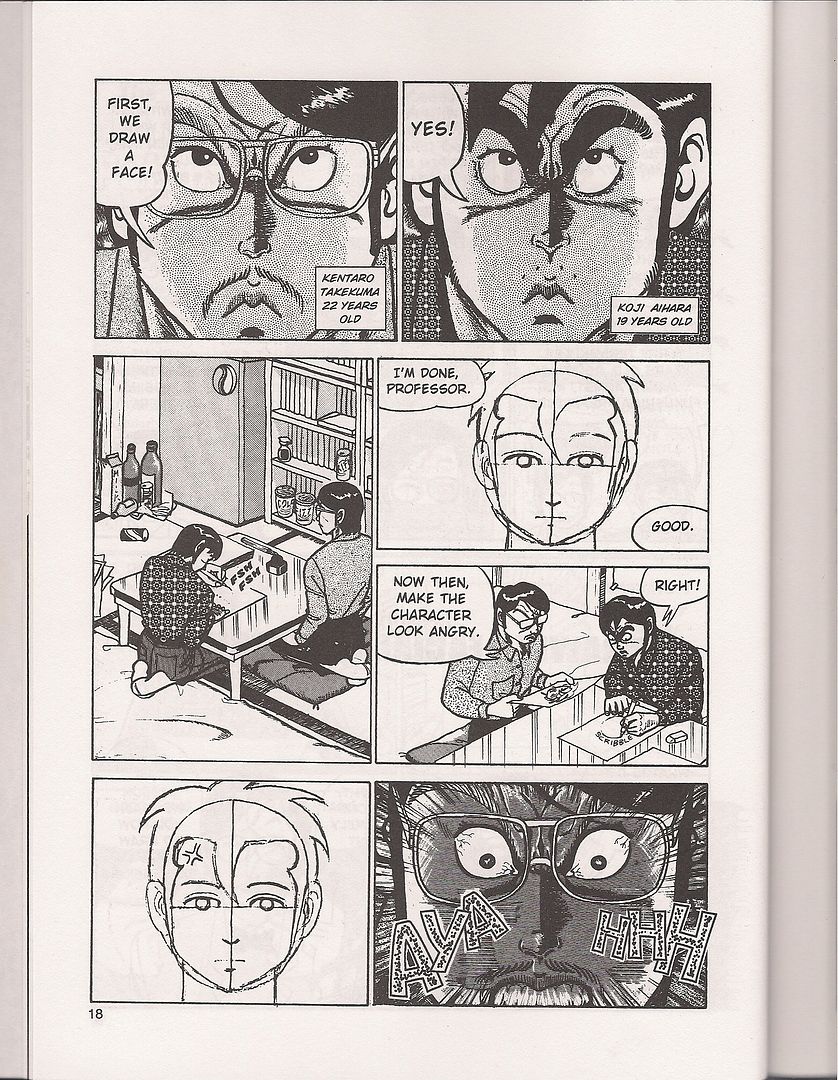
(from Even a Monkey Can Draw Manga; art by Koji Aihara & Kentaro Takekuma)

Japanese comics, right? Maybe a collection of recognizable icons - big eyes, speed lines, etc. Flowers in the background, cartoony art. Except when it's not.

How about format? It's dozens of little books on the shelves of Borders. Naruto. Nana. Death Note. Pluto. A Drifting Life. A different world, an alternate reality - a foreign industry where comics are more popular and more prolific, escapism of an extra-narrative type. More comics for women, more comics for kids, more comics, beholden to their own traditions and biases, maybe intimidating, maybe interesting. Maybe a precognition, if you're feeling irrational: a new funnybook behavior, an example for America or insert-your-nation-here to follow. Or at least a steady-promised stream of comics of a type becoming cozy. Manga has fit right in for a while now, looking broadly at books.

But that's the present and the future. What about the past? What about manga the way it used to be taken in North America, the answer to the very same question if asked a quarter of a century ago. What is manga?

Well, there's one easy response:

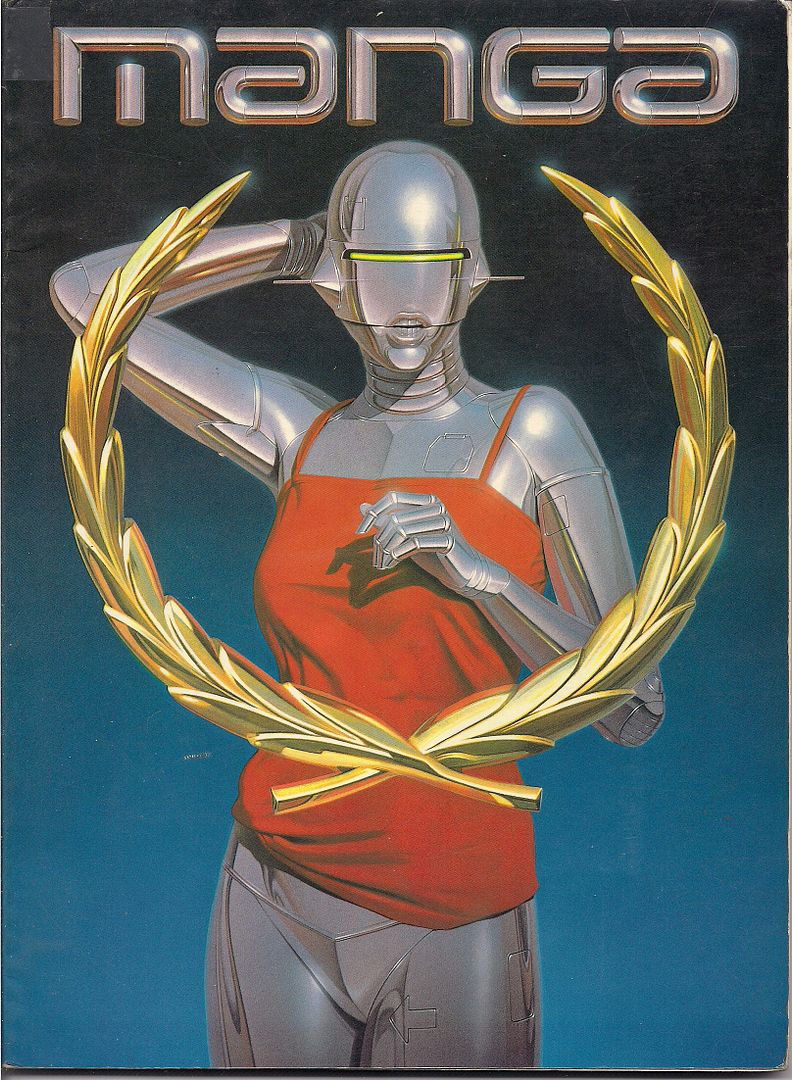
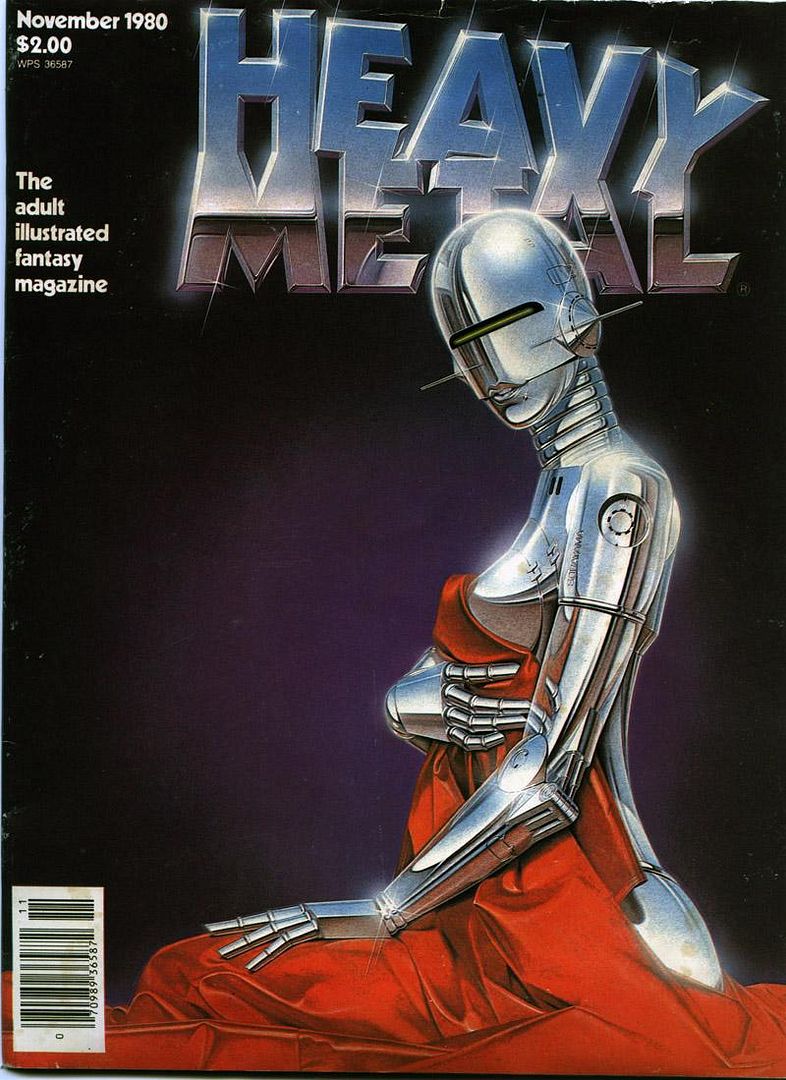
Yeah, that's it! Says so right up top! Manga, objectively, is a robot woman vamping in the sunrise while casually failing to grit her teeth. A red cocktail dress is hiked up over her hips so as to model the stainless steel panties that are apparently welded to her loins. An arrow has been discreetly cast onto her left leg, so as to assist the confused or inexperienced viewer. Her upper body is an official selection of the Venice Film Festival, and her thin visor evokes an even hotter iteration of Robocop. She was there first, though. She's why law enforcement needed a future. Vice law, for a sexy future. There's an arrow.

As is sometimes his way, the artist -- famed illustrator Hajime Sorayama -- appears to be joking around. A pin-up model's body is matched with a distinctly inhuman face, almost bemused with how the viewer must be eyeing her. This isn't his flesh-and-steel Gynoid work, it's all gloss and chill; pin-ups can be son unrealistic, and this one makes it obvious. There's no lock on that chastity belt - that's why she's showing it off, as a joke. The punchline is: "you cannot access the robo-booty, hu-man."

Er, manga!

This is on the back cover. Manga, you see, is a book: a perfect bound, magazine-sized softcover. Its one-word title is the first part of its explanation for itself, and the above image is literally all the rest; no cover price is provided. It's 88 pages, in b&w and color. Ten artists are showcased, with absolutely no further explanation provided. Just their names. There isn't even a date of publication; in the Jason Thompson-edited Manga: The Complete Guide, veteran editor Carl Gustav Horn narrows the possibilities to anywhere from late 1980 to 1982, though I've seen sources online placing it as late as '84. Horn also provides the ISBN for easier searching -- 4-946427-01-5 -- and cites one of his sources as Mike Friedrich, editor & publisher of the famed "ground level" comics anthology Star*Reach, one of the noteworthy bridge works between the old underground funnies and the 'mainstream' of the mid-to-late-'70s.

Friedrich also served as Manga's consulting editor, even though it was a Japanese-published book, from "Metro Scope Co., Ltd." of Tokyo. There was a Japanese editor, of whom more will be said later. It was still intended for American readers (despite a Japanese release that charmingly played peek-a-boo with the cover art), however, and I suspect Friedrich's participation might have been due to his yet earlier role in bringing Japanese comics to North American readers, which I'll get into later. Comics writers such as Larry Hama and Steven Grant were brought on board as "adapters" to work the scripts into fit English. Connections in the rapidly-growing Direct Market were presumably sought, although I don't have the slightest idea who carried the damned thing. "Damned" is a most appropriate word.

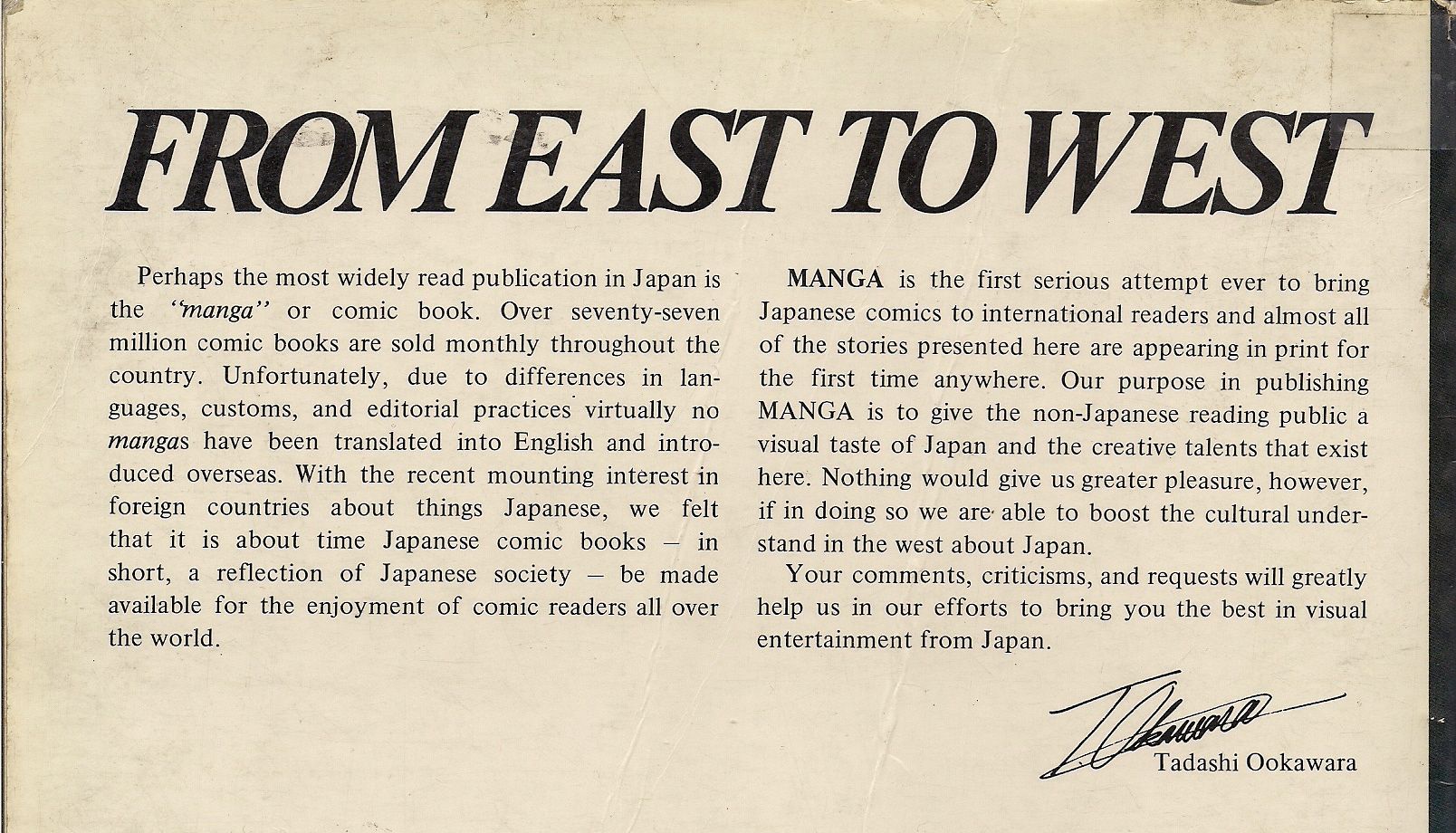
And, crucially, though it has nothing to do with the book directly, though it seems to fly in the very face of that back cover statement of Executive Managing Director Tadashi Ookawara (of whom I can locate no record whatsoever of subsequent involvement in manga in North America) that this hand-selected "reflection of Japanese society" was purposed "to give the non-Japanese reading public a visual taste of Japan and the creative talents that exist here" and maybe even "boost the cultural understand [sic] in the west about Japan" - in spite of all that, cover artist Sorayama provided a rather famous image for that very important 'bridge' comic, Heavy Metal, in late 1980.

The timing couldn't have been more perfect. The implications will soon become clear. Manga isn't what it used to be, but that old, obscure place, that 1980-84 says a lot about Japan and America, and Japan's view of America, and which particular aspects of Japan should best be reflected in America's direction through these crazy mirror things called comics.

So let me modify our first question. ***

What Was Manga?

***

I. THEY SAY HE GOT JEDI FROM JIDAIGEKI

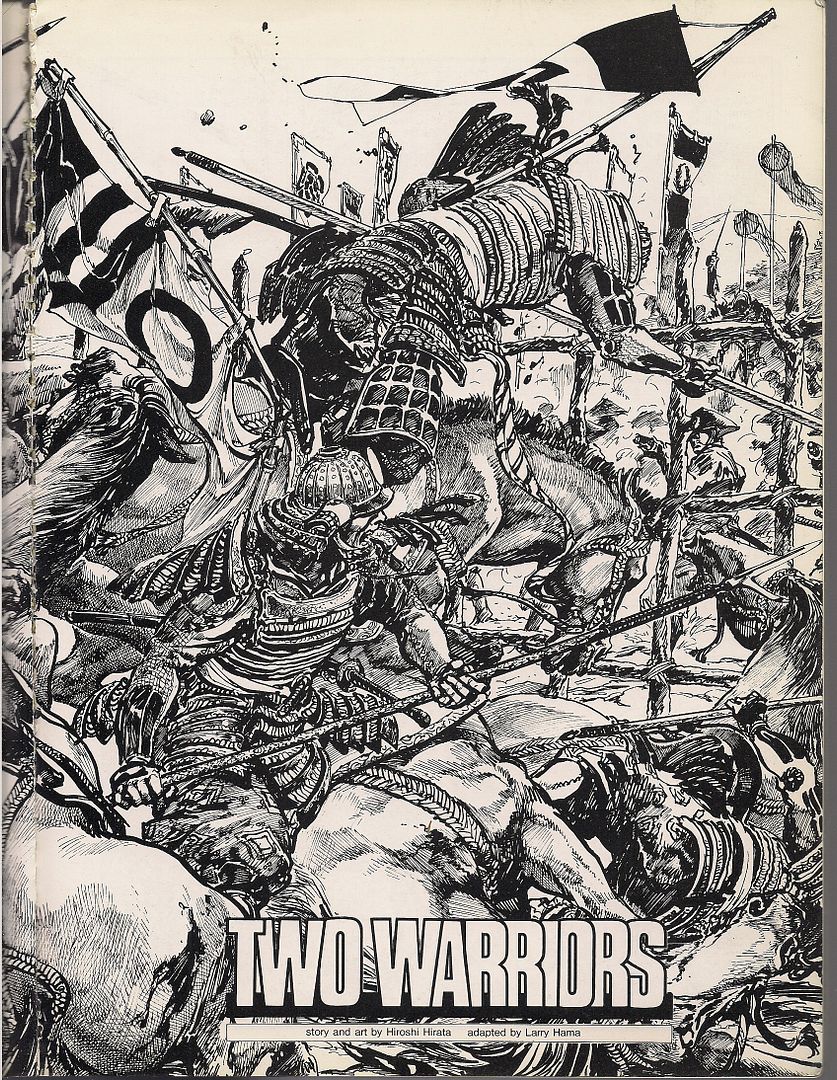
The very first story in Manga-the-anthology is by probably the most experienced and acclaimed of the artists roped in with the project: Hiroshi Hirata.

Sure: there's worse ways to start an anthology. I think this is how Kramers Ergot 1 kicked off. Ben Jones, how you've changed.

And it makes perfect sense to get those swords swingin' and helmets clashing as fast as bloody (and bloodily) possible in a book of this type, because Japanese period pieces have proven so frequently successful in the West, and also as unusually fertile ground for cultural influence. The Magnificent Seven from Seven Samurai; bits of Star Wars from The Hidden Fortress. From Le Samouraï to Ghost Dog: The Way of the Samurai. Comics would be no different; around the arrival of Manga, one of the most popular artists in the field was already flaunting his Japanese influence in an extremely prominent manner.

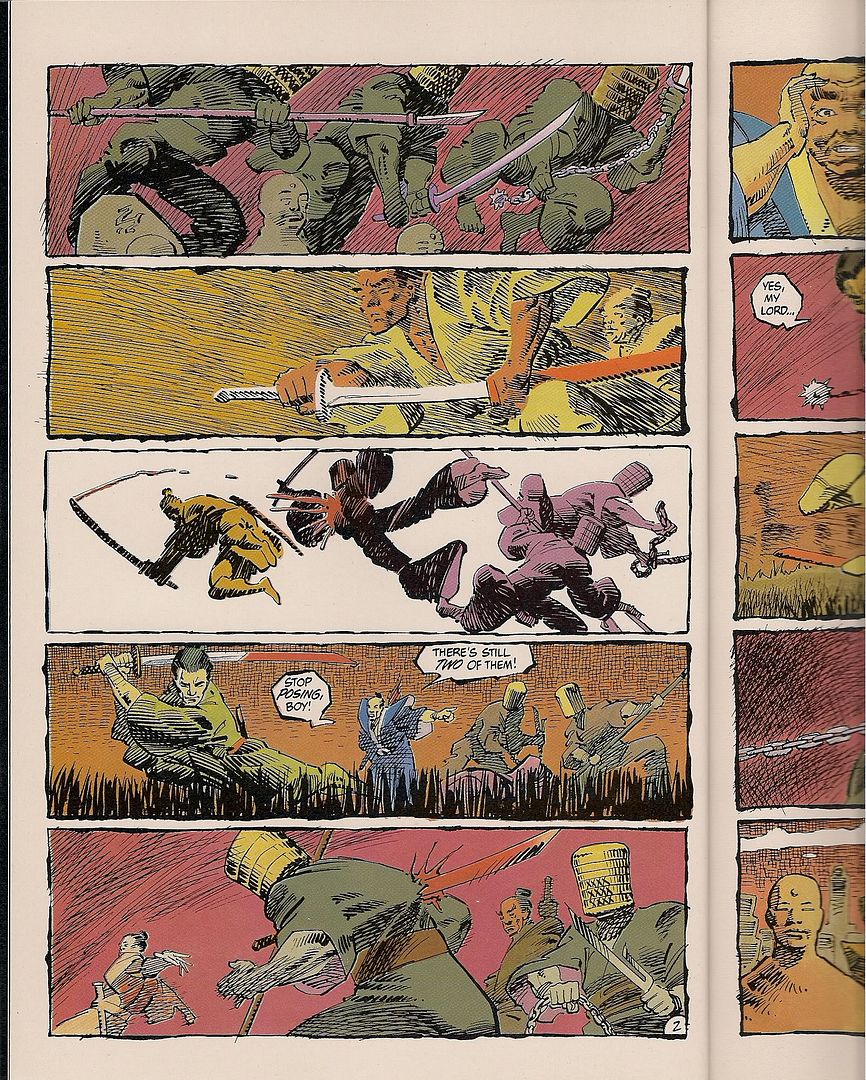
(from Ronin; drawings by Frank Miller, color by Lynn Varley)

In 1983, Frank Miller began serialization of his miniseries Ronin at DC; the influence of the aforementioned films of Akira Kurosawa and the samurai comics art of Goseki Kojima was noted, though Kojima's and writer Kazuo Koike's seminal Lone Wolf and Cub wouldn't see release in North America until 1987, in pamphlet form despite its 28-volume length. Miller provided cover art, an introduction and miscellaneous seals of approval as if to cement the work's value for the skeptics. That was a big year, '87 - the same month that served up First Comics' release of the Koike/Kojima manga saw the publishing debut of the mighty VIZ, then in association with Eclipse Comics, armed with their own damn swordfight manga, The Legend of Kamui, from genre godhead Sanpei Shirato.

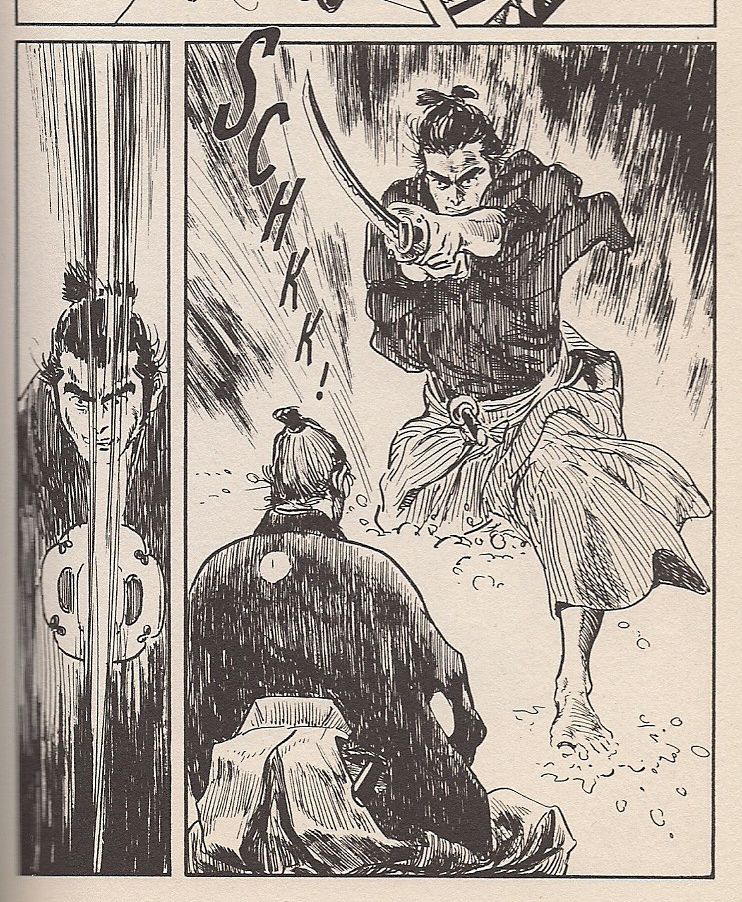
It's easier now to appreciate the place of these artists in the greater history of manga. Both Kojima and Shirato were noteworthy practitioners of gekiga, the "dramatic pictures" cooked up by artists who wanted the postwar "whimsical pictures" of Osamu Tezuka to grow up with them. Shirato in particular proved to be a major figure, his popular Marxism-informed ninja sagas providing a valuable popular hook (and even the title) for the famous 'alternative' manga anthology Garo. Kojima likewise became known for intense period work, the 'jidaigeki' of cinema, novels and theater perhaps becoming jidaigekiga, which might not be a real word, I admit. But back then, artists made it up as they went along, like Lone Wolf writer Koike, who advocated creating complex characters as paramount to comics writing, enough so that stories could often just happen.

(from Samurai Executioner; art by Goseki Kojima)

It's ironic, then, that Hirata arrived in North America first. On first glance his work might seem more appealing than Kojima's, with muscular, detailed figures ripping across mighty panels hosed with testosterone and whisked with manly tears. Even the MAD Magazine-style "we're not a comic oh no sir, those are for babies" robot typeset lettering can't detract much from the rippling power of Hirata's compositions, professionally engineered to drive a reader wild with appreciation for these impossible deeds of awesome he-man samurai gods.

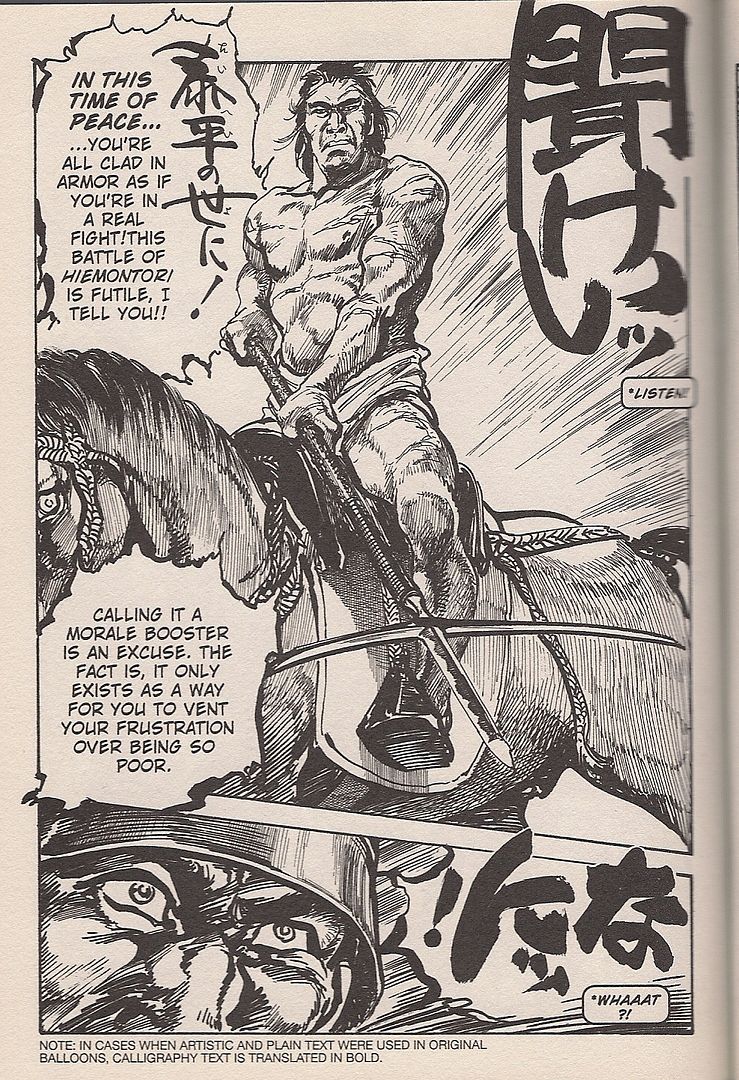
That Ralph Steadman-ish lettering above is there to approximate a specific flourish of Hirata's: rendering the most crucial of his characters' titanic exclamations and/or blood oaths in rich, classical calligraphy. When Dark Horse set about translating Hirata's Satsuma Gishiden (1977-82) in 2006, it opted for the unique option of subtitling those whopping images, so vital to Hirata's style. So firm in the historical period. Same thing.

(from Satsuma Gishiden; art by Hiroshi Hirata) Yet that five-book series remains the only other 'pure' Hirata work released in English -- he also provided the art for a 1987 (that year again!) East-West project Samurai, Son of Death (Eclipse Graphic Novel No. 14), written by Sharman DiVono and lettered by Stan Sakai -- and it sold poorly enough that Dark Horse pulled the plug after vol. 3.

Part of that failure, I expect, is due to Hirata's writing. Very little of Shirato's work has been made available in English-speaking environs environs either -- VIZ has two out-of-print volumes of The Legend of Kamui floating around, although the old Eclipse pamphlets go a bit further along than those collections -- but what's available belies an instinct for tucking the political/philosophical content into a sugar cube of rip-snortin' ninja action. And Kojima, for his many North American-released work, always had Koike, who's never encountered a crackpot digression or sensational plot twist or perverse character wrinkle he wouldn't embrace.

Hirata, in comparison, and admittedly going by what's available, is a truly ponderous writer, offsetting the over-the-top fury of his combat scenes with long historical explanations and almost compulsively detailed depictions of political intrigue. Following their introductions his characters rarely waver from their place on his most-to-least scale of masculine honor, positions set by electric words and blood drawn for ritual or warfare, the lifeforce of Old Times.

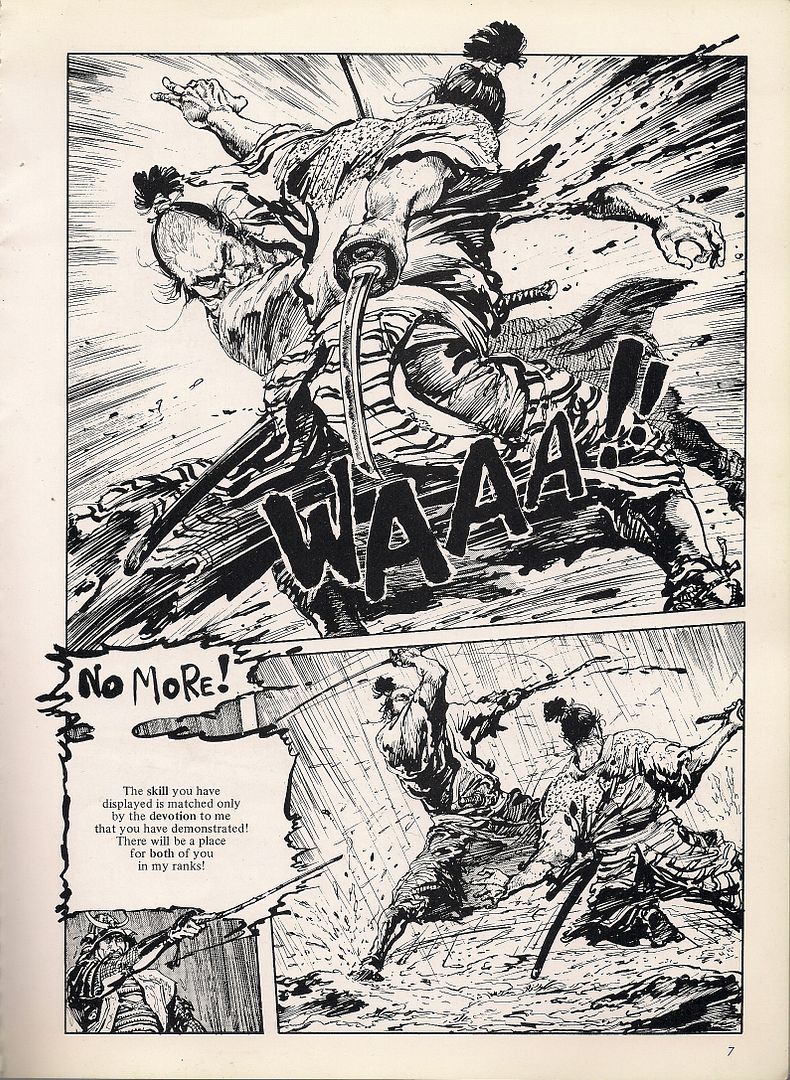
His contribution to Manga is self-contained and quintessential (as far as that goes, given how little of his work is available), focusing on two friends ordered to duel to the death at the pleasure of a warlord; the act will both reveal the greater fighter and seal his devotion to unquestioning obedience. Yet one of the men hesitates, and the other slices off his arm, after which the warlord allows both of them to serve as his personal guard.

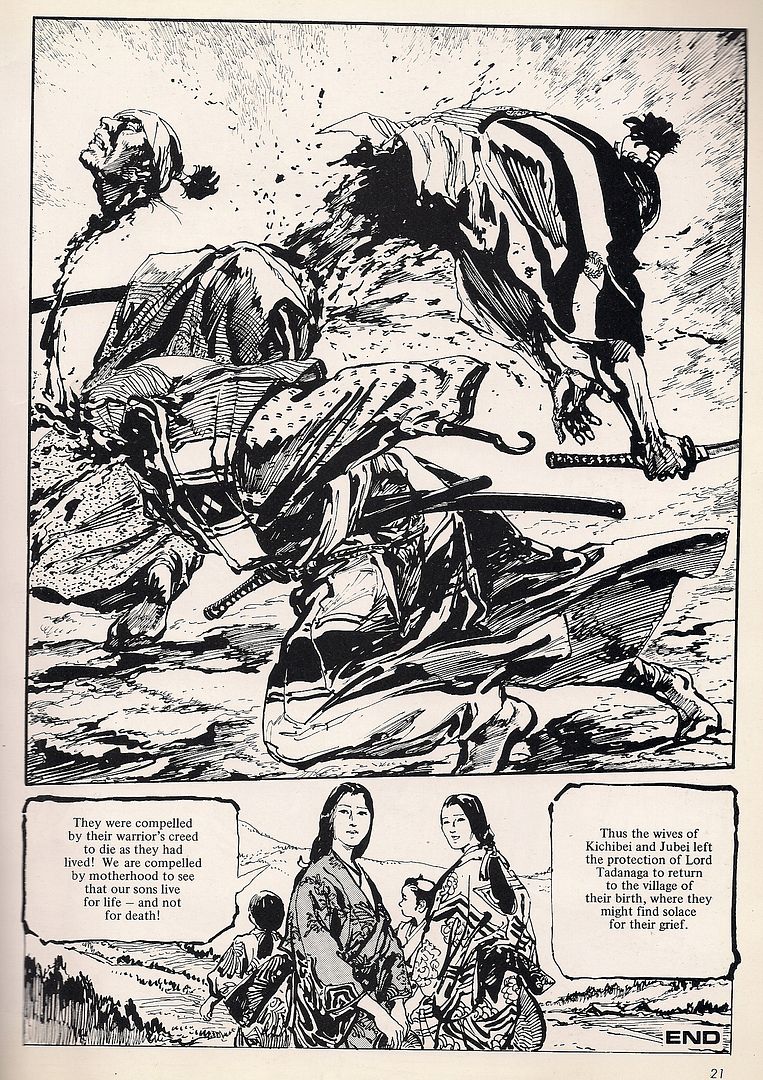
But alas, years later an arrow plunges into the warlord's eye. In shame, the one-armed man jabs his own eye out, yet the warlord is unmoved, ordering the man's still-whole friend to kill him. It is only then that the unmolested man reveals that, in sorrow for never hesitating in that terrible duel, he urged the warlord to allow his maimed compatriot to serve. Incensed, the proud one-armed, one-eyed fighter declares that friendship is alien to the warrior's creed, and that they must duel again, beyond hesitation or pity! In a sickly whirlwind of skin and steel, the samurai collide in a for-the-books bonanza of dismemberment that oh, dear readers, leaves them literally torn to pieces, each man killed by the other's hand!!

And if you're thinking, "hmm, those wives don't look all that upset over the carnage up in panel #1, notwithstanding the caption to their immediate right," know that such things are really the point of Hirata's manga. The violence of those times was terrible, and modern society has its perks, yes, but boy - all that bleeding man honor was goddamned amazing, you've gotta give it up. The fans, revered author and code of honor devotee Yukio Mishima among them - they knew. And it traveled. Except when it didn't.

II. ARCHIE GOODWIN IS A SUGAR MERCHANT OF LICORICE LIES

It likely wasn't just Hirata's intent immersion in Sengoku overload that did in his American prospects, however, ironic as it might be to witness a body of art spoiled in its crossover potential as a historical work for being too steeped in history. No, there's also the simpler fact that 'manga' in 2006 was very different from the exotic and pliable concept of the early '80s. Kojima & Koike continued to sell, having been established for years, but the wildcard macho art of Hirata didn't look a damn thing like One Piece or Fruits Basket, and it didn't have a scrap of the art comics cache necessary to survive outside the 21st century manga bubble. For the older, harsher works, the Satsuma Gishidens drawn in the late '70s, there is little hope.

Ah, but with Manga, anything was possible! A "reflection of Japanese society," remember! Why, I don't see any language promising coverage for all of society, do you? It could be anything anyone wanted, a whole visual culture shifted just a step or two to one side, for the purposes of landing the work on foreign soil. Samurai would work then; everyone knows about them, and Hirata has a good, strong visual style. Appealing. Realist, and thereby less likely to seem weird or confusing to the untapped readership.

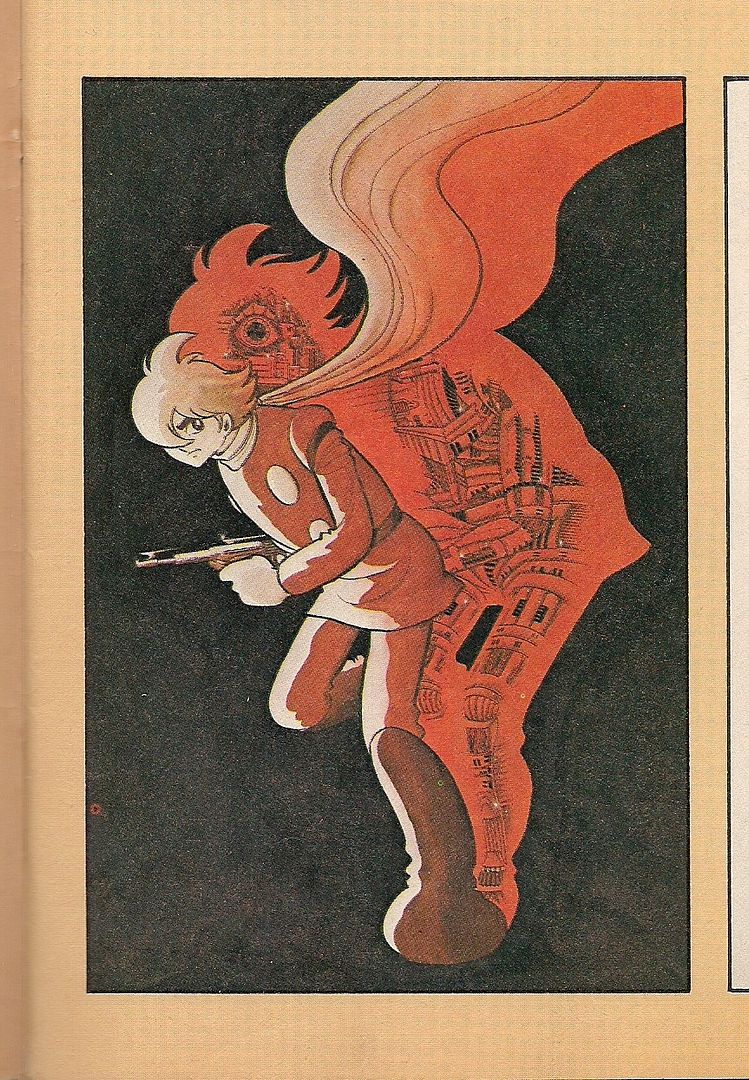
There were a few alternative perspectives around, mind you. The Winter 1980 issue of Epic Illustrated -- issue #4, the last quarterly edition -- featured an illustrated profile of the great Shotaro Ishinomori, written by Gene Pelc and the magazine's editorial director, Archie Goodwin. Ishimori was a great figure in boys' manga history, creating the famed Cyborg 009 series in 1963 and designing the beloved tokusatsu television hero Kamen Rider in 1971. His art beamed with all the popular style of the time.

(from Epic Illustrated #4; art by Shotaro Ishinomori)

Which is to say, you can draw a rather short, straight line from Ishinomori to Osamu Tezuka; the former even assisted on the latter's Astro Boy. Such work is closer to the source of postwar manga, the status quo that gekiga developed to answer.

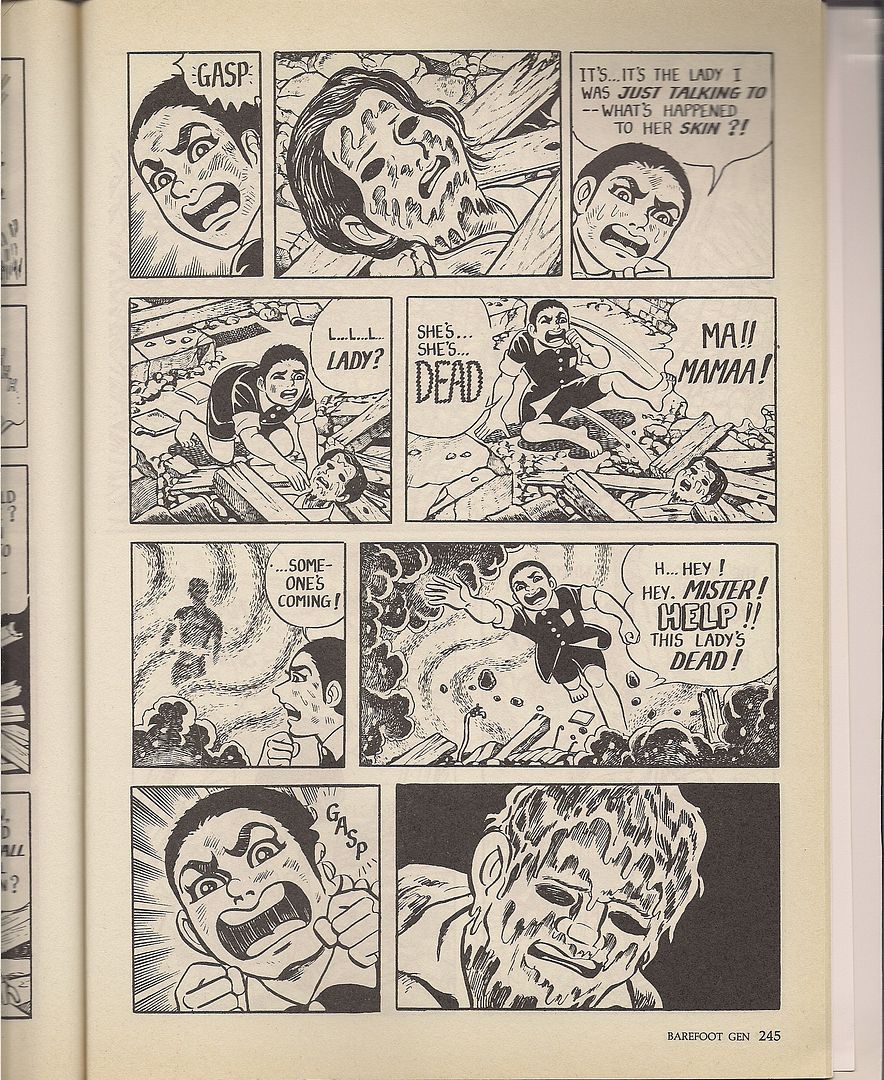
And it wasn't just fun frolics for boys that were drawn in the manner - Keiji Nakazawa's semi-autobiographical Barefoot Gen, a saga of a young survivor of the Hiroshima bombing, can be startling in how firmly it's planted in the male youth tradition of shōnen manga, loud and bright and cartooned. A few volumes were nonetheless published in the early '80s, clearly in regard for its weighty subject matter, and an excerpt appeared in Frederik L. Schodt's landmark 1983 study Manga! Manga! The World of Japanese Comics.

(from Barefoot Gen, as excerpted in Manga! Manga! The Art of Japanese comics; art by Keiji Nakazawa)

Schodt made note of Manga-the-anthology in his book as "carefully edited," which might carry a double meaning depending on how you take 'editing.' In his 1996 follow-up, Dreamland Japan: Writings on Modern Manga, he makes reference to the early '80s manga-in-English mini-proliferation of, among short stories, English-learning aids and anime tie-ins, "vanity press" books "by Japanese artists hungry for international attention." One is reminded of Lead Publishing's ill-fated 1986-87 attempt to break Takao Saito's Golgo 13 into the North American market by sheer force of will and glossy production values, but Schodt might as well be referring to Manga.

But for a vanity tome, they did have some keen presentational ideas. Remember that Heavy Metal cover above? Same guy that did the cover for Manga? The years just about match up so that the connection might not be a coincidence. Indeed, Carl Horn mentions in the Thompson book that Manga gives off an impression not unlike that of Heavy Metal; I agree, and would actually go farther to speculate that the book -- while not a magazine, just sized like one -- might have been planned as the first of a series of Japanese answers to Heavy Metal's solidly French line-up. Or at least they saw success in action and opted to look like it.

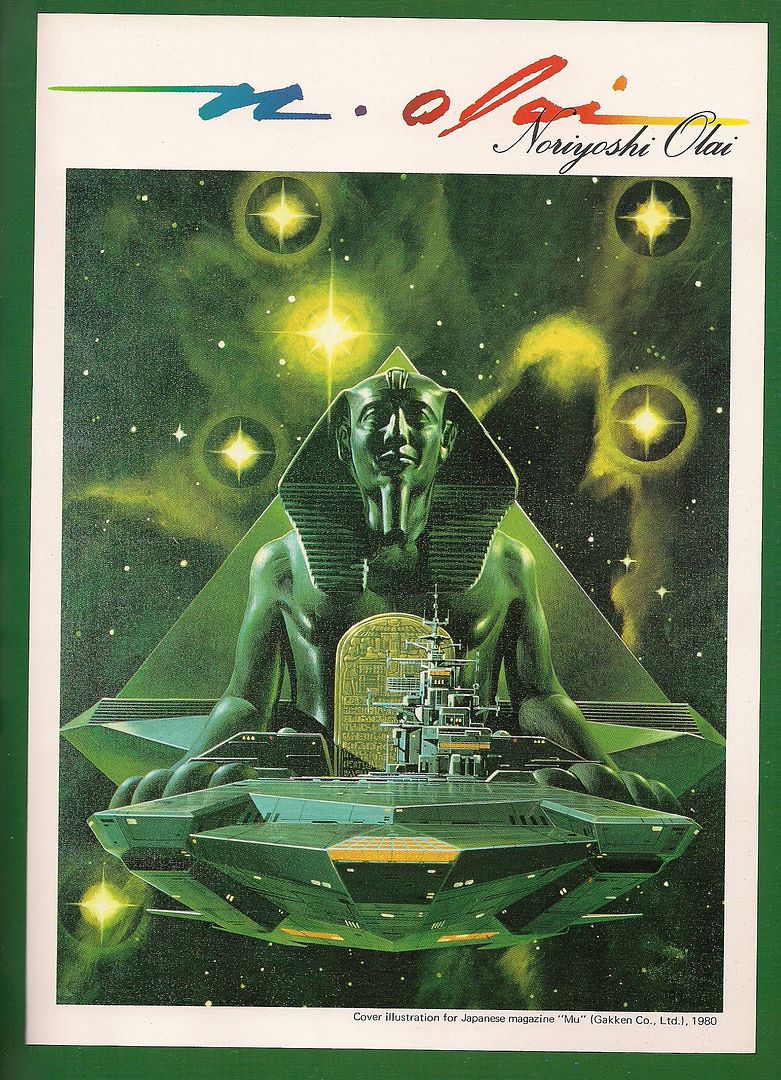
Hell, they even threw in an illustrator's profile section, spotlighting one Noriyoshi Olai, a painter of book and magazine covers who'd just completed some poster artwork for The Empire Strikes Back. In the proper Heavy Metal tradition, special emphasis is lavished on his brooding images of horror/sci-fi stuff or lavish depictions of women wearing little-to-nothing above their waists. It's universal: French, Japanese, American - we all like stuff like this:

Oh don't deny it.

It'd be a mistake, incidentally, to pretend that no French-Japanese exchange had happened around the time of Manga. The artist Moebius hadn't just taken off in North America; his inspirational reach in Japan would eventually inspire the visual approach of Hayao Miyazaki's fantasy manga Nausicaä of the Valley of the Wind when it started up in 1982. That's probably a bit late for Manga, but the scent was in the air earlier.

A French influence can be picked up in this, a no-panels three-page story by Yousuki Tamori, who had recently (in 1979) begun work on his most popular creation, the fantastical PoPoLoCrois, later to be adapted to various anime series and role-playing video games (the first of which to see release in North America was the 2005 edition for the PSP). The very title of that work reflects Tamori's international flair, with "popolo" being Italian for "people" and "crois" being French for "crossing." People crossing, cross-culturally. Very neat, but I know of no other manga by the artist to see translation for English reading.

Likewise, it'd also be wrong to invoke Tezuka without acknowledging the obvious impact of vintage American animation on his own artistic development, the Disney features and Fleischer Brothers. And for the occasional shit Miyazaki has slung at Tezuka for damning Japanese anime to the limited animation cellar of sweatshop television schedules, a peek at Tezuka's short animation work -- recently collected on R1 dvd by Kino -- reveals several works that don't look a damn thing like anime at all.

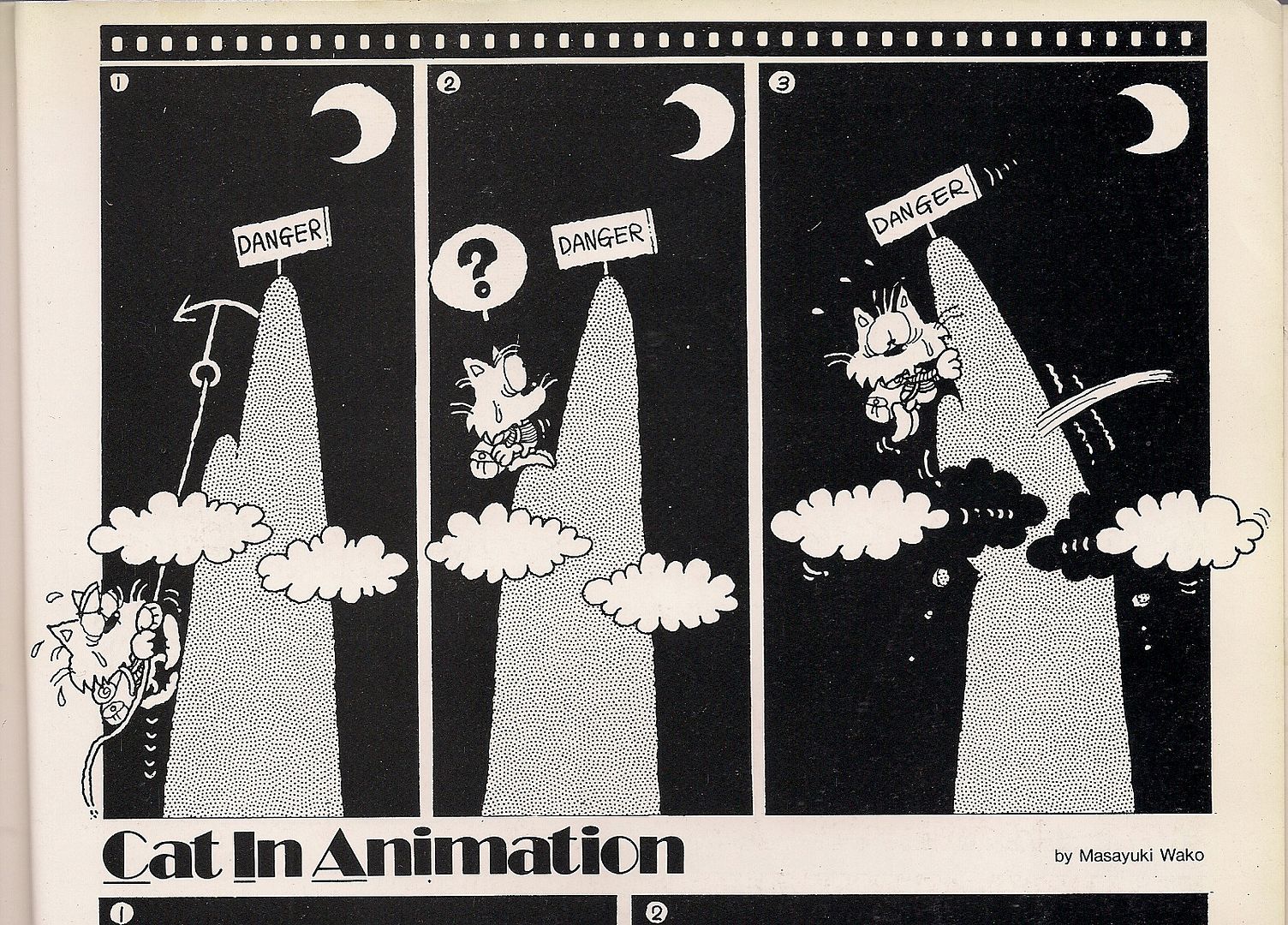
There's a small batch of animation-informed strips in Manga, wordless pieces by Masayuki Wako, about whom I know nothing, under the banner title of Cat in Animation. They're cute little jokes about the comics form, icons taken literally and stuff; sometimes they're not all that clear in delivery. But they do sort of touch on this formative Western influence that seeded 'modern' manga, reliant on Tezuka's application of cinematographic principles to the comics page, not to mention his adoption of the Disney big eyes. Wako, for his effort, was not to my knowledge seen in American comics again.

Picking up a pattern? Several? It's true that many of the artists showcased in Manga would not become well-known later on. In fact, all of them -- even one particular former white-hot superstar whom I'll be addressing soon enough -- are either unknown or diminished in today's North American manga-in-English scene. That could well be related to another pattern: Manga-the-anthology's cherry-picking of certain artists influenced by certain phenomena (or just working in a salable genre) that made them seem Western.

"Although solidly adapted into English, what strikes the contemporary reader is how little the pieces of Manga resemble popular notions of manga itself," remarks Horn, but it's not just that - it's how much the pieces of Manga seem tuned to look like comics a newsstand Metalhead or a patron of the still-sparkling Direct Market might regularly encounter, only more polished, just a little bit different. Friendly. Unless it's something really obviously Japanese in the exotic sense, like samurai. Cutting each other to pieces over HONOR! The length of the magnificent manga series doesn't strike me as a factor; this was mostly new, commissioned short work, and a great amount of Japanese editorial control over the collection's look and feel can be presumed.

Again, if you're looking to present an appealing comic to a foreign market, it seems to make economic sense to erase the Tezuka aspect, the weird underground stuff and frankly most of the popular youth looks from the cultural landscape, as you're presenting it. Moreover, the early '80s also saw a genuine wave of Western influence in manga art, spearheaded by Katsuhiro Otomo and likeminded semi-realists. It wasn't the whole story, but it could form a whole story, with only 88 pages to fill.

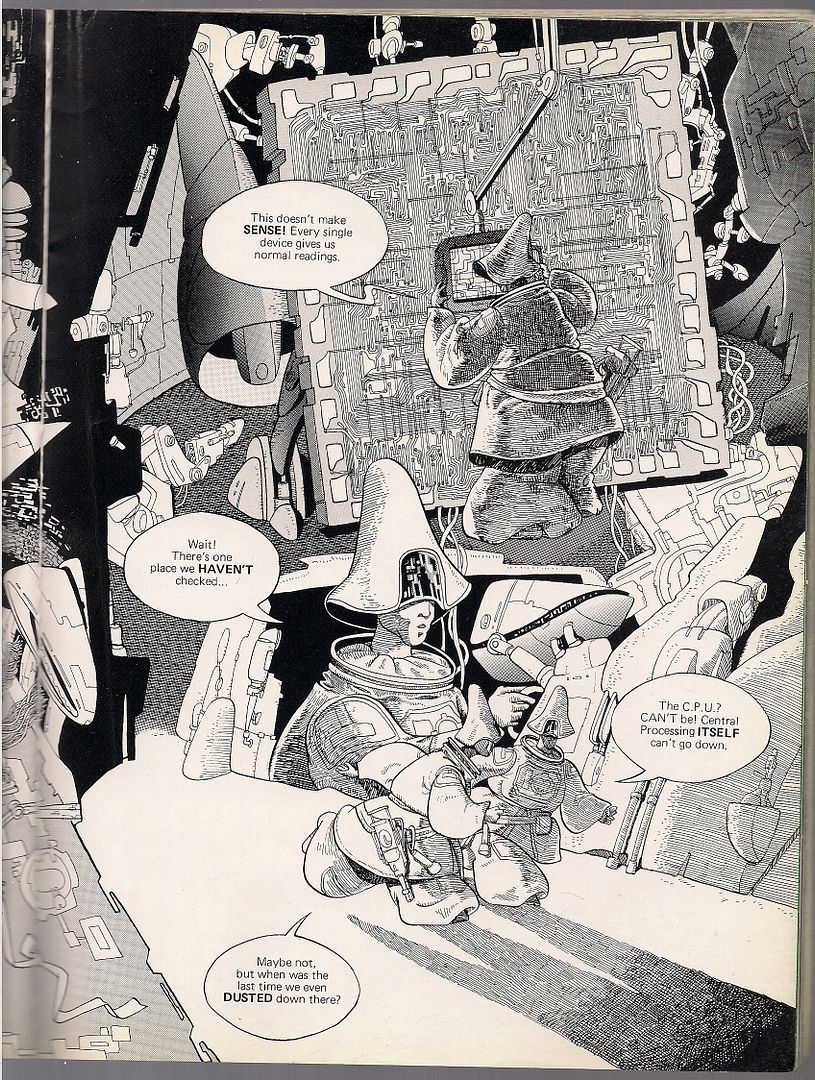
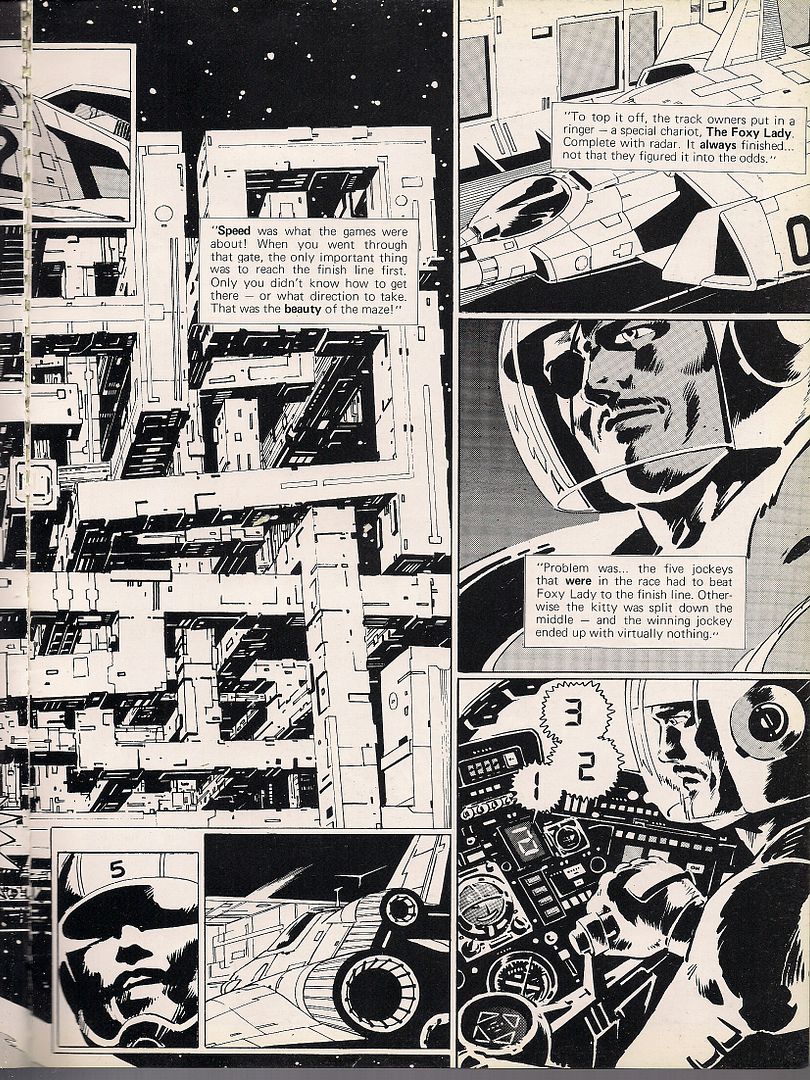
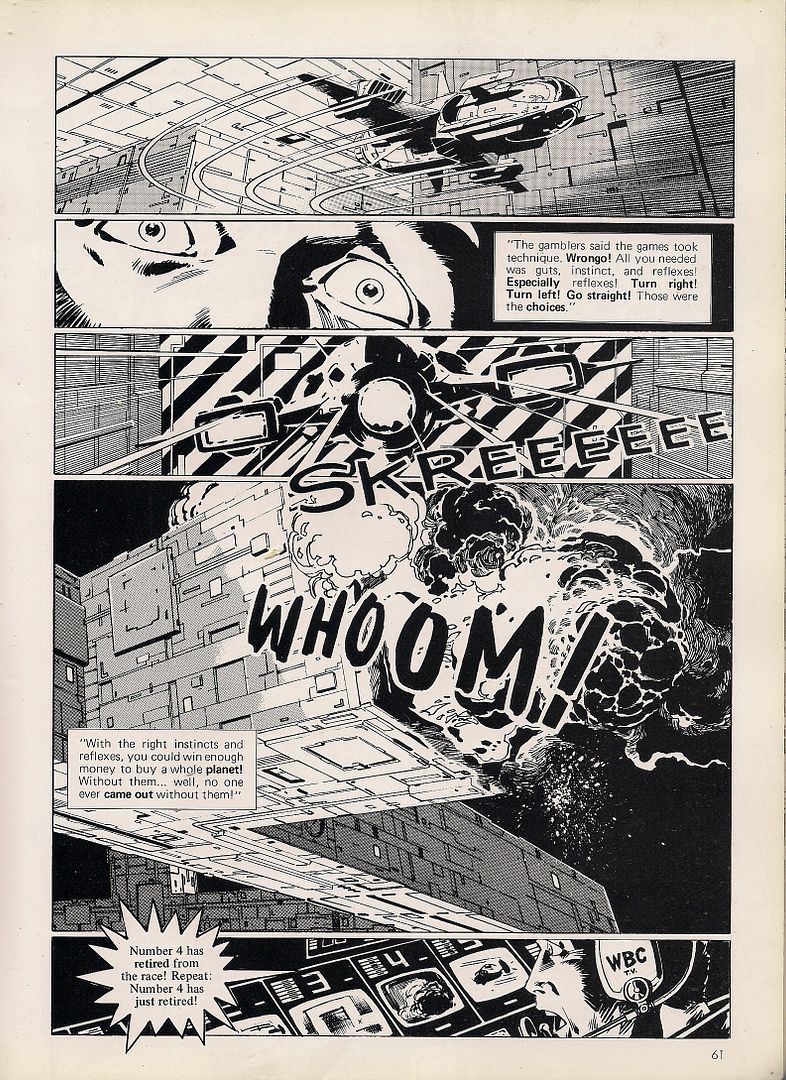
Just look at this. It's from a 12-page contribution by Noboru Miyama, who died very recently, in 2007. His story, The Great Ten, is filled with images just like this: detailed machines and steely environments, with humans reduced mainly to faces beholding the wonder of setting. That's good, since Miyama's human figure work isn't so strong; this was among his earliest published stories, unless it actually is his first published solo work, since most sources cite 1981 as the year of his pro debut. Prior to that he'd worked as an assistant to Satoshi Ikezawa, creator of a mid-to-late '70s racing manga titled Circuit no Ohkami.

This story too is a racing manga, boiled down to its essence. Carlin is the greatest jockey ever to race in the deadly 3-D Derby, a cube maze that kills. His shocking series of wins delights the betting public, until they tire of how his excellence prevents big payouts and thrilling death lunges for 1st. He's too good, and thus hated; and while the kindly fellow in the pace car tries to warn him that he's playing with fire, Carlin can't help but go for a big 10th win, unaware in his ambition that the game is now fixed against him.

Lots of well-drawn tech, some fine action. And a message about pushing yourself as hard as you can go - not an unfamiliar sentiment for the youth manga that Manga didn't show. But there were other things, revolutionary things the book didn't show, that would broker no great similarity to this boyish activity, that nobody could have believed would have flown with Manga's laser-honed American target audience. Something was hidden.

***

(Forward to part 2)

Claremont's X-Men 3: It's All Downhill From Here, Maybe.

The Phoenix Saga ruined the X-Men for a few years.

I know Jeff Lester disagrees with me on this, but he's wrong; as exciting and classic comics as it may be, the whole Dark Phoenix thing derailed UNCANNY X-MEN all the way through #175, and I'm blaming it all on Jim Shooter and John Byrne.

Okay, that's maybe not entirely fair - especially Byrne left the book within six months of the end of the storyline, and Shooter probably bears less responsibility than Claremont, who was, y'know, writing the book and all - but while everything from #125 through #137 has become Official Comic Landmark material because Claremont and Byrne are working in such sync and with such success that even introducing Dazzler can't slow them down, the following year is a pretty great example of watching a writer thrown entirely off his game.

That year between #125 and #137, though, is a great read; Claremont and Byrne are on fire, introducing the Hellfire Club, Emma Frost and Kitty Pryde as well as Dazzler, and keeping the main characters evolving (Colossus has to kill! Cyclops stands up to Professor Xavier because he knows the X-Men better!) even before the big cosmic showdown that sees a character turn, essentially, outright evil and then pay the price for it. The year seems like the fulfillment of basic Marvel ideals, mixing soap opera and superhero, showing the need for responsibility that comes with power and ending with a tragic self-sacrifice that "This Man, This Monster" would've been proud of. It's really good stuff, and a peak (the peak?) of the series as a whole, one of the few times that everything comes together with such intensity and sincerity that it actually works... and then everything falls apart.

It's actually understandable that it did, and surprising that it didn't happen more obviously or more horrifically; Claremont and Byrne were forced to redo #137 after it'd been completed, because the original plan of leaving Jean alive with depowered wasn't thought to be enough after she'd destroyed a planet as Phoenix (FWIW, I think it was a change for the better), but even if they hadn't been, where do you go after a story so cosmic and... well, big? It's no wonder that the majority of the next year (all the way up to the subplots starting in #147, even if the A-plots remained weak until #150) seemed so generic and pedestrian in comparison: After saving the universe from one of their own gone bad, visiting Alpha Flight in Canada to go after a Hulk villain (Even one with Wolverine history) or taking on Doctor Doom and Arcade just doesn't really seem as interesting.

(There's a two-issue exception, of course, the "Days Of Future Past"/" Mind Out Of Time" story in #141-142 that would, once Claremont had exorcized his Phoenix demons, come to define the X-Men franchise with its dystopian, never-smile-because-you're-hated-and-by-the-way-your-future-duplicate-is-more-depressed-than-you-about-it vision. In the context of what followed its initial publication, though, it just seemed like a two-part story without a lot of impact. It'd take a few years to get full-on-depressathon.)

(The ghost of Phoenix haunted the book in more ways than one; she makes a hallucination-appearance in #144, and then the cover of #147 shows an out-of-control Storm with the tagline "We did it before -- Dare we do it again?" It's hard to know whether Scott Summers or Chris Claremont was most affected by Jean Grey's death.)

The loss of Byrne hits the book hard, too; looking back, I still think he and Austen lacked a lot of the personality of Cockrum's earlier issues, but the Cockrum that returns to replace him is a different artist, one who's more conservative and lacking the verve and invention that Byrne papered over with glamor (He's not helped by Joe Rubenstein's inks, either; Rubenstein tends to flatten out a lot of the pencilers he works with, giving everything a kind of generic quality that makes him perfect for a multi-artist project like The Official Handbook Of The Marvel Universe, but not something where you want someone to follow Byrne and Austen.

As the series approached #150, it seemed to have flamed out. With the big villain hinted at for the anniversary issue Magneto yet again, capping off a year of familiar (and non-traditionally-X-Men) villains, it'd wouldn't have been too surprising if fans following the series then were wondering if the series' best days were behind it. Oh, how right/wrong they were.

Tucker Really Hopes You Like His Reviews Of Comics So Much You Guys

Looks like there's been enough meat-y think posts on here since the last time I checked in. Too bad that they all keep being on comics you cats have all read, right? I thought I'd take a look at some of the 2009 small press stuff, and I totally started on that, and then I got distracted by the fact that a ball of aluminum foil can reflect light. I keep batting it around, but since it's not really round, I never know what direction it's going to go in. Here's three though. They're all in the Upper Echelon of the Ratings Scale, if you've got your computer turned on its side.

Jan's Atomic Heart JAH_cover They're calling this one a graphic novel--it's got a spine, sure, but it's pretty short. Guy who did it is 20/21 years old? Name's Simon Roy.

It's GOOD.

One of the things I've enjoyed most in the last year or so was the opportunity to spend some serious time reading a bunch of Future Shocks stories from 2000 AD--it's a fountain of ideas, a place where guys like Moore, Morrison, Milligan and other dudes without M-names did all kinds of "get out the comics" work. While it doesn't share any visual sensibilities with the old EC Comics stuff, there's this sense of work that comes about when you're catching up on them en masse as opposed to the weekly installments, and that sense is one of the things I like about EC. 2000 AD and its sister-titles, that original EC stuff--that whiny part of my brain starts to shut down when I read them, because I can't stop thinking about how consistent they were/are with their content. It just kept coming, and in my estimation, EC had a pretty incredible Hit-To-Shit ratio.

Jan's Atomic Heart has nothing to do with EC, but it reminded me of 2000AD, Bilal's Memories, all those kinds of random one-shot tales of dirty, rusty futures. It's a science fiction story about a guy who ends up in a temporary robot body while he's waiting on his flesh-y one to recover from a car wreck. It has a great ending, which I'm not going to ruin, because it earns its great ending.

This is the first page. It's like Gipi drawing Otomo. jah_1 According to Roy's comments at CBR, he started the project as an "exercise in environment-building", and ended up turning out a story while in the midst of drawing stuff. I'd like to say it shows, because that's sort of what you want to read on a site with "Critics" in the name, correct?

Not really that dude, broseph. I hear tell that you can buy Ng Suat Tong's attentions with a box of Thin Mints, so look into that. I just liked this comic--I liked it before I found out it was a comic birthed out of screwing around with drawings of buildings and robots, and I liked it even more after that. In its fashion, it's an old school sort of story--a guy is coming out of the shock of a car wreck, upset because he can't fit his robot frame into any clothes but sweatpants, and he's starting to realize that things May Not Be As They Seem. There's a little of the old Lack of Faith on the part of Roy when it's time to draw the robot being surprised--he draws a halo of white to indicate "Hey!"--but it's made up for in the little throwaway panel where the character involuntarily rubs his eye, which, as a robot, he would have no reason to do. It's a clever, subtle reminder that the body is merely a temporary home, one that Jan wants only to understand, not be assimilated into. By the close, he's gotten all his answers, and I've got one of my own. I want to read more of this guy's comics. Hope college doesn't fuck his brain up.

Papercutter # 9 pc9web_lg There's three comics here. The first one is by Aron Nels Steinke, who also gets cover detail. From what I've read of Steinke's work, this is more of that. I don't care for it, although I think that's probably just because I find a bit too much of myself in the lazy protagonist. He gets up late and calls his significant other and promises to start going to bed earlier, since she's already gone off to work like a regular person with values. Then he starts telling her about the dream he has last night, ignores her sweet reprimand to maybe stop, since she doesn't care. And then, she firmly says "Wait! Stop. I don't want to hear about this dream anymore." And he says "Oh I know...but you have to listen. Please." After he gets off the phone, he gets scared because he thinks there might be a ghost in the house.

Like--I sort of want to kill myself now? And sure, it's a comic, and you want to know if it looks good...hell, I don't know. There's some nice looking pages, but this is one of those small press comics where they draw dots on bare legs to indicate hair. Not my thing. Go ask Alice.

The second comic is a one pager made up of four gag strips, each of which are four panels in length. It's by Elijah Brubaker, who I quite like. I'd first come across his stuff when I was trying to find a copy of Monkey Wrench, an old anthology comic that featured Ed Brubaker. See, Elijah also has a comic called Monkey Wrench, so when you buy a comic book online sight-unseen called MONKEY WRENCH BRUBAKER, you might end up with the Ed one--which also features Richard Sala & Jason Lutes doing some of those Mega-Genius Comics you hear shut-ins talk about all the time--or you might end up with the Elijah one. Either way, you're a winner, although you shouldn't mention that to any of the people involved with the Brubaker/Sala/Lutes comic, because somebody somewhere said the contributors got kinda fucked over by the publisher.

Digressions? You know it. They keep my teeth yellow.

Elijah Brubaker's contribution to Papercutter, the gag strips: it would be real Iconoclastic and Shitty Critics to say that they're the best part of the issue. It'd also be a lie, because while they're quite good, there's a real Top Dawg Draw here. That little slice of heaven would be Diamond Heights: A True Story, by Hellen Jo. It's a short, beautifully illustrated piece, ten pages long. A couple of drunk kids--does Hellen Jo draw adults?--get accosted by a couple of barefoot Asian girls in the middle of the night. That's it, really. You'll see what's coming as soon as the girls arrive on the scene, it's made abundantly clear when a gasp turns into vomiting--and then it goes down, Streets of Gotham style. (You see that recent issue? Paul Dini's putting kids in cages and pulling the trigger on-panel. I ain't crying, but jesus man. Can't Batman punch somebody that doesn't put babies blood in their milkshake?)

Diamond Heights is similar to Steinke's ghost story--it's regular people encountering weird shit--but everything about the delivery system is completely different. There's no backgrounding to who these people are, and the fact that they're both drunk puts to question whether the two girls that descend upon them are supposed to be real people or not. It's brevity makes it that much more potent a story, the sort of anthology installment that is better served by being surrounded by items it doesn't share an author with--when (and it's hard for me not to dissociate myself from thinking of this, apologies for that) Hellen's work achieves "we can make a big hardcover of this" status, Diamond Heights will probably get passed by as a solid, but brief, idea. Here, it's a fucking story, and it's a VERY GOOD one. You know how they keep saying Blackest Night is supposed to be a Horror Comic? Man, that shit ain't scary. It's dark. It's violent. But being freaked out by freaky people when you're alone, just trying to make it home after getting stupid? That's scary. That shit happens all the time.

Reich # 6 reich6coverlarge Hey, I used to date this really gorgeous cokehead that was raised in this wacky Wilhelm Reich-ian commune! I don't know that her coke/cheating-on-me problems stemmed directly from being raised there, but the participants did have a tendency towards being naked around six year olds before the local government sent the cops out to shut 'em down, so here's a stolen Abhay colon: Highly Likely? But she was a real fox, one of those kind of ladyfriends that made it fun to go to bars, because everything turned into a sarcastic beer commercial with all the bartenders doing a fist-pump and mouthing "You da man, nine-year-old!"

The first time we broke up, it was due to my insistence that she kowtow to my definition of "girlfriend", which meant someone who had at least as much sex with me as they were having with strangers, be they men/women/drug connections. That commitment was at cross purposes with her Willingness To Maintain Porous Emotional Reich-ian Body Armor, so we parted ways. When she showed up the next morning at my place, she was covered in bruises and openly weeping. Apparently, despondent over the collapse of our terrible relationship, she had gotten drunk with her father the night before--he had directed a Woody Harrelson movie and never fully recovered--and then she'd gone out into the street to drink more, only stopping to lose her purse and get in a fistfight with a cab driver. That kind of romance--it's the stuff they used to write poems about, you know, back when poets could actually get some ass by being, well, poets. While she couldn't promise to lay off the cocaine or other people, she did promise to change absolutely nothing, but remain physically attractive and crazy. Although I have no defense for the choice I made, I'll own up to being really jazzed about the fact that somebody had gone to such lengths for a relationship that neither party seemed to care that much about. Look, I'm a semi-tolerable cocksman, but when it comes down to it, my physical appearance isn't far removed from what my mother looked like when she was 14. But that's math, relationships ain't math. Somebody gets tore up and fights a cabbie after you ask them to stop jumping into bed with strangers? That's worth working on, especially when you don't work on it all. 

Oh, Reich the comic? It's GOOD. Elijah Brubaker did it, clearly he has fonder associations with Wilhelm Reich than I do.


And Here Are Some Things I Read Recently...

Look! I done read some new comics for a change, and here I am talking about them. It's just like old times, under the jump. ADVENTURE COMICS #2: How to sap a new series of almost all of its excitement, part 23: As soon as #2 comes out, announce that the creative team is being taken off the book before the seventh issue - while pointing out that two of the issues before then are crossovers with the latest event, by a fill-in artist - and then tell everyone that the lead strip is being also being removed so that the new writer can expand the back-up to fill the entire book. On the plus side, I'm as excited about new Levitz Legion as the next man, but on the minus, Geoff Johns' and Francis Manipaul's GOOD Superboy deserved more of a chance, especially considering the (enjoyably) slow, sentimental route it was taking.

BATMAN AND ROBIN #4: Aaaaaaahhhh, my eyes! After three issues of clear, creative playful Frank Quitely art, Philip Tan arrives and demonstrates just how not to tell a story. The art overpowers the writing entirely, and is confusing, over-rendered and just plain ugly. Good thing Cameron Stewart and Frazer Irving are taking over after the next couple of issues, because I'll need their lusciousness as an antidote to this AWFUL mess.

BEASTS OF BURDEN #1: To the lack of surprise of anyone, probably the best book of the week. Maybe it's because I'm a sap for animals - that's what living in a two dog, one cat household will do to you - but I was completely in love with this by the third page, and it just got better from there. Evan Dorkin's funny-without-being-snarky script and Jill Thompson's art (full of nice little background touches in the group shots) were ideal, and my only problem, genuinely, was that I wanted to read more immediately. EXCELLENT.

BLACKEST NIGHT #3: Oh, so that's what's going on with the Indigo Tribe. Kudos to everyone who called out the Hal As White Lantern idea that'd entirely avoided my brain originally, as Johns seems to be pointing fairly obviously in that direction here (So much so that it seems like it might be a dodge, to be honest), but at least there's some forward motion here, unlike the second issue (In particular, I liked the surprising "they're not zombies, they're recreations of the dead" angle raised here). A high GOOD, I think. And, DC? When this is done, Johns and Reis should really take over Justice League of America already, don't you think?

BLACKEST NiGHT: BATMAN #2: While I don't think Peter Tomasi necessarily has the strongest grip on the new Batman/Robin dynamic, by the time Commissioner Gordon was using a pump-action shotgun and Batman a flamethrower to take care of the Black Lanterns, I was digging this as the ridiculous superhero zombie flick it's clearly meant to be. GOOD.

CAPTAIN AMERICA REBORN #3: Am I the only one who shares Steve Rogers' sense of deja vu with this book? Cap travels through well-known moments of his history while monologing, while in the future, villains plot and superheroes fight them. This felt really like the last issue to me, and in general, the series feels slower and less... impressive, I guess, than I'd hoped it would be. OKAY, but here's hoping something new happens next issue.

GALACTICA 1980 #1: Color me surprised; for all that I've been snarkily making fun of this revival of the second Battlestar Galactica series on io9, I actually really enjoyed this first issue, particularly the cynicism/realism of the impact of the Galactica trying to make friends with humanity by appearing above the White House only (Spoiler warning!) to get nuked because the President thinks they're invading. Having a suicidal Lorne Greene-Adama was a nice touch, too. A tentative GOOD, for now.

THE LONE RANGER #18: Sticking with Dynamite, I'm again declaring my love for the slow burn of Brett Matthews and Sergio Cariello's take on the pulp Western hero; despite having issues like this - where it's much more about the foreboding hint of things to come than that much actually, y'know, happening - it's just done so stylishly that I can't resist. VERY GOOD.

MARVEL ADVENTURES SPIDER-MAN #54: I don't know where my recent rebirth of Spider-Man love has come from, but I'm glad that it's coincided with Paul Tobin and Matteo Lolli's relaunch of the "all ages" Spider-book, which mixes the high school soap opera/comedy with just enough superhero moments to come up with the perfect mix of everything I liked about Spider-Man Loves Mary-Jane and Ultimate Spider-Man. Add in Skottie Young covers that are wonderfully eye-catching, and you're one good logo away from my ideal Spidey. VERY GOOD.

ULTIMATE ARMOR WARS #1: Well, that felt slight. I don't know, maybe I've read too much Ellis/Morrison/everyotherBritishwriterwhodoesthis, but introducing new characters by having another new character say something like "The Ghost. I don't believe it. It's actually The Ghost..." just feels lazy and a sad signpost for this book that seemed a well-done collection of cliches and old ideas as much as anything worth reading. The very definition of EH.

X-MEN FOREVER #7: In which fill-in artist Steve Scott works off the new models and costumes for the characters, even though they haven't been introduced yet, leading to a "Wait, that's supposed to be Gambit?" moment, as well as a "Why has everyone switched costumes between issues?" one. Aside from that, this issue is pretty OKAY; the last couple of issues have seemed particularly directionless and jarringly so, especially considering all of the loose plot threads of the first five issues.

X-MEN LEGACY ANNUAL #1: Remember when annuals were stand-alone stories that had some kind of major event in them? Mike Carey doesn't; this is just the opening of the next Legacy storyline (and theoretically something to establish the new status quo, except that it doesn't, really), and if you've not been keeping up with the X-Books recently, you'll be completely lost here. The highpoint is definitely Daniel Acuna's art, which always makes me wonder why he's not so much more loved than he is; it's gorgeous, gorgeous stuff. There's also a Gambit back-up, which is beyond generic filler. EH, at best.

And for those awaiting Claremont's X-Men part 3: This week. Really, honestly.

Hibbs quick hits 9/16

Just a quick in and out to hit a few books from this week... after the jump!

ARCHIE #601: Wow, that's seriously weird for an Archie comic -- there's a shout-out reference to Kurtzman/Elder "Starchie" story (!); there's a titty joke ("Oh, you must be Juggie!") (!!); and there's even a hint of pre-marital sex (!!!). Don't get me wrong, it is all extremely mild, and a 8 year old girl isn't going to read it the same way I did, but still, none of that's what I would have expected in an Archie comic.

Other than that, I enjoyed this just fine -- but I thought the resolution of the Betty story was a bit... mm, shoehorned, maybe? It's extremely sweet that Archie "proposed" "Best Friendship" to Ms. Cooper, but it really should have sent her off crying even harder, IMO. All in all, though: GOOD.

ACTION COMICS #881: Man, that's one busy ass-cover "World against [superman symbol]" anchoring the top. "Second Feature: Captain Action" anchoring the bottom (which is as useful as tits on a bull, I have to say -- the bottom is "dead space" from a display perspective). And "The Hunt For Reactron: part one" also basically on the bottom. PLUS you've got the normal trade dress AND the "triangle numbering" Yeesh!

I'm generally bored with the superman books right now -- this New Krypton storyline isn't especially compelling, I'm missing the lead characters, and turning the super-characters into the X-Men ("Sworn to protect a world that hates and fears them") just doesn't work at all, even a little bit. EH.

BATMAN & ROBIN #4: While I liked the story better than #3, on each and every page I was thinking "Man, I wish Quitely was drawing this!" OK

M.O.D.O.K. DARK REIGN: Is this not the Marvel Age of M.O.D.O.K.? This book had me laughing really really hard. Funny stuff! VERY GOOD

ULTIMATE ARMOR WARS: Marvel has got to work out the color effects behind the "Ultimate" logo -- it's nearly invisible on this one. It's also probably a mistake to publish this at the same time as the kids-oriented "IRON MAN ARMOR WARS", but hey I'm not a publisher, so what do I know? If you want drunken playboy superheroes, this is probably exactly the book for you. I thought it was a pretty high OK.

What did YOU think?

-B

Some Indie Shit and Manga David Done Read

Yeah, so I haven't written about superhero comics for a while largely because - not to go all David Brothers in this piece - while I've been enjoying a lot of stuff coming out, I haven't been driven to write much about a lot of it. So instead, I've been dipping my uncultured, pervert-suit-loving self into the world of INDEPENDENT SMALL PRESS COMICS, not to mention the dangerous and exotic Orient of sequential art they call "man-ga."

Joking aside, here's some pretty great shit I read recently, and what I thought about it. (Obviously, there is more after the jump.)

Asterios Polyp by David Mazzucchelli, Pantheon Press

Yeah, I'm hardly the first person to come out and say that this is a pretty stunning artistic achievement. I've been putting off writing about it basically for that reason - after guys like Wolk and Mautner weighed in, what good is there in a schlub like me throwing his opinion horseshoe onto the post?

The thing is, I think it's easy to get lost in Polyp's shadow. The book is unmistakably a formalist masterpiece on first skim-through; Mazzucchelli's virtuosity with almost every aspect of sequential art is immediately evident. It's easy to get lost in symbolism and allusion with this book, since every single image seems weighted down with meaning, but there's a reason all of this symbolism and allusion is captivating in the first place: it's a good story, told astonishingly well. Yeah, Mazzucchelli's providing some incredibly stunning images and sometimes forcing you to read a comic in a way you're not used to, but it's all stunningly intuitive - Polyp somehow manages to be incredibly deep without being overwhelmingly challenging. It's not just this big stylistic monolith; it's also an engaging, emotional and entertaining story about two fully realized characters with dialogue that makes them easy to care about.

It's remarkable the balance Mazzucchelli was able to achieve here. It rewards each successive reading without requiring it; it can be a breezy, entertaining read if you want it to be and an annotator's dream if that's your thing too. It really is the kind of book you could hand to pretty much anybody. I've seen the comparisons to Ulysses thrown around, and considering the experimental storytelling on display combined with the penchant for alluding to Greek mythology, I can see where it comes from. But Ulysses is commonly seen as an undertaking or even a chore, while this is just a pure joy. Needless to say, utterly EXCELLENT.

I Killed Adolf Hitler by Jason, Fantagraphics Books

I grabbed this one largely due to the strength of Jason's fantastic contribution to Marvel's Strange Tales, which is probably the least hip reason ever to pick up an indie cartoonist, but hey, whatever. The result: I really enjoyed it! I'd read strong reviews of this around earlier, and I was expecting something offbeat and madcap (and certainly wasn't disappointed in that regard), but I was also surprised by just how emotional Jason was able to make a story about an Anthro-dog murder society and time travelling hitmen. Yeah, the entire thing is patently absurd on every level - self-consciously and humorously so - but it's also a story about the impermanence of rage and the importance of forgiveness, alongside what a goddamn twat Adolf Hitler can be when all you want to do is shoot the bastard. The description on the back describes the book as "deadpan," and that pretty much nails almost every aspect of its execution, from the anthropomorphic characters' frequently emotionless expressions to the unexclamatory dialogue to, well, the entire concept of the book. It's a quick read and very rewarding, and something I imagine I'll come back to from time to time for a while. Smart, funny and surprisingly poignant, this was VERY GOOD.

Pluto v.1-5 by Naoki Urasawa with Takashi Nagasaki, Viz Signature

Yeah, so I really lied when I said no superhero comics, because Pluto is basically a far more talented creative mind attempting the "maturation" of traditionally kids' comics characters exemplified by the spandex rape celebration known colloquially as Identity Crisis. What separates the two? As far as I can tell, where half of the American comics industry and Naoki Urasawa split up is the topic of sensationalism. When something terrible happens in a Brad Meltzer comic, the record stops, everyone stands around and the buckets come out for ten pages of superhero weeping. When something awful happens in a Naoki Urasawa comic, the characters react in various ways and the plot moves on without fetishized close-up spreads of a dead body or rape victim.

On top of that, Urasawa is essentially - like Grant Morrison or Alan Moore - a humanist at heart, and his stories are all about the necessity of holding the high road and respecting the sanctity of life, even when shit gets tough. They're also about the idea that redemption's always out there, and the virtue of forgiveness. It's difficult to find a pure villain in an Urasawa story; even in Monster, where he most explicitly dealt with the concept of pure, unmitigated, unexplainable evil, there was always stress placed on the importance of believing in change. This absolutely extends to Pluto, a gorgeously drawn and masterfully paced murder mystery that reinterprets "children's entertainment" through the lens of adulthood and nostalgia to create a sci-fi whodunnit bereft of moral judgments, just people (and robots) pushed to emotional extremes by unexpected events.

Every character in an Urasawa story is fully fleshed out, and Pluto is no different; seeming bit characters always have considerable background, and every action a character makes is placed into context by the life experiences that drove him or her towards it. Urasawa might be one of the tightest plotters in comics today, with a supernatural skill for creating a fully-realized character even through the broadest of strokes, without resorting to base sentimentality.

In short, everybody working on Big Two shared-universe superhero comics should have this as required reading. This is how you fucking do it. EXCELLENT.

Yotsuba&! Vol. 1 by Kiyohiko Azuma, Yen Press

I got this at the recommendation of David Brothers, and it did not disappoint: this book is basically an elaborate creation developed by research scientists to make even the most cynical person smile. The titular Yotsuba, whose exploits form the book's content, manages to be the rarest of fictional children: precocious without being obnoxious. It functions more like an episodic sitcom than any sort of continuous narrative, although the episodes (at least in this first volume) definitely follow a loose thread - a girl who behaves very strangely has moved into a new town and house with her long-suffering father, and now each episode features her "tackling" a certain subject (hence the title - Yotsuba&Moving, Yotsuba&Global Warming, etc.), usually by taking something symbolic literally or misinterpreting a piece of advice. Her antics are always amusing because they're not random; there's always a piece of logic, no matter how twisted, that justifies her behavior, so the laughs, while considerable, never seem cheap. The end result is a comic that makes me smile every time I read a chapter, no matter what kind of mood I'm in, and that's assuredly VERY GOOD.

Casanova Vol. 1 by Matt Fraction and Gabriel Ba, Image Comics

Man, I feel like a moron for not getting into this earlier, since it has pretty much everything I enjoy in a comic: parallel universes, time travel, hilarious use of the word "fuck", and the absence of the overwhelming distaste for humanity that seems to, for me, infect all the Warren Ellis stories that meet the first three criteria. Casanova manages to channel the far-out wackiness of a Nextwave and combine it with real characterization and something resembling a point, and as one of the five people on the Internet who didn't like Nextwave I'm incredibly grateful for that. Other than that: incredibly imaginative, gorgeously drawn, took me a second read to grab a lot of the basic plot structure (it's QUITE complex) but that second read was rewarding enough I can't complain too hard. I've heard that as good as this is, volume 2 is a significant improvement, and I would greatly appreciate it if Image Comics and Mr. Fraction could see to the publication of a hardcover of those issues so that I can read them without rooting through back issue bins. Is there somewhere between GOOD and VERY GOOD? Because that's where this is.

Arriving 9/16/2009

Wouldn't it have been awesome if that Pop-up Dracula book was a pop-up version of Abhay Kholsa's Bram Stoker's Dracula? I'd pay good money for that, yes.

28 DAYS LATER #2
ACTION COMICS #881
AGENTS OF ATLAS #11
AIR #13
AMAZING SPIDER-MAN #605
AMAZING SPIDER-MAN PRESENTS ANTI VENOM #1 (OF 3)
ANGEL #25
AOD ASH SAVES OBAMA #2 (OF 4)
ARCHIE #601
ATHENA #1 W/ OBAMA FLIP CVR
ATOMIC ROBO SHADOW FROM BEYOND TIME #5 (OF 5)
BATGIRL #2
BATMAN AND ROBIN #4
BATMAN STREETS OF GOTHAM #4
BEASTS OF BURDEN #1 (OF 4)
BETTY & VERONICA DOUBLE DIGEST #174
BLACKEST NIGHT #3 (OF 8)
BRAVE AND THE BOLD #27
CAPTAIN AMERICA REBORN #3 (OF 5)
CAVEWOMAN RED MENACE ONE-SHOT
CITIZEN REX #3 (OF 6)
DARK AVENGERS #9
DARK REIGN LIST DAREDEVIL ONE SHOT
DARK WOLVERINE #78
DEADPOOL MERC WITH A MOUTH #3
DOMINIC FORTUNE #2 (OF 4)
EX MACHINA #45
EXECUTIVE ASSISTANT IRIS #3 BENITEZ CVR
FABLES #88
FINAL CRISIS AFTERMATH ESCAPE #5 (OF 6)
GHOSTBUSTERS DISPLACED AGGRESSION #1
GI JOE ORIGINS #7
GREEN ARROW BLACK CANARY #24
INVINCIBLE IRON MAN #18
JSA VS KOBRA #4 (OF 6)
JUGHEAD AND FRIENDS DIGEST #34
LONE RANGER #18
MARVEL SPOTLIGHT MARVEL ZOMBIES RETURN
MARVEL ZOMBIES RETURN #3
MIGHTY AVENGERS #29
MODOK REIGN DELAY
OUTSIDERS #22
POE (BOOM) #3
PUNISHER #9
PUNISHER NOIR #2 (OF 4)
REBELS #8
SCOOBY DOO #148
SIMPSONS COMICS #158
STAR TREK ROMULANS SCHISM #1
STAR WARS CLONE WARS #9
STAR WARS KNIGHTS OLD REPUBLIC #45 DESTROYER PT 1 (OF 2)
STARCRAFT #4
SULLENGREY SACRIFICE #1 (OF 2) DOUBLE-SIZED
SWORD #19
SWORDSMITH ASSASSIN #2
THOR ANNUAL #1
TINY TITANS #20
ULTIMATE COMICS ARMOR WARS #1 (OF 4)
UNCANNY X-MEN FIRST CLASS #3 (OF 8)
UNTHINKABLE #5 (OF 5)
VEIL #3
VENGEANCE OF MOON KNIGHT #1
WALKING DEAD #65
WAR MACHINE #9
WE KILL MONSTERS #3 (OF 6)
WEDNESDAY COMICS #11 (OF 12)
WORLD OF WARCRAFT #23
X-FACTOR #48
X-MEN LEGACY ANNUAL #1
ZOMBIES THAT ATE THE WORLD #5 (OF 8)

Books / Mags / Stuff
3 STORY SECRET HISTORY OT GIANT MAN
ALCOHOLIC SC
BAD GIRLS TP
BATMAN CACOPHONY HC
BIOGRAPHICAL NOVEL CHE GUEVARA GN
CAPED TP
CAPTAIN AMERICA TP MAN WITH NO FACE
DRACULA CLASSIC POP UP GN
HAUNT OF HORROR TP
HEAVY METAL NOV 2009
HULK PLANET SKAAR HC
HULK SKAAR SON OF HULK TP
INDIANA JONES ADVENTURES TP VOL 02
JOHN STANLEY LIBRARY NANCY HC VOL 01
JOHNNY BOO HC VOL 03 HAPPY APPLES
LEES TOY REVIEW #202 SEP 2009
LOCKE & KEY HEAD GAMES HC VOL 01
NEIL GAIMAN ODD AND FROST GIANTS HC ED
OISHINBO GN VOL 05 VEGETABLES
PLUTO URASAWA X TEZUKA GN VOL 05
SECRET WAR TP NEW PTG
SECRET WARRIORS PREM HC VOL 01 NICK FURY AGENT OF NOTHING
SHOWCASE PRESENTS WARLORD TP VOL 01
SIZZLE #43 (A)
SPAWN BOOK O/T DEAD TP
SPIDER-MAN NOIR GN TP
THOR BALDER BRAVE PREM HC
WASTELAND APOCALYPTIC ED HC VOL 01
WILL EISNERS SPIRIT ARCHIVES HC VOL 01 NEW ADV
WITCHBLADE ORIGINS TP VOL 03
YOTSUBA & ! GN VOL 06

What looks good to YOU?

-B

Abhay Re: Crime Novels.

COMICS: All blow. Instead, I've been reading CRIME NOVELS.

I turned my attention to the girl beside me. She was a reasonably sized, well-proportioned, dark-haired, basically sound specimen of human female, but she was doing her best to hide the fact, at least the female fact. She had a boy’s haircut, or what used to be a boy’s haircut before they all started letting it grow. She also had a boy’s pants on, complete with fly—pretty soon nothing will be safe from women’s lib, not even our jock-straps. -- from MATT HELM: THE INTRIGUERS, by Donald Hamilton.

SEVERANCE PACKAGE by Duane Swiercynski:

The back cover promised action: a group of office drones show up for a meeting at corporate headquarters, and their boss tells them (1) they’ve been working for a front organization for the CIA, (2) the CIA’s shutting down the operation, (3) they all know too much, and (4) they either immediately agree to take poison or they will be shot to death.

Except the back cover’s a bit of a bait-n-switch. That entire elaborate premise is pretty much resolved in the first 50 pages. The next 200 pages devolve rapidly into a one-joke slasher movie. It’s not BATTLE ROYALE in an office, like I hoped; it’s more JASON TAKES MANHATTAN, just set in the Nakatomi Plaza.

The SEVERANCE PACKAGE characters are all obnoxious slasher-movie characters, just an office variety instead of a teen variety: boss, secretary, dragon lady, a completely random “heroic writer” character for no reason, etc. There’s the slightest hint of a gender-based critique of corporate life, but that mostly gets drowned out in explosions.

Swiercynski almost gets by on style: single-page illustrations, text messages, layout hijinks. Simple sentences; fast-pace; everything fast, fast, fast. He almost makes up for story with verve. The giddiness is likable. If it’s not quite a book, you know, it’s at least not the worst popcorn movie. Sometimes, being able to turn pages rapidly is enough for me. Sometimes, I’m on airplane.

I suppose I wasn’t a very receptive audience because this book had the misfortune of following Will Beall’s L.A. REX. Beall’s a LAPD Homicide detective stationed in South Central; maybe I gave his splattergore more credit for that reason. Here’s a sample: They’d also jammed a tin funnel into the man’s right ear and poured drain cleaner down his ear canal. The open bottle of Draino stood on the counter next to the sink. Blood and yellowish matter had leaked from that ear down the side of his face. Packed into the guy’s eye sockets, nose and slack mouth, thousands of pale maggots, each no larger than a grain of rice, wriggled and moiled.

SEVERANCE PACKAGE was wire fu, by comparison. More action than violence.

Swiercynski writes comics, too: IRON FIST and CABLE for Marvel. That’s been a thing with Marvel lately— collecting crime novelists. Hurwitz and Gishler and Huston and whoever else. I hadn’t read any of Swiercynski’s comic work, so I looked at a random issue of CABLE after I read his novel. If I’m remembering this right: Cable was on a farm in the future, wearing overalls; he fought bugs. If you want a comic about cyborgs fighting bugs on a farm—that happened. Ariel Olivetti drew it, so if you want the farmer to have muscles painted top of his other muscles, that issue may have just gone from an A-plus to an A-plus-plus for you.

They got themselves a novelist to write that comic, though. There’s a sort of inherent perversity to hiring suspense writers to write mainstream comics; is anything less suspenseful on this Earth than a mainstream comic book?

1) The main characters all live.

2) The dead characters come back to life.

3) Every plot is announced ahead of time.

4) The plots are thoroughly debated online prior to the book being offered for sale—people argue whether or not something SHOULD be the plot of a comic they haven’t read yet.

Swiercynski the novelist tries to find graphic ways to spice up the action, to distinguish his paperback action thriller from other paperback action thrillers: Let’s put a single sentence on a page. Let’s use a page to show a piece of evidence directly to the reader rather than describe it. Let’s put speed lines in a novel. Here’s one sentence from the book, formatted as it is in the book:

“She felt like she would be falling forever.”

Not a spectacular innovation, nothing craaaaazy. But: Swiercynski the novelist came to play. Swiercynski the comic book writer? He just wrote a paper movie, same as everyone else at Marvel writes right now. (And again, I haven’t read his IRON FIST; maybe I’m wrong). Marvel’s hired novelists, independent comic writers, screenwriters, playwrights, whoever, and all to them are writing comics that look and feel identical. Can you tell a Marvel comic written by an independent comic creator apart from a Marvel comic written by a cook-book author from a Marvel comic written by a jingle writer? I don’t think I can tell the difference. Is that sad? Well, maybe that’s just the commercially best way to write comics, the best way to write comics for a mass audience. Is that sad? I don’t know; what do I care. If it weren’t like that, I’d just find something else about Marvel to complain about; I’m a guy on the internet—complaining about Marvel is how we do. Is that sad?

(I figured it’d be unfair not to read a more recent issue so I went with issue #18 of CABLE. Cable is in prison in outer space, and the X-Men character Bishop is trying to kill him for some reason. Here are two panels in sequence:

That’s two different people talking. The caption boxes in panel 1 is dialogue being spoken out loud, but the caption boxes in panel 2 is narration depicting a character’s internal monologue. And then check out this panel later in the issue:

So: caption boxes used where there’s “off-screen” dialogue, caption boxes with first-person internal-monologue, and then caption boxes with third-person exposition. In just 22 pages of comics? Really? On the other hand: people sometimes call Bishop the Archbishop and that’s pretty funny, maybe intentionally).

I made a face. “God, aren’t we mysterious! Lorna. She’s a tough one, I’ve heard. Won’t take orders from any man. Except Mac.”

“Why should she? Why should a woman have to work under a man if she’s as good as a man?”

I said, “Well, it’s the customary reproductive position, but I understand there are others.”

-- from MATT HELM: THE INTRIGUERS, by Donald Hamilton.

THE OUTFIT by DONALD WESTALKE:

I’d read Donald Westlake books when I was young, probably too young to understand his books. My favorite was his comedic murder mystery set in the world of tabloids, TRUST ME ON THIS. But: I’d never read Parker. I obviously knew about Parker, but I knew Parker had inspired some pretty terrible imitators: I’ve had the misfortune of sitting through an Andy Vachss book, say. Vachss alone was enough to scare me away from ever reading Parker.

Then, Westlake passed away. So: THE OUTFIT.

THE OUTFIT doesn’t waste your time; the first sentence is “When the woman screamed, Parker awoke and rolled off the bed.” It’s a nice sign you’re in good hands. This is the third of the Parker novels, re-released in 2008. I’ll try not to spoil the plot, but: bad guys screw with Parker; they find out that’s a bad idea. (Okay, actually, I think I just spoiled the plot. Sorry.)

Anyways, the bad guys lose because they’re soft, and Parker wins because he’s hard. And getting harder—it appears that a regular part of Parker’s schtick, I think maybe left out of the movies, is that Parker’s violent adventures sexually arouse Parker. You know those video games where the more you hit people, the more your character’s “rage meter” fills up? It’s like that. Except instead of an empty rage meter, imagine Lee Marvin’s flaccid penis.

What I liked about the OUTFIT was it felt like just the good parts: Parker murders someone, Parker solves a logistical problem of living outside of the law, there are a series of heists, and then Parker murders some more, and the end; go home. Just the good parts-- Donald Westlake’s Boner-Jamz, if you will. It’s not entirely perfect: one of the book’s subplots is left to a later book to resolve. Plus, if you like heists like I do, the book basically peaks in the middle with the heists; the book’s final action scene isn’t much fun by comparison.

But I probably prefer Westlake to “Richard Stark”; Westlake had wit. The “tough loners in suits” genre—at a certain point, it just seems like schtick. I don’t think I read crime novels for the cartoon characters—the knight errant detective, the femme fatale, the corpulent mobsters, any of that. Oh, it’s fun. But it sort of makes crime and greed and vice seem distant and remote, the sport of a different breed of cat, instead of pervasive, constant, a force of nature, a foundation stone. Parker seems apart from the world because the rest of the world is slow and dim and bovine; which has a truth to it, certainly at the time the OUTFIT was written. But: characters who are “apart from the world” are basically romantic fantasies, whether it’s Parker or Phillip Marlowe or what have you. They’re entertaining, but a more honest diagnosis would probably be grimmer.

Other nerds are likely to be flocking to this book in coming days—it’s the next book Darwyn Cooke intends to adapt as part of the 4-book adaptation series he’s created, published by IDW. The OUTFIT promises that we’ll get to see Cooke facing an interesting challenge—Parker disappears entirely for at least half of the book, the book’s best half. All of the heists? Parker ain’t there; he’s not the one pulling the heists in the OUTFIT. How will Cooke approach those heists?

There might be differing opinions how to answer that question after THE HUNTER, which has gotten a wide range of reactions. There’s bound to be—the underlying fantasy of this type of loner character is of total detachment from the world, being able to dispense with violence and sex without the messy business of the soul being involved. That sort of theme’s no problem for prose. Comics, though? “Here’s a character who doesn’t care about anything in the world except for his money and his women. I spent 5 hours drawing him by carefully dipping a Windsor-Newton brush into a well of India ink and moving the brush along a sheet of Bristol Board.” There’s a disconnect there.

Cooke’s solution seems to have rankled, though it’s actually what I liked about his adaptation more than anything: some panels are lavishly executed, but for the most part, the pages don’t feel too careful. Some of the long-shots especially nears stick-figure theatre. The line weights are inconsistent. He’s given critics plenty of ammunition.

But I think that’s what I liked about it: with Cooke laying on the book’s blue-color by hand, the pages just seem still... wet. Fresh from his drawing board. Many artists complain that some energy or power gets lost moving from thumbnails to finished pages—the HUNTER pages feel like they’re focused on retaining that thumbnail energy. Cooke doesn’t try to just adapt the surface story, but to match Westlake’s spare prose. To me, that was fun. Can I imagine a prettier comic? Sure. Would a prettier comic have better served the material? I don’t know if I necessarily agree with that.

Which isn’t to say Cooke doesn’t make some terrible choices along the way: He blows the revenge pages—the gestures hardly have any violence to them, at all. His character designs for women are deadly dull, pretty-girls from animation, Sketchbook Session jerk-off girls. Bruce Wayne: Parker isn’t too thrilling to watch. And if ever a book didn’t need Blam Krak Pow sound effects…

(I can’t say I was too persuaded by the argument that Cooke’s vision of the past was too focused on “cool” iconography. The movie POINT BLANK has a 10-minute long bongo-jam in it; there’s at least 10 minutes of a guy on the bongos with another guy going “YEAH” periodically, at least 10 minutes. Cool seems like kind of the point of the entire exercise for everyone who’s ever touched this material. You can have Dortmunder with Robert Redford in the 70’s, or you can have Dortmunder with Martin Lawrence, you know? But maybe I misunderstood the argument.).

If I had a problem with the HUNTER, though: I think any adaptation invites the question of Why this, why now? Parker’s about the lone, rugged individual facing down the organization. But: I guess I associate “rugged individualism” as the theme of, well, douche-bags. Rugged individualism sounds cute when Glen Beck’s crying about it, crying his crazy little eyes out, but you put enough rugged individualism into your coffee, next thing you know: you’re the crazy-fuck hick screaming that the President’s a liar in the middle of a speech to Congress. The rugged individual out for his own greedy advantage destroying the work of many people organized for their mutual good? We have that: it’s called Wall Street; how’s that working out for everybody? Yeah, the HUNTER is anti-corporate, but Parker’s hardly a hippie WTO-protestor; he’s just a different breed of capitalist.

So: I couldn’t really tell you why this adaptation exists other than for Cooke to wallow in that aesthetic universe. Is that enough? Is that anything?

I grinned. “There you sit, wearing a man’s zip-up-the-front pants and a man’s hairdo, giving me that poor-downtrodden-women line. Just what do you think would happen to me if I started wandering around the countryside in a woman’s skirt with my hair clear down my back? What would happen to any man who tried it? You know damn well we’d be locked up as transvestite perverts so fast it would make your head swim. Hell, we poor men can’t let our hair grow even a little without half the cops in the country trying to bash in our heads, but you ladies can cut it all off and nobody bats an eye. Which sex was it you said was being discriminated against?” She gave me another scorching look, obviously unimpressed by my argument. Well, maybe it wasn’t much of an argument.

-- from MATT HELM: THE INTRIGUERS, by Donald Hamilton.

The final book was Ian Rankin’s HIDE AND SEEK. Which…

There’s one kind of crime novel I avoid, the most common type: the recurring detective series. I think it’s all the jazz music. The serial detective novel will invariably have some detective in it that’s way into jazz. There’ll always be a scene of them, feeling lonely, putting on Miles Davis because, hey, man, they’re not modern guys, they don’t listen to rock-n-roll. Detectives in lonely-man detective novels don’t listen to Jay-Z.

Rankin from HIDE AND SEEK: “John Rebus’s flat was his castle. Once through the door, he would pull up the drawbridge and let his mind go blank, emptying himself of the world for as long as he could. He would pour himself a drink, put some tenor sax music on the cassette machine, and pick up a book.”

Tenor sax music. Because the alto sax is for communists and panty-sniffers! To be fair, the book was published in 1990. In 1990, I thought Color Me Badd was the best band of all time. And by “1990”, I mean last year. But the whole “lonely man” theme—you know, going from superhero comics to that kind of crime book, is it just exchanging one kind of No Girlz Allowed club for another? I don’t know.

This is probably the most like a “real novel” than any of the three. The characters are vivid and their actions are unpredictable; the details of subplots have themes that resonate with the main plotline’s themes; moments seem dictated by character more than plot. The mystery isn’t the focus; the mystery is an excuse to spend time exploring procedure and characters and setting. The mystery is a window into Edinburgh in the 1990’s, grappling with the early days of gentrification.

(From the perspective of a severe recession, though, the whole gentrification thing sort of loses its teeth. People used to get mad that their neighborhoods were getting TOO RICH. Oh noes! Good thing we don’t have to worry about that anymore.)

The biggest problem being: the mystery, once solved, is nothing much at all. The solution to the mystery, the dark secret that threatens to topple polite Edinburgh society? You can buy it now legally; you can find it for free on the internet. What might have become shocking in 1990 has become a consumer product by 2009. It’s 272 pages, but it builds towards nothing that sticks. Subplots, character, prose, themes—that’s all nice, but a mystery novel that doesn’t have much of a solution? Can you still call that a success? I loved the story in that porn movie.

Rankin’s mystery is “who killed a junkie”, the pathos supposedly being no one cares. Except: I don’t know that I cared either. Does that make me a bad person? Probably.

DC’s published Ian Rankin’s name across 4/5ths of the cover of DARK ENTRIES, one of the launch titles of their new Vertigo Anal-Sex line. Strike that, supposedly DARK ENTRIES is launching the Vertigo Crime line.

Funny thing: the launch book for Vertigo Crime? NOT A CRIME NOVEL. It’s a horror comic. There’s hardly any crime in it even. It’s a haunted house story, starring John Constantine. They launched Vertigo Crime with a Vertigo horror comic! Exclamation mark!

So: a year from now, if we’re unlucky and Vertigo Crime no longer exists, and some so-and-so is screeching that “None of youse fools on the internet people could have done better because we are geniuses who thought of EVERYTHING” … I would suggest that maybe one thing they could have done differently is launched their crime line with crime fiction…? Just a silly thought.

I mean, I’m rooting for Vertigo Crime because—I’m the audience for crime comics, 100%; the editors and creators announced for this line are all people I usually expect to always at least be interesting, if not always successful. And launching with DARK ENTRIES is not the worst idea: Rankin’s a name in crime fiction, so launching with the biggest name they could get makes a certain sense, even if he didn’t actually in point of fact write anything resembling a crime novel. There’s even a quote from Brian Vaughan on the back that mentions “haunted house” story, if you’re especially attentive. There’s also crime on the cover, and not in the book, though, so…

Is the book any good as a horror comic? Not really. I enjoyed Werther Dell’edra’s art, truly I did—lots of blacks, very much my kind of style. Except: he’s drawing a haunted house comic, so setting it in a very definite place with very definite background drawings has an increased importance. Dell’edra seems better with mood and suggestion than drawing definite surroundings. The geography of the house is just never precisely delineated enough to be scary.

Rankin’s story is a one-gag story about reality television. The gag didn’t make me laugh; might do something for you. Reality television is shit, but: who cares? Caring about how shitty reality television is, that’s nearly as boring as reality television. There are some fun details; the “solution” to the book’s “mystery” is at least a little clever. The ending works; the ending is a good, classic John Constantine ending (as far as I know, having not read much Constantine).

But: Rankin probably hasn’t read much Junji Ito. The DARK ENTRIES team tries to do monsters-popping-out-of-the-dark scares. Those are movie-scares, not comic-scares. The “Oh, I’m surprised and I will jump out of my movie seat because I’m surprised” scares. Those don’t work. It’s obvious those don’t work. They don’t work in books; god knows why a novelist would think they’d work in comics.

Junji Ito’s comics are scary. NIJIGAHARA HOLOGRAPH was scary. Scary because they’re comics. Comics take fucking forever to make. A comic where you’re forced to imagine a person spending fucking forever to create something where the images don't add up, something that’s wrong, that's diseased, something that doesn’t satisfy the “rules”? That can be scary. But: that’s not DARK ENTRIES. DARK ENTRIES is just another installment in the commercially successful adventures of John Constantine. What’s supposed to be scary about that?

I got angry after I read DARK ENTRIES. (I was happy how angry I got, that a comic could still get me angry, that I’m not completely apathetic about them. Ooh: I got so angry.) Monsters, spooky-creatures, everything DARK ENTRIES trucks in is bullshit. Rankin, as a crime novelist, seems to know that; as a novelist. HIDE AND SEEK doesn’t have monsters; it doesn’t need them—it has people. HIDE AND SEEK, if it has a theme—no, if crime fiction has a theme, it’s that there are no demons or devils out there causing the evils of the world, that blaming the wrongs of life on monsters from religious myths is what children do, that the evils of the world are the result of people, people being greedy, needy, evil, or, hell, just bored.

There’s a book I read a few years ago, Bernard Lefkowitz’s OUR GUYS-- it got made into an Eric Stoltz Movie of the Week. The book is about how a suburban high school football team gang-raped a retarded girl with a broom handle, and how they basically got away with it. But that’s not the bad part. Here’s the bad part: there’s a classmate of the football team named Mari, and when the football team gets charged with raping a retarded girl with a broom handle, Mari gets an idea. She befriends the retarded girl—she becomes maybe the first friend that retarded girl ever has. And she wears a wire and tape records their conversations and convinces the retarded girl to talk about how much she enjoyed having sex with the broom handle, so she can help the football team avoid prosecution.

Satan is bullshit. Satan doesn’t need to exist; Mari already does.

 

Giant-Sized Wait, What? #1 Now Available For Your Ears....

Like a time traveler arriving to warn us all from the long-forgotten bygone era of Sunday, Giant-Sized Wait, What? #1 is available for your listening pleasure. In it, Graeme and I talk, approximately a week late at the time, about the announced purchase of Marvel by Disney. (Sure. See if we do that shit again. We emailed each other just yesterday about discussing the recent DC restructuring, but decided to do so would only invite further seismic activity along Ye Olde Direct Marketplace Fault Line.)

Seriously, though, you may find some enjoyment in this--it's like, um, steampunk comic market analysis! Or...something.

It's also long (hence the name, but also to distinguish it from the other episode of Wait, What? we recorded that's still being sonically sliced, diced and pureed for eventual consumption)--like 90+ minutes long, so it's good for commutes, and mindless wage-earning drone work, and digging a deep, deep grave in which you can finally dispose of that hateful corpse that's been silently nagging you for so long...

Some notes:

1) The Hibbs open letter to Disney we mention is here.

2) Laura Hudson's article is, uh, here? Or maybe, uh, here?

3)For me, anyway, the key to understanding why Disney was hot for Marvel, even with movie deals in place, is what Heidi mentions here in her first bullet/section point.

Hope you enjoy!

And what rough beast, its hour come round at last, slouches towards Bethlehem to be born?

[ONE EDIT: 9/9/09 9:54 PM, scroll to the next brackets]

As you may have now heard, Paul Levitz is now out at DC, and DC Comics will now become "DC Entertainment", headed by Diane Nelson.

This is, I think, much bigger news than the Disney/Marvel thing from last week. Paul certainly has his shares of detractors, but I've always thought of him as the Smartest Man in Comics, and absolutely one of the key Architects and Protectors of the DM.

Rich Johnston (of all people) has probably the best "eulogy" for Paul over on Bleeding Cool.

[HERE'S THE EDIT: Kurt Busiek nails it even better than Rich]

I think Paul is a Class Act, and there's nothing more that I fear than Warners completely ruining the DM. I'm absolutely shattered by this news -- I was hoping we'd have AT LEAST another decade with Paul at the helm, and now everything -- everything -- is up in the air.

Chances are that, by 2012, nothing in comics will even remotely resemble what it does today.

You can read Paul's farewell statement over here. I appreciate the fact that Paul specifically mentions retailers. He also uses the words "comics" as a noun five times.

You can read an introduction from Diane Nelson over here. This is probably the most relevant paragraph:

DC Entertainment’s mission is to deeply integrate the DC brand and characters into all of Warner Bros.’ creative production and distribution businesses, while maintaining the integrity of the properties and DC’s longstanding commitment to and respect for writers, creators and artists. The founding of DC Entertainment is about Warner Bros. taking DC to the next level and giving DC an even greater degree of focus and prioritization in all the businesses in which we operate—films, television, home entertainment, digital, consumer products and videogames.

She doesn't use the noun "comics" even one time.

That terrifies me.

I'll probably have more later, but right about now I have to start checking in my comics shipment...

-B