Asshattery, and so forth: Hibbs burbles some

Like Jeff said, you being active in some way really DOES matter -- whether it is giving us a buck, or even just posting to the comments threads, it keeps us going knowing that people ARE interested.

So, since like 25% of the people posting in the shipping list thread asked, let's talk about Asshats.

I like that word, because it's really only sort of a swear -- it sounds dirtier than it really is, I think, because for me it really is more about idiocy than anything else. After all, who needs a hat for one's ass? It would quickly fall off!

(Mechanical) things are the way that they are in the DM for what are usually actually very very sound reasons. That's not to suggest or imply that the DM is perfect, or that there aren't 47 different things that go wrong in the execution, but when you look at the underlying principles behind, say, the solicitation process, they evolved into what they are because they work for the participants of the DM.

There's a reason, for example, that books generally ship monthly -- much slower than that, and the audience is much more prone to drift; much less than that, and the audience gets confused whether they've bought an issue or not.

Honestly! *one* of the (many) reasons we put in a POS system was that we get asked "did I buy this already?" quite a bit. MOST comics readers don't come in weekly. MOST don't have a pull list. MOST don't read the news sites. MOST aren't totally-organized in their collecting, making themselves lists or whatever.

So, for me, screwing with how-the-customer-buys is just an idiotic thing to do. And that makes you an Asshat.

There's no way I'm going to do this every week -- because there's weeks where no one was especially egregious, or there's nothing meaningful to say, or there's some really valid other reason. But sometimes you get some pretty obvious boners, and it's worth handing out the Award for Auspicious Asshattery.

There's even TWO this week!

AAA #1 goes to LOCAL #10. Holy, frickin' cow, this book was supposed to ship in NOVEMBER 2006. Nine months late? Are you insane? And you have the AUDACITY to not resolicit? I deeply deeply love much of what Oni puts out, but they have some of the sloppiest shipping schedules in the business. Listen: freakin' AVATAR is a more-likely-to-hit-their-shipdates publisher these days (Avatar has, to their credit, seemed to have mostly solved their shipping problems)

AAA #2 goes to an old friend of Asshattery: Robert Kirkman and WALKING DEAD #41. Dude, #40 came out LAST FUCKING WEEK. Double-you-tee-eff? Man, am I going to be swimming in "did I buy this?" questions for the next few weeks! I repeat: MOST comics customers don't come in weekly. Don't undercut your own sales. What's funny is that I believe that if WALKING DEAD shipped on an old-school schedule, like how I know that some of you could remember the days when you could set your clocks by comics -- BATMAN came out the second week of the month without fail, or whatever -- anyway, if I could tell people, "yeah, WD comes out the last week of the month, guaranteed", we'd be selling 30% more copies just like that. WD would be a top *50* comic, y'know? And the ironic thing is that I tend to suspect that with the freakish exception of MARVEL ZOMBIES, as a creator-owned book under the Image deal, Kirkman pretty much has to be making more money off of WD than any of his page-rate Marvel work.

What really makes this harder for me is that I GENUINELY like WALKING DEAD. There may be sequences I hate (like the rape stuff), but over all this is pretty much certainly Image's strongest and most consistent book. If I had written reviews last week (ah, sorry, sorry, it was order form week with a new computer system, and new hybrid method of taking orders!), I would have given #40 an "Excellent", full of wonderful and vivid characterization.

Which brings me to a special Award for Auspicious Asshattery: Diamond comics for shorting me 2/3rds of my order of WALKING DEAD #41, so I can't even fill subs, let alone have copies for the rack. Though, actually, this sorta works in my favor, because now it will look to most of my customers as though there were two weeks between issues. Hmmmmm.....

(Robert Kirkman is now allowed to make the "...and such small portions!" joke in the comment section, if he feels like it; and I will be obligated to say something self-deprecating in return)

-B

In Which Jeff Asks You For Money.

Howdy! I'd like to ask you to do something for me. I'd like you to use the little Paypal button below the list of the SavCrits and give us a dollar. (Actually, if you're reading this on an RSS feed, I'd like you to do two things for me: First, go directly to our site; then, use the little Paypal button below the list of the SavCrits to give us a dollar.) Here's my thinking on the subject. As of Graeme's post this morning, there have been approximately 50 posts this month (not counting my garage sale posts or the Douglas Wolk signing pix) and there will doubtlessly be more by the time August ends this Friday. (Maybe 55 posts?) If you came across a zine in your local comic book store that had the dozens of reviews everyone's done, plus Abhay's smart-assery, plus Jog's coverage of Igor Kordey's career at Marvel, and the overview of Valérian: Spatio-Temporal Agent, would you play a dollar for it?

Let's say I follow the public television model and only do this once every four months. Would you pay for a dollar for a zine that would then be (let's assume) four times that size, with four times the reviews and four times the etc., etc.?

Now, I think you know right now whether you'll push that little button and give us a dollar or not. Some of you aren't going to give us a dollar because you don't have to, or you don't have paypal set up, or you can't be arsed with remembering your paypal password, or you think if you give us a dollar today, everyone will be hitting you up for a dollar by this time next year. No matter what reasons I put forward for why you should give us a dollar--with the possible exception of me suddenly breaking into piteous cries of extreme financial distress--I think you've already decided whether or not you'll give us that money. But in the interests of making this entertaining, I'll still go ahead and tell you why you should.

Clearly, the North American comics industry has been changing dramatically over the last several years. Interestingly, and for very different reasons, the North American newspaper industry has been as well. For example, despite being essentially the only daily paper in town, The San Francisco Chronicle recently went through a rather grueling round of layoffs and cutbacks, in part because circulation numbers diminish as more people get their news and opinions electronically. In the past, I think newspapers would have, over time, come to employ fulltime critics to perform reviews of graphic novels and the comic medium as they did with other developing media. But because the newspapers are struggling to find their place in a dynamically different workplace, that's probably never going to happen: they're using freelancers, or they're assigning their regular critics to cover this field. Comics doesn't have its Tim Goodman, or its Frank Rich, or its Andrew Sarris. Despite my delight that in Douglas Wolk we may finally have our Pauline Kael, Douglas isn't (yet) set up at the New Yorker, able to focus on educating and inspiring weekly and not having to worry about hustling for the rent. Coverage in the news about comics is still spotty, and it will probably remain so from some time until it figures out how to understand how to best take advantage of the public's new habits. Until it does--whether as Boing Boing Media Networks or Google Press, International or Digg Universal or whatever--a rejuvenated field has little more to rely on for its criticism than passionate individuals who continue to contribute to the field with their own free time and resources.

We all do this out from a sincere passion and love for the artform, and that won't change no matter how many people click the Paypal button. But what we do here does take time and energy and commitment, and financial remuneration has a way of making the time we clear from our schedules easier to justify, to ourselves and our loved ones, and it is my hope that it will provide the sustenance--emotionally, at least--for smart, knowledgeable people to continue to write engagingly about this medium at a good clip for some time to come. It'll also make a strong incentive to expand the site, whether that's adding interviews, podcasts, or merely another wave of critics for an even wider view of the marketplace.

To phrase it a bit more succinctly, Making with the clicky shows both that what we do matters, and also that it matters that we do it. Looking back on the first forty days or so of the rebooted Savage Critic, I very strongly believe both those statements to be true. So much so, in fact, I sent in the first dollar myself earlier today.

As I mentioned above, I'm thinking of a public television model for this, and one of the things they do with public television pledge weeks is they offer incentives. So the person who offers the first donation will get a DVD of Seijun Suzuki's Pistol Opera mailed to them, and the person who donates the most by the end of this week will get a copy of Jim Woodring's Seeing Things. If you want, I'll even personalize each with a little critical blurb (or not, as you prefer--they're certainly both such significant pieces of work they can get along just fine without me.)

But I'd like to think you don't need any such incentives. It's the last week of the month and payday is right around the corner. If you think what we do here is valuable, take a second to remember your password, and take the plunge. Although I'm only speaking on behalf of myself here, I'm sure all of us at The Savage Critic would appreciate it. Thank you.

Arriving 8/29


I've been sorta blaise about posting the shipping list (I missed 2 of the last 3 weeks), partly because I'm not sure how it really fits the NEW Savage Critic(s), and I wanted to see who might say "hey, where is it?"

Not that many people mentioned its absence, but one of them was a Professor of Marketing, and I figure one should listen to professional educators if you're going to listen to ANYone. So, here's the list:

2000 AD #1549
2000 AD #1550
30 DAYS OF NIGHT EBEN & STELLA #4
52 AFTERMATH THE FOUR HORSEMEN #1 (OF 6)
ACTION COMICS #855
AMAZONS ATTACK #6 (OF 6)
AMERICAN VIRGIN #18
AMORY WARS #3 (OF 5)
AUNTS IN YOUR PANTS (A)
AVENGERS INITIATIVE #5 CWI
BATMAN ANNUAL #26 HEAD OF THE DEMON
BIG BANG COMICS PRESENTS AGENTS OF BADGE #6
BLACK PANTHER #30 CWI
BOMB QUEEN IV #1 (OF 4)
BRIT #1
CARTOON NETWORK BLOCK PARTY #36
CONAN #43
COUNTDOWN 35
COUNTDOWN TO ADVENTURE #1 (OF 8)(CD)
EMILY THE STRANGE VOL 2 DEATH ISSUE #1
ENIGMA CIPHER #2 (OF 5) (RES)
EX MACHINA MASQUERADE SPECIAL
FALL OF CTHULHU WALPOLE CVR B #5
FALLEN ANGEL IDW #19
FANTASTIC FOUR #549 CWI
GENE SIMMONS DOMINATRIX #1
HACK SLASH SERIES SEELEY CVR A #4
HELLBLAZER #234
HELLBOY DARKNESS CALLS #5 (OF 6)
HOT MOMS #10 (A)
HUNTERS MOON #3 (OF 5)
JUGHEAD #184
KISS 4K #3
KNIGHTS OF THE DINNER TABLE #130
LAST FANTASTIC FOUR STORY
LOCAL #10 (OF 12)
MARVEL SPOTLIGHT HALO
MICE TEMPLAR #1
NINJA SCROLL #12
OUTSIDERS FIVE OF A KIND WEEK 5 GRACE WONDER WOMAN
PUNKS THE SUMMER COMICS SP
SILVER SURFER REQUIEM #4 (OF 4)
SONIC THE HEDGEHOG #179
SPIDER-MAN ONE MORE DAY SKETCHBOOK OMD
SUBMIT #1 (A)
TALES TO DEMOLISH #1
TEEN TITANS #50 (NOTE PRICE)
TEEN TITANS GO #46
TRUE STORY SWEAR TO GOD IMAGE ED #8
USAGI YOJIMBO #105
WALKING DEAD #41
WARHAMMER 40K DAMNATION CRUSADE CVR A Of(6)
WARHAMMER FORGE OF WAR CVR A #3 (OF 6)
WASTELAND #11
WETWORKS #12
WITCHBLADE TAKERU MANGA MACK CVR B #7
WONDER WOMAN #12 (AA)
WORLD WAR HULK X-MEN #3 (OF 3) WWH

Books / Mags / Stuff
ADVENTURES OF RED SONJA VOL 2 SHE DEVIL WITH SWORD TP (RES)
ASIADDICT GN
ASTHMA GN
BATMAN BATMAN AND SON HC
BATMAN SECRETS OF THE BATCAVE TP
BECK MONGOLIAN CHOP SQUAD VOL 9 GN (OF 19)
CABLE DEADPOOL VOL 7 SEPARATION ANXIETY TP
COMPLETE BITE CLUB TP
DC TOP COW CROSSOVER CLASSICS TP
ESSENTIAL DAREDEVIL VOL 4 TP
FONE BONE PLUSH TOY
GIRLS AND CORPSES MAGAZINE PREMIER COLLECTORS ISSUE VOL 0
GIRLS AND CORPSES MAGAZINE VOL 1 FALL 2007
HULK AND POWER PACK PACK SMASH DIGEST TP
INCREDIBLE CHANGE BOTS GN
JEREMIAH HARM VOL 1 TP
JUXTAPOZ SEPT 2007 VOL 14 #9
LOOKING GLASS WARS HATTER M PX HC
MANHUNTER VOL 3 ORIGINS TP
NINJA SCROLL TP
NOTHING BETTER VOL 1 TP
PREVIEWS VOL XVII #9
SQUIRRELLY GRAY SC
SUPER SPY GN
TANGENT COMICS VOL 1 TP
TAROT WITCH OF THE BLACK ROSE VOL 5 TP
TOKYO IS MY GARDEN GN (RES)
WIZARD MAGAZINE SPIDER-MAN ONE MORE DAY QUESADA CVR #192

So my question is: DOES this fit on this site any longer, or should I move it over somewhere on comixexperience.com? Any opinions?

What looks good to YOU?

-B

I'm tired and I'm sick: Graeme makes it to the end of the week, just, 8/22.

Goddamn, but my ass is getting kicked by this week already. Is this some kind of weird karma for the fact that there's a holiday weekend coming up, or am I just cursed?

BATMAN #668: More than anything else, this three-parter that JH Williams is illustrating makes me very excited for the rumored Morrison/Williams creator-owned book that the two are apparently planning - What makes this Very Good has nothing to do with Batman whatsoever, and everything to do with the way the two creators play around with the comic format and visual identities of different parts of comic history. Which isn't to say that I'm not into this particularly-Avengers-esque (that's Steed and Mrs. Peel Avengers, not the Iron Man and Captain America ones) story, just that it's almost more exciting to imagine what else the two could get up to, in other circumstances.

COUNTDOWN #36: Yet again, the series gets to the point where - for the plot to get where it's supposed to go - the characters have to act like idiots. Zatanna really calls Mary Marvel a brat who needs to get spanked? The Justice League seriously meet with Jimmy Olsen about his joining the team? What? Seriously? Blah and Crap, really.

GREEN LANTERN CORPS #15: I love the craziness of this whole comic; I mean, there's a sentient planet that's being attacked by an evil sentient city that manages to disrupt the planet's gravity and tear it apart, which is not something you see every day. It's got the dumb insanity and overwhelming sense of everything-happening-at-once that something like Infinite Crisis had, but without the feeling that you have to read seven different comics to get what's going on, which makes it pretty much the definition of Good superhero emergency comics for me.

THE SPIRIT #9: Just like a Buffy episode as we head into the last third of a season and it all starts tying together, plots from earlier issues come back to haunt poor Denny this time around. It's a shame to think that Darwyn Cooke's leaving the book so soon, considering the consistently Very Good work he and J. Bone put into this series issue after issue - Maybe I'm greedy, but I'd love to see this kind of thing all the time.

SUPERMAN #666: Kurt Busiek really gets the old-school Superman thing even as he updates it, something that this devilish little treat proves handily; it's relatively throwaway and - if you ignore all the murderin' and stuff - reasonably light, but no less enjoyable for all that, partially for the injokes and fun of seeing Mean Superman, and partially for the joy of Walt Simonson's bold and exciting artwork. It's not the kind of Superman story I'd want to read on a regular basis, sure, but as a special Satanic one-off? Hellishly Good.

TANK GIRL: THE GIFTING #3: Who knew that an Ashley Wood/Jamie Hewlett collaboration would look like that, that's what I want to know. And something else I want to know - Just who is Rufus Day-Glo, now credited with layouts on the book? He(?) really has a Hewlettish touch to his(?) stuff, whoever it is... Otherwise, the series continues along the "pretty, but ultimately unfulfilling" road that it's been on since the first issue - Maybe we need some Philip Bond in the fourth issue to balance things out. Eh

Tomorrow: We return and begin again, sadly...

My I don't have to runday: Graeme bemoans where the time goes, from 8/22.

And, of course, after taking two days out for the weekend to get caught up on other writing I had to do, I have two days left and all manner of books from this week to review. So let's get all of the Marvel ones out of the way first, shall we?

AMAZING SPIDER-MAN #543: I love the fake-out on the cover of this book - "Oh no! Peter is covering his face while pulling cloth over a body on a hospital gurney! Aunt May must be dead!" even though the entire issue is essentially one big piece of filler because JMS can't quite finish off his "Aunt May has been hanging onto dear life" plot until, what, November now, because of Joe Quesada's schedule. While I kind of like the idea that Peter Parker is now breaking real laws because of what he feels is his great responsibility to the people he loves, the execution of it manages to almost suck all the life out've the idea. Very much Eh.

ANNIHILATION CONQUEST: STARLORD #2: On the plus side, Timothy Green's artwork continues to shine, and those were some unexpected deaths. On the minus side, a lot of the quirkiness of the first issue seems to have gotten lost in the jumble of "war is chaos" scenes here, and as a result, the book seems much less charming and more generic this time around. Okay.

ASTONISHING X-MEN #22: It's not going to stick, of course, but part of me really would like the last page here to be the final death of Cyclops, if only because I'm very amused by the idea that one of his last memories is having sex with Emma (Or perhaps I've just got a dirty mind, and that's meant to be something else). That said, even as we're clearly approaching the endgame here, the book seems to have lost a lot of the focus and intensity of its earlier issues; maybe it's because of the schedule, or perhaps I'm just not that interested in the generic alien monsters or seeing Colossus and Kitty have sex...? Either way, Okay, depressingly. I want to enjoy this more.

THE IMMORTAL IRON FIST #8: They had me even before they introduced a sumo wrestler called Fat Cobra as a challenger to Iron Fist in this new martial arts tournament storyline, I have to admit. Ignoring the great art by David Aja (with Roy Allen Martinez taking the Travel Foreman flashback artist role this time around), Matt Fraction and Ed Brubaker hit just the right notes of awe and humor when dealing with the mystical city of K'Un-Lun and the mystical tournament between it and six other mystical cities that Danny is forced to compete in... Month in and month out, this really continues to surprise and amuse with just how Very Good it is.

IRON MAN, DIRECTOR OF SHIELD #21: For some reason, this feels as if it's the first issue written once the Knaufs had read the end of Civil War - We get nightmares about the death of Captain America and a plot involving the Initiative - instead of the first post-World War Hulk issue, but for all that, it's as Okay as ever. There are probably many people who enjoy the deliberate pacing and strong leadership of Tony Stark in this book, but I'm not one of them. Roberto De La Torre's art is still nice, though.

THE ORDER #2: So much more enjoyable than the first issue - I thank the idea of Britney Spears analogs fighting bears with jetpacks, personally - with a team dynamic and book dynamic slowly emerging as things go on. I'm still not the greatest fan of Barry Kitson's art, but have to admit that Mark Morales' inks make it look better than I've seen it; Matt Fraction's script seems to have recovered the sense of humor that I thought was missing from the first issue, and I appreciated seeing the PR flack appear and having that side of the show played up more... Whether things'll continue along these lines or next issue will be back to the more straightforward superheroics of the first remains to be seen, but for now? Good.

Tomorrow: DC! Tank Girl! And arguably nothing else...

Another Random Selection: Just a few 8/22 reviews from lovable, furry old Jog

The weekends go fast. Lots of reading. Today, I spent a good chunk of time with an old issue of The Comics Journal I picked up for two bucks - it's #202, from March of 1998, and no less than 62 pages of it are devoted to Gary Groth's career-spanning interview with Kevin Eastman, with a special emphasis on the life of Tundra, the infamous alternative comics publisher that he founded, and ultimately blew $14 million of his Ninja Turtles fortune on. Detail after absurd detail piles up - you can hardly believe it all really happened, the circumstances are so surreal. Really one of the classic Journal interviews.

Oh, last week.

Batman/Lobo: Deadly Serious #1 (of 2): Remember in the old Sam & Max comics where Sam would get off the phone with the Commissioner and say something like "Bad trouble in ancient Egypt, Max," and then in the next panel, by god, they'd be in ancient Egypt? That's kind of how this comic starts, with Batman summoned away to space in panel 1, on page 1. And he's staring down Lobo by page 4. No scene-setting shilly-shally while writer/artist Sam Kieth is around!

No need for introductions; as far as this issue goes, there isn't even anything all that Batman or Lobo-specific going on. There's some typical odd couple clashes -- physical and moral -- but mostly the title characters run around and react to a strange entity that's possessing innocent schoolgirls and straight-laced women with space clipboards, and transforming them into shredded-clothing murder machines... and the entity is often passed from body to body by same-sex kissing!! Don't worry gang, it's actually all about how women are driven to explode by male subjugation! Can Batman and/or Lobo trample through the vintage where the grapes of wrath are stored before Earth is doomed or something?!

It's sort of fun, very much a loosely-plotted lark that gives Kieth an excuse to draw pretty girls and ugly alien creatures, and Batman's extra-long cape. He remains as good as ever at that, although I generally prefer seeing his energy channeled through the daffy personal vision of something like My Inner Bimbo (the one extant issue of it); here, Kieth treats the superhero bits almost as an obstacle, which makes for a hint of unease with the antics. OKAY for what it is. I'd have liked it more as a Sam & Max story, but that's also what I thought about The Three Paradoxes, so maybe it's me.

Guy Ritchie's Gamekeeper #4: You know a series is skipping off the rails when one of the variant covers sports a character that's not only absent from this particular issue, but hasn't been introduced to the story at all, and the official website contains plot spoilers that have to stretch at least a couple of issues into the future. Maybe the promo stuff got pumped up since Ritchie is going to direct the film adaptation? It doesn't say much for the pacing if what I'm seeing is supposed to be basic scenario stuff.

It will be a fun movie to watch if Ritchie bases his visual choices off of artist Mukesh Singh's, in that all the action bits look like murder scenes from Susperia. Sadly, there's none of that this issue, which devotes itself almost totally to backstory, including that interminable b&w flashback I'd be getting sick of even if I didn't now know how it pans out at some point in a later issue. It's not that Andy Diggle's dialogue is lacking in craft, but straight-up thriller material such as this isn't going to benefit from dwelling so long on generic plot contours. And almost totally stripping an issue of action only underscores just how generic it is.

There's still spark in the art - I can't get enough of Singh's jutting ink stroke tree branches, and he can compose some nicely sterile metal and glass urban environments. I especially liked how, going over the flashbacks, only the bloodletting done by the hero is in color, so as to emphasize its radiance in his memory. But that's all this book's got keeping it at EH level in an issue like this.

SPECIAL BONUS IN-DEPTH ART COMMENTS:

Black Summer #2 (of 7): Juan Jose Ryp sure can draw a man's face being ripped off.

Wolverine #56: I liked Howard Chaykin's version of the character better the more he looked like a caveman, the final splash being the apex of my joy. Although, if my co-worker was a drunken, emotionally ruined screw-up to a 'kick the shit out of him by the dumpster' extent, I'd probably protest his continued operation of the gigantic weapon that's the only thing keeping the extremely dangerous mutant at bay down in the metaphor pit. Wait, that wasn't an art comment.

Weekend's End: Jeff Gabs About Manga and Movies.

Howdy. Here's what I've been reading and watching lately. God help me, I'm still so trained to write reviews in old school SavCrit style, you get it all in one big glop. I'd like to do something similar about the comics I've been reading, but can't quite tell yet if my week is going to open up enough to let me do so. Anyway, for now, here's what's what.

CEMETERY MAN: Cinematically, I've been in search of some satisfying lowbrow thrills and it really seemed like this cult favorite was gonna do the trick: after all, it's an Italian horror comedy based on a graphic novel by the creator Dylan Dog about a morose gravedigger who must not only bury the dead but kill them when they inevitably return to life. After all, it's got zombies. And boobies. And Rupert Everett at his deadpan best. And yet? Still not very good. It's designed to be a horror film for the Smiths set, with Everett being a proto-emo moper trying to separate fear of death from fear of life, and confusing, as the youth do, love and death, and passion and pain. But not only is Everett about five to ten years too old for the role to make any sense, the filmmakers run out of script about two-thirds of the way through and begin throwing anything at the screen to see if it'll stick, with Everett encountering different incarnations of the woman he loves and being led to greater and greater acts of violence and passion. And then they throw in an ambiguous ending to make the whole thing seem like a mysterious riddle, rather than a cobbled together waste of time. In some ways, it reminded me a lot of Donnie Darko, except I liked Donnie Darko and thought it accomplished a lot of what it wanted to, while this flick was sub-EH. But there are still people who act like this movie was a greater invention than ice cream, so what do I know?

COMIC FOUNDRY #1: There's a lot to like in this first issue and a ton to nitpick, although I'm not sure it'd really be worth your time or mine to sort everything this issue has into those two piles. I think it's highly OK, although the mag should seriously get a good ad rep so there are ads for somebody other than Previews and Rocketship in there (if nothing else, a higher page count would make that price tag sting a little less). And this is probably really dickish for me to do since I can just email the guy and tell him directly, but I thought Ian Brill's fiction piece brilliantly parodied (although I think maybe inadvertently so) chick lit's over-reliance on brand names (Think The Devil Wears Prada, but with comic nerds) and cannily used the protagonist's superhero creation, The Reality Surfer, as a metaphor for youthful indecision. It wasn't the most brilliant piece of short fiction I'd read in some time, but it was effective. More than any other piece in the magazine--and, like I said, there's a lot of stuff to like in here--it makes the case that Tim Leong's ballsiness might really bring something new to the comics magazine marketplace.

CONFESSIONS OF A POLICE CAPTAIN: Continuing in my search for cheap lowbrow thrills, I picked up the inexpensive Grindhouse Experience boxed set which has 20 films jammed onto five DVDs for a low price. Astoundingly, I found a good movie on my first try (although the transfer was, as you'd expect, terrible): Confessions of a Police Captain, an Italian cop procedural from '74 with Martin Balsam and Franco Nero that plays like a variation on Touch of Evil. Balsam plays the jaded police captain who starts the movie off by setting a killer off on a bloodbath, and Nero plays the idealistic district attorney investigating Balsam to determine just how corrupt Balsam actually is. (The great thing about the movie is that it's set in Italy, so corruption is never a question, it's just the degree of corruption). Despite the occasional shootout or stabbing, it's not really an exploitation flick, although it is the sort of film that sounds salacious enough to have played a grindhouse in the '70s. It is, however, a chance to see Martin Balsam play the shit out of a leading role, and to watch a film with insight into the urban Italian mindset of the day. While not exactly a diamond in the rough, it's a highly OK little flick and I'm glad I saw it.

DR. SLUMP, VOLS. 4 AND 5: Out of all of my guilty manga pleasures, this is probably the guiltiest since I miss being in the target group's age range by about thirty years or so. And make no mistake, Dr. Slump revels in its childishness, with cheap jokes built around the size of Tarzan's "dingy" or aliens trapped on Earth mistaking a toilet for a new spaceship, and stories sporting titles like "Yay Yay Wildland." But not only is all this nonsense executed with an infectious sense of joy, but Akira Toryama's cartooning chops are formidable--I'm shocked at how everything he draws is so appealing and visually consistent, be it robots, a parody of Golgo 13, the back of a TV set, or a valley at sunrise: it's all clearly part of the same kooky universe. I've been meaning to donate these volumes to the library forever now, but I find myself picking them up and flipping through them whenever I come across them. They're deeply goofy comics for little kids (and maybe not the sort of stuff you want to pass along unless you're comfortable explaining why Dr. Slump wants to see Ms. Yamabuki's panties so badly) but they're really quite GOOD.

DRIFTING CLASSROOM, VOL. 7: Probably the first volume where things lag a little bit. Of course, in the world of Kazuo Umezu's horror/disaster manga, a lag means only that after the flash flood is through ripping people to shreds, strange mushrooms begin to grow on all the food and tough decisions have to be made about whether or not the strange fungi should be eaten: it leads to a 30 page section where motivations get even thinner than usual and cruelty exists less for thematic purposes than to keep the chain of events clanking along. After that, however, we get deformed monster-children, a hasty religion devoted to the hero's mother, the new opiate of the masses, and a one-eyed Lovecraftian menace that threatens to devour everyone and everything. Vol. 7 suffers by comparison to the other books in the series as the pace flags just enough to suspect that Umezu is either vamping or winging it entirely. Still, quite GOOD and apeshit enough to make for a fun read.


FLOWER & SNAKE '74: Strange little impulse purchase, which I made in part because they mentioned Riichiro Manabe did the score, and his music for Godzilla Vs. The Smog Monster is probably my favorite Godzilla score ever, and in part because I have such fond memories of the ultra-insane Sex & Fury which this seemed to resemble. Turns out it's not nearly as inspired (or inspiring) as the Lady Snowblood-styled Sex & Fury, and instead comes off a bit like Belle de jour if you stripped that film of all of Bunuel's lovely surreal touches and put an obsession with enemas in its place. Flower & Snake '74 is about Makoto, an kink-loving impotent clerk living with his pornography making mother, who is hired by his boss to break the boss' wife. The 70+ minutes of bondage and enema inducing are made watchable (unless, you know, that's your thing) by the novelistic approach to Makoto's character (he's been rendered impotent ever since childhood where he caught--and killed--a black G.I. making love to his mother) and, similarly, a cast that has the (very) slightest bit of depth to the personalities. (And it's pretty easy to make the case for Makoto, traumatized by the conquering of his mother by an American, representing good ol' fucked-up post-war Japan in the filmmaker's eyes). There's also a few shots-- such as when the bloody spirit of the murdered G.I. appears against a blood-red sunset--that are technically impressive. But, generally, unless you've got an annual subscription to Comic A-G, it's the kind of exploitation trash you're not missing much by skipping. Highly EH.

GOLGO 13 VOL. 7: As is the way with these volumes, Takao Saito makes us pay for the awesome (Sweet Jesus! Golgo 13 snipes a nuclear power plant!) with pages of technical research and blathering secondary characters. In the second story, G-13 ends up in a compact piece of gangster noir set in a small Nevada town, with the tale's highlight being a one-page knife-versus-gun fight that's an engaging and spiffy bit of page design. Finally, Takao Saito is interviewed by the charmingly insane Kunio Suzuki who gets bonus points for writing craziness like "Golgo 13 was the textbook of my life." If you've been digging Duke Togo 'til now, you'll probably think it OK.

JOJO'S BIZARRE ADVENTURE VOLS. 1-3: The Overlooked Manga Festival at Shaenon K. Garrity's Livejournal has become an invaluable resource for me, and as soon as I read her overview of JoJo's Bizarre Adventure, I knew I had to get my hands on it. The pleasing mix of epic scope (several generations of family and friends travel the world to fight a vampire who's taken possession of the patriarch's body and his superpowers; everyone has a psychic power based on a motif from the major arcana of the Tarot deck), astounding dopiness (many characters have names that are lame puns on '70s and '80s rock and pop performers; the art looks like the project was originally intended to be Street Fighter II slash fanfic) and over-the-top gorey horror tropes (how else to describe the fight scene that's largely a man being cut apart by a straight-razor wielding voodoo doll?) make it an entertaining, deeply dopey read. JoJo's Bizarre Adventures isn't without its significant weaknesses--at three volumes in, the story is deeply formulaic (like levels in a fighting game) and there are times when the author, Hirohiko Araki, gets bored or runs out of ideas and whisks his characters off to the next location and the next enemy--but it also takes frequent turns into the inspired, such as the section where the heroes have to fight a porn-reading orangutan on an abandoned oil freighter. So far, the book reminds me of what the early days of Image Comics were supposed to be: product so juvenile and energetic it's irresistible (as opposed to what the early days of Image Comics actually were, which was product so undisciplined and yet fiscally calculated it was simultaneously annoying and dull). I should really call this stuff highly OK, but considering how eagerly I gobbled down the first three volumes (and how much I'm looking forward to the next three) I guess I'll reservedly call it GOOD. It won't appeal to everyone, certainly.

LUCKY V2. #1: I loved how this issue uses the autobio up front to heighten the punch of the extended dream narrative in the back. It's not done in the way that you might think with recurring visual motifs or what-have-you, but through some brilliant tricks of pacing. By breaking the autobio stories into brief one or two page segments, and by continually excerpting her performance of the dream story in the back in a hyper-compacted fashion, the dream story, My Affliction, feels much, much longer and recreates the feeling of being trapped in an seemingly endless dream. It's really fucking brilliant, and makes the issue well worth the $3.95 cover tag. A VERY GOOD issue, and one that moved me from being a casual fan of Bell's work to avidly interested in what she'll do next. (By the way, is it wrong that Gabrielle Bell's style reminds me of J. Backderf's? I feel like I should be seeing more of a David B. influence, but that cover and the use of blacks really makes me think of Derf. Not that it's a bad thing, but I can't think of a tone more opposed to Bell's than Derf's.)


MONSTER VOL. 10: The most satisfying of this week's Viz Signature releases, and not just because it's about 30 pages longer than Golgo 13 and a dozen pages longer than Drifting Classroom. Although you'd think Naoki Urasawa's introduction of yet another kindly drifter (Grimmer, a former spy turned freelance journalist) would undercut the story's narrative tension, Monster succeeds by setting up any number of potential victims to be preyed upon by Johan's evil scheme, the mystery of Kinderheim 511, and all those crooked cops and violent gangsters lurking around every turn. Or maybe I'm just a sucker for long narratives jammed with characters and odd details (the strangely understated and creepy street sign for the Three Frogs Bar in Prague made the whole volume for me)--I thought it was a VERY GOOD chapter, in any event.

MY DEAD GIRLFRIEND VOL. 1: Eric Wight's first book from Tokyopop made me curse the heavens, not just because I'd spent money on the thing, but because the book could've been so much better if Tokyopop had treated the material as more than a simple IP grab: Graeme in his review gripes about the pacing of this book and what he suspected was an imposed three act structure on the story. And certainly, there's some really awful pacing choices in this book that seem designed to drag the story out for another two volumes. But even more frustrating than that are choices that suggest Wight really didn't consider his structure too much in the first place. In the opening few pages for example, the protagonist recounts the family curse that results in all of his ancestors dying a highly absurd death. As the hero finishes up, we see that he's been delivering a school report... and that all his classmates are monsters. It's not done in a way that maximizes the reveal, by the way: it's just done as a standard transition by someone telling a story without much thought for the best way to get the maximum impact from it. Similarly, once the supernatural setting is fleshed out, you can't figure out why the protagonist is so upset about the idea of dying, or even dying absurdly: all of his ancestors, including his ghostly parents, are still around, playing cards and telling stories. In this Addams Family lite setting, death is only one more moment on an unending continuum, making the protagonist's anxiety about it come across as deeply prissy.

The reason all this bugs me so deeply is that if there's one section of the American comics marketplace that should understand the importance of an editor helping a creator shape the material and maximize its impact, it would be one of the top three North American manga companies. I mean, Wight's panel to panel storytelling is good, his character design is appealing, and his art has a Bruce Timm-ish quality to it I really like--it wouldn't take much for someone read the material he has, criticize it constructively, and help him find the best way to present the material, and I get the impression that most manga companies in Japan wouldn't let it get out the door without that. But Tokyopop, like most of the other big comic companies here in the U.S., is more than willing to keep the overhead low, push the material into the marketplace, and reap the dividends, should there be any.

On the other hand, what do I know? Graeme gave it a Very Good, and the book's front, back and inside covers are practically leprous with blurbs from industry professionals praising the book. So maybe I'm wrong and I read this book on the wrong day or something. But it must've been a worse day than I realized, because I thought this was a frustratingly EH piece of work.

SAMURAI COMMANDO VOL. 1: You ever see that Sonny Chiba movie G.I. Samurai (also known in some places as Time Slip)? I stumbled across it on video a few years ago, and it's one of my favorite b-movies for both the elegance of its plot hook and its execution: a troop of Japanese Self-Defense Force soldiers on maneuvers end up back in feudal Japan and decide, basically, to conquer the country. Despite being armed with firearms, a tank, a helicopter and other modern weaponry, the soldiers aren't prepared for the combination of their own internecine conflicts and the power of their enemies. As I said, it's one of my favorite action flicks, so I got pretty hopped up to come across this manga by Harutoshi Rukui and art group Ark Performance reprinted by CMX: it's essentially the same premise, except that the Colonel of the Forces instead makes allies with the warlords of the past and together they declare war on the present. (Both the movie and the manga work from the same material, the novel, Sengoku Jieitai by Ryo Hanmura.)

However, while the Chiba movie balanced out the blabbity-blab with ninjas attacking helicopters, Samurai Commando (which appears to be only two volumes long) spends so much time setting up the premise, introducing the characters, and hinting at their backstories, and so by the time you've got gunfire and decapitations by samurai swords, it's too little, too late. It's a shame too, because the art by Ark Performance is dynamic and strangely airless in a way that I think fans of Jim Lee would like: this could have been, like Death Note, a nice little transitional manga for comics readers of the Big Two looking to branch out a bit. But instead, it's a very EH little manga, and given the choice between recommending it and suggesting you visit Amazon and pick up an out-of-print copy of G.I. Samurai for less than five bucks, I have but little choice but to exhort you to do the latter. Pity.

TRAIN_MAN VOL. 1: It's easy to see why this tale of a reclusive Internet introvert struggling to find romance with the help of his online community is wildly popular: it's nearly impossible to read this and not have your heart strings plucked, to the point where I found myself a little resentful of the brazen emotional manipulation. Each chapter gives the Train_Man a minor challenge that seems insurmountable to his sheepish soul, and each chapter shows him succeeding, with page after page of laudatory exclamations from members of his online community. And yet, to bitch about the first volume of Viz Media's Train_Man being sweet to the point of near implausibility is like chastising a teddy bear for being cuddly: that's what it's supposed to do, it's clearly marketed as such, and it's very effective at what it does (I'd be lying if I told you I *didn't* read the volume all in one breathless sitting). It's Good material, provided you've got a weakness for the cutesy, but I can't guarantee you won't hate yourself just a little for enjoying it.

Abhay Reviews the Comic Books that Make the Whole World Sing!

I was planning on skipping this week, but I'd like to write briefly about one of the most interesting comics that came out this month. Maybe not THE single most interesting, but ... Top 5. If it were my Myspace friend, I'd put in my Top 8. Its Myspace song would be Okkervil River's Our Life is Not a Movie or Maybe. Later: I'd discover it was a 40 year old police officer, and I'd inadvertently been caught in an elaborate sting operation to track down internet pedophiles. The regret, the horrible, horrible regret. All because of this comic. It's that interesting. I'm of course talking about the two-page Honda Elements SC Advertisement fumetti in this week's Marvel comics.

THE PLOT: a lion, recently escaped from the zoo, has met a Honda Element, somewhere "in the city" (presumably New York City). Plainly, the lion is a super-genius as not only can it escape from zoos, but it also can talk; however, the lion is insane as it's talking to a car. Cars can't talk. Anyway, the comic ends with Crazy Fucking Lion teaming up with the Friendly, City-Slicker Honda to go find a drugstore where it intends to purchase hair products. And then, off to Marquee, to snort blow off of Lindsley Lohan's skeleton! Aaah, New York!

It's two pages about a schizophrenic talking supergenius lion, which is intended to sell Honda SUVs, and I found this in an ad for Marvel Comics The Order #2 and Mister Iron Fist #8-- not in Vertigo comics, not in Fantagraphics comics, but plain old mainstream, run-of-the-mill Marvel comic books.

We all know that comics aren't for little kids anymore-- they're wildly inappropriate for little kids. But, fuck, are they even for college students anymore? They're for people with enough disposable income to purchase sports utility vehicles. I didn't have that kind of money in college-- did you? I don't know a thing about cars, not a thing, so to me, a SUV is for families-- at least late 20's, early 30's. And that's not just the audience for The Order, but enough of the audience to capture the attention of advertisers...?

It didn't just end up in these comics by accident-- Marvel must have people who sell ads. Honda must have people who evaluate whether it makes sense to purchase ad space, whether it'll hit their target demographic, meet their branding strategy, etc. The comic reflects not only an aging comic audience, but a series of business decisions, money changing hands, memos going out, phone calls, e-mails, teleconferences-- the channels of fucking commerce, you know, lit up and shit two pages of Honda ads into my Mister Iron Fist comic book.

The other ads in these book are o-kay, but not as good. The Army has a recruiting ad-- recruiting standards have gotten so low thanks to the War that the Army is willing to accept nerds now. Great. Fucking fantastic. The 81st Fighting Hemophiliacs... watch out terrorists. You can not only bring democracy to the Middle East-- you can bring the Philosophy of Star Trek. That's what that region needs. I say Go! Sign up! Say hello to Iran while you're there, Cosplayers. And then there's a men's underwear ad that's all about negatively stereotyping women-- which... not only did those advertisers decide to sell to the comic book audience, but they even got the casual misogyny right! Cheers, Mad Men!

But the Honda ad's the most interesting. You know, the lion is a symbol in the Book of Revelations for Christ-- the "Lion of the tribe of Judah." Check out this awkward line of dialogue from the Honda ad: "You're a lion on the lamb." The lamb? Also a symbol of Christ, only from the Gospel of John: "the lamb of God who takes away the sin of the world" (John 1:29). So really isn't this Honda ad essentially all about the Second Coming of Christ? And I think what Honda is saying is if and when the Second Coming happens, Jesus will not only return, but return in a Honda Element, North America's Truck of the Year in 2003. Also: he will apparently have beautiful hair because the Honda Element will help him to purchase hair conditioner before he redeems the world.

Fucking A! That's what you call a hard sell.

I love how much credit it gives to comic book fans, too-- they can't just do a straightforward ad campaign. They have to use Dadaist humor in order to connect with comic fans, since comic fans are so cynical and discriminating...? Really, Madison Avenue? Come on, now.

The Order #2 and Mister Iron Fist #8 were both fun or whatever, but that lion ad? HOLY SHIT.

World War Wolk! Jeff brings you the photos!

(The nerd conundrum for the new millennium: who's stronger, Annalee or Graeme?)

Sorry these took so long to post; Douglas's signing is at the start of my workweek and was followed immediately by my garage sale (which turned out great, by the way), and after the last nine weeks or so of six day workweeks when I finally got time off, I totally slacked.

Of course, I've got no right to bitch after meeting Douglas Wolk--not only had the guy only been home 22 hours in the last month (the way he put it was, "22 hours total," which leads me to infer they were non-contiguous hours), but he still had something like 11,000 words to write before(?) he left for Burning Man (which he may be doing today, I can't remember) for his six or so regular columns.

Yeah, he's kind of a dynamo, Douglas, and yet still manages to be an incredibly sweet guy, very low-key, filled with great stories, be they about how he got his new column at The Nation, or one of the bands on his record label. (Yes, Douglas Wolk is that kind of terrifying ultra-achiever: the hyphenate.) Not that I'm an expert on either man, but he really reminds me of Scott McCloud when I first met McCloud at San Diego back in 1990--very, very smart, very kind, self-assured but not content to just rest on accrued laurels. (I hope that doesn't sound like a diss against current day Scott McCloud, by the way, because it's not: it's just that when I met McCloud in 1990 and complimented him on the great work he was doing on Zot!, he thanked me and told me he was leaving the book to do a mammoth how-to on comics, a fact at which I could only stand there and gape. "Well, you've earned my trust as a creator, so if that's what you want to do I'll be there..." I not-very-encouragingly said.)

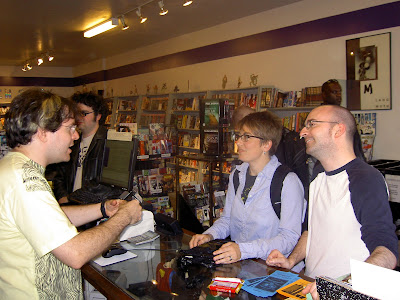
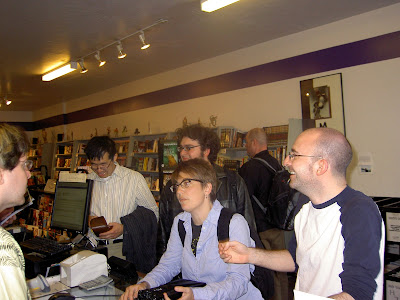
Anyway, here's just a few photos of the signing, and if you get a chance to turn up for one of Douglas's signings in the future, you should do so because he's great.

(the man himself, Douglas Wolk)

(I don't remember what Douglas was saying here, but it obviously entrancing)

(Douglas Wolk, Peter Wong, Ian Brill, Annalee Newitz, Graeme McMillan... it's like the entire Internet showed up for this photo!)

(Hibbs achieves enlightenment, courtesy of Douglas Wolk)

They Have a Plan: Graeme may have to wait two years to find out what it is, though: 8/22.

And in a strange bit of synchronicity, in the same week that I was talking about the Battlestar Galactica comics (Hi, Annalee), Dynamite Entertainment's BATTLESTAR GALACTICA: SEASON ZERO #1 presents itself for abuse.

Looking at it one way, I can see the draw of doing a Season Zero for Dynamite; the show itself has such tight continuity that it's hard (if not impossible) to be able to do any meaningful stories during that time frame - It's something that completely destroyed any sense of tension in Greg Pak's twelve issue run, as you knew constantly that everything had to work out in the end because the characters were just about to meet the Pegasus and you'd already seen that - not to mention the probability of stepping on storylines that the television crew are planning or wanting to keep for themselves. But on the other hand, I don't really care enough about what the characters were doing before the TV show started to read an ongoing book about it. Setting a series then removes the main thrust of the entire concept, as well as the series' main antagonists in any meaningful way, and instead relies on things that we've already seen in backstory from the television show (that, to be honest, in some cases work better as backstory and dramatic counterpoint to what's happening currently) to drive the story. And, again, we already know where we're going to end up, so without the introduction of all new characters that the creators can actually do something surprising with (thereby pissing off the fans who want to see Starbuck's ass), everything again seems kind of toothless and playing-for-time.

And that's the main problem with the first issue, at least. Yes, there's a small bit of interest in seeing Ellen, Tigh, Adama and his wife celebrate peacetime and talk about how easy life is going to be aboard the Galactica, but aside from that, the story feels pointless and a diversion from what Galactica is meant to be about. The conflict comes from a new set of characters with uncertain motives, but we've not seen enough of them to really understand why what they're doing is interesting, and because the one event that brought everyone together is years away from happening, the majority of the cast is missing, and - with the exception of Tigh and Adama - the character interplay that makes the TV series so engrossing is nowhere to be found.

As strange as it sounds after what I've just said, though, the creators try their best in the circumstances; Brandon Jerwa's structure matches the crosstime-cutting of some of Ron Moore's episodes even if his dialogue isn't quite there yet, and Jackson Herbert's art - while stiff in places - is thankfully much closer to the understated visual style of the show than Nigel Raynor's from the previous series. It's just that, ultimately...? I'm not sure anyone could make this book more than an Eh.

A great shape for the shape they're in: Graeme gets surprised, 4/5 of the way through from 8/22.

And this is where I surprise many of you by saying the following: OUTSIDERS: FIVE OF A KIND: METAMORPHO/AQUAMAN #1? You should really go out and pick it up.

I'm not changing my tune on the entire "Five Of A Kind" event, I have to point out. It's an entirely unnecessary series of books that almost works against the stated intent - I don't feel that anything I've read in the first three books (Nightwing/Captain Boomerang Jr., Katana/Shazam! and Thunder/Martian Manhunter, for those of you with a short memory) has done anything whatsoever to promote the new Batman And The Outsiders series, and may even have done the opposite and made the series seem less attractive with each successive issue - in the name of cash grab and filling shelf space. If you threw the entire series in my face and asked me yay or nay, I'd go for the nay option after complaining about you throwing something in my face in the first place. But nonetheless, this Metamorpho and Aquaman team-up succeeds where the previous issues have failed by managing two things that the others didn't: Having a story, and having some really rather amazing art.

Story first, because - as good as it is - it's the lesser of the reasons to look at the book. G. Willow Wilson, a writer new to comics (This may be her first published comic? I think she has a Vertigo graphic novel out soon, but I can't remember when it appears), comes up with a oneshot that succeeds on its own terms - It's nothing that will bowl you over, perhaps, but it's a solid short story that ties in to Metamorpho's history and attempts to introduce and explore its two characters' personalities as much as their superheroic powers and identities. As basic as that sounds, it's still something that none of the other books in the line have lived up to, and as a result, more than I was expecting here.

Much more than I was expecting, however, was the artwork by Josh Middleton. Don't get me wrong; I've liked Middleton's art in the past, but somehow was still unprepared by the clear storytelling, quirky linework and textural color he brings to the table here - It's a wonderful look that raises the writing up on every level and makes the book so much more enjoyable. Stylized and full of life, it's the kind of thing that can make you want to go back and find everything that he's worked on, to see just how he got to this (Disney meets James Jean, to my eye) place. Without Middleton's artwork, this would still be a fun enough read and still the best by far of the Five Of A Kind books, but with it, it's a high Good and worth reading even if the idea of Batman and his Outsiders makes you break out in hives.

My Life is Choked with Comics #6 - Soldier X #1-8 (and surroundings)

It was the day of Jemas.

A lot of things had happened to various Marvel comics since Bill Jemas had become president of consumer products, publishing and new media, with Joe Quesada as editor in chief. Reader attention had been mobilized, and several noteworthy projects had begun. Not every effort initiated in that time would be successful, nor would all of even be noteworthy, but in retrospect one can sense an atmosphere of relative experimentation, albeit one formed from financial strife.

And nothing screamed 'relative experimentation' like the extended X-Men line.

I've heard some call this period of X-history a 'progressive' era, one that extended roughly from writer Grant Morrison's debut on the freshly re-branded New X-Men in July 2001 to the X-Men ReLoad event of May 2004, a line-wide creative shift which served, in part, to erase some of the departed Morrison's most visible story and character changes, and in a wider sense marked a return to more emphatically traditional mutant superhero stories. But that period didn't just begin with Morrison; it saw a large number of upsets occur, in both the creative teams and the very directions of several series.

And there for the duration, just as indicative of the time as Grant Morrison, was Igor Kordey.

A Croatian-born illustrator, designer and comics artist, Kordey first became visible on the US comics scene as a painter, his first work for Marvel being the two-issue Tales of the Marvels: Wonder Years in 1995. His 20th century work at the publisher would not extend beyond that, and the two-issue Conspiracy miniseries of 1998.

Instead, he contributed to a number of licensed books, most notably offering extensive contributions to Dark Horse's Tarzan line, including a sadly unfinished 1999-2000 series titled Tarzan: The Rivers of Blood (four out of an intended eight issues published, never collected), which had been in the works for over a decade. Kordey both drew, and co-scripted with fellow Croatian Neven Antičević, who devised the story with noted Danish writer/translator Henning Kure. Two other Tarzan projects are worth noting for our purposes: the 1995 one-off Tarzan: A Tale of Mugambi and the 1998 miniseries Tarzan/Carson of Venus (both collected into a 1999 trade, named for the latter work), with Croatia-born writer Darko Macan. The two would reunite before an English-language audience during that period of mutant growth at Marvel.

The path of Kordey's latter career at Marvel quite neatly follows the trajectory of the 'progressive' era for X-Men and related books. It began in November 2001, on a revamp of the consummate '90s mutant character Cable. It ended with the July 2004 X-Men ReLoad revival of Excalibur, the very series set to do the heavy lifting of continuity adjustment. Kordey was set as the series' regular artist, but he was suddenly released from his duties the day prior to online solicitation posting, despite having completed issue #1 and begun work on issue #2. All of his material was replaced. He has not worked for Marvel again, although, interestingly, it appears that he was offered the troubled Combat Zone: True Tales of GIs in Iraq project, that Dan Jurgens eventually drew.

But it wasn't just a straight path from the revivials of 2001 to the counter-revivals of 2004. There are always bumps in the road. Surely the biggest bump in Kordey's time with Marvel was his infamous run on Morrison's New X-Men, where he began as a fill-in-for-a-fill-in. These, it is sad to say, are likely the works Kordey remains best known for across the whole of English-language comics. Given the popularity of New X-Men, and its status as prime X-Men book of the day, it was likely many readers' first and only exposure to Kordey's art.

And if all you had read were those issues of New X-Men, you might have thought Kordey wasn't worth much. Pages seem ripped apart with gashes of thick black ink. Poor Cyclops looks like he's been punched in the face for a full hour. Those leather Frank Quitely costumes seem to seethe like hot, stretching tar. Reading over the material, it's frankly not as bad as I remember it being, but it's still not good.

The problem was, Kordey could draw an entire 22-page comic in about 10 days. And he did, when both primary New X-Men artist Frank Quitely and fill-in artist Ethan Van Sciver couldn't keep with the deadlines, and X-scheduling got tight. He shouldn't have, but he did. "I was my only judge, jury and executioner all the time," Kordey later mused (see link above). He drew more issues after that. And an awful lot of readers disliked him, greatly and biliously.

But for much of his time at Marvel, Kordey was a fine talent. From his b&w line art, it's clear that his range extends from graceful cartoon observation to well-defined, idiosyncratic realism. He could also do some nice action and careful environments, although neither of those examples are from Marvel projects. Color did not sap any power from his lines, which worked well with both rich and faded hues. But his lines were not quite like what usually graced a superhero comic, even though they were rather close; I suspect that some readers who did see more of Kordey's work than was displayed in New X-Men, probably didn't care for it much anyway. Yet it was the rushing, I suspect, that always colored the wide view of his work. Hell, people disliked those New X-Men issues so much I've been on message boards where Kordey's work was used to slam Quitely, some posters unable to distinguish between the two men's work. Dislike that potent can be projected.

Yet Kordey's style was fitting for Marvel in 2001. Kordey didn't entirely draw like a superhero artist, and he can thus been seen as a perfect representative for books that didn't entirely want to seem like superhero comics, for a short time, for better or worse.

Take the Cable revival. Written by David Tischman (usually a writing partner for Howard Chaykin, who was initially meant to supervise the series but couldn't), it saw the famed time-travel gun messiah decide to travel the globe, finding various scrupulously-researched 'hot spots' and affecting present-tense change by shooting things and alluding to his backstory. It was a decent run, with some vivid secondary characters and convincing political settings, but it ran into the same problem faced by several of these superhero hybrid projects - the superhero elements sat uneasily in the larger work. For me, every mention of baroque X-Men continuity kind of tossed me around; it's not that you can't have a serious political gunfire comic with superpowered people (Golgo 13 isn't all that human, after all), but you have to be very careful with the mix. Tischman didn't do a great job of matching mentions of the Legacy Virus and such up with his larger international action story - it's like that whole 'Marvel superheroes' business kept getting in the way, lousy stuff!

Interestingly, in the back of the first trade paperback collection of Tischman's run as writer (Cable: The Shining Path), Tischman's series proposal is included as a bonus feature. And that proposal actually does a much nicer job of integrating the mutant superhero and political explosion elements of the project. For example, in the first storyline Cable finds himself mixed up with a group of Communist revolutionaries in Peru. This group has neatly mixed mutants in wih humans, and Tischman proposes using this setup to draw parallels between Communism and the famed 'dream' of Professor X - both deeply idealistic, and both doomed to fail when put in the real world. You can make out echoes of this theme in the story itself, but the execution tips the balance greatly toward the politics, leaving the superhero stuff to look lost.

Also in the proposal was an ongoing focus on Cable's role as Askani messiah, master of a future peaceable-yet-proactive philosophy that he hopes to plant the seeds for, thus saving the future. Tischman and Kordey even managed to cleverly use Marvel's 'Nuff Said no-dialogue gimmick month to have a special issue in which Cable finally overcomes the techno-organic virus that had always held his amazing mutant powers back, thus giving him the uncontrollable power of a god. Tischman seemed to want to develop the spiritual aspect of Cable in greater depth as the series went on. He didn't manage it himself; having started on Cable #97, Tischman ended his run on the book only as far as issue #104. For Tischman's final four-issue storyline, seeing Cable dealing with clashes between ethnic Albanians and Macedonians, Kordey aided with the story for the first three chapters, and became primary writer for the final one.

At that point, the writing chores were taken over by the aforementioned Darko Macan.

I think it's very useful to read all of Tischman's material, plus Tischman's proposal, and then all of Macan's material, because the whole thing is an excellent example of how one writer can pick up the work of a prior writer, introducing his own themes and his spin on the material, while continuing the work already started. If Tischman wanted to go farther with Cable's spirituality, and his attaining the power of a god, Macan absolutely presses it to the limit. The final issues of the regular Cable series, #105-107 (featuring some rare fill-in art on #106 from Mike Huddleston and John Stanisci), sees the title character really struggling with his powers; he accidently wipes out dozens of minds in a secret fighting arena, evaporates a building housing a nuclear weapon, and becomes tempted by a Singapore zillionaire who wants him to shape the whole world -- not just a few countries -- as a corporate-backed God. The last of the Tischman issues and the beginning of Macan's run are collected in the trade Cable: The End.

And that was the end of the Cable ongoing series.

Which leads us to Soldier X.

Which is actually the old Cable series, with Macan on writing and Kordey on art, but retitled in a multi-series, mid-2002 effort to goose sales and better set up revamped properties as individuals (and maybe make them easier to get rid of, should the need arise). X-Force became X-Statix, Deadpool became Agent X, and Cable became Soldier X.

Kordey and Macan lasted for eight issues on Soldier X. Sales were not good. The material was never collected. But these issues are some of my favorite things from the X-Men revamps of the period, ideal back-issues to stumble across, loaded with eager personality, and willing to boil the tortured concept of its lead character down to the essence of superhero metaphor, while retaining the global outlook of the stories that came directly before it.

There's more comedy than before, and maybe a excess of ambition to the structure - the first six issues tell a long story, which zips the character's 'present' timeline to two years after the end of the prior series, yet acts as a lengthy flashback to near the prior present, as a Daily Bugle reporter reviews a disc of information sent to her from Cable about his transformative adventures. Even as the flashback material occurs, we see Cable's present-day recorded narration via caption; sometimes it falls into the trap of telling us what we're seeing, but more often it exposes the stony character's impressions on what's going on.

But the first issue barely even features the main character, instead following the reporter as she sits through terrorism fear bedlam on an airplane, has her job endangered, meets with bumbling agents of S.H.I.E.L.D., encounters a sumo wrestler in a Sailor Moon costume, and more. Kordey's character art by this time has grown broader, perhaps as a result of his punishing workload, but it matches Macan's tone perfectly. Often, Kordey delivers 23 pages of new art instead of the typical Marvel 22; this is because several of the recap pages are fully-realized pieces of art, with a different character explaining the plot to the reader in their own voice. At one point, the recap page actually appears in the middle of an issue, as a minor character stops the book with converse with YOU. Several jokes are made at the expense of the book's cool new title, and the plotting is deemed "enchantingly meandering" by its own cast of drawings.

I can't say they're wrong - the plot is all over the place, with Cable meeting up with what seems to be his wrinkled Yoda-like mentor Blaquesmith, except the once-sage little imp has become a total hedonist. He directs Cable toward a young mutant in Russia, who seems to have Christlike healing abilities - touch and be cured. Along the way, a large supporting cast attaches, including the girl's drunken father, her controlling-yet-devout mother, a gang of Armenian gangsters, a mob of devout Christians looking for healing, and a bizarre Russian surplus superhero named Geo, who's taken to blowing up empty fast food restaurants in protest of globalization. The action moves (gradually) from Russia's urban environments to the countryside, and then on to St. Lenin, "an old factory, where a mad artist used to work on blending Orthodox and Communist iconography. In a way it made perfect sense. It made sense because it made no sense at all."

Some might extend that notion to the story itself. Characters often don't act so much as converse. Sequences of mutant action mix with images of the grotesque, like the little mutant girl kissing a grown man's massive chest of boiling sores. This mix of tones and approaches is handled very carefully by Kordey, though, his art often adopting an especially Corbenesque character, emphasis placed on squat, weathered characters walking through rough but vivid places. It also manages to 'sell' the mutant superhero angle a lot better than the prior stories, if only through its general air of anything going.

And Macan's story really does cohere very nicely. It's a detailed parable for personal spiritual awakening, kissed with a unique concern for Westernization and ethnic & capitalistic conflict. The Armenians are determined to be better exploiters than victims, but all of them dress like American gangbangers, and some are obsessed with a movie hero notion of being 'hard' men. They want the little healer girl for money, but her mother wants her because religious faith is all she has, and there is nothing finer than to be the mother of a Saint, even if it means the child is martyred. The girl herself makes a mid-story transformation from healer to a type of succubus, drawing strength out of people when she used to give it away - a nice little story about religious faith, that. Geo challenges the confused Cable to stand for something:

"I want the right to be a hero WITHOUT LOOKING like one! I want a world where I could be EQUAL without being the SAME!"

Feel free to indulge in any metafictional reading that pleases you.

Anyway, Cable eventually wakes up. He even undergoes a scourging, his skin torn apart by "three thousand" bullets, then even more of it torn off his body in long strips by people eager for healing. Needless to say, he rises again, even if he doesn't die. He grows to giant size, and strips all the metal off his skin, and decides that if he has the powers of a god, he ought to start acting like one. Clearly, the superhero-as-God theme isn't a new one (even the unfortunate film event Superman Returns came complete with an ill-advised Jesus subtext); what makes it work here is Macan's investment in an emphatic catalog of beliefs among characters, recognizing that religion and politics and philosophy and ethnicity often cannot be separated. And I can't say I've ever seen that subject matter addressed quite so effectively through the broad men-as-gods sweep of a Marvel superhero comic.

The final two issues of Kordey's and Macan's Soldier X more or less act to complete the work's themes. Issue #7 suffers from what seems to me like evident compression problems, owing to a creative team being asked to clean off their desks and wrap things up. Sales weren't good, you know. Cable flies around, using his powers for uniquely non-violent godly purposes; he wants to demonstrate that having destructive powers doesn't mean you need to use them. He discovers that the Blaquesmith he met was a fake, but the impressionable imp becomes Cable's disciple, reversing the master-apprentice roles.

And issue #8, just like with the end of Morrison's New X-Men, whisks us far into the future, to the year 4006, long after the seeds of Cable's Askani way have taken hold. For this issue, colorist Matt Madden works directly from Kordey's pencils, creating a delicate, unreal sensation. The story follows a young Askani boy and an older woman, who travel to a nearby town to defuse a race skirmish, and serves mainly to underline the themes of the stories that preceded it, and show that the man-and-god influence of Cable has congealed into a semi-misinterpreted religion that nevertheless equips people to face most of the same problems as existed in the past. Not a bad Christ metaphor, which is what they're going for. But Cable gets off a little easy in comparison - we get a flashback/flash-forward to Cable's peaceful death, in one of those sequences (I'm a sucker for) where nearly all of the characters from Macan's and Tischman's stories show up to implicitly say goodbye.

Ha! I told you Macan worked to further Tischman's themes! All of these Cable/Soldier X plots add up from the nation-by-nation focus of early issues to the broadest effect of all, if one ironically dispersed in impact. This is a rare occurrence in modern superhero books, where lines are often drawn by writers. Here, it is Kordey, the artist and sometimes-writer, who is the constant. And that may be due, by and large, to his embodiment of the time.

Solder X went on for two more issues, under a different creative team, and then ended in late 2003. Marvel didn't seem to know what to do with Kordey. He'd have been excellent on The Punisher MAX, had the series not had months to go before it started. Instead, Kordey was puzzlingly placed on what I gather was the most traditional, most stylistically conservative of the X-Men line, Chris Claremont's X-Treme X-Men. Kordey was not an easy fit with such classical superheroics at all. He ran into content clashes with editorial. He blanched at being assigned inkers, which to my mind (given my limited exposure to the work) seemed to act as a means of slicking his work up, to hammer it into a 'proper' superhero approach.

By the time ReLoad came around, Kordey was gone. He'd later do lovely work on the IDW series Smoke. He'd work on the first two albums of project for French publisher Delcourt, L'Histoire Secrète. I don't know what he's doing now.

But you can still find his works scattered. They might not collect them, but they can't hide them. I continue to see Kordey's Marvel work as perfectly of its time, yet never really dimmed by what few years have passed. I think his reputation will get better, as time burns off the snark and controversy, leaving the work. He was fast. He was good.

Maybe he'd have even gotten this column in on time.

I'm orbiting Pluto, drawn in by its groovitational pull: Graeme uprises into 8/22.

It's both a complement and an insult to say that HALO: UPRISING #1 reminded me of some old European Heavy Metal-type comic, I guess.

Visually, at least, it's all complementary. Alex Maleev's art has never really fit the American superhero market to my mind - not that that's a bad thing - and his recent work for things like Illuminati or Civil War: The Confession have seemed pretty but out of place, some awkward attempt to give those books gravitas that they didn't really deserve. Here, however, his photo-referenced, John Van Fleet-lite, work makes more sense; I'm not familiar with Halo at all - I've never played the game (Games? Is there more than one?), and I didn't look at the graphic novel released last year - so I came to this with no preconceptions as to how the world should look, which may be one reason why it worked so well for me, but I think another is that Maleev's work should be on some kind of "War is Hell" book, even one that's all about how Space War is Hell as well, you know? He has the grit and realism for that kind of thing. It's not just the artwork that makes the visual aspect work so well, however; the lettering is a factor, with its square dialogue balloons and slightly-too-large font. It's different enough to remove the reader from the other Marvel books' context and, indeed, place them in a Heavy Metal frame of mind instead.

The less-than-complementary aspect of it reminding me of a European book is in Brian Bendis' script which isn't so good. It's not just that his dialogue seems to be more artificial and self-conscious than usual, but that there are times when what the characters are saying seems completely divorced from the visuals (In particular, there's a torture scene where a character is clearly in pain and begging to be released in the dialogue, but nothing is happening to him visually; he doesn't even look as if he's in pain) - it all reads like some kind of bad translation or misunderstanding of original (probably French) dialogue, for some reason. Not that the writing is especially bad, but it certainly falls into Bendis' special "Interesting failure" category at this point.

Whether you dig this book or not depends, I think, on how much you want to dig it. It's certainly flawed, and not for everyone - if you dislike Bendis and Maleev, there's not enough sci-fi to pull you through, for example - but I can't really say that it's appalling or such. Instead, it's pretty much just Eh. But then, I never really liked Heavy Metal.

Sick, tired and sober: Graeme finishes up 8/15.

Ah, starting off the week with a sick day is either (a) a good way to have a three day weekend, or (b) a really, really bad way to make a busy week just that little bit busier. You be the judge, but I'm leaning towards the latter option. For now, have a round-up written in a state of belly-churning haze. I'm pre-emptively apologetic about it, if that helps...

ACTION COMICS #854: If there was any doubt in my mind that Final Crisis was going to involve some kind of continuity reboot yet again, this issue - or maybe COUNTDOWN #37, which really started the whole "Jimmy Olsen knows Superman's secret identity now" thing - removed it entirely. Much more than Jimmy knowing who Robin or Wonder Woman are on their downtime or even having superpowers himself, knowing just who Clark Kent really is marks Jimmy for some kind of death/rebirth/mindwipe down the road very very clearly. Which is kind of a shame, considering the other things that Kurt Busiek sets up in the Action issue, in particular Jimmy's new ownership of Krypto the Super-Dog. Action is still a fun Good, but Countdown only manages to be passably Eh (Nice Stephane Roux art on the back-up origin of Poison Ivy, though).

BLACK CANARY #4: Somehow, both Hibbs and myself completely missed that there was a third issue of this, but that kind of suggests that we care about it more than is actually the case; this final issue just manages to hammer home how little this story was actually about Black Canary, and how much it was really about removing the developments that Gail Simone had come up with in Birds of Prey so that DC can go ahead and get her married off to Green Arrow without having a pesky foster daughter or any of that "independent, smart" stuff. Seriously, whoever came up with the "You made me think that my daughter was dead, but really you'd just kidnapped her to be trained by monks so that she doesn't grow up to become an assassin and I can never see her again? Of course I'll marry you!" ending? What was that? Crap.

CAPTAIN AMERICA #29: Just when you think that he'll zig, Brubaker tends to zag, especially on this title, which continues to be much more interesting without the lead character than with... Now, if they could just get poor Sharon into an outfit that doesn't look like something Dazzler wore in the '80s, everything would be Good.

JUSTICE LEAGUE OF AMERICA #12: It'd be lazy to say "Yeah, what Hibbs said," but that's pretty much the case. Meltzer's run ends with what is more or less a fill-in issue instead of any kind of summation of what he's done so far, including advancing (or in some cases, creating - Geo-Force is an informant for Deathstroke, but really he's double-crossing him? Huh?) subplots that he had no intention of finishing any time soon. You can see what he was going for, but it falls far short of being anything other than Eh.

OUTSIDERS: FIVE OF A KIND: THUNDER AND MARTIAN MANHUNTER #1: Interesting mostly because of the needless Countdown crossover (Someone is killing the New Gods! I get it already!) and J'Onn J'Onnz's portrayal - I guess that "angry young Martian" thing from his recent mini didn't last long at all, then - than anything else, this is thoroughly Eh. The new Batman and The Outsiders series isn't looking in the least bit promising at this point.

SPIDER-MAN FAMILY #4: Jeff Parker and Leonard Kirk reunite with their Agents of Atlas again in the fun lead strip - which feels curiously old-fashioned, in the way that the creators and characters are going through different books instead of just being launched into their own ongoing immediately - and the reprints include Mary Jane #1. It's as if this cheapie anthology title is made for me to continually tell everyone that it's quirky, offbeat and thoroughly appreciated in these regions, which probably dooms it to cancellation within the next year. Until then, it's Good and worth checking out.

TERROR INC #1: If anything was designed to give me that special "Wait, what?" feeling over and over again, it's this gonzo crime horror book. It's one of these things that I'm convinced that I shouldn't like, but I do, and feel guilty about it. There's nothing original or even that entertaining about it, other than the strange relentlessness of the whole thing, which I'm sure will have worn thin by the end of the next issue, but still... It's... Okay, somehow. Which feels wrong to admit.

What did the rest of you think?

No new mysteries: Graeme listens, chum, to 8/15.

I missed the boat on Ultimate Spider-Man. I'm big enough to admit that. I read, what, maybe the first four or five issues or so, and thought "Eh, that's pretty good, but do I need to be reading Spider-Man for?" Cut to, what, six or seven years later and I've devoured all of the Essential Spider-Man, Essential Peter Parker, and Essential Marvel Team-Up books and - finding the current Spider-books lacking - find myself on the lookout for something to provide those old-school Spider-thrills.

Cue ULTIMATE SPIDER-MAN #112.

I'd been hiding from this book for awhile now, despite suspecting that I'd like it a lot. The idea of catching up with a book that had 100+ issues of tight continuity and references put me off, and I longed for a good jumping on point. And then, as if by magic, Stuart Immonen appeared.

Here's the funny thing, though; as much as I love Immonen's art, the reason this book was enjoyably Good for me was almost all down to Bendis's writing. Immonen's art, in fact, seemed more static and awkward than usual here, with his Peter Parker in particular seeming kind of off (I think it's his tiny little mouth), although there are still parts that impress (His school hallway crowd scene towards the end of the book, for some reason, sticks with me). Bendis's writing, meanwhile, manages to juggle the so-familiar-that-it's-almost-funny sitcom plot of Peter's school life with the none-more-ominous return of Norman Osborne in such a way that he makes it look easy, and this is a book where the Bendis dialogue tics are a strength rather than schtick - Suddenly Peter is funny again, and the angst is legitimate teen angst, rather than dull, "Is my wife going to die," angst. It's such a whole new world that I feel even more dumb for missing the boat the first time around, until I read all the rumors about the Ultimate universe folding up post-Jeph Loeb's involvement...

I Didn't Buy a Lot of Comics This Week: Jog is quick with the 8/15 review, since it's now 8/20

But then, I didn't get to review issue #1 of this over here. Also: this series reminds me so much of The Winter Men, which was a really nice series, and still has a long-lost final issue to go, and I wish it'd be out soon.

The Programme #2 (of 12): Well, I suppose you can tell whether an issue of soap opera is for you by your reaction to "Get out of my sight before I tell daddy to load his shotgun and blow your lousy Jew-loving head off!"

Which is an actual line uttered by a jilted lover to her formerly straight-arrow boyfriend, who met a pretty Jewish girl, got called a fascist, dropped acid and woke him up to how America's supersoldier program is bad bad bad. The boy later turns some subversive dials on the supersoldier machine, heads for Canada, writes books on American imperialism, but then gets dragged back home by the CIA to tend to our errant superman, who probably ought to beat up the Soviet villain flying around the Middle East.

This brand of high-pitched melodrama and ultra-blunt politics won't appeal to everyone, and it doesn't entirely appeal to me, particularly since artist C.P. Smith, when faced with long stretches of dialogue, has a Tony Harris type of habit for broad facial expressions and exaggerated body acting, which never quite work for me in as heavily realist a character art style as this, even when colorist Jonny Rench splashes it all with as many garish hues as he can manage. I still think the interplay between realist character art and splashy color/shadow work gives the book a unique feel, energizing Peter Milligan's script with a lot of extra nervous energy, but this chapter suggests that maybe the series needs to lean heavily on the fantastic in its story content, so as to better serve its visual aesthetic.

Still, I can't complain too much with exchanges like:

"The Spirit of Lenin! Whoever came up with that name should have been shot."

"He probably was."

OKAY, and I wait to see how it goes.

Me Me Me: Graeme's selfish 8/15 review.

I'm sure that the usual suspects already have the knives out for THE FLASH #231, Mark Waid's reboot of the title that made his name fifteen or so years ago (and, by the way? Now I feel surprisingly old). I don't know what their complaints will be, exactly - That it's unrealistic to see the former reporter Linda Park be recast as a scientific genius doctor thanks to a remedial course on some alien planet offpanel? That they don't want to see their childhood favorite superhero with kids, because that's not what they think kids want to read about? That the issue of just what happened to Wally and family post-Infinite Crisis is more or less avoided beyond saying that they were on vacation on an alien planet? - but this was one of those books that, as I read, I could almost feel people wanting to complain about. Maybe I'm just getting cynical and sensitive in my old age, because personally, I thought that this was really Very Good.

One of the pluses is that this clearly isn't Waid revisiting past glories - not only has he ditched his old device of Wally narrating each issue starting with "My name is Wally West. I'm the Flash, the fastest man alive," but with the addition of Wally's kids, he's revised not only the set-up of the book but also the tone; it reads as something lighter than when he was last on the book (and definitely much lighter than Geoff Johns' run on the series, or the short-lived Bart Allen version of the character), as much superhero sitcom as all-out action book (Something reflected in the punny title: "The Wild Wests"). Daniel Acuna's artwork - reminiscent in places of Kyle Baker's work on things like "You Are Here" - helps with that, especially in panels that are essentially visual gags to play off the dialogue (Wally's expression as he deals with superspeed diapering, for example), and his lush coloring helps make the depiction of the speed effects one of the more impressive in the character's history.

The result is a book unlike any other superhero book that DC is putting out - Visually impressive with a digital look approaching painterly animation, and a family-friendly tone that thrills and amuses without excess. I hope that the rumors are wrong, and that this team is on the book for the long term because, really? This is the kind of superhero book that I'd love to see more of.

Bobby's got a gun that he keeps beneath his pillow: Diana dismantles 8/18

David Lapham is either very clever or very confused. TERROR INC. #1 is the latest release for Marvel's MAX imprint. Like most MAX comics, what this actually means is that it's a standard Marvel story with copious amounts of awkward sex and violence attached in a very forced and artificial way (not unlike Justin Timberlake's faux-ghetto routine - he's from sodding Memphis, for God's sake, who does he think he's fooling?).

It's a bit backwards, isn't it? Rather than be branded "for mature readers" due to content, I get the feeling that this issue's content was determined with an eye towards justifying the brand. You have to wonder whether Lapham's first draft came back with "MORE BLOOD & BOOBIES" written all over it.

The last time I saw Terror, he stole Arana's severed arm and was trapped in a future nobody cared about. Lapham anticipates this problem and seems to start from scratch, spending most of his first issue introducing the protagonist. This is where I don't know whether he's being smart or scattered: Terror survives by stealing body parts and attaching them to himself, making him a sort of patchwork monster. And the story itself is a chimera as well: a bit of 300, a bit of MARVEL ZOMBIES, a bit of CONAN, a bit of... well, take your pick from the "mercenary tricked by government" sub-genre. Is Lapham just throwing stuff out there in a blind panic? Or was this a deliberate creative decision? It's hard to say for sure, because I've seen plenty of writers gleefully hurl the kitchen sink at their readers' heads in an attempt to engage them; then again, Lapham can be tricky when he needs to be.

Either way, I can't give it much more than an EH, because even if the structure was intentionally designed to mirror the main character, it didn't make for very interesting reading beyond "well, isn't that a cute idea." Part of the problem may be that, as a hybrid creature, TERROR INC. doesn't seem to offer anything you can't find elsewhere; the downside of incorporating so many different sub-genres is that none of them have much breathing room, and if zombies are your thing, you'd probably be more satisfied with something like THE WALKING DEAD or MARVEL ZOMBIES, simply because those books deal with the subject matter as a central theme.

Abhay Reviews Comic Books For Website; Wishes His Life Had Gone Differently

I'm going to try my very first classic Savage Critic style lightning round-- horribly slow and wordy lightning! Excited? Don't be! The Chemist: This is the new Image "crime" comic from Jay Boose. Though Boose's day job is (or was) apparently Pixar animator, the comic reminded me more of a "Youth Restricted" anime from the 1980's: the cool car, sexually charged bimbo sidekick, amoral and sexually frigid super-professional main character, even the main character's name (Vance!), all remind more of Riding Bean, say, than Monsters, Inc. The comic starts promising as Vance and his sidekick are at first portrayed as unrepetent drug dealers, which I found quite charming; unfortunately, the comic pulls its punch and while the girl sidekick is still a drug dealer, Vance pussies out on us: "I reverse engineer prescription pharmaceuticals for the ninety percent of Americans who couldn't afford it otherwise." What the fuck is that? Apparently the thrill-a-minute world of discount pharmaceuticals is lucrative enough to give him a cool car, an apartment out of Beineix's Diva, an intimate knowledge of how to handle gunfights with generic mobsters, etc. It feels like the Hollywood choice instead of the story choice, but, like I said, the girl sidekick is a happy-go-lucky drug-abusing dealer so points to Boose for going that far at least. Anyways, it's not really a crime comic, so much as a light-hearted male fantasy of banging a mentally-retarded pixie. All the drugs are mostly window-dressing for a comic about the bimbo sidekick acting cutesy / quailtarded. I like caper stories enough to have had a good time, and I like that it gives so much space to its characters even if I didn't enjoy their company as much as Boose does. You know: not great, not horrible, good choices, bad choices-- what's there to say? The art's accomplished. It has that "frames from a cartoon" feel that certain older Kyle Baker comics once had-- the colors are rich and consistent, and the acting is expressive. Unfortunately, a reluctance to cover too much of the art with word baloons often leads to cramped, unpleasant lettering. I hope Boose does more comics; I just wish the main character sold crack.

Fun Home: The lady's dad turns out to be gay! Very Good.

Drockleberry Book One: Swell art (the easy comparison is to Tony Harris and I'm too lazy to go past the easy comparison) compliments this inscrutable, slow, ambitious, confusing, adjective and jaggedly-paced apocalypse thriller. Early on, the going is rough and the dialogue frequently devolves into sub-Vertigo "look, Ma-- I have attitude!" one-liners. For example: "If bad news were x-lax, you and I and this whole fucking planet would be sink'n balls deep at the corner of shit fer luck and go fuck yerself"-- do you understand what in the fuck this means? I don't! Is the author trying to sound like one of those UK writers? Or worse: are they from the UK? Let's hope not! It's often more content to show off than clearly present a story-- here's an excerpt of narration to give you an idea: "The weavers, for all their great mystery, were predictable in at least the one sense, that they would suffer nothing which threatened the pristine, if not baffling order of their amaranthine efforts." So: yeah, it's pretty amaranthine all up in that mug, but the art is strong enough that it's not such a terrible thing having to watch this comic show-off, no: Andrew Dimitt's work is increasingly stylish as the pages go by. It took me around 40 to 50 pages to start to understand the plot, though-- Dimitt frequently seems to set up scenes where the plot is about to be explained in clear language, and then cuts around those scenes. But the plot, to the extent I understand it, seems kind of compelling. It's a bit dismaying how much of the apocalypse Dimitt has happen off-camera, though, but at least that seems like there's a reasoning behind that choice. At minimum, Book One ends on an interesting note, a strange and promising cliffhanger-- I'm under the (possibly mistaken) belief that Dimitt is taking a break from Drockleberry to pursue BENTHIC ANGELS, a project with Dan Goldman(SHOOTING WAR). Anyways: I'm a sucker for comics about the apocalypse and Dimitt provides enough eye candy that I'm willing to indulge him enough time to work out some of the early kinks. And this is the kind of reason I visit the Act-i-vate site: flawed work, yes, but because a talented creator is taking advantage of an opportunity to attempt things he wouldn't be allowed to elsewhere in comics. How much can I shit on that without looking like an asshole? Less than I have in this review. Be advised, though: the final 20 pages or so seem to only be available at the Act-i-vate site as of the date of this review.

Jeff Smith's Captain Marvel: How would I know? I'm a grown man.

Jonah Hex #21: Jordi Bernet supplies his typically wonderful art for an exploitation ramble from "Gray & Palmiotti." The comic opens with comic book bimbos being mercilessly raped, then it cuts to a 100% unrelated story of criminals on the run from Jonah Hex who are instead scalped by a deranged Native American, until winding back to reveal that the bimbos have been raped to death during the comic's long and pointless digression. Cue: more violence, and hee hee, the end. I don't read this comic regularly, but if they're all this empty-headed, oblivious to story, pointless and cheerfully exploitative, I might start. I'd seen a couple of Phil Noto's issues which were slick and appealing, but I think Bernet is better casting for the book since Bernet seems more comfortable drawing a Wild West with dirt in it. Still: does every issue feature racially-numb-skulled amaranthine imagery and completely pointless gore? I hope so! Let's find out together! Yet another comic book where I'd have been happier if the main character had sold crack.

Lil Abner: This stretch of strips from March 23 1955 to April 18, 1955 is a pretty good time if you enjoy humor about rural inbreds as much as I do. Lil Abner needs to win a cake-baking contest for his wife, but he's too embarrassed to admit he cooks to the other men in his town. Cross-dressing capers ensue, and the plot whizzes around hither and dither in a pleasing way. Years later, Al Capp would be accused of sexually harassing Goldie Hawn. But I really like how characters in classic strips like Abner have their own way of speaking-- it seems like people in Comic Strip World used to have their own language. Even in comic books, there used to be all sorts of amaranthine expressions that originated in comics: "Great Ceasar's Ghost" or "Sweet Christmas" or "Holy Human-shit, Batman" or "Blood-Soaked Pubic Hairs!" It's strange that such a once-popular aspect of cartooning has almost completely dissappeared. Or maybe it hasn't disappeared and I'm just forgetting a bunch of examples. I don't really care.

I Killed Adolf Hitler: Scandinavian comic superstar Jason presents another funny-sad funny-animal comic, this time a time travel action adventure story involving professional hitmen, a time machine, and Hitler. I liked how the comic used Hitler: the comic spends a lot of time with people who believe their lives would be better if someone else weren't around, so including Hitler in the narrative makes a satisfying amount of sense, for obvious reasons. Except there's something about a Scandinavian dog version of Adolf Hitler that's both disturbing and funny to me for some reason I can't quite articulate. The genre horseplay early on wasn't terribly interesting to me, but eventually it settles down to being about regret and sexual frustration and depression, all that good stuff what was the dance that brought me. I don't know-- it's a good time. It doesn't come up in the comic, but many historians believe that Hitler had a fetish for urinating on his girlfriends.

Plain Janes: I read this comic a long time ago, and while I didn't like it much, I had a few positive things to say at the time since I like Jim Rugg and how he draws so much. But boy, this comic has just festered with me since. Festered! I really just get mad to think about it-- it become this thing in my head of ... Look: they release a comic-- it's incomplete. It has no third act, no plot resolution, none of the character arcs are resolved-- it does not have a proper ending. They wait a while for suckers like me to buy it. Then, they announce a "sequel." Explain how that's okay to me! Explain it! The writing and the art are both fine, it's the product of talented people, super, great, fine, but boy, I just can't stop being mad about this comic and the culture that produced it. I keep hearing nice things about the other Minx books, but I just don't trust them. Of course: I'm not a teenage girl, so how worthless is my opinion? Very! Still: anger!

What do you think? Oh, how special you are! Haha, just kidding: you suck-- I don't care what you think.

Hibbs explains it all.

Over at Newsarama, Hibbs talks more about the POS system in the store:

"I’ve only been using POS for two weeks now; and only the one system, so nothing I say on the topic should probably be granted that much weight, really, but I can already see how this is going to transform the way that I operate my store, my ability to properly order things that have fallen “off my radar”, my accidents in double or triple ordering some material, my access to data for customer searches and special orders, and so on. If I can enact even half of the efficiencies that POS promises my store should quickly become that much more efficient and profitable."

It's not necessarily that easy, though. Go and read why.