Same Old Show, This is the Killing Of A Flash Boy, Oh: Graeme on another 8/15 debut.

Let's get the obvious things about KILLING GIRL #1 out the way first. Yes, artist Frank Espinosa is a very stylish artist, especially when he handles the coloring as well as the brushwork, as he does here; the art here is easily the best thing about the book, to the point where I wonder whether Espinosa's absence from the series in the last Image solicits (Toby Cypress is listed as artist, instead. Having seen Cypress's art in The Tourist awhile back, it may actually be an improvement, but I digress) will hurt the series' chances with the audience in the long run.

That said.

Espinosa may be too stylized for his own good, especially on this book - his retro '50s sense of line and color is not only at odds with the subject matter. It's too attractive, for want of a better way of putting it - it's not that there's an interesting cognitive dissonance (Hi Johanna!) between the two, but that they just plain don't work together - and also, at times, hard to read what's happening successfully. It's frustrating to read, because you know that Espinosa's a talented artist; he simply needs an editor to tell him to take another pass at a page every now and then for his stuff to be completely drop-dead wonderful.

The story, meanwhile, doesn't live up the art, no matter how flawed the art may be. Sad to say, there's nothing in the writing that you've not seen before, and done more successfully, at that; the dialogue is cliched, the plot relies on coincidence too much (The boyfriend of the assassin's long lost sister just happens to run into her at a stoplight? Really?), and the whole thing is slathered in narration that makes you feel as if the lead character has only ever read shitty airport spy novels in her entire life. Which is to say, it's not a very good story, sadly.

The end result is a book that pairs the most generic of writing with art that could do with being a little bit more generic, which is as unsatisfactorily Eh as it sounds. An oddity, but not necessarily an interesting one.

What's wrong with this picture?

[Apart from the fact the only stuff I've posted on a comics review blog lately is this pictures, a movie review, and a shill about my garage sale?]

I'd opine there's something wrong with throwing these books in a quarter bin. Some of them are too recent, most of them are too expensive, and a few of them are just too good to get thrown into a big long box and let go for a quarter.

This is exactly the kind of hopping-blind anxiety I go through for the annual garage sale: usually, I start out by worrying that nobody's gonna show if I'm not making some outrageously good deals (except Joe Keatinge and Chris French, who then go on to mock me); then I move through a stage of avarice where I go and pull the books that are surely worth a bajillion (which I then check on Ebay to find, most of the time, that if I hustle I might be able to sell the books at a profit... as long as I bill out my time at about ten cents an hour), then laziness sets in and I throw most of 'em back in the box, then despair, etc. It's quite the comic book passion play, with me moving through all the stages of the long box.

Anyway, these books are definitely going out--stuff I've since gotten in trade, stuff I read and enjoyed but realized I would never read again, stuff I thought was overhyped but might be a fun read for a quarter--and I've still got to make the call on many others (since I have Promethea, Preacher and The Invisibles in trade, why am I holding on to the singles?): there's gonna be a lot of fun early '80s junk, I'll have at least one bin of supercheap toys, a long box of trades, and about 25 PS2 games that are hitting the chopping block.

Again, that's this Saturday, from 9 to 4, at approximately this location (there's about eight dopes who pay extra to sell along Cortland rather than out of their garage, and I'm one of them. Of course, they usually don't let us know until the day before the sale, if then....) and I hope you can make it. If you know me and think you can make it, drop me a line and I'll put aside something for you.

Now, if you excuse me, I've got more sorting, hauling and panicking to do...

Death March With Cocktails: Graeme gets into a pilot from 8/15.

I have to admit, I kind of like the idea behind Top Cow's "Pilot Season." The idea of trying out six books and seeing which two have the best response before greenlighting ongoing series for them seems like a smart move - although the cynic in me wonders whether the voting is going to end up rigged, or whether the series that get the nod to continue are going to have the same creative teams - and the choice of creators on some of the books is both interesting and potentially exciting. Take the team behind RIPCLAW: PILOT SEASON #1; Jorge Lucas may be the kind of artist that you could've imagined on a spin-off from Marc Silvestri's Cyberforce, but Vertigo darling Jason Aaron is a more unusual choice for writer (A Wolverine fill-in aside, isn't this his first non-Vertigo work?). Together, they come up with a strange, kind of patchwork, revamp of the character and concept that works perhaps better as a pilot for a series than a story in and of itself.

(Which means that it's a successful execution of the Pilot Season idea, maybe, but not necessarily a successful comic book, if that makes sense. But I'm maybe getting ahead of myself.)

The off-kilter humor of the writing is something that seemed too off-kilter in the opening of the book, for some reason - The initial over-the-top scenes of "one man against the entire underworld," including traditional "How many people...?" "Just one, sir" exchange, read as cliche at first, and it wasn't until the first hint at Ripclaw's new status quo that it all seemed to fall into place for me... so much so, in fact, that I went from thinking that it was a half-assed story that wrote down to its audience to wondering just where Aaron would take the character if he got the chance to continue. To say more might ruin the McGuffin of the new take, but suffice to say that it's something that makes the character less of a Wolverine rip-off by using an idea that I'm sure someone has already used for Wolverine.

Lucas's art is a plus for the book, though; his artwork - showing influences from (cover artist) Tony Moore, Moebius, and Silvestri, amongst others (which is both less pretty and more generic than it sounds, however) - manages to hit the right tone of being serious and dead-pan at once, and also matches Aaron's script in the almost-pitch-perfect-but-not-quite stakes. They'd be a pair worth paying attention to, if the book were to continue.

And that's maybe what it comes down to. Would I read more issues of a Ripclaw book, based on this pilot? Yeah, probably, to be honest; it brings a different tone to the Top Cow books than what they've already got, and if the team decided to take things even further off-kilter based on what worked for me in this issue, it could be a quirkily successful addition to the line. A guarded Good from me, but what do you think?

They complicate my life: Graeme gets a boost from 8/15.

Strange but true: I had a dream last night where I suddenly remembered that I had agreed to write a series for DC Comics at SDCC. As in, it was still August, and everything else was entirely like real life, but I had somehow forgotten that a couple of weeks back, I'd said to Dan DiDio that I would write something (I don't remember what, the way that dreams can be both entirely clear and completely opaque at the same time - I think that it was Justice League?) for him for a few months. I remembered this, in the dream, with something approaching a sense of dread: "Why did I say I'd do that," I moaned to someone, "I don't have time to write comics."

That sound you heard was the death of all fun in my life. Shall we review?

It's embarrassing to admit, but when I was twelve years old or so, Booster Gold wasn't just my favorite comic book but also my favorite comic character. I'm not entirely sure why, exactly; I think there was something about his being (back when he was starring in his original series, before the JLI days) a flawed hero who nonetheless was trying to be better, but I'd be lying if I didn't admit that Dan Jurgens' art didn't help a lot. When I was twelve, Jurgens was somewhere close to my favorite comic artist, as well.

(You may mock, but Jurgens was pretty directly responsible for my love of Grant Morrison; Morrison's Zenith was starting in 2000AD around this time, and the idea of materialistic, kind of selfish superhero like Zenith was an easy sell to someone who thought that it was probably just a weekly, black and white version of his favorite comic character. Little did I know what I was getting into, but then again, I was twelve.)

All of which is my way of telling you that it's fair to say that I was rather excited about BOOSTER GOLD #1. In addition to the whole fanboy nostalgia about the character - if not Jurgens' art, which hasn't grown up with my tastes, sadly - it's also been sold as one of the two 52-spin-offs that actually involves the writers that made the original series so good, and it's all about time travel. How could it fail?

For those expecting me to now list the way in which it fails, you should all be less cynical; the issue is actually pretty Good. It's not going to revolutionize comics or even your opinion of Geoff Johns (who I happen to quite like, actually. Sorry, Alan), but it does exactly what you want it to, and does it rather well. Johns (and co-writer Jeff Katz) lay out a first issue that clearly introduces the characters involved as well as the new concept behind the series with a minimum of expositionary clunk - Call me old-fashioned, but I actually appreciated the data dump dialogue when it appeared - and then repeat the Justice Society trick of ending the issue with four peeks into what's lying ahead in the first year of the book, whetting your appetite for more. It's a smart pilot episodic format, giving the reader everything they need to decide whether or not they'll want to keep reading, and even if you're not the kind of person for whom time travel stories that also work as continuity implants seems like a big draw, you still have to appreciate the everything-you-need-in-one structure.

Jurgens' art, which defined late-80s, early-90s superhero comics for me, is solid enough, but maybe it's that association with a specific timeframe that makes it seem dated for me, along with his tendency towards a genericism of figure and facial experessions. It's not bad, but it's just... solid. There's a potential for this book to be quirkier and more fun, and as much as I like the idea of the character's creator being involved in this new series, I do kind of wonder what a more left-field artist could've done with the material.

All of that said, I finished this issue and didn't feel the feeling of fanboy depression that I'd expected. It's not like being twelve years old again - which can only be a good thing, really - but if you liked the Booster stuff in 52, you'll be on board with this for the foreseeable future. Insert your own time travel-related punchline here.

My Life is Choked with Comics #5 - Valérian: Spatio-Temporal Agent

Hello, all. Let me tell you, I just couldn't wait to climb up here onto the internet today and tell you about my week so far; it's been a real roller coaster, unlike anything experienced by anyone before.

First off: the cheesesteak place by my office changed their primary cheese from white American to yellow American. This was big, and completely upset the lives of everyone in the city. I almost had a heart attack, and not the sort of heart attack I usually almost have when eating there. I couldn't believe there weren't news crews at the scene; I mean sure, sometimes I guess other sexy and upsetting things happen in the city -- somebody inflating a giant pig on the capital steps whenever a member of the state legislature is seen as naughty, for instance -- but I think we all need to get our priorities straight. Cheesesteaks are the stuff of life.

But there was another sharp turn in store for me this week, yet one I'd been hoping to clutch my ribs over: I happened upon a cache of bargain-priced English-language European comics in a store that had recently moved, and in that pile of stuff I managed to complete my English-language collection of Valérian: Spatio-Temporal Agent.

Which, by its nature, isn't going to be very complete, but let me explain.

Sometimes, comics hits from one culture translate well to another. Take Death Note. A very popular work in its native Japan, and pretty damned successful seemingly wherever it goes. It's caught on well among the English-language manga crowd for sure, and I expect the anime adaptation will do the same for anime viewers.

But then, sticking with manga for a moment, there's always something like Mushishi, a hugely acclaimed work that's also shown up on Best Of manga and anime lists, right alongside mighty hits like Dragonball Z. Yet there is little force behind the Mushishi manga in the US, which has had its US release schedule pushed back to a twice-yearly beat, which all but ensures that we won't be catching up to those Japanese editions any time soon. The anime just recently got released around here. Maybe it'll do better.

And Japanese comics, as you might have heard, are 'big' in English-speaking environs. Pity the poor Franco-Belgian comics, where even the longest-lived hits have a hard time in North America. Like the book I'm talking about here, which I'll now refer to as simply Valérian.

The brainchild of writer Pierre Christin (who would also write several stories for Enki Bilal) and artist Jean-Claude Mézières, Valérian has been in release since 1967, where it debuted in the pages of the famed comics magazine Pilote, which was already the home of the mighty Astérix and the famed western serial Blueberry. Christin and Mézières had attended school together as boys, and they reunited in the US of the mid-'60s, as Christin worked in Utah as a visiting professor and Mézières had been spending time as... an actual cowboy. Together, the created a hugely influential and popular sci-fi work, which has resolutely avoided catching on in the US, at least.

There are currently 21 'core' Valérian albums. The most recent was just released earlier this year. Of those, a grand total of seven have been officially translated into English and released for US consumption. Of those seven, two have been released no less than three times, including the obligatory run in Heavy Metal, and several different book collections from publishers like NBM. I don't have every iteration of all of these; rather, I have a series of four oversized albums released by Dargaud Canada Ltd. (later Dargaud International Publishing Inc.) from 1981-83, and a trade paperback omnibus titled : The New Future Trilogy, collecting three albums (somewhat in the style of the ill-fated DC/Humanoids venture) and released by iBooks in 2004.

It's interesting to see how the early books in particular are sold. The Dargaud volumes (and Dargaud is also the French publisher, so keep in mind I'm talking about the English-language wing of the time) don't contain any indication on the back cover as to what's exactly in these comics - rather, there's a solid wall of laudatory (if selective) quotes from American comics professionals, reading like:

"...one of my favorite SF epics..." JIM STERANKO

"...truly beautiful comic artwork..." ROY THOMAS

"...A wonderful balance of intellect and craft... a comic page that is structurally whole..." WILL EISNER

"...tite ass shit indeed, Broseph..." HARVEY KURTZMAN

Wait, no. Kurtzman's quote was simply "...WOW!" But you get the point.

I guess I understand the impulse. Maybe readers who really like one artist or writer will want to follow what said artist/writer likes. It's a technique that's met with limited success; surely some readers will recall Warren Ellis all but falling unconscious onto the pub floor promoting The Metabarons, and that sucker has still never been fully released to the US in English-language form. I suspect things were tougher for Valérian in the early '80s, although it's worth noting that some of the introductory material included in these books went out of its way to avoid talking about comic books, focusing instead on newspaper strips. Which makes sense, given the tender state of the comic book market at the time, and considering that the average Valérian page of the time was assembled from two or three serialized strips stacked atop one another. Look here, and note how the page is bisected into "25a" and "25b" in the bottom right corners of some panels.

I guess I should point you to Mézières' homepage in general; there's a million great things there, some of which are even in English, like the aforementioned Mr. Eisner's introduction to the initial Dargaud tome. Plenty of pretty pictures too.

But wait, what's this comic about? It's the adventures of the titular Valérian, who looks a bit like one Casanova Quinn, and travels through time and space on missions for the human space capital of Galaxity. He has a partner named Laureline, an assertive girl Valérian picked up from 11th century France, and quickly went from eye-candy romantic interest to near-protagonist. There's elements of continuity from book to book, including a massive shake-up about halfway through that saw Galaxity erased from time itself and the main characters left to wander as freelancers, but all of the Dargaud books are neatly self-contained, mostly concerning themselves with sci-fi adventure and gentle social/political satire.

And really nice art, by the way. Mézières started the series off in a very cartoonish manner, somewhat reminiscent of certain MAD artists to US readers. But he quickly tightened his style into something cute but detailed, with much attention paid to endearing character art and colorful environments. His use of shadows and backgrounds in these early stories can be quite striking, although detailed 'realism' (for what it's worth) always co-exists with sprightly comedy, some strong cartooning chops on display.

Indeed, Valérian is a true all-ages comic, at least in these stories. The earlier Dargaud stories, including World Without Stars (1971) and Welcome to Alflolol (1972), seem a bit like politically-active children's cartoons, in which Valérian and Laureline become caught up in some metaphoric business, like World Without Stars' literal war between the sexes on a distant world, involving hard, militaristic women and makeup-wearing male aesthetes. Both forces learn to not destroy their world before long. In Welcome to Alflolol, the duo see an ancient race return to their beloved home planet, which has happened to become the center of the Terran Galactic Empire's industrial development. Will they be cooped up on reservations? Forced to work for their living on a world they used to know? The resolution is pat, but Christin's sense of comedy and character is sound.

But Valérian the series got better as it went on, and Christin's satire grew more sophisticated, and Mézières stretched his art to more intensive design levels. The excellent Ambassador of the Shadows (1975) sees Our Heroes stuck escorting a belligerent human diplomat to the chaotic Central Point, a patchwork construct of societies that somehow runs the universe through its diverse counsel. The Ambassador plans to use warships to increase human influence, but he and Valérian are kidnapped, and Laureline is left to search through a multitude of small, capitalistic societies -- psychic jellyfish and shape-shifter prostitutes and literal dream merchants -- armed only with a lil' critter that shits out multiples of anything you feed him, money included. But in the end, paradise is found in the middle of muck, various minds are expanded, and there's maybe little hope for even enlightened humans.

I also enjoyed Heroes of the Equinox (1978), a simple story of Valérian's participation in a mystic quest to venture to a mystery island that must be conquered for a planet's people to have children. He competes against some parodic characters, including a war-like Norse killer, an armor-clad Communist who unconvincingly insists that he loves democracy, and a druggy primitivist magician. All represent certain social impulses, with Valérian embodying the creative team's preferred hands-off liberal humanism. There's some fun poked at superhero-style fights, and a gentle parody of Moebius's Arzach stories (Jean Giraud being a friend and peer of Mézières).

But mostly, Mézières' art indulges in some thrilling uses of repeated panel designs and concurrent action, with four plots occurring at once on different zones of the page, then reconstituting into one entity, then splitting off again, sometimes with small panels overlaid on the main action, and segments split by lettering. At times, it anticipates some of the formal innovations Howard Chaykin brought to US comics in American Flagg!; none of the art samples I can find demonstrate this visually, but I can show you the boldness of Mézières' line.

It's entertaining, satisfying stuff. It proved influential, both on the later Star Wars series of films, as well as on various visual works that Mézières himself worked on, such as The Fifth Element. Eventually, the artist's style would grow sleeker in terms of character art, and Christin's stories a bit more brooding. People without a home and all. Yet, there was always a bit of melancholy; a slightly downcast view on human affairs as always needing a change, philosophically and politically.

I can't tell you how Valérian is today. I hope it's doing better than Astérix. Have you seen the most recent album of that? The comics industry satire? Reading it is akin to walking into a bookstore, only to find an elderly man standing by the comics section, his eyes wide with alarm, piercing shrieks erupting through his lips from deep in his chest as he whips his cane against the manga shelf, over and over, knees bobbing with each strike. This scene continues for several minutes, until a barista creeps up with a sample of raspberry pound cake, and nudges him toward the exit. That’s about what it’s like.

Our viewpoint is limited, though, if we don't import, and seek translation. Or learn French. That cuts out the majority of English-language comics readers. Maybe it's no big deal - even in English the series has never taken off. But it's a good one, an important one, and one I have great affection for. Maybe it's the responsibility of devout readers to go through the trouble of seeking out everything that their language and their surrounding audience won't support for viable domestic release. I think many will hope for the next try at English, since there's been so many tries already. I've just managed to finish finding the English stuff. I'll get back to you when I go French.

A League of his own :Hibbs assays JUSTICE LEAGUE OF AMERICA #12

I'm a little conflicted about Brad Meltzer's run on the JLA. My first thought is "well, 12 issues is a mini-series, not a run, man". My second thought is that I have generally enjoyed the "density" of his comics writing -- while one may or may not like the specifics of the content, any given issue issue of JLofA has not been a 4-minute read like too many comics these days. My third thought is that there's a very fine line between characterization and vamping, and that line is often drawn through conflict ("FONFLIF!!") between characters.
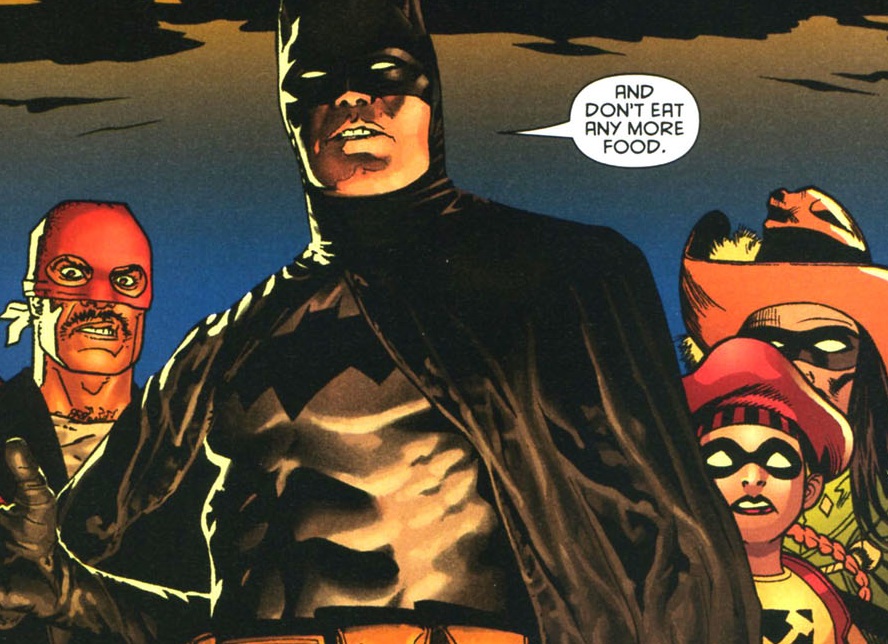
Meltzer's run has largely been three stories. "The Tornado's Path", "The Lightning Saga" and the "Trapped in a cave-in issue"... and that's it. Again, that's not even a "run", kinda. It feels to me, as a reader, like Meltzer tried the monthly comics game, then suddenly realized "shit, this isn't for me" -- I bet $5 that's not even close to the truth, but that's what it feels like for me.

JLofA #12 is the third issue of the run to feature two 50/50 covers that form a single issue. This bothers me really deeply. Surely this is exactly not the kind of high-profile-if-not-event comic that can stand on its own without artificial outside gimmicks spiking sales? Weirdly, I probably wouldn't have minded if this was JLA #511 (261 of v1, 113 of JUSTICE LEAGUE [blank/international/america], 125 of JLA, and 12 here), and Holy Mother of God, I just realized that Meltzer's first issue is thus #500.... Has no one else said that outloud yet?

This one's a nice cover, too -- probably everyone who buys it WILL want both halves -- I know that I, just looking at the left side right now want to see the other bit, too.

JLofA #12 is also $3.50, being "double sized". It's got some fairly effective character studies going on, with the sole problem that, really nothing happens. There are beats here -- but there's not any conflict; well not at least any conflict that, as far as I know, Meltzer is going on continue.

See, here's the thing: its all well an nice to set up future plotlines for characters for someone else to carry the ball on. But I tend to think that history shows us that the next person or two in line tends to want to make their own mark on a book/character, and tends to ignore those kinds of hanging chad.

We have: Vixen has no animal powers, Hawkgirl and Speedy are screwing, Black Lightning is a snitch, and Tornado... Tornado is a dick? I mean, Meltzer went out of his way to bring Reddy back, and this is where he leaves him?

Geo Force... does he even have a plot? What's he doing in the league? Has he even ever been in an "adventure" with them? He's so generic a hero that I tend to mentally edit him out of comics not drawn by Jim Aparo

I don't know, if I were the incoming writer, I'd want to ignore most of those fairly boring concepts, and ditch some of those characters and bring in others that I wanted to put the spotlight on.

In a way, this issue is just "look, the Magnificent Seven are the League" (even if 2 of the 7 in the framing device didn't appear to slightly reflect their current manifestations {cue DC editorial: "that's on purpose!"}), "plus here are 5 other characters I like"

(though, reading this back, I just realized I've left Canary out of the mix.... so, Magnificent Eight, then? Canary belongs in the League, in my opinion, because she's the Bridge between Society and League. Hell, Moore made her an Archtype in WATCHMEN)

Like I said, I'm torn -- I thought I got my "$3.50" of value out of the issue over all; it is GOOD in that regard. But this is a run, by dint of its promotion, and its "pedigree", that seems like it wants to be "quintessential"... and is kind of just... there.

My idea of the "perfect" League is the Mag7 (or 8) and a small additional cast of oddballs or outcasts -- Zatana, Firestorm, Booster Gold, characters with something slightly askew to them. Both Reddy and Vixen could fit those bills, but it seems to me that Meltzer left both characters at a nadir.

Geo Force and Hawkgirl are really basically just dull characters (sorry), and, really, I'd have to say that if either have any consumer interest it's probably more likely because of their connection to other characters. I mean, the only reason I'm even willing to take the time to type the words "geo force" is because the swerve of Terra in Wolfman and Perez's TEEN TITANS worked so damn well 20-something years ago. But Brion has barely any defining characteristic beyond "brother of Terra".

And Black Lightning, poor Black Lightning, trapped in plothammer after plothammer as some desperately tries to figure out what the hell to do with him. Plus, yar, that's a damn ugly costume.

You have to give Meltzer credit for trying -- he's really really terrifically earnest in his attempts to make it all feel "epic". But, at the end of the day, I sorta don't think these 12 issues are going to make so much of a mark. And you can quote the last line of Meltzer's last issue for the reason why: "It's the true beauty of [the League] -- for all its changes, the League never really changes"

That's not what I'd call a thematic note with any weight or resonance.

What do YOU think?

-B

Horseradish Ketchup: Johanna Tries to Get Current

Following Graeme's lead, here's quick takes on the superhero books still sitting around from weeks previous. (And yeah, Graeme, really weird week here, too. Very mood swingy.) Stormwatch PHD #10 -- It surprises me to realize this, but this title is probably my current favorite team book. (Although statements like that say as much about what else is available as the quality of this title; and the last time I said something like that, it was about Power Company, so we see what that's worth.)

Anyway, the strength of this title is characterization, as the plots so far have been pretty simple "bad guy team infiltrates, then attacks" or "someone is attacked, find out who did it". The roster's huge, with new characters and returned-from-the-dead from previous title incarnations and, in this issue, faux historical characters. Someone is killing retired Stormwatchers, which gives writer Christos Gage reason to create yet more superheroes. I don't mind, he's good at it. Ghetto Blaster? New Romantic? Not only are they on-point concepts (summarizing powers and look succinctly), they capture the sense of a particular era.

(I don't mind simple plots for superhero titles, actually. They're easier to remember month-to-month. There's a reason they're classics. And the fun comes with the details put around the edges.)

The characters are why I enjoy the series, especially since Gage has come up with two of my favorite new superhero women. First, Gorgeous, a former moll whose power is manipulating people. I find her an insightful comment on the roles women are forced into and how they subvert them from the inside. She's a classic version of the streetwise sexpot who's got the upper hand because she knows a lot more about people than they realize. All they see is body and blonde. Think Harlow with a psychology master's.

Second, Black Betty. She's got generic magic powers, but she's so inspirationally cheery that it's a pleasant contrast from the usual version of those types of characters. Unfortunately, she isn't given any distinctive dialogue this issue, so you'll have to take my word for it. I also like the way these characters have relationships -- marriages, flings, and everything in between.

Artist Andy Smith does sexy superheroes (WildStorm's reason for existing) well, in the classic exaggerated "realistic" style, although he sometimes makes people appear generically interchangeable.

This was Good. So much for brief, hunh? Let's see if I can move more quickly.

Gen 13 #11 -- Waste of paper. Tries to do something clever with meta-commentary on previous versions and multiverses, but way too many characters means the reader is quickly lost in forgettable interaction. The concept's time is over. Bury it. Awful

Hawkgirl #66 -- Didn't read the series, mainly because when this latest version relaunched, I didn't care for Howard Chaykin's nipple-tastic art. So why am I praising the final issue of the series? Because Walter Simonson shows how you should close a title in a shared universe.

The big premise, the Hawks' cycle of reincarnation, is resolved; there's a big fight with the big villain, who's defeated; the love story recurring subplot is given a happy ending; Kendra's psychological problems (stemming from mystic schizophrenia) are fixed; and the two Hawks fly off together into the sunset. The characters are put back to the way that works best for any future writers, and readers get as much resolution as you can have in a never-ending superhero universe. Good

Supergirl #20 -- Hey, we put a new writer and a new artist on Supergirl, and there's lots of online buzz about new readers being interested in trying the title, so let's make their first issue tie in with the illogical Amazons Attack! That'll annoy the continuity fans following the crossover who don't like change AND the new readers who have no idea what's going on and don't care! Idiots running the ship, I swear.

Turns out it was all bait and switch anyway; Bedard and Guedes are only on for three issues until the real new creative team takes over. Right. Fool me once...

No rating because I was so annoyed I didn't read it.

Arriving 8/15

Here's the list for this week, that's arriving at Comix Experience. Scroll down a bit for some other news, too, in case you're in the habit of skipping these posts... 2000 AD #1547 2000 AD #1548 A G SUPER EROTIC ANTHOLOGY #63 (A) ACTION COMICS #854 (CD) AMAZONS ATTACK #5 (OF 6) ANNIHILATION CONQUEST QUASAR #2 (OF 4) AQUAMAN SWORD OF ATLANTIS #55 ARCHIE & FRIENDS #112 ARMY @ LOVE #6 (MR) BLACK CANARY #4 (OF 4) BOOKS WITH PICTURES #6 (OF 6) BOOSTER GOLD #1 BRAVE AND THE BOLD #6 CAPTAIN AMERICA #29 CWI CATWOMAN #70 (AA) CHECKMATE #17 COUNTDOWN 37 DRAGONLANCE CHRONICLES VOL 3 MANIAK CVR A #3 (OF 12) FLASH #231 FRIENDLY NEIGHBORHOOD SPIDER-MAN #23 GRIFTER MIDNIGHTER #6 (OF 6) HELLBLAZER #235 (MR) HIGHWAYMEN #3 (OF 5) JUDGE DREDD MEGAZINE #261 JUSTICE LEAGUE OF AMERICA #12 (NOTE PRICE) KILLING GIRL #1 (OF 5) (MR) LEGION OF SUPER HEROES IN THE 31ST CENTURY #5 LOVE THE WAY YOU LOVE #5 (MR) LOVELESS #19 (RES) (MR) MAD MAGAZINE #481 MAINTENANCE #4 (MR) MARVEL ADVENTURES HULK #2 MARVEL ILLUSTRATED TREASURE ISLAND #3 (OF 6) NEW X-MEN #41 OUTSIDERS FIVE OF A KIND WEEK 3 THUNDER MARTIAN MANHUNTER PROGRAMME #2 (OF 12) REX MUNDI DH ED #7 RIPCLAW PILOT SEASON #1 ROBIN #165 SCARFACE DEVIL IN DISGUISE #2 (MR) SHADOWPACT #16 SIMPSONS COMICS #133 SPAWN #170 SPIDER-MAN FAMILY #4 SPIKE SHADOW PUPPETS #3 SUB-MARINER #3 (OF 6) CWI SUPER VILLAIN TEAM UP MODOKS 11 #2 (OF 5) SUPERMAN BATMAN #39 TERROR INC #1 (OF 5) (MR) ULTIMATE SPIDER-MAN #112 WOLVERINE ORIGINS #16 ZOMBIE HIGHWAY DIRECTIONLESS (MR)

Books / Mags / Stuff 30 DAYS OF NIGHT DARK DAYS TP NEW PTG (MR) BABY SITTERS CLUB VOL 3 MARY ANNE SAVES THE DAY SC BALTIMORE STEADFAST TIN SOLDIER & VAMPIRE PX HC BETTY BLUES GN BIZENGHAST VOL 3 GN (OF 5) BONE VOL 6 OLD MANS CAVE COLOR ED SC CATWOMAN ITS ONLY A MOVIE TP CEST BON ANTHOLOGY VOL 3 GN (MR) COMICS BUYERS GUIDE OCT 2007 #1634 COMPLETE PEANUTS VOL 8 1965-1966 HC DP 7 CLASSIC VOL 1 TP DUNGEON PARADE VOL 2 TP DAY OF THE TOADS FALLEN ANGEL IDW VOL 3 TP FLASH GREATEST STORIES EVER TOLD FORTEAN TIMES #226 GIRL GENIUS VOL 6 SC (C: 0-0-1) GOOD AS LILY IRON MAN DIRECTOR OF SHIELD TP JAMES BOND DEATH WING TP KAT WHO WALKED IN BEAUTY PANORAMIC DAILIES OF 1920 HC KODT BUNDLE OF TROUBLE VOL 20 TP LIBERTY GIRL VOL 1 THE RETURN TP LIFE AFTER BLACK BARRON STOREY THE JOURNALS HC NARCOLEPTIC SUNDAY GN (MR) NEW AVENGERS VOL 6 PREMIERE HC NEWUNIVERSAL VOL 1 EVERYTHING WENT WHITE PREM HC PIRACY IS LIBERATION VOL 2 INFOTRIP GN (MR) TOMARTS ACTION FIGURE DIGEST #157 WILL EISNERS SPIRIT ARCHIVES VOL 22 HC WIZARD KING TRILOGY BOOK 2 ODKIN SON OF ODKIN (MR) YESTERDAYS TOMORROWS GN

In other news, I'm doing my Final Order Cutoff (FOC) for the week, and I was STUNNED to see LEAGUE OF EXTRAORDINARY GENTLEMEN: BLACK DOSSIER HC on the list, for shipping 11/14/2007.

Its not going to be resolicited, apparently, and retailers have until Wed night to put their final number down -- so if you don't already have a copy coming, I'd strongly advise you to call your LCS RIGHT NOW. If they're anything like me, they're ordering semi-blindly, as our subscription data for the title is over a year old at this point. I've no idea what TODAY'S demand for the book actually is.

I'm also unsure to what extent DC is going to overprint or will go back to press, or whatever, so jump jump jump on this now....

Other than that, what looks good to YOU?

-B

I stand up next to a mountain: Graeme finishes off his 8/8 haul.

Before I launch into a bunch of things written very, very early morning today, I have to ask: Has anyone else been having a really stressful and strange last few days? At work, I've had maybe the oddest series of (bad) coincidences in a short period of time since last Friday, and in attempting to calm me down from climbing the walls and looking for the Graeme Voodoo Dolls, people have been telling me that everyone seems to be having a weird time of it lately. So abuse the comments section below and comfort me.

CRIMINAL #8: It's got to be dull for you to keep reading that each issue of this book is solidly Very Good, so instead I'll skip over the wonderfully noir dialogue ("It had been a long time since a woman had looked at him like that...") and artwork that reminds you of Toth's simplicity with scratchier personality, and instead point out that this book also contains the best recap page in comics these days.

DAREDEVIL #99: Continuing the Ed Brubaker love, things are coming to a head emotionally here, and it still works even if I have no idea who the supervillain at the end is - some kind of Scarecrow rip-off? - purely because of the melodramatic intensity that the creators manage to sell you on. Despite the whole "part five of five" thing when you start the issue, this is very, very clearly an old-school "Next issue is #100!" one, and Good for that.

GREEN LANTERN #22: According to the cover, this is The Sinestro Corps War Part 4. According to the third page of the issue, it's Sinestro Corps Chapter Two. And while, sure, it can be both (fourth part of the crossover, second chapter in this particular series), there's something about that kind of sloppiness that makes me want to make cheap jokes about Countdown, just because. Nonetheless, the story itself is full of high stakes and tough-guy dialogue ("It's ironic, isn't it, Jordan?" "What, Amon? Me about to use your father's ring to break your nose?" Oh, Hal. You're so macho jerk) and rompiness and, even though not that much actually happens, it manages to skate just under the line of Good thanks to my goodwill about the larger story and Ivan Reis's artwork.

THE INCREDIBLE HULK #109: Emphasizing just how much last issue was a last-minute fill-in, this issue picks up directly from the ending of #107 and continues WWH #3's turn towards the Hulk turning out to be an unjustified bastard after all. It's sad to admit that the more the actual plot kicks in and replaces people getting beaten up, the less I find myself interested in World War Hulk, but I guess I'm just a simple lad with simple tastes. Eh.

THE NEW AVENGERS #33: If you melded recent superhero novel "Soon I Will Be Invincible" together with "Invasion of The Body Snatchers" and a complete lack of attention to Dwayne McDuffie's Fantastic Four run, then you'd come up with this Eh issue. The supervillain stuff is pretty generic - and isn't the Wizard currently in Fantastic Four and, um, nothing at all like he's being written here? - and seriously bogs down the issue, which at least offers a healthy dose of Luke Cage being unhealthily paranoid now that the Skrull plot is happening. More of that and less of everything else, please.

THE NEW AVENGERS/TRANSFORMERS #2: Crap, and worth mentioning only because of that cover - with such a terrible Wolverine and such a great Transformer - and the sad sight of Todd Klein's computer lettering.

NOVA #5: I keep expecting it to zig, it keeps zagging. Color me happily surprised to see the fill-in Nova story explained so quickly and this particular cliffhanger. Sure, both events will surely be undone within the next two issues, but I'm enjoying the irreverence with which Dan Abnett and Andy Lanning are treating their material. Good, and just saying that makes me pause and thinking "Huh," in a surprised manner.

OUTSIDERS: FIVE OF A KIND: KATANA AND SHAZAM! #1: Or, as it should really be renamed "Katana, with a guest shot by Shazam that really doesn't matter one way or another." When the best thing about a comic is that you're happy to see the writer (Mike W. Barr, in this case) still getting work, then you know that it's pretty Crap.

THE UN-MEN #1: What's good about this issue: The logo and Tomer Hanuka's cover art. What's not so good: Everything else. Another bad-mood-book that replaces originality, wit and intelligence with world-weary faux-cynicism and shallow social commentary, this is the kind of Eh thing that leaves a bad taste in my mouth and a longing for when Vertigo launched and was the place where anything could happen. Ah, to be young and naive again...

Abhay: Just A Note About Mike Wieringo Before I Resume The Clown Show

What is this year? Daniel Robert Epstein at only 31, Drew Hayes at 37, Tom Artis, Marshall Rogers, Arnold Drake, Bob Oksner, Iwao Takomoto, Johnny Hart, and on and fucking on and on. And Vonnegut, and whoever else you want to add in there; whoever I've forgotten; I'm sorry. Still... Mike Wieringo? What a fucking cruel year.

I liked Wieringo because he could draw, but I liked him more because he could write:

Art monkey; Wrist-for-hire; Have pencil-will travel--- there's a ton of them. But I think these terms stem from the fact that the trend has been for quite a while now that the 'vision' for the comic book is strictly that of the writer, and the art team is simply there to make that vision real on paper. The 'Marvel method' of creating comics has gone the way of the Dodo, really. All scripts done for Marvel are now, like at DC, done in full-script form, so unless the writer is feeling generous enough to bring the penciler in on the initial writing of the story (and there's little or none of that happening), then the penciler is relegated to the status of 'flunky', in my humble opinion. And for someone like me, who spent his childhood writing and drawing his own stories-- and who has been in a very collaborative relationship on a creator-owned project as I was with Todd Dezago on Tellos, it's a bitter pill to swallow to have to return to being relegated to nothing more than (fill in the blank with any of the aforementioned terms). 

From here.

Set aside the substance of what he's saying in that quote; save it for later -- what a pleasure to have a comic artist write so honestly and cleanly about his work, fears, anxieties, ambitions! Who else did that? Who else ever bothered? I can't begin to imagine what friends and family lost, but for the rest of us, it might be important to note that his fans didn't just lose an artist who could draw a lovely comic, but someone rarer and even more generous than that as well.

I honestly didn’t think that many people would pay attention…. but over the years, that attention has grown and this blog has become important to me in more ways than one. Not only has this little corner of the web become a place for me to share and interact with folks online, but the blog has been– on more than one occasion– cheap therapy/cathartic for me when I’ve been stewing something over in my head. Being able to get thoughts down in type and share them with you folks who provide feedback has been a great thing. 

From here.

The Wieringo family has asked that in lieu of cards or flowers, please donate to the ASPCA, the Comic Book Legal Defense Fund, or the Hero Initiative in his name.

Regular nonsense from me later this week.

But I suppose, in a nutshell, I could say that to succeed in this business—work constantly and always be open to criticism. The only way to improve is to continually work at improving your craft. Nothing will make an artists work grow more than just incessant drawing. I thought I was ready for regular work when I got my first assignment, but I wasn’t. I had no idea how much I still had to learn—and STILL need to learn—when I got started. And the learning process never ends. An artist always has things they can improve on and so the education of art is a life-long process. Stay open to that and everything should be OK. 

From here.

Usless Information, tons of Useless Information: Graeme counts down from 8/8.

Something that becomes immediately apparent as soon as you start reading COUNTDOWN #38 is the way that it's incredibly like the comics that Dan DiDio and the current DC braintrust probably grew up reading. It's not just the incredible number of coincidences that Brian's already pointed out - a throwback to days when audiences were younger and less demanding - but also the dialogue. The third panel in the comic has the following exchange:

"Superman, any idea what's going on?"
"I'm not sure, Powergirl, except for the obvious..."
"Oracle said something unleashed a global computer virus."

It's exactly the kind of self-identifying thing that people have made fun of the original Crisis on Infinite Earths for; all you need to complete the set is for Hawkman and Green Arrow to walk on and have a fight about Reaganism while mentioning each others' names every second page. Similar, too, to those 1980s stories is the sense that everything is part of some larger story - although, unlike the comics that they're clearly modeled after, there's nothing in this issue that makes you want to run out and pick up back issues to understand what's going on, because there's no sense of excitement and urgency in anything that happens here - Characters appear and die, and other characters watch from behind the scenes and give melodramatic speeches to themselves, and it's all rather dull.

It's also rather nonsensical; the Question and Batwoman find two supervillains who everyone is looking for, and just let them go because the Question thinks they're too dumb to kill the person they're supposed to have killed? And none of the other characters think that that's weird? Or, for that matter, no-one seems to want to stop the mysterious being that murdered the Deep Six in front of their eyes (And good job introducing the Six there for readers unfamiliar with Kirby's Fourth World, guys. This series really needs, if not an editor who's really trying to make each issue easier-to-understand for new readers, then a website that'll explain the minor characters slightly better...)? Other than because it doesn't suit where the plot's supposed to go, there's no reason for either of these things to happen and neither really makes the characters involved look intelligent or capable.

In my weaker moments, I kind of wish that I was doing some kind of 52-Pickup for Countdown. Not because I want to try and replace Douglas - my arcane knowledge is nowhere near as good as his - but because I want to see someone really dig into this book on a regular basis and talk about the strangeness of plots being developed by the Dan Jurgens back-up, or the way in which the story is propelled as much by the future solicitations and interviews as much as what's in the comics themselves. But then I realize that something this Crap, which fascinating, probably isn't worth the time...

Let's see if this image posting thing works: Graeme also reviews something from 8/8.

What is it about Grant Morrison and JH Williams? The two of them get together, and all of a sudden, the pop thrills get dosed with feelings of dread and portentiousness. Take BATMAN #667, for example; up until this point, there's been a devil-may-care feeling about Morrison's Batrun - the idea that, no matter what death-traps may show up, it's not to be taken too seriously and everything will end up fine in the end. But now that Williams has appeared for the first of three parts of "The Island of Mister Mayhew," it all seems much more dangerous and grim. Which isn't to say that it's not enjoyable, because it is - but there's such a change of tone that it's somewhat disconcerting to the few of us who were enjoying what we'd previously seen...

The real star of the show here, though, is JH Williams and the amazing work he puts in here. Even if you can somehow ignore his sense of design - which is pretty tough, considering some of the pages he puts in here (His old school opening double-page splash, with the logo contained within a Bat-icon isn't even the most eyecatching one on the issue - the hand-shaped panel with exploding plans gets my vote, instead) - this would still be one of the most visually impressive mainstream books of the year based on the different art-styles Williams appropriates for the different characters; seeing him do perfect versions of Chris Sprouse's line, Howard Chaykin's, or Ed McGuinness's would be worth-seeing on its own, but to see him manage to mix those styles not only into the same story, but the same panel is pretty damn great.

Don't get me wrong - This would still be worth reading even if Andy Kubert or whoever was drawing it, but it's the artwork instead of the writing that raises it from a "If you like Batman, sure, go ahead" to a Very Good must-see.

Becoming More Like Alfie: Graeme goes Cass from 8/8.

The first thing you'll notice about CASANOVA #8 is that it's very, very blue. The shift in color palette is initially completely overwhelming - writer Matt Fraction's said online that it's pure Cyan, and given the way that it practically glows on the page, I believe him - and it was only after a second read-through that I realized how smart a move that was, pulling the reader away from the change in artists from Gabriel Ba to Fabio Moon so that, by the time your eyes have recovered from the blue, you're already used to Moon's less-Mignola-esque, prettier, artwork (As much as I love Fabio's stuff, it's still awkward to see him draw characters that I'm so used to Gabriel's take on; I think I like it, but there's such a sense of "That's not the way they look!" that I'm not sure. Having a few pages of Fabio in your system while you try not to be distracted by the color choice helps, though).

The second thing you'll notice is that Fraction's a smart writer - It's not the way that you're dropped right into the story and only given the exposition midway through (It's just like Mission Impossible, if Tom Cruise wasn't, you know, Tom Cruise!), but the way that the story's structured so that the reveal at the end both comes as a surprise but also makes complete sense within what you've read up until that point that convinces you that there's something worth paying attention to happening here. Which isn't to say that this second series isn't as playful or unexpected as the first (to the point where it seemed as if it was unexpected even to the creators, sometimes), because it is; the sense of "anything can happen" is, if anything, amplified by the time you get to the last page of the story, with the introduction of an element that almost seems too fantastical for a series that's made its mark by being full of spectacle and the fantastic.

This issue pulls of the trick of being both a reminder of, and reinvention of, what you enjoyed about the series the first time around. It's both familiar and unknown, full of confidence (arrogance?) in knowing what it can do and wanting to find out what else its capable of at the same time. Pretty much Very Good, then.

Archie as RIAA Shill

Archie #577 tries to tackle a modern issue, but the presentation is so one-sided and ignorant that it fails even as brainwashing. The Archies, it seems, are ready to record a song that's been popular when they've played it live. (The lyrics we see are "RU the 1 4 me", which suggests that they've been listening to an awful lot of 80s Prince.) They scrape together money for studio time and decide to sell the record on their website, only with no physical CD "to reduce overhead". But boo hoo, their fans make copies for each other instead of buying, so they don't make any money.

There's so much wrong with this story in terms of internal logic that it's hard to know where to start. We're supposed to believe that they're savvy enough to have a website and conduct a financial product analysis, but they've never even thought about downloading until it prevents them from getting rich? And there's little incentive to want to support such spoiled kids. Instead of asking each other "hey, have we made enough money to cover recording costs yet?" they brag about how their ship has come in and use the term "fortune" in their plans.

The exaggerated ending has the kids working at Big Burger in order to replace their lost savings. Why don't they play a few more gigs? They presumably get paid for those. Or sell signed physical CDs at shows, for an experience the kids can't get online? If they refuse to create an object for sale, why are they complaining that people aren't willing to give them the money they feel they deserve? Kids are drawn handing each other CDs, so that suggests (whether the creator intended or not) a desire for something physical.

Not to mention that we're talking about an Archie comic, where every other ad is for an Archie logo bag or Archie cartoon DVDs or different kinds of collections or subscriptions or packs of back issues. The publisher has obviously figured out a lot of different ways to make money off the same material, giving the audience choice.

But what do you expect from a writer who has one character ask another, in terms of determining how their website downloads are doing, "how many records have we sold so far?" And yeah, there's only so much you can do in six pages, but I think this one should have been double-sized if they were serious about handling the subject.

I've been told that a review isn't "real" unless it discusses the art, so here: the faces are sometimes squished in odd ways. Since most of the panels are talking heads with various arm motions, this is a detriment, but it's made up by the variety of expression shown.

There are three other stories in this issue. Archie and Veronica go canoeing, which always ends badly because Archie is a klutz. (So why does Veronica keep agreeing to go?)

Betty and Veronica go to the beach together, where they argue over Archie. This is a poor story, because there's no reason to it other than pointing out that the triangle among the three is ridiculous, especially given how long-lasting it's been. It's questioning one of the basic premises of the series in a way that leaves the reader unsatisfied. If the reader agrees with the characters, then they feel silly for even reading the comic. If they disagree, there's nothing else to the story.

Last, Archie takes a Boy Scout-like group on a hike where Jughead brings the food. Amazingly, Archie is competent in this story, perhaps because he actually doesn't do much but stand around.

Rating this issue doesn't seem like fair play, because it is what it is. It's formulaic, as are many superhero comics, but that's comfortable for its target audience of younger readers. If I have to, I give it an Eh.

Wolk this way!

(I'm going to hell for that post title, I just know it!)

This Friday, August 17th, from 4 to 7 PM, Comix Experience is very happy to host DOUGLAS WOLK, international bon vivant, Savage Critic, and author of the most excellent Reading Comics: How Graphic Novels Work and What They Mean


Join us for an afternoon of book signing, comics theory, continuity debate, and, unless I miss my guess, beer.

Plus, since we're in San Francisco, I'd say odds are frankly terrific that we'll also have Jeff Lester and Graeme McMillan on hand (well, after they get off work), so four, count them four Savage Critics to pontificate!

Be there or miss the most insider comics afternoon of the summer!!

-B


If I Don't Finish Before Sunrise, Dust Takes Me Back: Jog and 8/8 creatures of the night.

At 4:00 AM, my funnybook reviewing powers at their peak. The good never sleep while there's funnies to be reviewed!

Batman #667: The secret to J.H. Williams III’s success in superhero comics isn’t that he produces the most thought-through visual work around; with superhero comics there’s a risk of over-thinking things, missing the immediate appeal of the genre while pursuing an inappropriate sophistication. But Williams absolutely grasps the beauty of primal costumed impact, and infuses his relentless experimentation with the joy of direct aesthetic assault. I kind of squealed every time he shaped an evil panel like THE BLACK GLOVE, iconographic villain of the piece.

Williams’ approach here differs from his recent(ish) Detective Comics issue, which got a simpler, campier version of his Desolation Jones style; here, Williams produces an overview of superhero designs, with each of the many characters detailed in their very own homage-powered style, indicative of their discreet worldviews and developments. This is appropriate for Grant Morrison’s story, plus his run on this series. Always, Batman is confronted with alternate visions of himself: Damian, the three evil Batmen, and now many Bat-variants.

It’s the same approach with Morrison’s All Star Superman, though Superman and Batman are opposites - while Superman’s confrontations with his alternate selves inevitably lead to a certain peaceable education, Batman must always bleed and grit his teeth. Also: while ASS contains itself to simple, digestible issues, Batman sprawls across jumpy storylines, making review of a set-up issue like this tricky. I do wish the conversations between the many heroes had been insightful; when a fat Roman hero stumbles to his death, a symbolic tapestry in the background mocking his stumbling death throes, it seems merely banal.

Yet Williams adds a unique level of depth to his projects, and it is he that’s most compelling here. Plus, that last page is one of the nicest Batman pages I’ve seen in I-can’t-remember, and it’s GOOD to behold.

Blade #12: Howard Chaykin is one of the artists whose style Williams adopts, actually. Remember when Chaykin’s art was kind of hard to come by? This here is the second of three Marvel books he’s drawing this month, two of which are double-sized. And boy… parts of The Punisher MAX #50 looked rough (book three will be Wolverine #56). I presume Chaykin’s current style gets things done much quicker than before, but surely there’s such a thing as too quick! This comic, luckily, is a lot tighter; Blade has consistently been the best forum for Chaykin’s latter-day airy superhero style, affording him lots of opportunities to indulge in elaborate costuming and swooping, dancing midnight fight concepts.

But he doesn’t have Blade anymore, since this is the final issue. I’ve really grown fond of the book over this year; sure, writer Marc Guggenheim never did quite get a grasp on keeping the ‘individual’ issues, er, individual, but it turns out he’s pretty adept at layering plot strands into a big, slobbering narrative - this’ll make for a decent hardcover, if one is planned. The book also had a nice sense of absurdity about it, happy to mix up Count Dracula and Doctor Doom and Spider-Man and Civil War into a big, loud Marvel Universe thingy, albeit a thingy occurring on the fringes of more weighty stories.

This concluding issue characteristically mixes ancient prophesies with corny jokes and fairly affecting characterizations, while still taking setting aside a panel to assure us that the Yellow Kid joke vampire from the Civil War tie-in is still alive, I guess in case he’s needed for World War Hulk. It’s a charmingly square thing, pleasingly non-slick, with an oddly satisfying denouement. OKAY all around. The best sort of series to stumble upon in a bargain bin.

Diana dances with the Devil by the pale moonlight, 8/8

I have mixed feelings about DAREDEVIL #99.

On the one hand, Ed Brubaker's decision to gradually move away from the Frank Miller paradigm is commendable; it's always nice when writers remember there's more to Daredevil's history than the Kingpin, Bullseye and Elektra. And if, when he first started out, Brubaker relied on some of those familiar icons, he's now making a point of using new characters, and old-timers who never really had a chance to dominate the page while Miller's definitive A-listers were around. Spotlighting these less-popular individuals puts some variety and unpredictability back into the equation.

Of course, the flip-side of that decision is that once you start bringing in villains and supporting characters who haven't been around in any meaningful capacity for a while, reintroduction is necessary. You can't just assume that your readers will peg the Enforcers on sight, or that they'll recognize the significance of the name "Cranston" without any context. This issue marks a rare misstep for Brubaker, in that he ends the issue (and the arc) on a cliffhanger that doesn't work if you don't know who you're looking at. No one explicitly identifies this character, whose appearance is very similar to another Marvel villain... it's kind of a mess.

But all that really does is downgrade the issue to GOOD rather than Very Good; Brubaker's a master at this sort of slow-burn criminal conspiracy thing, and the consistency of Michael Lark's artwork lends an appropriately dark and murky quality to the story. I also like how our expectations are being toyed with in very subtle ways - I'd grown so accustomed to Milla being an annoying prat that I never thought there might be a deeper reason behind her latest string of freak-outs; and while Lily Lucca seems to fit the "femme fatale" archetype to a T, she might actually be telling the truth when she says she's not interested in disrupting Matt's marriage. It's these little things, as well as the more grandiose unveiling of master plans, that make DAREDEVIL worth a read every month.

Not Comics: Jeff Reviews The Bourne Ultimatum

The first moment in The Bourne Ultimatum I truly loved comes about fifteen or so minutes into the film, when Jason Bourne (Matt Damon) is about to meet with reporter Simon Ross (Paddy Considine) about articles Ross has been publishing about Bourne and his mysterious past. Seeing what's about to go down, CIA uber-clench Noah Vosen (David Strathairn) places a call to have both men eliminated. The call reaches a man (Edgar Ramirez) sitting on a bed in a nondescript room, his bag on a chair nearby, and when he gets the call, he takes the bag and exits without hesitation.

 

This shot of Paz, the man in the room, is indicative of the rest of the film: it happens very quickly; it relies on your knowledge of the previous films to convey meaning (Paz, like Bourne, is a hired killer for the CIA but unlike Bourne he still does whatever he's told without hesitation); and it seems so straightforward as to lack any deeper subtext.


If there is subtext to The Bourne Ultimatum, it stems from precisely that scene and others in the film like them. The Bourne Ultimatum is, from what I could tell, a fetishized love letter to the assassin, to lonely men in empty rooms and the things of which they're capable. Bourne himself is one of these men; a trained killer who, after losing his memory, finds himself locked in near-constant battle with the CIA as he struggles to find out who he is (first film), take revenge on what was done to him (second film), and find out how he was created (third film). As Bourne becomes more and more unstoppable, the films cannot help but create a greater appreciation for this man without a history, without a place, who lives forever on the run and five steps ahead of anyone else. His only real threats are other men like him--similarly streamlined men with backpacks and furtive steps, capable of entering anywhere, killing anyone with anything. The Bourne films take the figure of Lee Harvey Oswald--the nobody with the gun believed to have done the work of mysterious men--and turns him into a superhero, and I find that both alarming and oddly comforting.


The alarm, I would think, is easily understood: no one would like to see a upswing in the number of blank-faced young men breaking into apartments and killing people with magazines, textbooks and Hummel figurines. But I hope the comfort is too: cities are filled with lonely men in empty rooms the world over, and the Bourne movies are made for them, flatter and woo those lonely men with no lives as if they were prettiest girls on their blocks. The Bourne Ultimatum, in fact, makes the connection between lonely men and cities manifest, as the camera frequently zooms in and out on the facades of one international city after another--London, Madrid, New York--similar to the way it does on Bourne's guarded face. And, of course, no matter what city, Bourne and his kin can dash about in ultimate confidence, able to maneuver through it with a speed and ease native policemen cannot. Even more than they celebrate the magic and mystique that surrounds the assassin, the Bourne films romanticize the global, post-industrial urban worker: rootless and without community, appearing in any city to do any job asked of them, these men appear to own nothing but their own specialized skills and yet can do anything better than anyone else. In The Bourne Ultimatum, the non-Bournes are men of color, played by Edgar Ramirez and Joey Ansah, and they are presented as Bourne's equals in every way. When battling Bourne to the death, their fights aren't charged with the fear of the Other, but by a strangely liberating feeling of equality: in the world of this film, all of God's childrens got the skills to kill with a bathmat, a candlestick and a Peugeot.


Now, like its predecessors, The Bourne Ultimatum is so well-made and so satisfying I'd hesitate to link the movie's success to this subtext. Director Paul Greenglass and screenwriters Tony Gilroy, Scott Z. Burns and George Nolfi create a movie shorn of any unnecessary detail, and allow viciously unrelenting momentum to take the place of character, theme or meaning. At times, the viewer is one split-second behind what's happening onscreen and then, without warning, there'll be a pause and the viewer will have a second to appreciate what's coming next, and then things accelerate again. It's completely exhilarating, although also a little depressing if you think about it a little bit afterward: part of why you're able to follow what's happening is that so little of it is new. The films play like classical variations on each other and, as well, the man on the run genre. But they're made with so much intelligence and clarity of vision you leave the films feeling both smarter and more clear-eyed after seeing them.


It'd be lovely if this intelligence and clarity was joined to something morally or spiritually edifying, which is probably where my temptation to bemoan/praise/pick at the film's possible subtexts comes in. Still, the Bourne trilogy (almost certain to be a quadrilogy, considering Bourne's monstrous opening weekend) has proven to be a surprisingly sharp series of action films, the kind that Hollywood burns to make more of but by and large lacks the skills to do so. If you haven't already, check them out.

None More Black: Graeme's second 8/8 book.

"From the pages of 52 and Countdown" announces the cover of BLACK ADAM: THE DARK AGE #1 - although those last three words are missing entirely from the cover, for some reason - and what's interesting about this first issue is the way that it feels very much like an uncomfortable mash-up of those two books' styles. From Countdown, there's the immersion in continuity without setting out what that continuity is for new readers, and from 52, the unexpected twist that makes sense if you do understand the continuity.

Which isn't to say that the book approaches either of their levels of quality; there's nothing here that approaches the fun and sense of anything-can-happen of 52, nor the oppressive crush of editorial edict that runs through Countdown; instead, you get something that misses both the highs and lows of both books - This is an entirely Eh piece of uninteresting continuity which somehow manages to offer some detours on the way to its known conclusion. Congratulations, then, to Peter Tomasi, even if I have no desire to see Teth-Adam get himself beaten up to avoid being recognized or see yet more supervillains-as-terrorists stylings.

One of the genuine sadnesses about the book (When you expect very little from a book, it's almost comforting when it gives you very little after all) is that Doug Mahnke's art feels less like his work than usual - Maybe it's Norm Rapmund and Christian Alamy's inks, or a move towards a new (and slightly more generic) style? - which removes one of the more obvious selling points of the series. The overall effect, when paired with the writing, is a firmly mid-level book that's intended only for a die-hard pre-sold audience. Which seems rather fitting for a contemporary DC superhero book these days, really.

Not Gold, etc: Graeme thinks too much about Andi Watson's 8/8 book.

You know what's been completely bastardized? The term "charming". Used to be, if you called something charming, then people knew what you meant - that is was (to quote dictionary.com) something that was "pleasing" or "delightful." It was a good thing to be charming, back then. And then, somehow, irony and sarcasm got in the way and calling something charming was suddenly a backhanded compliment, a snarky way of saying that it lacked excitement or didn't wow you for some reason. Charming became this kind of cursed word.

Fitting, then, that GLISTER #1 is something that I found completely charming in the earlier sense of the word. Pleasing and delightful are two other good words to describe the book, mind you, but what’s interesting to me is that I love it in completely the wrong way (Well, maybe not completely the wrong way; I mean, I’m not wrapping it in saran wrap and taking it into the bathroom for extended periods of time or anything). I realized this after writing an earlier version of this review, and thinking about what I actually liked about the thing – I started thinking that, yeah, Andi Watson’s writing is gentle and familiar, like a bedtime story with its expositionary narration and safe sense of the absurd, normalizing ghost stories into friendly capers, but it wasn’t really the story that sold me on it, and as much as his art is attractive and simple and tells the reader what’s happening well, it was more the stylization that sold it for me, and the way that it went together with the cover colors and design and and and oh right, I love it because it reminds me of an idealized kids’ book of my youth that never really existed.

And I kind of feel guilty about that, to be honest. I mean, taken on its own terms, it’s still Good; the story may be slight, but it’s well-done and entirely enjoyable, and there’s something to be said for people who can do this kind of all ages book that’s actually made for all ages, and not just children. But for some reason, I can’t stop myself looking at the whole thing in some bizarre art object way, and considering how the paperback size and retro colors of the cover remind me of the books from the 1970s that were lying around the libraries of my youth, or the way that the artwork reminds me of Edward Gorey even though it doesn’t really look like Edward Gorey’s work at all (One of you, I’m sure, will be smarter than me and able to tell me who I’m really thinking of instead of Gorey). I bring all these other things to the book that it maybe doesn’t deserve, and end up fetishizing it (again, not in the saran wrap way) into something that I want to call Very Good, even if only for people who think too much and are design and packaging geeks like me.

So maybe the best way to think of this book is charming, as ruined as that word may be, and let you all make up your own minds beyond that.