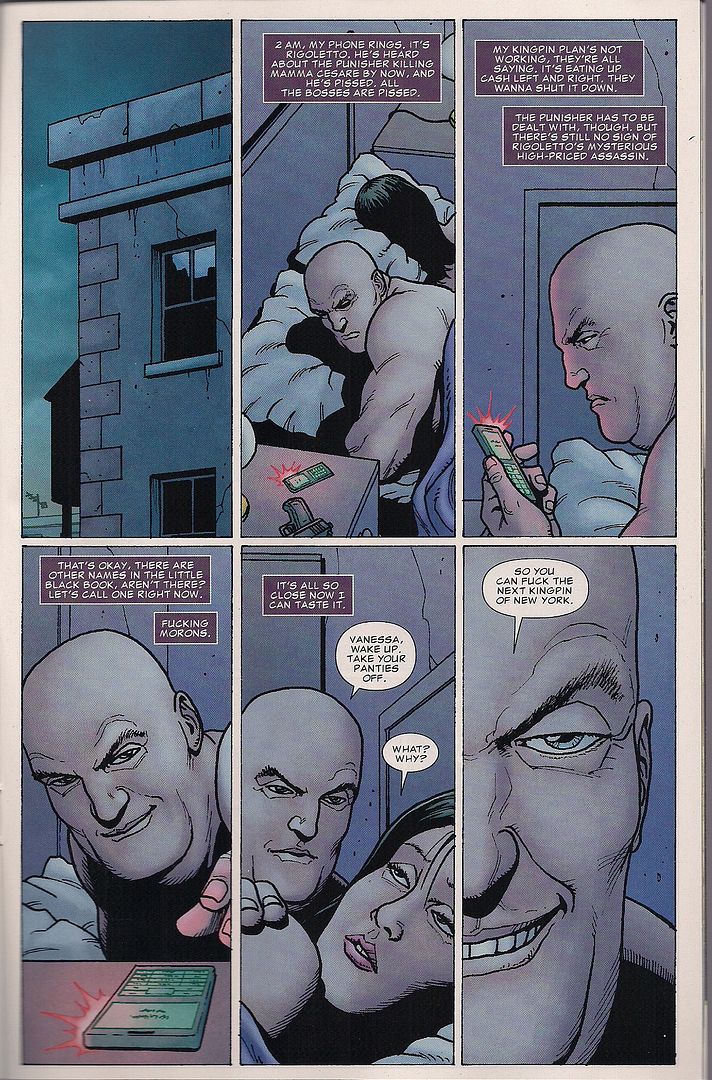
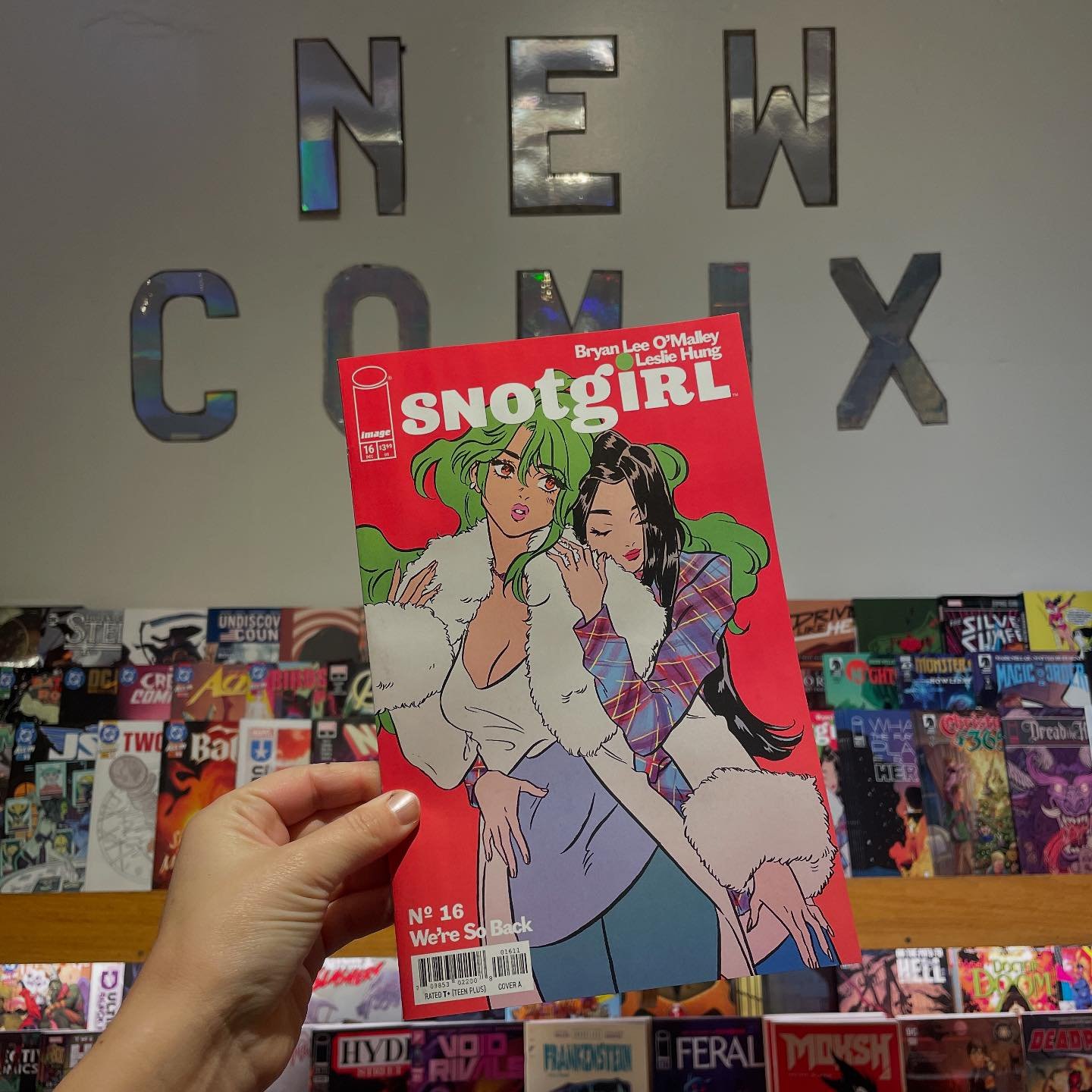
According to the advertisements all over the side over there (---->) Stan is, apparently, back. Wouldn't it be cool if it was some sort of zombie-related thing with Stan feasting on the hearts of the wicked? "Face Front, True Believer.... so I can reach your braaaaaaaain!"
No? Maybe it is just me...
Well, I thank them for the ad dollars, anyway!
So, some quick reviews (yeah yeah, I missed the goal of one-a-week-for-the-quarter -- I had a hectic fortnight!)
JUSTICE LEAGUE OF AMERICA #42: Yeah, liking this. This is really how I want a JLA comic to be -- taking place in, and mining the DC Universe. I also quite liked the (Earth-3? Well or whatever they're calling it today) New Gods appearance. My only real quibble is what Plas is doing in the WW2 era, that's a continuity change, ennit? Anyway, I like the scope, the byplay, the whole thing -- I'll say VERY GOOD.
JOE THE BARBARIAN #2: I didn't love this as much as issue #1 -- and I think it is down to the "real world" scenes. I didn't feel like there was any stakes or peril there, though it appears we're supposed to think the kid is dying, but that didn't really come across very well for me, and felt very disconnected to the Fantasy world stuff. Still, the art is faboo, and the book is a fair amount of fun. I'll go with GOOD.
SUPERGIRL #50: It's not that I have anything especial to say about this issue, but I was deeply, massively, profoundly amused by the screaming headline on the cover: "Featuring a tale by HELEN SLATER!". Yeah, there's maybe 17 people in the entire world who get why that might be even vaguely interesting (it isn't), and that's COUNTING Slater's immediate family. Don't get me wrong, I think it's great that the actress in an awful movie can get a byline in a comic... but it is like 25 years too late for that to be meaningful to anything remotely resembling today's audience.
In the main story, I was a bit bugged by the (at least) three instances of swearing -- even if two of them were in "Kryptonese". I'd kind of prefer a Suprema-esque use of language, really. But then, my Supergirl doesn't wear a belly-shirt either, so I guess I'm not going to win that one any time soon... Anyway, I thought the entire issue was a bit EH.
GREEN LANTERN #51: I really liked the deftness of having this be a (fairly integral) crossover into the main BN story-line, but that if you didn't read BN, or, conversely, read BN, but not GL, you're probably just fine in reading along. I thought this was pretty GOOD.
DARK AVENGERS #14: I'm fairly uncertain how this is a "Siege" crossover, really, except for the one little sentence about it, and I remain unsure about the value of jerking Sentry around like that. Despite the fact that it is a manufactured and inserted character, it would appear to me that this gives the character even less possible places to go -- except, maybe? becoming the Marvel version of Superboy-Prime, which would be a fairly tragic mistake, IMO. Overall, this was only OK.
ZOMBIE VERSUS ROBOT AVENTURE: I still don't really "get" the missing "D" in the title (wiki says that it is a noun: aventure (plural aventures)
1. (obsolete) Accident; chance; adventure.
2. (obsolete) A mischance causing a person's death without felony, as by drowning, or falling into the fire.
and none of those really seem to fit much?
There's some nice art in here, but it all feels... well, it feels a bit like HEAVY METAL where it is like the story isn't supposed to matter, really, because the art is so nice. Which, in premise, is fine, but then, where are the titties? It seems to me that the value in the "ZvR brand" is really all about Ashley Wood, but none of the styles involved here are really anything like Wood, so, yeah, I Don't Get It. My customers don't seem to, either -- sales on this were very poor, and much lower than the Wood-driven issues. Overall, I thought it was pretty EH.
28 DAYS LATER #7 AIRFIGHTERS #1 AMAZING SPIDER-MAN #622 GNTLT ARCHIE #606 AVENGERS INITIATIVE #33 SIEGE AVP THREE WORLD WAR #2 (OF 6) BART SIMPSON COMICS #52 BATMAN AND ROBIN #9 BILLY BATSON AND THE MAGIC OF SHAZAM #13 BLACK LANTERN GREEN ARROW #30 (BLACKEST NIGHT) BLACK TERROR #8 BLACKEST NIGHT #7 (OF 8) BLACKEST NIGHT JSA #3 (OF 3) BUCK ROGERS #9 CAPTAIN SWING #1 (OF 4) CHOKER #1 CHRONICLES OF WORMWOOD LAST BATTLE #3 (OF 6) COWBOY NINJA VIKING #4 (OF 4) DARK TOWER BATTLE OF JERICHO HILL #4 (OF 5) DARK WOLVERINE #83 SIEGE DEADPOOL #20 DEADWORLD FROZEN OVER #4 (OF 4) DONALD DUCK AND FRIENDS #351 ENDERS GAME MAZER IN PRISON SPECIAL FALL OF HULKS RED HULK #2 (OF 4) FOH FANTASTIC FOUR #576 FLASH REBIRTH #6 (OF 6) GOTHAM CITY SIRENS #9 GRAVEL #17 HALO BLOOD LINE #3 (OF 5) IMAGE UNITED #0 (OF 6) IRON MAN VS WHIPLASH #4 (OF 4) IRREDEEMABLE #11 JUSTICE SOCIETY OF AMERICA #36 KING CITY #5 KNIGHTS OF THE DINNER TABLE #159 MADAME XANADU #20 MARVEL ADVENTURES SPIDER-MAN #60 MARVELOUS LAND OF OZ #4 (OF 8) MARVELS PROJECT #6 (OF 8) MS MARVEL #50 MUPPET KING ARTHUR #2 NATION X #3 (OF 4) NEW AVENGERS #62 SIEGE NORTHLANDERS #25 OBAMOUSE OFF HANDBOOK MARVEL UNIVERSE A TO Z UPDATE #1 OFFICIAL INDEX TO MARVEL UNIVERSE #14 PALS N GALS DOUBLE DIGEST #139 PVP #44 REALM OF KINGS INHUMANS #4 (OF 5) ROBOCOP #2 SCALPED #35 SECRET WARRIORS #13 SPIDER-MAN CLONE SAGA #6 (OF 6) STAR TREK TNG GHOSTS #4 STAR WARS LEGACY #45 MONSTER PT 3 (OF 4) SUPERMAN #697 TALES FROM RIVERDALE DIGEST #37 TALES OF THE DRAGON GUARD #1 (OF 3) TEEN TITANS #80 THOR #607 SIEGE THUNDERBOLTS #141 SIEGE TRANSFORMERS ONGOING #4 ULTIMATE COMICS ENEMY #2 (OF 4) UNKNOWN SOLDIER #17 USAGI YOJIMBO #126 NUKEKUBI VICTORIAN UNDEAD #4 (OF 6) VIKING #5 WALKING DEAD #70 WALL-E #3 WE WILL BURY YOU #1 WEB #6 WEIRD WORLD OF JACK STAFF #1 WILDCATS #20 WONDER WOMAN #41 X-FACTOR #202 X-FORCE #24 XN X-MEN FOREVER #18 X-MEN LEGACY #233 XN
Books / Mags / Stuff BATMAN CHRONICLES TP VOL 09 BATMAN KING TUTS TOMB TP BEN TEN ALIEN FORCE DOOM DIMENSION GN VOL 01 DAREDEVIL LONE STRANGER TP DEADPOOL & CABLE ULTIMATE COLLECTION TP BOOK 01 DODGEM LOGIC MAGAZINE #1 HALO HELLJUMPER PREM HC HITMAN TP VOL 02 10000 BULLETS NEW PTG IMMORTAL WEAPONS TP INDIANA JONES FURTHER ADV OMNIBUS TP VOL 03 JUDGE DREDD MEGAZINE #294 JUXTAPOZ VOL 17 #3 MAR 2010 KUROSAGI CORPSE DELIVERY SERVICE TP VOL 10 LOST OFFICIAL MAGAZINE #28 PX ED MARVEL ADVENTURES IRON MAN SPIDER-MAN TP DIGEST NEW AVENGERS PREM HC VOL 12 POWER LOSS POPGUN GN VOL 04 PREVIEWS #258 MARCH 2010 PROJECT SUPERPOWERS CHAPTER TWO TP VOL 01 REQUIEM TP VOL 02 VAMPIRE KNIGHT SPARROW HC VOL 14 ASHLEY WOOD VOL 3 SPLENDID MAGIC OF PENNY ARCADE 11.5 ANNIV ED HC TOMARTS ACTION FIGURE DIGEST #185 WIZARD MAGAZINE #223 MCKONE SPIDER-MAN CVR
My very very first thought was "Well, wait, where does that leave Karen and Vertigo?"
My second thought was "Just knowing the little I know about Life and Power, a five-headed power-sharing structure doesn't seem like it has much practical chance to work."
My third thought was "Well, good for Jim and Geoff" as this expands on what they were pretty much already doing, and gives them some Portfolio, and, we would hope, a pay raise to keep doing it.
My fourth thought was, and this was my uncharitable one, "Uh... Dan? Really?"
I haven't made any particular secret that I don't like many of Dan's editorial policies and instincts, but that's all Armchair Quarterbacking on my part. *I* don't have to like them, as long as enough of my customers do. But that's just difference of opinion and if Warners like his sales figures, then who am I to say otherwise?
But I have major concerns about Didio in terms of his willingness to engage with the Direct Market retailer; which, given the rhetoric on display about the importance of our segment of the market and the dominance of intent on comics and print makes it kind of all the more nerve-wracking.
(Not that I am not pleased that they crafted that rhetoric in the first place -- because that puts them at least a step above Marvel's historical public statements -- but things change when the rubber meets the road, and "say" and "do" are very different things)
From a business-to-business POV, rather than the do-I-like-his-output POV, I've found Dan to largely be dismissive of any idea that doesn't fit his notions, and defensive about the ones he has. That's not necessarily a bad thing for an editorial position, but I deeply fear the potential problems as the publisher.
I remember Dan angrily yelling at me (I nearly typed "screaming", but that's maybe a touch too strong) on the floor at WonderCon... '07 was it? when I questioned how they handled the solicitation process for COUNTDOWN. I mean on the floor of the con, seriously.
Here's the thing when dealing with retailers: when it comes to something within their own four walls, they're almost always correct. When I come to you with, "this is what my preorders have been on project x, y, and z; but project Q had this minuscule fraction of that number because of how you chose to release information in the name of 'secrecy'" then you have to give that weight, you have to take it seriously, even if it goes against how you'd like to run things.
I want to underline that I'm talking about business-related things, not opinions like "I don't like title Q".
I also remember the ComicsPRO meeting where a bunch of concerned retailers from, let's call them Red States, were really upset about the content that was going into ostensibly "code approved" DCU titles -- the drug use in that issue of FLASH, the "God damn"S and so on, and, again, Dan get utterly dismissed these concerns as having any validity whatsoever. I mean, at all -- "it's nothing worse than prime time TV", I think was the phrasing? Angry raised voices again.
Look, I'm in the Bluest neighborhood in the Bluest City in the Bluest state in the country, and when I hear these retailers say, "We're really concerned because these things hold a lot of potential problems from angry parents, and we're afraid it is possible some of us might even get arrested", and I instantly agreed -- because that is the truth within their four walls. I don't have a horse in that race, but I sure understand that THEY do.
I've seen Dan be utterly dismissive of retailer concerns on things like not having the named protagonists even appear in their own books for extended periods of time, and so on and so forth.
I do think that the job of EIC of a super-hero universe might mean always thinking you're right, once you've made a decision, is the only way it can work. But I think that the job of Publisher needs someone who knows that they're probably wrong a lot, and hopefully you become a little less wrong the next time.
It has been at least a year since I've had any interaction with Dan, so this isn't any recent activity, to be sure; and I'm sure at least one person reading this is slavering to respond with "further proof you hate the guy", but I don't. I completely admire his energy and above all else his passion for what he does -- I like people who BURN. That's what moves the world.
But what I want, and what I think the Direct Market needs, is a publisher at DC who is extremely willing to change their mind on business matters when presented with appropriate evidence, and none of my business interactions with Dan have given me confidence he would do so.
My fifth thought was "Well, let's see how it works"
My sixth thought, and one I had seconds after hitting "post", so this is an edit about 90 seconds later, is "don't be a douche, Bri, congratulate him" which is absolutely correct, I'm a douche: Congratulations, Dan.
And, of course, the seventh thought was "Man, it must suck to be the '...and the rest' part from the Gilligan's Island Theme Song", so congrats to Caldon and Rood as well. I'm sure they'll learn to hate me soon enough! (Starting....now!)
Been away from the Savage longer than I expected to be, and that's how it goes when you can't see your keyboard through a veil of tears. I'm not the political type, so don't expect any side-taking in the whole Communist America controversy, but I will remind you of this one fact, learnt from my pappy's knee: any sort of testicular manipulation (including "teabagging") is a 100% fantastic way to spend one's time, and a little summer fun with the Lord's satchel never hurt a soul. Stealing the term for usage in the latest re-re-remix of party over here/party over there may not be an actual crime, but no matter which side you take on the Bookscan debate, we've all lost a bit of our innocence.
Let's ask the mainstream to bring it back to the center, and let the groaning commence. (These came out last week.)
Hit-Monkey # 1: Let's Make This Perfunctory
The "monkey with guns" idea works best when you're Mike Mignola and the beast only gets a couple of panels, but it's obvious from Marvel's "Heroic Age" banner that some people won't let the sun go down on an idea until that idea's corpse is ejaculating maggots with last names. Hell, this comic isn't even about that Agents of Atlas gorilla with the wisecracks, it's about some other monkey, who has other guns. So what is Hit Monkey? Some kind of weird bet amongst creative types? A convention sketch come to life? On the plus side, there's one joke in here that hits the mark (that one being where the assassin chooses to wear his suit throughout months of recuperation, including all the time he spends pruning up in a hot springs), but this is otherwise AWFUL fare. That's not really a shocker. At least it's only a one-shot, and all the people involved can get back to whatever it is they do with the rest of their time. Deadpool? Being legitimized by Giuseppe Camuncoli?
Batman & Robin # 8: Let's Make This Personal
I gather I'm just not the audience for this. I came to the idea of Grant Morrison-doing-Batman with a level of anticipation that no actual comic could have ever met unless it magically teleported into my bathroom and started bench-pressing victory. Honestly, the last few years have been a lesson in how little I really do want to read super-hero comics that "take post-modern chances" or whatever histrionically worded expectation I've placed on this writer's output. The things that I loved about his "mainstream" work on Doom Patrol, Animal Man, JLA Earth 2, New X-Men--they weren't the Invisibles style idea exercises, the "at play in the fields of symbolism" Seaguy-ish bits, they were how well that Morrison handled the perfunctory moments of kitchen sink standards. I liked when the Beast would get to jump around and hit shit in X-Men, the long-form friendship drama between Cliff Steele and Crazy Jane, the desperate sadness when Batman got to team up with the father he still keenly missed. I'm a sucker for it when it works, and all that Buddy Baker crying and wanting his wife back kind of stuff, all those moments of simple, easy drama worked so goddamned well whenever Morrison felt like throwing it in.
These Batman stories haven't had a lot of that. There's been a good bit of Morrison's Justice League kind of lines, where Batman says threatening stuff, scenes where he's presented as the be-all, end-all of the Being One's Best bootstraps fantasy, but there's so little sweetness in between. Damian is the main exception--under Morrison, he's a genuinely funny character--and the art has had some considerable moments of grace and beauty. (Cameron Stewart's bleeding headlights in issue 7, or the way this issue presented Damian as a sweatervest-wearing Bruce in miniature, complete with pomade slicked hair.) Domesticity and Batman can go well together--there's still a lot of pleasure in the moments that force Bruce out on dates--but everything here is set at the Final Crisis interpretations of super-heroism, frenetic depictions of guy-fights-evil that never take a second to look around. It's still a GOOD comic, and I can imagine a genuine appreciation for its style that would push it higher, but it would be a lie to say I shared it.
Adventure Comics # 7: Let's Make This Punditry
This is a Valentine's Day Special in everything but name, throwing a heart on the cover just to make it clear. Expanding on the portion of Blackest Night where resurrected super-heroes became short-term Black Lanterns, it's up to writer Tony Bedard (and a five man art squad?) to get Superboy from point A (is Black Lantern) to point B (is not Black Lantern). It's a job, not a story. Page limitations lock the guy into treatment writing, the ensuing battle between Superboy and his sorta girlfriend Wonder Girl is as paint-by-numbers as it gets, which means it's easiest just to focus on a piece of spiky dialog to test the comic's pulse. That piece of dialog is where the mind-controlled Superboy tries to scare/humiliate/upset his sorta girlfriend by strongly implying that he masturbates to fantasies involving his cousin Supergirl. That--yup--makes sense within the story, as the Black Lanterns have been consistently shown to be interested in arousing a lot of emotion in their super-powered victims, and telling your girlfriend you'd rather jerk off to thoughts of incest than have sex with her is probably something that would result in a bit of a tiff. (Wonder Girl is occasionally portrayed as having a self-esteem problem, so it's also wholly possible that she considers herself less attractive than Supergirl. Which might be true? It would seem impossible to tell the difference between the two characters if they were wearing street clothes.)
It's besides the point whether this is "gross" or "decadent" or not. Again: this isn't really a story, it's a task. Adventure Comics was going to be handled by Paul Levitz by this point, that changed because DC's going to move to the West Coast and everybody's going to get fired so the companies intellectual properties can become digital avatars that are transmitted for free through radio waves, all so that You Too Can Write Blue Beetle At Home, or whatever the latest explanation via Mad Libs is. This is a filler story, something that could've gone anywhere, that could've been handled in a couple of panels in the Blackest Night series, or it could've just never been told at all. Point B--Superboy not being a Black Lantern--was all that "had" to be reached, Adventure # 7 exists because the 22 page solution was the one picked out of the editorial hat. Is it an AWFUL comic because a bunch of random good soldiers collected a paycheck to get the pencils inked and its writer delivered the geriatric plot that editorial selected? Is it an EH book from a "is this product worth your time or money" standpoint? Is it CRAP because some people find its dialog offensive? Or is it VERY GOOD, maybe even EXCELLENT, all because it doesn't resort to the cliche of having the mind-controlled person hammer their friend's face into the pavement over and over again, until their friend's face is a bloody pulp, and then, right before the final killing blow is thrown, the mind-control wears off and the pummled meat of the friend's face mumbles "it wasn't your fault" through broken teeth shards?
God only knows. There's a bunch of new stuff waiting already, but if you can find it, you can make the call on this one yourself. Last time I checked, report cards already had plenty of grades. And if Adventure Comics # 7 is anything, it's that: a memo with notes in the margin, passed on down from one hand to another.
Comix Experience is extremely proud to celebrate its 21st anniversary, on Saturday, April 3rd, starting at 8 PM, with a “Coming of Age” party, and you’re invited!
CE:21 is a benefit for the Comic Book Legal Defense Fund – a non-profit organization dedicated to the preservation of First Amendment rights for members of the comics community – and happens during WonderCon weekend in San Francisco.
Featuring an El Toyanese Taco Truck, sponsored by Image Comics, and delicious beer courtesy of 21st Amendment Brewery, this is the comics event of the year!
Comix Experience is the oldest comic book store in San Francisco with the same owner and location. All attendees making a donation to the Comic Book Legal Defense Fund will receive a “goodie bag” filed with neat stuff. There will also be an art auction, to benefit the CBLDF, and donations are still being accepted.
For more information, please contact Brian Hibbs at 415-863-9258
First off, seriously, "Bookscan Analysis as Direct Market Public Service Announcement"? Really? I feel like I've been told to get off Tom's lawn for playing too much...
Eric's comments are wonderful, but I don't really see that they have much (if anything) to do with anything that I actually WROTE, as opposed, possibly, what people might want to think that I wrote.
If someone can point me to anyplace where I've represented the BookScan numbers to be anything other than what I say they are -- that they "don’t, in any way, represent all 'book stores' selling comic book material." That "Also, remember that this analysis represents RETAIL SALES. This absolutely doesn’t include anything like Library sales, or School Sales, or things like book clubs and so on. Those are not RETAIL SALES." Or that at any place in the piece that I ever represent these numbers as anything other than "sales from the stores that report to BookScan", then I would dearly love to see it.
I've also never suggested, thought, implied, or even believe that virtually any publisher anywhere could survive or prosper without ALL channels working to sell books. Again, if anyone can cite a statement like that, please feel free.
I like Fantagraphics' output. A lot. They are clearly an important publisher in terms of the bodies of cartoonist's work they are bringing to the market, and many of the things they publish are among my best sellers.
I might be worth noting that the word "Fantagraphics" doesn't appear in this year's column whatsoever, and I make a single passing reference to one book of theirs (as noted before, intended purely as a follow-up from the '08 column), and a handful of the cartoonists they publish. The context of that statement is, at least I think, to express regret and amazement that those cartoonist's works aren't selling better, via the stores that report to BookScan, then they are.
Eric says, "I did a cursory look at a half-dozen titles from the last couple of years, and in some cases, our library/institutional sales can amount to as much as 30-50% of our overall book trade business. This is one stream that does not report to Bookscan..." which, as far as I can tell, is exactly what I said! It's also largely irrelevant -- the BookScan analysis is NOT a report on everything that sells in non-DM channels. I directly and repeatedly say that. I directly and repeatedly say that this is retail sales (repeat it with me!) "the stores that report to BookScan".
Further, BookScan is sales made to consumers -- not wholesale. Let's say, with no basis in reality, that 1000 stores that report to BookScan rack L&R #2, that could mean that there are 1000+ copies out there on the racks awaiting purchase by some sophisticated buyer with taste. Awesome. BUT THE NUMBER OF COPIES THAT SOLD TO A CONSUMER (via "the stores that report to BookScan"!) is 374 copies. If anyone, anywhere, has any evidence that this is not a factual statement, then I'd like to hear it.
That DOESN'T MEAN that FBI should abandon the bookstores, or that those are not "good" sales, or anything else that Tom or Dirk would seem like to spin as something that I am implying. I am not.
If people want to engage in arguments that *I* am not... well, I can't stop you, but there's no other possible way for me to respond except for "I never said that. I never implied that. I don't believe that. And anyone who does is, actually, not very smart, whatsoever."
Look at the numbers for what they say. Criticize me for things I actually say -- that's totally fair game. But don't criticize me for what you infer that I am saying, because that inference is on the plate of the reader, and does not bear any relationship to either what I wrote, nor what I believe. I think we'll all be much happier that way.
Eric concludes with "I don't pay attention to Bookscan too closely, but one thing I've gleaned from reading Brian's annual essays is that either he reads way too much into Bookscan numbers, or we pretty dramatically buck the conventional wisdom of what Bookscan "means" in the bigger picture."
At a guess, I suspect the latter is the case. As for the former, the only thing that I'm really "reading into" BookScan is that a work as (in my personal opinion) over-reviewed and mediocrely done as, say, Stitches, sells like 30 times better than something as transcendent, and created by cartoonists at their peak of craft and skill, as L&R.
Tom Spurgeon has some excellent comments up about my BookScan Analysis, and I feel compelled to engage his commentary. This is not a Blog War, but I'm hiding most of this behind the jump for those of you who Don't Like To See The Parents Fight...
Let’s start with motivations, which works nicely as a “response” to numbered point #1 ("I know I'm grateful...It's fun to see how certain books did on the chart"). First and foremost, I'm getting the Top 750 out there, and if you don't like my analysis, in the words of the great "Scoop" Nisker, "If You Don't Like The News, Go Out And Make Some of Your Own"
The entire reason I bother to write that beast every year is because *I* want to see the bookstore data. We’ve known that data was there, but it used to be locked up in a black box. I wanted to see it, so I called in favors and got it set free, and my assumption has always been that if I want to see it, then others do as well. As long as I had it, I might as well actually write about it and expose that data to a wider number of people.
I’ve always disliked and mistrusted the few shimmering glimpses we get at the data, generally because it is coming from people with something to lose (read that specifically as “access to the data” in the main) if they get too specific about their reporting. That’s why we get ICv2 headlines that say things like “Watchmen #1 on BookScan for xth week in a row”; which I find to be more frustrating than illuminating. I mean, what does that mean in any kind of broader context, or in relationship to other things? Comparative analysis gives a much better picture of what the trends and things really are.
So, yeah, I want that information out there, and I want it out in a venue that it might attract some attention and be searchable rather than, dunno, putting it up as a torrent or something, where only people who know to look for it might have a chance of finding it.
I think that books, in general, are weird because it is very hard to get specific data about how well they’re doing – I love the existence of a site like boxofficemojo because it presents virtually any piece of information you might want to know about a film’s performance in a pretty easy to find format. I also like sites like John Jackson Miller’s Comichron because it attempts to do much the same for the comic book industry. Its major flaw, however, is that it ONLY does it for DM sources of information.
So: at my core the reason I write this every year is to give a chance for that information to be out, natively in the wild, and to be a part of the Historical Record.
I will tell you this: I’m not convinced that my analysis is really any good. I mean, if you have like 6 spare hours, go through and read all seven years of analysis, one after another, and look at how much my tone and methodology has changed. In year one, it is really about 90% Direct Market, and maybe 10% bookstore because what I was actually hoping in my heart is that someone else would actually take up the data and perform their own analysis on it, so that I wouldn’t have to.
As I came to understand, over the years, that no one was going to bother to do that, I’ve gotten closer and closer to writing something actually worth reading – the first 3 (I think?) years had entire “What about the Direct Market?!?!” sections that I ultimately abandoned as being counterproductive to the exercise.
Anyway, my motivation to release this information is simply that: I want the information released, I have a long standing and “well respected” comics industry opinion column, it seems like a good match.
But, I also have to think of what I understand about my audiences.
Primarily, I write for and to other Direct Market comic book retailers. That’s the entire point of these columns. Remember, TILTING started in the controlled circulation COMICS RETAILER magazine, only ever seen by 5000 people, maximum.
Secondarily, ever since I made the switch to the wider internet with Newsarama, and, current, Comic Book Resources, I feel like I have to spend a reasonable amount of time writing for the “lay” audience. Which is why you’ll see me over explaining things, sometimes (“What is an SKU?”, that kind of thing), because I want the layfolk to at least have a notion of what I’m talking about. More importantly, my “lay” audience is mostly comprised of folks who are really really interested in the Direct Market version of “comics”. That is to say, disproportionately interested in “mainstream” Marvel and DC superhero comics. That it to further say, I believe that 75% or better of the people who read TILTING know nothing whatsoever about the industry except whatever “common truths” they’ve managed to absorb, and repurpose to their own ends.
My tertiary audience is that of the “Decision makers”, and it’s tertiary because they have much better data than I do, have to balance the needs of a much wider range of participants, and because they’ve already made their decisions. The chances of my actually directly impacting or changing any decision made is vanishingly small. I’ve been writing columns for nearly twenty years now, I know that very very well. At absolute best, I can hope to possibly influence some potential future decision by adding to consensus (and, in fact, I think that one of my leakers gives me data for precisely that reason)
So this comes to Tom’s point #2 –- "Hibbs' qualitative analysis is so infused with this highly insistent defense of the Direct Market" -- yes, it IS a DM oriented column for a DM oriented audience written by a DM oriented participant. I literally don’t know if it is *possible* for it to not be “infused” with a pro-DM slant, given its genesis, and ongoing status. I write 11 months of the year in a DM-oriented fashion, it is extremely difficult to expect me to not do that on the 12th month.
In my “defense” (though I don’t think this is something that needs a “defense”, per se – because I think it IS extremely valid) not only do I specifically (overly?) point out my biases and directly ask for other perspectives, but I’ve made my best faith efforts over the years to become as dispassionate as I can be. Again, read the way the commentary has changed over the course of seven of them: it has gone from DM-centered to DM-“infused”. I count this as a victory!
Having said that, I have to tell you that in the Best Alternative Universe Ever, I’d rather read a 20k word essay on the Annual BookScan analysis by Tom Spurgeon, than writing this shit myself, because I think he’d do a much better job of it than I ever would in keeping Professional Distance. He’s a Reporter by nature – I am an Opinion Columnist.
Tom’s point #3, and the first of the “big, sweeping problems” is “I can't figure out who on earth holds the positions he insists on dismantling.” And I guess Tom and I just travel in different circles. Again, Tom does note people “in a difference-making position”, but, as I said before, they’re my tertiary audience. Because I hear a lot (a LOT) of misinformed, or downright wrong statements from both my primary and secondary audiences quite a bit. Now, I will grant you that “bookstores will save everything” was actually replaced in 2009 by “digital downloads will save everything”, and that my own conflation of the two may be at fault here, but anything that I wrote stemmed from something that I’ve heard recently as a continued meme.
Let me sidebar for a second and talk about my working method. Because there’s a certain amount of boilerplate that I only rewrite slightly (for instance, just about everything before I get to the actual yearly overview), and there are all of the charts that I’m just adding new rows to, I actually just open up the previous year’s column and start editing and rewriting. Typically I go into each section, add two pages of carriage returns, then start writing the new piece. After I handle a subsection of each section (say, “10 ten books over all” followed by “top 5 dollar books” and so on – though I don’t explicitly label those subsections, that’s how I write it, in order to stay sane), I’ll scroll down and see what the results were in the previous year, and add in any relevant comparisons (“such and such grew by this much/lost this much”)
So, because of this, there are sometimes things I return to simply because I talked about it last time. Example: the citation of L&R #2. So, there are a handful of things in any given report that will be “last year’s discussion follow-up” items.
Anyway, for Tom’s #3, I guess I’d say “I’m writing for a mass audience for whom a significant number still hold these views as not-debunked; and not really for the ‘intelligentsia’ or 'Decision Makers'”. It is fair to question whether that is right or wrong decision (or if I’ve over-inflated in my head the actual response) but that’s what I’m thinking.
Also, I hear similar kinds of things from new entries into the market quite a bit. I get lots and lots of blind “I’m going to be a new publisher and this is how things work!” emails, maybe more than Tom does? Admittedly, virtually all of the people who come in with those thoughts either get gutted instantly, or quickly modify their tune, but while it is true “Everyone that matters knew this years ago,” some of the people who will matter 20 years from now are likely starting their education today.
For Tom’s #4, ("Hibbs admits the numbers are untrustworthy in a lot of ways... and then compares them anyway and goes on to make sweeping statements...") I think there’s value in comparing two relative performances, even if they’re gathered by wholly different methodologies and are less-than-perfect measures in the first place, as long as you know what the limitations of that data are going in.
That is to say, looking at the number sold for Fables, Y or Sandman in Direct, and comparing as a percentage to the Vertigo Crime line, and that looking for that same number sold for Fable, Y, or Sandman via the stores that report to BookScan compared as a percentage to the Vertigo Crime line, and seeing that it follows basically the same pattern that the Minx line did before it, and drawing a conclusion from that… well that seems like a fair conclusion to make. That doesn't mean I inherently believe that either set of numbers are actually 100% accurate (or tracking the same things -- no not at ALL!), but that a trend can be perceived. Is that perception right or wrong? Dunno, that's why I put it out there, let's have a conversation on the merits of the argument itself?
So, I don’t want to necessarily disagree with Tom’s point, but to say that I think that I’ve handled it appropriately, and I’m much more eager to engage on the specific conclusions than on “Don’t cross the streams, that would be bad” as a general point.
And I think (repeat: think) that I either slather any direct comparison between channels with Weasel Words (“I would strongly suggest that this indicates”, yikes!), or I do so otherwise only in the abstract. If there are particular and specific instances anyone disagrees with, I’d be glad to discuss them. No, strike that, I would be ecstatic to do so!
Tom’s #5 ("...bookstore vs. DM argument takes over those sections even when it's not brought up. "), I appreciate his acknowledgment that it might be his personal weakness. And I think some of it is, because I’ve tried, continue to try, and will continue to try to tone it down over the years.
I like his questions, though! The answers are...
"Could this leave bookstores open to someone suggesting they have the next Watchmen in the form of some Green Lantern book?"
More willing to try something new that hasn’t ‘proven out’ in Direct first, but not so willing as to position a capey book that flops in Direct. ‘Earth-One’ would seem to be our next available test, as it was positioned as a ‘bookstore initiative’ as I read it.
"Will they favor the shelving of DC books for a while?"
Potentially, but of course, Chain bookstore shelves are ultimately For Sale, plus there’s a pretty big X-factor in ‘how many of these books are selling on Amazon, et al’, where there isn’t ‘shelving’ in the way you meant it.
"Will this make it that much harder for Marvel to kickstart their post-Disney purchase bookstore program?"
I’d think not; why would it? And those shelves are For Sale, anyway.
"Were stores stuck with Watchmen copies as the cycles worked themselves out?"
Unlikely to be ‘stuck’ that significantly, because I bet you $1 that result is as much a function of expanding the number of storefronts carrying the book in the first place as it is from copies-sold-per-store, and IF anyone was carrying way way too much inventory, and if DC did sales into bookstores even remotely in parity as they did in the DM, they were taking full 100% returns on that one book, as needed.
"Are they asking for new Watchmen material?"
No clue from me. Ask Dan DiDio.
OK, that was fun, and I wish the entire post was just that!
On Tom’s #6 ("I think Hibbs vastly underplays the recession."), I am not sure how so? And in regard to “And if everything must be a market to market dick-measuring contest, it also makes perfect sense to me that a market serving relatively casual readers is going to be hit harder in the first 12-15 months of a recession than a market serving the most devoted fans.”, I have to say “huh?” Or did you not see the sentence about the DM being down FIFTEEN percent, which is a LARGER drop than the bookstores? Muh?
#7 ("I think Hibbs underplays the effect the quality of books has in a lot of comics' sub-markets."): Wait, now you’ve totally lost me. You’re positing that quality of a work is the most important reason it does or doesn’t sell? Really? That’s why nothing by, say, Urasawa, hits in the Top 750, but Naruto is #1 in manga? Is he saying that Stitches is externally and qualitatively a better book than, dunno, Optic Nerve? (*I* don't think so!) I don’t know how to engage that one at all! Quality doesn't have but the most cursory relationship to sales, look at the music, TV or film charts, if you doubt that...
#8 ("I think Hibbs overplays a manga "freefall.""): Fair enough. Actually, if you go back and look, those 3-4 paragraphs are almost completely lifted from the ’08 report, because I felt it was still pertinent, but yeah, fair enough.
I very very much look forward to any independent analysis that Tom can muster, and, like I said, that’s what I absolutely hoped would happen when I started this 7 years ago. (Not just Tom, I mean – I’m always hoping for 4-5 competing analyses!)
As for Tom's "challenge", I will forthrightly state that I don’t envision anytime in the future that I say *nothing* about the DM or my own individual experiences. That’s not why I write TILTING, and if I'm not entertaining/being relevant to my perceived audience, then I don't expect to keep it. But I will promise to at least to continue to be conscious of it, and to continue to try and tamp it down if I keep getting access to the data (which is, by no means, guaranteed)
Please note that the Monday holiday this week is NOT one of those that delays comics -- everything should be on sale on Wednesday, as usual (barring snow problems on the East Coast?)
AIR #18 AMAZING SPIDER-MAN #621 GNTLT ANGEL #30 ANYWHERE #2 (OF 6) ARCHIE DOUBLE DIGEST #206 ASTOUNDING WOLF-MAN #21 (RES) ATOMIC ROBO REVENGE O/T VAMPIRE DIMENSION #1 (OF 4) AUTHORITY THE LOST YEAR #6 (OF 12) AVENGERS VS ATLAS #2 (OF 4) AZRAEL #5 BATMAN #696 BATMAN STREETS OF GOTHAM #9 BATMAN THE BRAVE AND THE BOLD #14 BETTY & VERONICA #246 BLACK WIDOW DEADLY ORIGIN #4 (OF 4) BLACKEST NIGHT THE FLASH #3 (OF 3) CAPTAIN AMERICA #603 CARS #1 CHASE VARIANT ONE SHOT IS ALL I NEED (ONE SHOT) DAREDEVIL #505 DARK AVENGERS #14 SIEGE DEADPOOL #19 DEADPOOL MERC WITH A MOUTH #8 DEATHLOK #4 (OF 7) DEVIL #1 (OF 4) DIE HARD YEAR ONE #6 DOCTOR VOODOO AVENGER OF SUPERNATURAL #5 DOMINO LADY #4 DOOMWAR #1 (OF 6) ENDERS SHADOW COMMAND SCHOOL #5 (OF 5) GARTH ENNIS BATTLEFIELDS HAPPY VALLEY #3 (OF 9) GREEN LANTERN #51 (BLACKEST NIGHT) GREEN LANTERN CORPS #45 (BLACKEST NIGHT) GUARDIANS OF GALAXY #23 HELLBLAZER #264 HULK #20 FOH INCORRUPTIBLE #3 INCREDIBLE HERCULES #141 INCREDIBLE HULK #607 FOH INCREDIBLES #5 INVINCIBLE #70 JENNIFER LOVE HEWITTS MUSIC BOX #3 JOE THE BARBARIAN #2 (OF 8) JUSTICE LEAGUE OF AMERICA #42 LOCKE & KEY CROWN OF SHADOWS #3 LOGANS RUN #1 MAGOG #6 MARVELS EYE OF CAMERA #6 (OF 6) MICE TEMPLAR DESTINY #7 MODERN WARFARE 2 GHOST #3 (OF 6) OUTSIDERS #27 PHANTOM GENERATIONS #8 POWER GIRL #9 PSYLOCKE #4 (OF 4) PUNISHER #14 RESURRECTION VOL 2 #8 SIMPSONS COMICS #163 SONIC UNIVERSE #13 SPIDER-WOMAN #6 STAND SOUL SURVIVORS #4 (OF 5) STAR TREK DS9 FOOLS GOLD #3 STAR WARS KNIGHTS OLD REPUBLIC #50 (OF 50) DEMON PT 4 (OF 4 SUPERGIRL #50 (NOTE PRICE) SUPERMAN BATMAN #69 SUPERNATURAL BEGINNINGS END #2 (OF 6) TALISMAN ROAD OF TRIALS #4 TICK NEW SERIES #2 TINY TITANS #25 UNCANNY X-MEN #521 UNCLE SCROOGE #388 WEB OF SPIDER-MAN #5 GNTLT WEEKLY WORLD NEWS #2 ZMD ZOMBIES OF MASS DESTRUCTION #6 (OF 6) ZOMBIES VS ROBOTS AVENTURE #1 (RES)
Books / Mags / Stuff ALMOST SILENT HC ANGEL ONLY HUMAN TP BLACK PANTHER POWER TP BROKEN TRINITY TP DC UNIVERSE ORIGINS TP GI JOE TP VOL 02 HEAVY METAL SPRING 2010 IGNITION CITY TP VOL 01 JACK STAFF TP VOL 04 ROCKY REALITIES KICK ASS PREM HC (RES) LEES TOY REVIEW #207 FEB 2010 MEANWHILE PICK ANY PATH 3856 STORY POSSIBILITIES NAOKI URASAWA 20TH CENTURY BOYS GN VOL 07 STAR TREK ROMULANS PAWNS OF WAR TP STARMAN OMNIBUS HC VOL 04 WIZARDS OF MICKEY HC VOL 01 MOUSE MAGIC WOLVERINE DARK WOLVERINE TP PRINCE
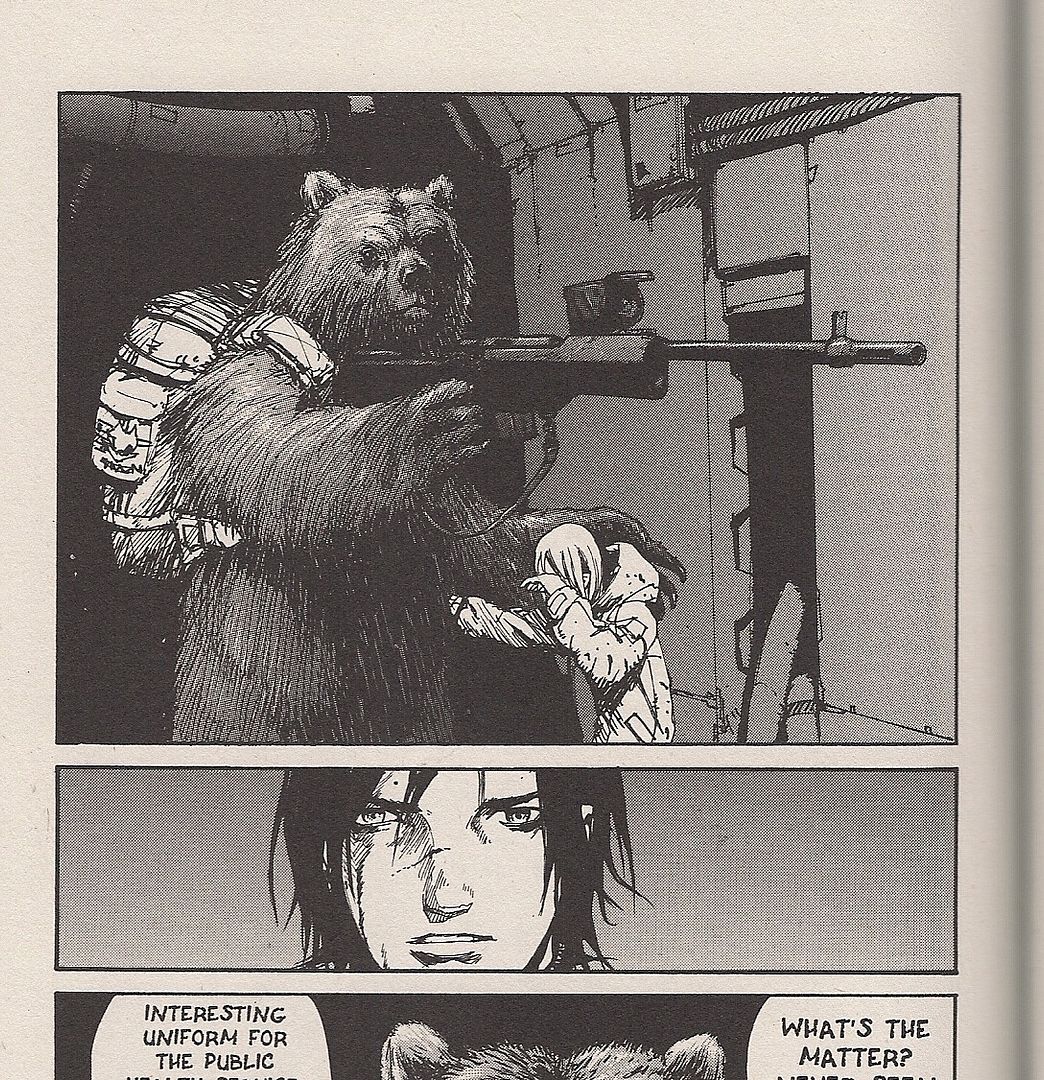
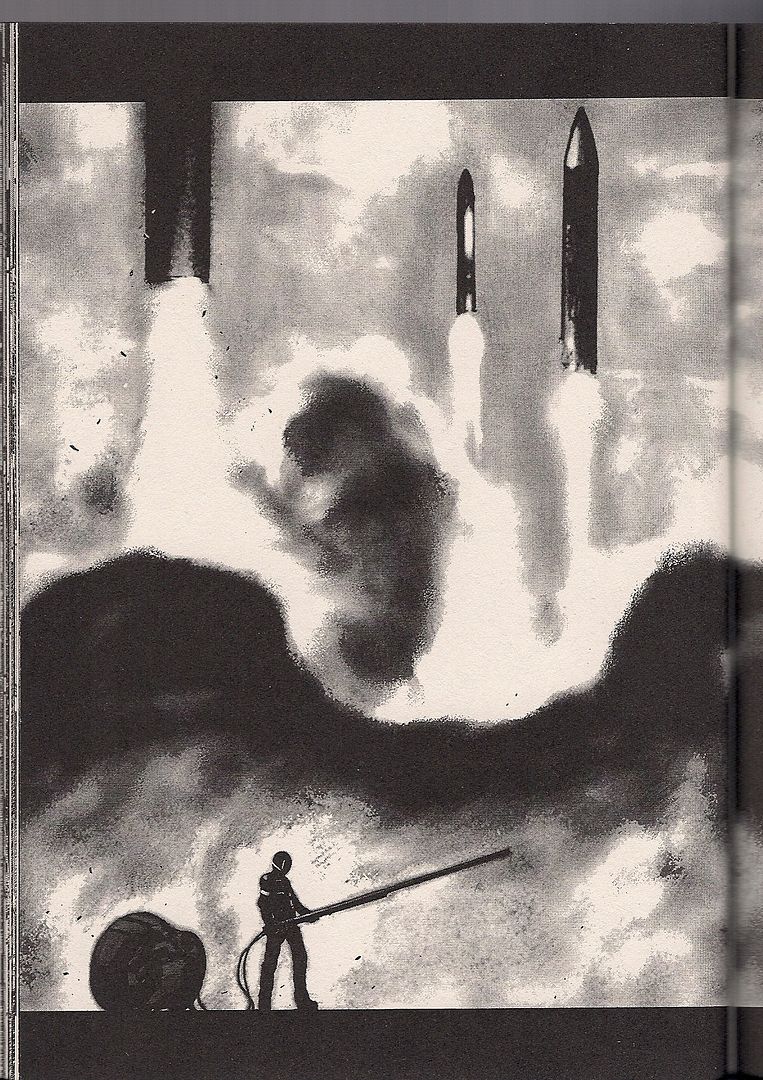
It's the 31st century and a virus from Mars is transforming everyone into mutant zombies; a synthetic human dressed in a black uniform and a black helmet rides his talking motorcycle at 666 km/h into a walled city on a mission to find a teenage girl, whom he almost immediately runs over as she crosses his path, tearing her leg most of the way off, only to have it heal herself in a manner perhaps expected of an Accommodator of the virus from Mars - the dazed girl, however, is also the ward of a talking bear with a rifle who shows up and whisks her away to a tall castle, wherein she is disguised in a bear costume which fails to bamboozle a Cenobite-looking villain with a bloody smock draped over a black cloak who defeats the talking bear and the synthetic human in combat and then stands on a ledge, the girl hoisted over his/her shoulder, shooting the castle with his gun until it explodes, albeit as the synthetic human rescues the talking bear, Kozlov L. Grebnev, who retreats to a submarine while Zoichi, the synthetic human, rides on his talking motorcycle, Fuyu, her AI materialized holographically as a woman in white, through a whole crowd of zombies, whacking at them with an axe en route to shooting the Cenobite-looking bloody smock villain in the head from a distance away while another Cenobite-looking villain in a gown of bandages loads the girl onto a shuttle, leaving her compatriot to mutate into a less human form and lecture Zoichi, who cuts him to pieces, on the villains' terrible plan to purge humanity forever and start a new race with the Accommodators, as emphasized by the sudden launch of thirteen intercontinental ballistic missiles -- while the talking bear watches television in a submarine and a newscaster shoots himself in the head because he cannot abide the baptism of the new society -- upon which Zoichi assembles a very long cannon from out the back of his talking motorcycle, somewhat in the manner of that very long gun the Joker pulls out of his pants in Tim Burton's Batman, and shoots all the missiles out of the air, a la the Batwing, as told to another black-uniformed rider, elsewhere, who fires his own wounded talking motorcycle's AI away in a rocket before confronting another Cenobite-looking villain in a trench coat with a gigantic sword who whacks him on his head, smooshing it all the way down between his shoulders, as the rocket evocatively clears the Earth's poisoned atmosphere into the dead silence of cool outer space. Comics.
Biomega is a big, loud, ridiculous heavy metal tractor pull of a comic, a nakedly derivative blood-on-black-leather action/sci-fi jamboree aimed squarely at 14-year old boys prone to drawing ninjas in class and 14-year old boys prone to drawing ninjas in class at heart. It's the kind of manga that mother (Studio Proteus) used to make (localize to English), and highly OKAY on that level, even if most of us can name a lot of recent zombie-dotted action/horror comics from out of North America; I've often found that manga iterations of such familiar material tend approach things with a notable lack of inhibition (see: talking bear w' rifle), and that's pretty much the prevailing virtue here.
Also, of course, there's the art of creator Tsutomu Nihei, whose 10-volume magnum opus Blame! (pronounced "BLAM" like a gunshot) was released by Tokyopop a few years back, along with an odds 'n ends 'prequel' book NOiSE, although he actually enjoyed the unique honor of a North American-specific color comics introduction prior to any of his Japanese manga seeing release, courtesy of the late Jemas Era out-of-print Marvel curio Wolverine: Snickt!, continuing the onomatopoeia theme.
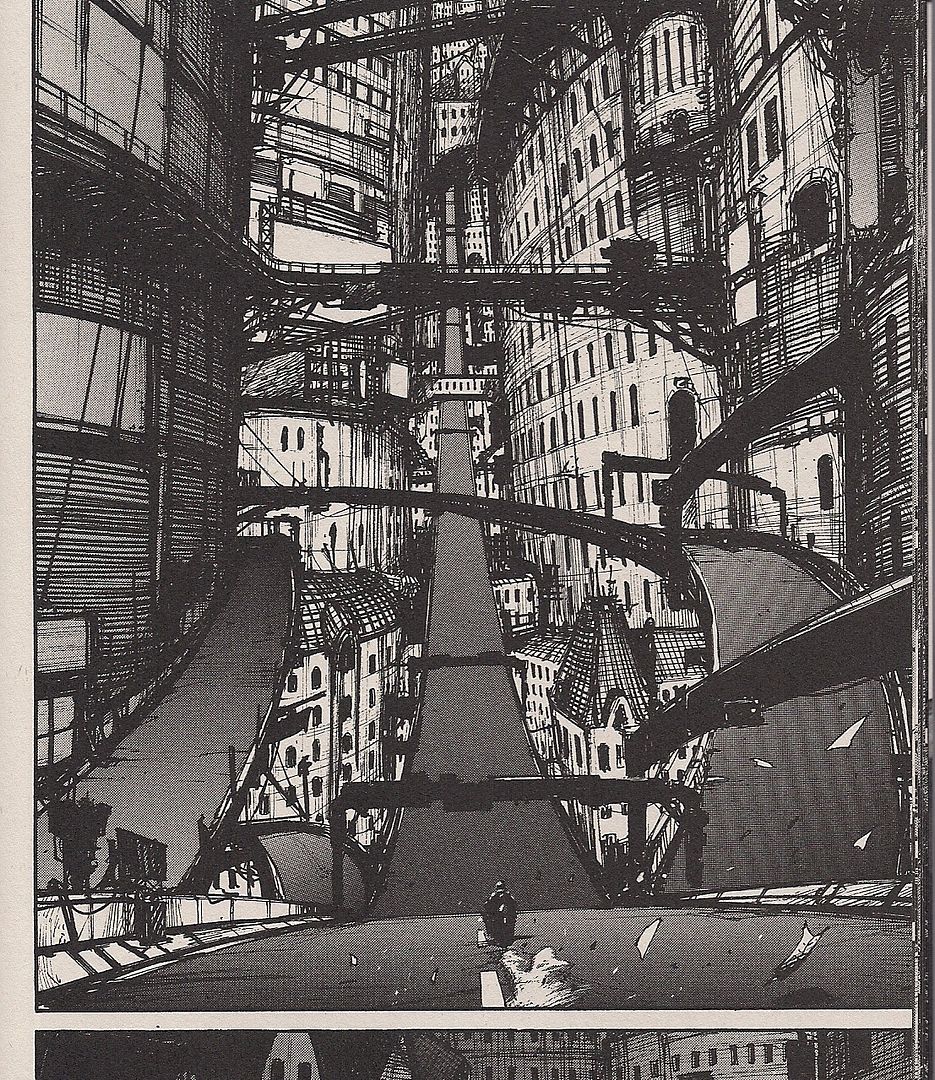
You might therefore conclude that Nihei is a man of lean, sleek action, but that's not quite right; a former architecture student and studio assistant to seinen suspense artist Tsutomu Takahashi (whose Ice Blade was among Tokyopop's early, unfinished translations), he's more 'François Schuiten reborn as an Image founder,' which isn't to say that his work looks like any of those artists' on the surface -- his settings owe more to the late Zdzisław Beksiński while his character art somewhat evokes Hiroaki Samura of Blade of the Immortal, comparisons which frankly do him no favors -- but that he practices a funnybook monumentalist approach reliant on the stillness of figures, be they looming man-made spires or detailed humanoid forms tense in action poses and thereby as awesome as skyscrapers.
So, yeah, it's more Cyberforce than Les Cités Obscures, despite Nihei drawing much influence from European sources; while Schuiten might reinforce the vulnerability of humans against massive mortar metaphors, Nihei explores the similarities of the two by rendering them both as cold structures -- with a few fuzzy talking anomalies -- coherent only in that they look as awesome as possible on every page, fully appropriate for his scenarios of humankind caught mid-transition into something new and less emotive, a theme sometimes attributed to other Japanese action stylists, like dubious anime legend Koichi Ohata of M.D. Geist and other bloody messes spattered over winning steel and augmented bones. Unlike many North American comics, which you can easily imagine spinning Biomega's man-against-many story as a fable of enduring individuality, this one explicitly casts its hero and villains as representatives of unseen organizations, literally built to order. The sociologists might have more to say on that.
This points to Nihei's faults as well. His plots tend to be exceedingly basic, elaborated upon mainly to throw obstacles in front of characters prone to coughing expository matter into each other's faces when they open their mouths, which is not often. Nihei demonstrates little command of body language, and seems disinterested in the niceties of facial expression. Moreover, he's largely inapt at conveying physical contactbetween panel elements, which, all visual-thematic analysis notwithstanding, is kind of a problem for an action comic that boils down to Kamen Rider Vs. the Zombies; that early bit with the talking motorcycle running down the heroine is so lacking in visceral impact its huge overcompensating WHUMP sound effect -- admittedly a publisher's addition, but I tend to presume these things roughly match the Japanese sfx elements -- comes off as simply funny.
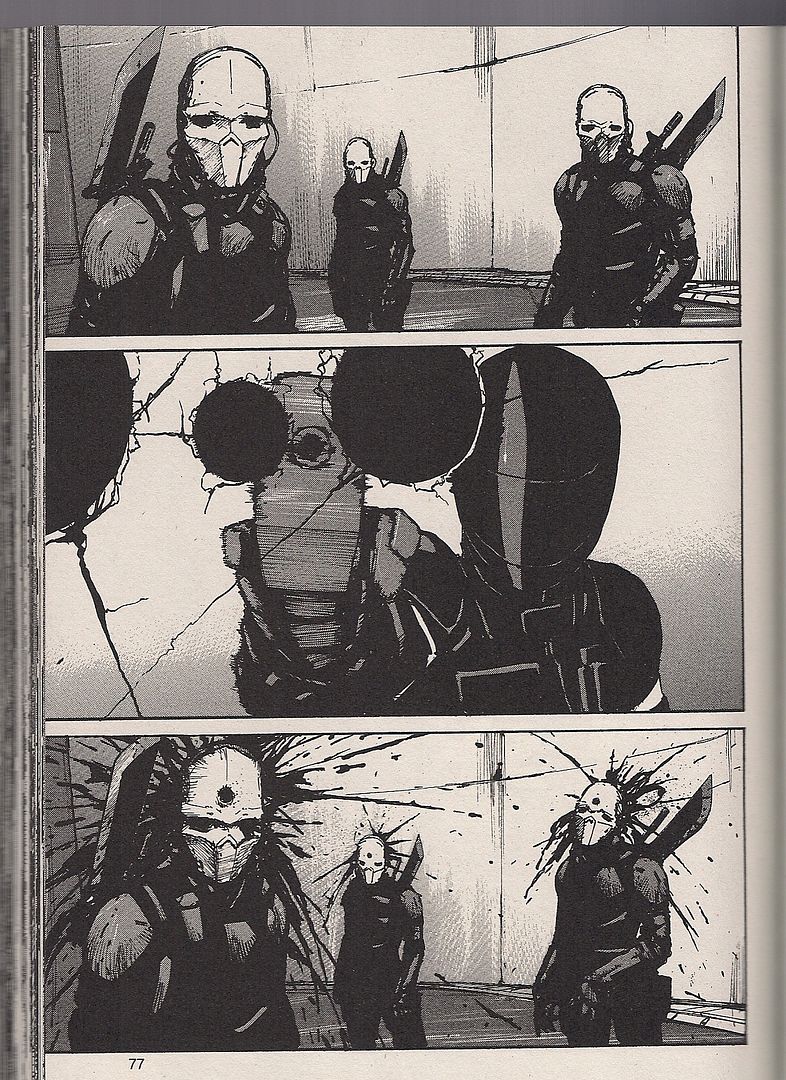
What makes this more worrisome is that Biomega is a newer work (serialized 2004-09), and seemingly intended as a more directly engaging piece; say what you will about Jim Lee, but when, say, All Star Batman kicks All Star Corrupt Police Officer in the face, you can fucking feel it. Little of that comes through in Nihei's art, and I do get the impression he's keenly aware of it - a later bit with the Cenobite smock villain winging a punch off of Zoichi's helmet sees the entire point of impact covered by a helpful shower of sparks. Likewise, virtually all of the big action sequences are powered by fairly clever shifts in perspective, like a close-up panel of a character firing a rocket -- and speaking of stillness, Nihei is extremely fond of stroboscope-like images of projectiles frozen in mid-air having juuuust exited the barrel of a weapon -- followed by an over-the-shoulder glimpse of the target with the prior character now in the background, the rocket halfway between them. All posed, all tense.
An interesting effect sometimes results, circumstantial evidence of the artist thinking his limitations through. Zoichi is a very fast character, even without his talking motorcycle, much faster than most of his opponents. Nihei will sometimes use good ol' speed lines to convey this, but other times, without warning, he'll lay out a series of panels depicting Zoichi performing some activity grossly out of synch with everyone else around him, so that he'll nonchalantly draw his gun and calmly point and fire at everyone's head while other characters spend every panel in either exactly the same pose or some barely-along variant of such, save for their heads erupting. Their bodies will still be in mid-fall as Zoichi prepares to leave, and then the in-panel action will snap back into synch. A very cool effect, and I mean 'cool' as in disaffected, and neatly facilitated by stiff, posey characters.
He can't do that all the time, so, despite his rough, scratchy lines, some pages replicate the detached feel of slick, heavy realist superhero artists, though Nihei is closer to Jae Lee's intense reliance on mise-en-scène then overt ships-passing-in-broad-daylight chaos. From this, the artist taps his greatest effect - the sense of place that admirers tend to cite. That's not just in background drawings; David Welsh recently compared Biomega's overall style to that of a first-person shooter -- and indeed, Nihei is supposedly an avid Halo player, preceding his contribution to The Halo Graphic Novel -- but it struck me as more of a 3D action platformer, where the fighting is often secondary to exploring landscapes, just being there, although you can't really advance without fights.
In this way, the key problem with this first volume is that it's an awfully event-heavy play-through, a straight shot, I guess more of a 'proper' crazy uninhibited action manga, from an artist that's defined by his visual/tonal departures from the norm.
But the oddest clash in this book isn't so visual. Keep in mind: when I say the story is "uninhibited," I don't mean it's something like Hiroya Oku's Gantz, which is so po-faced skintight sleazy it borders on camp; in fact, Nihei's body of work is notable in being almost totally without overt sexuality, to the point where I was surprised to learn that his official art book has 'erotic' pages. To my eyes, Nihei's depiction of bodies implies reproduction as a mechanical operation, an act of necessity in appropriate circumstances, as suggested by Blame!'s particular transhuman blend.
Even though I look at the villains in this book and think "Cenobites," Clive Barker's creations tend to be very specifically sexual beings; with Nihei, the surface is adapted into a larger asexual aesthetic. H.R. Giger is another popular point of visual reference, but his fetishistic aspect is diluted into people-as-buildings-as-society totality. Certainly there's no superhero mega-cleavage or male manga fanservice, although the perpetually dazed, childlike 17-year old at the heart of Zoichi's quest showcases several prominenttraits of the helpless, hapless, tragic moe girl, which makes for a hilarious, brilliant, and almost certainly unintentional illustration of exactly how little this character type differs from the damsel-in-distress stock of the most clichéd, retrograde macho man heroic fantasies imaginable in genre fiction.
I wonder if that kind of stuff was added to this book to make it more 'appealing' to a wider audience? The back cover and the color front section are decorated with the image of a zombie woman in low-riding bikini bottoms. My problem isn't these images on their own, or Nihei's sexless style, but how badly they jar, like a (possibly editorial) grandmother sitting down with a boy who'd rather play video games than talk about girls and awkwardly inquiring as to his favorite actresses. "I think Kevin Costner is very attractive." Hence: bottoms.
Yet Nihei's true fascination manifests. When a zombie woman shows up, lean and mostly unmutated in a little black dress, her cheekbones are good mostly for detailing how her teeth come out when Zoichi blows open her skinny head. When the girl Zoichi seeks appears, walking in a skirt, it's mainly much the better for tracing the luxurious stretching and splitting of a nude leg torn open by a (talking) motorcycle's tires, and then the recombination of its bloody strips and dancing tendons into a filmy new whole. Better hop into that bear suit, kid - it's a short life for the old flesh.
***
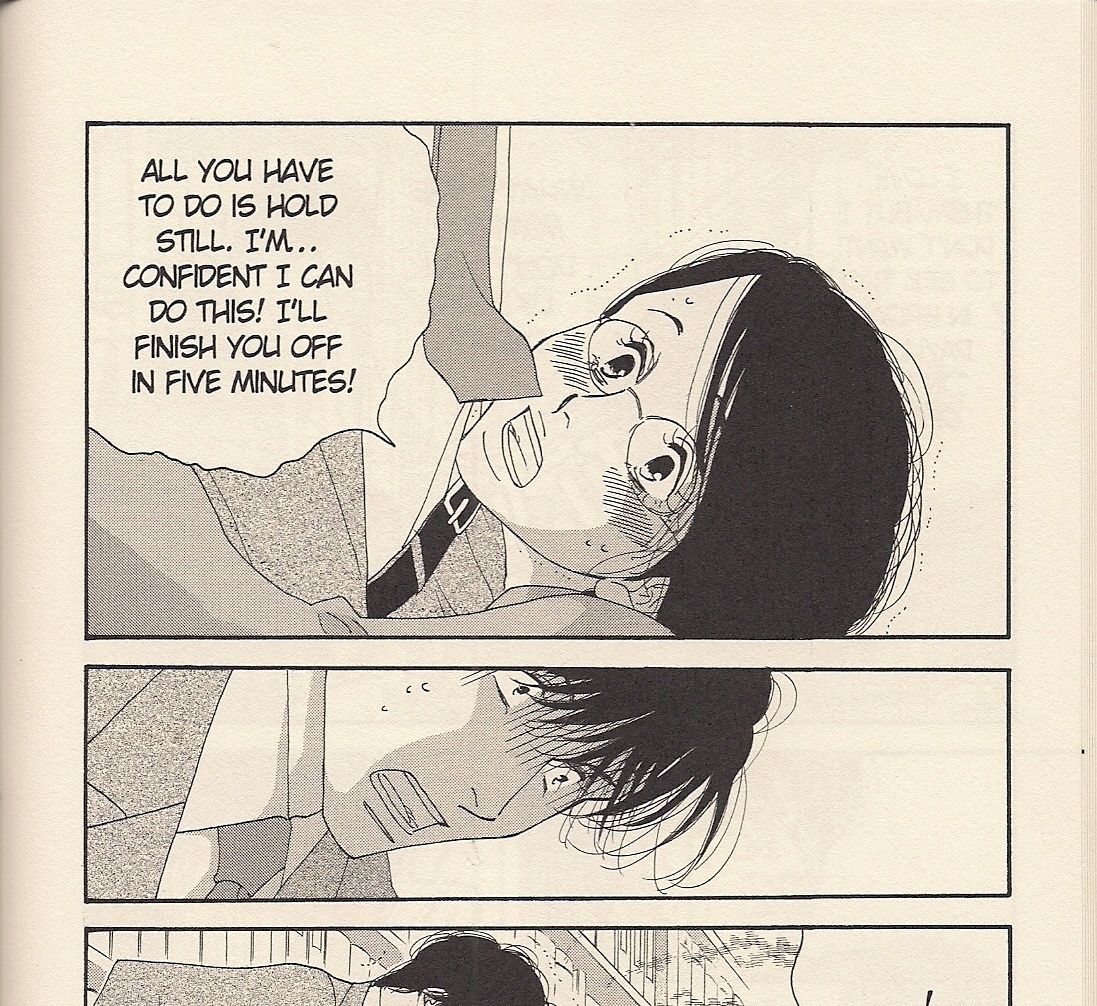
All My Darling Daughters: So, this girl walks into her teacher's office and starts taking off her clothes. She keeps repeating "It's all right" as the flummoxed lecturer urges her to stop, eventually trying to run away when she lifts up her bra. Despite this, he concedes that he likes the girl's breasts, causing her to tear up. She pins him against a bookshelf and demands that he let her go down on him or else she'll yell. He relents -- even though the girl is weird and her hair is oily and sticky -- much to the chagrin of his circle of acquaintances at dinner later on. Yet the girl is among the only ones in his class that seems to listen to him at all; even he considers some of his lectures to be boring. After a subsequent encounter, he offers the girl coffee, which she frantically insists he cannot do, although she tells him he's kind. The teacher idly imagines that he'd accept a more beautiful student's advances anytime. The girl, however, insists that the two of them should not have sex, because it's too good for her; and sex is for the female partner's benefit, while blowjobs are what a man likes best. He smiles when he sees her dutifully copying his words in class. She tells him later that she'd die if he only looked at her face when they're together, and that she used to be embarrassed by her big breasts but accepted them after she learned guys like them; her ex-boyfriends told her that her breasts were her only asset, though she insists they were great guys, because they came to her apartment and ate her food and accepted her presents. She says she likes him better. He admits he's starting to like her, and a friend tells him to return to where it started to go wrong. The next time they're together, he tells her not to go down on him; she cried, but her offers her tickets for them to see a movie. They embrace, and she tells him he's too good for her. In class, he reprimands her for coming in late, and the boy sitting next to her calls her a slowpoke and an ugly bitch. She grins at him as he looks away. "I hope she finds a guy who's a little better than I am." The teacher smiles. Comics?
Well shit, of course it's comics. Not long ago, folks would've called it 'literary' comics, and while that might have raised annoying qualms about imposing prose publishing's literary-genre dichotomy on a different art form -- in that a literary comic could simply be like 'literature' in the sense of being like prose writing itself -- it would nonetheless signal some form of thematic or formalist ambition on the part of various North American comics, albeit at a time when possibly any departure from genre apparatus could be construed as just that.
But comics have grown a lot in the past decade, and the old labels don't stick so well. Case in point: Fumi Yoshinaga, doujinshi-making fan turned pro, the widely-admired creator of the workplace dramedy Antique Bakery and the ongoing alternate history serial Ōoku: The Inner Chambers. This is her newest English release, hailing from 2003 in Japan, a suite of five interconnected stories, one of which I've synopsized above in a way that doesn't leave it too dissimilar to something out of, say, Optic Nerve, Adrian Tomine's quintessential literary comic, which, particularly in its later issues, always struck me as far more cinematographic in its ice-carved observational visuals than anything else. Er, should I mention Raymond Carver?
Prose is not always to be trusted, though, particularly when the prose writer's chief qualification is his blogspot account. What quickly leaps out from Yoshinaga's story is something a plot synopsis cannot capture: how the artist's handling of such potentially risible subject matter is inseparable from her use of the most time-honored aspects of manga iconography. Sweatdrops, booming sound effects, wacky cartoon faces, tiny balloonless dialogue asides - the gang's all here, if not as blatantly so as in youth manga. Still, they are the operations of a mangaka working in a relaxed idiom, a detailed comics language so fully hammered into place by decades of usage in a mass medium that they needn't be questioned. The purpose of Chibi-like cartoon faces are easy to understand (someone is losing their cool), so why not use them in a painful story about a teacher and his student? Because people won't take you seriously? Because you need to look like something else?
Manga may not be the most seriously considered art form in Japan, but it's understood enough that its toolbox doesn't need to be emptied to meet some threshold burden for adult consideration. It's like this: when Jaime Hernandez uses zany cartoon effects dating back to before Dan Decarlo, it's Jaime Hernandez being Jaime Hernandez; when Fumi Yoshinaga does it, it's manga being manga.
Another crucial difference: North American comics don't have a tradition of perfectly GOOD dramas like this to draw from. Currently, they have a small niche capable of selling drama as literature, without the distinctions that mark prose literature, or a limited means of presenting drama as an accessory to genre mechanics.
The beauty of manga is that drama can be simply drama, which, oddly enough, allows for less fussy access to certain literary qualities -- psychological depth, social inquiry, etc. -- though some might claim a more direct comparison to television drama; indeed, Yoshinaga is no stranger to that terrain, in that Antique Bakery was adapted into both live-action and animated television series in Japan, in addition to a feature film in South Korea. This might be a product of comparative serialization, though; certainly most of the television comparisons I hear regarding North American works surround superhero comics, the last big holdout of monthly or weekly chapters around here.
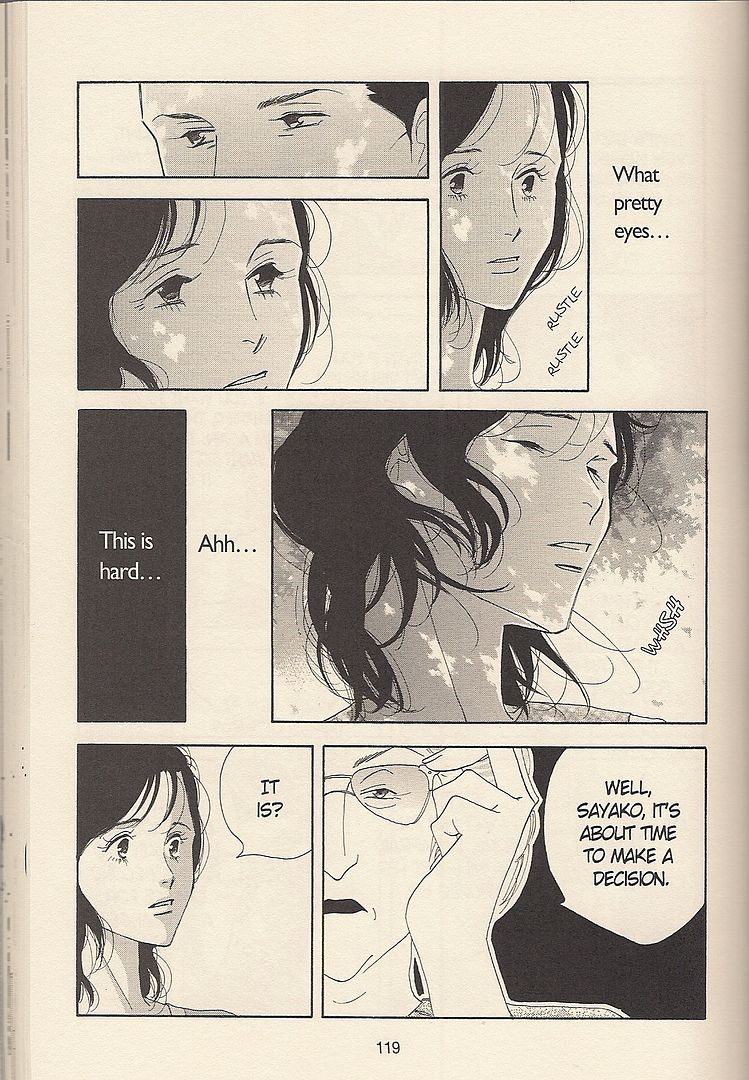
What Yoshinaga's work lacks is interaction with the comics form beyond that of the relaxed idiom. I doubt most non-devotees could even pick her artwork out of a lineup, it's so placidly observant of developed manga values, although a likable blockiness to certain obstinate characters' faces becomes noticeable over the course of the book; certainly she can put together attractive page designs, as evidenced above by the interplay between tones and blocking and those narration-only panels for... special... emphasis.
All of this is directly communicative, however - Yoshinaga is just not a fancy storyteller, rarely attempting even basic dissonance between words and pictures, except for comedic effect. It could be the tide of critical thought is turning, and that as drama becomes more commonplace in North American comics -- hardly guaranteed, given the precarious state of the market -- formalism might yet emerge as the new easy-reading shorthand for 'ambitious' funnies; last year's darling, Asterios Polyp, would obviously fit that bill. I haven't read every manga in the world, but I can't imagine a work like Mazzucchelli's coming out of Japan; maybe my imagination is limited, but it could be that the conditions necessary to conceive of such an obsessive metaphorical outlay just don't exist with manga, where even 'art' comics tend to study movement, like Yuichi Yokoyama's, or play with perspectives or drawing styles, a la Shintaro Kago or the heta-uma artists, or swing a hard fist at societal conditions, as did some of the older gekiga.
You don't need to fulfill any of these criteria to make an effective comic, much in the way you don't need to appear on critics' Top 10 lists to be good. The point I'm getting at is that the transformation of North American comics' makeup will probably cause a shift in how comics are analyzed qualitatively, and it's unassuming books like this that'll raise the biggest questions for readers disinclined to let nationality serve as their co-pilot. Yoshinaga remains upfront, like literature also can. As a writer, she typically has her characters flatly state their minds, confessing to or confiding in one another to move the plot, laughing and crying. She draws superb tears; there's these two pages with a little kid waking up sick, crying and spitting and puking, and there's a world of pain in that, one of the simplest ways comics can charge you up by being what they are.
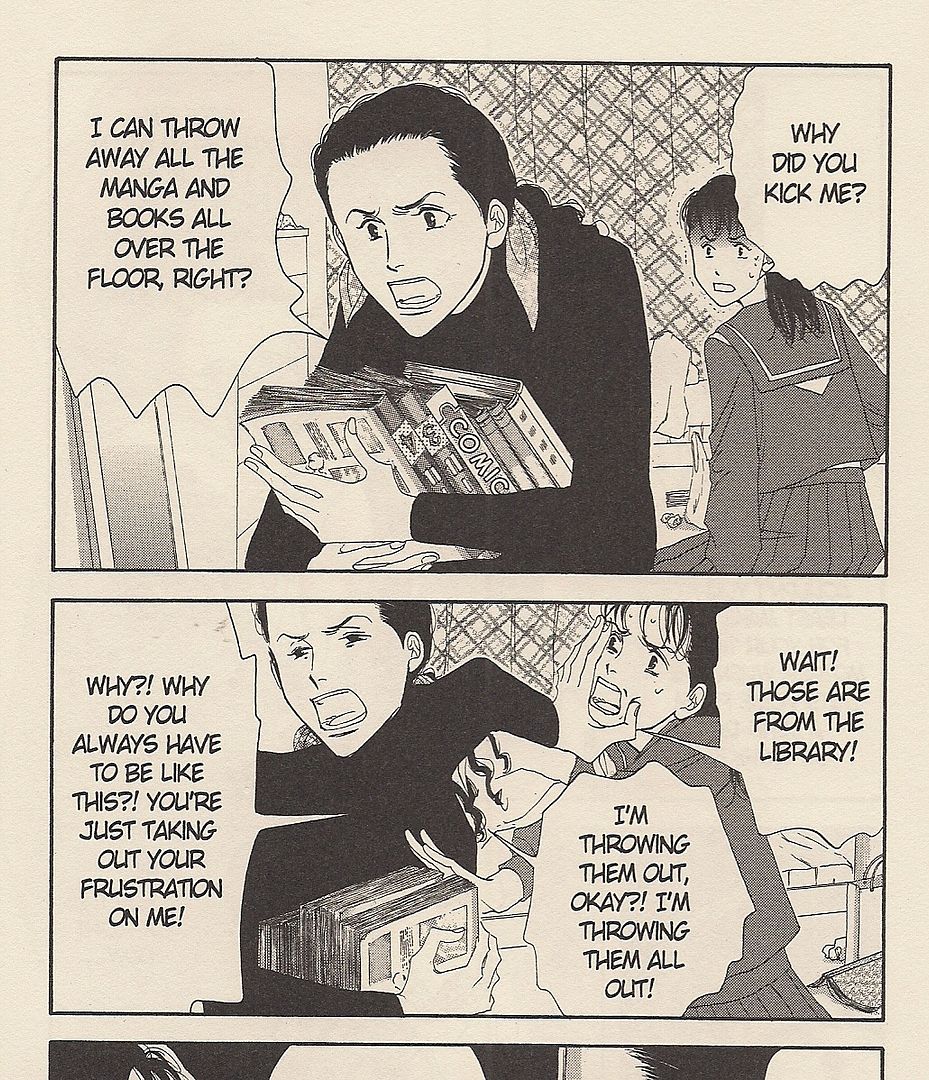
The stories of All My Darling Daughters aren't very tightly connected -- the characters are all somehow friends or relations of each other, if sometimes tenuously -- although the last one does circle around to compliment the first, and the passage of time is duly conveyed as characters build relationships or get married. All of them concern women struggling with a deterministic world that ensures their relationships are connected to events of the past. Schoolroom slights create lasting tension between a mother and daughter, understandings between friends are informed by teenage vows for the future; probably the most complex aspect of the book is its title, indicating a particular parental concern, a love that Yoshinaga's manga reveals as potentially stifling.
"She said I was too good for her," says the teacher to his friends. That's a recurring sentiment throughout the book, a summary of the neuroses bedeviling Yoshinaga's characters. From this union of aching, across the book as a whole, we can understand the student in that story, even while the artist maintains the male's perspective (the only one of the book) throughout. She is young, and she might find her way out of the trap, although the only characters to really take control of their lives are prompted by one mother's life-threatening disease, thereby signalling a daughter to do the same.
Well, there is another character that undergoes a big change: a young woman who seems to care for everyone, yet never manages a romantic relationship. She's the star of the book's longest and most troublesome story, illustrative of Yoshinaga reaching too far, working with the fairly sophomoric notion of falling in love as potentially cruel discrimination between people as its thematic axis, then ungainly dressing it with allusions to the early 20th century struggles of Japanese leftists and the teachings of Christ, after which a perfectly logical and still faintly silly conclusion is reached.
This character is the counterpoint to Yoshinaga's mother and daughter, a person that can't stand the vagaries of romantic love and thus cuts herself off entirely from mainstream society. It's tempting to read this as revealing of the artist's own position, more adept with smartly observing domestic interactions than grappling with headier stuff; she does seem to want after something different, given this false start's inclusion, and the vastly expanded scope of Ōoku. We may be coming into a time where the new critical biases will demand more, and maybe in a way that Yoshinaga's straight-shot art cannot provide.
Yet maybe the nurturing of calm drama will spark its own nuanced appreciation, and readings will spread outward. Just having a book like this glide across bookstore shelves like it's just manga shows how much the years can change comics, more pliable than Yoshinaga's drawn families and nervous lovers for sure.
This is up late because Diamond was completely shut down yesterday, though West Coast books are shipping on time. Still, puts me a day behind on everything else I do, too...
Another tiny week. Which I suppose is good for people caught in Snowpocalypse '10, but not so good for the rest of us. Publishers are breaking the weekly habit.
2000 AD PACK JAN 2010 ACTION COMICS #886 ADVENTURE COMICS WITH BLACK LANTERN SUPERBOY #7 AMAZING SPIDER-MAN #620 GNTLT AMAZING SPIDER-MAN PRESENTS JACKPOT #2 (OF 3) ANCHOR #5 ANGELUS #2 (OF 6) ANITA BLAKE LC EXECUTIONER #4 (OF 5) ARCHIE & FRIENDS #140 BATGIRL #7 BATMAN AND ROBIN #8 BETTY & VERONICA DOUBLE DIGEST #178 BLACKBEARD LEGEND OF THE PYRATE KING #3 BOOSTER GOLD #29 BPRD KING OF FEAR #2 (OF 5) COLT NOBLE AND MEGALORDS (ONE SHOT) DARK TOWER BATTLE OF JERICHO HILL #3 (OF 5) DARK X-MEN #4 (OF 5) DAYTRIPPER #3 (OF 10) DMZ #50 (NOTE PRICE) ENDERS GAME COMMAND SCHOOL #5 (OF 5) ESCAPE FROM WONDERLAND #4 (OF 6) GEN 13 #34 GREEN ARROW BLACK CANARY #29 GROO HOGS OF HORDER #3 (OF 4) HAUNT #5 HIT-MONKEY #1 HUMAN TARGET #1 (OF 6) INVINCIBLE PRESENTS ATOM EVE & REX SPLODE #3 (OF 3) JOHN SABLE FREELANCE ASHES OF EDEN #5 JSA ALL STARS #3 JUGHEAD AND FRIENDS DIGEST #36 LEGENDARY TALESPINNERS #1 (OF 3) MARVEL ADVENTURES SUPER HEROES #20 MARVEL BOY URANIAN #2 (OF 3) MUPPET KING ARTHUR #1 MUPPET SHOW #2 NEW MUTANTS #10 PHANTOM DOUBLE SHOT #2 (OF 6) KGB NOIR PHONOGRAM 2 #7 (OF 7) SINGLES CLUB PUNISHERMAX #4 REALM OF KINGS IMPERIAL GUARD #4 (OF 5) REBELS #13 SCIENCE FICTION & FANTASY ILLUSTRATED #1 SCOOBY DOO #153 SECRET SIX #18 (BLACKEST NIGHT) SHIELD #6 SOLOMON KANE DEATHS BLACK RIDERS #2 (OF 4) SPIDER #3 SPIDER-MAN AND SECRET WARS #3 (OF 4) STARSTRUCK #6 STRANGE #4 (OF 4) SUPER FRIENDS #24 SUPER HERO SQUAD #2 SWORD #4 (MARVEL) TAILS OF PET AVENGERS #1 THE GOOD THE BAD & THE UGLY #8 TITANS #22 ULTIMATE COMICS ARMOR WARS #4 (OF 4) ULTIMATE COMICS SPIDER-MAN #7 UNCANNY X-MEN FIRST CLASS #8 (OF 8) UNWRITTEN #10 VENGEANCE OF MOON KNIGHT #5 WALT DISNEYS COMICS & STORIES #703 X-MEN FOREVER #17 X-MEN PIXIE STRIKES BACK #1 (OF 4)
Books / Mags / Stuff 28 DAYS LATER HC VOL 01 ALL STAR SUPERMAN TP VOL 02 ANCHOR TP VOL 01 BRAVE AND THE BOLD MILESTONE TP CHOCOLATE CHEEKS GN ESSENTIAL DAREDEVIL TP VOL 05 FROM THE ASHES TP VOL 01 HELLBLAZER PANDEMONIUM HC HULK TP VOL 03 HULK NO MORE JUDGE DREDD MEGAZINE #293 KING SPECIAL EDITION HC LITTLE NOTHINGS GN VOL 03 UNEASY HAPPINESS MADAME XANADU TP VOL 02 EXODUS NOIR MARAT SADE JOURNALS ULTIMATE REVISED ED MARVEL 1602 TP NEW PTG MESMO DELIVERY GN VOL 01 MICKEY MOUSE CLASSICS TP VOL 01 MUPPET PETER PAN TP VOL 01 NEWAVE UNDERGROUND MINI COMIX O/T 80S HC NEXTWAVE AGENTS OF HATE TP ULTIMATE COLLECTION OBEDIENT ONE (A) PREACHER HC BOOK 02 SPIDER-MAN 24 7 TP STAR TREK NERO TP STAR WARS LEGACY TP VOL 08 TATOOINE TOYFARE #152 MATTEL DC UNIVERSE CLASSICS CVR WIZARDS OF MICKEY SC VOL 01 MOUSE MAGIC WORLD WAR 3 ILLUSTRATED #40
I should have mentioned this earlier in the week, but I Forgot.
The gents at Comic Book Geek Speak have be back yet again, and I get all pontificatey in episode #777, which you can listen to here: http://www.comicgeekspeak.com/episodes/comic_geek_speak-999.php
I'm pretty good about doing my own research, most of the time, but as I wander through my BookScan Analysis this year (Sheesh, I'm at 12,000 words, and I still haven't touched 2 of the 4 categories!) I'm hoping I can depend on YOU to help me a bit.
What movies based on comics were released in 2009?
Watchmen, obviously. And Wolverine. Astro Boy. But then I start to blank. Name me some titles, would you?
I'm drowning in work, so I'll keep this super-double short this week...
JUSTICE LEAGUE: CRY FOR JUSTICE #6: You know something's gone wrong with scheduling when a COMPLETELY DIFFERENT ARTIST THAN SOLICITED (Scott Clark, rather than Mauro Cascioli) does the interiors. Clark's work has enough surface similarities that it isn't jarring (and, in fact, if you didn't check the credits, it is possible you didn't notice), but man that's some tacky shit.
There's not much to this issue, other than "Prometheus kicks roundly everyone's ass, except for the one guy he doesn't have a file on" (well, and a sucker punch) -- which is pretty much exactly the plot of the LAST "canon" Prometheus appearance. I don't think there's a lot that you can really DO with a "reverse Batman" like this, but at least Prommie has read his copy of WATCHMEN (Which that issue of "The Question" shows was published on Earth-DC), because he pulls an Ozymandius, and POOF! goes a fictional DC city.
I guess I just felt all the way through this "Been there, read that", and it all seems... well, I don't know if "Cynical" is too strong, but poofing away cities and mutilating heroes -- both possible because no one cares all that much about that city or character -- well, it's all so 1990s, y'know? "Maybe people will care about this character again if we put unspeakable tragedy upon them" or whatever. Feh. By which I mean: AWFUL
JUSTICE LEAGUE OF AMERICA #41: In a certain way, this is even worse, because it totally spoils CFJ #7, AND BLACKEST NIGHT (though, in the latter case, I don't think anyone expected the Big Guns to stay Zombies or whatever), which is such a... well, it is a Marvel-move, and we all expect much more from DC. It also shows why having Big Events with Lots of Moving Parts can be a really awful idea, since if they don't ship in the correct order everything breaks down and your Willing Suspension of Disbelief fails... and what is a superhero universe except a REALLY BIG W.S.D.?
Having said that, I enjoyed the "tone" of this issue pretty well - much like the STARMAN comic from last week, it feels like Robinson has found his sea legs again, and is getting refocused on character development, as well as crazily obscure DC minutiae (Darwin Jones, indeed!)
I'm not really all that enthused by a JL that's largely characters from TITANS "graduating", anchored by not-quite versions of the Big Three (Donna, Dick and Mon-El), but one nearly imagines that's just a stop-gap problem. I was also deeply underwhelmed by the GL/GA sequence which takes place seemingly nowhere, AND manages to totally undersell the tragedy of a major city going "poof", but there seems to be enough groundwork being laid here that, yeah, maybe this will end up being a good run, eventually.
BUt, for what is probably too many Meta reasons, I'll go with OK here.
Whoops, the new order form is due tomorrow. Guess I better start it?
Also? Publishers: We can't make money if you don't ship us comics....
28 DAYS LATER #6 ALADDIN LEGACY OF THE LOST #1 (OF 3) A CVR DJURDJEVIC ANGEL HOLE IN THE WORLD #3 AUTHORITY #19 BATMAN CONFIDENTIAL #41 BETTY #184 BLACKEST NIGHT WONDER WOMAN #3 (OF 3) BOYS #39 BUFFY THE VAMPIRE SLAYER #32 TWILIGHT PT 1 (OF 5) JO CHEN CV CABLE #23 CARTOON NETWORK ACTION PACK #46 CINDERELLA FROM FABLETOWN WITH LOVE #4 (OF 6) CONAN THE CIMMERIAN #18 CRIMINAL SINNERS #4 DAFFODIL #2 (OF 3) DEADPOOL TEAM-UP #896 DEMO VOL 2 #1 (OF 6) DISNEYS HERO SQUAD #1 DOCTOR WHO ONGOING #8 DOOM PATROL #7 EXISTENCE 3.0 #2 (OF 4) FALL OUT TOY WORKS #3 (OF 5) GHOST RIDERS HEAVENS ON FIRE #6 (OF 6) GI JOE ORIGINS #12 GOD COMPLEX #3 GREAT TEN #4 (OF 10) GREEK STREET #8 HOUSE OF MYSTERY #22 INDOMITABLE IRON MAN B&W INVINCIBLE IRON MAN #23 JONAH HEX #52 JUSTICE SOCIETY OF AMERICA ANNUAL #2 KILL AUDIO #5 (OF 6) LONE RANGER #20 LOONEY TUNES #183 MARVEL HEARTBREAKERS #1 MILESTONE FOREVER #1 (OF 2) NOVA #34 QUESTION #37 (BLACKEST NIGHT) REALM OF KINGS SON OF HULK #1 (OF 4) RED ROBIN #9 RED SONJA WRATH OF THE GODS #1 (OF 5) RED TORNADO #6 (OF 6) SAVAGE DRAGON #157 SCALPED #34 SIEGE #2 (OF 4) SIEGE EMBEDDED #2 (OF 4) SONIC THE HEDGEHOG #209 SPIDER-MAN NOIR EYES WITHOUT A FACE #3 (OF 4) STREET FIGHTER II TURBO #11 A CVR CRUZ SUPERMAN WORLD OF NEW KRYPTON #12 (OF 12) SWEET TOOTH #6 TANK GIRL SKIDMARKS #3 (OF 4) TORCH #5 (OF 8) TOY STORY #1 ULTIMATE COMICS X #1 WARLORD #11 WIZARDS OF MICKEY #1 WOLVERINE SAVAGE WOLVERINE WEAPON X #10 X-MEN NOIR MARK OF CAIN #3 (OF 4) ZORRO #19 ZORRO MATANZAS #1 (OF 4)
Books / Mags / Stuff ALAZARS FETISH FANTASIES TP BEAST MASTER GN VOL 02 (OF 2) BERSERK TP VOL 33 COMPLETE DRACULA HC CROGANS MARCH HC DARK TOWER FALL OF GILEAD PREM HC DOMINIC FORTUNE IT CAN HAPPEN HERE AND NOW TP FABLES TP VOL 13 THE GREAT FABLES CROSSOVER GREEN LANTERN SECRET ORIGIN TP I HATE GALLANT GIRL TP LITTLE LULU TP VOL 22 BIG DIPPER CLUB NARUTO TP VOL 47 (RES) RECIDIVIST HC (O/A) SHOWCASE PRESENTS SECRETS OF SINISTER HOUSE TP SMILE SC STAR WARS ADV TP VOL 03 LUKE SKYWALKER TREASURE DRAGONSNAKES TINY TITANS SIDEKICKIN IT TP VIETNAM JOURNAL TP VOL 02 IRON TRIANGLE
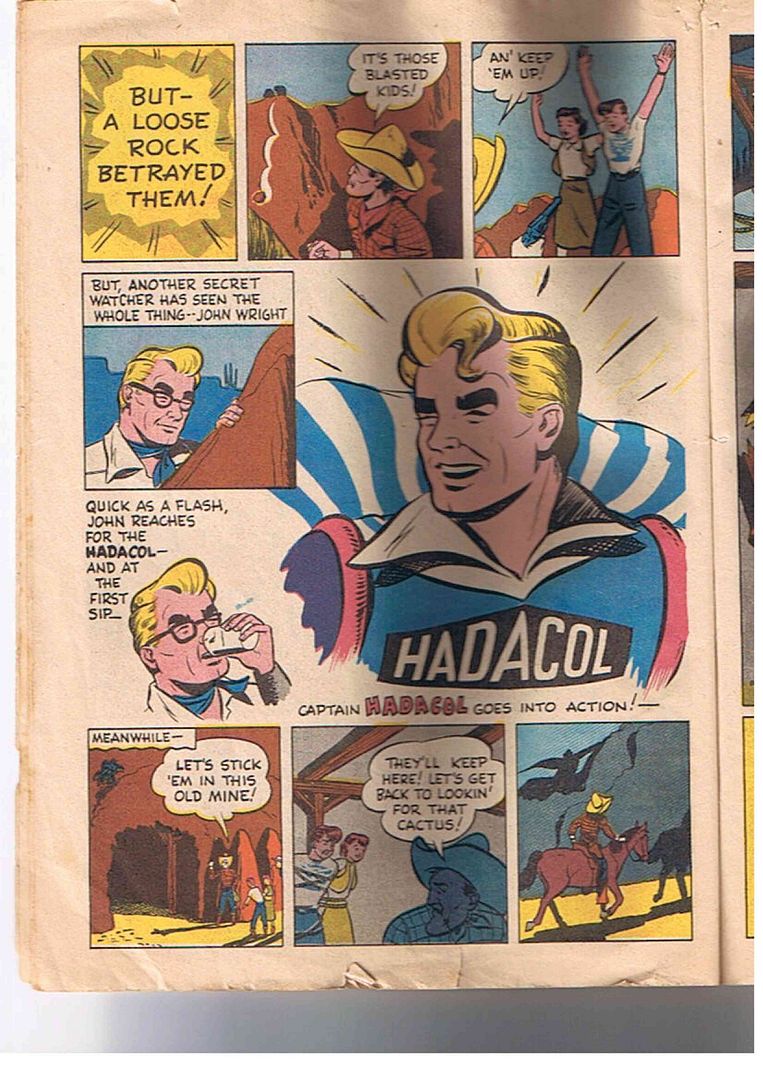
This is a song about Louisiana and some of the people in it. Or outside it. Or nearly anywhere in these United States as the 1950s approached, and superheroes declined as charismatic rogues stood tall, proud like they knew we'd miss them once fatedly laid low. It's a nostalgic record.
Let it play. Can I offer you a drink?
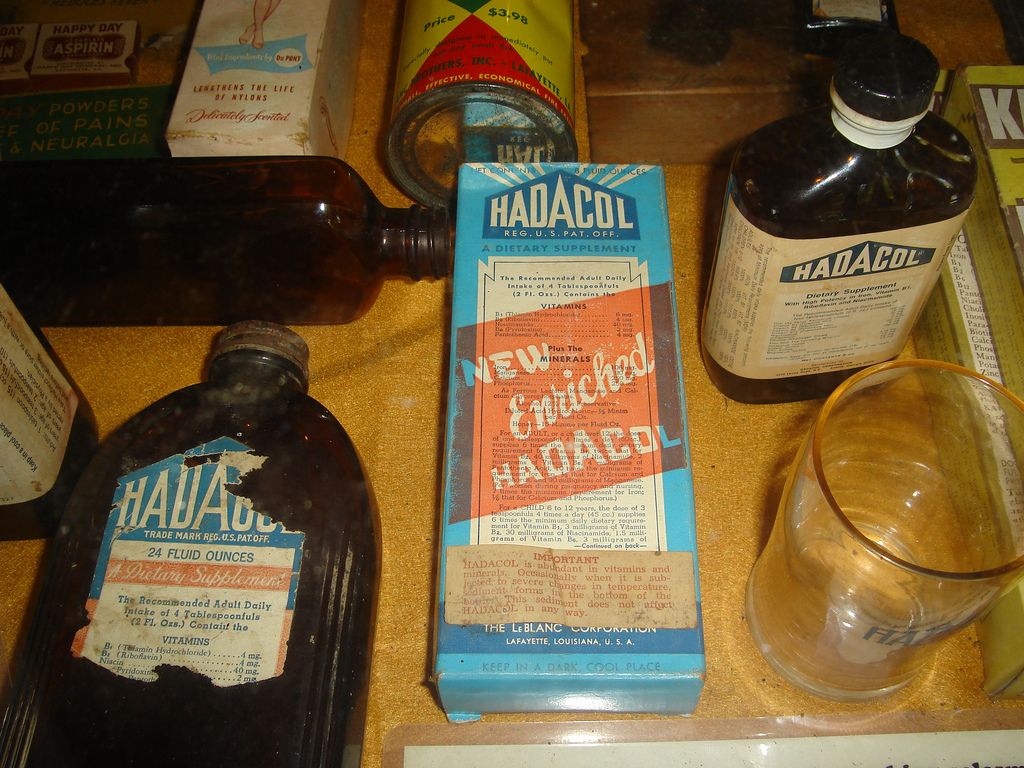
This is Hadacol.
***
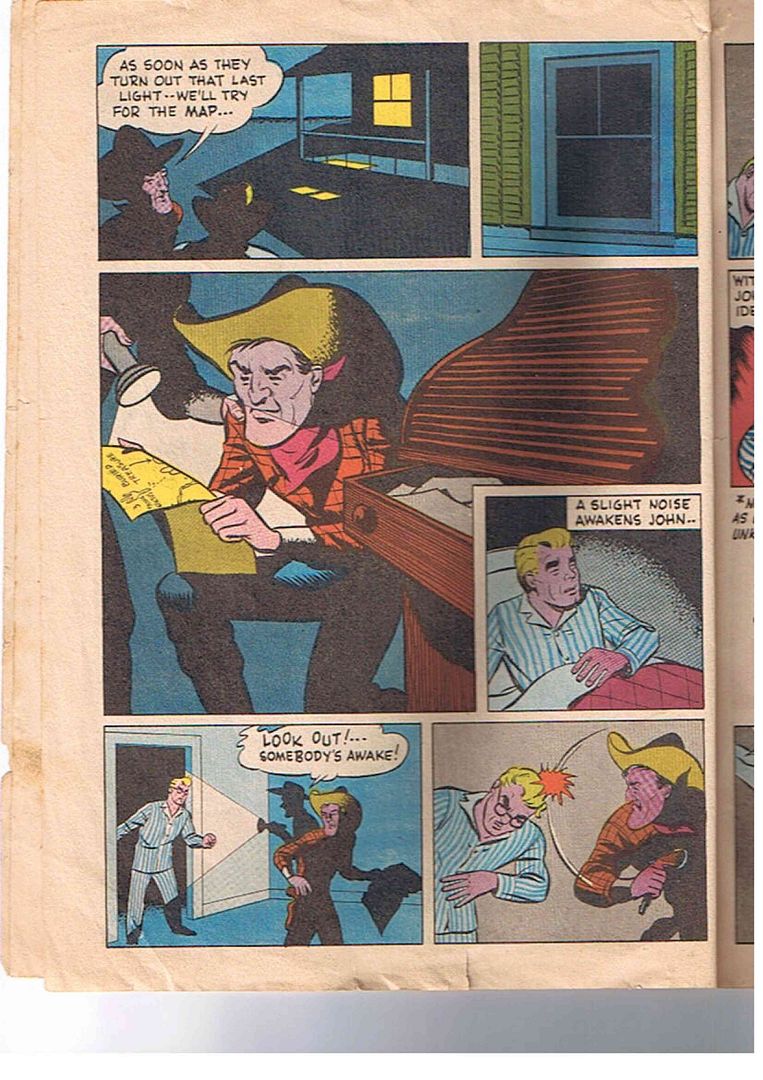
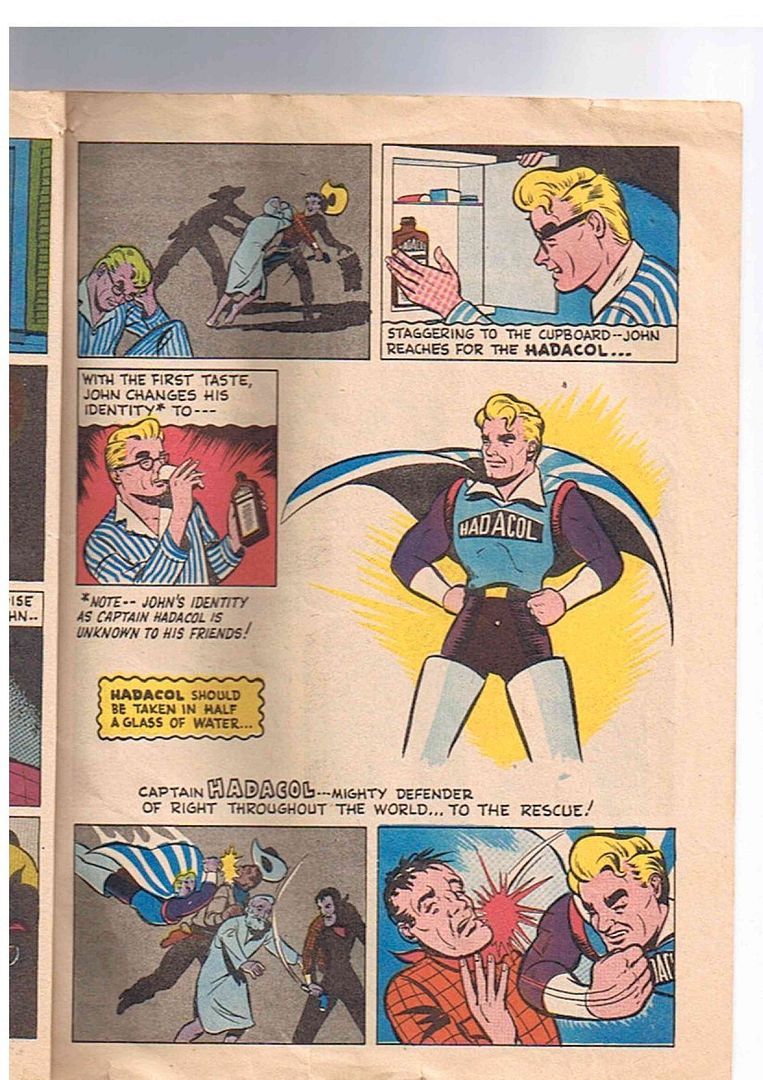
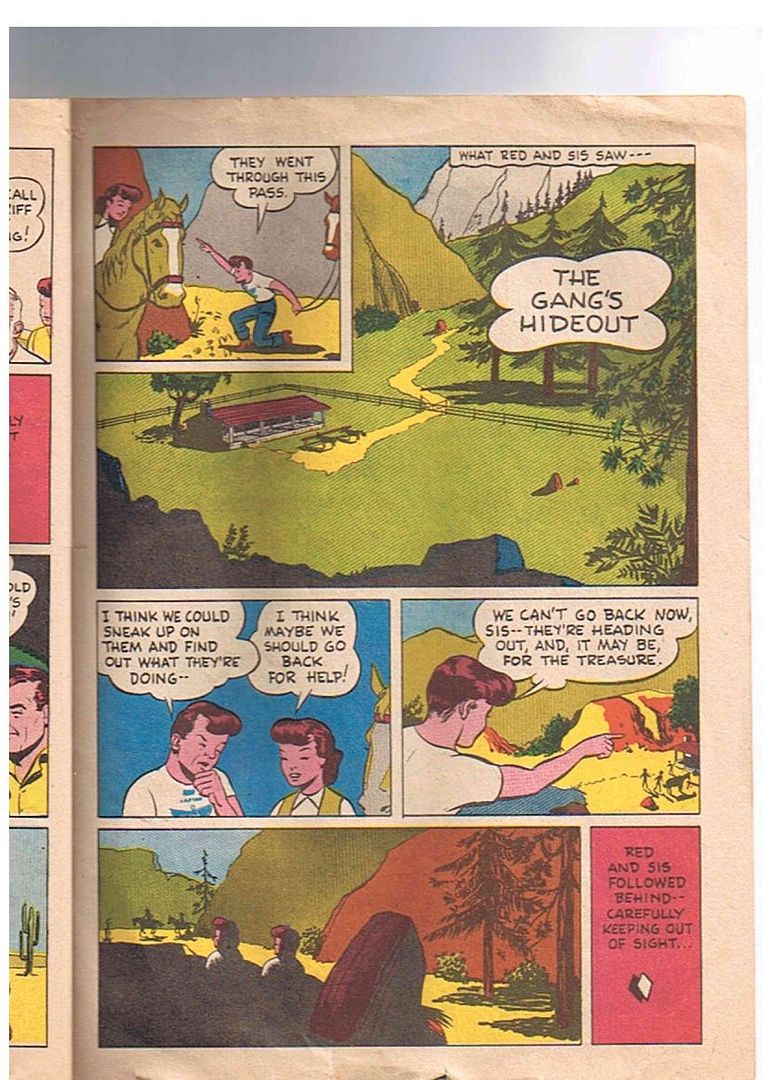
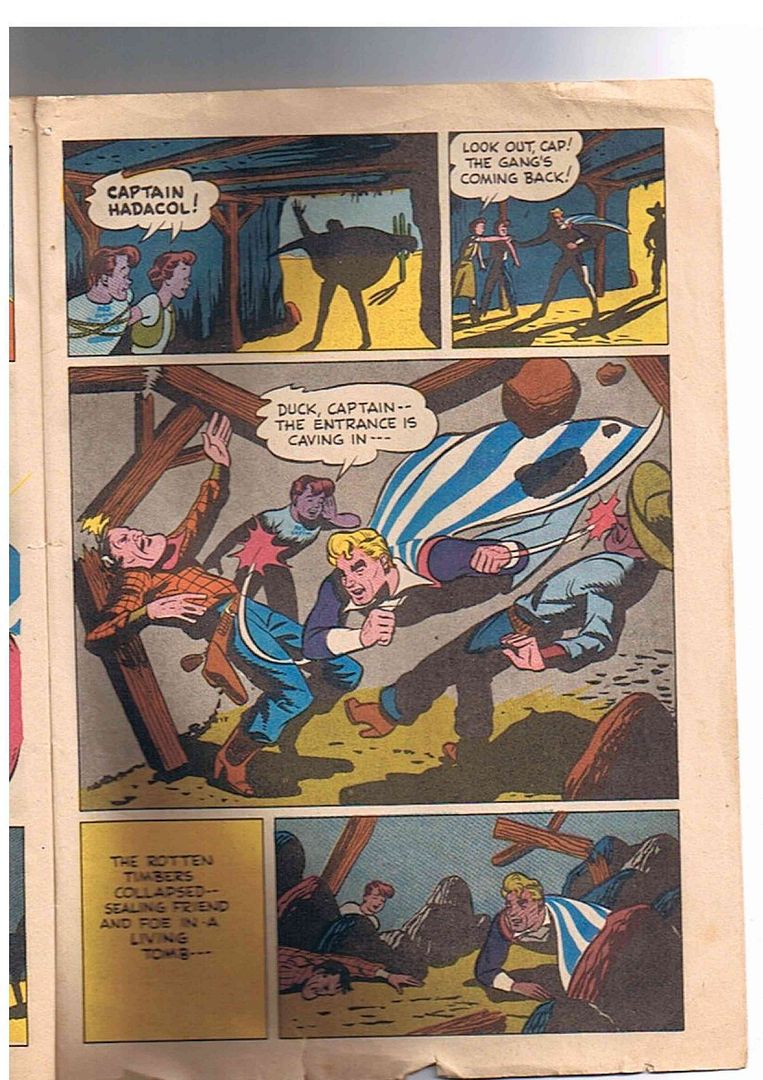
Twelve Percent True(Being a second and updated version of a post of January 31, 2010, amended to include exciting superhero art and duly expanded/adjusted text and formatting.)
***
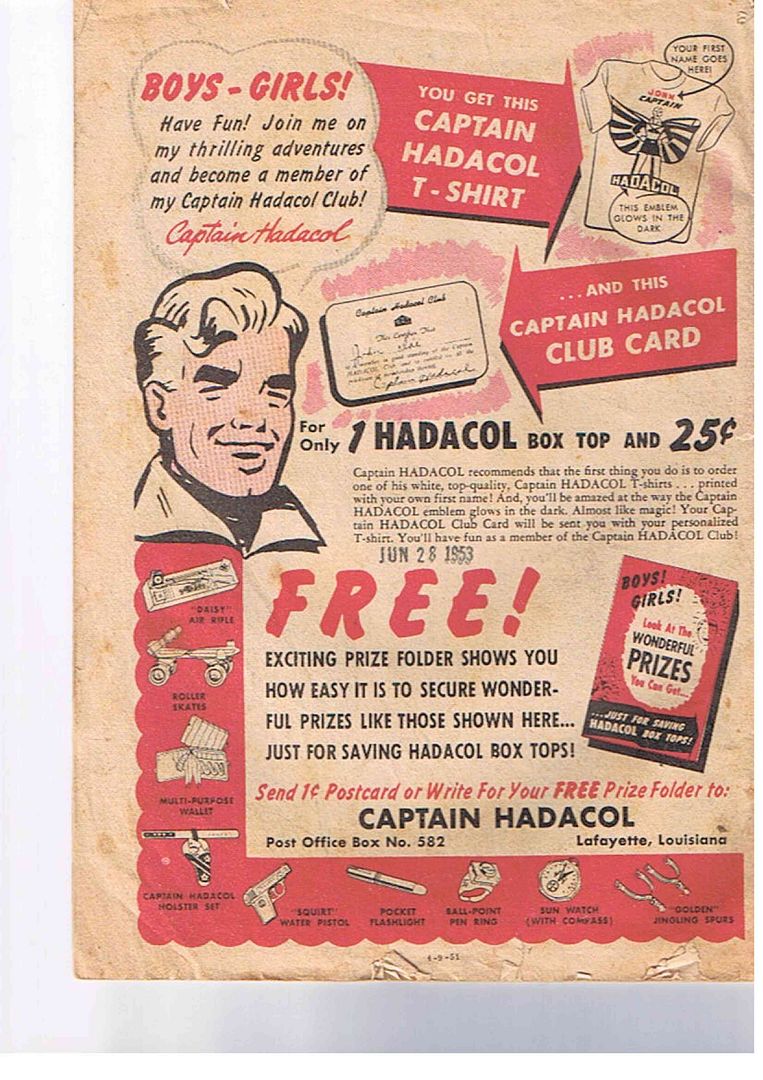
Hadacol was a popular 'patent medicine' of the late 1940s that transformed into a full-blown national fad as the century's midpoint arrived. "A Dietary Supplement," as you can see, Hadacol was supposed to be taken four times per day -- once after every meal, then right before bed -- as diluted in water, half a glass for one tablespoon. A typical bottle retailed for $1.25 (over $11.00 today), chock-full of vitamins B1, B2, and B6, with Niacinamide, Iron, Manganese, Calcium, Phosphorous, and sweet sweet honey.
And... diluted acid hydrochloric, which the product's Wikipedia page happily informs us (without citation) was intended to open the body's arteries to facilitate better absorption of the Hadacol health mix, including its 'preservative' - 12% alcohol, roughly as much as in a typical bottle of table wine.
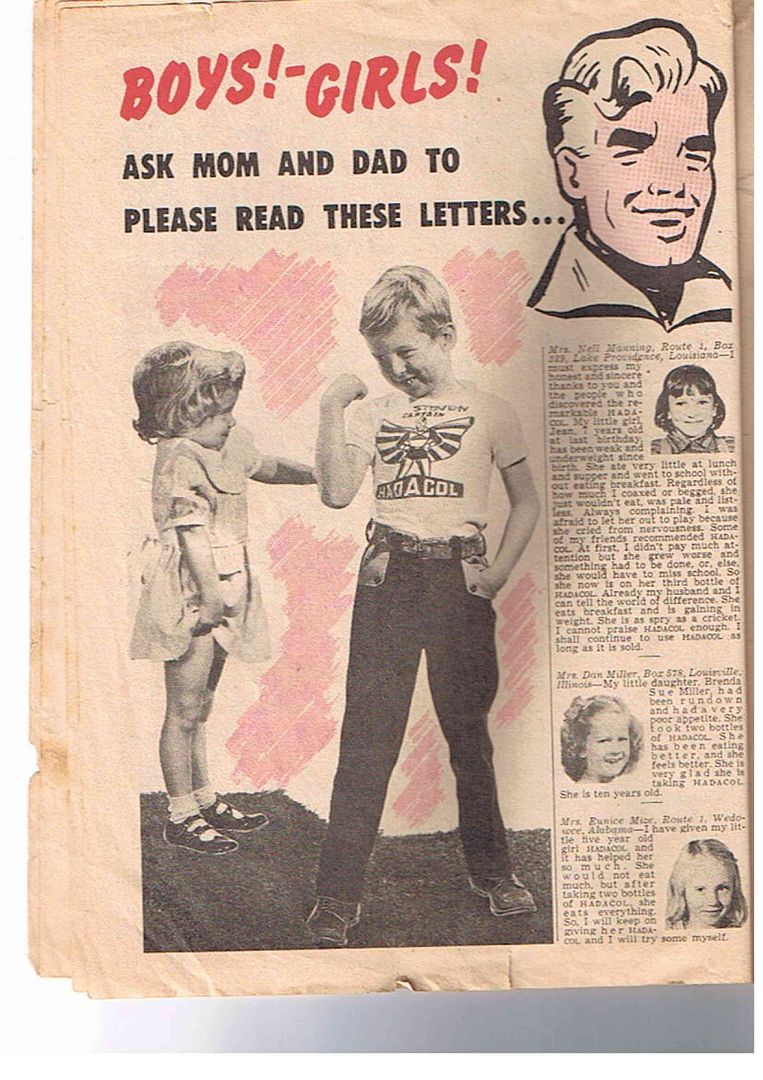
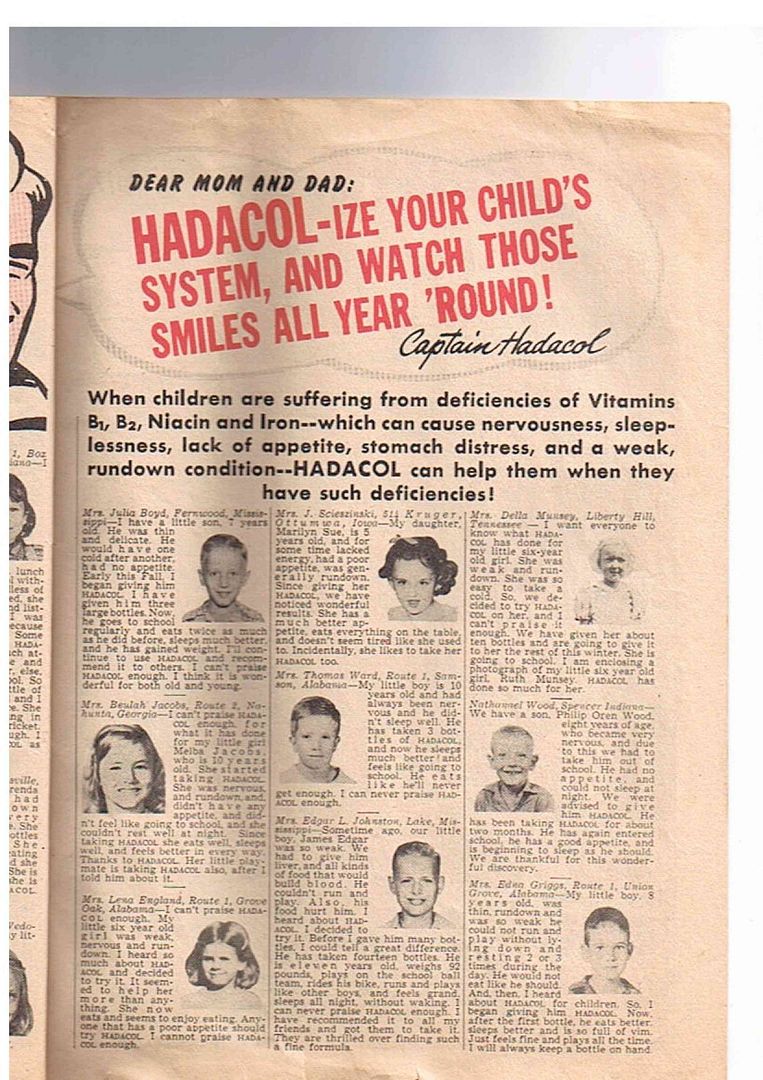
By literally every account I can track down, Hadacol was absolutely disgusting, which probably didn't matter: it was healthy! Sort of! At least, enough so to circumvent the legal/moral/religious concerns of 'dry' communities across the land, while giving even the most saturated household a special license for consumption. Plus, it was fun, the ballyhoo of it all, much grander than that behind the boozy potions of earlier American miracle vendors, dating back to before the Revolutionary War. A new, modern, post-WWII country needed a contemporary elixir, and Hadacol cured just what ailed 'em.
Dr. James Harvey Young provided a detailed overview of the Hadacol phenomenon in his 1966 book The Medical Messiahs: A Social History of Health Quackery in Twentieth-Century America (rev. 1990, free online), so I'll just run down the highlights. Hadacol was the brainchild of one Dudley J. LeBlanc, a Louisiana politician, entrepreneur, and quintessential Colorful Character from Down South prone to boasting that he got the inspiration for his bottled success in 1943 by way of swiping an injectable prototype from out of a doctor's office after the nurse had left the room. It wasn't LeBlanc's first patent medicine endeavor; one earlier project, Happy Day Headache Powders, in fact ran afoul of the Food and Drug Administration. Apparently not one to lay down and accept defeat, LeBlanc compressed the name of his former Happy Day Company into Ha-Da-Co-L, the 'L' being his own last name.
But if this time it was personal, LeBlanc didn't show it - mostly, he liked to say that he hadda call his product something.
I bet that's not the first time you've heard that joke. Hell, it's not even the first time today if you listened to that song like I asked you. But don't go thinking the lore of Hadacol entered into song and jest unassisted - it's said that LeBlanc himself commissioned Everybody Loves That Hadacol, licentious subtext and over-the-top claims and all. I mean, did that guy grow new toes?! Hadacol sounds scary.
Did the song end? Here, try this.
LeBlanc started out hawking Hadacol in French to Louisiana's Cajun population, to which he belonged, but it didn't take many years for the earthy nostrum to build its way up to the level of a genuine south-to-midwest consumer craze, aggravated by aggressive advertising tactics and lavish spending prompted by the possibility of tax write-offs. Mad culmination manifested in 1950, in the form of the Hadacol Caravan, a massive traveling spectacle accessible to the consumer only with the presentation of two Hadacol box tops (one for kids). Plenty more would be available inside, as the caravan wasn't a particularly new idea - it was a medicine show, of a type rapidly withdrawing into antiquity. Leblanc's affair was way bigger and far more monied than avarage, but it was essentially traditional, and I can't imagine some happy Hadacol purchasers didn't grasp the implication as to the, er, palliative qualities of the medicine accordant to such shows.
Ann Anderson's 2000 study Snake Oil, Hustlers and Hambones: The American Medicine Show positions the Hadacol Caravan as effectively the last great example of its folk entertainment kind, though poorer docs continued to wander into the 1960s. The form went out with a bang: among the Caravan's features, albeit not at the same time, were Hank Williams, Roy Acuff, George Burns & Gracie Allen, Jack Dempsey, Jack Benny, Sharkey Bonano's Dixieland Band, Bob Hope, Carmen Miranda, Dorothy Lamour, Rudy Vallée, Cesar Romero, Mickey Rooney, Milton Berle, Jimmy Durante, a chorus line, clowns, acrobats, vaudevillians, beauty queens, prizes, fireworks, and, of course, LeBlanc himself, cruising up through the venue in a white Cadillac. While he was serving in the Louisiana state senate, mind you. By the show's 1951 season, audiences ballooned to number in the tens of thousands.
Interestingly, Anderson's description of the show's over-the-top disposition -- purportedly adorned with unsubtle nods toward the star concoction's primary ingredient and winks at an aphrodisiac quality -- falls right in line with the awfully tongue-in-cheek tenor of the extended jingles we've already heard. Writer Jeremy Alford's account is similar, presenting some of the Caravan's action as approaching a prolonged and elaborate in-joke between Dudley J. LeBlanc and interested personages in Dry America:
A clown dressed in a police uniform stumbles around on stage and makes his way into the audience. A spotlight follows the ensuing folly as every time the clown takes an energetic step, an oversized bottle of Hadacol nearly jumps out of his pocket. He reaches quickly for the tonic and helps himself to a healthy swig. His massive glasses glow in the evening shade with each pull on the bottle. It's obvious that this is one drunken clown, and he's soon joined by another inebriated fellow whose nose lights up when he takes sips. The crowd ' children and adults ' loves it and screams into the night air.
Now, make no mistake, this is hardly the first instance of 20th century advertising adopting a fairly sardonic posture in re: the product at hand. Witness this 1932 marvel, fronted by a pair of New York City brothers that everybody reading this site has heard of:
And that's for Oldsmobile, as opposed to the most noxious libation this side of Jeppson's Malört. Yet people often still think of mid-century advertising as goofily forthright in its glosses and fibs, even while the Fleischers long ago poked at the virile promise of automobile ownership, and LeBlanc, decades later, sometimes giggled openly at the carnival pitchman's shamelessness of his own endeavor; this was a man with the trickster's spirit enough to stand on stage with an inter-party political rival and, at one point, switch his address to French so as to excoriate the man next to him to the delight of fluent attendees, as the target smiled.
Needless to say, he also got into comics publishing.
One comic, as far as I know. A superhero comic.
About a superhero that gets his powers from an authentic, eminently purchasable health product of dubious medicinal value, 24 proof.
That treasure took seventeen hours to find, because Captain Hadacol is smashed. And that's because the secret to his powers is booze. VITAMIN BOOZE.
I don't actually own this comic, nor do I know who wrote or drew it. All scans to follow come courtesy of the Deborah LeBlanc Collection, which informed me that Captain Hadacol -- whom I'd only known of by barest reference in product lore -- is a Superman-Popeye hybrid character, a plain man granted enormous temporary powers through imbibing the sponsor potion (available now, just $1.50). This came as a relief, since Cap looks strikingly like a 'vitamin'-addled normal guy who perhaps only thinks he has powers. Also, his costume looks like stuff he found. Then again, it probably does take a hero to successfully navigate in over-the-knee flat boots; I hope Marvel is taking notice for its upcoming Heroic Age, 'cause those Napoleonic puppies are back in style.
Just look at that wholesome, concerned face, bedecked with the same deadly squint promotions connoisseur Chris Ware sometimes uses for his Super-Man, which puts me in dire fear for Twelve Percent Lad's health. I just made up a superhero name right there; the proper name of that boy on the cover is "Red Reddie," whose family appears to have some firm connection to "John," the top-secret bespectacled identity of Captain Hadacol. "Comic Book No. 2" sees the Reddie family and their blond chum cutting loose down on the ranch:
Now if you're like me, your first thought is "gee, nice colors!" It's not unlike the anonymous, popping fresh style that does a lot to compliment Fletcher Hanks' (earlier) work. But the more you get into this comic, the more you notice its odd stylistic tics, like how four out of its nine story pages utilize the same motif of an expanded center panel, bordered on one side with a smaller column of panels and capped top and bottom with two thinner panel rows. Two additional pages utilize an even wider midsection, giving the comic an eccentric expanding and contracting feel.
Then there's the in-panel art, prone to a curvy sort of caricature, with scenery elements that border on the expressionistic - dig that wiggly drawer balancing the composition! Anyone who knows me is fully aware that I'm the worst person at spotting Golden Age art in the whole of North America's comics readership, so maybe this is some phenomenally well-known talent cashing a Hadacol check anonymously, but it's also possible that a local illustration hand put this thing together in the spirit of just having a go at the form.
Use as directed, kids! Actually, Anderson's book describes a totally different Captain Hadacol -- possibly the contents of the otherwise elusive issue #1 -- in which Our Man entreats a boy to slam eight consecutive bottles of Hadacol for immediate super-strength. "The alcohol in eight bottles of Hadacol equaled a pint of bonded whiskey," Anderson notes. And while that's coincidentally where my powers come from, apparently in this issue the power of Hadacol has expanded sufficiently to charge a man up 'by the label,' in addition to changing his clothes, thereby suggesting a brand of humor doubtlessly better suited to the Hadacol Caravan.
Here's another iteration of Artist X's layout style, with the interrupted big panel now up top. You're not missing any story reading along in this abridged manner, by the way; it's a totally uninspired genre short, propulsive mainly from its heavy breathing page compositions. Quite a thing for shadows too.
I mean, wow - Captain Hadacol's ready to kick some ass up there! I pretty much came out of this story hoping that nobody else discovers the secret of Hadacol, given what it does.
So, in that apparently everyone is a superhero by way of Hadacol's intervention, I can only conclude that the premise is broadly the same as that of The Boys. And sure enough, Captain Hadacol has the same basic superman look as the Homelander -- as well as similar military-corporate interest superheroes from Marshall Law or Power and Glory -- down to that faintly Aryan appearance beloved by talents eager to tease Fascist implications from superhero characters, as it takes only a few modifications to go from flat boots to jackboots.
Captain Hadacol isn't a fascist, of course; indeed, while I may be stretching, there's perhaps an interesting ethnic specificity to his costume, its cape seemingly patterned after the blue and white of the Hadacol box, but its overall blue, white and red-striped color scheme, with a single point of gold in the belt buckle, very loosely approximating the colors on the flag of Acadia, from where the Cajun people came (this is not to be confused with the present, similarly-colored Louisiana-specific Acadianan flag, which was not designed until 1965). Given that the costume itself appears to be slipped over a normal dress shirt and slacks, I wonder if Captain Hadacol 'himself' didn't make any promotional appearances at local events?
This is the back of the comic, listing the real treasures boys and girls can discover with Hadacol's aid; this whole 'comic' 'story' business is plainly secondary. In teeny tiny type at the bottom, it also lists a possible date of publication, January of 1951, right at the roaring height of the craze. We can therefore accept Captain Hadacol as exactly the kind of thing all those crafty satiric superheroes comment on, selling stuff to the public out from the seat of authority -- perverse, corrupt ideas of 'heroism' or 'justice' to Pat Mills or Garth Ennis, rather than decorous booze -- though most of us know that superheroes weren't really so idealistic at birth, certainly not the murderous ones sprung from the pulp tradition (say, Batman).
Still, comics are older than superheroes, just as medicine shows were older than Dudley J. LeBlanc. The most recent (39th) Overstreet guide contains no mention of Captain Hadacol -- given that the issue at hand is #2, there was presumably at least a #1, unless LeBlanc was pulling the contemporaneous comic book stunt of starting a run at a higher number to create the illusion of demand for nonexistent early issues -- although its lovely Promotional Comics section does mention that comics relating to patent medicine date back into the mid-19th century, much like the American medicine show, a fellow promotional entertainment. The two are thereby historically linked.
Yet look at the differences! If the Hadacol Caravan -- at least from the scattered historical record available to me -- seemed awfully wry and rightly sophisticated in its rib-poking promotion, Captain Hadacol the comic occupies a promotional area where LeBlanc wasn't kidding around - the comic book form manifested a simple entertainment for kiddies, if potentially enlivened by oddly emphatic art, and ideally facilitated forthright appeals to Mom and Dad. Behold:
It'd probably be in the Hadacol spirit to make a beer muscles joke here, but instead I'll observe that the promotional comic, as opposed to the promotional live jamboree, operates on these pages as appropriate for a naïve form. As the song goes:
my ex she lives near Bayou Blue
and she could not read or write
she just reads comic funny books
every day and every night
but then she took some Hadacol
and it gave her quite a thrill
'cause now she's teaching high school
she's the best in Abbeville
-from Everybody Loves That Hadacol (Cajun Version), as posted above
Ha, you see? Comics are stupid! Adults who read them are STUPID! They're for little kids, everyone knows this, you can reference it in a song and everyone will get the joke! That's why it's the perfect means for kids to deliver these urgent testimonials to their parents - how could a dumb, childish art form like this lie? It's on-the-nose advertising, and in an inappropriate venue for the arguably more mature posture of the more colorful Hadacol hype. In case you can't see the small text:
--
I must express my honest and sincere thanks to you and the people who discovered the remarkable HADACOL. My little girl, Jean, 7 years old at last birthday, has been weak and underweight since birth. She ate very little at lunch and supper and went to school without eating breakfast. Regardless of how much I coaxed or begged, she just wouldn't eat, was pale and listless. Always complaining, I was afraid to let her out to play because she cried from nervousness. Some of my friends recommended HADACOL. At first, I didn't pay much attention but she grew worse and something had to be done, or, else, she would have to miss school. So she now is on her third bottle of HADACOL. Already my husband and I can tell the world of difference. She eats breakfast and is gaining in weight. She is as spry as a cricket. I cannot praise HADACOL enough. I shall continue to use HADACOL as long as it is sold.
--
My little daughter, Brenda Sue Miller, had been rundown and had a very poor appetite. She took two bottles of HADACOL. She has been eating better, and she feels better. She is very glad she is taking HADACOL. She is ten years old.
--
I have given my little five year old girl HADACOL and it has helped her so much. She would not eat much, but after taking two bottles of HADACOL, she eats everything. So, I will keep on giving her HADACOL and I will try some myself.
--
And, you know, comic books were immature at that time, though superheroes were rapidly hibernating by 1951, in favor of crime and (increasingly) horror comics. And Disney comics and Archie comics, yes, but the nasty stuff caught the attention of society's guardians, terribly concerned for the well-being of susceptible youth.
No worries of this sort from Dudley J. LeBlanc - like Wu-Tang, nearly half a century later, Hadacol is for the children:
--
I have a little son, 7 years old. He was thin and delicate. He would have one cold after another, had no appetite. Early this Fall, I began giving him HADACOL. I have given him three large bottles. Now, he goes to school regularly and eats twice as much as he did before, sleeps much better, and he has gained weight. I'll continue to use HADACOL and recommend it to others. I can't praise HADACOL enough. I think it is wonderful for both young and old.
--
I can't praise HADACOL enough, for what it has done for my little girl Melba Jacobs, who is 10 years old. She started taking HADACOL. She was nervous, and rundown, and, didn't have any appetite, and didn't feel like going to school, and she couldn't rest well at night. Since taking HADACOL she eats well, sleeps well, and feels better in every way. Thanks to HADACOL. Her little playmate is taking HADACOL also, after I told him about it.
--
I can't praise HADACOL enough. My little six year old girl was weak, nervous and rundown. I heard so much about HADACOL and decided to try it. It seemed to help her more than anything. She now eats and seems to enjoy eating. Anyone that has a poor appetite should try HADACOL. I cannot praise HADACOL enough.
--
My daughter, Marilyn Sue, is 5 years old, and for some time lacked energy, had a poor appetite, was generally rundown. Since giving her HADACOL, we have noticed wonderful results. She has a much better appetite, eats everything on the table, and doesn't seem tired like she used to. Incidentally, she likes to take her HADACOL too.
--
My little boy is 10 years old and had always been nervous and he didn't sleep well. He has taken 3 bottles of HADACOL, and now he sleeps much better and feels like going to school. He eats like he'll never get enough. I can never praise HADACOL enough.
--
Man, this is a lot of testimony! How about another song?
Feel free to do the Hadacol Boogie along at home (or an especially liberal workplace), although I think it might be a euphemism for sex. Hey - where do you think kids come from?
--
Sometime ago, our little boy, James Edgar was so weak. We had to give him liver, and all kinds of food that would build blood. He couldn't run and play. Also, his food hurt him. I heard about HADACOL. I decided to try it. Before I gave him many bottles, I could tell a great difference. He has taken fourteen bottles. He is eleven years old, weighs 92 pounds, plays on the school ball team, rides his bike, runs and plays like other boys, and feels grand, sleeps all night, without waking. I can never praise HADACOL enough. I have recommended it to all my friends and got them to take it. They are thrilled over finding such a fine formula.
--
I want everyone to know what HADACOL has done for my little six-year old girl. She was weak and rundown. She was so easy to take a cold. So, we decided to try HADACOL on her, and I can't praise it enough. We have given her about ten bottles and are going to give it to her the rest of this winter. She is going to school. I am enclosing a photograph of my little six year old girl, Ruth Munsey. HADACOL has done so much for her.
--
We have a son, Philip Oren Wood, eight years of age, who became very nervous, and due to this we had to take him out of school. He had no appetite, and could not sleep at night. We were advised to give him HADACOL. He has been taking HADACOL for about two months. He has again entered school, he has a good appetite, and is beginning to sleep as he should. We are thankful for this wonderful discovery.
--
My little boy, 8 years old, was thin, rundown and was so weak he could not run and play without lying down and resting 2 or 3 times during the day. He would not eat like he should. And, then, I heard about HADACOL for children. So, I began giving him HADACOL. Now, after the first bottle, he eats better, sleeps better and is so full of vim. Just feels fine and plays all the time. I will always keep a bottle on hand.
--
But she wouldn't have much time to do it. In late 1951, LeBlanc sold his interest in Hadacol to investors up north. Six weeks later, they discovered that Hadacol was in fact in tremendous debt, and distribution soon collapsed amid FTC complaints and mounting criticism of the product's unique not-all-that-healthy approach to diatary supplementation. LeBlanc was saddled with a hefty tax bill, and never again realized that level of success; a non-alcoholic vitamin drink, Kary-On, proved unpopular. However, despite unsuccessful bids for the U.S. Congress and the governorship of Louisiana, he remained popular enough in his home district that he died in office as a state senator, 77 years old in 1971.
In 1952, the year after the end of the Caravan and the fall of Hadacol, a comic book titled Mad debuted from the increasingly notorious comics publisher EC. Under founding editor Harvey Kurtzman, it would bring a skeptic's eye to comic books, something typically reserved for newspaper or magazine cartoons, more favored species of the comics form, devoting itself to cracking the codes of superheroes and advertisements and gala shows and everything else Hadacol and LeBlanc profited from, in part through comics itself.
And then in 1954 the Comics Code Authority was formed, and comic books couldn't speak ill of judges.
Oh well, you know - the seed was planted.
As for Captain Hadacol himself, indulge me this advertisement of my own:
***
HELP ME. I AM RUNDOWN AND LACKING IN VIM, AND THE ONLY CURE IS INFORMATION. IF YOU KNOW ANYTHING ABOUT CAPTAIN HADACOL -- WHO WROTE OR DREW IT, HOW MANY ISSUES WERE PUBLISHED, WHERE OR HOW THEY WERE DISTRIBUTED OR SOLD -- PLEASE LEAVE A COMMENT OR SEND ME AN EMAIL.
***
Hell, maybe all my half-formed and tenuous ideas as expressed here will change with a little more Hadacol context. Maybe the discovery of future rip-snortin' Cap'n Hadacol adventures will yet boast a texture unique in promotional funnies; its creator didn't seem the type to leave any ballyhoo hanging in the air without the special grin of a born gamer. But as it stands now, Captain Hadacol is more an oddball exhibit of neat visual qualities speaking to a sophistication that comic books, in their stories and their society, could not embody, and so the joke could only be on them.
Let me sum it all up with a story that appears in nearly every Hadacol-related text, starting with Martin Gardner's 1952 omnibus expose Fads and Fallacies in the Name of Science, which I have not read. Accordingly, I'll print the legend.
It so happened that Dudley J. LeBlanc, as Hadacol boomed, was being interviewed by Groucho Marx, whose brother Chico had played/would play the Caravan, which, all things considered, probably provided a nice payday for hard-working performers transitioning away from hot stardom.
At one point, Marx turned to LeBlanc and asked what Hadacol is good for.
"It was good for five and a half million for me last year," LeBlanc replied.
***
- One million thanks to the Deborah LeBlanc Collection for the wonderful scans and information.
I really REALLY should be working on the new TILTING (I finally got the BookScan numbers, and it's like a 20+ hour job to write that column each year), but promises are promises....
BRAVE AND THE BOLD #31: Comics like this really make me say "Double-you-tee-eff" out loud, and get my six year old asking me "What does that mean, daddy?". I decline to state for Ben, but for you? Look, the problem with this comic is it literally could have been any character in the Atom role. Oh, sure, he's the only one who naturally shrinks, but there wasn't anything besides his power that he added to the story. Couple that with a Joker origin that doesn't match any other Joker origin anywhere, and I'm wondering what's going through DC's head. I'm of the mind that the Joker works (or, maybe "works") because he's transcendentally insane, not because he's a garden variety crazy person who kicks puppies, or whatever -- I mean, if you're going to contradict Alan Moore, then you really need to be much better than him. And this isn't that. JMS said in some interview somewhere or another that these B&B stories are going to add up to something down the line -- but I can't see anyone but the most extreme DC completest staying the course until he gets where ever he thinks he's going. So far he's had issue after issue of showing he doesn't really "get" most of the characters he is writing about, and they're just puppets acting out ill-fitting roles. Puppet show or Spinal Tap? I'll take Spinal Tap, please -- this was purely AWFUL.
CAPTAIN AMERICA #602: I kind of like the conceit of having the follow-up to the Cap/Bucky thing being called "Two Americas", and not having Steve Rogers have anything to do with it whatsoever, but I think I would have liked this a lot better if we hadn't had to have that 8 month (or whatever) gap. I trust Brubaker to go somewhere with this, but it FEELS like Time-marking here, and CAP really didn't need to have been interrupted to have told this story. I might have gone with a "Good", but, damn, that "Nomad" story is totally out of place here in tone and craft, and it raised the price by a buck, and even DC seemed to quickly figure out that the concept of "extra content" doesn't go far for the extra price. Downgraded to OK because of "Nomad".
DARK AVENGERS #13 SIEGE: Another serious "double-you-tee-eff" moment here as Bendis rewrites Sentry's origin YET AGAIN to not only suggest he's a junkie thief, but also is, apparently, God, with a Capital G. Either that, or Capital G God isn't actually God, but it, dunno, an Alien or something maybe? Who knows what Bendis is thinking here, really? The big problem with Sentry is he's become like a Silly Putty transfer from a comics page -- all stretched out and weird and not looking very much at all like the original any longer. The big problem with this comic is it really isn't a "Siege" tie-in, except in some sort of nominal and distant way -- anyone picking this up BECAUSE of the branding is, I think, likely to be extremely disappointed, unless something bugfuck happens in SIEGE #2 or later. At least it was pretty to look at. EH.
DARK WOLVERINE #82 SIEGE: There's something wonderfully creepy about Dakan and his sexually charged powers. Not something that I would read for pleasure, no, but at least it is sufficiently different than anything else I read this week. The cliffhanger was entertaining, too, though one can't imagine that's going to stand, and, if it does, this is a pretty major spoiler... OK
JOE THE BARBARIAN #1: I liked this quite a bit. Not quite loved, because I thought the writing of some of the transitions were a bit awkward, but I just loved the art to death, and the premise seems like it has solid potential. I was also pretty thunderstruck by how well it sold -- we were out by Friday, and I placed a reorder of 50% of my initials, which basically never happens, unless you're talking about initials under 5 copies. My initials here were my third highest order of the week. VERY GOOD.
OUTSIDERS #26: Really, the Eradicator? Eh.
PHANTOM STRANGER #42 (BLACKEST NIGHT): I don't understand how the Black Lantern rings can control the Spectre, which is an aspect of Capital G God, but I guess it makes sense to someone, somewhere. I also don't like the Phantom Stranger being much other than DC's The Watcher -- he actually DOES stuff here which seems wildly out of character, but then what do I know? Merely OK
RASL #6: This, on the other hand, was really superb -- it's taken a while for RASL to get up to speed, but now it is cooking on all burners, and I'd really quite like to read the next issue now now, right now. EXCELLENT.
STARMAN #81 (BLACKEST NIGHT): You may not be able to go home again, but you can at least do a drive by. I'm not certain I agree with all of Robinson's choices here, but who cares what I think -- these are clearly his characters and his Proper Voice, and I think I'm glad that he's been writing some not very good comics this last year because I went into this with low expectations, and had them greatly surpassed. I thought it was VERY GOOD.
SUPERMAN / BATMAN #68: The Hat Trick in my "Double-you-tee-eff" week as I wonder why anyone thinks that anyone is interested in post-game "Our Worlds at War" crossovers. Plus, it kinda wasn't anyway. This is now official a comic book series Without A Point. AWFUL.
Finally, a normal sized week... right at the end of the month *sigh*
2000 AD PACK DEC 2009 AMAZING SPIDER-MAN #619 GNTLT ARCHIE #605 ASTRO CITY THE DARK AGE BOOK FOUR #1 (OF 4) ATOM AND HAWKMAN #46 (BLACKEST NIGHT) AVENGERS INITIATIVE #32 SIEGE BATMAN AND ROBIN #7 BETTY & VERONICA DIGEST #201 BILLY BATSON AND THE MAGIC OF SHAZAM #12 BLACK TERROR #7 BLACKEST NIGHT JSA #2 (OF 3) BUCK ROGERS #8 CAPTAIN AMERICA REBORN #6 (OF 6) CHEW #8 COMPLETE ALICE IN WONDERLAND #2 (OF 4) DAREDEVIL #504 DARK REIGN HAWKEYE #5 (OF 5) DKR DETECTIVE COMICS #861 DIE HARD YEAR ONE #5 DO ANDROIDS DREAM OF ELECTRIC SHEEP #8 (OF 24) DONALD DUCK AND FRIENDS #350 FALL OF HULKS RED HULK #1 (OF 4) FOH FANTASTIC FOUR #575 FRANK FRAZETTAS DARK KINGDOM #4 (OF 4) FRAZETTA CVR A FUTURAMA COMICS #47 GFT PRESENTS NEVERLAND #0 (OF 6) GOTHAM CITY SIRENS #8 GREEN LANTERN #50 (BLACKEST NIGHT) (NOTE PRICE) GUARDIANS OF GALAXY #22 HALO BLOOD LINE #2 (OF 5) IRON MAN I AM IRON MAN #1 (OF 2) IRON MAN VS WHIPLASH #3 (OF 4) IRREDEEMABLE #10 JACK OF FABLES #42 JUGHEADS DOUBLE DIGEST #157 JUSTICE LEAGUE CRY FOR JUSTICE #6 (OF 7) JUSTICE LEAGUE OF AMERICA #41 CVR A JUSTICE SOCIETY OF AMERICA #35 KICK ASS #8 KIDS OF WIDNEY HIGH ONE-SHOT KNIGHTS OF THE DINNER TABLE #158 MADAME XANADU #19 MARVEL ADVENTURES SPIDER-MAN #59 MARVELOUS LAND OF OZ #3 (OF 8) MS MARVEL #49 NEW AVENGERS #61 SIEGE NORTHLANDERS #24 OFFICIAL INDEX TO MARVEL UNIVERSE #13 PILOT SEASON DEMONIC #1 PREDATOR #4 (OF 4) PRESIDENT EVIL #4 YES WE CANNIBAL PUNISHER #13 RESURRECTION VOL 2 #7 ROBOCOP #1 SARAH WINCHESTER #1 SECRET WARRIORS #12 SIEGE STORMING ASGARD HEROES AND VILLAINS SPIDER-MAN CLONE SAGA #5 (OF 6) STAR TREK TNG GHOSTS #3 STAR WARS LEGACY #44 MONSTER PT 2 (OF 4) SUPERGIRL #49 SUPERMAN #696 SUPERMAN SECRET ORIGIN #4 (OF 6) SWORD #21 TAROT WITCH OF THE BLACK ROSE #60 TEEN TITANS #79 TERRY MOORES ECHO #19 THOR #606 ULTIMATE COMICS ENEMY #1 (OF 4) UNKNOWN DEVIL MADE FLESH #4 UNKNOWN SOLDIER #16 VICTORIAN UNDEAD #3 (OF 6) WALKING DEAD #69 WALL-E #2 WEB #5 WILDCATS #19 WITCHBLADE #134 SEJIC CVR A WOLVERINE ORIGINS #44 WOLVERINE WENDIGO #1 WONDER WOMAN #40 WORLDS FINEST #4 (OF 4) CVR B X-BABIES #4 (OF 4) X-FACTOR #201 X-FORCE #23 XN X-MEN FOREVER #16 X-MEN LEGACY #232 XN
Books / Mags / Stuff AFRODISIAC HC ALIAS ULTIMATE COLLECTION TP BOOK 02 ART OF GREG HORN HC VOL 02 COVER STORIES AVENGERS WORLD TRUST PREM HC BARBARIAN CHICKS & DEMONS TP VOL 02 (A) BATMAN UNDER THE COWL TP CARS TP VOL 02 RADIATOR SPRINGS COMPLETE WORLD WAR ROBOT HC DEADMAN WONDERLAND GN VOL 01 GEAR LEFT OF CENTER O/T UNIVERSE AUDIO CD HOUSE OF MYSTERY TP VOL 03 THE SPACE BETWEEN INCREDIBLES TP VOL 01 CITY OF INCREDIBLES JUSTICE SOCIETY OF AMERICA STRANGE ADVENTURES TP LOSERS VOLUME 1 AND 2 TP MAN WITH NO NAME TP VOL 02 HOLLIDAY IN THE SUN MARVEL ADVENTURES SPIDER-MAN AND AVENGERS TP DIGEST PREVIEWS #257 FEBRUARY 2010 (NET) REMEMBER GN ROCK N ROLL COMICS TP VOL 01 BEATLES EXPERIENCE SONIC THE HEDGEHOG ARCHIVES TP VOL 12 TALES OF THE GREEN LANTERN CORPS VOL 02 TANK GIRL REMASTERED ED TP VOL 05 APOCALYPSE WIZARD MAGAZINE #222 MARVEL SIEGE CVR WIZARDS TALE HC VOL 01
The one problem about promising to do this weekly for the quarter (well, or perhaps more properly promising to TRY) is sometimes I feel stupid and tired and without anything meaningful to say. So this one will be short!
ADVENTURE COMICS #6: I sort of wonder if Geoff Johns had really intended to be on this book for more than the 6 issues or not, but it all ends this issue. The "what would Superman/Luthor done?" thing gets buried here, too -- and none too fast to my tastes. That whole thread really didn't work, given the possible end-games, and it is hammered in all of the wrong directions here as Luthor does something stupidly evil here. Mostly stupid. I've got to go with... well, I started typing "eh", but actually I think I'll mark that as AWFUL. There are no LSH bits this issue, and I sort of wonder if everything that was meant to be building up for... geez, it feels like 3 years, can that be right? with all of the LSHers in the present time is just going to peter out and come to nothing in the end as well?
BUFFY #31: I dunno if it just lagged out on the main plot that doesn't happen the same way when it is a TV show coming into your house for free, but I've been itchy with BTVS for the last few issues -- I'm especially not liking this whole "everyone loses their powers/Buffy is superpowered" thing that just doesn't really work in the time spans comics are released. My bigger problem with the book, and especially the expanding cast is how weak some of the likenesses have gotten recently. Is that Oz at the top of the issue? Is the wounded soldier supposed to be Riley? Is that Andrew that Twilight has there in the middle? I can't fucking tell! While it isn't "natural", having characters say one another's names to make these things clear would be a swell idea. The Xander/Buffy conversation was very nice, but, overall, we're getting into merely OK territory for this reader.
INVINCIBLE IRON MAN #22: Part 3 of 5, and it really felt like a time marker to me. Not much HAPPENS so far in this story, and this is the least-happening of them. If you're jumping on IM because critics like me like it... don't start here. OK
POWER OF SHAZAM #48: Are there ANY rules to these BN crossovers? I'd thought we were told quite explicitly that the zombies WERE NOT the actual dead people, that the rings were simply accessing memories. WTF is going on here then? Without rules Science Fiction is just Fantasy, and most fantasy is just AWFUL.
SECRET SIX #17: Editing 101: if you're doing a three part story, and part one was not in the same series you're currently reading then you NEED to put some sort of "continued from SUICIDE SQUAD #xxx" note in the comic SOMEwhere. Anyone getting Sec6, and who didn't pick up the SuiSq lead in to this would be COMPLETELY AND UTTERLY LOST. Even having read both I was kind of meh on the endless rolling fight scene. EH.
That's all I got for this week... what did YOU think?
Orc Stain #1: This is a VERY GOOD Image comic about orcs and stealing and penises and conquest. It didn't come out this week, but I didn't get hold of a copy until Saturday, which is okay by me; this is a perfect comic to find, to turn around in your hands and marvel at how 32-page all-story comics still exist at $2.99, in color, out of the front of Previews, embodying in their small confines a pure worldview, like the underground genre comics of 40 years ago, and their 'alternative' children going all the way forward. These days $2.99 feels like underground pricing too.
Tradition is highly pertinent to the case of creator James Stokoe, still in his mid-20s, I think, and probably best known right now for his two-volume Oni Press series Wonton Soup (2007, 2009), a high-spirited fusion of comedic sci-fi and cooking manga, presented in those 200-page b&w packages that will probably connect Oni to Bryan Lee O'Malley's Scott Pilgrim until the sun has consumed the Earth.
However, Stokoe is best compared with a former studiomate, Brandon Graham, whose own King City is also ongoing from Image and gets a place of honor as this comic's one and only advertisement. In-story, meanwhile, artist Moritat gets a shout-out; he's been the primary artist for Richard Starkings' Elephantmen series at Image, which as of late has served as something of a focusing point for some artists in this Image/Oni-centered group, particularly Marian Churchland, whose graphic novel Beast was also released by Image last year, to some acclaim.
And while these projects aren't all very similar -- King City is digression-prone urban sci-fi relationship drama paced like popular manga (and initially released in 2007 as an OEL manga from Tokyopop) while Beasts is as politely contained a literary comic as one can imagine -- they do reflect an embrace and intuitive parsing of international comics-as-comics styles, apparently disinterested in provincial aesthetic concerns or old-timey genre biases, instead basing creative decisions on the personal impact of diverse older works.
This isn't so different from other periods of comics activity, ranging from the '60s underground through the 'alternative' comics era, but now the solitude of the American, Franco-Belgian and Japanese scenes has faded, stretching the plane of influence to true IMAX proportions, to say nothing of non-comics influences like gaming or animation or graffiti art - indeed, what sets these artists apart from Ben Jones & Frank Santoro of Cold Heat or C.F. of Powr Mastrs is the comparable absence of 'fine' art in the mix, although Graham was also part of the same Meathaus group as artists like Dash Shaw, and anyway was publishing with manga-friendly North American outlets as early as the mid-'90s. I think the best times will arrive when ill-informed future historians concoct the Meathaus vs. Fort Thunder rival schools kung fu narrative.
Orc Stain is cognizant of all of this, but especially drawn toward that earliest American period for comics like this: the underground era. The presence of Vaughn Bodē can be felt as much as the whimsi-mythical creature designs of Hayao Miyazaki (let's say), or the pulsing ultra-detail of Euro-fed seinen manga from decades back; it's maybe also helpful to think of Cobalt 60 as a touchstone, although I don't know if Stokoe ranks it himself, since its mid-'80s Epic Illustrated origins brush against many of these aspects.
The story is airy and fairly simple, as happens in a lot of these current comics: the powerful Orctzar is in search of a "god-organ" that will bring him domination over all the highly fractious and dick-obsessed orc planet, and prophecy provides that a one-eyed soul can hook him up. Fitting the bill is a young thief up north, a dissatisfied master at cracking organic locks, making money by robbing the graves of the great orcs of the past, the only personages allowed names, which are really only numbers.
Summarizing the plot does this comic little good, though; much of it is spent on looming sights and explorations of how those sights function, like how to best crack open a monument to a fallen hero, or create a foreign language potion (by locating a creature that speaks the language, roasting it, bashing its skull open and pouring water through the hole and out its mouth, as you might have guessed). Such visually swollen work is really very fitting for Image, founded on art and artists chasing their desires - work like this both brings that impulse into the present while sitting it in a historical context, although these days all of history seems to exist at once, in the way that Stokoe's interest in near-parodic manly combat virtue by way of bodily function seems both linked to Johnny Ryan's Prison Pit and the old anatomic detail of Richard Corben.
I realize I'm going on a lot about history and interrelated artists here. That's because this is frankly a comic that leans heavily on experiential factors for its value; to study it best is to know how fun and lovely comics can still crackle with new energy, even while evoking old comics books, in a rather old format. It's not random that orcs have ruled their planet for countless years without accomplishing a lot, or that young orcs don't have names anymore, or that the best money is in working smartly on the legacy of the older and richer. All the orc world is open to artists and thieves now; knowing fulfillment is knowing where to hammer.
***
Army of Two #1: Ah, but what of the living legends? Peter Milligan could hardly expect to co-write one of my favorite comics of all time -- that'd be Rogan Gosh -- and expect me not to follow him down every odd road he finds. And man, these days I can hardly keep track of him - our own Douglas Wolk had to clue me in on the very existence of this project, the first output of EA Comics, a joint venture between IDW and Electronic Arts, aimed at dedicated proliferation of video game-licensed series. Have you heard about Orson Scott Card co-writing the Dragon Age comic? First comes Peter Milligan and Army of Two!
Unfortunately, the best I can say of this book is that I think it's supposed to be tongue-in-cheek, and I say that knowing that Milligan himself has described it as more or less a character piece, on which terms it unequivocally fails as a compelling introduction. But really: it's a sequel to the original game, which I haven't played (although I hear it's the kind of thing where your character plays air guitar on his weapon after a particularly awesome accomplishment, so I'm thinking it's not entirely serious itself), following a pair of highly bad dudes that sadly live in a time where you can't just rescue the President from ninja, you've got to bring down your corrupt private military company from within and form a new PMC with the two of you as apparently its sole agents.
This issue begins a ripped-from-the-headlines story about drug gangs in Mexico, following a hapless young lad recruited into a world of violence while our hockey mask-wearing heroes charge into an inter-gang hostage situation, only to discover that the hostages have already been shot. Then they pause and wonder if they should have tried to negotiate, but it turns out that hostages were actually dead a long time ago, so it turns out only harder and nastier lethal action is the answer! There's also a Mexican army major that brings up the culpability of the U.S. drug market in funding such activities, but then the villains shoot him to death and the Army of Two shoot back, remarking "Who needs drugs when you got this kinda rush?" There's also a green recruit that provides pathos via getting shot to death, covering his entire projected character arc in the space of the first issue.
In other words, it's Peter Milligan writing, basically, a Mark Millar comic. He's hampered on two major points: (1) artists Dexter Soy (pencils) & José Marzan, Jr. (inks) work in a proficient, unemphatic style that'll probably pass a technical spot check but adds virtually nothing to the dialogue beyond the illustrative qualities of who's going where or who's talking, even sometimes garbling that as characters lose detail in longshot; and (2) Milligan's "visible writing" -- i.e. his dialogue and the basic scenario -- are subdued to the point where it depends on the art for visceral or funny or dramatic impact, be it a function of "invisible writing" -- script directions to the artist dictating mood, panel layouts, etc., which obviously aren't invisible on the page, they just can't be attributed to the writer without looking at the script itself -- or simple trust in the artists' burden.
The result is a comic that totters uneasily between winking at hoary conventions and simply adopting them in a dryly self-evident manner; as guitar rock simple as its premise might seem, it's actually a bit more overtly demanding on the story-art blend than a more literary, writerly thing. Case study, this. AWFUL place to be.
***
Neonomicon Hornbook: But what happens when we do have the script in front of us? This is a $1.99 preview of Avatar's new Alan Moore/Jacen Burrows project due out later this year; note that it's Moore's first totally original script for the publisher, as opposed to an adaptation of a story or poem, or a project reprinted or continued from another source. The solicitation promised design sketches and an interview with Burrows, but the final product is simply nine pages of completed art from issue #1 paired with Moore's original script for four of those pages, with an unidentified splash page I presume is a cover preview. That's fine by me; I like reading Moore's scripts, and I'm thinking Avatar is very interested in showing off the all-new, all-Moore state of the writing.
The Magus himself has proven less forthcoming about the project, at one point remarking "I don’t know about my story, it might be a bit black, I don’t know, you know." He then went on to heap praise on Burrows, who also drew Avatar's 2003 The Courtyard, a Moore prose adaptation (formatted for comics by Antony Johnston) that serves as the inspiration for the current project. And while not all of the publisher's Moore adaptations have been successful as comics, the Courtyard benefited from a very simple, prose-specific concept: disguised as a police mystery, the story is really an avalanche of H.P. Lovecraft references, culminating in the big idea of Cthulhoid language as a drug, which serves as a metaphor for the addictive, lingering influence of Lovecraft himself, as embodied by the story entire.
Bringing this to comics actually opens it up nicely, in that language (magic) is of such paramount importance to Moore that placing it all in a visualized locale gives the basic plot a grounded feel absent from the source material. Burrows was a good choice for that; as currently on display in Crossed, his specialty is taking smooth, animation-ready characters and contorting them into horrible states in open, chilly spaces.
But how do you read a comic like this - a comic and script? I mean, if you don't like script excerpts you save your two bucks, but since I do I find myself reading them in tandem, interested in correlation. I know the comic is supposed to be the only real part of the story, but 16-page books like this compel me to accept all the information as dual parts of the content (particularly when two bucks are on the line). I realize this doesn't always do the artists many favors, since working full script often requires picking and choosing representations from "the shimmer of murky possibilities" accordant to some prose, in the words of biblical translator Robert Alter, evaluating Robert Crumb's The Book of Genesis Illustrated.
Moore doesn't much benefit from scriptural ambiguity of concision; a 47-line block of text, excerpted above, is followed by "OKAY, I THINK THAT'S PRETTY MUCH IT FOR THIS OPENING IMAGE," after which there are eight more lines before the dialogue begins. Yet Moore's script is remarkably demanding, and slick to boot - he isn't just telling an artist what to draw, he's building parts of a rather self-sufficient story in all that text. Describing the contrast between one character safe in a cozy car and another acting agitated outside in the cold, Moore presents what I suspect is a synecdoche of their dynamic as an opening flourish.
That's lovely, but it's demanding too, benefiting from the evocation of language so that only superior visual nuance could fix it in full as image. This isn't Burrows' strength; his figures aren't so much expressive as liable to be dramatically twisted, while environmental effects (or the disparity between environments) don't tend to register on his cool, clean planes. Yet reading Moore's script doesn't reflect all that badly on him, partially because I think even the most uncharitable reader knows it's rhetorical dirty pool to count the absence-on-page of each and every one of Moore's voluminous stage directions against him, but also because Moore's writing is often so close to 'proper' prose it sometimes begs for its own comics script adaptation; it's like when I read Voice of the Fire and I decided it was better than most of Moore's comics, and then I frowned a little.
Oh, what? How's the comic? Well, I'm afraid it mostly resembles The League of Extraordinary Gentlemen: Black Dossier from this segment, specifically the early bit with Allan & Mina washing up while rolling out an awful lot of stilted exposition; it was like Moore couldn't wait to get the characterization out of the way so he could launch into Ideas, which is the appeal for some readers, granted, but I'm starting to think the all-lecture final issue of Promethea is going to end up as the representative success of the writer's late period, a 'success' based in part on dispensing with characters and plot altogether.
And I loved that issue of Promethea, but Neonomicon does appear to have a plot and characters, and unlike the self-contained Black Dossier we're being asked to only read the setup for now, wherein characters uneasily banter about debilitating personal problems and at one point devote a panel's worth of conversation to summarizing what happened on the prior page. Then there's a final panel reveal that doesn't offer a lot of clarity on its own, but at least restates the Courtyard's worldview-in-a-package outlook in a manner not entirely at the mercy of language. Ironically. OKAY for the sum of it, but if all you want is the comic, it's probably best to wait.
***
Starstruck #5 (of 13): Here's a different take on comics and prose as an ongoing comic book, with the added benefit-burden of being a genuine series rather than a preview item, albeit a series that's up to its fourth incarnation of some of this material. Good news, though: five issues in, and it's becoming clear that IDW's Starstruck is a nearly Chris Ware-caliber feat of creative reconstitution, poking and prodding and expanding and clipping writer Elaine Lee's & artist Michael Wm. Kaluta's stuff into something that seems born for funnybook serialization.
Not that it's transformed into a lightning-quick read, oh lord no - like the aforementioned alternative genre comics of today, Starstruck isn't so much concerned with brisk plotting as enjoying the sensation of being in its detailed world. Unlike those comics, Lee accomplishes this through wildly info-dense, time-skipping story bursts that don't betray any immediately obvious story goal; as the old Epic house ads used to say, "It's not just a comic book. It's an entire universe."
IDW's series exploits this universal state of being by envisioning each issue as not so much a story in the way we expect to see 20-22 pages of comics inside a 32-page book but as a collection of materials: some of it comics, some of it text, and much of it narrated by totally different characters, addressing different points on the series' timeline. Most of the text is placed in between comics segments too, forcing the question of its inclusion as part of the story. You don't have to read it, but it always compliments the dizzy style of the comics segments, which devout fans know will not reach a climax upon issue #13 - the characters will have barely been introduced by that point, again highlighting the grab bag nature of the whole.
It'll read differently as a collected book, sure, but that's the collection's concern. This is comics.
Anyhow, this issue's main comics bit sees hapless Molly Medea -- the future space legend Galatia 9, if you've been reading the text segments, or any of the series' prior incarnations -- advanced to age 21 and her art terrorist phase, despite not being much of an artist or a terrorist. Her struggle with wicked half-sister Verloona Ti lands her in a perfectly absurd prison break situation with a muscular cellmate, foreshadowing future adventures with fellow quasi-protagonist Brucilla the Muscle, who's still a little girl in the issue's backup comics section.
Shot through it all is Lee's fascination with interactions between women in an allusive, often parodic sci-fi universe. Verloona may not deal in, say, genetically engineered sex slaves that die after their virgin use, but she does run a chain of beauty outlets exploiting women's fascination with men's fascination with those things, thus furthering the series' complex interest in notions of sexiness, which can be misinterpreted as sexism or exploitation, because it refuses any simple pro-cleavage/anti-cleavage categorization. Too expansive a universe for that. VERY GOOD.
***
PunisherMax #3: But in the interests of ending this on a more traditional high note, since I am a traditional man, here's a GOOD current ongoing series from Marvel, where Jason Aaron's and Steve Dillon's story and art function in lovely concert, and that's the whole show.
A different Marvel-published writer, Kieron Gillen, also of the Image series Phonogram -- and perhaps more pertinently, the fine gaming news and criticism site Rock, Paper, Shotgun -- recently suggested that writers-on-comics refrain from bifurcating attribution of "innovation" to any specific member of the creative team, in that the writer usually dictates some aspect of the visual presentation (my "invisible writing," as seen above), while the artist inevitably affects the writing with any given choice in page layout, panel-to-panel storytelling, etc. The point is, the terms 'writer' and 'artist' are somewhat vaporous in the realpolitik of comic book creation; Gillen's suggested alternative is to treat the creative team as a "faux-cartoonist," i.e. an even more illusory single person, so as to more effectively address the totality of a work.
I'll go even further than that: we also labor under an illusion in merely accepting the names in the credit boxes, particularly in collaborative Marvel/DC comics, because an editor certainly could have directed some of an issue to put it in line with the wider continuity, or the writer might have fallen ill and asked a friend to put together some stuff, or the artist might be utilizing an uncredited background artist to get the work together in time, or maybe just one panel was inked by a more established artist as a gift or a favor and that panel happened to turn out especially well. But we typically don't address these possibilities because we need a calm, steady space in which to position our analysis, even if it's less 'real.' Mind you, Gillen obviously isn't suggesting that his offered paradigm is somehow more 'real' -- I mean, faux is right in the fucking name -- but rather a more agile mirage, capable of phasing out rhetorically troubling zones.
So I'm fine with that, though I don't think it's a cure-all; there's a lot of forms of writing-on-comics, and some of it rightly ought to hone in on a single member of a creative team. To use one of Gillen's examples, it is no doubt useful to look at a Grant Morrison/Frank Quitely comic as a work by a faux-single entity, yet there's little use in denying that Morrison tends to draw some power from referencing and questioning and building upon his own, real-single body of work, which of course stretches across multiple separate collaborations; indeed, All Star Superman functions as much as a continuation of Morrison's DC meganarrative as a discreet look at the Man of Steel, urging some isolation of themes and plot qualities. Moreover, if you're looking at Detective Comics right now, I obviously consider some study of J.H. Williams' work across his own career instructive on how the book does and does not succeed, although surely you can't credit every bit of the visuals to him (or Dave Stewart).
The question you have to ask is: what kind of criticism do I want? What do I want to talk about? How can I accomplish that without making things up, unless it's a really good joke?
This is all a long way of saying that Jason Aaron (lettered by Cory Petit) and Steve Dillon (colored by Matt Hollingsworth) can very easily be taken as one person, so unified is their drive. Mind you, this is a mid-story bit in a series somewhat famous for flowing more as a segmented book than as chapters, so it doesn't have the same kick as some of the comics covered above, but it is progressing nicely.
The primary theme at work is family, covering the ruined crime families Wilson Fisk is playing off for the sake of his own family, driven by the broken family of his older days, much in the way Frank Castle himself shoots away the ghosts - a nice bit of mirroring panels in issue #2 summed this up, concluding with Fisk stepping into the arms of his son and the Punisher hovering in a doorway in shadows. This issue introduces a super-assassin character from a plot-convenient extreme Mennonite sect that also struggles to preserve his home, a delicate thing indeed in this series.
Garth Ennis' set of themes were similarly bleak, and this new run continues to beg comparison by revisiting the scene of a famous prior set piece. But this new entity-featuring-Steve-Dillon is gradually demonstrating how different it is in the same setting, replacing the Dillon-drawn comedy of early Ennis issues with a more wicked lightness of being, as an arm's length Punisher wipes out every obstacle in the MAX Universe proto-Kingpin's way, and the delight isn't just the reader's but his. As established by Ennis, Aaron continues: the Punisher is gross, so the most fun to be had with his efforts is by the most wicked character around. There's your returning artist's pictures slightly shifted by a new writer's words, like he's a new man, fake or not.
 According to the advertisements all over the side over there (---->) Stan is, apparently, back. Wouldn't it be cool if it was some sort of zombie-related thing with Stan feasting on the hearts of the wicked? "Face Front, True Believer.... so I can reach your braaaaaaaain!"
 Been away from the Savage longer than I expected to be, and that's how it goes when you can't see your keyboard through a veil of tears. I'm not the political type, so don't expect any side-taking in the whole Communist America controversy, but I will remind you of this one fact, learnt from my pappy's knee: any sort of testicular manipulation (including "teabagging") is a 100% fantastic way to spend one's time, and a little summer fun with the Lord's satchel never hurt a soul. Stealing the term for usage in the latest re-re-remix of party over here/party over there may not be an actual crime, but no matter which side you take on the Bookscan debate, we've all lost a bit of our innocence.