Chris Attempts to Write Capsules

Hey, long time no see. I've been remiss in picking up single issues of anything lately, and my trade review is being held up until I can rewatch Major League for research purposes, so I grabbed some Big Name Titles off the shelf and attempted to write capsules for them. They turned out more like horsepills. Amazing Spider-Man #592 by Mark Waid & Mike McKone The past two issues' set-up for “24/7” was goofy in all the wrong ways: dumb science poorly applied to handwave a two month gap that in turn handwaves a bunch of supporting cast developments. Still, as headline-grabbing high concepts go, J. Jonah Jameson: Mayor of New York is a fun one. It's also nice to see someone going Full-Time Superhero without any of the “my civilian identity is only a façade, I must save EVERYONE” angst that traditionally spurs on this trope. Waid and McKone have enough fun with the concept that I can even forgive their “Look Who Aunt May’s Having Sex With!” scene at the end, something that's somehow become its own trope in recent years. Like a surprising number of recent Spider-Man stories, this is GOOD.

Hulk #11 by Jeph Loeb & Ed McGuinness Three things about Hulk: 1. As if the 1990s weren’t back already with Skrull Kill Krew and Fantastic Force on the shelves, this book channels that decade's insatiable appetite for splash pages. This issue's got forty four panels over the course of twenty two pages. I know this is supposed to be the big dumb action fight book, but really? 2. I enjoyed McGuinness and Dexter Vines’s efforts last issue to channel John Buscema and John Romita on the Silver Surfer and Namor flashbacks (why no Gene Colan style for Dr. Strange, though?). Those style changes come back briefly in this issue, but with no real rhyme or reason. I'm wondering if I was projecting the whole thing. 3. Jeph Loeb’s cannibal fetish must be stopped. Between Killer Croc in Hush, Ultimate Blob, Sabretooth in his Wolverine run and now an adamantium-tooted Tiger Shark declaring his intention to EAT NAMOR ALIVE, this is a troubling pattern. I realize that mass murder, rape and murdering children have become old hat in modern day comics, but that doesn’t mean we need yet another lazy shortcut to badass villainy. If you're young or drunk, I guess this might be OKAY. It aspires to be nothing other than dumb slam-bang action, and its little stubby T-Rex arms of ambition can handle such a short reach.

Justice League of America #32 by Dwayne McDuffie & Rags Morales Some important things to remember about Dwayne McDuffie's run on JLoA:

  • It's twenty one issues in.
  • It began with Justice League of America Wedding Special #1, in which no one got married.
  • That first issue tied into the relaunch of Green Arrow/Black Canary, and his run has subsequently been used as a tie-in depository for Salvation Run, Tangent: Superman's Reign, Suicide Squad: Raise the Flag, Final Crisis and the forthcoming Justice League: Cry for Justice, a book that won't be out until July at the earliest.
  • Pursuant to these tie-ins, seven out of twenty one issues have been written, in whole or in part, by someone else.
  • There have been sixteen pencillers and twenty three inkers so far, and at least one more of each in the next couple issues, if solicitations are to be believed.
  • Solicitations are regularly not to be believed for this run.

I point all of this out to point out that while I am a big fan of McDuffie, his showrunning on Justice League Unlimited, and the Milestone Universe he co-created and is integrating into this comic, it's a massive uphill climb to get this book into the readable column.

And this is just barely in that category. Rags Morales is the fifth artist in as many issues, and while he's not my favorite artist, he's a welcome respite from Ed Benes and his terrible clones. The sequences that deal with the remaining team coming to grips with losing so many comrades to Editorial Edict are actually pretty fun, but things fall apart when the "surprise" mastermind villain Starbreaker shows up. The issue seems to be written as if Starbreaker's return is a big reveal, but this was severely undercut by putting him on the cover of the issue. And spotlighting him for last month's "Faces of Evil" linewide event. And having him show up in February's "Origins and Omens" linewide event. Neither of those tie-ins were written by McDuffie, which adds to the feeling that DC undercut its own story here.

This is pretty OKAY, but it looks like more fill-ins and revolving door artists in the forseeable future, which dispirits me. Still, this is somehow DC's top-selling monthly title, so I suppose their theory is, "why mess with success?"

Mighty Avengers #24 by Dan Slott & Rafa Sandoval Dan Slott has stated his intention to make Mighty Avengers "the most Avengery Avengers book you can get," and sadly he's followed through on the threat. I was as big a fan as anyone of the highlights of the "old" Avengers book, but all too often the book fell back on backwards-looking globetrotting featuring The Team We Could Get.

This book has a whole lot of that, with generic international battles chock full of the same cringe-inducing pseudoscience Slott unleashed on his last Amazing Spider-Man arc. Of course Pym particles can be used for teleportation, but if you cut off the main door from the Pym Pocket to Earth then the 'doors' will slowly fade and in a couple days they'll be "stranded outside of all time and space!" And then the fart machine will have too many farts in it! I'm not saying everything has to have a Warren Ellis style infodump from an issue of New Scientist, but there's only so many hokey plot points that you can gloss over before they start to detract from the story. As an added bonus, Slott casually makes Norman Osborn's Cabal look like a bunch of chumps. Way to share the sandbox, kid! Remarkably AWFUL.

Batman Didn’t Tap: David Reviews Detective #853 and the State of DC Comics

"Well, it definitely wasn't going to be called Whatever Happened to the Caped Crusader? at that point. That was what some people at DC Comics started out calling it, and eventually it stuck, but the title did take me slightly by surprise." - Neil Gaiman

I had some of this review prepared before this little piece of news hit, but first I just want to address the recent Mark Waid interview posted at Ain't It Cool News, which is pretty much the balls-out closet-opening light-shining festival on the perceived insanity behind DiDio's DC that I've been waiting for, also containing a few incredibly choice (and very humorously put) words for Crossgen's Mark Alessi and former Marvel head honcho Bill Jemas. I think it's must-reading for anyone with an interest in the superhero comics industry at all, and especially for anyone who enjoys Waid's work. What's striking from it, though, is just how callously it seems the current DiDio office at DC treats its star talent - and make no mistake, Waid is star talent - when they don't fall in lockstep with their agenda. Some of the cirumstances around Waid's recent tenure at DC didn't fall into place due to the Siegel lawsuit, like reuniting Superman with the Legion of Super-Heroes, but there's no denying that Waid's account of his recent tenure, especially with Legion of Super-Heroes and Superman: Birthright, paints it as going something like this:

(Image courteously provided from my joking suggestion by the incredibly talented Adam Rosenlund)

So it's pretty interesting when DC actually pulls out a creator-driven comic that doesn't involve an almost-forgotten property (R.E.B.E.L.S. (I realize it's not completely off to the side), War That Time Forgot, Warlord). Thus, the second half of the much-reviewed, on this site and others, Neil Gaiman/Andy Kubert/Scott Williams/Alex Sinclair ostensible magnum opus "Whatever Happened to the Caped Crusader?", named, as the starting quote indicates, largely by editorial.

So what we get here is DC somehow managing to turn even a title that's billed as being creator-driven into an editorial mandate, which was basically "hey, popular British dude, write something as timeless as that Alan Moore story about Superman so we can make it really clear that we are turning. the. fucking. page. on this era of Batman." Which isn't very creator-driven at all, and it sure as hell shows in the final product, since the only thing I can imagine producing this comic is pure, unbridled perseverence to get through this assignment. Gaiman didn't give up, and even though near the end he fairly clearly just went for broke and started asking Andy Kubert to draw crazy shit that he layered boilerplate Gaiman narration about the cyclical nature of stories over, he turned in this assignment. And that, apparently, is what he admires most about Batman.

I'm not especially versed in mixed martial arts, but even after watching a little bit you tend to notice some of the background details - like the clothing guys come out with before they get into the ring, especially the label and credo of a lot of the more religious Christian fighters - "Jesus Didn't Tap." Reading Detective Comics #853, all I could imagine in my head was Neil Gaiman, walking up to the UFC cage of wrassling ridiculously-conceived work for hire assignments, clad in a sweaty black hoodie featuring the motto "BATMAN DIDN'T TAP."

I enjoyed the supernatural detective story Gaiman was setting up in the first chapter a hell of a lot more than this denouement for a number of reasons. I realize this is going to be the third review for this thing in a row, after Brian and Graeme, but for some reason I still really want to talk about it since more than anything I’m bothered by just how unimaginably trite the resolution was - it turns out that the common thread between all of the stories of Batman's death is the fact that - surprise! - he doesn't give up! Batman does not tap out, he gets up and goes forward and solves the mystery and does his job, or he dies trying. But really, not only was this aspect of the character just illustrated in a far more interesting (if perhaps apparently less easily digestible) manner in Grant Morrison's recent Batman R.I.P., but despite his superhuman amounts of resolve, focusing on it as the character's most important driving force doesn't really make him all that different from the regular world's everyday heroes, and certainly doesn't provide anything near the sort of encapsulating vision of a character that Alan Moore's story this is so clearly based on did.

I realize that comparing this to one of the most well-constructed and popularly affecting Superman stories may seem unfair, but this is what everybody involved in this production set themselves up for with the title and placement in the character's career. And really, to be honest, there was no way this was going to work - Alan Moore's story was pitched to Julie Schwartz fairly passionately as a story he very much wanted to tell (ref. the introduction to the collected edition), while Gaiman's is, as previously stated, an offered assignment with a very specific editorial goal and some sort of grand, delusional plan that if you hire good talent and give something the right title you'll get a classic o' the medium and genre. The fact of the matter is, though, you won't.

Instead, you'll get Gaiman wrestling the concept down to the mat and not giving up, producing a 60 (I think?)-page brilliantly-drawn mystical meditation about how Batman doesn't give up and can't die and keeps coming back as a baby with a huge bellybutton after being delivered by a doctor whose hands are formed out of a Bat-Signal in space, shortly after a grown man reads "Goodnight Moon" with his mother to the gigantic underground proverbial treehouse he built underneath his mansion. It's suitably ridiculous, and on first read tugs the heartstrings and kind of reminds you of all the juxtaposition of the deadly serious and utterly ludicrous that defines Batman stories so much, but subsequent investigations just show that past "BATMAN DOESN'T TAP," there just isn't much there. So while there's something to be said for Gaiman giving this assignment his all and seeing it through, I just don't see anything remotely novel on subsequent readings and as a result I've regrettably got to give this fairly cynical cash-and-Eisner-grab an EH.

Arriving 4/30/2009

I finally set up a Facebook page, maybe five years late, I guess? I mean, heck, my DAD already had one (not that I knew that until I made my own), which really tells you that I am a late adopter... I also have one set up for the store, but I have this sneaking feeling we did something wrong, because people can't be "friends" to Comix Experience, only "fans"? Fuck, I have no idea what I am doing!

I don't really "get" the "social networking" thing -- I mean, is the idea to "gotta catch them all" and to add friends to anyone even slightly connected to your fields of interest? Or are you meant to actually only add ACTUAL friends? I don't really know. I've been limiting myself more or less to people in my address book or that I have some sort of valid personal connection to or communication with, but I keep thinking I should add ANY comics related person. But that seems gauche to me, some how. Opinions are certainly welcome!

What I also really don't get is how you people have time to keep up with all of this -- I mean, it seems to me, if I go the "anyone in comics" route, that I could spend 20-30 hours finding people and adding them, and that's before I even DO anything with MY page, or pay attention to any interest other than the Big One. Do all of these people just sit around at work all day NOT working or something? That's really the only thing that makes sense to me...

Anyway, if you use that thing, feel free to add me as a friend, and Comix Experience as a fan, because everyone likes big numbers, I guess.

Coming in 2014: maybe I'll "tweet" by then (though if I have THAT kind of free time, I'm probably doing something wrong!)

2000 AD #1627
2000 AD #1628
2000 AD #1629
2000 AD #1630
A G SUPER EROTIC ANTHOLOGY #103 (A)
AMAZING SPIDER-MAN FAMILY #5
ARCHIE #596
ARCHIE DOUBLE DIGEST #198 (NOTE PRICE)
ASTOUNDING WOLF-MAN #15
ATOMIC ROBO SHADOW FROM BEYOND TIME #1 (OF 5)
AVENGERS INVADERS #10 (OF 12)
BATMAN BATTLE FOR THE COWL THE UNDERGROUND #1
BATMAN GOTHAM AFTER MIDNIGHT #12 (OF 12)
CAPTAIN AMERICA THEATER OF WAR BROTHER IN ARMS
CARTOON NETWORK BLOCK PARTY #56
CONAN THE CIMMERIAN #10
DARK AVENGERS #4
DARK REIGN CABAL DKR
DEAN KOONTZS NEVERMORE #1 (OF 6)
DR DOOM MASTERS OF EVIL #4 (OF 4)
ENDERS GAME BATTLE SCHOOL #5 (OF 5)
FARSCAPE DARGOS LAMENT #1 (OF 4)
FINAL CRISIS LEGION OF THREE WORLDS #4 (OF 5)
FRINGE #4 (OF 6) (RES)
FULL CIRKLE II #3 (OF 3)
GARTH ENNIS BATTLEFIELDS TANKIES #1
GEARS OF WAR #6
GRAVEL #10
GREEN LANTERN #40
JUNGLE GIRL SEASON 2 #4 (OF 5)
JUSTICE SOCIETY OF AMERICA #26 COVER A
KABUKI REFLECTIONS #13
LITERALS #1 (OF 3)
MAD MAGAZINE #500
MADAME XANADU #10
MADMAN ATOMIC COMICS #15 (RES)
MARVEL 70TH ANNIV CELEBRATION
MARVEL ADVENTURES AVENGERS #35
MARVEL ASSISTANT SIZE SPECTACULAR #2 (OF 2)
MASQUERADE #3
MS MARVEL #38 DKR
MUPPET SHOW #2 (OF 4) CVR A
NOVA #24
PHONOGRAM 2 #2 (OF 7) SINGLES CLUB
PROOF #19
RASL #4
RED SONJA #43
RUNAWAYS 3 #9
SHERLOCK HOLMES #1
SKAAR #10
SONIC UNIVERSE #3
SPAWN #191
STAR WARS LEGACY #35 STORMS PT 2 (OF 2)
SUPERMAN #687
SUPERMAN BATMAN #59
TEEN TITANS #70
THUNDERBOLTS #131 DKR
TRINITY #48
ULTIMATE WOLVERINE VS HULK #5 (OF 6)
UNCANNY X-MEN #509
UNKNOWN SOLDIER #7
WAR MACHINE #5 DKR
WITCHBLADE #126 SEJIC CVR A
WONDER WOMAN #31
X-MEN ORIGINS WOLVERINE #1

Books / Mags / Stuff
ABC WARRIORS SHADOW WARRIORS GN
ABSOLUTE SUPERMAN FOR TOMORROW HC
ANGST BEST OF NORWEGIAN COMICS TP VOL 02
ANITA BLAKE PREM HC BOOK 01 LC ANIMATOR
ARCHIE HIGH SCHOOL CHRONICLES TP VOL 01 FRESHMAN YEAR
ASTOUNDING WOLF MAN TP VOL 02
BLUECOATS GN VOL 02 NAVY BLUES
CHRONICLES OF CONAN TP VOL 17 CREATION QUEST
CLASSWAR SERIES 1 COLL ED HC
DRAW #17
GREEN LANTERN CHRONICLES TP VOL 01
GREEN LANTERN SINESTRO CORPS WAR TP VOL 01
GUARDIANS OF GALAXY PREM HC EARTH SHALL OVERCOME
HOUSE OF M TP CIVIL WAR
IZNOGOUD GN VOL 03 DAY OF MISRULE
JACK KIRBY COLLECTOR #52
JUDGE DREDD MEGAZINE #283
LEES TOY REVIEW #196 MAR 2009
LITTLE LULU TP VOL 19 ALAMO & OTHER STORIES
MANHUNTER TP VOL 05 FORGOTTEN
MMW AVENGERS TP VOL 01
PATH OF THE ASSASSIN TP VOL 15 BAD BLOOD PART 2
PREVIEWS #248 MAY 2009 (NET)
PROJECT SUPERPOWERS TP VOL 01
QUEEN & COUNTRY DEFINITIVE ED TP VOL 04
RESURRECTION TP VOL 01
SECOND THOUGHTS GN
SPIDER-MAN SPIDER-WOMAN TP DIGEST
STAR WARS ADV TP VOL 01 HAN SOLO & HOLLOW MOON OF KHORYA
STAR WARS KNIGHTS O/T OLD REPUBLIC TP VOL 06 VINDICATION
SUPERNATURAL RISING SON TP
THOR HC AGES OF THUNDER
THORGAL GN VOL 05 LAND OF QA
ULTIMATE IRON MAN TP VOL 02
ULTIMATE SPIDER-MAN TP BK 02 ULTIMATE COLLECTION
VIDEO WATCHDOG #149
WIZARD MAG #212 TOP 100 GN LAST 15 YEARS CVR

What looks good to YOU?

-B

Favorites: The Diary of a Teenage Girl

PhotobucketThe Diary of a Teenage GirlPhoebe Gloeckner, writer/artist Frog, Ltd., 2002 312 pages $22.95

Heartbreak and rage: that's what I feel when I read this book. It's the story of one Minnie Goetze, a 15-year-old girl growing up in '70s San Francisco, doing so in large part by having sex with her alcoholic mother's adult boyfriend and, as time goes by, through various other increasingly drug-fueled sexual encounters. There are a couple of noteworthy tricks to the book, and I talk about them after the jump... There are a couple of tricks to The Diary of a Teenage Girl. The first is that "Minnie Goetze" is Phoebe Gloeckner. Gloeckner doesn't so much deny that the book is autobiographical as question the validity of the very notion of autobiography, but I mean, that's a photo of teenage Phoebe Gloeckner on the cover, what can I say. Does it matter, more than in just a lurid/tabloid way? I think it does a bit, in that you can then see the book not just as a novelistic chronicle of a precocious teenager's troubled adolescence but as a product of that adolescence, and of the subsequent lived experience of its author. It also goes a long way toward explaining how perfectly Gloeckner is so able to capture teenagedom's unique combination of acute self-awareness and total cluelessness, its passion for physical pleasure and mental/emotional inability to process that pleasure's ramifications: Presumably, a lot of this is lifted from an actual diary of an actual teenage girl.

The second trick is that the book is a hybrid, "An Account in Words and Pictures" as the subtitle puts it. The bulk of the book is prose, a series of entries from the titular diary. That material is the voice of 15-year-old Minnie, pure and simple. Though she frequently addresses an imaginary audience in those entries, they really have an audience of one, Minnie herself, and they're where you get her unfiltered in-the-moment understanding of what is going on in her life. Then there are doodles and full-fledged, underground-style comics created by 15-year-old Minnie (actually 15-year-old Phoebe) interspersed throughout, revealing how Minnie is processing her experiences into art, just like any artist would. (At 15 she could already draw the pants off a lot of underground cartoonists, by the way).

Next there are illustrations by the grown-up Gloeckner (we never have a sense of the presence of a grown-up "Minnie"), sometimes presented as spot illos, other times receiving a full Victorian-style page with a caption beneath it. Here is where the current, adult author inserts herself, crafting psychologically subjective images of whatever is going in the narrative. Sometimes they're just impeccably drawn portraits of the characters ("Ricky Ricky Ricky Wasserman, that exquisitely handsome boy") or doodles of the minutiae and marginalia of Minnie's life and mental environment ("the image of the dinosaur that is travelling through space right now"). Other times they're stylized for effect, highlighting the venality and ridiculousness of Minnie's situation with satirical savagery. A favorite weapon in Gloeckner's artistic arsenal is to exaggerate the size of Minnie and her teenage friends' heads in proportion to their body, or exaggerating the size and fleshiness of Monroe, Minnie's adult lover, in proportion to Minnie--emphasizing the fact that for all her intelligence and sexual experience, Minnie is a child, often with a child's way of relating to the world. (It's easy to understand the implication of her near-constant crying before and after liaisons with Monroe, or while there's just as much of a thematic connection between her sexual and pharmacological voraciousness with her sweet-tooth as there is with the alcoholism and drug use of her mother and Monroe himself.)

Finally there are the comics, which is why I'm talking about this book on this site to begin with. This, again, is adult Gloeckner expressing herself, but this time with the dispassionate yet brutally condemnatory eye of reportage--a Joe Sacco of Polk Street, right down to the formidable chops. (Gloeckner worked as a medical illustrator, which helps explain images like these--"exceptionally unsafe for work," as the site warns.) Using a couple of simple grid templates and relying on few illustrative tricks except exceptional craft, the comic sequences generally focus not on the truly disturbing moments in her life, the statutory rape and the heroin--for that, see Gloeckner's first book, the collection A Child's Life--nor on the girly teenage fun stuff that pops up in the illustrations and prose with just as much frequency as the sordid material. Rather they depict the run-of-the-mill not-right-ness of her everyday life. A mother who parties with a lawyer they've nicknamed "Michael Cocaine" in front of Minnie and her sister, though he'd never do so in front of his own kids. A married man Minnie's friend Kimmie babysits for, getting them high and driving to a hotel to have sex with them. Various men, from family friends to upperclassmen, making comments about Minnie that are just this side of uncomfortable and inappropriate. Minnie's mischievous antics around Monroe, Monroe's dismissiveness and emotional unavailability and predation toward Minnie. There's a bravura, wordless sequence where Monroe takes Minnie and Kimmie to the beach, and as we and Minnie watch, Monroe seduces her friend. Another knockout where Minnie and the girl she falls in love with, Tabatha, smoke a joint that Tabatha then tells Minnie was laced with angel dust, the neat grid of the comic giving way with a page-turn to a midnight-black splash page peppered with psychedelic non sequitur images (the dinosaur travelling through space makes a return appearance), evoking the mystery and terror of chemically blowing a mind that isn't nearly finished growing on its own.

It's not easy material, that's for sure. But it's warm and detail-driven and just so, so smart, even at its most potentially sensationalistic. And it's rich, extraordinarily so. The main storyline is devastating, no doubt--this time around reading the book, I found myself getting physically nauseated when Minnie's diary falls into the wrong hands, the same way I felt when I had a similar experience as a teenager; meanwhile my anger and disgust for Monroe and Minnie's neglectful (or outwardly abusive, depending on how charitable you feel like being) mother were almost physical as well, as was my delight in reaching the book's final illustration/caption combo (you'll enjoy it when you get there, too). But you can just as easily spend a read-through focusing on, say, the contrasting qualities of the illustrated material like I did above. Or the development of Chuck and Pascal, the two characters who genuinely appear to have Minnie's best interests at heart, and their fates as we learn whether or not that is in fact the case. Or the '70s countercultural touchstones: David Bowie, Donna Summer, Pink Floyd, EST, Rocky Horror, R. Crumb and His Cheap Suit Serenaders. Or how fearlessly Gloeckner addresses teenage sexuality and sex in general. The raw pleasure, the hunger for it...

Oh God, you know, you can really feel it when they come inside of you.

I know Monroe would miss me if I wasn't around. I know he'd think about me then because he doens't know anyone else like me. I think of him all the time.

And that hot breath...dreamy.

And when they're just as hard as rocks and they're stabbing you and you could just scream you can hardly breathe it is so 78vghjftgj46z35uzsfyubyuib78cx5742q24xr68v680b790[79[v689pc568ozx3463455yw46uc46759v689pvyuiuilv679

...and the barely suppressed disgust at the physicality of it...

The sexual nature of Kimmie Minter is a viscous cervical mucus that always welcomes mating. She was slimy and wet even though she always says she doesn't like Monroe and she says Marcus' dick is much bigger and it's too bad I didn't see it.

...and the emotional trauma it can cause when people who should know better have made it so that's all you see yourself as good for...

I hate men. I hate their sexuality unless they are gay or asexual or somehow different from the men I've known. I hate men but I fuck them hard hard hard and thoughtlessly because I hate them so much. At least when they're fucking me, they're not looking at me. At least I can close my eyes and just hate them. It's so difficult to explain.

The Diary of a Teenage Girl is, in that sense, the diary of a lot more than one teenage girl. It's the intimate mind-life of a segment of society populated by men, so very very very many men throughout the book, who sense pain and hunger like that radiating off a 15-year-old and swoop in like moths around a flame, like vultures around a carcass. And for every extraordinarily strong and brilliant and talented Minnie who manages to emerge from the swarm intact enough to recount her experiences decades later, how many don't? It's a comic from the edge of the abyss, and I love it.

PS: In case you missed the link, here's a lengthy interview I conducted with Gloeckner back in 2003. It's one of my favorite interviews I've ever done.

Bodly...final...seek out...etc

Went to an advance screening of STAR TREK last night.

The situation was odd -- originally the screening was at the Metreon on Wednesday night. Then, suddenly, on Wednesday afternoon, around 3pm or so a messenger showed up with a note that the Wed screening was canceled, and it would instead be held at the AMC 1000 on Thursday instead. Weird.

What I don't know is what happened to people who showed up at the Metreon -- did they just get told to piss off, were they offered thickets to this show? What happened?

Well, they certainly didn't make it to the Thursday showing. The place was EMPTY. Maybe a quarter full, at best. I have never EVER been to an advance screening that was as empty as this one. Even the press seats were mostly empty.

(That's not as interesting as what happened in Austin, however)

So how was it?

Yeah, it was pretty enjoyable. The casting was keen, the writing was crisp, and I laughed and cheered and enjoyed the fan service. In terms of rebooting the franchise, it is a grand slam.

But it really isn't that good of a movie.

Let's get back to that, however.

[There will probably be SPOILERS after this point, so let's hide the rest after the jump]

If you think TREK is "about" the Kirk/Spock relationship, this is a super incredible affirmation of that. Chris Pine as Kirk doesn't ape any of Shatner's mannerisms, but he nails the core of the character nonetheless. Zachary Quinto's Spock clearly studied Nimoy closely, and he, too, nails it. They're both great, and the development of the relationship is the heart of this movie.

The rest of the cast is pretty great too -- the only two I didn't really feel were Chekhov and Sulu, but those two had very little to do, anyway. Uhuru, on the other hand, is probably a more significant character in the film than McCoy even, which is slightly strange I guess, but there you go.

There's an interesting choice to make this a hard reboot, but to explicitly make it a Parallel Universe. That's kind of ballsy, really, and while it both makes organic science-fiction sense AND allows them to change up any damn thing they like without offending "continuity", I can't think of something like that ever being done anywhere outside of comics. Will the "general public" be able to follow (or care about) any of that?

Particularly with the success of the hard reboot of the Bond Franchise, I'm not so clear exactly why they felt that they had to EXPLAIN the reboot. I think that most real trekkers are probably more interested in seeing more Trek than would be freaking out between differences between TOS and nuTrek. I mean, I don't like the new Phasers or Bridge all that much, but so what? Obviously they're going to update those kinds of things, whether I like it or not!

The thing is, other than giving you (effectively) STAR TREK: YEAR ZERO, the reboot IS the plot -- the creation of the parallel IS the "story". And therein lies the problem.

The villain, Nero, is utterly forgettable. And terrifically two-dimensional. Further, in the context of the story, his very existence in the story means he already accomplished his own goal -- because nuSpock is NOT Spock. The film makes a point of double underlining that with his relationship. nuSpock almost certainly isn't going to become "our" Spock, because things are unfolding differently in this parallel. Which means he's unlikely to do what he did. Further to that, "our" Spock done fucked up, which was not heroic, and there wasn't even the thought of an ATTEMPT to try and fix what they created. Meh on that.

There's also a bunch of unnecessary action sequences. One thinks they're trying to show "Look, we have a budget for once!", but I could have done without the flashbacks in Spock's vision, or the monster chase scene on the ice planet, or probably even half the combat on and with Nero's ship. They're not particularly exciting sequences, and they don't add anything.

So, walking out of the theater, I was like "YAY! Hm, that was OK" -- I'm ready to see the sequel RIGHT NOW, because now that all of the exposition is over, they've got a GREAT cast, and reasonable design, and maybe they can make a really really good STAR TREK movie next time.

I'd say this: TREK, to me, should properly be about US. In showing the rocky start of nuKirk and nuSpock, they got really close to that -- but the Science Fiction part of the story really needs to support and underline that mirror. That's not what we have here, so while this is a GOOD film using characters set in Gene Roddenberry's creation, it really isn't a STAR TREK film.

Once you see it, I'd love to know what YOU think...

-B


Whatever Happened To Good Send-Offs To The Caped Crusader?

And this is where Brian and I go our different ways, because I thought that DETECTIVE COMICS #853 was really, really appallingly bad. As in, I read it and almost thought that I had accidentally been reading some misprinted copy and that somewhere out there, there was a "real" version of the issue that had, you know, a story and a point and anything other than an overwhelming smugness and sense of incredible deja vu.

At first, I put down my sense of disappointment to the fact that the issue was late and that that had, somehow, raised my expectations of it to an unrealistic level, but a second read made me realize that, no, it was just plain bad. I'm not sure where to start with where I thought it went wrong, but I can tell you that the part where we spend five pages of Bruce saying "Goodnight, [name of familiar Batman element" over and over again before the Batsignal turns awkwardly into a pair of hands delivering a baby who - gasp - just happens to be Bruce Wayne was the point where I felt as if Neil Gaiman wasn't just even phoning it in, but giving to his assistant to phone in over a bad cellphone connection. Everything about the writing in this issue seemed lazy, even the obvious desperation to "say something" about Batman as myth rather than just character; all of the characters showing up to say their bit about "their" Batman seemed strained and unsubtle, and almost everything Batman himself said felt as if he'd been replaced by Expositionman ("I'm having a near-death experience, aren't I, ghost of my mother? Do you get that, fanboys? And here's where I explain that I am more important as a myth and urban legend than anything else. Look. I'll do it in captions over splash pages so that you know it's important."). Gaiman may have a great fondness for Batman, but he doesn't seem to have any special insight into the character; everything that he tells us here we've read many, many times before, and in a way that feels less like something rushed out in an afternoon to meet a deadline.

And talking of deadlines... There's something weird about Andy Kubert's art here; there's a slickness and generic quality that it usually lacks, enough to make me wonder if other people helped out to make sure this book wasn't more than two months late. His Batman - the "real" Batman, I mean, not the various ones in flashback/anecdotes earlier in the issue - in particular feels like it's come from a different artist depending on what panels you're looking at in the issue, and I don't think that's because he's trying to ape different artists' styles during the same scene. It's just weirdly inconsistent.

In a weird way, I'm glad that Brian liked it so much, because that makes me feel less guilty about saying that - for me - it was surprisingly Awful. At least there's some audience out there who it worked for, and it's not like Bri doesn't have better taste than me in most things...

Potpourri

I haven't done one of these for a while, so let's kick it OLD SCHOOL CRITIC style, with a quick look at ten titles out this week...

ASTONISHING X-MEN #29: I find Bianchi's art to have some beautiful, ethereal qualities, and I enjoy looking at it. On the other hand, I don't think he's much of a storyteller, and in reading the comic, I find that I'm just racing from balloon to balloon, letting that tell the story rather than the art. Overall, I'm digging the story, but the delays between issues are just killing the momentum. We're down by just over 50% from the first issue of the arc (and the 16 pages for $4 of GHOST BOXES didn't help matters one bit). This is certainly high concept stuff, and reasonably smart, but it doesn't really feel like it is happening to "our" X-Men. Overall, though: GOOD.

BATMAN BATTLE FOR THE COWL ARKHAM #1: The plus here is that THREE new characters are introduced, which is what you'd hope that nearly any comic would give you. The downside is that it really isn't that interesting. Lots of blah blah blah and lots of covering things that have been in other comics already. I'm more favorably inclined towards this book simply because of the new characters, even if none of them really feel like proper Bat-villains, but everything about "Battle For The Cowl" seems like such a cash grab to me. EH.

DETECTIVE COMICS #853: A gajillion years late, but y'know what?, I liked it anyway. This is a good capper to Bruce Wayne as Batman...though he'll be back sooner or later, and maybe that's the point. Though I can't imagine much of the audience for this wanting to move on to "Battle for the Cowl #1" as the "next issue" box suggests. That's pretty discordant. Also: I never would have guessed, in a million years, that that guy in the Bar towards the end was meant to be Joe Chill, if the backmatter hadn't spelled it out... Anyway: VERY GOOD.

FANTASTIC FORCE #1: Christ, that fucking sucked. Here's your entire argument against throwing shit at the wall to see if it sticks... now you have shit covered walls! Clearly someone at Marvel realized either how shitty this was (or the numbers can in REALLY low) because this was solicited as an ongoing monthly book, and it is suddenly a 5 issue mini-series. That's going to be four issues too many. Boring characters, set in the stupid nu-earth idea from Millar's run. I can only hope that this puts a stake in the idea that the FF can support spin-off titles. It can't. Fuck, I think this was even worse than the 1994 version of the title. And that was really awful. If Marvel keeps up production of shit like this that there isn't any audience for, things are going to start looking like the late 90s again there... I think I ordered five times the number of copies as I'll actually need... and I ordered less than 10 copies. CRAP.

HULK #11: Big bat-shit crazy is fine, but for $4? Ugh, can't do it. Neither can my customers, it seems, as HULK sales have dropped by more than half since the price increase. So, naturally, they're going to go "back to" the "old" numbering on INCREDIBLE HULK, yet again, with the July issue coming in as #600. *sigh* This is solidly OK, but needs to be a lot better for $4...

IGNITION CITY #2: Ellis writes so many books that it is really hard keeping track of what is what and which is which. Hell, he had four new releases this week alone. This one is the real deal, though -- I like world setting, I think the underlying ideas are terrifically strong, and, while I don't LIKE the characters (who does in a Warren Ellis comic?), I found them all compelling. No, this is no PLANETARY, but it's damn damn close. (I didn't like the lettering, however) Pick this puppy up! VERY GOOD.

KICK ASS #6: I think Millar lost the thread here. Yes "ha ha" to the idea of the Punisher as an 11 year old girl, but this seems pointlessly digressive in a series that is wicked late already. Hey, but it already has a movie deal, so it must be good! Meh. There's a good line or two in here, and the heel turn at the end works adequately, but I can't even imagine ANYone wanting to see this as a movie. Good for Millar and all, but I'm calling it extremely EH.

SKRULL KILL KREW #1: Speaking of things from the mid-90s that Marvel really really shouldn't be going back to again, I present Exhibit B. Now all we need is a new NIGHT THRASHER monthly. Not QUITE as bad as FANTASTIC FORCE, but only by inches. There's no audience for this, especially at $4, and it repeats the mistake of the original by having unlikeable protagonists acting through a single, uninteresting note. Completely AWFUL.

THOR #601: Also in the $4 club, yet I find this pretty appealing. JMS really has infused a lot of new life into THOR, a character (and milieu, in Asgard) that I've NEVER found appealing. I'm now actually reasonably eager to check into this book each month (well, kinda each month). If I have a complaint, it is that there might be TOO much going on -- the subplot with the diner guy and whoever that chick is slowed things down a bit for me. But, at the end of the day, if you're going to charge $4 for a funny book, this is the level of density that I'm going to want. A sold GOOD.

X-FORCE #14: I think the art in this is nearly unreadable: too dark, too gory, and pretty bad at panel-to-panel storytelling (just what IS happening towards the end of the issue in the fight scenes?); I also just think "Ugh" with anything ever involving Stryfe or Apocalypse or any of that (again!) mid-to-late 90s bullshit... and yet... and yet... and yet I'm pretty much enjoying this storyline. I must be slipping. Solidly OK.

In terms of what I personally bought this week, I had more things this week than I have had in the rest of the month combined. I took home: BPRD TP VOL 10 THE WARNING, KODT BUNDLE OF TROUBLE TP VOL 24, and QUESTION TP VOL 04 WELCOME TO OZ. OK, that last one is sort of a mercy fuck because the series had lost its way by the time we get to these issues, but I like having the spines on my bookshelf.

As always: What did YOU think?

-B

Favorites: Batman: Knightfall Part One: Broken Bat

PhotobucketBatman: Knightfall Part One: Broken BatChuck Dixon, Doug Moench, writers Jim Aparo, Jim Balent, Norm Breyfogle, Graham Nolan, artists DC, 1993 272 pages $17.99

Knightfall was the big Batman event during my time as a comics reader in the early to mid '90s. That basically means it was the big superhero comic event for me during that time. Batman was the character that got me reading comics. The first Tim Burton movie sparked my interest in the character, and The Dark Knight Returns--the first comic book I can actually remember reading--cemented it. The comic shop I went to was called Gotham Manor, for pete's sake. And so, a multi-series crossover pitting Batman against basically his entire rogues gallery until some hulking brute takes advantage and breaks his back? Yeah, sign 9th-grade Sean Collins up. But how does it look now? Find out after the jump...

Unlike most of the straightforward superhero comics I read during that time, I actually remember Knightfall, and remember it fondly at that. This is not to say it doesn't suffer from all the shortcomings you'd expect. The dialogue, the clothing designs, the hairstyles, especially for anyone we're supposed to think of as "cool"...you almost wonder whether early-'90s DC writers and artists ever had any contact with the outside world at all. The book is also deep, deep in the shadow of Dark Knight, and not just in the obvious grim'n'gritty way; it occasionally serves up ersatz versions of Miller's satire--a pop psychologist called "Dr. Simpson Flanders" hawking his book I'm Sane and So Are You! and glibly defending the rights of the escaped Arkham Asylum inmates, for example--with none of Miller's sharpness or genuine comedic sense. Despite the overwhelming tonal debt to Miller and Burton, the character designs and color palette remain incongruously bright and buoyant. And while the newly created archvillain Bane cuts an impressive figure despite his many detractors at the time, the less said about his perfunctory posse of villain types (bird guy, knife guy, tiny brick) the better. This comic is not one of my favorites in the way that Black Hole is one of my favorites, in other words.

But! The book still somehow remains exactly what a big crazy Batman event should be. For one thing, it's got that inner-eight-year-old appeal: What Bat-fan wouldn't want to see Batman tangle with all his big enemies in rapid succession, with some minor ones given impressive tweaks and thrown into the mix for good measure? The very nature of Batman's rogues gallery--75% of them spend their days right next to each other in a row of cells in Arkham Asylum, allowing both the comic and your imagination to pace the hall and peruse them like a set of action figures on the shelf--taps into a childlike desire to see a bunch of cool characters one after the other, and the story takes full advantage.

But it's not just that Knightfall shows Batman fighting the Joker, Scarecrow, the Riddler, Killer Croc, the Mad Hatter, the Ventriloquist, Firefly, Zsasz, Poison Ivy and so on all in a row--many subsequent storylines, for both Batman (Jeph Loeb's Hush) and other characters (Mark Millar's Spider-Man), have gone back to that well with diminishing returns. Knightfall clicks because, as far as Batman comics go, it makes sense. If I were some criminal mastermind who wanted to take over Gotham and fuck Batman up, blowing a hole in Arkham Asylum and freeing all the crazy supervillains is exactly what I'd do. Meanwhile, if I were Batman, taking on all my crazy supervillain enemies in a row really would wear me down to the point of exhaustion. To Dixon and Moench's credit, the labors they put Batman through are such that they emphasize the physical toll Batman's heroic activities would have on his body. During one fight, he has to leap his way through a burning amusement park; during another he has to carry the wounded mayor through a flooded tunnel; he does an awful lot of hand-to-hand combat with guys with swords and knives or guys twice his size. And keep in mind that this is the Jim Aparo-era Batman, not a Frank Miller tank or a Jim Lee splash-page pin-up. He has a sinewy swimmer's body that you can practically feel getting pummeled. His downfall--ahem, Knightfall--is perfectly plausible.

Then there's the ending. Ninth-grade me wound up so upset about Bruce Wayne getting replaced that I stopped reading with that issue with the die-cut Joe Quesada cover where the new armor-clad Batman takes Bane down; the bad guy got his comeuppance, and that was enough of that for me. I've since managed to track down most of the KnightQuest and Knight'sEnd material that followed, and it seems to me that the mega-event couldn't keep up the manic intensity of this opening arc. So in that sense, having Bane break Batman's back so that a new guy could take over may not have amounted to much. But as an image? One of the highlights of the '90s in superhero comics, certainly. Say what you will about Bane and Doomsday, but people remember them not just because of what they did (if that were so, everyone would remember all the Clone Saga bad guys too), but because of the memorable way in which they did it. And after issue after issue of histrionic overwriting, it's how simple the end winds up being that makes Bane stick: There's the famous splash page of Bane snapping Batman's spine over his knee, followed by the words "Broken...and done." After all this crazy build-up, Batman goes out like a sucker, and Bane drops him on the floor like garbage. It's almost the opposite of the big final simultaneous punches that enabled Superman to "die" a hero. It's appropriately more morose.

Knightfall is a book I return to often, but not to read. I flip through it, skimming a passage, checking out an image, slowly going through a sequence. The execution may often be wanting, which makes going page by page a slog, but the basic ideas are sound as a pound and a delight to light upon. When I'm in the mood for raw superhero action and thrills, there aren't many books I like better.


Arriving 4/15/2009

Back from NYC, and I have sooooo much work to catch up on. Why do you always need a vacation from your vacation? *sigh*

I'll have some reviews in a few days, just let me get caught up and get my sea legs again...

100 BULLETS #100
ACTION COMICS #876
AIR #8
AMAZING SPIDER-MAN #591
AMERICAN MCGEES GRIMM #1
ANGEL SMILE TIME #3
ARCHIE DIGEST #253
BETTY & VERONICA #241
BEYOND WONDERLAND #6 (OF 6)
CAPTAIN AMERICA #49
DARK TOWER SORCERER #1
DMZ #41
DOCTOR WHO CLASSICS SERIES 2 #5
ENDERS SHADOW BATTLE SCHOOL #4 (OF 5)
EUREKA #4 (OF 4)
FABLES #83
FARSCAPE STRANGE DETRACTORS #1 (OF 4) CVR A
GODLAND #27
GREEN ARROW BLACK CANARY #19
GREEN LANTERN CORPS #35
HALO UPRISING #4 (OF 4)
INCOGNITO #3
LEVITICUS CROSS #3 (OF 5)
LILLIM #2 (OF 5)
LORDS OF AVALON KNIGHTS OF DARKNESS #5 (OF 6)
MAN WITH NO NAME #9
MARVEL ADVENTURES SUPER HEROES #10
MOON KNIGHT #29
MYSTERIUS THE UNFATHOMABLE #4 (OF 6)
ORACLE #2 (OF 3)
PHANTOM GENERATIONS #1
PUNISHER #4 DKR
RAMPAGING WOLVERINE #1
REBELS #3
REX MUNDI DH ED #17
SI AFTERMATH BETA RAY BILL GREEN OF EDEN #1
SIMPSONS COMICS #153
SOUL KISS #3 (OF 5)
SQUADRON SUPREME 2 #10
STAND AMERICAN NIGHTMARES #2 (OF 5)
STAR TREK ALIEN SPOTLIGHT KLINGONS
STAR WARS CLONE WARS #5 (OF 6)
STRANGE ADVENTURES OF HP LOVECRAFT #1 (OF 4)
SUB-MARINER COMICS 70TH ANNIV SPECIAL #1
SUPER FRIENDS #14
SUPERMAN BATMAN #58
SUPER-ZOMBIES #2
TEENS AT PLAY WINTER BREAK SPECIAL (A)
TERMINATOR SALVATION MOVIE ADAPTATION #0
TINY TITANS #15
TRINITY #46
UNCANNY X-MEN #508
VIGILANTE #5
WALKING DEAD #60
WOLVERINE NOIR #1 (OF 4)
WORLD OF WARCRAFT #18
X-FACTOR #42
X-FILES #6 (OF 6)
X-MEN LEGACY #223
ZORRO #12

Books / Mags / Stuff
100 PERCENT HC
ALEX TOTH GOES HOLLYWOOD SC
BATMAN LOVERS AND MADMEN TP
BATTLE ANGEL ALITA LAST ORDER TP VOL 11
BATTLESTAR GALACTICA GN ECHOES NEW CAPRICA
CTHULHU TALES TP VOL 04 DARKNESS BEYOND
DYLAN DOG CASE FILES TP
ESSENTIAL DAZZLER TP VOL 02
EXILES ULTIMATE COLLECTION TP BOOK 01
FIREBREATHER TP VOL 02 ALL BEST HEROES ARE ORPHANS
G FAN #87
GEEK MONTHLY FEB 2009
GEEK MONTHLY MAY 2009
HARDCORE HELLCATS IN 3D #1 (A)
HULK PREM HC VOL 02 RED & GREEN ADAMS CVR
IRON MAN TP LEGACY OF DOOM
JSA HC VOL 04 THY KINGDOM COME PART 3
LEES TOY REVIEW #197 APR 2009
MESS OF EVERYTHING GN
MIGHTY AVENGERS TP VOL 04 SECRET INVASION BOOK 02
PLANET OF BEER SC
PUNISHER WAR ZONE PREM HC RESURRECTION MA GNUCCI
RESISTANCE GN
SPIDER-MAN TP KRAVENS FIRST HUNT
STAR TREK NEXT GENERATION GN VOL 01 (OF 2)
SUPERGIRL WAY OF THE WORLD TP
TOYFARE #142 DC UNLIMITED WOW CVR
WAR IS HELL FIRST FLIGHT PHANTOM EAGLE TP
WOLVERINE TP LOGAN
WONDERMARK TP VOL 02 CLEVER TRICKS STAVE DEATH

What looks good to YOU?

-B

Give me something to sing about: Diana gets nostalgic, 4/9

Here's an interesting bit of synchronicity: just as I'm feeling a bit tired of comics, two of my old favorites stage a comeback. Insert Al Pacino/Godfather reference here... EXILES #1: I may have mentioned that EXILES used to be one of my favorite series back when Judd Winick was writing it. I liked the Tony Bedard run too, warts and all. But then Chris Claremont took over, and... well, I'm pretty sure that if you hold his first issue in your hands and listen closely, you'll hear an eight-man band playing "Nearer My God To Thee". It was that bad.

Enter Jeff Parker, relaunching the book with a new #1, a new team, and a familiar premise with a new twist. I think the most important thing Parker brings to the table, right off the bat, is subtlety; after the electric-jackhammer stylings of his predecessor, it's refreshing to see simple narrative devices like foreshadowing being used effectively - for example, there's a mystery in this issue (hint: somebody might know more than they're saying), but Parker doesn't hang a neon sign that reads HERE IS A MYSTERY OMG.

Being the debut issue, there isn't much here by way of characterization: with the exception of the Panther, the Exiles seem more or less consistent with what you'd expect. But there's plenty of leeway for maneuvering, and Parker's track record leads me to believe he just might pull this off. I'm actually looking forward to the next issue, for the first time in a long time. GOOD.

TIMESTORM 2009-2099 #1: So that other favorite of mine? Marvel 2099. Well, half of it, anyway. I adored Peter David's SPIDER-MAN 2099, and DOOM 2099 was sort-of-okay during the John Francis Moore run but really took off with Warren Ellis, and X-MEN 2099 had no Wolverine (seriously, I want you guys to just stop for a second and imagine a X-Men series running for over two years with no feral Canadians at all), plus it put together an interesting and diverse bunch of mutants without ever doing the Great-Great-Grandson of Scott Summers bit.

So the line had a great run for a while, until it quite literally drowned in editorial interference and that was pretty much the end of it. Well, unless you count Robert Kirkman's attempt to revive the franchise in 2004 (which I don't because my God it was AWFUL but that's neither here nor there). And now it's 2009, and Brian Reed is trying to bring it back. Sort of.

Marvel's traditional stance on future timelines (especially dystopias) is that even if you avert whatever event created the World of Suck, said World will still exist in an alternate universe. From a marketing standpoint, that's a sensible approach: you can keep mining the popularity of those timelines long after the present-day story's moved on (case in point: "Days of Future Past" and the many, many, many spin-offs it's generated since 1981).

I mention this because that's not what Brian Reed does here. The 2099 of TIMESTORM has some familiar elements: Tyler Stone's still running Alchemax, Miguel O'Hara's around, Shakti Haddad is still Cerebra (though she's been boldly - and disturbingly - redesigned), etc. But the furniture's been rearranged too, and normally a writer would just handwave this as being a "different 2099" (which is what Kirkman ended up doing for the Marvel Knights story). Reed does one better: Tyler Stone is using time travel to rewrite the past, and every change causes a ripple effect that alters the "present" of 2099. Frankly, it's a very clever twist - it lets Reed rewrite and reconfigure whatever he wants while maintaining that sense of nostalgia, because as far as we readers know, anything that isn't consistent with the original is a result of Stone messing with the timeline.

Points off for using Wolverine, though. So... GOOD, and I hope this does well enough that we get an ongoing or two out of it.

Every Band Has A Burrito Blade Who Loves Them: Part III of Jeff's Talk with Adam Knave

Part the last of my talk with Adam Knave, covering his webcomic, influences, and the 'speed of ludicrous.'

My thanks to Mr. Knave for taking the time to talk to me, and all of you for taking the time to read it (or suffer through it in silence, depending).

More jibbity-jab after the jump.

JL: So how long have you been doing comics then between this and…I’m assuming you’re pretty new to it between this and Legend of the Burrito Blade and the other webcomic whose name has dodged me [Things Wrong With Me]… AK: I’ve only really been doing this for, good lord, probably less than a year, writing comics?

JL: That is not a very long period of time. Do you see your work changing over the course of the year? AK: Oh, good lord, yes. I have a story which will hopefully be in Volume Four. And you know, I gotta say, I do love Popgun, if only because we don’t get our stories in any easier than anyone else. I’ve had stuff rejected.

JL: Really?

AK: Oh yeah. I have a story idea, I send it off to Anthony and D.J., who are editing Volume Four, and I’ll be their assistant again. And they were just like, ‘No, this doesn’t really work for us.’ Okay, so I tried again. It’s just as tough for us.

Comics is a whole new world. That’s part of why I’m doing things like Burrito Blade, because me and my artist---and I don’t know if you’ve looked at the comic at all—but he has, frighteningly enough, never drawn this many sequential pages of anything in his life. And you can see in the first thirty pages, his art is taking these weird leaps. Every three or four pages, he’s learning new tricks.

We just decided that this is a five year boot camp project, where I’m just writing script every few weeks—and that’s why I have an editor—and he’s just producing three pages a week, come hell or high water. And it forces you to up your game consistently, because there’s no waiting, there’s no second thoughts. It’s just, you write, and you get it back and you see it. And you go, ‘Wow, I could’ve done that better,’ and they you write more and you figure it out.

JL: I do notice that with Burrito Blade, that some of is his storytelling and some of it is your storytelling, but it almost feels like when you get on a ten-speed bicycle, and it’s not quite in the right gear at first, and then as you go in, there’s a sense of things being figured out. It’s good, because it does feel a bit like boot camp, and it’s sort of fun to read because of that, I think. AK: And from where we are, because we’re neurotic, we’re something like four months ahead of publication. Because part of boot camp is, we both want to be in the industry more. I’m kind of edging close to it now, but that’ll only get you so far.

And part of it is not only being able to do the work but being able to hit the deadlines. And, you know, having an artist who is obsessive about deadlines is strange.

JL: Yeah, that right there is like, chain yourself to that guy.

AK: Renato is, hands-down…And, you know, again, I’m sitting here proposing to Matteo on the one hand and then leaving him from Renato over here—I’m a shameless hussy. Renato will do things like send me pages, and go ‘what do you think?’

And I will say to him, ‘this is not…this needs to be flipped, this needs to be here, here’s this old weird comic panel as what we’re trying to do, look at this for reference.’ And he’ll just go, okay, scrap the entire page, and re-draw it.

He’s never balked at anything, because he just wants to get better and hit deadlines and make this all work. So we’re all coming from this place so that, by now, we’re in the middle of doing—he just started actually drawing Chapter Four. Which they went about an issue—between twenty-one and thirty pages a chapter—because we’re making a graphic novel, and we set limits on it to try and hit those marks, for pacing issues and everything else. And by Chapter Four, the writing—just being able to see it when I get it back from my editor—the writing is tighter. There’s less of this, ‘I’ll spend a page when I should be spending two panels.’ And his art is getting better, just knowing how to move a camera.

JL: That actually brings a question for me about ‘Legend of the Burrito Blade,’ and I’m sorry to actually interrupt what I was asking you because I do want to hear about you and Renato, too. But it is very, very goofy for something that sounds so incredibly ambitious on your guys’ end. AK: I can’t not do that. I love being able to go, ‘you know what? Today I want a muffin to explode.’ Just because that makes me laugh right now. I want to make a Real Genius float, just because…who doesn’t love Real Genius?

But at the same time, I want to do this deep, big story that’s very ambitious, and part of me has a little bit of fear there, where if we fail in the big ambitious thing, at least we still have the funny to lean on. Just being perfectly honest, that does exist there.

And the rest of it is, I’ve always personally love stories that are a lot deeper than they seem on the surface. So you’re not hammering the point—you can read Burrito Blade through the five year story we have planned, and never get any of the deeper stuff we’re talking about but hopefully still enjoy it.

[It’s too fine a point to being two things at once], but it’s just that’s kind of how I write, sadly.

JL: It’s funny because it reminds me—I just assume that you’re much, much younger than I am—but it reminds me of some of the weird ‘70s Marvel stuff. Definitely there’s a lot of Steve Gerber— AK: Yes, there is. There is a lot of Steve Gerber in that. I will tell you—and D.J. can not like me for saying this—if we get the second Agents of the WTF story done [for Popgun Vol. 4], there is…people will who know Steve Gerber will just look at me and go, ‘you stole what?’ Because I had to, and sadly D.J. is not as big a Gerber fan as I am.

But I used to have a column, which I should really get back to someday, where I was going through every issue of Dazzler. Because, frankly, I love Dazzler. And looking back at it now, it was twenty years ahead of its time. And Bob Haney invented pop comics—and all that stuff…I have a theory about comics that really only two people have ever really ever nailed, which is that there is a speed of ludicrous.

Not the Mel Brooks’ ‘ludicrous speed,’ perhaps ludicrous is the wrong word to use then. But it’s really Bob Burden and Keith Giffen are the only people I know who nail this thing consistently, where you go just fast enough that all of the crazy just kind of happens, but not so fast that it blurs and you can’t keep up and you get confused, and not so slow that you can see the fact that it’s all crazy and it falls apart. There’s a sweet spot of ‘insane’ that things have to be able to move at.

And a lot of those old things, like, Gerber did it in a completely different way but he was doing the same thing with Howard the Duck and some of his Defenders work, god knows. And Giffen and Bob Burden live there. They kind of built the house.

And so every comic page I ever write is literally written for Giffen to draw. In my head, I write things with fifteen panels, and that’s how I want everything I ever do, drawn by Giffen…who will now take out a restraining order…

But yeah, that’s exactly where I live. That weird ‘70s Marvel, ‘let’s just be crazy and also tell a story’ place.

JL: And I wanted to ask you, actually: one thing that did strike me about the Burrito Blade, was even as I was reading it and I’m like, ‘yeah, these guys are still learning and putting things together,’ I was also like, ‘damned if you didn’t nail down, here’s the end of the page and here’s the event that happens at the page turn.’ AK: When I started writing, I told Lauren, ‘keep an eye on this editing-wise,’ because I had the weirdest job in the universe: three pages a week means that you read a page and the next day there’s nothing there. There’s no reason for you to show up. So every page has to give you a reason to want to come back two days later, every third page has to give the reader a reason to want to come back three days later, but it also has to read as a complete chapter, where all the chapters have to read as a complete volume, and all three volumes have to read as a complete god-damn story. So every single page has to play about four different roles. Those turn-points, there’s always a moment at the end of everything—it’s crucially important in my head because I always want people to come back.

It’s the old page 22 in Waid’s entire Flash run.

JL: Yeah, exactly! But each page definitely has a very strong intention to hit that beat, which I thought was interesting. AK: Well, I’m glad it’s working.


Happiness Is A Warm Popgun: Part II of Jeff's Talk with Adam Knave

Yesterday was the first part of my interview with writer/editor Adam Knave, wherein I did a terrible job of getting him to talk about the third volume of Popgun, out today. Today, I do a slightly better job, and although I'm still meager with the art, it doesn't look quite as tiny.

The interview should conclude tomorrow, with discussion about Knave's webcomic and influences.

Part II is after the jump.

JL: Anything else you want to add about Popgun?

AK: It’s awesome and you should buy it? It’s funny; my mother is mostly an editor and also a writer. My father was a writer first and would occasionally edit. And I grew up self-identifying—I’m not like one of those kids who was fifteen, ‘I’m a writer!’ But in my head, I’m always that guy who writes stuff, and never an editor.

And outside of D.J.’s story and the occasional thing, you know, work on websites and doing columns, I haven’t been an editor…until I got thrown into this. And it’s been an incredible learning curve. D.J. Kirkbride is one of the most amazing proofers I’ve seen in my life. The man has a gift. And the fact that Popgun comes out roughly every eight months? It kills me that anyone gets the book done. Just the amount of work, and how strong the book is. If you look at Book One or Two or Three, there really aren’t bad stories.

Part of why I agreed to the book was I was just a fan of it. Because anthologies traditionally don’t really sell, unless—and again Rantz is a god among men for pulling together Comic Book Tattoo—and let’s face it, he was kind of smart: yeah, put Tori Amos’ name on an anthology, it’ll sell. Yeah, that works.

But Popgun had nothing for it but ‘let’s make this incredibly good.’ And that’s kind of where we all sit when we work on it. It’s—I’ve been involved in publishing too long, I’ve seen too many teams of people who just really work together on a project for the money because they’re there today, and they think they’re supposed to be. But with Popgun, everyone involved in it is honestly just there for the love and are amazingly good professionals. And I think we end up with an amazing book full of people that produce…'Bastard Road.' Every chance I get I mention 'Bastard Road,' let me tell you. I am such a hardcore fan of that strip.

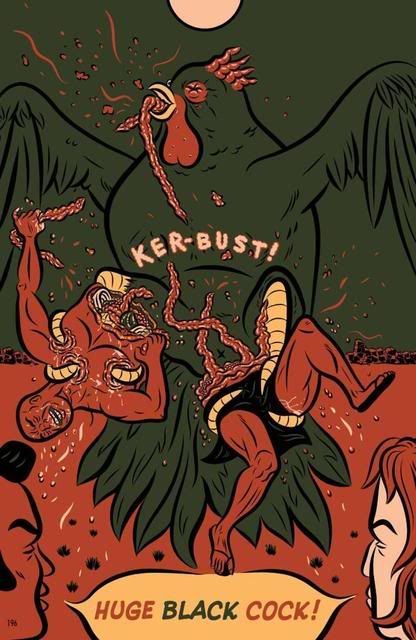
JL: That’s the [Cockfighter Blues]?

AK: Yeah. I actually told Brian I want the panel of “Giant Black Cock!” printed on velvet, and I will hang it framed in my living room. I’m not kidding.

Bastard Road: Cockfighter Blues by Brian Winkeler and Dave Curd

But it’s such a joyous thing. It’s that weird mix of everything comics can do, and a lot of Popgun is about that potential of comics. Don’t we all just keep hearing this, you know, ‘oh, well, comics. Just the superhero stuff is all that actually sells and nobody is really innovating anything…unless your name is Grant Morrison,’ unless you’re attacking Grant Morrison that day, in which case he’s not.

But you hear like three names of people who innovate in comics, and I’m telling you, we have like four hundred and seventy-odd pages of people who innovate in comics, hands down. These are people who are just doing incredibly new things with the medium. And it’s brave, and it’s just interesting to see from a production thing—hey, I get to read this stuff first—al of these stories that don’t always have anything in common, but you look through the book and you can feel this thread. You know, that music sensibility isn’t in every page. People aren’t going, ‘let me write a comic based on a rap song.’ But you do feel that sensibility of—before Top Forty Stations became huge and, you know, I grew up in New York, so I’m going to assume the rest of the world was like New York. You know, what became of Top Forty stations back in the early ‘80s played some really weird stuff. They were playing ‘Mercy Seat’ by Nick Cave on the god-damned radio, not a song you would actually get away with playing today.

But they would take these chances, and you had DJs who didn’t have orders to play these four records over and over, and you had people creating something interesting. Even if you didn’t like it, you had to respect it. And I think that’s really where Popgun lives. Because I don’t like every story in the book. I would be lying if I said I did, let’s face it. There’s too much stuff in there to love every story in the book.

But even the ones where I sit there and go ‘Really? This is--? Uh, okay,’ I consistently respect the craft that went into it, because everyone is at a really, really high level here. You have to respect the creators who push this stuff out, and you can tell they just kind of gave their all for it for, again, an Image anthology that—yeah, Volume One won a Harvey, and that’s awesome and well-deserved, I think. But I think it’s not going to buy these cats a car, you know? Let’s face it.

And I get mail, constantly, from people who are not unknown in the industry, who go, ‘I want to be part of Popgun.’ And that just amazes me. Not because, ‘Wow, they like us.’ But just that word is spreading and we’re becoming this place you go for the experiments, for the fun of it, for ‘let’s see what comics can do for a change,’ instead of being told what comics can do.

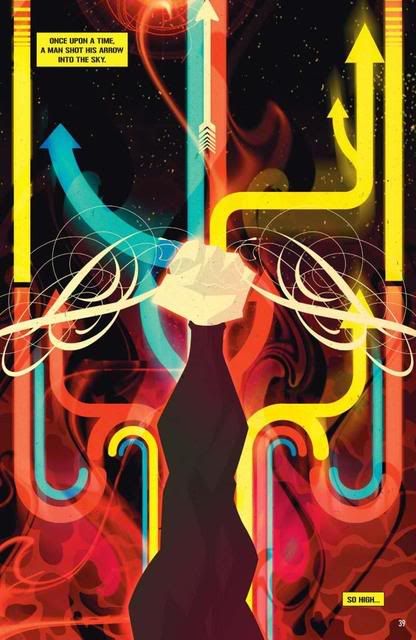
Vertex by Juan Doe

We tell people, ‘play. What’s the story you’ve always wanted to tell? Let’s see that one.' We actually just got a list of pitches from somebody whose name I can’t remember at all, who’s going to do a story for us, and he gave us these three choices. Here he is, a nice guy, he’s giving us options, that’s kind of awesome. ‘Which one do you want?’

And me, D.J., and Anthony all took a look at this list and we all universally, without talking to each other, went for the strangest, most experimental one in the batch. We’re just like, ‘we want to see you pull off that.’ Because no one’s done that yet.

And you don’t include that really unique, special weird thing unless it’s the one you really want to do. No one ever includes that in the list unless that’s the one they want. So that’s the one we’re going to go for. We want people to tell those stories that they really are fully invested in, because you can see that investment on the page.


We Like the Guns, The Guns That Go Pop: Part I of Jeff's Talk with Adam Knave.

Adam Knave is an assistant editor for the third volume of Popgun, out this Wednesday. He's also a writer of prose and a webcomic writer, and from what I can tell he works his ass off. Other writers and artists have projects they describe as "boot camp," for example, but Knave, along with artist Renato Pastor and editor Lauren Vogelbaum, are planning their webcomic to be a five year boot camp, one in which they're already significantly ahead of what they have posted.

I'm still learning the interviewer ropes so I apologize for the awkward breaks and pacing in the interview--I tried to keep this first part short then realized it was in fact too short. Part one is behind the jump.

Jeff Lester: Let’s start with Popgun, because that’s in theory the stuff that’s most important to get out on time here. When did you—let’s go for the big picture. How would you describe Popgun for somebody who’s never seen it or read it? Adam Knave: The way it was originally pitched to me, when I first came on board, that it was the graphic mix tape. And that’s been their tag since Day One. And you know, you hear something like graphic mixtape, and you say it to people, and they go, ‘so they have music?’ You know, and then you realize you’re dealing with the slow people.

But it really comes down to, it is a graphic mixtape—they actually pull that off. You know, it has all the weird joys of a great mixtape: there’s a flow to it—we’re actually trying something slightly different with the flow in Volume Three than we have in the past.

JL: Oh, yeah?

AK: Yeah, we get to play with that. Volume Two was very much: here are these cool songs that go together. Volume Three, there’s a thematic flow. There’s more of a grouping of stories going on. Because I’m going to take you from one place to the other.

And there’s always an intermission in the middle of the book which…I don’t know if this is what they were thinking of when Mark and Joe first started the book, but it gives me such fond memories of cassettes and that’s the inset cover of the cassette. And so that’s awesome! Because it’s just like the flip to the cassette map! That just makes me smile. Every time.

I’m easily pleased.

JL: That’s good. Always helpful in this line of work.

AK: You know, everyone—everyone—has made mixtapes—or I suppose at this point, playlists—for friends. And that’s really what it is—trying to find established voices doing new things, as well as brand-new voices who just really should be bigger than they are right now. And just letting them play, and seeing where it all comes to and then finding a way to mix it all together, to get a finished product that reads like it was meant.

JL: So do you guys lay down any sorts of boundaries, as far as page limits or topics, or anything like that? AK: Yes and no? There are some boundaries for content. It is an Image book. There’s never going to be outright porn. Past that? Mmm, not really. If it’s justified in the story, we’re usually fine with it.

Page count? I think the longest thing we’ve ever had is thirty pages. I know we have a thirty pager in Volume Three, and that’s the longest anything’s ever going to go. But we also have at least one one-page story. So we’re fairly free; it’s just we have so many people and so much material that we have to put a cap on it somewhere.

JL: I would think so. It’s a pretty big slice of comics.

AK: The great thing is both—I believe it’s Volume One and Two, actually—every volume so far has had roughly 100 pages of content that gets chopped out and pushed to the next volume.

You know, you’d think we’d already have a hundred pages, we’d stop. We don’t. And in Volume Three we actually hit the physical limit to keep the price point. We hit the physical page limit.

JL: How did the story that you end up co-writing in this volume end up happening?

AK: D.J. and I go way back. I don’t know if you remember—here’s a little slice of comic history for you—Too Much Coffee Man magazine.

JL: Oh, yeah.

AK: My first-ever, like, hard-print published journalism type stuff was in an issue of that. A website I ran, we interviewed Shannon Wheeler, and I kept in touch with him because I’m shameless. It’s how you get somewhere, you know?

And then just every now and then, I’d tell him, you know: if you ever need anything done, let me know. Glad to help out.

And one day he dropped a line and said, ‘I had this guy who was going to interview somebody for it me and then he dropped out. Can you do it?’ I said, ‘Sure.’ This was a Wednesday.

He said, ‘Okay. I need you to find someone who speaks Klingon and interview them.’

And I was reading this going, ‘You want me to—am I reading this correctly?’

And he’s like, ‘Yeah, find someone who speaks Klingon, interview, but we’re going to just present the interview in Klingon with no translation. And it’s going to be really funny.’

And I was like, ‘Okay.’ Again, this is Wednesday. He says, ‘All right. I need it by Friday.’

JL: So you actually had to transcribe—conduct and transcribe—an interview in Klingon in two days. AK: I did it over email. I actually had a friend in Atlanta who knew someone they worked with who spoke Klingon.

God bless people who live near DragonCon. That’s really the secret.

But, no, I had to proof Klingon. Which, you know, I’m sitting with a book, going, ‘You need this extra apostrophe after this q.’ Just sitting there going, ‘what the hell am I doing?’

But I ended up on the staff of that for like the two or three issues before it went under. Which I still say had nothing do with me. And the last issue—which actually never came out—was Kirkbride’s first issue.

It was one of those things where he was now the new kid, and I was now the seasoned vet of like an issue and a half. So we were like, ‘let’s do something together!’ And we just found that we write together really weirdly well.

So when he was doing Popgun, I edited his story in Volume Two. And we said, ‘we should do something together.’ So we started doing all these stories. And finding artists—which, you know exactly the fun of that. Where you go, ‘It’s for Image. There won’t be any money! Because, well, it’s Image. So there’s no pay rate. So there might be money at the back end, but won’t you do this for free for now?’ It’s an eight page story, that’s why we get someone to say yes.

So we had a bunch of stuff in the works that we thought was going to end up in Volume Two. And nothing quite got done in time. We had an artist bail on us, and all the standard things that happen in life. And we ended up finding Matteo, who…I want to ‘art marry’ him.

He’s blindingly fast. And if you look at his work…he turned those pages around in something under a page a day.

JL: Good grief. Really.

AK: He’d sent us these sketches, and they were kind of very airy and all over the place. And we’re like, ‘there’s not going to be enough room! How is this going to work?’ And he says, ‘Oh no, those were just the sketches. I’m re-drawing them!’

And we’re like, “You’re going to…okay?’ You know, what do you say. ‘You go do the thing you do that frightens us, and we’ll be over here, screaming.’ And he just knocks them out of the god-damned park.

JL: That’s really amazing to know, particularly since the storytelling is really energetic—the angles and perspectives are all over the place, and everything’s always moving. You guys have just a few pages so of course it’s got to move, but there’s maybe half a panel where somebody isn’t screaming or running or flying.

AK: And I will admit, this is mostly my fault. I come from prose which, you know, that sentence makes it sound like another planet, and I guess in comics it is. I was at New York Comic Con talking to people, and I’d be like, ‘oh, did you want a copy of my book?’ Because I had my book with me (because I’m a whore, and I don’t mind that) and people were going, ‘It’s just prose? Why would you do that?’

So I hadn’t been writing many comics, because…when you grow up and you love comics, you want to write comics but you don’t know any artists, and after a while, you stop trying. So I hadn’t been really working in comics, so I was very much a wordy bastard. (As you might be noticing from this interview. It’s a curse.)

So the script kind of had these six pages that really should’ve been more like twelve. And it kind of forced ‘Teo to just make everything move that much faster. And when we saw it, we’re like, ‘Oh my god, you actually pulled this off. And we’re so sorry we did this to you!’

You know, we’re doing another one for Volume Four. Same characters. We’re doing a sequel. Not so much a sequel, as another story with these lunatics. We’re taking twelve pages and we’re writing about the same amount of script we did for the first one. Just because we figured we’d actually let him draw.

Tomorrow in Part II: More about Popgun, webcomics, etc.

Da Fug? Jeff is Enslaved by Seaguy: The Slaves of Mickey Eye

Is it fair to review a book about which I have very little to say? To you or to me?

Probably not. And yet, it seems necessary to write a little review of Grant Morrison's Seaguy: Slaves of Mickey Eye #1, if only because I and a million other people on the Internet were more than willing to record our impressions of G-Mo's Final Crisis each and every time an issue came out. Although I have nothing to support this theory, I've always assumed one of the conditions to Morrison's agreeing to do Final Crisis was that Vertigo publish the follow-up to his sublime but not particularly fiscally successful Seaguy.

And so, in my mind, while not fair to you or or to me, perhaps writing up my thoughts on this issue at this early juncture is more than fair to Grant Morrison, so that my second-guessing, half-baked theories, and if my flimsy, lazy thinking ends up being shown off in all its deluded, wearing-my-underwear-on-the-outside-of-my pants glory...then maybe so much the fairer.

You are welcome to join me in my fool's errand after the jump.

Let me begin by cataloging my sins. I purchased this issue and read it almost immediately, occasionally smiling while doing so. I then put it aside. Then, after a few days, when I realized things had remained relatively quiet on the Internets, I decided it might be good to see if I could start some sort of conversation on the matter. To do so, I did NOT go to my bookcase and dig out my Seaguy trade (it's all the way on the other side of the room!), I did NOT scrupulously re-read Seaguy: Slaves of Mickey Eye #1 (I spent about two minutes re-reading it), and I did NOT think through what I was going to say before I started typing.

As long as I am cataloging my acts of hubris, I should confess my nagging doubt that I have deeply misunderstood the first Seaguy limited series, if only because it seems to me one of the clearest and most straightforward pieces Morrison has ever written. Every time I read or talk to someone saying they enjoyed Seaguy but were pretty sure they weren't getting a lot of it, I realize my conviction regarding Seaguy's thematic transparency is more than likely that of the narcissist, the undeveloped child, around whom the world seems to revolve, and with whom the world communicates its system of odd, gnostic signs with perfect soothing clarity.

For me, the first Seaguy mini was a lovely, devastating meditation on the nature of corporate-owned characters and their lot in life: They traipse about in theme parks, immortal, carefree. As Morrison frequently does (and can often do so well), Seaguy is a look at how that life must feel for the character--the unsettled, subtle anguish of someone for whom everything is pleasant but nothing is good. The theme park in which they are an attraction seems to them a boisterous, capricious town eager to distract from what lies behind its manufactured facade. The characters never die, but their sidekicks do--but in order for everything to stay the same, the memories must be ripped from them, like a waxing of the forebrain, and although the mind aches from the loss, it doesn't know why.

And even better, this sort of haunted, ahistorical pleasantness was just a perfect god-damned snapshot of America--not post-9/11, but post-post-9/11, where my wife and I go out to dinner and shop along some lovely prefabricated spot like Santana Row, while non-chain stores sicken and die like poisoned children; where we sit at home and speculate about Lost, while the TV barely shows the war, now in its fifth year of grinding up the poor; and where I lie awake sometimes at night knowing that my distance from the true and terrible conflicts in this world (which I can sense thrashing about, coiling and uncoiling like a serpent fighting for its life, which I sometimes imagine being the cause of the flickering I can see on the night horizon from my window) is a luxury, a luxury for which I'll gladly suffer under the yoke of dull but steady employment, even while I idly wonder what it must be like to touch the scales of that furious beast. All of this I can feel in my life and see in the bright candy colors of the first Seaguy mini, in the pitch-perfect art of Cameron Stewart, looking like a one-page comic ad for the action figure you never bought, and, like I said, the whole thing doesn't seem baffling at all. It's as to-the-point as a ransom note.

And so I was never too riled up about seeing the sequel to Seaguy, although I rooted for the possibility and was gladdened by its announcement. For me, the perfect sequel of Seaguy would be exactly--and I mean exactly--the same three issues of Seaguy, just with Lucky El Loro in place of Chubby Da Choona. Failing that, it's probably for the best to have only the original miniseries and the the promised sequel never to arrive, so that a reader had no choice but to return to the original story again and again until they'd suddenly realize that the first volume of Seaguy was the sequel, and that they, the readers, were the true slaves of Mickey Eye.

But just as a child spends some time investigating outside their window and realizes with some degree of relief and no small amount of disappointment that the faerie messenger scratching and knocking furtively at the bedroom window was merely a newly displaced dangling branch, I come to tell you the the first issue of Seaguy: Slaves of Mickey Eye is not a mere repeat of Seaguy's first issue, but a comic book all its own, a continuation of the fugue, but also an entirely new measure of it.

In Seaguy: Slaves of Mickey Eye #1, Seaguy is more unsettled, more aware that something isn't quite right in his world, and quicker to realize when he's being lied to. Where it last time took Seaguy the course of several issues to wander in over his head and lose his sidekick, here it takes less than twenty pages, leaving enough time for a quick asylum incident that recalls the end of Peter Pan and a rescue by the three chaps seen on the cover, whom I've nicknamed (for now) TeaGuy, ThreeGuy, and PeeGuy (although the colors and logos on the closing page and the cover don't match, so maybe Peeguy is really green and Teaguy is really yellow, I don't know).

Considering the rescue comes hot on the heels of evil Lotharius' order for "radical solutions," I think it seems likely the trio of Seaguy analogues may end up being tools to keep Seaguy from discovering the truth. It'll be interesting to see if Teaguy, Threeguy and Peeguy end up being Morrison's spoof on the growing tendency to give superheroes lineage make-overs, putting them as but one in a line of Fisty Riders or Green Flashes. It seems important that Seaguy consider himself inessential, when the behavior of everyone around him suggests that he is in fact crucial to the world around him. And, of course, doltish clod of a comic reviewer that I am, I only know begin to realize how Seaguy's scuba mask resembles nothing so much as an eye itself. It seems a very Morrisonian pun if 'Seaguy' is in fact 'Seeguy' and I wonder if he's going to end up having some unexpectedly close ties to Mickey Eye than might have already been established. (That last clause is a a somewhat slipshod way of confessing I don't quite remember what was revealed at the end of the last Seaguy by the time he ended up on the moon--butterflies? Mummies? Maybe I really should've dug through my shelves and re-read that trade?)

Oh, and the art on this, by the way, was superb. Stewart knows right where to put an unsettlingly realistic touch in the midst of things at their most unreal (there's a close-up shot of slightly misaligned bottom teeth that's just spot-on) and I love how none of the panels here are fully bordered--they manage to feel both claustrophobic and disquietingly open-ended, as if the characters inside are trapped, but something could still enter in suddenly and change everything. And the colors by Dave Stewart? Also great--I really liked that greyish miasmatic feel he gives the first few pages.

So that's one rube's opinion: Seaguy: Slaves of Mickey Eye #1 is Very Good stuff, worthy of your time and attention and even that high-end Internet chatter that we only seem to break out for the big-money events. Ignore it at your peril.

Arriving April 8th, 2009

I'm in New York City this week, which is why I've been otherwise silent for the last couple of days, and will be for the next few.

Our 20th anniversary thing went REALLY well -- we did more than 200% of a normal Wednesday, saw a lot of old and familiar faces, AND we got a ton of food donations for the San Francisco Food Bank, yay!

We went out to dinner last night with the astonishingly awesome Garth Ennis, the even more awesome Ruth Cole (*I* wouldn't have the stones to do an intercontinental yacht race, that's for sure), and Brian K. Vaughan. Such nice people, such great company.

Anyway, here's the one tiny bit of work I have to do this week, and now I'm done, so back to vacation!

1001 ARABIAN NIGHTS ADVENTURES OF SINBAD #9
3 GEEKS SLAB MADNESS #3 (OF 3)
A G SUPER EROTIC ANTHOLOGY #102 (A)
ALL NEW SAVAGE SHE-HULK #1 (OF 4) DKR
AMAZON #2 (OF 3)
ANITA BLAKE LC NECROMANCER #1 (OF 5)
ANNA MERCURY ARTBOOK #1
ARCHIE & FRIENDS #130
BATMAN BATTLE FOR THE COWL #2 (OF 3)
BATMAN CONFIDENTIAL #28
BETTY & VERONICA DIGEST #193 (NOTE PRICE)
BOOSTER GOLD #19
BPRD BLACK GODDESS #4 (OF 5)
CAPTAIN BRITAIN AND MI 13 #12
CARTOON NETWORK ACTION PACK #36
CLEANERS #3 (OF 4)
DAREDEVIL NOIR #1 (OF 4)
DARK REIGN HAWKEYE #1 (OF 5) DKR
DARK TOWER GUIDE TO GILEAD
DEAD IRONS #3
DEADPOOL SUICIDE KINGS #1 (OF 5)
DOKTOR SLEEPLESS #12
EXILES #1
GEN 13 #29
GREEN LANTERN #39 (ORIGINS)
GRIMM FAIRY TALES #37
HEXED #4 (OF 4)
HOUSE OF MYSTERY #12
IGNITION CITY #1 (OF 5)
INFINITE HORIZON #4 (OF 6)
JUGHEADS DOUBLE DIGEST #149 (NOTE PRICE)
LAST REIGN KINGS OF WAR #5 (OF 5)
LOCKE & KEY HEAD GAMES #4
MARVEL ADVENTURES SPIDER-MAN #50
MARVEL APES AMAZING SPIDER-MONKEY #1
MARVEL ZOMBIES 4 #1 (OF 4)
MASQUERADE #2
MICE TEMPLAR SKETCHBOOK #1
NORTHLANDERS #16
PUNISHER FRANK CASTLE MAX #69
SCOOBY DOO #143
SECRET SIX #8
SHRAPNEL #4 (OF 5) BROOKS CVR A
SOLOMON GRUNDY #2 (OF 7)
SONIC THE HEDGEHOG #199
SPIRIT #27
STAR TREK MISSIONS END #2
SUPERGIRL COSMIC ADVENTURES IN THE 8TH GRADE #5 (OF 6)
SUPERMAN WORLD OF NEW KRYPTON #2 (OF 12)
SWORD #16
TERMINATOR REVOLUTION #4 (OF 5)
TERMINATOR SALVATION MOVIE PREQ #4 (OF 4)
TERRY MOORES ECHO #11
TIMESTORM 2009 2099 #1 (OF 4)
TITANS #12
TRINITY #45
ULTIMATE WOLVERINE VS HULK #4 (OF 6)
WAR OF KINGS ASCENSION #1 (OF 4)
WARLORD #1
WOLVERINE WEAPON X #1
WONDERFUL WIZARD OF OZ #5 (OF 8)
YOUNG LIARS #14
YTHAQ NO ESCAPE #1 (OF 3)

Books / Mags / Stuff
AND THERE YOU ARE GN
CHARLATAN GN VOL 01 PRELUDES
DOCTOR WHO FORGOTTEN TP
GANTZ TP VOL 04
GREEN ARROW YEAR ONE TP
GRIMM FAIRY TALES TP VOL 05
HARVEY COMICS CLASSICS TP VOL 05 HARVEY GIRLS
HEAVY METAL MAY 2009 #123
HELLBLAZER PRESENTS CHAS THE KNOWLEDGE TP
JUSTICE LEAGUE UNLIMITED HEROES TP
JUXTAPOZ VOL 16 #4 APR 2009
MARVEL ZOMBIES 3 HC
MARVEL ZOMBIES TP VOL 02
MOBY DICK TP
NARUTO TP VOL 42
NARUTO TP VOL 43
NARUTO TP VOL 44
POPGUN GN VOL 03
SHOWCASE PRESENTS THE DOOM PATROL TP VOL 01
SIZZLE #41 (A)
SKETCH MAGAZINE #39
STAR TREK COUNTDOWN TP
STILL I RISE GN
TALES FROM WONDERLAND TP
UNCANNY X-MEN HC MANIFEST DESTINY
WOLVERINE HC WORST DAY EVER
WORLD WAR 3 ILLUSTRATED #39

What looks good to YOU?

-B

Patterns of Patterning: David Takes a Look at Irredeemable #1 (With Capsule Comments on Other Stuff From This Week)

In Grant Morrison's afterword to Irredeemable #1, he discusses an email exchange he had with the book's writer Mark Waid regarding patterning, or the practice of essentially permanently categorizing and cubbyholing a person's potential and MO. Morrison goes on to relate this to himself being "patterned" as a factory of insane gobbledygook - and while that's an opinion of him that may be held by many, I'd hardly call it a complete majority, so I was surprised at how defensively that came off - and of Waid being "patterned" as a dude who writes Silver Age throwback stories, which, well, is pretty true. A lot of people don't remember Empire.

And it's difficult not to compare Irredeemable with its seeming spiritual predecessor - they're both stories where Mark Waid, Biggest Superman Fan Alive, writes about really nasty people doing shitty things to each other, so some people seem to initially view it as a sort of novelty thing, like Avenue Q or that YouTube video with Bert & Ernie performing M.O.P.'s "Ante Up" - hey, Mark Waid's writing about bad people! Empire succeeded creatively, though, because it relied on more than shock value - Waid's a superb character writer, and all of his skills in that arena were on full display. So it's disappointing that Irredeemable #1 seems to sidestep the issue of character entirely so that Mark Waid can try to break his pattern.

I'm not saying it's a bad comic, not by any means, but the Plutonian (the I'm-sick-of-being-called-of-a-fag-so-fuck-you-guys spiteful, homicidal Superman analogue that drives the action of the book) isn't really a character yet, he's a just a guy flying around blowing shit up while people panic - something which takes up a decent chunk of the issue's bulk. It's a lot of shock and sadism, and it's certainly well-executed (and, I must admit, not overly gory or fetishistic in any way - credit to artist Peter Krause on the opening sequence especially), but throughout the issue we're only teased with a glimmer of the "why" for all this. It's certainly Waid breaking out of his pattern, but a part of me wonders if it isn't going too far in the other direction - if it's trying so hard to be mean that it loses sight of that human element that marks the best of Waid's work. Or maybe I'm just patterning the guy.

Peter Krause does a great job with the art - it reminds me a lot of Steve Epting in Captain America, except with a far more varied and vibrant color palette courtesy of Andrew Dalhouse, just the right mix of mythological iconography and creepy stalker faces for a book that's all about perverting the supposedly incorruptible.

None of this is to say that it isn't a Good comic - it is, and I'm fairly confident that my complaints about the book's lack of a human hook won't last long, since this is an ongoing series and I doubt he'll stay away from that for long. I think it's going to make for a really good ongoing series, and I'm incredibly happy Waid's finally in the position where he can give himself a canvas like this. But taken as a hermetically sealed first issue, I'm still going to be buying the second issue more on my trust in Mark Waid as a creator than in me being hooked into the story so far.

Also, if you ever wanted to see what a two-page four-star verbal blowjob was like, Grant Morrison's afterword sure is something.

On to some other stuff - it's a shame Geoff Johns's run on Justice Society of America is ending with such a whimper, since the first few issues of this run were superb and really seemed to be showing a ton of promise, but the endless droning of the Kingdom Come storyline killed so much momentum that I can really see why Johns chose to leave the book. It just doesn't have as much energy as his other work, and has that same plodding, co-written feeling that his late issues of Teen Titans did, where the car was just running out of gas. I think next month's Eaglesham-drawn Stargirl spotlight will probably be a winner, but other than that this issue and run overall have been fairly disappointing. Okay.

In terms of superhero fun, I'm really enjoying the "Messiah War" storyline crossing over between Cable and X-Force - this week's Cable #13 is the second part, sort of rearranging all the pieces of the stuff I remember loving as a kid (Cable! Deadpool being funny! Wolverine slicing shit up! Archangel flying! Stryfe's awesome blade armor! Copious time travel!) into a story that actually has some degree of forethought and coherence, unlike the flying-by-the-seat-of-the-pants plotting of the Liefeld/Nicieza/Lobdell stuff I inexplicably loved as a kid. I really wish Olivetti would draw his own backgrounds instead of using 3D models and Quake II screenshots, but Duane Swierczynski writes quite a Good comic here.

Lastly, I've got to admit I've really turned around on Daniel Way recently - I thought a lot of his early Wolverine: Origins work was fairly awful, horribly paced stuff, so I'm really surprised by how much I'm enjoying not only that book these days (the focus provided by Dark Reign certainly helps, though) but also his Deadpool, which pushes out its eighth issue this week, the third part of the "Magnum Opus" crossover with Andy Diggle's Thunderbolts. It's a fun madcamp romp more than any sort of high art to be sure, but for God's sake the story is titled "Magnum Opus" in full self-awareness, and as a superhero comedy that manages to stay within the bounds of seriousness I can pretty much say that I laughed a lot and was genuinely surprised by a number of the plot turns, so that's a pretty Good comic to me.

I've also got quite a lot to say about the first issues of Flash: Rebirth and Seaguy: The Slaves of Mickey Eye, one in review form and one in a sort of annotation-esque form (I'm not sure yet), but I owe some love to my homies at Funnybook Babylon so make sure to keep an eye out there for those and other great articles.

Arriving 4/1/2009

Don't forget: Wednesday is Comix Experience's 20th anniversary! Bring in a food donation for the San Francisco Food Bank, and receive a 20% discount on ANYthing in the store (including all of these new titles)

2000 AD #1625
2000 AD #1626
AGENTS OF ATLAS #3 DKR
AMAZING SPIDER-MAN #590
ANGEL BLOOD AND TRENCHES #2
ASTONISHING TALES #3
ASTOUNDING WOLF-MAN #14
AUTHORITY #9
AVENGERS INVADERS #9 (OF 12)
BANG TANGO #3 (OF 6)
BATMAN BATTLE FOR THE COWL MAN BAT #1
BETTY #179 (NOTE PRICE)
BILLY BATSON AND THE MAGIC OF SHAZAM #4 (RES)
BLACK PANTHER 2 #3 DKR
BOYS #29
BUCKAROO BANZAI ORIGINS #1
BUFFY THE VAMPIRE SLAYER #24 CHEN CVR
CABLE #13 XMW
CAPTAIN ACTION COMICS #3 MYCHAELS MODERN CVR
CAPTAIN AMERICA COMICS 70TH ANNIV SPECIAL #1
CARS ROOKIE #1 (OF 4)
DARK REIGN FANTASTIC FOUR #2 (OF 5) DKR
DEAD OF NIGHT FEATURING WEREWOLF BY NIGHT #4 (OF 4)
DEAD ROMEO #1 (OF 6)
DEADPOOL #9 DKR
DESTROYER #1 (OF 5)
DR DOOM MASTERS OF EVIL #3 (OF 4)
FARSCAPE #4
FLASH REBIRTH #1 (OF 5)
FRANKLIN RICHARDS APRIL FOOLS
GI JOE #4
GLAMOURPUSS #6
GRAVEL #10
GREATEST HITS #6 (OF 6)
HAUNTED TANK #5 (OF 5)
INVINCIBLE IRON MAN #12 DKR
IRREDEEMABLE #1
JERSEY GODS #3
JONAH HEX #42
JUSTICE SOCIETY OF AMERICA #25
KNIGHTS OF THE DINNER TABLE #149
LOONEY TUNES #173
MARVEL ASSISTANT SIZE SPECTACULAR #1 (OF 2)
MIGHTY #3
NEW AVENGERS REUNION #2 (OF 4) DKR
OFFICIAL INDEX TO MARVEL UNIVERSE #4
PALS N GALS DOUBLE DIGEST #130 (NOTE PRICE)
PRIDE & PREJUDICE #1 (OF 5)
REMNANT #4 (OF 4)
SAVAGE DRAGON #146
SCALPED #27
SEAGUY THE SLAVES OF MICKEY EYE #1 (OF 3)
SECRET WARRIORS #3 DKR
STAR TREK COUNTDOWN #4
STAR TREK CREW #2
STRANGE ADVENTURES #2 (OF 8)
SUPER HUMAN RESOURCES #3 (OF 4)
SUPERMAN BATMAN #57
TEEN TITANS #69
TEEN TITANS ANNUAL 2009 #1
TRINITY #44
UNIVERSAL WAR ONE REVELATIONS #1 (OF 3)
WAR OF KINGS #2 (OF 6)
WHO WANTS TO BE A SUPERHERO THE DEFUSER
X-MEN FIRST CLASS FINALS #3 (OF 4)

Books / Mags /Stuff
4 GIRLFRIENDS GN VOL 01 (O/A) (A)
BATMAN THE HEART OF HUSH HC
BOMB QUEEN TP VOL 05 BOMBASTIC
CHRONICLES OF SOME MADE GN
DC WILDSTORM DREAMWAR TP
DUNGEON ZENITH TP VOL 03 BACK IN STYLE
ELIXIR GN
FALLEN ANGEL TP VOL 06 CITIES OF LIGHT AND DARK
FREEDOM COLLECTIVE ONE SHOT
HELM TP VOL 01
HI FRUCTOSE MAGAZINE QUARTERLY #11
JONAH HEX BULLETS DONT LIE TP
JSA TP VOL 02 THY KINGDOM COME PART 01
JUDGE DREDD MEGAZINE #282
PIANO TUNER GN VOL 02 (A)
PREVIEWS #247 APRIL 2009
RESIDENT EVIL FIRE AND ICE TP
STAR WARS OMNIBUS EMISSARIES AND ASSASSINS
TRIPWIRE SUPERHERO SPECIAL
VIDEO WATCHDOG #148
WARHAMMER 40K DEFENDERS OF ULTRAMAR TP
WITCHING HOUR TP NEW PTG

What looks good to YOU?

-B

My Scott, Your Jean: Jeff Takes A Quick Look at His Sacred Cows.

Because I follow several of the Alert Nerd people on Twitter, I had the head's up about their "what's your Scott & Jean?" event they were planning for March 30th. Unfortunately, because I'm still a waster with terrible time management skills and the world's worst book to re-draft, I didn't realize that March 30th would somehow end up being, y'know, today.

I think the question is relatively comprehensible to yr. average comics geek. As Sarah puts it in Alert Nerd's master post:

Said phrase means, essentially, “That is my geek sacred cow, the one topic I cannot discuss rationally because it makes me too insane/angry/scary-eyed.”

So what's my geek sacred cow? Let's find out together shall we? After the jump.

Being the "Raised on '70s Marvel" geezer that I am, my list of geek sacred cows back during that time would've been something like:

(1) Bucky stays dead; (2) Gwen Stacy stays dead; (3) Uncle Ben stays dead; (4) Howard The Duck does not wear pants, and wears a hat too small for his head.

Howard the Duck Pictures, Images and Photos

In the '80s, I think I would've added the following to the list:

(1) Jean Grey stays dead; (2) Nobody but Frank Miller writes Elektra; (3) You never learn Wolverine's origin; (4) You can't break up Nightwing and Starfire (Hey, my entry point into DC was Wolfman & Perez's Teen Titans).

In fact, this may have been the true joy of being a young comic book geek: stepping out each fine morning and looking out an entire herd of geek sacred cows happily grazing before you--nobody but Kirk will command the Enterprise; the Man From Atlantis will never remember his origin; in the end, Godzilla never loses; you can't have a Planet of the Apes movie without Roddy McDowall; you never see the Human Fly's face. There's something thrilling about coming down from Mount Sinai with those two tablets of shall-nots and will-nots. Every parent will tell you about the phase their kid goes through where their response to everything is 'no!' But there's also something satisfying about these rules because you learn them, basically on your own. Unless you're reading a John Byrne comic, nobody would ever say, 'Reed can never cure Ben! Iron Fist will always love Misty Knight! Scott will only love Jean!' They're the things you learn on your own--that's why they're so powerful, something so similar to sacred.

But over time, as you get older, you watch most of your sacred cows get a bolt in their brain, hung upside down and bled, cut into parts. Then you are offered the chance to plunk down some cash so you can bite into that extra-thick and juicy hamburger formerly known as your sacred cow. And some of us bite deep into that burger just so we can complain knowledgeably about what a horrible waste, a sacrilege, a defilement of the divine, the burger's production is. And some of us realize the sacred cows were never grazing in our pasture, and we either stay because we like the view, or we split.

Or, you know, every so often, in mid-self-righteous mouthful,we find ourselves going, 'this is one damn tasty burger.' I was not a big fan of bringing Bucky back, but god-damned if Brubaker didn't grill that shit up and serve it to me with thick-sliced onions and a side of bacon. I was incredibly annoyed at how lame 'One More Day' was, but on the next-to-last page, I was a little bummed Gwen Stacy wasn't right there next to Harry Osborn--as long as you're gonna defile the church, people, fornicate on the altar, not in the pews.

Sex With Gwen Pictures, Images and Photos (ugh, no, not literally.)

Now, it may be that I have some list of geek sacred cows that I am hiding from you--that I am, in fact, hiding from myself, so that I don't have to worry about saying them out loud and having today's writers go, 'Wow. That would blow everybody's mind if it turned out that Dick Grayson was gay, wouldn't it? Hmmm...'

Because in a marketplace that caters exclusively to the disciples, sacrilege sells. If you can sell the sacrilege in a way that stays true to the characters, then you've got a pretty good future in this business. But if you can't? Find the cow, man. Find it and kill it.

But I came to this meme to honor it, not to bury it. I'll give you two Scott & Jeans, in fact: a bugbear and a meta-bugbear, either of which I'll happily argue about until the [WARNING: STOP TALKING ABOUT FUCKING COWS!]... new comics come in.

Scott & Jean Number One: Lois Lane and Superman and Clark Kent must always be a love triangle.

Why? Because apart from his constant inherent goodness (which is only interesting now because no other hero is considered constantly, inherently good--fifty years ago, that was par for the course) it is the only fucking interesting thing about Superman, that's why. Nearly every other single interesting thing about Superman (Kandor, weird 'L.L.' fixation, lost civilization of Krypton, the Legion) is an odd external facet, some little idea that stuck and crystallized in a really interesting way.

But the fact that Lois loves Superman and Clark loves Lois, but Lois doesn't love Clark the way she loves Superman and so therefore Superman can't love Lois the way she loves him, comes from Superman/Clark himself, and not from any external geegaw or fifth-dimensional whatsit or from being exposed to some rare strain of Kryptonite that makes him peevish or capricious. You can spend a lot of time and energy thinking about why this weird dynamic exists (and believe me, I have) and you'll never get to the heart of it, but you can, like an actor, pick a reason that makes sense to you and craft stories that suggest your explanation.

The bizarre love triangle (or maybe it's better to say Bizarro love triangle, since it's not a triangle at all) is not only tied to the internal drama of the lead character and multivalent, it's also real. (In fact, it's better than real--it's super-real, in that "a wheel is a leg" kind of way.) Remember that person who liked you enough to hook up with you (repeatedly, even!) but always had some weirdo explanation as to why they couldn't be with you? Remember that person who adored you, and you realized all you had to do was adore them back and everything would be fine, but there was something--the way they slouched or the way they laughed, or your unrequieted love for someone else, or the fact that you were still five years away from realizing you were an emotionally damaged alcoholic who had to keep everyone at arm's length? Sometimes, later on, you figure out why things didn't happen, or maybe you never do and you think of that person--not so much the one who got away as the one you let go--and you accept it because that's the way things are, you guess: Lois loves Superman and Clark loves Lois, but Lois doesn't love Clark the way she loves Superman and so therefore Superman can't love Lois the way she loves him.

Scott & Jean Number Two (the meta-bugbear): Continuity matters.

Continuity is a noose. Continuity is a trap. I believe that, I really do. It's one thing to have continuity for five years or ten years in your superhero universe--maybe you can split your Earths in two, and you can double that. But it's like entropy--sooner or later it gets you. At a certain point, it renders the system useless as every transaction in the closed system is made and no other transaction can be made. A noose. A trap.

But even though I know that, continuity matters to me--without it, the idea that what happens now matters to what happens next, and what happened last month is important to what's happening now. The noose of continuity is what has raised superhero comics to such spectacularly successful heights. More and more, I enjoy the craft of a fine done-in-one, but that's because there aren't that many continuity driven stories I enjoy these days--maybe because I'm not personally invested in them, since there's either a good chance they'll be undone in the next two years or because they ignore some piece of former continuity, or the continuity they had to wipe in order for the story they had to have happen. But as much as I enjoy sitting around high on the drug of my choice reading Bob Haney Brave & The Bold showcases (and I'm enjoying it these days probably more than I should), I totally would've ditched comics when I was twelve or fourteen or seventeen if that's all there had been to it.

(Yes, really.)

I wish I had somewhere further to go with this point from there, but I don't think I do. This is where I have to remember that those cows don't belong to me--they belong to the guy next door, the one who assures me the cows are sacred to him, too. (You know, the guy running the slaughterhouse.) He's gotta make a living, or he closes up shop and there are no more cows. [HOW THE HELL DID I END UP ON THE FUCKING COWS AGAIN? STOP, STOP, STOP.] Maybe this is why I'm more vegetarian these days--18 volumes of Urasawa's Japanese mushrooms; Jaime and Gilbert's strange burrito joint with the tear-summoning hot sauce; stranged aged cheeses from the '40s and '50s. I dunno.

And, anyway, the stupid settlement says that Howard has to wear pants, so what are ya going to do, right?


Abhay Talks about Two Stacks of Comics.

At the beginning of March, I spent a week living out of a hotel room.

Hotel-living turns into the fucking Shining for me pretty fast. Long creepy hallways of identical rooms, filled with strangers. Why are there so many pillows on hotel beds now? 9 pillows? 10 pillows? The classier the hotel, the more pillows on the bed. Occam’s Razor says that the logical conclusion is that fancy people like to play pillow fort on vacation. Plus, thanks to the Local Channel 6 News Action Eyewitness Investigation Squad-team on my TV, I’m convinced that if I had UV goggles, the entire room and all 20 pillows would all glow white-hot with fancy-man semen stains, like Tron bukkake aftermath.

After the hotel stay, I visited my hometown, stayed with my family. I was around My Stuff again, not Hotel Stuff. Not just My Stuff, but My Old Stuff. Found a stack of old comics, thirteen random comics from different years, different eras, slung together next to my bed, collecting dust.

I want to write about that stack. Not really "reviews" or anything that formal-- I don't see the point of "reviewing" any of these comics, but just talking about what books were in that stack. Plus there’s another stack, a second stack.

The Mighty Thor #382 by Walt Simonson and Sal Buscema: This was the very last issue of the Walt Simonson run. Thor's soul is trapped in the body of the invincible Destroyer robot, and he has to robot-fight his way through Hell in order to steal his dead body away from the Goddess of Death, in time to defeat an army of evil ice dwarves invading Asgard.

Do they still make comics like that? Maybe they do; I haven’t bought one recently.

In the letter pages, Sean of Tahoe, California, "a fan of legends", writes a letter in support of Thor's new beard. He is responding to a previous letter from an earlier letter column that disapproved of the beard. Tank Girl 2 #1 by Alan Martin and Jamie Hewlett: A collection of short Tank Girl stories. They just cram jokes into the margins, nooks, crannies— it’s just filled with drawings and doodles and noodling. It still feel very alive. A lot of people don’t make that effort.

Suicide Squad #18 by John Ostrander, Luke McDonnell, and Bob Lewis: After I quit Marvel comics in middle school, I eventually switched to DC. This was one of my first DC books; I got it from the 24-Hour Ameristop next to the chili place in town. The Suicide Squad fights some bad guys. Without even re-reading it, just by looking at the cover, I could remember at least one line from it: Captain Cold tells a bad guy how "Hell isn’t hot. Hell is cold, and buddy, I'm Captain Cold."

When I first got into DC Comics, everyone in them was a middle-aged failure at life. The Suicide Squad was all about Amanda Waller, an aging, widowed, morbidly obese bureaucrat. The Secret Origins story of Cave Carlson ends with one of Cave Carlson’s sidekicks, years after their adventures together, homeless and in a wheelchair, begging for change. The Atom was divorced, after he’d caught his wife cheating on him in the back of a Chevy. Captain Atom had a dead wife and kids he couldn’t relate to. The Swimmer would go from swimming pool to swimming pool, fighting crime. I don’t really understand DC characters any other way, I guess. DC books don’t make any sense to me, anymore.

The Last American #1 by Alan Grant, John Wagner and Mike McMahon: I don't really remember anything about this comic other than buying it for Mike McMahon's drawings, the way he builds drawings out of sharp lines, flat colors, off-kilter shapes. Lego humans, wandering through desolate post-apocalyptic landscapes.

Most of the comics I’ve read lately have just been that sort of “Art Experience” for me. When I got home from my trip, I returned back to a second stack of comics. I’ve been buying #1 issues this year, non-established-universe #1 issues, trying to get some whiff of what’s new in comics, what people making new things were trying to do. But: Jersey Gods (Image), The Great Unknown (Image), Mysterius the Unfathomable (Wildstorm), Bang Tango (Vertigo), The Life & Times of Savior 28 (IDW)…?

Couldn’t catch a scent of anything.

I’m not saying these are bad books necessarily (well: maybe some of them)(Bang Tango), just that my experience of them has been really art-focused. I guess I’ve been distracted. I've already forgotten every single one of Jersey Gods' characters; I just remember enjoying Dan McDaid's performance.

Jersey Gods is about Kirby-style Space Gods fighting in New Jersey; The Great Unknown is about an inventor whose ideas are being stolen from his mind; Mysterius the Unfathomable is about a magician who is a PG-13 asshole; Bang Tango is about a retired gangster who dances tango, who goes back to being a gangster; Life & Times of Saviour 28 is about a superhero who gets murdered while protesting the Bush Administration.

Some of the books are entertaining, for what they are. Mysterius seems focused on “fun” in a very professional way, and in a way I think most people will find effective; I think smart people trying to create fun stories is at least admirable in theory-- it's something I've always enjoyed about the Ocean's 11 movies, say. Et cetera. Sure: entertainment, if you’re in the mood to be entertained.

I just didn't feel very connected to any of them regardless.

American Flagg #3 by Howard Chaykin and Ken Bruzenak: Aaah-- Chaykin, lingerie, blowjobs, Ken Bruzenak lettering, and violence, all for a single U.S. dollar.

But more than that—the way a comic can contain a whole world. You can see signs in the background, you can see what people are wearing, you can see the brand-names of their junk food. The characters in FLAGG, I know what they watch on TV: Bob Violence. The name of the cab company in WATCHMEN? Prometheus Cabs.

Who does that needlepoint right now?

The new comics I’ve read-- none really created an entire world for themselves. Jersey Gods tried but its first issue cribbed so heavily from Jack Kirby that it was hard to take it very seriously as its own thing. But I can’t really criticize all of these new books for failing to tell me their main characters' favorite TV show, can I? That sort of world-building seems rare in general, so singling these books out in particular strikes me as unfair.

X-Men Classics #98 by Chris Claremont, John Romita Jr., Glynis Oliver, Dan Green: Before I’d ever seen an X-Men Comic, or had any idea what one was, another kid in third grade attempted to describe the contents of this issue to me. Do you have any idea how long it took him? “The X-Men fight Nimrod” takes somewhere between nine hours and forever to explain to someone who’d never heard of a mutant, Rogue, Wolverine, Sentinels, Days of Future Past, any of it. Now, you can just rent the movie.

Someday, I would like to travel back in time and give both of those kids wedgies. Then: I'd put them in a figure four leg-lock or a camel clutch, and I'd explain to them that they were gebronies. Then, dangle them over a cliff until they wet themselves, you know like Bill Paxton in True Lies. Then, I would explain sexual intercourse to them because I think at that age, it'd really gross them out and it'd just be super-funny to see their expressions. Plus, I would throw in stuff like vagina dentata or nekomimi fetishes or docking or whatever, just to screw them up a little mentally, you know, for giggles. Then, if I had time, and I wasn't tired, I'd go back in time and murder Hitler and prevent the Holocaust or whatever. But first: beating up those little brats. Priorities.

The last panel of this comic is my favorite-- a Russian with an eyepatch says "We are fast approaching a crossroads, Sasha. And I fear that somewhere, somehow, the decision has already been made...to turn us irrevocably towards Armageddon."

I’m about 100% sure this is how every single issue of the X-men ended in the 1980’s.

Tribe #1 by Todd Johnson and Larry Stroman: this was a black superhero team by Larry Stroman at the peak of his comic career, published by Image Comics near the peak of its fanboy-dominance. 1993. The cover is black cardstock with the Tribe logo in gold-embossed letters. No art-- just the gold-embossed letters. Stroman and Johnson's names are almost bigger than the title of the book. According to Wikipedia, it was cancelled by Image before the second issue came out, because it had been delayed so much. According to Wikipedia, its final issue was issue #0.

If you explained the 90's to a kid reading comics today, do you think they would believe you?

Jinx True Crime Confessions by Brian Michael Bendis: Bendis creates a comic around a series of monologues and interviews, people talking about violence they've witnessed, pranks they've pulled. I think this is reprinted in the Total Sell-Out trade.

The selling point aren’t any characters; it has no characters. The selling point is just Bendis. The old Jinx books were just so packed with entertainment value-- letter pages, reviews, short humor strips from his Cleveland newspaper strip. That’s not really true of any of the books in my New #1 Comics stack. Everyone’s trying to make their stories the stars; no one seems very interested in communicating anything about themselves instead. Only Jersey Gods even has a letter page, and it’s not exactly rich with personality...

I doubt this one-shot would ever get made today, but it’s not like comics have ever really been set up to sell books like this. Plus: not many people seem interested in making stuff like this anyways, comics that are just entertaining without trying to sell some new character / concept / bullshit.

Stray Bullets #3 by Dave Lapham: This issue is titled "The Party," but it doesn’t have Lapham’s best party scene in it. For that, you want issue #5, the first Orson issue. But I remember when this comic first started coming out being so excited, going out-of-my-head excited, that the page numbers continued from issue to issue. You know, how if issue #2 ended at page 45, then issue #3 started at page 46...? Oh, man!

It's a strange detail to be excited by but I think a lot of people overlook how much those little details can matter for fans. The letter page in the old Bendis Jinx comics, the page numbers in Stray Bullets, the lettering in American Flagg-- just some hint that there's something going on, some extra bit of work being invested.

The new comics I’ve seen? Can I really tell any of them apart? The Great Unknown has a one-color all-blue color scheme, but even that’s becoming a thing now, maybe.

I tried Dave Lapham’s Vertigo book Young Liars again a couple weeks back, issue #13 (“The Rock Life”). I hadn’t thought much of the first issue, but the new issue had some Twilight Zone moments that were somewhat appealing. The premise apparently went in more of a science fiction direction than the first issue had promised. I didn’t think the first issue had promised anything with any particularity, at all.

Which: maybe that’s true of the other new comics I’ve read recently-- maybe they’re holding back some key part of their DNA. Reading past a first issue is essentially a leap of faith. One I’m making less often.

I went to a screening of a documentary about Joe Sedelmaier the other day. Yes, THE Joe Sedelmaier. At the Q&A afterwards, he said two things that stuck out. First, talking about the work he'd created that he hadn't felt good about, he said "I always said 'Oh-oh' when someone said to me, 'Joe, it's good for what it is.' If something's 'good for what it is', what it is is usually bullshit." I laughed and thought of Mysterius the Unfathomable. The second thing he said, before introducing a (terrific) short film he'd made: "It's about the importance of having an open mind. Everyone thinks they have an open mind, the same way everyone thinks they have a sense of humor. Usually, they don't have either." I didn't really laugh at that.

Instant Piano #1 by Kyle Baker, Mark Badger, Robbie Busch, Stephen Destefano and Evan Dorkin: This was a very uneven issue of a comedy anthology. Some comedic voices blend together well; these guys, not so much-- everyone's voices were just too different. I remember the second issue being much better, but the series didn’t last very long. Dorkin still makes comics, too rarely; Destefano works on the Venture Bros. now, I think; I don’t know what happened to Badger or Busch, though both have blogs, of course.

Challengers of the Unknown #2 by Steven Grant, Len Kaminski, John Paul Leon, Shawn Martinbrough, and Matt Hollingsworth: Aaah, John Paul Leon working with Matt Hollingsworth-- why doesn’t that happen every week?

This was in a brief era in comics in the mid-90's when everyone was trying to recreate the success of the X-Files television show. DC's solution was a Challengers of the Unknown revamp. I enjoyed it at the time—Grant & Kaminski did done-in-one “weird mystery” stories that Leon & Hollingsworth were suited for more than would always be the case in their later assignments.

But living in something else’s shadow never makes much sense in the long term. I’m no expert on positioning, but-- you know: as fun as Dan McDaid’s art is (and it’s fun), as hard as they try, can Jersey Gods ever be anything besides “that book trying to be Jack Kirby”? Jersey Gods is about Kirby; tango-dancing aside Bang Tango’s first issue didn’t promise anything besides cliched pulp crime fiction; Mysterius is about a Mandrake/Doctor-Who type character; Life & Times of Saviour 28 will likely be compared unfavorably to the current storyline in Captain America, let alone any number of other superhero "deconstruction" stories. An argument can be made here on behalf of The Great Unknown. The Great Unknown at least doesn’t feel assembled from a pop culture erector set, at least. Which isn't to say it succeeds at the whole character/dialogue/plot thing, but...

Of course, The Walking Dead perhaps started out owing some debt to George Romero; Casanova owes a debt to, well, plenty; Umbrella Academy probably pays some small licensing fee to Grant Morrison’s Doom Patrol. I don’t know. There’s an expression that “bad artists copy; great artists steal.”

Casual Heroes #1 by Kevin McCarthy: This was a weirdly well-remembered celebrity superhero riff-- very fondly remembered by the few people who caught on to it, though glancing at it now, I don't really know why. The celebrity superhero riff has become old hat since this first came out; maybe it was fresher then. There were rumors that Kevin McCarthy was making comics again a few years back, but I don’t know what became of them.

Super Powers #4 by Jack Kirby, Joey Cavalieri, and Adrian Gonzales: This is terrible shit, a 10-cent bin gamble that never paid off. Jack Kirby draws a cro-magnon Superman fighting the Justice League on the cover, but nothing inside remotely pays off on the promise of that.

Adrian Gonzales draws the interiors. The cover sold the book, though. Jack Kirby. I went with the Jack Kirby hardcover LOSERS collection this week. I’d never seen any of his LOSERS comics, but I love the Kirby HOWLING COMMANDO comics. I'm only a couple issues in; so far, the Losers aren’t quite as cheerfully violent as the Howling Commandos. I like Kirby’s war comics for the violence, but I have a hard time putting the fact that he served in the war out of my head. Kirby almost lost limbs to frostbite, but could still make happy-go-lucky comics about the Losers saving a classical pianist from the Nazis...? These sugary candy-coated explosion-fantasies. But, you know, Lee Marvin made The Dirty Dozen. It's sort of amazing, sort of odd.

According to wikipedia, Kirby’s wife Roz worked in a lingerie store during the war. I’d never read that before today. What were lingerie stores like during World War 2? I never really thought about World War 2 era lingerie stores before, what that shopping experience must have been like.

Dateline: Normandy. Jerry's nowhere to be found now that our boys landed on their shores. Goodbye, Jerry, say hello to St. Peters. Dateline: New York. Sale on Crotchless Bustiers brings Broadway to its knees-- the bee’s knees. Why, is that Vivian Leigh buying a chiffron babydoll with faux fur trimmed cups, satin bow, and g-string? Those leathers corsets she's buying provide as much support for her, as Liberty war bonds provide support for our boys. Our March to War has been silky smooth thanks to pink-satin corsets with removable straps. What’s that? Francis is getting in on the action, buying a spaghetti-strap fishnet crotchless bodystocking with low-cut, criss-cross backstraps? Thatta boy, Francis! You know who doesn’t likes Lace Deep-V Teddies? That’s right: Adolf Hitler.” Oh god, I could do this all weekend...

And weren’t they rationing fabrics during the war? Was lingerie during World War 2 made out of, what, potatoes? Sex potatoes? I’m guessing Jack Kirby's wife didn't sell very sexy lingerie. Deal with that opinion, nerds. Savage critics.

Anyways, right: comic books. I guess I gave up on my whole first issue plan. It just wasn’t leading me anywhere interesting, and I'm having a better time sticking with Jack Kirby. Same as everybody, I really enjoyed Boom Studios' and Roger Langridge's MUPPET SHOW #1-- I'm not made out of stone. Same as everybody, I liked that they didn't do some "Muppets have a Charles Dickens adventure in Space" bullshit but stuck with the Muppets at their most entertaining: theater-nerds trying to put on a show.

Past that, I’m not finding anything that means anything to me. Whatever inspired these creators to create these particular books, I didn't share in that feeling when I read them. But: I didn't give any of them much of a chance either. If I'm honest about it, I don't think I did. Everyone thinks they're open-minded but... And I don't know why that's the case, why I wouldn't be receptive to what they're selling. They're nerdy books? Well, I'm a nerdy guy so that should be an okay marriage. But: not so much. And it's disconcerting. It’s like being in a hotel-- you’re surrounded by this stuff, and it’s like, “Bed” or “Table”, stuff you like in theory. But they're not right. There’s something not right about them. There’s too many pillows.