These points of data make a wonderful line: Diana is Still Alive, 11/21

I don't even play Portal and I'm addicted to that damn song... Anyway, during the Savage Critics' short-lived re-enactment of Marvel's Civil War (whose side were YOU on?), Peter Adriaenssens made what I thought was a rather insightful comment:

"I find it interesting that the reviews are considered 'joyless' and 'dreary', as that seems to be one of the prevailing opinions on superhero comics in general these days."

Now, personally, I think Peter's made the Call of Duty 4 equivalent of a head-shot here: enthusiasm, that genuine joy one gets out of reading comics, is hard for me to come by these days. I get terribly jealous of someone like Chris Sims, who seems to pull it off so effortlessly week after week, even when reviewing soul-destroying artifacts of Satanic origin like TAROT: WITCH OF THE BLACK ROSE. I just can't work myself up to that level, mostly because the endless chain of mediocre events and crossovers and "oh hell no" moments on both sides of the fence have taken me to a pretty apathetic place, generally speaking. I get a lot more fun and satisfaction out of webcomics (which, Hibbs willing, I may actually talk about here someday!).

I'm going to be fair here, and note that the Big Two are business enterprises and they have every right to prioritize the cash-grab (COUNTDOWN) over quality (CRIMINAL). And I'm not saying that financial motivation can't produce a good story, though I'm hard-pressed to think of a recent sales stunt that I actually enjoyed as a reader: the return of Captain Marvel? World War Hulk? Skrulls? Meh.

So, yes, there are times when my outlook on comics gets a bit dreary and lacking in the fun department, because I'm not having fun and I'm not happy about it.

Then Ed Brubaker puts another comic on the shelves, and I get my groove back.

When I think about comics that have truly impressed me over the last few years, Ed Brubaker's CAPTAIN AMERICA is pretty high up on the list. Since issue 25, Brubaker has taken what could have been an empty sales stunt - I'm looking at you, "The Death of Superman" - and turned it into a true character-driven story full of action and intrigue. With the most recent CAPTAIN AMERICA #32, we're now eight issues into the "Death of the Dream" storyline, there's no sign of the protagonist, and this series isn't the least bit poorer for it.

Part of it has to do with the way Brubaker's almost writing around the Captain's demise now, in that the story's still moving: Falcon and Bucky and the Black Widow are picking up the slack, and Sharon Carter's in a dangerous place, and the Red Skull's endgame - whatever it may be - continues to unfold. I'm still invested in the story and in these secondary characters, precisely because Brubaker's fleshed them out to the extent that they can maintain themselves as credible protagonists even without Cap to provide the context. And that's no small feat: could Superman's supporting characters have held the line together if he'd never come back? Probably not, ADVENTURES OF PERRY WHITE doesn't have the same ring to it (though I suppose that, in the Silver Age, it might've actually made for some hysterically funny reading).

I'm also very appreciative of the way Brubaker's done away with decompression without sacrificing the story's integrity: a lot happens this issue, and a lot happened last issue, and it's gratifying to feel like the story's going places rather than tread water for 22 pages at a time.

For all these reasons, I'm giving CAPTAIN AMERICA #32 a well-deserved EXCELLENT. Bravo, Ed!

My Life is Choked with Comics #13 - Black Jack

I may be some some east coast blue blood cracking my knuckles over doorbuster savings as I type, but out west at Savage Critic(s) headquarters it's still Thanksgiving, a beautiful all-American time for eating things and planning shopping trips for the next day. Personally, I'm thankful for overconsumption every day of my life, so I'm never 100% sure as to why it needs its own holiday, but at least I'm sitting at my parents' house instead of my desk, and tapping out another installment of this lil' column. It takes a special column for this special day, so in the interests of keeping things 'in the spirit,' allow me to provide a short list of things I'm thankful for. Take my hand.

EIGHT THINGS I, JOSEPH S. "JOG" McCULLOCH, AM THANKFUL FOR ON THIS PROUD DAY OF DAYS (ACCORDING TO CERTAIN TIME ZONES OTHER THAN MY OWN):

1. Doctors

The threat of stomach pumping always looms on this bright American vacation day, so I figured it'd be good to talk about doctors. Who else will heal me from from my many imagined ailments? Licensed professionals, friends. When the chips are down, doctors can embody the very spirit of America.
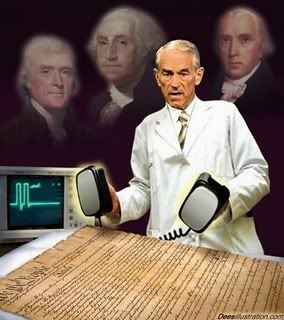
Photo Sharing and Video Hosting at Photobucket

But oh, that cranberry sauce has brought out my contrarian side, so my thoughts have drifted to the doctors of Japan. Two of them - one real, one fictional.

2. Osamu Tezuka

I trust most of you have heard of Dr. Tezuka. Truly one of the giants of world comics, Tezuka was a man of immense popular instinct, and creative prolificacy comparable to Winsor McCay. A brainy child of art-loving parents in the Japan of the early 20th century, Tezuka survived the onrushing militaristic thrust of his nation and the WWII bombings of Osaka to become a teenage comics superstar in the rubble of the late 1940s.

Obviously, there were popular manga artists before him, but Tezuka exerted an immense transformative influence on the form, blending irresistible narrative propulsion with a visual style inspired by the newspaper comics and animated films of the United States. His 1947 breakthrough in longform comics, New Treasure Island, all but jumped off the page via rigorous integration of cinematographic principles into the comics form.
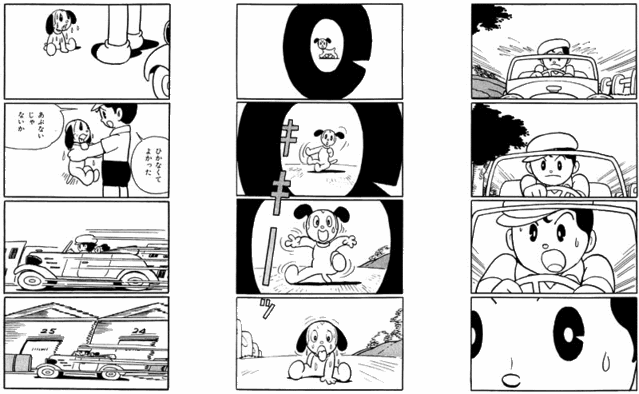
Photo Sharing and Video Hosting at Photobucket

He'd quickly calm down with the Ub Iwerks-style zooming, but I suspect it was valuable that manga became so immersed in cinema so quickly, in such a broad manner; these techniques quickly became internalized, acting as a core component of a growing comics idiom.

And Tezuka's achievement continued - his 1950-54 project Jungle Emperor Leo (aka, in anime form: Kimba the White Lion), a 600+ page cradle-to-grave account of an anthropomorphic hero in a world of animals and humans -- and not a female void in sight! -- brought popular renown to the longform magazine serial. In 1952, Tezuka introduced Tetsuwan Atom (Astro Boy), perhaps his most enduringly beloved work, a series of mostly standalone stories concerning a boy robot fighting for peace in a gleaming daydream of Japan's beautiful future, but not one incapable of cruelty. The very next year, Tezuka adopted a sprightly sparkle style for Princess Knight, a landmark work aimed at young girls. By 1963, Tezuka and his Mushi Productions had the Tetsuwan Atom television adaptation on the air, the first weekly anime series.

Sure, animators like Yoshinori Kanada were probably more responsible for the look and feel of 'anime' as we know it today, and manga has since gone through countless stylistic shifts, but Dr. Tezuka's powerful influence cannot be denied.

Oh yeah, he was licensed as a medical practitioner in 1952. It's been written that he rather liked the idea of becoming a doctor, a highly respectable social position, only to actually devote his life to the immeasurably less prestigious vocation of drawing comics.

3. Black Jack

In 1973, Tezuka began to draw an episodic manga series about a doctor. It was called Black Jack, and it became another monster hit. The comic ran, in various forms, until 1984. A slew of adaptations, remakes and extensions followed, easily outliving Tezuka, who died in 1989.
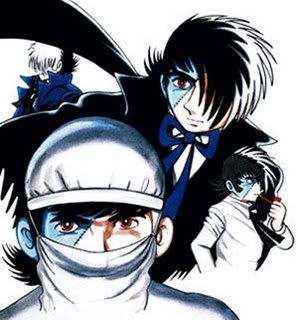
Photo Sharing and Video Hosting at Photobucket

In the autumn of 2008, Tezuka specialists Vertical Inc. will bring Tezuka's original manga to the English language. They won't be the first.

4. Ye Olde Books o' Manga

The story of manga publication in the United States is a rip-snorting one, the action-stacked details of which may kill the soft, but in the interests of post-feast digestion I'll only say that many false starts were made and format experiments pursued on the road to glory. One of the most prominent manga publishers today is VIZ Media, and its long history is littered with unfinished series and lost, unpopular items, going back to its late '80s biweekly pamphlet-format releases in association with Eclipse.

Prior to striking gold with its current monthly US edition of the mighty weekly anthology Shōnen Jump, VIZ made several other attempts at selling the primary serialization form of Japanese comics to North American readers. One of them was Manga Vizion, a mix of old and new(ish) series which ran from 1995-98. And from 1997 through the end of the magazine's life, Black Jack adventures were featured.

You can't say VIZ didn't try. Following the anthology's end, VIZ released two volumes of collected stories, one in 1998 and another in 1999. Compiling all of the Manga Vizion material with (I presume) a bunch of previously untranslated material, these books currently make up all US readers, at least, can read of the series in English.
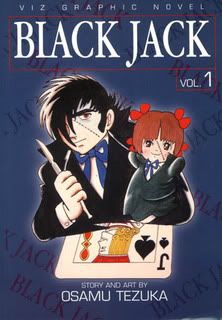
Photo Sharing and Video Hosting at Photobucket

I love hunting the phantoms of manga of in the US. The old, forgotten snatches of series. The bright efforts of days gone away. This will be the one. This one'll break us through. Manga is not beholden to the collector's market. The old books exist as used items, library castoffs and dusty bookstore lifers. They're often cheap; you need only find them, and study the many ways one comics "solitude," to steal Bart Beaty's term, tried to relate to another through days of bounty and famine.

I have Vol. 1 of the VIZ collected edition, and my perspective is duly warped by that exception.

5. Funnybook Fusion

To understand Black Jack is to understand a certain impulse of Tezuka's. In many of his works, he takes to tone like an inebriated teenager does a rented go-kart. That's not a complaint. Careful, building tragedy will inevitably deflate with a sudden pinprick of slapstick. Odd comedy will veer toward melodrama at the drop of a hat. Philosophy will mix with bullets pouring from Astro Boy's automaton ass. History is the stage for cold facts and pageantry in the Takarazuka Revue tradition.

This is the tenor of the man's most popular works. Some find it distractingly eccentric, but I see it as a vital component of Tezuka's charm - so many influences were embraced in his revolutionary style that he developed a supremely idiosyncratic method of communication, one that spoke to many thousands yet silently marked his work as forever his, even while many others adopted the mechanics of his style.

Black Jack is much the same, but with some added personal touches. The title character is a rogue, unlicensed surgeon, probably the greatest in the world. When he was young, he and his mother were caught in an awful explosion, and a doctor essentially sewed him back together, inspiring him to become the best in the world at healing others; a similar, albeit much less dramatic incident had inspired Tezuka's own interest in the medical profession. Much like the famed manga assassin character Golgo 13, Black Jack demands high sums for his efforts, and lives outside of polite society, but he fixes people to incredible degrees, often well past the boundaries of fantasy.

So, it's a little like an adventure, and a little like a superhero comic, but always boiling down to "Oh Black Jack, how will you medicine your way out of this one?"
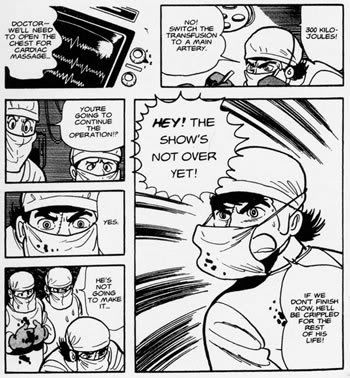
Photo Sharing and Video Hosting at Photobucket

A fine illustration can be had with the origin story of Black Jack's sidekick, Pinoco, as included in the first VIZ book. Black Jack is woken in the dead of night to treat a masked female patient, a woman so prominent that none may know her identity for fear of scandal. Things look bleak - she's got a massive growth on her side, a most abnormal teratogenous cystoma. Her skeevy treating physician is a definite buzzkill:

"No hospital in the world is capable of performing this surgery!"

Still, none can match the unwavering skill of Black Jack. Even if the cystoma happens to be an undeveloped birth twin of the patient, lodged inside a rubbery membrane with a full compliment of vital organs. And psychic powers.

Yes, as any medical school in the industrial world will tell you, psychic powers can prove tricky on the operating table. Any surgeon that's so much as approached the cystoma has been taken with the urge to fling scalpels at nurses or smash bottles over their head in high slapstick form, until the OR is more a battlefield. Our Hero initially fares no better, wrapping a hose around his neck and holding his own scalpel to his throat, until he promises the sentient mass of parts to pull off a miracle procedure, and keep it alive.

Graphic, photorealist medical art ensues, slicing the story free from Tezuka's cartoon approach, then sewing it back on. Soon, Black Jack's got a heap of body stuff floating in a jar, and the patient's snooty entourage can't wait to be rid of it. Alone in his lab, Black Jack stares at the jar, pours himself a stiff one, and sews the organs together inside a doll's plastic body, resulting in a small humanoid being that walks and talks and declares itself his wife.

Photo Sharing and Video Hosting at Photobucket

One year later, the patient returns for a follow-up, and Black Jack introduces wee Pinoco (a doll brought to life, ya see), who immediately sets about kicking the shit out of her masked sister until Black Jack drags her off. "That brat couldn't possibly be my sister!!" declares the prominent woman, and her understandably agog aides drive her away, as Pinoco weeps against the doctor's leg.

If this sounds like a peculiar comic, rest assured - it is. But Tezuka's melange of style creates a bizarrely logical universe, as much through sheer force of will as advanced craft. In one panel, silhouettes of broad cartoon men emerge from a realistic ambulance, approaching the wavering, seemingly freehand-drawn Stately Black Jack Manor, a hazy sky behind them. In one page, Black Jack's eyes gleam like dinner plates from underneath his curvy surgical gear, as he brushes one of Pinoco's eyeballs with his glove. Two panels pass by, her realistic spew of organs ensconced in the stylized, anime-ready body seen above, the realistic vanishing into the fantastic.

That is the essence of Black Jack.

6. Lists Within Lists

Many other stories are included in that first VIZ book, each with a similarly berserk entertainment aesthetic.

- A rich man's wicked son rips himself to bits in an automobile accident. Black Jack is called in to save the lad, but he'll need a full-blown human body for replacement parts. Papa then musters a stirring command of citywide corruption, railroading a poor, innocent boy through the legal system as the responsible party for the wreck, getting him sentenced to death and spirited away to Black Jack's operating table. In possible violation of the Hippocratic Oath, Black Jack lets the shitty rich kid die and performs plastic surgery on the innocent boy so he looks just like the dead kid, then loads him and his mom up with cash so they can flee Japan. MORAL: Kill all decadent bourgeoisie, rise oppressed workers.

- Black Jack calls on a wealthy businessman whose life he saved to collect his fee. Since Black Jack operates outside the legal system, the monied man cackles and refuses to pay up. Were this a Golgo 13 story that'd be grounds for immediate neck-snapping, but Black Jack is a nice fellow who agrees to accompany the rich man and his buddies on a tour of his new impregnable airtight vault. A freak earthquake causes the door to lock with everyone inside, and Japan's lords of finance soil their slacks. Black Jack then makes everyone promise to pay him a hillion jillion yen to break them out, and his formidable skills allow him to find just the right part of the wall to cut through to get at crucial wires. Then everyone refuses to pay, but Black Jack still wins because he walks away proudly to let them stew in their moral shortcomings, just like that one story Steve Ditko did with The Question. MORAL: Fucking capitalist scumfuck shits.

- A young man is planning to leap to his death after bombing his high school entrance exams, but a passing day laborer gives him a good talking to. Then a gas pipe explodes and most of the laborer's limbs are blown off. Meanwhile, the fuzz have finally hauled Black Jack in for his wild outlaw healing ways, but he coerces them into letting him go in exchange for not letting people die (what a guy!). He then puts the laborer's arms and leg back on after remarking "Heh... usually I'd charge an arm and a leg for this kind of surgery..." Amazingly, further suicide attempts do not follow. Oh, and the boy learns the value of life, I guess. MORAL: Arms are really important.
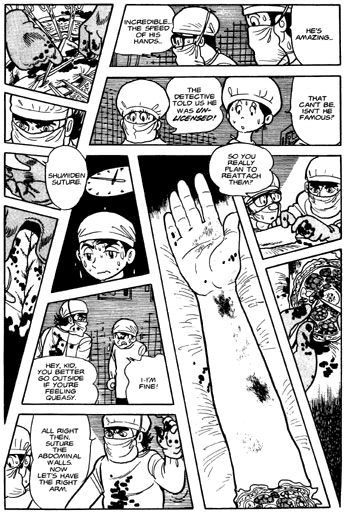
Photo Sharing and Video Hosting at Photobucket

- Black Jack is sent a scalpel in a mystery sheath by the doctor that saved his life lo those many years ago. After a journey, Black Jack arrives at the old man's bedside; he's dying, but he still needs to reveal the truth about the operation that saved Our Hero's life. Turns out he left a scalpel inside young Black Jack, and kept it a dark secret until he could operate again seven years later, at which point he found that the scalpel had been coated with calcium secretions, thus protecting Black Jack, and providing for a great mailbox surprise. All the medical skill in the world can't account for the mysteries of nature! Then the guy collapses and Black Jack totally fails to save him, because we are but mortals. MORAL: Death is inevitable, True Believers!

And that's just some of it. 7. Pumpkin Pie

I like pumpkin pie. It often tastes very good.

Photo Sharing and Video Hosting at Photobucket

8. The Expansion of Vizion

I mean "some of it" not just in terms of other stories being in VIZ's book, or VIZ's other book, but in the Black Jack catalog as a whole.

So often, in dealing with foreign language comics, we act from a limited perspective. Blinders around our eyes.

For example, years ago, Tezuka could barely be known without consulting the Japanese originals or small excerpts in reference books. Later, bits and pieces of his works trickled into English. At that point, you could firmly believe that the mode of style I described above -- the comedy meeting melodrama meeting violence meeting philosophy -- was his sole signature, his whole way of being.

But Tezuka was so large. He created over 400 volumes of comics in his time. More and more came in, as manga became strong. More could be seen of Tezuka. The Dark Horse release of Astro Boy (their choice of title), showing both his range on children's comics and, yes, his reliance on formula. The Dark Horse release of early works like Lost World and Metropolis, clumsy, vigorous things redolent with still-congealing agony of influence. And Vertical's books. Apollo's Song, matching his love for education with a very '70s moral resignation. Ode to Kirihito and MW, seeing the master strip away elements of himself, to face the dramatic gekiga style that rose in response... well, to him. To what he represented.

Tezuka mutates. So does all manga. Perhaps as the current English-language audience grows, the predominant boy-and-girl comics of today's shelves will dissolve into the older-skewing manga that Japan has long ago grown for itself. A history in miniature. We won't need to hunt down the old editions for anything but history - no more constrained glimpses, like our Black Jack is.

He'll be back. Redone. Stronger, more whole. I'm thankful for that.

So mark down that late 2008 date, eh? Maybe next Thanksgiving I'll go over this stuff in a new way. I'll be equipped, and you can be too.
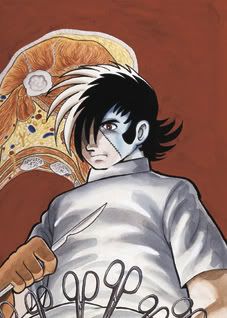
Photo Sharing and Video Hosting at Photobucket

You wouldn't want him to be upset, would you?

And the Number One Reason I'll Never Be A Paparazzi...

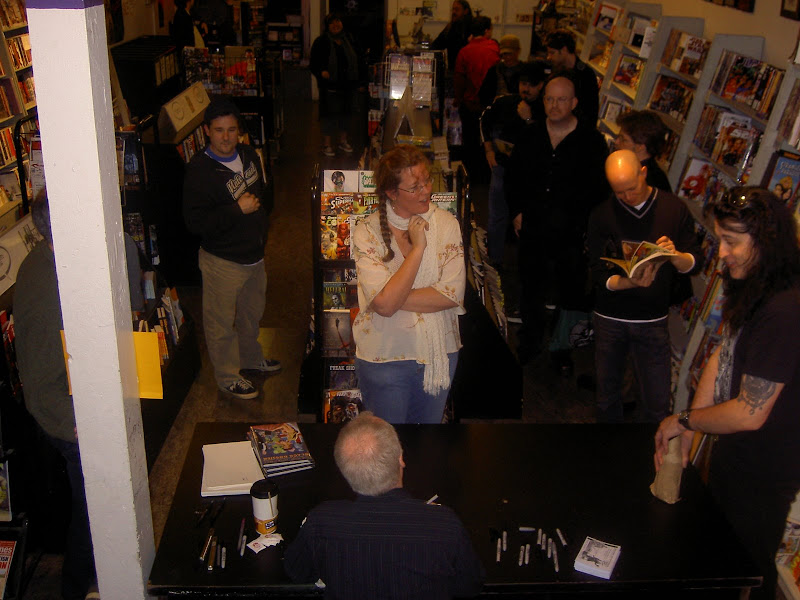
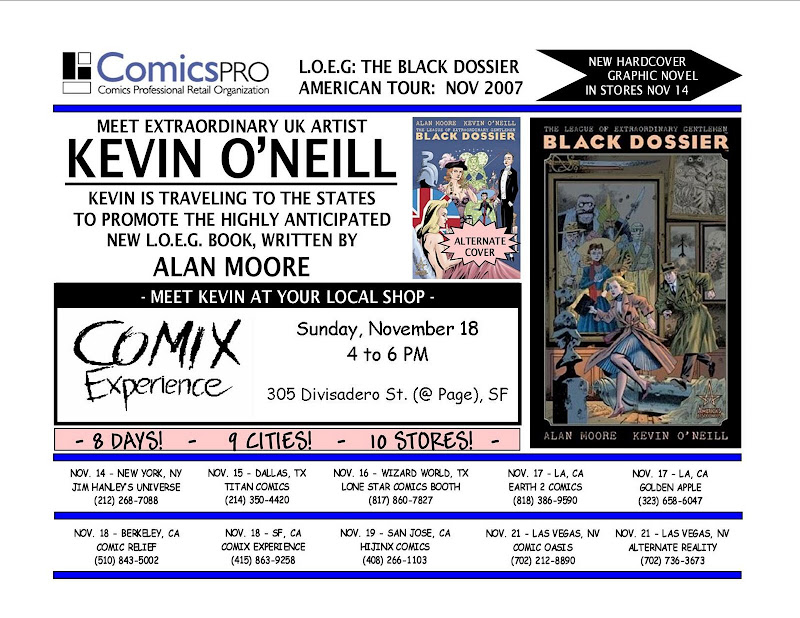
I was at Kevin O'Neill's signing at CE Sunday night...with my camera...and asked the gracious and stylish Mr. O'Neill if I could take some photos...to which he graciously and stylishly agreed....and I barely took any photos at all. Because I am absurdly meek, and a FUGGIN' IDJIT. Nonetheless:

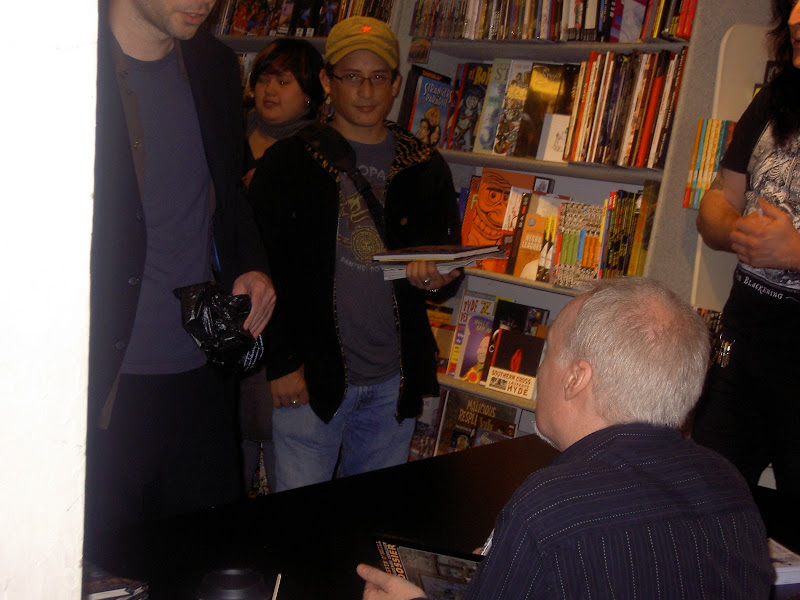
Here's a shot of the man himself. (Obviously, I shoulda run it through some light adjustments on Picasa before uploading it.) We were shop number seven in four days on his tour, and the guy would do a sketch in anyone's Black Dossier if they wanted. Really cool.

I knew he wouldn't be anything like his drawings, more than likely, but I was still somehow unconsciously surprised he wasn't one of his terrifying lantern-jawed crazy men chortling "Hur, hur, hur!" while demeaning all of us.

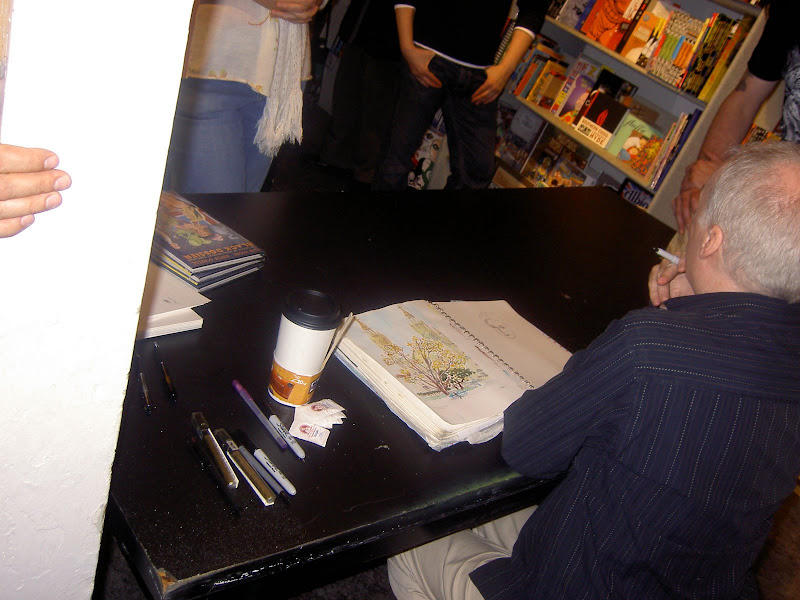
I thought I could catch from this angle (behind and above him) the sort of casual charisma he radiated--it was like everyone in the store, even nearly all the people hanging out at the front all had their body turned toward him the whole time he was signing. Instead, all I really caught was that awesome infinity-loop bald spot he has--it's insanely better than the goose egg I'm sporting.

Another wuss shot by me--I thought it would be cool to catch him in mid-sketch as he draws Mina Harker in Sue Riddle's sketchbook (that's her work on the left page, I'm pretty sure). But, uh, nope.

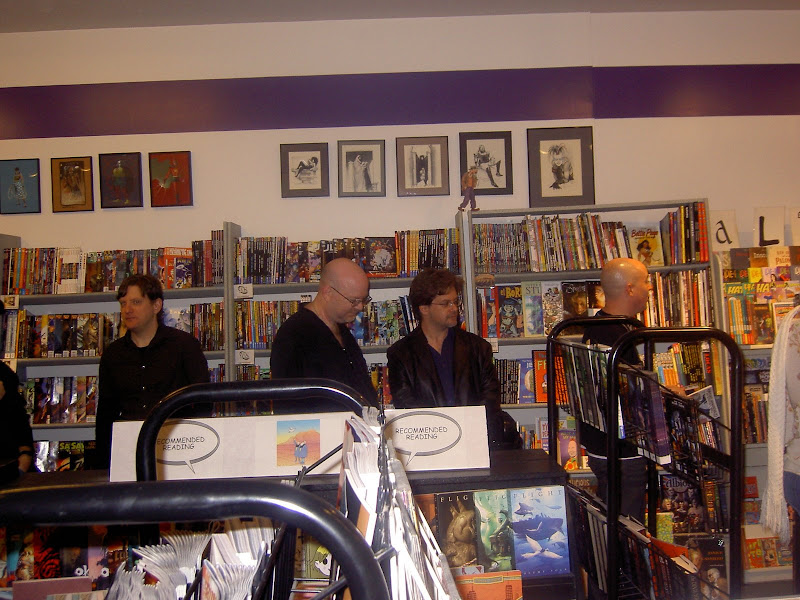
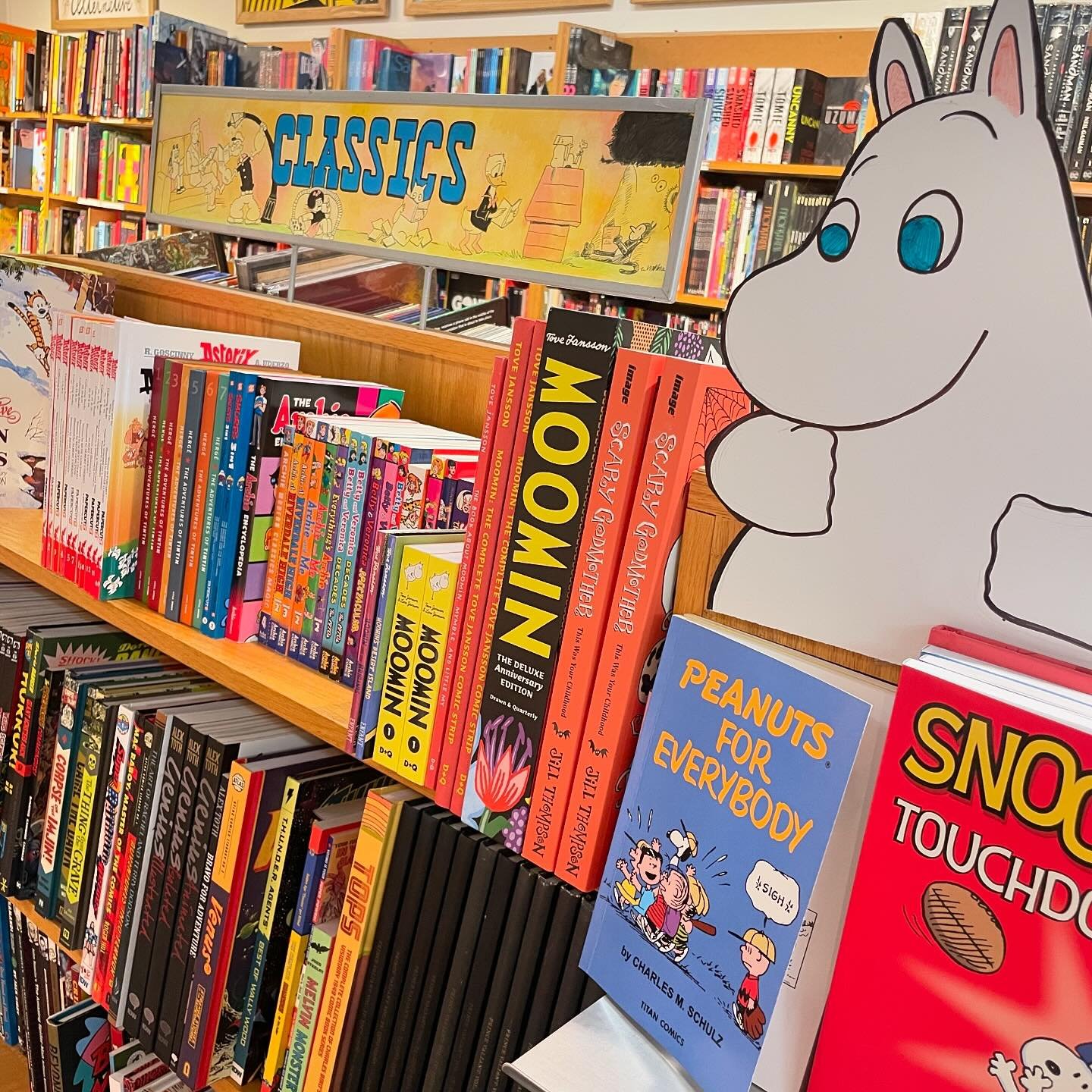
We had a steady line the whole time I was there, as you can see. But I'm mainly putting this photo up so those who've never visited the shop can admire the lovely original Matt Wagner JSA portraits on the left, and the Mike Driggenberg original Endless portraits on the right. (Oh, and also because I didn't take enough pix of Kevin O'Neill, right?)

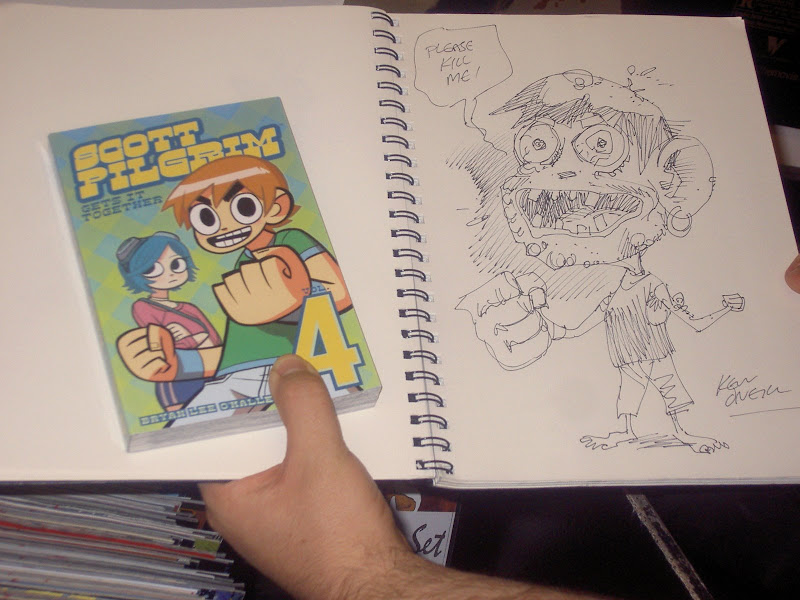
The first--but hopefully not the last--collaboration between Ian Brill and Kevin O'Neill: a commissioned sketch of Scott Pilgrim. Maybe we'll get lucky and Oni will release it as the "Oni Zombie" alternate cover to SP4 early next year...

Wow. See? That--that--is a perfectly shaped ear, right there.

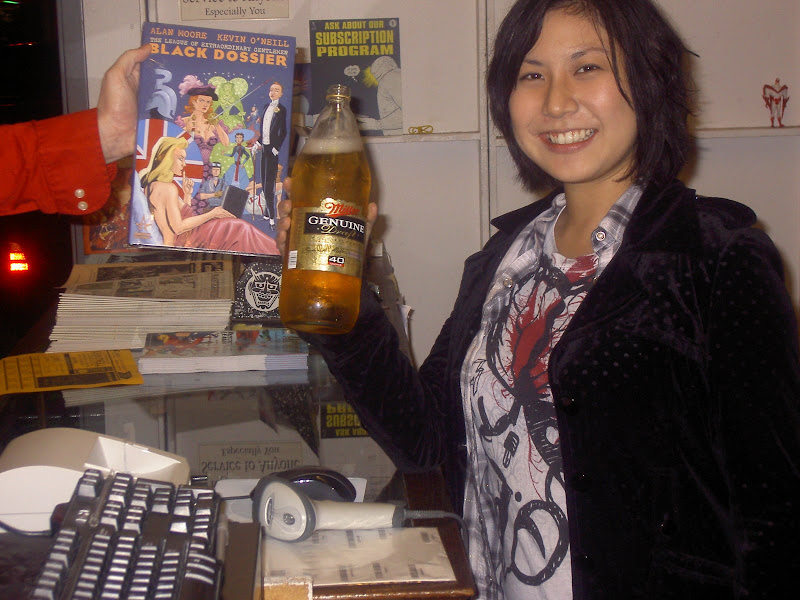
Meanwhile, up at the front of the store...

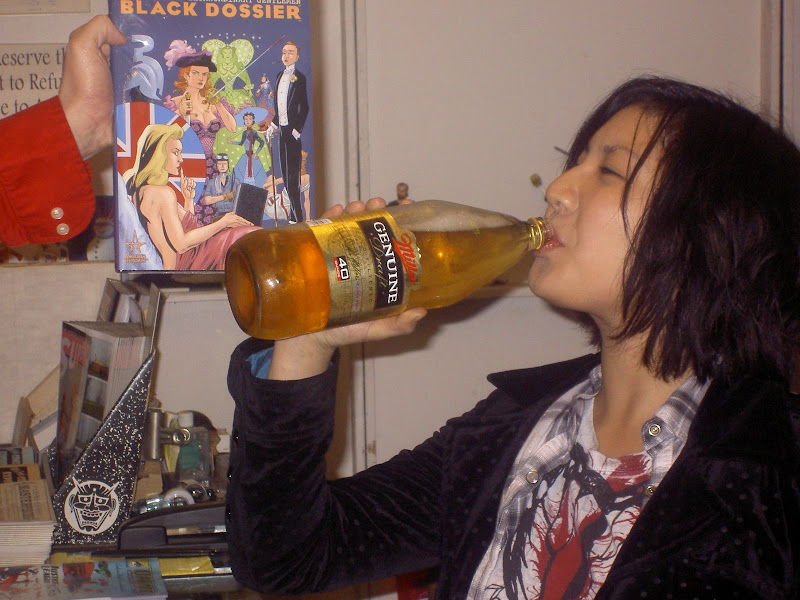
No, but seriously. Go buy Black Dossier--it's even more filling than a 40 of MGD.

So, in conclusion: I promise to be better at taking photos in the future. Also, go to Comic Oasis and/or the wonder that is Ralph Mathieu's Alternate Reality in Vegas tomorrow night and experience the wonder that is Kevin O'Neill yourself. You won't regret it.

Arriving 11/21/2007

Comics arrive normally this week, but Thursday is Thanksgiving. NEXT week comics aren't until Thursday, however 2000 AD #1559 2000 AD #1560 ACTION COMICS #859 ANGEL AFTER THE FALL #1 ARMY @ LOVE #9 AVENGERS CLASSIC #6 BATMAN CONFIDENTIAL #11 BIRDS OF PREY #112 BLADE OF THE IMMORTAL #131 BOYS #12 BRAVE AND THE BOLD #8 CAPTAIN AMERICA #32 CAPTAIN AMERICA CHOSEN #4 (OF 6) CASTLE WAITING VOL II #9 CATWOMAN #73 CAVEWOMAN PANGAEAN SEA #10 CHECKMATE #20 CONAN #46 COUNTDOWN SEARCH FOR RAY PALMER GOTHAM BY GASLIGHT #1 COUNTDOWN TO FINAL CRISIS 23 COUNTDOWN TO MYSTERY #3 (OF 8) DARK SECTOR #0 (RES) DETECTIVE COMICS #838 (GHUL) DRAFTED #3 EX MACHINA #32 FALL OF CTHULHU CVR A #8 FLASH #234 FRANKLIN RICHARDS FALL FOOTBALL FIASCO GODLAND #20 GRAVESLINGER #2 (OF 4) GRENDEL BEHOLD THE DEVIL #1 (OF 8) GRIMM FAIRY TALES #18 GROO HELL ON EARTH #2 (OF 4) HALO UPRISING #2 (OF 4) HAWAIIAN DICK #1 HELLBLAZER #238 HEROES FOR HIRE #15 HUNTERS MOON #4 (OF 5) INCREDIBLE HULK #111 WWH INDIA AUTHENTIC YAMA LORD OF DEATH #7 INVINCIBLE #46 IRON MAN DIRECTOR OF SHIELD ANNUAL #1 JUDGE DREDD MEGAZINE #264 LEFT ON MISSION #5 (OF 5) LEGION OF SUPER HEROES IN THE 31ST CENTURY #8 LONE RANGER #10 LONERS #6 (OF 6) MARVEL ADVENTURES AVENGERS #18 MARVEL ADVENTURES FANTASTIC FOUR #30 MARVEL ILLUSTRATED LAST OF THE MOHICANS #6 (OF 6) MARVEL ILLUSTRATED TREASURE ISLAND #6 (OF 6) METAMORPHO YEAR ONE #4 (OF 6) MIDKNIGHT #1 NEW TALES OF OLD PALOMAR #3 NEW X-MEN #44 MC PENANCE RELENTLESS #3 (OF 5) POWERS #27 PROGRAMME #5 (OF 12) PS238 #27 RED SONJA #27 REX LIBRIS #9 SADHU THE SILENT ONES #3 SCOOBY DOO #126 SCREAM #1 (OF 4) SHADOWPACT #19 SHE-HULK 2 #23 SIMPSONS COMICS #136 SNAKEWOMAN VOL 2 TALE OF THE SNAKE CHARMER #5 SONIC THE HEDGEHOG #182 SPIRIT #11 STAR TREK ALIENS SPOTLIGHT ANDORIANS STRANGE EMBRACE #6 (OF 8) TALES FROM RIVERDALE DIGEST #25 TESTAMENT #21 THUNDERBOLTS BREAKING POINT ULTIMATE VISION #5 (OF 5) UMBRELLA ACADEMY APOCALYPSE SUITE #3 (OF 6) VERONICA #185 WALKING DEAD #44 WETWORKS #15 WETWORKS ARMAGEDDON #1 WHAT IF ANNIHILATION WITCHBLADE SHADES OF GRAY #4 (OF 4) (RES) WOLVERINE ORIGINS #19 X-MEN EMPEROR VULCAN #3 (OF 5) ZERO KILLER #3 (OF 6)

Books / Mags / Stuff 52 VOL 4 TP AMERICAN VIRGIN VOL 3 WET TP ANNIHILATION BOOK 3 TP AVALON HIGH CORONATION VOL 1 MERLIN PROPHECY GN (OF 3) BATGIRL 13 INCH COLLECTOR FIGURE BATMAN CLASSIC 13 INCH COLLECTOR FIGURE BATMAN DEATH IN THE CITY TP BETSY AND ME GN BEYOND PALOMAR PALOMAR VOL 3 TP CAPTAIN AMERICA VOL 1 DEATH CAPTAIN AMERICA PREM HC CHARLEYS WAR VOL 4 BLUES STORY HC COMPLETE BADGER VOL 1 TP EXCESS ART OF MICHAEL GOLDEN AND HOW HE DOES IT SC FLINK GN FORTEAN TIMES #229 GOON CHINATOWN HC GRAPHIC UNIVERSE HERCULES TWELVE LABORS SC GRAPHIC UNIVERSE ISIS & OSIRIS TO ENDS OF EARTH SC GRAPHIC UNIVERSE KING ARTHUR EXCALIBUR UNSHEATHED SC GRAPHIC UNIVERSE THOR & LOKI IN LAND OF GIANTS SC GRAPHIC UNIVERSE TROJAN HORSE FALL OF TROY SC JACK KIRBYS FOURTH WORLD OMNIBUS VOL 3 HC JUXTAPOZ DEC 2007 VOL 14 #12 KRISTINA QUEEN OF VAMPIRES VOL 2 GN (A) LOVE THE WAY YOU LOVE SIDE A TP MAD ARCHIVES VOL 1 HC NEW PTG MAD ARCHIVES VOL 2 HC MADMAN VOL 2 TP NEW AVENGERS VOL 1 HC PERLA LA LOCA LOCAS VOL 3 TP QUEEN & COUNTRY VOL 8 OPERATION RED PANDA TP RED SONJA VOL 2 ARROWSMITH ADAM HUGHES CVR TP (RES) REPTILIA SC SPIDER-GIRL PRESENTS WILD THING CRASH COURSE DIGEST TP STAR TREK KLINGONS BLOOD WILL TELL TP SUPERGIRL IDENTITY TP UVC MAGAZINE #4 WILL EISNERS SPIRIT ARCHIVES VOL 23 HC WIZARD MAGAZINE BEST OF 2007 CVR #195 WORLD WAR III TP X-MEN FIRST CLASS TOMORROWS BRIGHTEST TP X-MEN GOD LOVES MAN KILLS PREMIERE HC

What looks good to YOU?

-B

Speed Reading: Graeme finishes off 11/14's books.

It had to happen, of course; the busiest week for new releases in a long time coincides with my busiest week workwise, meaning that I have a whole stack of books beside me that I haven't even mentioned yet. Let's try and remedy that right now, shall we?

ALL-STAR SUPERMAN #9: Feeling more like a series of scenes illustrating ideas than a coherent story, something about this issue doesn't come together properly. Still Very Good, but more for the strength of its individual pieces - the humor of seeing Kryptonians talk like Glaswegians ("A soft wee scientist's son," Grant? Really?), or the colors of the weirdly unfinished cover, for example - than the whole.

BATMAN AND THE OUTSIDERS #1: Pretty much reading like a book that exists only for DC continuity completists, right down to the appearance of the mystery villain on the last page. There's no excitement to the writing, no spark between the characters. Julian Lopez's art is nice enough, but doesn't raise this to anything above an Eh.

BOOSTER GOLD #4: It may sound weird considering the point of this title, but the reveal of the bad guy to be a minor character from a forgotten mini-series that hasn't been in print for more than ten years felt like a continuity nerditry too far, and discovering that Supernova is pretty much Evil Booster Gold, complete with Evil Skeets (Nice Black Hole reference, though) felt obvious, rushed and unsatisfying. Four issues in, and it's already losing its sense of fun and openness? Not a good sign. Eh.

CAPTAIN MARVEL #1: Apparently, I'm the same age as Mar-Vell. Huh. Of course, when that's the thing I remember most about a book as ponderous and pretentious as this one, that's probably not what the creators intended. Lee Weeks' artwork is easily the best thing about this Eh book; Brian Reed's script is slow to get to a point that I thought we were already at before the series started.

COUNTDOWN TO FINAL CRISIS #24: Like Bri said, it read like an issue where everything interesting that happened last issue was undone, as if Paul Dini read it and thought "Wait! I didn't want to do that! Or that!" And Superboy Prime appearing here, ruining the Sinestro Corps storyline for a second time? Somewhere, Geoff Johns is crying. Awful.

HOUSE OF M: AVENGERS #1: Look, I'll even buy into the idea that retailers have been crying out for more House of M material, but does anyone really want an alternate universe story about these particular characters? It read more as if Christos Gage and Mike Perkins were indulging their nostalgia than creating a story, and I don't see where any dramatic tension is supposed to come from, considering that we already know how it ends. A confused Eh, I guess.

NEW AVENGERS #36: Well, I guess we don't have to read that next Mighty Avengers arc now. Awfully slow and fragmented; Bendis is trying to do too much with his titles, and with Mighty running so late, it pretty much falls apart; I can't tell if Deathlok's off-panel defeat is something that's supposed to happen in another book, or just sloppy storytelling.

NOVA #8: Dan Abnett and Andy Lanning go for the Grant Morrison award, and almost get it, with the idea of a civilization called Knowhere inside the head of a Celestial, complete with telepathic Russian dog. There's something very Doctor Who about the viral villain, complete with catchphrase, as well, but seeing characters reduced to zombies again is the bum-note here, and so bum as to bump the whole thing down to an Okay.

SALVATION RUN #1: Amazingly, enough to make me long for the days of Amazons Attack, with a plot conceit so dumb that so many things are just not even mentioned in the book itself: Why put the villains on another planet with their costumes and weapons, for one thing? Where is the planet? How did they find the planet? Aren't they worried that someone is going to wonder where the villains have all disappeared to? Or that the villains will find some way home? I mean, those last two are obviously going to happen along the course of this series, but neither possibility is even raised here... The lackluster execution by Bill Willingham and Sean Chen doesn't help, either; you could overlook the stupidity if there was some verve and excitement to the way the story was being told, but sadly not in this case. Pretty much Crap.

THE SWORD #2: An amazingly slow second issue, with the dramatic moments made all the less so by the lack of subtlety in the way they're presented - two splash pages with one line of dialogue, in a font larger than in the rest of the book, in case you've somehow missed that you're meant to be shocked there. With scenes and characters as cliched as they are here, I'm not sure who this book is aimed at - People who wanted to watch Buffy the Vampire Slayer but got scared off by the fact that it wasn't written like Law and Order? Awful.

THOR #4: Very pretty, but best appreciated if you don't actually try and read it - The story is overly convinced of its social relevance, and instead misses that it has no suspense or surprise. Hopefully, the end of the issue, and the promise that Thor will speed up his discovery of the other Asgardians, isn't a pointless tease, because it's not the most exciting over-arcing plot to base a title on... but what happens after that? Eh, and that good only because of the artwork.

Next week: Well, after tomorrow, it's time for me to jet to New Mexico for four days and escape this bitter, twisted, online life for awhile. I get a vacation, and you people get a vacation from me. Everyone wins!

They rise above this, they cry about this: Diana is let down by 11/19

Better late than never? When it comes to WELCOME TO TRANQUILITY #12, I would've preferred NEVER. Gail Simone seems seriously off her game lately. Between this AWFUL series finale, WONDER WOMAN, ALL-NEW ATOM and GEN13, a trend has started to emerge where Simone throws a bunch of random events and character beats together in the hopes that they'll gel, and they rarely do. Her comics, of late, read like Grant Morrison-lite in that Morrison tends to use the same shtick, tossing out all these weird ideas that don't seem to go anywhere... but with Morrison, the payoff is (usually) worth the confusion. I don't feel that way about WELCOME TO TRANQUILITY.

To be fair, there's nothing wrong with the high concept of superheroes and supervillains living together in a retirement community. In fact, that and Simone's knack for humorous wit got me interested in the series from the very beginning. But she didn't quite pull it off here: twelve issues in, you've got about ninety cast members running around, none of whom are even remotely fleshed-out in terms of characterization, and whatever humor Simone sees fit to inject comes off rather weakly.

On top of that, the storylines deteriorated into half-crossover half-Biblical mush, with all these pastiches being sewn in from seemingly random places (where the hell did that Cowboy Punisher come from?). If I make like Masi Oka and squint until I go blind, I can just about see what Simone was trying to do - Tranquility is a sort of nexus for characters from all comic book genres, which means you could tell pretty much any story you want. But the groundwork just isn't there. And even though WELCOME TO TRANQUILITY was cancelled rather quickly, and I do take that into account when evaluating what was done here, the painful truth is that this book was losing readers long before the axe fell. And I can only attribute that to the lack of a hook, and this, I think, is where Simone's quasi-Morrisonian emulation falls short. Morrison is a thoroughly weird writer, but his best work had, at its core, human (or human-ish) characters you could care about. Simone's no stranger to this principle - it defined her run on BIRDS OF PREY and DEADPOOL/AGENT X before that, and GEN13 more recently - and yet we have books like TRANQUILITY and THE ATOM which just don't allow for any real emotional center. Failing that, you'd have to have a pretty intriguing plot/premise to keep people coming back, and while WELCOME TO TRANQUILITY falls firmly into the "cute" category, that's just not enough in the long run.

P.S. Unless Blogspot lies, this was the Savage Critics' 1,000th post! Happy millenium, guys! Here's to another 1,000 comics savaged!

Marvels Advance -- Johanna Drops She-Hulk, Tries Iron Man Annual

She-Hulk #23 -- I gave it another shot, but I see nothing here to stick around for. The cliffhanger is resolved though a typical Marvel "all rules out the window" substitution, and one that makes me fear upcoming event crossover (spoiler: the broken-necked Jen is a Skrull). When Peter David's wisecracks suit the characters and fit the situations, they're gorgeous. Here, they're more like generic, seen before or bolted on regardless of character voice. She-Hulk doesn't solve her own problems (like the miniature Titania in her ear canal); instead, she hits things until everything's resolved. Bravo for a strong female hero, but it would be nice if she a) showed some brains as well and b) didn't disavow being a superhero constantly. And since when does she have a Wolverine-like instant healing power? Super-tough, sure, but the rest of it didn't feel right.

Lots of fighting, too, which isn't what I read superhero books for. (I know, I'm not the target audience.) The stuff with Jen feels like filler, there just to meet page count. Even the stuff that should be cool, like a giant shark exploding out of a broken tank towards the stunned She-Hulk and Absorbing Man, isn't, due to lackluster presentation.

I sound really harsh about this, but it's coming out of my disappointment. There are few enough Marvel comics I enjoy, and this one used to be one of them. It hasn't been for years, though, and this new direction has little to do with it. It's another example of Marvel retreating to their core competency in the face of fear of change. It's not bad enough to be Awful, so Eh with a drop.

Iron Man Annual -- This is the kind of thing that should be done with Tony Stark -- treating him like James Bond, Superhero. He heads off to Madripoor to depose its current ruler, Madame Hydra.

Lots of good roles for women, too, as Stark's undercover support staff. Too bad they all look like blow-up dolls. I guess that's in keeping with the milieu, but a little diversity would make me think the artist was capable of more than aping Jim Lee. I don't think men realize that a woman who was the absolute ruler of a country would bother dressing as though she was getting paid by the evening.

Not as fun as it could be because of the old-school Image look, but amusing. Christos Gage writes, and he's quickly gaining a spot on my list of writers to watch. Okay shading towards Good, held back by the art.

Extraordinary Gentlemen!

I just want to say that Kevin O'Neill is a Prince Among Men -- we had an absolutely wonderful signing with him last night, and he was extremely gracious with his time, given virtually every person who showed significant "face time", answering their questions, and doing quick sketches for each and every person. What a class act!

If you're down in the San Jose area, Kev appears at Hijinx Comics today (Monday) from 5-8, then he goes to Las Vegas and Alternative Reality Comics [edit: and Comic Oasis, sorry, Derek!] on Tuesday to wrap up the tour.

I suspect Jeff will be along before TOO long with pics of last night's signing.

We've got an EXTREMELY limited number of copies left over that Kev signed (though no sketches, sorry!), so if you haven't been able to score your copy yet, feel free to email me and see if we can accommodate you.

THANKS AGAIN, KEVIN!!!!

*****

Also last night was Alan Moore, art spiegelman, and Dan Clowes on the Simpsons -- if you didn't see it, at least for the moment it is up on YouTube, and I thought it was perhaps the funniest 10 minutes of Simpsons I've watched this decade. Oooh, let me try that embedded thing....

Let's hope that worked...

Even my wife, Tzipora, who only barely understands comics or comics culture, was howling in laughter at this segment.

Weird ending to the episode, though -- it looks at though the Android's Dungeon is closed permanently?!?

Anyway, WATCHMEN BABIES IN V FOR VACATION is a huge winner of a joke!

[Edit #2: I just noticed the LOST GIRLS poster in the background of the clip -- nice, Fox is advertising pornography, w00t!]

-B

The Alchemical Marriage: Jeff Looks at the LOEG Black Dossier.

In a just world, the best way to review of Moore & O'Neil's League of Extraordinary Gentlemen: Black Dossier would be type up a pastiche in which history's most famous and infamous literary critics team up: Dorothy Parker, Kingsley Amis, Harold Bloom, Alexander Woollcott, Edmund Wilson, Michiko Kakutani, H.L. Mencken, and Gary Groth all trot on panel to fight The League's attempt to collapse fictional and non-fictional reality (thus rendering critical thought--the border between fictional and non-fictional reality--impossible). Of course, to be a true pastiche, the reader would have to endure--after a gripping opening--the repeated erotic couplings of Wilson and Kakutani, with only the occasional bit of thuggishness from Mencken or Groth to spruce things up (until each kills the other), and the pastiche finally becomes a free-falling history of the universe as told by the critics (wherein one only finds out in a footnote or two what happened with the group's original encounter with their adversaries) and that this universe is actually a pastiche of the true Platonic ideal of the universe. Reality, it would turn out, is literally a work of criticism.

To really to do justice to the book under consideration, however, the pastiche would have to be bogglingly brilliant. If you're the type to derive succor from technical brio and steely formalistic ambition, The Black Dossier is a veritable winter's feast, capable of plumping up your brain to survive many a long, dark day.

For much of my life, I considered myself exactly that type. But either I've changed over the last few years, or technical tour-de-forces don't quite kick me in the breadbasket they way they used to--even as parts of The Black Dossier made me grin in delight (The League running for their lives inside a giant Brobdingnagian vajayjay as a sky-blotting cockhead threatens to destroy them all was where I actually laughed out loud), I found myself wondering what, exactly, was the point.

Having finished it, I think there may be several points to The Black Dossier, ranging from the absurd (I mean, it's The Official Handbook of the Marvel Universe by way of Gravity's Rainbow, for cryin' out loud!) to the sublime (is imagination, as represented by Mina and Queen Gloriana,a feminine force, and "reality," as represented by misogynistic Bond family, a masculine force, making Orlando,gender-swapping hermaphrodite, a representation of life as it is lived, according to Moore--sometimes one, sometimes the other, frequently both?)

To elaborate on that last point, the Black Dossier includes pure text as well as, in the collection of postcards with which the League sends back and forth and the various maps and diagrams, (near)pure image. Are comics, like Orlando, a combination of two interrelated opposites, and thus more able to capture a higher essence than either? (I mean, there's also a 3-D sequence at the end which is the meeting of two sets of images (and even in that sequence, sections where the images occupying the same space are not the same)). The Black Dossier is not only an alternate history story, but a history of alternate graphic story styles--gag panels, political cartoons, serialized biographies, Tijuana Bibles...

So. History as an alchemical wedding of imagination and reality, and comics as the formalistic application of same? I dunno. Of course, if you really want to know the point of an Alan Moore story these days, you need only go on the web and a much-interviewed Alan Moore will be along sooner or later, happy to tell you at precise and injudicious length his intentions. I'm probably alone in this but I've begun to think the lifespan of today's graphic lit would benefit from creators clamming the fuck up about a work's meaning. Although I'm sure it stems from both genuine relief at finally being taken seriously, and to correct the paucity of genuine knowledge endemic to comics' previous Dark Ages, the resulting pre-chewed nature of many of comics' big works may prevent them from looming larger in the cultural imagination than they otherwise might.

(Which is all my way of saying that my above theories probably stem from reading too many Alan Moore interviews, but I haven't read any of his interviews about The Black Dossier...yet, God help me.)

In a way, I wish this review could be more like Hibbs', and I could go on at length about what I thought of the various pastiches, since they--along with the delightful Easter Egg hunt of literary references--are the most enjoyable part of the book. I will say that, although no Shakespeare scholar, I found Faeries's Fortunes Founded pretty passable (although it reads more like early Shakespeare than the later Shakespeare it's presented as) and Sal Paradyse's Beat novel is pretty close to an utter disaster as it tries to imitate both Burroughs & Kerouac simultaneously and so badly bungles 'em both (this is assuming, by the way, that Dr. Sax is written in the bebop heavy rhythms Moore uses here--of Kerouac, I've only read some poetry and On The Road and the latter isn't half as absurd as the stuff we get here).

But overall, the delights here are many and varied--where else are you gonna find a Tijuana Bible based on Orwell's 1984?--and I regret I lack the language, both critical and otherwise, to praise Kevin O'Neill's amazing art in this. O'Neil's art (and stunning accompanying colors by Ben Dimagmaliw) is able to evoke all the various art styles on call while also remaining truly and clearly his own, and in a book that moves from postcards to paperback covers to subway maps, from Victorian literature to German Expressionism, from the dreariness of Orwellian England to the brightness of Dan Dare's Britain, it's hard not to see it as a crowning achievement. If Lost Girls had looked half this good, maybe I would've been able to actually rub one out to that damned thing.

Still, though, the most resonant moment in The Black Dossier comes when Allan and Mina, after sex, languidly flip through the dossier and Mina remark with light surprise and fondness upon finding the section on themselves, "Oh. Here, darling, look at this. It's us." It's the moment most familiar to anyone who enjoys reading--the sudden thrill of recognizing something of one's self in a work of fiction--and it's precisely that moment I found entirely absent in The Black Dossier: eternally young, beautiful, and seemingly unstoppable, Orlando, Quartermain, and Murray fight, flee and fornicate across nearly every fictional realm ever created, but there's hardly anything left in them with which to emphasize. Imagination isn't only a realm where we regale in our triumphs and strengths, but a place in which we peek at our failures, our frailty. I wish there had been more of the latter amongst so much of the former.

And so, while The Black Dossier is hardly the first technical triumph that fails to stir the heart even as it inspires awe, it's a measure of the regard in which one holds Moore that it feels nevertheless like a disappointment. It means that I can only give this Very Good book a rating of Very Good, despite the nearly consistent Excellence of its concept and execution. Get it; devour it; annotate it; but don't be surprised if you find yourself, all too soon, forgetting it.

Maroon Mock Turtle Soup: Douglas reads some Marvels from 11/14

Yes, WORLD WAR HULK #5 is disappointing, and I say that as somebody who waved the flag pretty hard for the early part of the story. Here's what I've got against it: *The Sentry as deus ex machina. Being the big gun who springs into action at the end of the story and fixes everything is literally the only thing the Sentry ever does; even if he had to do it here, it might've been nice to see him fix the problem by some means other than being a golden god, you know? Or at least a resolution that comes naturally out of the characters, since the rest of WWH has been remarkably character-driven for a big punch-up event? It's not as if anyone acts out of character or, you know, Skrully--Greg Pak knows how everyone here talks and acts--but the character beats aren't the story beats. (The other thing that fixes stuff abruptly in Marvel comics these days, which also happens here, seems to be Tony Stark coming up with some kind of magnificent machine that can resolve the plot. See below.)

*The premise that the Hulk actually hasn't killed anybody, ever, with a few exceptions that Pak explained weren't really his fault (over in Incredible Hulk). It's a clever idea that Banner is actually so smart that he can make sure the Hulk's freakouts are limited to property damage... but the premise of the lead-in to "Planet Hulk" was that his rampages did kill people, which was why it was so important to get him off-planet, right? This is the "well, at least no one was hurt" problem: the elephants fight, and no grass gets trampled. Honestly, I'm starting to think that DESTROY!! and Miracleman #15 defined two magnetic poles so strong that almost no superhero comic since has figured out how not to get stuck to one or the other.

*The total abandonment of the political dimension of the early parts of the serial. WWH started out as a story about blowback, political power, private interests betraying a public trust, etc.--it had resonance beyond people hitting each other on the page. The conclusion is just a story about the Hulk.

*The big death scene, which serves a formal purpose for the story, but somehow isn't at all dramatically effective. Especially because I can't imagine the dead entity will be dead long.

*The corny-ass sound effects--especially the ones that were obviously done on a computer. Hand-lettering sound effects makes all the difference. (There's one double-page spread whose effect is SPAKOOOM!, and all three Os have precisely the same "ragged" effect. Why is this a problem? Because it takes the reader out of the story to notice it.) Also, a number of people have noticed the one that goes GRGPAKK!, and I was particularly annoyed by the one that goes JRJRKJCSSSSS (the artists' initials)...

*The ending, which provides a meaningless existentialist pseudo-profundity in lieu of a conclusion--what happened to Miek, for instance?--and, in particular, the last page, which made no sense until I saw Pak's explanation of it over on Newsarama.

Even so, I thought this issue was pretty Good, and here's why: The Romita Jr./Janson/Strain artwork is fantastic. Christina Strain's coloring is particularly impressive here, especially the way the line art "heats up" from black to the brown range and into hot reds as the fight goes on. (Best bit: the end of the Hulk/Sentry scene, as the line color cools down again and the molten mass of force cools down to two ragged, exhausted-looking guys whacking each other with frail human fists.)

And the fight scenes are incredibly effective. Is a great fight scene in comics the same as a great mad scene in opera? This one really does seem like the laws of physics are being smashed before our eyes (that's a good thing)--there's something enormously satisfying about seeing those pieces of Janson ink-shrapnel flying off the points of impact. On the strength of the visual stuff alone, this issue rewards slow reading, if maybe not rereading--I wish a lot more mainstream comics had this much energy and flair.

And in the department of issues that require multiple readings to fully comprehend, we've got NEW AVENGERS #36. I'm really enjoying following Brian Michael Bendis's New Avengers/Mighty Avengers/Illuminati serial, even when individual parts of it are dissatisfying--he's very good at the "same story approached from multiple angles" trick. But the erratic schedule of the three titles has really been kneecapping the progress of the plot (the scene this issue with Carol et al. in the Avengers' HQ, with the Sentry icon still on top of it, in the middle of an un-destroyed Manhattan--guess everything's still happening before the first issue of World War Hulk six months ago!--looks like it was flown over from Mighty Avengers just so the story could move onward, and reveals what should've been a major plot point in an oh-incidentally way). I sort of wish he'd stop overextending himself with stuff like Halo and just write a weekly series instead--that's the direction his pacing is heading, and having to read episodes out of their intended order is frustrating.

I do really like the fact that Bendis is trying to give every issue a slightly different narrative tone lately, like making the first half of this one--including the big Venom fight--told as a conversation between Luke and Jessica. (And as redundant as the thought balloons in Mighty Avengers have become, they're useful to the Secret Invasion plot: if we can see characters' thoughts, we know their Skrullitude isn't hidden from us.) Unfortunately, the fight scene recapped as pillow talk doesn't work: the huge conflict he's been teasing for two issues is wrapped up in six pages, thanks to the now bog-standard "Tony Stark whipped something together and..." Which raises the question of how the Hood plot has anywhere to go. Iron Man vs. everybody in New York turned into Venoms: Iron Man wins! So the Hood and a bunch of other creeps vs. Iron Man + the Sentry + the Silver Surfer + Howard the Duck + about 20 others: how is that a cliffhanger? (I'm betting most of the characters on display on that last page are a Dr. Strange illusion, but still.)

This issue's skin-baring-woman-menaced-by-guy-with-sharp-blade scene (Wolverine confronts Jessica Drew while she's taking a shower) is considerably less self-congratulatingly button-pushing than last issue's. I still find Leinil Yu's storytelling a little glitchy, though--the beginning of that scene is sequenced in a way that doesn't quite make sense. Here it is:

Can anybody explain why the last two panels wouldn't be in the opposite order?

Yu is great with individual images, though--there are some fantastically evocative panels, like a silhouette of the team jumping across some rooftops. (The same page, unfortunately, shows Wolverine talking to Echo while he's behind her--artists seem to keep forgetting that Echo can read lips but can't hear.) Most of this issue is drawn with short, wide panels, which are fairly unusual in superhero comics--they're great for talking-heads scenes but terrible for establishing shots, since people are taller than they are wide, so it's hard to most artists to convey a sense of scale with wide "slivers." They also force action to proceed from left to right in each panel even more than it usually does. Yu still pulls it off by varying his perspective constantly, and even manages to give a sense of right-to-left motion in a couple of sequences. So a Good issue, overall; I just wish the pulse of this story were a little more regular.

A Quick One While He's Trapped On Paradise Island: Graeme does Winick from 11/14

Easiest way to get people to disagree with you on the internet: Say that you like a Judd Winick comic. And, while GREEN ARROW AND BLACK CANARY #2 isn't entirely without fault (The whole "Your ex-hooker sidekick with AIDS is unclean" scene was both ridiculous and clunky, for one thing), I have to admit the sense of humor on show in the book won me over; the dialogue of the last page alone, undercutting and subverting what you'd expect from the scene by replacing the traditional "statement of how bad things look to make the cliffhanger seem more exciting and dangerous" with a conversation about shared underwear, showed a tongue-in-cheek self-awareness that, when paired with Cliff Chiang's pretty-but-toothy artwork, makes for a book that's more Good than I expected.

Shame that I can't say the same thing about TITANS EAST SPECIAL #1, in which Winick doesn't so much attempt a story, but tries to stretch out two filler sequences into a one-shot that pretty much exists only to create faux-expectation for an upcoming new series in the new year. Given the comedy and aware quality of the Arrow/Canary book, it's even more surprising to see just how generic and dull the writing is in this one-shot, with narration like "Long ago... And not too far away... There was a group of children who grew up alongside champions. These heroes taught them to fight evil. The worst kind of evil," and the uneven nature of the plotting (Was there even an attempt to balance out the first half-flashback with the second half of the book, starring an almost entirely different set of characters?).

Maybe Winick just reacts to his artists, because whereas Cliff Chiang's work on the former book is easy on the eye, Ian Churchill's art on Titans East is horrible stuff, from the Wolverine in Robin's outfit - Seriously, when was Dick Grayson ever that hairy? - to the bland similarity in every character he draws. It's an exceptionally disappointing, Awful book that pretty much acts as a disincentive to pick up the new Titans book when it finally appears. Better luck next time, I guess.

Hope You Remember: Jog takes on an 11/14 book with roots in the hallowed spring of 2006, when the world was young and we all were gleaming

You want comic book delays? Issue #1 of this puppy hit the stands over seventeen months ago. I think the series was actually considered cancelled for a while, but now it's back. Looking around online, it seems the creator's DC work (whether in terms of simple time consumption or contractual obligation) got in the way...

My Inner Bimbo #2 (of 5): It's pretty rare that reading someone's comic makes me feel like I've actually invaded their privacy, but after this one I kinda want to fire off an email of apology to creator/writer/co-artist Sam Kieth urging him not to press charges, since I feel like I just finished breaking into his home and staring at things.

This is the latest Oni-published chapter of the most peculiar project Kieth's produced in a long career of peculiar projects; while technically the second entry in a suite of connected b&w stories (following the 2004-05 miniseries Ojo), it stands alone as a symbol-dense study of a sensitive man's troubled relationship with femininity, seemingly filtered through crypto-autobiography. An aging man named Lo, withdrawn from his significantly older wife, externalizes his own feminine personality -- predictably, via the intervention of a magical trout -- into a pink-clad airhead sex bomb that only he can see. But the bimbo begins to develop a hunger for maturity, and has a way of commandeering our man's body into new places.

But it doesn't act so straightforward. The book's visually restless style (Josh Hagler is co-artist) leaps from detailed caricature to pencil sketches to photographic and video images, all crammed into wordy pages that constantly bounce back and forth through time, and in and out of Lo's head, as he reflects on his most critical relationships with women. Pygmalion, Édouard Manet's The Luncheon on the Grass and the term "buttfuckeroo" all figure prominently.

While occasionally trying (and regrettably typro-prone), its cartoon invention and extreme emotional candor melt into a compelling personal iconography, the obscurity of which only aggravates its sense of personal revelation - if some comics adopt unadorned conveyance as a path to personal communication, this one acknowledges the traps inherent to simply communicating with yourself. Quite GOOD.

Monkey Vs. Robot... I mean, Amazon: Graeme gets Wonderful from 11/14.

With a story that starts with the heroine fighting an army of intelligent violent gorillas and ends with an army of technological neo-Nazis, it's not completely beyond the realm of possibility that we'll see some zombies, robots and pirates before Gail Simone's first storyarc of WONDER WOMAN (#14 of which, Simone's first issue, came out on Wednesday) is over.

The feeling of trying too hard permeates the entire issue - Simone hits the ground running with multiple plots starting at once, but maybe throws too many in there for the first issue: Mysteries about Diana's birth, Gorilla Grodd amassing ape armies, the appearance of Etta Candy - who seems to be investigating Wonder Woman's secret identity - and Nazis invading Paradise Island! All in color in 22 pages for twenty dimes! But the plots and subplots don't really gel together this time out, and the reading experience is choppy, rather than fun-filled and action-packed. Why is Gorilla Grodd genetically enhancing primates into intelligent monkey soldiers? We don't find out, and even the investigation into Grodd gets derailed by the shock reveal of Captain Nazi at the end of the book. For that matter, why does Diana take the monkeys home with her after fighting them, aside from setting up a comedic homelife for her? Why is Etta Candy back at all (To be fair, I'm hoping that her name isn't going to be Etta this time around - we didn't find out what her first name is this time around)? Why are the Society using an army of Nazis? Okay, that last one is presumably going to be answered soon, but nonetheless, I didn't come out of this issue feeling that there's a grand plan with lots of answers waiting for me soon, but instead that there's pressure to make a lot of things happen all of a sudden to grab readers' attention, which resulted in something frantic and fragmented.

Thing is, there's potential here. Look past the self-conscious narration - Why is Diana defining herself against Batman during her monkey fight? - and the overactive plotting, and Simone's take on Wonder Woman is interesting enough to pay attention to - Kick-ass, but willing to talk her way out've a fight that she's already won, which is a nice mix of Allen Heinberg's and Greg Rucka's versions of the character - and, once the need to please fades slightly, the unusually energetic and quirky tone may show off Diana's charm to better effect than she's been able to enjoy for quite some time. Keeping in mind the wonderful Dodson family artwork, this is a fairly Good start to what will hopefully be a memorable run.

BLACK DOSSIER annotations

Jess Nevins popped into one of our comments threads to point us to the online annotations of the BLACK DOSSIER HC -- I thought it deserved some time up on the front page so go look In other BD news, DC is SOLD OUT of the book (excepting whatever copies they've held back for damages and shortages) -- I found this out when I wanted more for Sunday's signing and was told "Nope."

I am cunning and strong, so I managed to get more copies, but still... when's the last time that DC sold out of a GN, and especially a HC, on the first day of release?

-B

Punching! Hitting! Lasers!: Graeme makes it through to the end of the World War, from 11/14

So it goes without saying that the end of WORLD WAR HULK #5 was somewhat underwhelming, but it should also be added that I'm not sure what kind of ending would have really managed to feel satisfying at this point. Maybe something that hadn't attempted to redeem the character, or had come to some kind of conclusion that lived up to the no holds barred opening to the series...? But that was never really an option, of course; for all of the illusion of change presented at the end of the issue, something as extreme as the heroes being cold-blooded enough to try and murder the Hulk or whatever is the kind of thing that'd never happen in this age of movie options and multi-media licensing.

(Even the "Is Bruce Banner dead? In stasis? Or something more sinister?" ending is incredibly easily reversed, and immediately following that with previews for a couple of new Hulk series launching next year makes that depressingly obvious.)

What's really underwhelming about the issue, though, is how tired and nonsensical the whole thing feels. While the series so far has hardly been a masterwork of intricate plotting and characterwork, there's something remarkably flat about the pages and pages of punching swapped between the Hulk and the Sentry, and going from that to the cheap "shock death" of a supporting character and the deus ex machina ending of Iron Man saving the day by doing... something... when the Hulk suddenly threatens some unclear kind of overload (Seriously, what is happening at the end there? Is the Hulk's whole "I'm radiating energy" thing something from Planet Hulk? And what does Iron Man actually do with the satellites?) felt more like the plot being driven by the need for a big finish rather than anything organically arising from the story so far. It feels forced and strained, sadly, and the last page reveal so simultaneously from out of nowhere and cliched, that it devalues the big dumb fun of earlier chapters, in a way.

Eh, then, albeit very nicely illustrated Eh; John Romita Jr.'s work, especially with Klaus Janson's inks and Christina Strain's coloring, has rarely looked better. I'm just disappointed that what started with such a bang ended with such a whimp... Oh, you know.

Superheroes Love Quests Like Dogs Love to Bark: Jog on all the 11/14 superhero comics he bought that weren't World War Hulk

The last page of The Punisher #52? That's how you go for broke with the cliffhangers. I mean, just the way it's staged suggests that it's most likely a fake out, let alone the content, but... just the fact that I'm not 100% sure is a victory for everyone involved.

All Star Superman #9: Well, this is clearly a GOOD superhero comic we've got here, but it left me feeling kinda relieved that writer Grant Morrison is going to have to start ramping up the endgame soon; there's a formula at work with this series, but this is the first issue that's seemed formulaic. Almost every installment of this series has taken a look at some noteworthy character or trope from the accumulated Superman story pile, often having the title character himself confront some variant of himself, so as to emphasize some appealing or vital trait of his character. A super-challenge is overcome, Our Hero learns a little something on the way down life's path - see you all in two to four months.

But most of those issues also managed to dig right into the concept, with Morrison's stories drawing out rich human concerns from the gaiety of colorful Superman stuff, while also reaffirming the surface appeal of the concept. This issue has all the usual ideas -- Superman discovers a pair of imperious Krypton survivors have replaced him on Earth, trouble erupts, compassion ensues -- but they don't so much gel as a story as execute themselves in the familiar manner. As a result, usually fine elements like Morrison's character 'voices' seem more distanced than usual.

Still, nobody can quite do velocity and landscape like Frank Quitely -- those wide panels of tiny objects zipping almost imperceptibly across placid scenes are as vital to the book's identity as any of Morrison's words -- and there's lots of nice moments, balanced between visuals (some poor robot's arm getting carelessly knocked off) and words (Bar-El's freakout over Superman using his bare hands to save a life - elitism as prophylactic!), which go a ways toward making the comic pleasing, if not quite stunning.

Wolverine #59: Hot diggity dog, looks like we've got us a metaphysical journey on our hands! And it sort of works!

Mind you, I'm actually okay with the idea of Wolverine having a slumberland throwdown with LAZAER, ANGEL OF DEATH every time he's mortally wounded; it's goofy as hell, but steeped enough in the character's subconscious broil that I don't think it chafes with the concept any. It also lets writer Marc Guggenheim toss in a few lines of chewy Dr. Strange dialogue before Logan goes searching the immaterial for his lost soul, a snippy thing that transforms itself and its surroundings into a Greatest Hits collection of Wolverine costumes and locales.

Howard Chaykin admirers will have some fun with this, since the reality-shifting nature of the story lets him bust out some of those repeating layouts and poses he does so well, while rapidly touring moods and environments (as always, Edgar Delgado colors). Smoky WWI battlefields! Adamantium-dripping combat on Avalon's checkerboard floor! A Claremontian ballgame! I especially liked his John Romita, Jr. style in an Enemy of the State panel, and the Frank Miller-like strokes of the Hand's cloaks. His Dr. Strange is appealingly grizzled.

But make no mistake - this little walking tour is geared toward veteran Wolverine readers, who'll possibly get more out of Guggenheim's broody narration and... er, soulful dialogue than I did. The concluding revelation in particular sailed right over my head, since it seems firmly nailed down to prior storylines and Guggenheim doesn't offer much context. While I know enough to 'get' the various references, I can't say they do much more than broadcast typical superhero angst and provide a nice excuse for Chaykin to strut around.

It's got energy, though, and a bit of the playful charm Guggenheim brings to his better scripts. Pretty OKAY.

Oh, god, I need to give this a title?

Let me acknowledge, right up front, that maybe I'm a little biased, given that Kevin O'Neill is appearing at the store this Sunday (11/18, from 4-6 PM, right, I can't help myself dammit, I am a retailer!) But, really, I thought that the LEAGUE OF EXTRAORDINARY GENTLEMEN: THE BLACK DOSSIER was one of the most extraordinary things that I've read this year.

I barely have the vocabulary for a decent review -- not only did I miss at least a third of the references (I'm aware, intellectually, of [say] Jeeves and Wooster - but its not like I've ever personally read a word of Wodehouse's), but even the ones I actually get, I don't actually have the language to comment on. Jog, or Lester, or Wolk are much better candidates for really and actually understanding the intricacies of what Moore and O'Neill have pulled off within this book.

But, although I've never actually READ _Fanny Hill_, I'm still able to understand how well Moore has written in that style' and though I've never read a page of Jeeves & Wooster, how well the melding of the Cthulu mythos to that really flows.

This is a comic that will have you checking your internet connection every few minutes -- I like a book that actually sends me to a dictionary for words I don't know (Tribadism, anyone? -- Firefox's spellchack even says that's not a word!); or exposes me to concepts I've never heard of before.

But sometimes even Google fails you, and I have to admit that I wasn't even slightly clear on the significance of Sir john Night and Night Industries, or Bill of the hiked-up pants, and the secret spy school, or the character that allowed Our Heroes access to the Blazing World. I'll admit that I'm just barely educated enough to know that the Shakespeare section scanned properly in Iambic Pentameter, but other than that, I can't really judge how close he got it, and so on.

I think I "got" about 75% of THE BLACK DOSSIER (which is maybe high for an American?), but even the parts where I was confused about the antecedents, I could tell were masterfully constructed, which much thought and form and craft.

Kev's, perhaps, the real master here -- dancing from style to style, yet still remaining clearly the work of Kev -- I was particularly taken by the art in the Fanny Hill section which generally looks "normal" to the eye, but when you look twice is incredibly filthy and pornographic. There's at least 5 generations of styles that are covered within this work, and Kevin hits them all pretty much dead on perfect. This is really an astonishing effort on Kev's part!

I really think that on almost all levels this book is a tour-de-force, and there's hardly a level in which it doesn't deeply satisfy. There's absolutely no doubt this is EXCELLENT work.

And I want to add that I spent nearly three and a half hours with this book, which is a real rarity with comics-related material -- this is a happy and easy $30 spent.

But, as always, what did YOU think?

-B

November 14 Exhausts Johanna

This is a really busy week, especially for DC books, which means too much to get distracted by. In another week, I might have tried Wonder Girl again, but I had two other comics with the Amazons I expected to like more. (Plus, I'm not interested in either New Gods or the goofy art.) I like Blue Beetle ok, but a "Sinestro Corps War" banner gives me a good excuse to skip this month. I'm looking for reasons not to get comics in order to keep numbers manageable. (This is why publishers should better manage their overall schedules to smooth out weeks, which would be better for readers and retailers, but that seems to be beyond them.)

Captain Marvel #1 -- I don't want to read about a steroid freak with a mullet. Especially one back from the dead, and one known best for his method of death. Too many superheroes already, and too much event escalation. Ignoring death only makes that worse.

X-Factor #25 -- I used to enjoy this series a great deal, and then it became crossover central. Now I don't read it any more. But others do, apparently. Good for them -- I hope they enjoy it as much as I used to.

Nightwing #138 -- Why is he throttling Vampirella in a black costume on the cover? (flip flip) Oh, apparently she's called Dragonfly, and inside, her costume actually has sides. So, artistic exaggeration. Or lack of inspiration.

Batman and the Outsiders #1 -- I used to like this book, back in the 80s, but I'm leery of Chuck Dixon these days, so pass.

Salvation Run #1 -- Why would I want to read a comic about a whole bunch of villains on another planet? The setting makes it much too easy for the writer to pull things out of his pants to take the story in whatever direction he wants. And a bunch of bad people fighting with each other... I get that every night during election season.

No, seriously, why does this book exist? And why would someone want it?

Green Arrow/Black Canary #2 -- I am SUCH a Cliff Chiang fangirl. He can do no wrong, and the regal Hippolyta on the first page of this Themyscira-set issue just confirms it. And the naked Green Arrow trying to escape from his captors is a definite eye-catcher.

Black Canary and ... what's the former-hooker sidekick's name? She's written with Judd Winick's typical subtlety, barely setting foot on the island before she's shouting about her previous profession and her HIV status, insulting her hosts, and causing Black Canary to fight with those who invited her. So I think I'll spend more time on the pictures. The story is obvious when it's not offensive, but it's sure pretty.

Wonder Woman #14 -- Is this Gail Simone's first issue? The DC website says it was last issue, but the way they juggle contents these days, I think it got shifted to this one. Diana winds up adopting some gorilla warriors as houseguests and waxing rhapsodically about cake. I'm most excited by the reintroduction of Lt. Colonel Candy, who's set against Wonder Woman.

This one's an okay read, but the art is typical "let me pause during battle to make sure you can see my butt and breast at the same time" pinup stuff. I would expect nothing else from the Dodsons. Simone and Chiang... I can dream, but until then, I have two books that make me say "but... if only..." instead of one I can adore.

Welcome to Tranquility #12 -- Did you know this was the final issue? I blame the zombies. I liked the "town of old superheroes" concept until that point. I found this installment incoherent, trying to wrap too much together and too many characters to keep track of. But I hadn't been paying attention for previous issues, either. Again, zombies. Don't care.

Oh yes, there will be blood

COUNTDOWN TO FINAL CRISIS #24: First, it's the Sensational Character Find of 2007, the Jokester, who comes out as being sorta interesting, then is unceremoniously killed a week later, and now Earth-15, the "If Only" world where the sidekicks grew up to become their mentors -- really, the only of the (new) multi-earths that I liked. Superb...er, MAN-"prime", fresh from his well-I-guess-we-know-how-that-turns-out Sinestro Corps storyline (and, really, is it just me, or does it feel like someone in DC editorial is upset that Sinestro Corps hit with the audience, and COUNTDOWN didn't, and is actively trying to undermine it? They can't be THAT petty, can they?) decides to kill everyone and everything on that earth, in about the most gruesome ways possible. I mean, seriously, do we really need to see a pregnant woman get a spear through her belly in "the spine of the DC universe"? Really? The craziest part is that, other than that, this is even a less interesting issue of COUNTDOWN than usual -- and given how low their standards have been until now that's kind of saying something. What else happens this issue? Last issue's possibly intriguing scenario of Firestorm being taken over by Desaad is undone in almost the least possibly interesting way, and Mary Marvel, rather than being in Darkseid's grip.... isn't. Wow. That's it.

Man, this is just plain CRAP.

I just don't get DC editorial this decade...

TITANS EAST SPECIAL: Weirdly, Judd Winick seems to not to get the New Teen Titans at all -- I say "weirdly" because he's of the right age for them to be a primary influence, but the whole opening section of the book featuring them at their glory point is astonishingly badly voiced. I know its favorable to bash on Judd as a weak writer, but I've always had a great deal of affection for the man, so how badly bungled this was (down to the visible leg hair on Dick Grayson's short-pants Robin) really hit me hard. Jerking away from that travesty, we switch to Vic Stone in the present Trying to Get The Band Back Together, then switching over the B-List Titan brigade when no one wants to. Vic apparently didn't read the cover blurb which asks us "which one will die?" (hooray for selling points!), and then we're treating to a bunch on b-listers dying horribly. Wow, now the Band Can Get Back Together.... for Revenge! Hooray!

This shit just makes me fucking sad. CRAP.

I really really don't get DC editorial this decade....

What did YOU think?

-B

First he jumped and then he looked: Graeme gets it together from 11/14

Weirdly enough, the arrival of SCOTT PILGRIM GETS IT TOGETHER reminds me of the arrival of Oasis' ill-fated third album, "Be Here Now" - Something that pop culture had collectively been holding its breath for while, at the same time, nurturing the backlash and secretly hoping for it to be a failure. Of course, the parallels fall apart when you consider that "Be Here Now" was an overblown, self-indulgent disaster fueled by cocaine and the uncomfortable love of Patsy Kensit, but nonetheless; it worked well enough to get me to a point where I can tell you that the fourth Scott Pilgrim book is Very Good indeed... if a little overblown and self-indulgent.

It's self-indulgent in the best ways, though; there're the video game logic and iconography, the wandering captions and everything else that you've come to expect from the series, but just... moreso than before, in some sense. It's a slower book, as well; the book comes with its own sense of ennui and overfamiliarity in those familiar tricks and cheats which seems fitting, considering that the book deals with Scott recognizing and moving on from his stalled life and onto lots of new somethings. In fact, for a book with a title about getting things together, a lot of the book seems to be about things falling apart - Friendships, relationships, and living situations. I wonder how much of that comes from O'Malley's own experience with this series in particular - Did he want to switch things up because we're midway through the series, or because he was getting frustrated with the way things were to date?

Nonetheless, things do get switched up, and towards the end, the book gains the momentum and energy that's been lacking earlier in time for a grand finale that's everything you wanted and more - Knowingly sentimental and romantic in such a way that still feels genuine and earned. On the way there, you get O'Malley's best art to date - much more confident than before, and in the final battle, bolder in his use of space and pacing - and some foreshadowing over Ramona's true intentions (Interesting dream sequence, there...) to pull you through to the next book, at least. It's very much a follow-on from the last book, which felt like a conclusion of something, in that it gives the character and series (and creator?) a new-found sense of direction, but also contains enough of what you liked before to satisfy that whole "what you wanted in the first place" thing.

But then again, I liked "Be Here Now," as well, so what do I know?