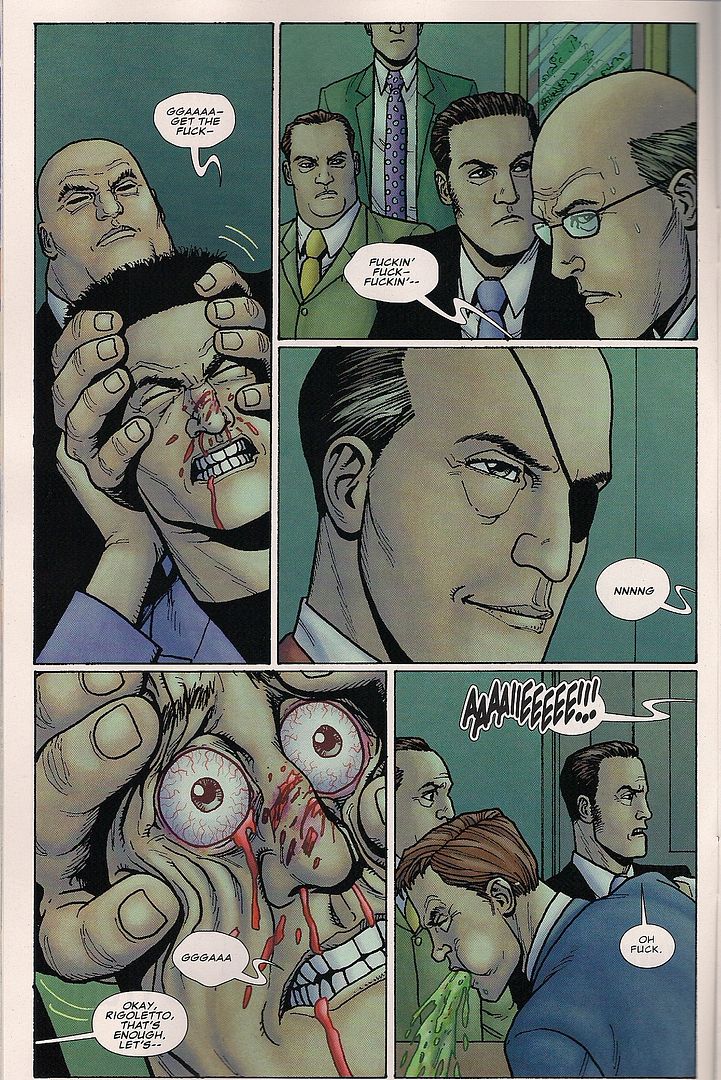
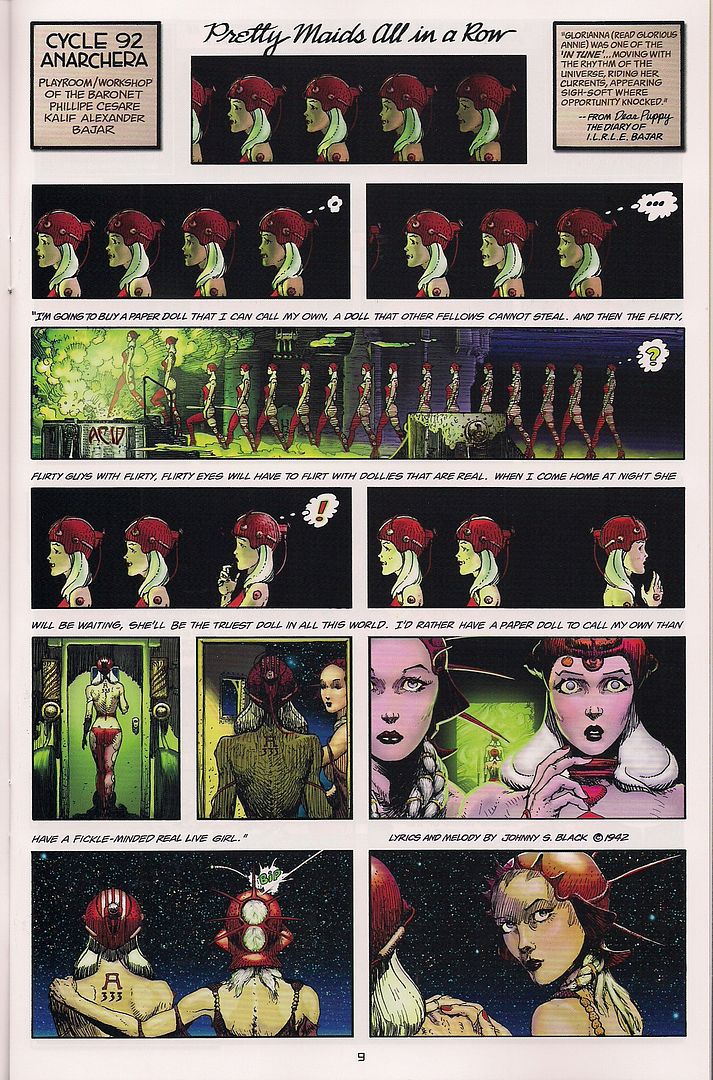
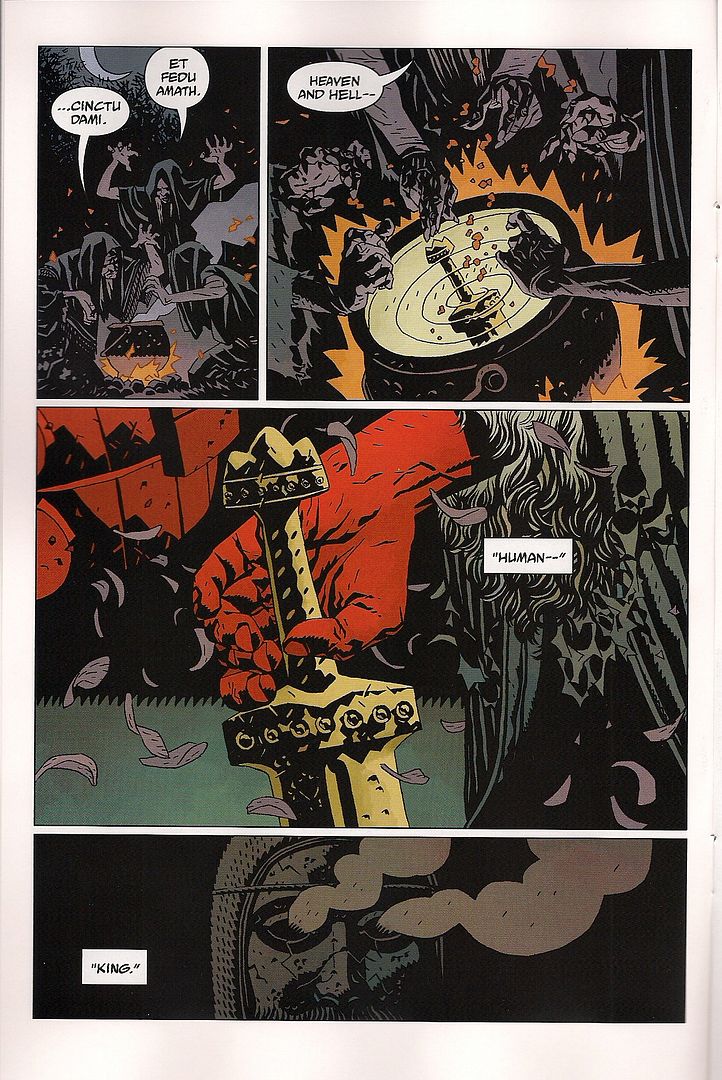
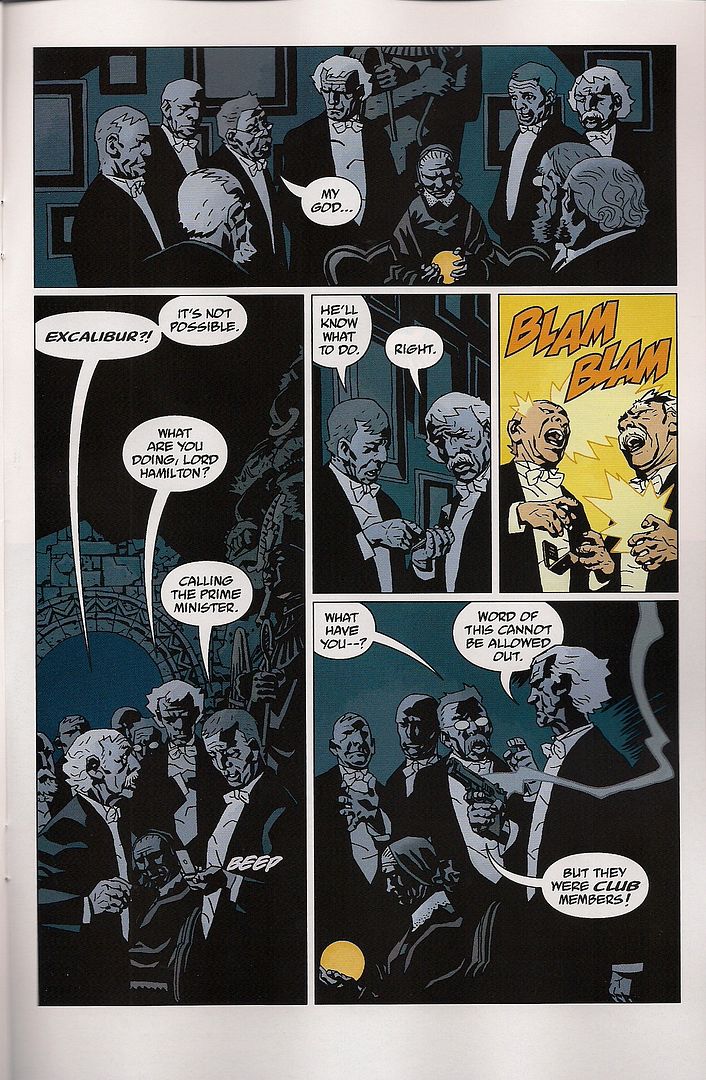
Douglas looks forward to 2010

I'm putting together a list of interesting-looking comics-related books that are coming out in 2010--what I've got so far is under the cut. Note that this is only book-format projects (so e.g. no "Joe the Barbarian," which reminds me: whatever happened to "Warcop" anyway?), and only things whose release dates have been announced either by the publishers or Amazon. Everything, as usual, is subject to change. I welcome additional suggestions for this list from anyone who doesn't work for the creators or publishers of the things you're suggesting.

January: Eddie Campbell: Alec: The Years Have Pants (Top Shelf)

Jan. 12: Dash Shaw: The Unclothed Man In the 35th Century A.D. (Fantagraphics)

Jan. 29: George Herriman: Krazy & Ignatz in "Tiger Tea" (IDW)

Feb. 2: Michael Dowers, ed.: Newave! The Underground Mini Comix of the 1980s (Fantagraphics)

Feb. 9: Jock: Hellblazer: Pandemonium (Vertigo)

Feb. 28: Jason: Almost Silent (Fantagraphics) George Herriman: Krazy & Ignatz 1916-1918: "Love in a Kestle or Love in a Hut" (Fantagraphics)

Mar.: Lewis Trondheim: Little Nothings vol. 3: Uneasy Happiness (NBM)

Mar. 3: Ben Schwartz, ed.: The Best American Comics Criticism of the 21st Century (Fantagraphics)

Mar. 16: Kevin Huizenga: The Wild Kingdom (D&Q)

Mar. 29: Al Capp: Li'l Abner, Vol. 1: 1934-1936 (IDW)

Mar. 30: James Sturm: Market Day (D&Q)

Apr. 1: Frank Young/David Lasky: The Carter Family: Don't Forget This Song (Abrams) Jaime Hernandez: The Art of Jaime Hernandez (Abrams)

Apr. 6: Jacques Tardi: It Was the War of the Trenches (Fantagraphics) Gilbert Hernandez: The High Soft Lisp (Fantagraphics)

Apr. 13: Peter Bagge: Other Lives (Vertigo) Jillian Tamaki: Indoor Voice (D&Q) Dash Shaw: BodyWorld (Pantheon)

Apr. 15: Judge Dredd: The Complete Case Files vol. 15 (Rebellion)

Apr. 20: Jim Woodring: Weathercraft (Fantagraphics)

Apr. 27: Daniel Clowes: Wilson (D&Q) John Stanley: Nancy vol. 2 (D&Q)

Apr. 28: Chris Onstad: Achewood vol. 3: A Home for Scared People (Dark Horse)

Apr. 29: Various: The Golden Treasury of Klassic Krazy Kool Kids Komics (IDW)

May 1: Dan Nadel, ed.: Art In Time: Unknown Comic Book Adventures, 1940-1980 (Abrams)

May 11: John Broome/Murphy Anderson: The Atomic Knights (DC) Various: Wednesday Comics HC (DC)

May 25: Megan Kelso: Artichoke Tales (Fantagraphics)

Jun. 8: Frank King: Walt & Skeezix book 4, 1927-1928 (D&Q) Showcase Presents Suicide Squad vol. 1 (DC) Greg Rucka/J.H. Williams III: Batwoman: Elegy (DC)

Jun. 15: Judge Dredd: The Restricted Files vol. 2 (Rebellion)

Jun. 22: Meredith Gran: Octopus Pie: There Are No Stars in Brooklyn (Villard) George Chieffet/Stephen DeStefano: Lucky in Love (Fantagraphics)

Jun. 29: The Creeper by Steve Ditko (DC) Kathryn & Stuart Immonen: Moving Pictures (Top Shelf) Ernie Bushmiller: Nancy's Aunt Fritzi Ritz (IDW)

Jul. 6: Paul Karasik/Mark Newgarden: How to Read Nancy (Fantagraphics)

July 13: Matt Kindt: Revolver (Vertigo)

July 20: Jason: Werewolves of Montpellier (Fantagraphics)

August: Jess Fink: Chester 5000-XYV and We Can Fix It (Top Shelf)

Aug. 15: Judge Dredd: The Complete Case Files vol. 16 (Rebellion)

Aug. 18: Robert L. Bryant: The Thin Black Line: Perspectives on Vince Colletta, Comics' Most Controversial Inker (TwoMorrows)

Aug. 29: Cliff Sterrett: Polly and Her Pals: The Complete Sunday Comics 1925-1927 (IDW)

October: Alan Moore/Kevin O'Neill: The League of Extraordinary Gentlemen: Century vol. 2 (Top Shelf)

December: Pat Mills/Kevin O'Neill: The Marshal Law Omnibus (Top Shelf) Alan Moore/Steve Parkhouse: The Collected Bojeffries Saga (Top Shelf)


So, Why Do Nerdy Things Work? Abhay Concludes a 5-Part Series on BLUE BEETLE.

Why elves? Why mecha? Why Trekkers? Why Browncoats? Why mystery men? Why rocket men? Why invisible men? Why pulp? Why vampires, why werewolves, why creatures from the Black Lagoon? Why space opera, why slipstream, why sci-fi? Why splatterpunk, why steampunk, why cyberpunk, why mundane SF? Why Max Headroom? Why Mad Max? Why Sam & Max? Why Samwise Gamgee? Why cons? Why cosplay? Why LARP, why TMBG, why TARDIS? Why Felicia Day? Why Freddie, why Jason, why Eli Roth? Why kaiju, why Aeris, why 42? Why IDW, why BOOM!, why Oni? Why Marvel? Why DC?

Uchhhhh, why me...

Why do nerdy things work? I've got questions and no answers; you've apparently got free time. You're reading the Savage Critics blog, and welcome to the 5th and final part of our examination of the now long-cancelled DC Comics comic-book series BLUE BEETLE. Starring your all-star BLUE BEETLE creative team: John Rogers, Keith Giffen, Cully Hamner, Rafael Albuquerque, Guy Major, Phil Balsman & co., Rachel Gluckstern, and Joan Hilty!

***

The final arc of the John Rogers era of BLUE BEETLE will be spoiled! Oh fuck! Ohfuckohfuckohfuck! Run! Hide! SPOILER WARNING!

***

Over the course of the previous four essays (1234), we discussed the failures of the first 21 issues of the BLUE BEETLE series, a new comic book starring a brand new superhero launching out of a now distant crossover event entitled INFINITE CRISIS. As this series of essays comes finally to a conclusion, we will now discuss the final four issues of what we've been calling the "John Rogers era" of BLUE BEETLE-- the part I actually liked, the part that made me want to write this series of essays to begin with.

The plot: around issue #13, Blue Beetle had learned that an alien invasion of Earth was underway. So, the plot of the finale is that Blue Beetle, family & friends fight off the alien invasion. Good guys win; bad guys lose.

And ... well, that's it, really. That's all there is to it.

Usually, I just care about the art. I read BLUE BEETLE because I wanted to see Rafael Albuquerque’s work. I've read well-written issues of NEW AVENGERS (I thought two issues ago was particularly well balanced) and there have been issues I haven't been into (I didn't understand the end of the new one...?), but: Stuart Immonen, everybody. If Batwoman and her lame dad got shot in the head in the next issue, and vultures made love to the exit wounds, I wouldn't care in the slightest. I'd be a little turned-on, actually. But, until that happens: holy shit, J.H. Williams III. I made it all the way to the end of INCOGNITO-- partially because of Jess Nevins; mostly, Sean Phillips.

But those last four issues of BLUE BEETLE... suddenly, it worked. Whatever that thing is, where you start to care what happens next, where the “funny” parts are funny, where the big “let’s all cheer” moments make you want to cheer? That happened for me. I re-read those issues before writing this essay, and it worked again.

Why?

***

A Digression on “Why Do Nerds Exist" --------------------------- OR "Curtis Armstrong, Your Life's Work is Incomplete":

As part of my extensive research for this essay, I googled "Why do nerds exist?" I felt like that was where I needed to go to explain the fact I enjoyed BLUE BEETLE comics—to an existential meaning-of-life type level.

I thought it was interesting that despite the million blogs about Ewoks and Snorks and … shit, I don’t know what all people are into on the internet, the #1 response at the time of this essay was a thread on a weightlifting message board that's apparently a popular place to discuss how best to use anabolic steroids: "Over 8,294,865 posts of underground intelligence, and 214,998 members, make this the busiest and most controversial community on the Net."

How come they never made Revenge of the Nerds V: Nerds on Steroids? How does that movie not exist? I ask you. ***

There's a recurring thing to DC books-- taking part in The Great Argument with DC fans. Well: "Great Argument" is maybe too kind a term. It's not really an argument so much as a lecture, after all. DC books all tend to lecture that "The Way You Like Comics is Wrong" when no better theme presents itself. You are Wrong to have liked Image Comics.

You are Wrong to want DC Comics to be Like They Were in the Old Days.

You are Wrong to Acknowledge You're a Fan of Our Comics Online. (?okay?)

You are Wrong for Wanting a Comic that Makes Any Fucking Sense, At All.

Taunts always seem to be the mark of a "significant" DC series.

Sure enough, BLUE BEETLE: Blue Beetle's family is saved at the last minute by a superhero "calvary": Guy Gardner, Fire, and Ice. Ice hadn’t appeared in this series previously. The climax of the comic-- the "And The Audience Goes Wild" moment: Blue Beetle is willing to give his life to save planet Earth, but is saved in the final seconds by Booster Gold. Booster Gold also hadn’t appeared in this series before.

So, you will agree that these characters show up not because they are needed to tell a coherent story, but for the Lecture. What do they signify? These third-party superheros were the best friends of the previous incarnation of Blue Beetle. The comic concludes with the following monologue: "As for me? I’m the third Blue Beetle. And I know there will be a fourth. And a fith. On and on. Some better, some worse. But the story, the name, the hero? That’ll go on forever. Past me. Past us all. And I think that’s kind of cool.

The finale of BLUE BEETLE is a persuasive essay for fans, written in invisible ink for the hardcore, whose point is this: "You are wrong about Blue Beetle. Some of you may complain that we got rid of the old Blue Beetle but change is inherent to this character. You are wrong because the characters who should care the most-- the previous incarnation's closest friends-- accept this character as being the true Blue Beetle. And so, you should accept him, too."

I think why I’m okay with BLUE BEETLE's lecture is that at least a message I’m sympathetic towards—a message celebrating new characters, celebrating DC’s legacy heroes (obviously, the best feature of the DC universe)—without feeling like… I don’t know, like I was being yelled at for no reason, by angry hacks. A lecture about accepting change seems contrary to the status quo at DC right now: DC seems to be in a mode of ever appeasing its most vocal fans' whims-- "You want Barry back? You want Hal back? You want jewelry? We'll give you jewelry! Jewelry and wine and roses. You want me to come with you and your mom to go see IT'S COMPLICATED? I'll fix your mom's answering machine, and we'll make a day of it. Yeah, no, I don't like any of my friends either. Just please don't ever leave me."

I like that BLUE BEETLE's lecture, a lecture about transience, is inherently a DC lecture. The DC universe's very foundation has now become its complete lack of foundation. The Marvel universe makes a certain amount of sense: it has a geography that can be mapped, an atlas. The "DC Universe" is chaos, distant successes drowning in decades of confusion. "Superman is an electric blue superhero who works for a TV station on multiple earths-- wait, make that a single New Earth-- wait, make that 52 earths-- wait, wait, just make me into a woman, I’m a woman trapped in a man’s body."

(Why am I workshopping my DC impression in this one??? "Here's my impression of what it'd be like... if Jack Nicholson was an editor at DC." Cue: hilarity).

Also: I think the BLUE BEETLE finale at least delivers its lecture in such a way that the finale can enjoyed even if you don’t pick up on what it’s about. Aliens, explosions, one-liners, action, etc. I don’t think that was as true of any of the DC series I mentioned above—I understood the themes of INFINITE CRISIS and FINAL CRISIS, but god help us all if I was ever asked to explain the plots of either to you. God help me if I was asked to remember the plots of either. Which one had autoerotic asphyxiation in it? That one was my favorite.

Is it "good", comics written in secret code for the No-Outsiders Club? Well: no. It's not. But I'd be lying to say that it's written in a language I don't sometimes understand; I'd be lying if I said that there isn't a weird, dopey pleasure to it when it's well done. If honesty is what's required here, this time around, I kind of dug it. If honesty isn't what's required here, I am competent at lovemaking.

***

A Digression on "Superhero Decadence" --------------------------- OR "The Broad who Wrote the Article is a Psychotic Coont":

How about shocking twists? How about unexpected violence? How about girls getting murdered so that a hero can rise? BLUE BEETLE lacks all of those things.

The last thing I wrote for this blog was about a comic whose content maybe raised an eyebrow, from a certain perspective; this piece is about an comic whose content falls within a toothless "all-ages" designation a certain type of fan on the internet is given to proclaim should be the whole of the genre. I'm praising the latter more than the former, and it occurs to me this might be mistaken as some kind of "political statement", a prescriptive "this is what we need more of" piece divorced from market realities, sales figures, numerically-measurable audience preferences.

Yeah, no: that's not really what I'm trying to say.

Of course, can I imagine having enjoyed the finale of BLUE BEETLE if it had been stuffed with what Malcolm Tucker would describe as "an awful lot of what we would call violent sexual imagery?" No. Me personally, not really. But I didn't enjoy the vast majority of how this creative team handled "Blue Beetle's adventures through the DC universe". The idea I'm going to enjoy it if DC raised the bar on it and asked the same team to create "Blue Beetle's gritty psychosexual action-drama"... well: of course not. (Which is not to diminish the good taste and discernment of the BLUE BEETLE creative team for not going to that place, as there is evidence to suggest that many retailers, the DC audience and DC editorial would all have been supportive if they had. You know: good for them).

What always strikes me about the term "superhero decadence", and why I ultimately have to reject it, is how kind an explanation it is to the creators, how generous, benevolent. Doesn't it inherently say "it's not you, why this comic sucks-- it's something inherent to the genre?"

So, yeah, no: I don't think it's the genre; I think it's them.

***

Here's my favorite part of the finale. Blue Beetle is trapped and surrounded by homicidal aliens as the penultimate issue draws to a close. How will he get out of this dilemma? He shouts Magic Words. Rogers doesn't just have him shout magic words at random-- the magic words were carefully planted in earlier issues; the magic words are explained, buttressed. But, still: magic words. I mean that in a good way.

Khaji Da. Shazam. Avengers Assemble. It's Clobbering Time. The Green Lantern oath. Lab accidents. Masks that just cover the eyes. Power rings. A walking stick that turns broken men into gods. A sanctum sanctorum in Greenwich Village. Trophy rooms. Mystery islands. Negative zones. Phantom zones. Microverses. All the savage lands that time forgot. And signal watches-- oh, those are my all-time favorite, the signal watches.

Part of the pleasure of any kind of fantasy is obviously its transformative quality. Blah is turned into blah-blah. The ordinary is invested with meaning. And people like to leave it there: "it's a game of what-if." But: why? Why play that game? To what end? I'm more prepared at this point to survive a zombie apocalypse than to cope with aging, taxes, retirement, etc. Isn't constant war-gaming of the never-going-to-happen inherently at the expense of thinking about the definitely-will happen? But it’s not just magic words, in isolation. BLUE BEETLE reminded me how DC combines the most ridiculous fantasies with these straight-laced nards; how much I liked that. Marvel characters are hippies, dopers; what Mamma Carlson would refer to as dungarees. The DC characters are ludicrous children’s fantasies grafted onto squares, fuddy-duddies, buzz-cuts. Total nards-- it's great. There’s a moment in the last issue where Guy Gardner appears—it was the first time in such a long while that I was really happy reading about DC characters. The entire book wasn’t “Here is why Guy Gardner is important; he’s like Jesus; is your blankey comfy?” ala Grant Morrison's All Star Guy Gardner. It was nice and simple: I like Guy Gardner; Guy Gardner's promising me violence; violence is my favoritest!

They're accountants with magic rings and fairy dust wands; I like that. The DC characters never seemed broke to me, but DC has certainly been very busy trying to fix them anyways.

***

A Digression on "Why Do Nerdy Things Work?" --------------------------- OR "A Creep In The Deep Or Will Success Spoil Boris Badenov?"

But: let’s step back—who cares why BLUE BEETLE works? Lots of things “work”. Why even write about it at all?

I don’t know—after reading the finale, I had this twinge of "Oh great, you're not a dork about enough nerdy shit-- you needed one more thing?" It was a special moment.

Looking back, the list of nerdy crap that I have been a dorky spazz-wad for is very, very long-- but why does that stuff work on me? What does all that dopey shit have in common? Is there a grand unified field theory of dorkism that can explain why certain ideas, images, idiocies, why they're capable of burrowing under the skins of sloppy nerds such as myself? And can that theory explain why that material consumes not just my attention, but more and more attention globally at a time when attention is such a precious commodity?

Why do nerdy things work? In addition to everything else: Why alien invasions? Why superheroes? Why BLUE BEETLE? I don't like most of the obvious explanations. "Nerdy things let ordinary people fantasize about being the hero." First of all, blech, that's condescending. Secondly, also untrue: zombie movies aren't fun because you fantasize about being a hero; they're fun because you fantasize about what you'd do if your neighbors wanted to eat your brains. Or there's themes: "Nerdy things work because they create an alternate and heightened context in which to examine relevant themes from a fresh perspective." Obvious example: your Buffy's of the world, create a fantasy universe where high school is a battle between good and evil, and let us see its themes of growing into an adult from a different angle.

This isn't a bad theory but I'm pretty dismissive of it anyways because of the horrible results it leads to. Comics about how "the X-Men are a metaphor"? Batman comics about the effect of his parent's death on his psyche, or some shit? That's my least favorite stuff. I underwent five teeth-grinding hours of James Cameron's liberal white guilt so I could watch robots fight dinosaurs for a half-hour. Not the other way around. I don't know that watching robots fight dinosaurs gave me a fresh perspective on anything; I don't think I asked it to.

Also, if my recent experience is any indication, comic fans: by and large, not so psyched about metaphors. People love to say the X-Men are metaphors for nice things, things that flatter them, but if you say that an X-Men comic works as a metaphor for something that doesn't conform to their sensitivities? Fans not going to throw a pep rally for you, it turns out.

BLUE BEETLE doesn't really support any of the foregoing hypotheses. For me, the crucial thing about BLUE BEETLE is that the first 21 issues didn't do anything for me, that I hated them, but that the last last 4 succeeded-- succeeded regardless of my having hated what preceded them, succeeded despite those previous 21 issues.

None of the above can explain that to me.

And as time passes-- more than a year and a half has passed since this series of essays started, longer since most of BLUE BEETLE's ardent fans have read the series. If you read it, what do you remember of it? Comic fans so often get accused of trying to recreate the past, but what do any of us really remember of the comics we grew up on? For me, the bad of BLUE BEETLE dropped away a long time ago; what's left? Just fragments, smoke really, just of the good parts, just of the best parts. Not even memories; just... a half-memory of a feeling. That's what fans are trying to recreate? Does any of the above explain that? Does anything? You could try to fashion an argument out of "escapism", of course. When something "works", I get to take a vacation from my incessant internal monologue of worries, anticipations, whatever. But nerdy things hardly have a monopoly on that. I spent five horrible hours with myself sitting through AVATAR; I took a vacation from myself watching THE HURT LOCKER. I found escape equally in STAR TREK, and in A SERIOUS MAN-- escapism alone isn't enough of an answer.

Maybe this question, maybe the answer is unknowable, inherently unknowable. According to the Wikipedia page on Cool (Aesthetic), which I consult before getting dressed every morning, there is the dilemma of "Cool as Elusive Essence," that what is "cool" is a real but unknowable property, something that exists but can only be sought after, something that can only be observed but ceases to exist upon observation. Bruce Lee: "Empty your mind, be formless. Shapeless, like water. If you put water into a cup, it becomes the cup. You put water into a bottle and it becomes the bottle. You put it in a teapot it becomes the teapot." Carl Weathers: "There's still plenty of meat on that bone. Now you take this home, throw it in a pot, add some broth, a potato. Baby, you've got a stew going."

Maybe this would be easier if we could all meditate on BLUE BEETLE until our chakras were good and we could get our third eye to open up. Maybe this would all be easier if we were Carl Weathers.

***

Some of the pleasure of the finale is watching the math being done. "That story set up this, this story set up that, etc." An earlier story about Blue Beetle investigating his origins set-up the magic words. An earlier story about Guy Gardner set-up his appearance in the finale. There's a panel early on where they jam all their math in, so you don't miss it ... The sentiment is dull, the dialogue is nothing special, the Spectre story referenced therein was a skippable inventory issue, but... I just get this little buzz from seeing the math. It's a signal. It signals that this is the story that the BLUE BEETLE team had been working towards the entire run, from the outset.

Which: is not a small thing for me. I don’t like the finale because it's an important story in the arc of Blue Beetle; I could give a fuck; that character is a douche. It's that it's the first arc where I felt like something was at stake for the creators. The early issues have a desparation to them; the finale is the only place where I felt like they had a chip on their shoulders. Something to prove. Some energy to share.

98% of a magic act, the magician makes my skin crawl. That is one creepy fucking profession; magicians? Creepy people. But that bit at the end where they go "Is this your card?" I love that bit because underneath that, there's always that little energy from the magician of "Fuck you, suckers.Love that part.

***

A Digression on "DC Comics in the 00’s" --------------------------- OR "The Hobgoblin of Small Minds"

DC Executive Editor Dan Didio, February 2006, Promoting Infinite Crisis: Didio explained that one of their more knowledgeable writers had been hired to "build a bible of all the characters for the other writers" to use. "Consistency in characters is what we're shooting for."

Dan Didio, February 2006, Promoting the Launch of 52 and Brave New World: “One of the things that is going to be accomplished in 52 and in the year that the story will be told, is that it reestablishes the tonality and the vision of the DC Universe, and what Brave New World does is it gives a sense of that new direction also, but in smaller bites."

Dan Didio, March 2007, Promoting the Conclusion of 52 and the Launch of Countdown: The next question led to DiDio talking about how while Jeph Loeb and Jim Lee's Batman was coming out at the same time as Ed Brubaker and Cameron Stewart's Catwoman, he saw a need for more consistency and cohesion in the DC Universe since those books were so different.

Dan Didio, March 2008, Promoting Final Crisis: "My hope is that [after Final Crisis] what we’ll see is a very exciting direction and tonality for our universe, and more importantly a very clear interpretation of who our characters are and what they represent, so that people who’ve jumped on board with Final Crisis have a real idea of the style and tone of the DCU."

Dan Didio, December 2009, Promoting Blackest Night: "It's one of the things I've wanted to do ever since I got here, and it never seemed right. But now it seems right. One of the things we're looking at, post-'Blackest Night,' is a very locked down sense of the rules and sensibilities and interpretations of our characters, and we don't plan to be reworking them as sporadically as we've done in the past."

"But now it seems right"...

*** I guess what strikes me the most about the finale is how Booster Gold had never appeared in the series until that final, climactic moment. As I alluded to above, Booster Gold and Blue Beetle had been the “buddy team” of the DC Universe for years. But in this series, Booster Gold is only mentioned briefly in the first issue-- he names the title character, but is then missing from his life. Anytime anyone said "Blue Beetle" he was there, his ghost-- just not actually around.

Like some deadbeat dad, only giving his approval at last once Blue Beetle has fully entered the World of Men, DC Universe style. The finale ends with Blue Beetle being made whole, with the absence at the heart of that character being filled.

There is that theory, of course-- that nerdy things work because we are in some way, all broken, with our own... holes that need filling (eeew!).

Damaged people, in need for whatever reason of stories about surrogate families like the X-Men or super-powered dads like Superman.

Arrested adolescents who went to neverland, and never quite made it all the way back.

The finale of BLUE BEETLE ends with an image I'm always a sucker for-- a hero surrounded by his family, the one he was born with, the one he obtained through his adventures. Oh man, I always love that type of imagery. I don't think too much about why that is.

Wedding porn movies probably work for the same reason, whatever it is.

Do racist child molestors exclusively rape kids of their same race, or do they exclusively rape kids of other races? I would guess it'd be one or the other, but: which? Maybe that’s why the only people wondering why nerds exist are steroid cases: there are answers but we wouldn't want to do what it takes to find out what those are. Not unless we were all seriously roid-raging.

On the other hand: aaah, fuck that theory. Maybe there's something wrong with the rest of you. Or probably. Or ... okay, near certainly, there's something wrong with the rest of you, but: not me, buddy, not me. I don't like Doctor Who or The Master because I'm some kind of tragedy case, ‘cause this shit's a Lifetime movie. I like them because the Master is basically the best villain ever. Basically. And sometimes a guy has to take a break from living it to the limit, people. So, yeah, I don't actually think I need Blue Beetle's fucking pity...? Well: I don't think I need Blue Beetle's fucking pity YET. Cue: heroin.

***

LONG WAY DOWN (ONE LAST THING):

And it's the end of the decade. What one might very reasonably argue has been the greatest decade in comics history.

This year, there were books I liked; books I loved. There was ASTERIOS POLYP; there was GOGO MONSTER. I read Tezuka; I read Tardi; I revisited STRANGE DAYS; I reread Feiffer (again). I read manga and minicomics; I read art comics and webcomics; I bought art books. I liked the first issues of UNDERGROUND, DAYTRIPPER and FORGETLESS. I thought that comic the AVIATRIX was hilarious. I liked a couple superhero stories-- I liked Kelly Link's short story "Secret Identity;" I liked that UMBRELLA ACADEMY sequel some. I related to that new issue of PHONOGRAM, which would be wildly embarrassing if it weren’t so obviously the case. People I know released some well-received comics into the world; I made some comics, even.

I wasn't very happy in 2009 anyways.

Apparently, I’m not completely alone: Messrs. Tim Callahan ("something's missing"), Chad Nevett ("I think people are just tired... I can't really defend things."), David Brothers ("I’m bored to death"), Dr. Geoff Klock("It's diminishing returns... it is time to stop showing up on Wednesdays..."), Alan David Doane ("I have to admit that I have not been reading a lot of comic books lately"), and well... me in my last essay, according to some of you ("I'm pretty sure whoever wrote this comic is the Green River Killer, guys. I've been spending time in the crime lab, and I think I just cracked this mother wide open.").

Steven Grant tried writing about this a year ago: "Dreariness. 2008 was one dreary year for comics." Internet kind of yelled at him; you know: internet. Internet is welcome to yell at me, too. I don’t dispute that I’ve read great books this year. I have a very long list of books I want to write more about; should have written more about. I don’t dispute that this decade has been unbelievable in terms of how much has changed, how much has improved. There are many, many great books I still haven't read yet.

But something bummed me out anyways. 2009 was a colossal fucking bummer, for my comic nerdery at least.

Setting aside art comics and foreign reprint material, where my complaints are comparatively few, where the bulk of my pleasure has been this year... what can we say? It’d be an obvious mistake to read too much into nebulous complaints, but the sentiment that struck me the most was from Dr. Klock: "Marvel needs to find a writer for Chris Bachalo and DC needs one for JH Williams. Someone NEW. Or someone from another medium."

A new wave of comic creators to come and sweep out all that's wrong in mainstream comics? Creators from different mediums? That happened already. That was the story of the aughts in mainstream comics. That is what we just lived through. (BLUE BEETLE is arguably an instantiation of those very trends).

And what do mainstream comics look like in the aftermath?

Mainstream comics in 2009, from the viewpoint of a 1999 mainstream comic fan, is almost unrecognizable. Except for gimmick crossovers. Except for gimmick "events". Except for gimmick covers. Except for late books. Except for “scheduling mishaps”. Except for excuses.

Except for everything that is shoddy and shabby and refuses to die.

But I'm a big fan of the comics your favorite mainstream creators used to make… (Stage directions to assist you in reading this sentence: sighing while shrugging while doing that move with hands that suggests masturbation of the male genitalia, preferably with both hands held slightly above eye level so as to suggest an altogether unwholesome scenario for no real reason other than my own perverse amusement; filling your belly button with dip and then dipping baby carrots into your belly-dip; divulging things you shouldn't on the internet; regretting).

Is it just we've all gotten too old, too jaded? That's the answer others are settling on, but I don't think that's it for me. I'm the target audience for movies about robots; Transformers 2 was partially my fault. I played a video game this year because it had the Ghostbusters in it. Besides MAD MEN and the fucking amazing 3rd season of THE THICK OF IT (holy shit!), my favorite TV show right now is LOST. I am a giant nerd, and my nerdy enthusiasms are still all the way to 11. I don't think it's me; fuck, I wish it were me; why can't it be me??

I have my theories, none very good, and I could go around and around in circles on this, but we've digressed enough already and I can't promise we'd end up anywhere interesting. Why do nerdy things work? Why do they stop working? Maybe only Bruce Lee and Carl Weathers know for sure.

Anyways: who could have guessed what this decade would be like 10 years ago? Who could have guessed what a roller coaster it'd be? I didn’t like 21 issues of BLUE BEETLE; but those last 4 issues were pretty good. So, there's at least reason to hope.

Arriving 12/23/2009

Here it is: your last batch of comics shipping for 2009!

2000 AD PACK NOV 2009
A G SUPER EROTIC ANTHOLOGY #109 (A)
ABSOLUTION #5 (OF 6)
AMAZING SPIDER-MAN #616 GNTLT
ANGEL ANNUAL #1
ANGELUS #1 (OF 6)
ARCHIE #604
ARKHAM REBORN #3 (OF 3)
AVENGERS INITIATIVE #31 SIEGE
BART SIMPSON COMICS #51
BEASTS OF BURDEN #4 (OF 4)
BETTY & VERONICA DIGEST #200
BILLY BATSON AND THE MAGIC OF SHAZAM #11
BLACK TERROR #6
BLACK WIDOW AND MARVEL GIRLS #2 (OF 4)
BLACKEST NIGHT JSA #1 (OF 3)
BUFFY THE VAMPIRE SLAYER WILLOW ONE SHOT (OSW) JO CHEN CVR
CAPTAIN AMERICA REBORN WHO WILL WIELD THE SHIELD
CHEW #7
COMPLETE DRACULA #5 (OF 5)
CRIMINAL SINNERS #3
CROSSED #8 (OF 9)
DARK AVENGERS ARES #3 (OF 3)
DARK TOWER BATTLE OF JERICHO HILL #2 (OF 5)
DETECTIVE COMICS #860
DO ANDROIDS DREAM OF ELECTRIC SHEEP #7 (OF 24)
DOCTOR VOODOO ORIGIN OF JERICHO DRUMM
ENDERS GAME COMMAND SCHOOL #4 (OF 5)
ENDERS SHADOW COMMAND SCHOOL #4 (OF 5)
FALL OF HULKS GAMMA FOH
FANTASTIC FOUR #574
FRANK FRAZETTAS DARK KINGDOM #3 (OF 4) FRAZETTA CVR
FREDDY JASON ASH NIGHTMARE WARRIORS #6 (OF 6)
GARTH ENNIS BATTLEFIELDS HAPPY VALLEY #1 (OF 9)
GI JOE ORIGINS #10
GOTHAM CITY SIRENS #7
GREEN LANTERN #49 (BLACKEST NIGHT)
GRIMM FAIRY TALES #43 A CVR AMORIM
GUARDIANS OF GALAXY #21
HALO BLOOD LINE #1 (OF 5)
HELLBOY BRIDE OF HELL ONE SHOT (OSW)
INCREDIBLE HERCULES #139
INVINCIBLE #69
IRON MAN VS WHIPLASH #2 (OF 4)
IRREDEEMABLE #9
JACK OF FABLES #41
JUDGE ANDERSON PSI FILES TP
JUSTICE SOCIETY OF AMERICA #34
KNIGHTS OF THE DINNER TABLE #157
LAST DAYS OF AMERICAN CRIME #1 (OF 3) A CVR MALEEV
MADAME XANADU #18
MARVEL ADVENTURES SPIDER-MAN #58
MONSTERS INC LAUGH FACTORY #4
NEW AVENGERS #60
NEW MUTANTS #8 XN
NORTHLANDERS #23
OKKO CYCLE OF EARTH #4 (OF 4)
POWERS #2
PUNISHER #12
SECRET WARRIORS #11
SONIC UNIVERSE #11
SPARTACUS BLOOD AND SAND #3 (OF 4)
SPIDER-WOMAN #4
STAND SOUL SURVIVORS #3 (OF 5)
STAR TREK TNG GHOSTS #2
STAR WARS KNIGHTS OLD REPUBLIC #48 DEMON PT 2 (OF 4)
STAR WARS LEGACY #43 MONSTER PT 1 (OF 4)
SUPERMAN #695
TEEN TITANS #78 (BLACKEST NIGHT)
THOR #605
UNCANNY X-MEN #519
UNKNOWN SOLDIER #15
USAGI YOJIMBO #125
VICTORIAN UNDEAD #2 (OF 6)
WALL-E #1
WEB #4
WHAT IF ASTONISHING X-MEN
WHAT IF SPIDER-MAN HOUSE OF M
WILDCATS #18
WITCHBLADE #133 SEJIC CVR A
WOLVERINE ORIGINS #43
WOLVERINE WEAPON X #8
WONDER WOMAN #39
WORLDS FINEST #3 (OF 4) CVR A
X-MEN FOREVER #14
X-MEN LEGACY #231 XN
ZORRO #18

Books / Mags / Stuff
AGENTS OF ATLAS TP DARK REIGN
ALEC SC YEARS HAVE PANTS LIFE SIZE OMNIBUS
ANITA BLAKE PREM HC BOOK 02 LC NECROMANCER
ATOMIC ROBO TP VOL 01 NEW PTG
ATOMIC ROBO TP VOL 03
BATMAN THE WRATH TP
CHARLEYS WAR HC VOL 06 UNDERGROUND & OVER THE TOP
CLASSIC TRANSFORMERS TP VOL 05
CONCEPTUAL REALISM IN SERVICE OF HYPOTHETICAL SC
CRIMINAL MACABRE CELL BLOCK 666 TP
DARK REIGN HOOD TP
DARK REIGN YOUNG AVENGERS TP
DEFINITIVE PRINCE VALIANT COMPANION SC
FANTASTIC FOUR TP MASTERS OF DOOM
FARSCAPE HC VOL 03 GONE AND BACK
FOOTNOTES IN GAZA HC
GANTZ TP VOL 08
GREAT ANTI WAR CARTOONS
GREEN LANTERN CHRONICLES TP VOL 02
INCREDIBLE HERCULES TP DARK REIGN
IRREDEEMABLE TP VOL 02
JUXTAPOZ VOL 17 #1 JAN 2010
MARVEL ZOMBIES RETURN HC
MARVELS TP NEW PTG
MIGHTY TP VOL 01
MINI MARVELS TP ULTIMATE COLLECTION GN
MORE THAN COMPLETE ACTION PHILOSOPHERS TP
NEXUS ARCHIVES HC VOL 10
ORIGINAL JOHNSON GN VOL 01
READ ME TP (A)
SCARLETT TAKES MANHATTAN GN (A)
SCOURGE OF GODS PREM HC FALL
SIZZLE #44 (A)
STAR WARS CLONE WARS TP VOL 04 COLOSSUS OF DESTINY
SUBLIFE GN VOL 02
SUB-MARINER TP DEPTHS
SUPERGIRL COSMIC ADVENTURES IN THE EIGHTH GRADE TP
WINTERWORLD HC
X-FORCE CABLE MESSIAH WAR TP

What looks good to YOU?

-B

Arriving 12/16/2009

The next to last shipping week of the year... and it's still not all that large. I guess this means that next week will be sheer brutality...

AIR #16
AMAZING SPIDER-MAN #615 GNTLT
AMAZING SPIDER-MAN PRESENTS ANTI VENOM #3 (OF 3)
ANGEL #27
ANGEL #28
ANGEL HOLE IN THE WORLD #1
ASTONISHING X-MEN #33
AUTHORITY THE LOST YEAR #4 (OF 12)
AZRAEL #3
BATMAN #694
BATMAN 80 PAGE GIANT #1
BATMAN CONFIDENTIAL #39
BATMAN STREETS OF GOTHAM #7
BATMAN THE BRAVE AND THE BOLD #12
BETTY & VERONICA #245
BEYOND THE WALL #2
BLACK PANTHER 2 #11
BRAVE AND THE BOLD #30
CABLE #21
CAPTAIN AMERICA REBORN #5 (OF 6)
CHIMICHANGA #1
COMPLETE ALICE IN WONDERLAND #1 (OF 4)
DAREDEVIL #503
DARK AVENGERS #12
DARK WOLVERINE #81
DARKNESS PITT #3 (OF 3) KEOWN CVR A
DEADPOOL MERC WITH A MOUTH #6
DOCTOR VOODOO AVENGER OF SUPERNATURAL #3
DOCTOR WHO ONGOING #6
ELEPHANTMEN #23
ESCAPE FROM WONDERLAND #3 (OF 6)
EX MACHINA #47
FABLES #91
FARSCAPE ONGOING #2
FORGETLESS #1 (OF 5)
GHOSTBUSTERS DISPLACED AGGRESSION #4
GHOSTBUSTERS PAST PRESENT FUTURE (ONE SHOT)
GI JOE #13
GIANT-SIZE GFT 2009 HOLIDAY ED A CVR FRANCHESCO
GODLAND #30
GREEN LANTERN CORPS #43 (BLACKEST NIGHT)
HELLBLAZER #262
HULK #18
INCORRUPTIBLE #1
JON SABLE FREELANCE ASHES OF EDEN #3
JUGHEADS DOUBLE DIGEST #156
JUSTICE LEAGUE OF AMERICA #40 (BLACKEST NIGHT)
KOOKABURRA K #2 (OF 3)
LADY ACTION SPECIAL ONE SHOT
LAST RESORT #5
LOCKE & KEY CROWN OF SHADOWS #2
LOVE AND CAPES #12
MARVELOUS LAND OF OZ #2 (OF 8)
MIGHTY AVENGERS #32
MS MARVEL #48
NEXT ISSUE PROJECT #2 (SILVER STREAK COMICS #24)
NINJA HIGH SCHOOL #175
NOLA #2
NOMAD GIRL WITHOUT A WORLD #4 (OF 4)
OFFICIAL INDEX TO MARVEL UNIVERSE #12
OKKO CYCLE OF EARTH #3 (OF 4)
OUTSIDERS #25 (BLACKEST NIGHT)
POWER GIRL #7
PROJECT SUPERPOWERS CHAPTER TWO #5
PS238 #42
REALM OF KINGS INHUMANS #2 (OF 5)
SIMPSONS COMICS #161
SPIDER-MAN CLONE SAGA #4 (OF 6)
STAR TREK ALIEN SPOTLIGHT CARDASSIANS
STAR TREK DS9 FOOLS GOLD #1
STREET FIGHTER II TURBO #10
SUPERGIRL #48
SUPERMAN BATMAN #67 (BLACKEST NIGHT)
TALES FROM RIVERDALE DIGEST #36
THUNDERBOLTS #139
TINY TITANS #23
TRANSFORMERS ONGOING #2
ULTIMATE COMICS ARMOR WARS #3 (OF 4)
UNCLE SCROOGE #386
UNDERGROUND #4 (OF 5)
UNKNOWN DEVIL MADE FLESH #3
VENGEANCE OF MOON KNIGHT #4
WALT DISNEYS COMICS & STORIES #701
WHAT IF DAREDEVIL VS ELEKTRA
WORLD OF WARCRAFT SPECIAL #1
X-FACTOR #200
X-FORCE #22 XN
X-MEN LEGACY #230
ZOMBIES THAT ATE THE WORLD #7 (OF 8)

Books / Mags / Stuff
AMORY WARS TP VOL 02 SECOND STAGE TURBINE BLADE
ART OF STEVE DITKO HC
ASTERIX HC ASTERIX & OBELIX BIRTHDAY
BATMAN DARK KNIGHT ARCHIVES HC VOL 06
CARTOONIST DVD
CHILDREN OF THE SEA TP VOL 02
CLASSIC GI JOE TP VOL 06
CLASSICS ILLUS HC VOL 07 DR JEKHLL & MR HYDE
COMPLETE CRUMB COMICS SC CURR PTG VOL 07
COMPLETE CRUMB COMICS SC VOL 12 CURR PTG
DEAD AT 17 AFTERBIRTH TP VOL 01
DEAD RUN TP VOL 01
DEADPOOL TP VOL 02 DARK REIGN
DRAWING DOWN THE MOON ART OF CHARLES VESS HC (RES)
FINDING NEMO REEF RESCUE TP
GAHAN WILSON 50 YEARS OF PLAYBOY CARTOONS HC
GOON TP VOL 06 CHINATOWN & MYSTERY MR WICKER
GRAVEL TP VOL 02 THE MAJOR SEVEN
JUDGE DREDD MEGAZINE #291
LEES TOY REVIEW #205 DEC 2009
MARVEL ILLUSTRATED TP GN KIDNAPPED
NAOKI URASAWA 20TH CENTURY BOYS GN VOL 06
PUNISHER FRANK CASTLE MAX TP WELCOME TO BAYOU
ROCKETEER COMPLETE COLLECTION DLX ED HC VOL 01
ROCKETEER COMPLETE COLLECTION HC VOL 01
SECRET WARRIORS TP VOL 01 NICK FURY AGENT OF NOTHING
SHOWCASE PRESENTS WONDER WOMAN TP VOL 03
SIMON DARK TP VOL 03 THE GAME OF LIFE
STAR WARS THRAWN TRILOGY HC VOL 01
SULLENGREY SACRIFICE TP
THOR TP AGES OF THUNDER
TOMARTS ACTION FIGURE DIGEST #183
VIXEN RETURN OF THE LION TP
X-INFERNUS TP

What looks good to YOU?

-B

No Use Brooding In Space: The Long Awaited Claremont's X-Men 4

Some would say that this post is, what, two months overdue? And they'd be right, but I'd rather think of it as "Well, I'm doing two years at a time, so really, I'm 22 months early.

...Okay, the next one will be here before February, I promise.

The couple of years of Uncanny X-Men between #149 and #172 see the book go through some strange comic version of adolescence, or perhaps a mutant metamorphosis - If you compare the first of those issues with the last, it's as if more than just the artist had changed: After a year or so of space epics that took the series away from the glossy soap operatic formula it'd perfected during the Byrne/Austin era, the return to Earth brought changes in focus, storytelling and characterization, and made the book what it still is today, in many ways.

Claremont has often made reference to trying to adapt his writing to suit his artist, and the latter Cockrum era feels like the place where that's most obvious. After a period of trying to do more of the uber-superheroics and mindswap drama that had made the book so popular previously, it must've become clear that Cockrum wasn't enjoying himself - Look at the surprisingly bland pages he produced, and also the number of fill-ins - because, suddenly, the book became a space opera, with the Shi'Ar and the Brood pretty much dominating the book between #153 and #167, with only a four issue breather back on Earth in the middle (Two of which, maybe tellingly, are done by fill-in artists). Cockrum's art seems more alive in the space issues, with more exciting design work and more interesting layouts, but the book feels weirdly un-X-Men-like, nonetheless. Despite the family connections to the Starjammers and Claremont giving it his best Alien rip-off (Between this and the Kitty-In-The-Mansion-Oh-No-A-Monster's-After-Her issue a couple of years earlier, he obviously really liked Ridley Scott's movie. Which, considering Ripley is very much a Claremontian character, makes a lot of sense), the X-Men themselves feel superfluous in their own series for the majority of this time; with little work, the stories could've been reworked as Avengers or, more likely perhaps, Defenders issues (The Shi'Ar issues feel like muddier versions of The New Teen Titans stories about Starfire and her sister, it has to be said, but I'm not sure about the timing on who came first).

Cockrum's gone from the book - off to create The Futurians, according to the lettercol, but probably because he wasn't gelling with the series that he'd helped co-create a second time around - before the Brood storyline finishes, and replacement Paul Smith brought a much lighter, much more open style to proceedings; his early work seems years away from Cockrum's more classic, illustratorly, approach but also Byrne's. It's more graphic, and more empty (Look at his backgrounds, which're often missing or abstract shapes or iconography, which seems to fit particularly well with Tom Orzechowski's lettering - oddly enough, Orzechowski was absent from Cockrum's last couple of issues, with Joe Rosen filling in; the return to Orz's smaller, tighter, cleaner letters in addition to Smith's similarly-clean art in #165 really makes the book look different in its entirety). With Cockrum gone, the in-process Brood storyline wrapped quickly (and detours back into more familiar territory before it ends, with Professor Xavier's Brood implant acting more like a mind-control story than the alien abductor of the Cockrum issues) and we're slammed back into territory introduced in the Byrne issues: Not only teen angst ("Professor Xavier is a jerk!") but bondage imagery (The Morlocks with their collared-and-trussed Angel) and questions of identity (But, instead of "Does power corrupt Jean?" it's "Does leadership corrupt Storm?"). It's exciting, fast-moving stuff, and reads at times like Claremont's been dying to do this kind of stuff for a long time, with the speed and smoothness he brings to the material. It's also - and this is maybe my betraying when I started reading the series, the most "X-Men-y" the book has felt yet; a return to the values of the Byrne era, perhaps, but in a different way, and with a broader scope and, for better or worse, less focused intent (Only the Madelyne Prior subplot really meets any kind of quick resolution, although that'd end up undone before too long; Rogue joining the team, and Storm's uncertainty about who she is, open up threads that will continue for years to come). But even more refining of what'd become the cliched Claremont writing technique was right around the corner, just when it'd look like fresh starts were about to happen.

A quick thought on the "Earth-One" OGNs

Heidi has a good write up on DC's newest initiative -- basically, it sounds like DC's version of the "Ultimate" line, but they're skipping out on the serialization, and going straight to OGNs.

There's not a ton of details in terms of exact format, pagination, or release schedule, so let's make some assumptions. Let's assume they're going to try for two releases of each character a year. Let's also assume that they'll be handled somewhat like THE JOKER HC from Azarello and Bermejo from late last year -- roughly 128 pages, in HC, for $24.95.

A monthly comic, of 22 pages each, would yield approximately 264 pages at the end of a year -- in this assumed OGN format, we're talking about 256 pages at the end of a year.

Using SUPERMAN: SECRET ORIGIN as a comparable metric, if these books were serialized as comics first, Comix Experience would sell something on the order of 50 copies of #1, 40 of #2, and an average of 30 copies each of #3-12, during our theoretical year. With a $2.99 cover price, on these 390 copies during a year would work out to $1166 (and ten cents).

In order to generate the same revenue from two OGNs, at a $25 price point, I'd need to sell almost 47 copies (46.73, says the calculator)

Here's the thing, though, in my experience OGNs are really only likely to sell 2/3rds or less of a similar periodical release (cf: 1001 NIGHTS OF SNOWFALL vs FABLES, LOEG: CENTURY vs LOEG: BLACK DOSSIER or SANDMAN: ENDLESS NIGHTS vs SANDMAN) -- and it can be closer to 1/3.

Working from the "mature" sales of #3 and beyond (which is really where you calculate these things, not from the top end of a #1), assuming 2/3 of those sales, that'd give me an order of 20 copies of v1. Even if we assume NO drop-off of v2 (hahaha, unlikely!), that'd yield a total of 40 copies sold. 40x$25 = $1000... or about 10% less revenue than a serialization would give us.

Of course, that's just "initial" sales -- one would presume this would continue to sell on and on, forever, if they're any good... but then you'd have the same from the TP collection of the serialized issues, so that's pretty much a wash.

(Also, you have to figure that somewhere between 10 and 25% of the people who bought a serialization will ALSO buy the collection... that goes away entirely with OGNs...)

[SANDMAN: PRELUDES AND NOCTURNES sells, for me, about 6 copies for every copy of ENDLESS NIGHTS I sell, today, years after initial release]

And, of course, I'm calculating using a $25 price point, if it is $19.95, or even less, that skews the math in a much uglier direction.

The bottom line is that customers are much less likely to plunk down for a Big Ticket item than they are for a periodical, which is one of the reasons that the OGN doesn't, to my mind, make a ton of sense.

And while it is possible that the "bookstore reader" will flock to superhero-OGN work... well, I kind of don't think that will happen... and, even if it does, I have a hardish time picturing them wanting it again and again -- because this theoretical 2x a year strategy IS a periodical, just much slower than usual.

Here's the thing: the "civilian" audience, the one in bookstores that we're assuming DC is going after on this? Well, they don't know, understand or WANT to understand the difference between a "TP" and an "OGN". TPs *are* "original" to them, if it is the first time they've ever seen it. When SUPERMAN: SECRET ORIGIN comes out in its eventual collection, it may as well BE an "OGN" to the bookstore customer. And when they ask "what's the difference between this and 'Earth One'?" is the answer going to make a lick of sense to them?

(My guess? No, not even a little bit)

This will be an interesting experiment, but one that I don't think is going to work all that successfully -- whatever the OGN might sell, I'm fairly certain that I would sell 1.x times as many as a periodical. Therefore the bookstores are going to have to make up the difference all by themselves... and I don't really see that happening.

-B

Arriving 12/9/2009

A really painfully small shipment this close to the holidays. Between this, and no New Comics the week after Christmas, I'm afraid of severe ball-breakers the next two weeks. It would be nice if our publishing partners could come up with at least slightly sensible schedules...

ACTION COMICS #884
ADVENTURE COMICS #5 (BLACKEST NIGHT)
AMAZING SPIDER-MAN #614 GNTLT
ANCHOR #3
ANYWHERE #1 (OF 6)
AOD ASH SAVES OBAMA #4 (OF 4)
ARCHIE & FRIENDS #138
ASTOUNDING WOLF-MAN #20
BATGIRL #5
BLACK WIDOW DEADLY ORIGIN #2 (OF 4)
BOOSTER GOLD #27 (BLACKEST NIGHT)
BPRD WAR ON FROGS #4 (OF 4)
CARS RADIATOR SPRINGS #4
CITIZEN REX #6 (OF 6)
COMPLETE DRACULA #4 (OF 5)
DARK X-MEN #2 (OF 5)
DAYTRIPPER #1 (OF 10)
DC HOLIDAY SPECIAL 2009 #1
DEADPOOL #18
DEATHLOK #2 (OF 7)
DMZ #48
DOOM PATROL #5 (BLACKEST NIGHT)
ENDERS GAME WAR OF GIFTS ONE-SHOT
GEN 13 #33
GHOST RIDERS HEAVENS ON FIRE #5 (OF 6)
GOD COMPLEX #1
GREEN ARROW BLACK CANARY #27
GROO HOGS OF HORDER #2 (OF 4)
INCARNATE #3 (OF 3)
INCREDIBLE HULK #605
INVINCIBLE IRON MAN #21
MAGOG #4
MARVEL ADVENTURES SUPER HEROES #18
MICKEY MOUSE & FRIENDS #298
MODERN WARFARE 2 GHOST #2 (OF 6)
MUPPET SHOW #0
NATION X #1 (OF 4)
NEW AVENGERS ANNUAL #3
PALS N GALS DOUBLE DIGEST #137
PHONOGRAM 2 #6 (OF 7) SINGLES CLUB
PILOT SEASON MURDERER #1
PUNISHER NOIR #4 (OF 4)
PUNISHERMAX #2
REALM OF KINGS IMPERIAL GUARD #2 (OF 5)
REBELS #11 (BLACKEST NIGHT)
RED HERRING #5 (OF 6)
RED ROBIN #7
SCOOBY DOO #151
SECRET SIX #16
SHIELD #4
SPIDER-MAN AND SECRET WARS #1 (OF 4)
STAR WARS CLONE WARS #11 HERO CONFEDERACY PT 2
SUPER FRIENDS #22
SWORD (MARVEL) #2
TANK GIRL NUGGETS (ONE SHOT)
TITANS #20
TOY STORY #0
UNCANNY X-MEN FIRST CLASS #6 (OF 8)
UNWRITTEN #8
VAMPIRELLA SECOND COMING #4 SUYDAM CVR
WALKING DEAD #68
WAR MACHINE #12
WEB OF SPIDER-MAN #3 GNTLT
WHAT IF WORLD WAR HULK
WOLVERINE UNDER BOARDWALK ONE-SHOT
X NECROSHA GATHERING XN
X-MEN FOREVER #13
X-MEN NOIR MARK OF CAIN #1 (OF 4)

Books / Mags / Stuff
ALTER EGO #90
BATMAN THE CULT TP NEW PTG
BOYS DEFINITIVE ED HC VOL 02 W/ SLIPCOVER
CROSSING EMPTY QUARTER & OTHER STORIES HC
DC SUPERHERO FIGURINE COLL MAG #21 RAVEN
DETROIT METAL CITY GN VOL 03
EX MACHINA TP VOL 08 DIRTY TRICKS
HEAVY METAL JANUARY 2010
JLA YEAR ONE TP NEW PTG
LOST OFFICIAL MAGAZINE #26 PX ED
MARVEL ADVENTURES SPIDER-MAN TP VOL 14 THWIP DIGEST
MS MARVEL TP VOL 07 DARK REIGN
RETURN OF KING DOUG HC
SKY DOLL TP VOL 01
SUPERMAN SUPERGIRL MAELSTROM TP
TERRA TP
TOYFARE #150 MATTEL WWE CVR
ULTIMATUM TP MARCH ON ULTIMATUM
ULTIMATUM X-MEN FANTASTIC FOUR TP
VIDEO WATCHDOG #153
VIETNAM JOURNAL TP VOL 01 INDIAN COUNTRY
WHAT IF CLASSIC TP VOL 06
WIZARD MAGAZINE #220 PLATINUM ROSS CAPT AMERICA CVR
X-MEN SPIDER-MAN TP
YOTSUBA & ! GN VOL 07

What looks good to YOU?

-B

Abhay Wrote a Quick Description of Dark Reign: The List -- X-Men #1, For No Reason

This one is not a review, really, so much as just a description of a Marvel comic book that was released in September 2009 called DARK REIGN: THE LIST -- X-MEN #1. Spoiler warning! Here is my first attempt to explain the context of this comic:

Marvel's comics have been contributing to an ongoing "Event" storyline entitled DARK REIGN. Within that larger event, THE LIST was a smaller sub-event, marketed as follows: Marvel would combine its top writing and art talent (and also, some other people) on a series of one-shots that would feature pivotal moments in the ongoing DARK REIGN storyline. Specifically, it would feature the Green Goblin, the lead antagonist of the DARK REIGN event, attacking various key heroes of the Marvel Universe-- those whose names he apparently kept on some kind of list.

DARK REIGN: THE LIST-- X-MEN #1 was one of those one-shots, one dedicated to the popular X-MEN comic franchise. This particular one-shot was a success: it sold out at Diamond, went to a second printing, and was favorably reviewed on various internet websites including this very blog.

When the DARK REIGN event began, the character of Namor the Sub-Mariner had been revealed to be a part of the new Masters of Evil assembled by the Green Goblin. Thereafter, Namor quit the Masters of Evil and joined the X-Men during a crossover between the DARK AVENGERS and X-MEN that took place in a previous DARK REIGN sub-event called UTOPIA.

Here is the premise of DARK REIGN: THE LIST-- X-MEN #1:

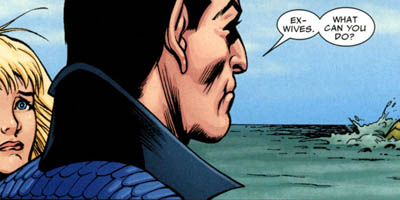
The comic opens with the Green Goblin angry that Namor has quit the Masters of Evil, and has instead joined the X-Men. As retaliation, the Green Goblin has decided to weaponize the horniness of Namor's ex-wife.

Here is the dialogue explaining his weaponize-the-horniness plan: "She's part human and part Plodex-- the Plodex are some kind of alien race apparently-- and when you mix'em up you get this. We've modified her to keep her perpetually in estrus which explains her rotten attitude... but the result is a genetic W.M.D."

Estrus is defined as follows: "A regularly recurrent state of sexual excitability during which the female of most mammals will accept the male and is capable of conceiving."

Here is a drawing of Namor's Ex-Wife: drawingx The monster is a canal with teeth, plainly invoking the classic image of the "vagina dentata"-- the vagina with teeth. Wikipedia: "Various cultures have folk tales about women with toothed vaginas, frequently told as cautionary tales warning of the dangers of sex with strange women and to discourage the act of rape. The concept is also of importance in classical psychoanalysis, where it is held to relate to the unconscious fears associated with castration anxiety."

In the monster genre, the origin of the monster frequently contains a warning to the reader. The Frankenstein Monster is a folly of science. Godzilla is awoken by the atom bomb. The Host is created by pollution the United States forces Korea to inflict upon itself. The origin of a monster is the part that speaks to the audience's true fears.

The origin of our vagina monster? It's a woman wanting sex. Sex makes women crazy and dangerous. The result of female sexual excitability is a "genetic W.M.D."

(As the New York Times Magazine pointed out last week, the true facts are that the opposite is true: women whose sex drives diminish over time report suffering from a profound despair. Here's psychologist Lori Brotto from that article: "I want to have sex where I feel like I’m craving it,” Brotto quoted from yet another file, giving voice to a desperation shared by many of her patients. “I want to feel horny. I want to want.”).

The obvious conclusion to draw from DARK REIGN: THE LIST-- X-MEN #1 is that at the close of 2009, a woman with an appetite for sex is apparently the very definition of fear and horror for Marvel comic creators and their audience.

I would diagnose such a belief as gynophobia.

This is not a metaphor; this is not sub-text. This is the explicit text of the comic: "We've modified her to keep her perpetually in estrus which explains her rotten attitude... but the result is a genetic W.M.D." This is page one. This is the establishing shot. Here's a line of dialogue from page 2: "Her gonadotropic hormones make her so hungry she's been driven insane."

Later in the comic, the arrival of the giant vagina is heralded as follows: "There's nothing to her but hunger and rage and... and hate." Here is the punchline:

dxxxxxx So, to be more specific: DARK REIGN: THE LIST-- X-MEN #1 isn't just about castration anxiety and gynophobia, but very specifically, the castration anxieties and gynophobia of a middle-aged man.

Here is a second attempt at explaining the context of this comic:

"Man Versus Castration Anxiety" has been a recurring theme for this generation of Marvel Comics "events". The first major "Event" CIVIL WAR began when Captain America was asked to submit to the authority of a woman named Maria Hill.

Captain America then initiates an all-out superhero civil war rather than take orders from a woman. At the conclusion of the comic, Iron Man has won that contest; however, the comic goes bizarrely out of its way to assure the reader that the patriarchal order has been restored: the comic's celebratory final three pages feature Iron Man forcing Maria Hill to get him coffee.

civil The CIVIL WAR can only truly end once a woman is put back in her "place". CIVIL WAR was then followed by a comic called-- oh God, here I go again-- SECRET INVASION, in which an alien Queen attempts to institute a matriarchy on Earth. In response, the Earth's superheros murder the Queen, specificially by repeatedly destroying the Queen's head. In issue 7 of the series, her head is shot through with arrows. In issue 8, it is revealed that she's survived the arrows, but then her head is blown off by the Green Goblin. In the same panel as her head being blown off is a drawing of Wolverine, poised to slice into her head with his adamantium claws.

The comic takes a perverse glee in damaging this woman's head, basically. Freud often suggested that the head was a symbol of the repressed desires of the lower body, that is to say, he often associated the female head with a vagina. As David D. Gilmore explained in "Misogyny: the Male Malady": "Freud wrote a paper specificially on this subject, 'The Medusa's Head' published posthumously in 1940. [...] Freud argues that Medusa's head represents the vagina in general and the mother's vagina in particular, the archetypal 'hairy maternal vulva'. Here is the Oedipal terror displaced to the head: Medusa embodies both mother and woman, and the hairy vulva typifies incestuous temptation." The SECRET INVASION can only end when the offending vagina has been destroyed.

As DARK REIGN's primary antagonist the Green Goblin was a male, one might have worried that the theme would not continue into present event. Luckily for Marvel Comics: DARK REIGN: THE LIST- X-MEN #1. The Green Goblin is not only an evil man with evil man plans, but he also literally has his own vagina. He was just waiting for the right moment to unleash it onto the Marvel Universe, apparently.

beyondthevalley14 DARK REIGN: THE LIST-- X-MEN #1 transforms the DARK REIGN event into a battle between the patriarchy of the Marvel Universe and an evil hermaphrodite.

Here is how the comic concludes:

Namor the Sub-Mariner's ex-wife is seen on various pages munching men to death. Accordingly, Namor the Sub-Mariner murders his ex-wife, rips off her head, and throws her severed head through a window at the Green Goblin.

43285060

Vagina dentata myths typically end with the teeth being destroyed, and the vagina made safe at last for penis. That seems to be what's happened here: Namor has apparently kept the bottom half of his wife's vagina-body, presumably to have sex with it at his leisure. Note that Alan Davis has reinforced the Green Goblin's hermaphorditic nature by his positioning of the severed head: Green Goblin is all man for the top half; all woman for the bottom half.

(Unfortunately, the reader doesn't get to see how Namor leaves the scene after throwing his ex-wife's severed head through a window, but-- whatever the reader devises in their head about how that scenes goes would probably be too hilarious to top).

Here is a Third Attempt at Context:

This is the second time that Namor has apparently murdered his ex-wife; and to be clear, not A ex-wife, but this specific ex-wife. From Wikipedia: "When [Marrina] became pregnant, the Plodex DNA reacted to her condition by turning her into a savage beast in the North Atlantic Ocean, a Leviathan. Namor was forced to slay her, impaling her with the Black Knight's enchanted Ebony Blade."

Namor being forced to kill Marinna, his ex-wife who has involuntarily become a savage sea-monster...?

That's been done before.

Dude: motherfucker's a re-run.

What the what now?

Obvious caveat: a wikipedia summary isn't the same thing as reading the Walt Simonson comics from 1988 referred to in the Wikipedia footnotes. There may be some quite rational explanation for why the motherfucker would seem to be a re-rerun, and a Wikipedia page isn't enough to draw any hard conclusions from. And hell: being reminded of the Simonson-Buscema-Palmer AVENGERS run isn't the worst thing that can happen to your day. The Kang/Dr.Druid shit in that run was fucking crazy-ass, says me, age 12.

Here are Two Digressions about Television and Movies:

98910945 Digression #1: No physical confrontation ensues after Namor throws his wife's head through a window. There's no conflict for a physical confrontation to resolve; the story has attained an equilibrium: the comic has begun with Green Goblin threatening to castrate Namor; it ends with Namor threatening to castrate the Green Goblin. What's interesting to me here is that the Green Goblin has a "witty comeback" to having his own ruined vagina thrown at him:

ax2 Green Goblin does not actually respond in any meaningful way, but only quotes the catchphrase regularly repeated by the bad guys of telvision's the PRISONER. Green Goblin is evil, inter alia, because he says dialogue that evil people on television say.

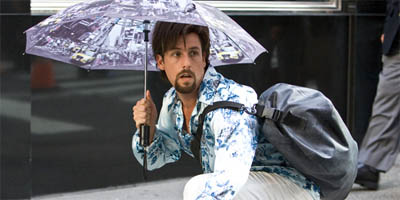
Digression #2: The story of DARK REIGN: THE LIST-- X-MEN #1 is also basically a story about a strange foreign man (Namor) who teaches his nebbish American cousins (the X-Men) how to tame the fairer sex (vagina monster)

zohan This is essentially the story of YOU DON'T MESS WITH THE ZOHAN, Adam Sandler's hit 2008 film about a Israeli super-agent (Zohan) who teaches nebbish American Jews (Nick Swardson) how to tame the fairer sex (Emmanuelle Chriqui). At the conclusion of UTOPIA, Namor joined the X-Men to live on an island nation that X-Men fans appear to be taking to be a metaphor for ... the state of Israel. Coincidence... or Zohan?

...

Well, okay, that one's probably coincidence.

Here is My Favorite Dialogue from the Comic: xxx1

The next panel is a giant monster head flying through a window.

Here is a Fourth and Final Attempt at Context:

The comic was created by Matt Fraction, writer of the independent comic CASANOVA (which was not published in this calendar year), a comic often described as "psychedelic."

Also published this year: various mediocre Batman comics written by Grant Morrison, writer of the psychedelic comic classic THE INVISIBLES.

J.H. Williams, prior to 2009: PROMETHEA. J.H. Williams in 2009: BATWOMAN.

Paul Pope prior to 2009: HEAVY LIQUID, say. Paul Pope in 2009: ADAM STRANGE comics. hodgman December's not over, but I'm going to go ahead and declare 2009 a victory for my fellow squares. Poindexters, and materialists. For those keeping track at home, that's squares: 1,000,000 billion. Heads: zilch.

Here is a Link to the Crusher:

This doesn't really have anything to do with DARK REIGN: THE LIST-- X-MEN #1, but I just love the Crusher.

Here's the part where I just throw my hands up and says "Marvel Comics are TOO good":

Namor the Sub-Mariner's ex-wife Marrina didn't take his last name, at least on her Wikipedia page. She's not referred to as Marrina the Sub-Mariner. Her last name?

Smallwood.

Marrina Smallwood.

Oh, God.

So an argument can be made that Namor must kill his ex-wife, repeatedly, not only to resolve his and the audience's castration anxiety, but because the Marrina character is an embodiment of Namor and the audience's insecurities over the size of their manhoods. Marrina mocks the audience, by her very existence, and so that existence must be ended through loving male violence. TWICE.

True believers, we will agree: Marvel Comics are TOO good.

Here are two quotes I saw today that I want to conclude this one:

"I always believe in following the advice of the playwright (Victorien) Sardou. He said, 'Torture the women!' The trouble today is that we don't torture women enough." -- Alfred Hitchcock

"As for suffering: I believe that there are fewer people than ever who escape major suffering in this life. In fact I'm fairly convinced that the Kingdom of God is for the broken-hearted." -- Mr. Rogers

My Life is Choked with Comics #19b: Manga

(Being part 2 of 2 in a series; part 1 is here)

***

III. JAPAN, HIDE YOUR WOMEN!

I'll ask it again, this time with feeling - what the hell is manga? Or more specifically, what the hell is manga today, in comparison to Western professional print comics?
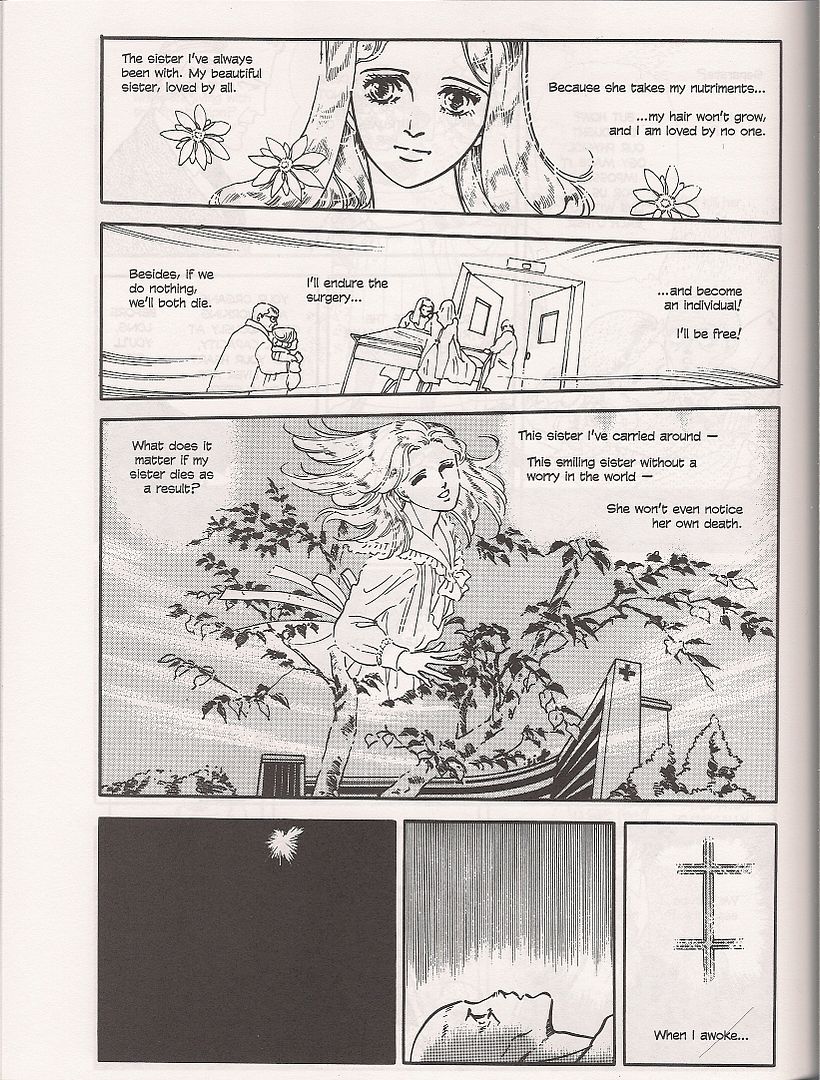
(from Hanshin, as presented in The Comics Journal #269; art by Moto Hagio)

There's matters of presentation and distribution, of course. I've mentioned that before. Manga is digest-sized paperback books, usually serialized far away from Western eyes in terms of venue -- anthology magazines, usually -- and often time, in that even the most popular current series have to wait several months for translations to finish or licensing terms to play out. This contrasts with the typically larger, bookshelf-ready originals of the West's dominant Franco-Belgian and American traditions, or U.S. pamphlets swiftly collected into fatter tomes.

Moreover, narrowing our focus to North America, manga is also the stuff that takes up the most space in big box bookstores, as opposed to the books that line most shelves in the Direct Market. Manga usually reads right-to-left, as it's been for as long as it's taken up the aforementioned space in your Borders and Barnes & Noble, while North American comics should ideally go left-to-right, barring some formal experiment and/or deadline catastrophe; the split doesn't get any smoother than that. Hell, if superhero comics are an especially large subset of popular action comics, then popular action manga can even be seen as a bulwark of 'cartoony' artwork against the preference for 'realism' in so many Marvel/DC series, though obviously these designations aren't absolute.

What is of paramount importance, however, is the word popular. If there's anything I hope I've established by now, it's that manga isn't monolithic, that many styles and approaches exist, that manga is big - enough so that an anthology like Manga could effectively excerpt a nation's comics output in the early '80s so as to arrive at something similar to what was preeminent in North America around the same time, possibly as a stratagem for presenting an unfamiliar, foreign kind of comic as not very different from Western funnies at all, except with samurai and stuff. 'Cause it's Japan!

Today, everybody knows something deeper about manga, if only that manga is a deeper something. It's big and present; it might not show on every Best of Decade list from every visible North American media outlet, but you can bet your ass a disclaimer will be provided upon request begging off coverage for lack of familiarity, because manga will not simply be ignored. You see manga everywhere in a way you don't with other professional print comics, like Fort Thunder-inspired bookshelf collections or superhero pamphlets for kids.

Ha - I bet you can already see how I'm comparing segments of the North American comics scene to a whole nation's output, covering decades of time. In my defense, I'll say that some types of manga remain far more prolifically translated than others -- long form pop comics for boys and girls, generally, followed by a little bit of stuff aimed at older men and a smattering of projects for mature women, with individual publishers specializing in 'classic' or 'art' or 'dirty dirty smut' manga -- though surely the picture presented ten to thirty steps away from your local Seattle's Best caffeine counter hews closer to what's actually most visible in Japan than what was seen in Manga-the-anthology, very far away indeed from the shōnen style evidenced in those 2,850,000 copies of One Piece Vol. 56 on new release day, or the attitude that would prompt an Eiichiro Oda to declare a triple-digit intent for a comic weighing in at 200 pages per compiled pop.
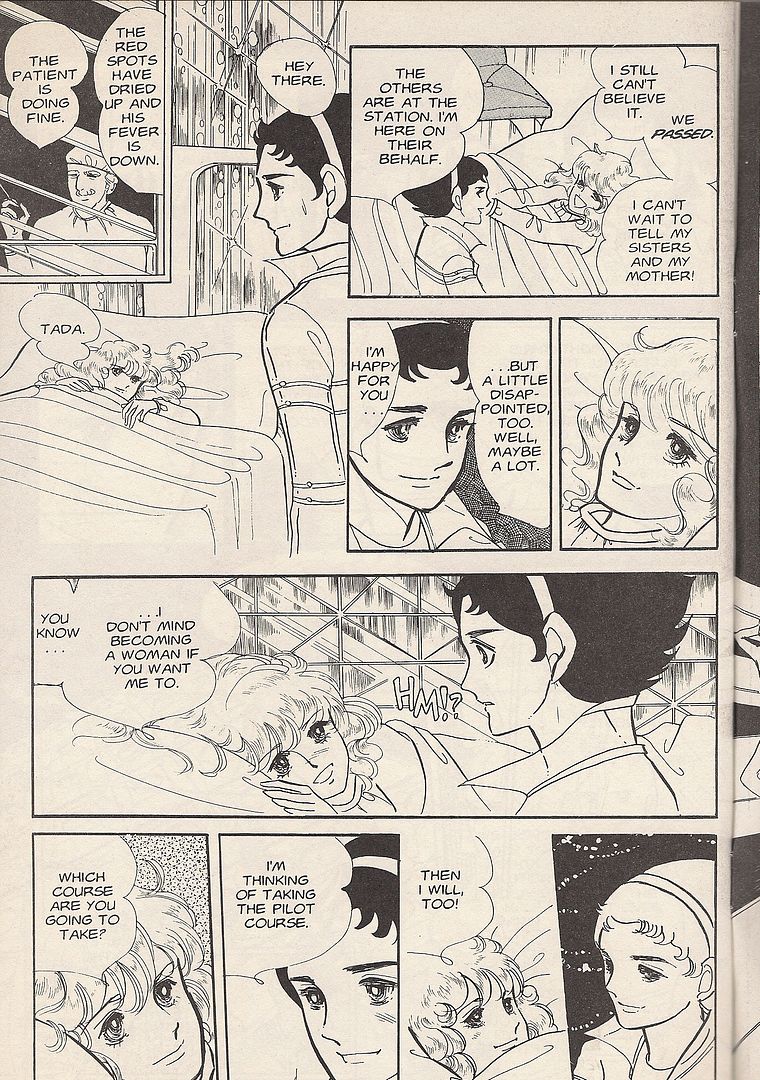
(from They Were Eleven; art by Moto Hagio)

That leads us to something else, something only partially intended by anyone in charge, I think. Here in 2009, in North America, manga functions as a full-blown alternative mainstream of comics; not the 'real mainstream' Oni Press or AiT/Planet Lar pondered earlier this decade -- i.e. something akin to entertainments or artworks popular outside of the comics sphere -- but a 'pure comics' mainstream positioned apart from the English-language way of things, with its own set of values and tropes and genres; a setup where foreignness can be a virtue.

With a few years of that kind of development behind it, manga has become the Other. Having made its incursion on North American territory (European too, though I'll stick to what I know in person), the rhetoric surrounding manga in North American comics-focused circles is now often defined by the void manga has filled in the domestic comics scene.

Manga is comics for women.

Comics for teenagers.

Comics for homosexuals.

Comics for everyone North American comics could have reached but didn't, not in a hugely broad money-making way at least, because obviously there are some North American comics aimed at all of those groups, and women and teenagers and gays that enjoy reading North American comics, but Japanese comics brought lots of them close to the comics form and into the bookstore or onto the websites and sold them many, many things they wanted.

This isn't a zero sum game. Naturally, you can read as many comics as you damn well want; plenty of people in North America read Japanese comics and American comics and whatever UK comics that float in and poor old European comics, which have their own storied history and culture but, high-profile exceptions aside, couldn't be less popular domestically right now if they were printed on the H1N1/09 virus and had to be read with a microscope, which is still an improvement from a decade ago.

But in the commentary, the debate, the Big Picture, the mind's eye of the uncertain observer, the comic book fan who hasn't read a lot of manga, standing in the middle of a male-dominated pop comics culture - manga seems so deep, so complicated, like a foreign language somehow in English, demanding of study, aimed at a different demographic, no part-timers aloud, Your Life Required, signed in blood on the dotted line or don't even open your fucking mouth, fanboy, because you'll just get it all wrong, ducking to avoid manga swung like a club against the shortcomings and weaknesses of North American comics, despite its own troubles, its own failings, its complexities, its accidents and strokes of luck.

The overlap of Japanese and North American comics can get lost. I have no doubt that most of you reading this right now can immediately cite someone, Naoki Urasawa let's say, as a mangaka whose work isn't a million miles away from a good spread of Western comics in aesthetic approach. That's fine, very true. Japan has a bigger comics industry than ours, and some of it, as Manga-the-anthology struggled mightily to show, isn't so different in style from ours.

Yet in manga's multitudes stir popular comics that are very separate indeed, and Manga hid it all away for the early '80s, including the revolution of female artists from just a few years before, the women that set the stage for manga's reign today and inevitably swept off most early outliers, the accidental pioneers we're surveying now.
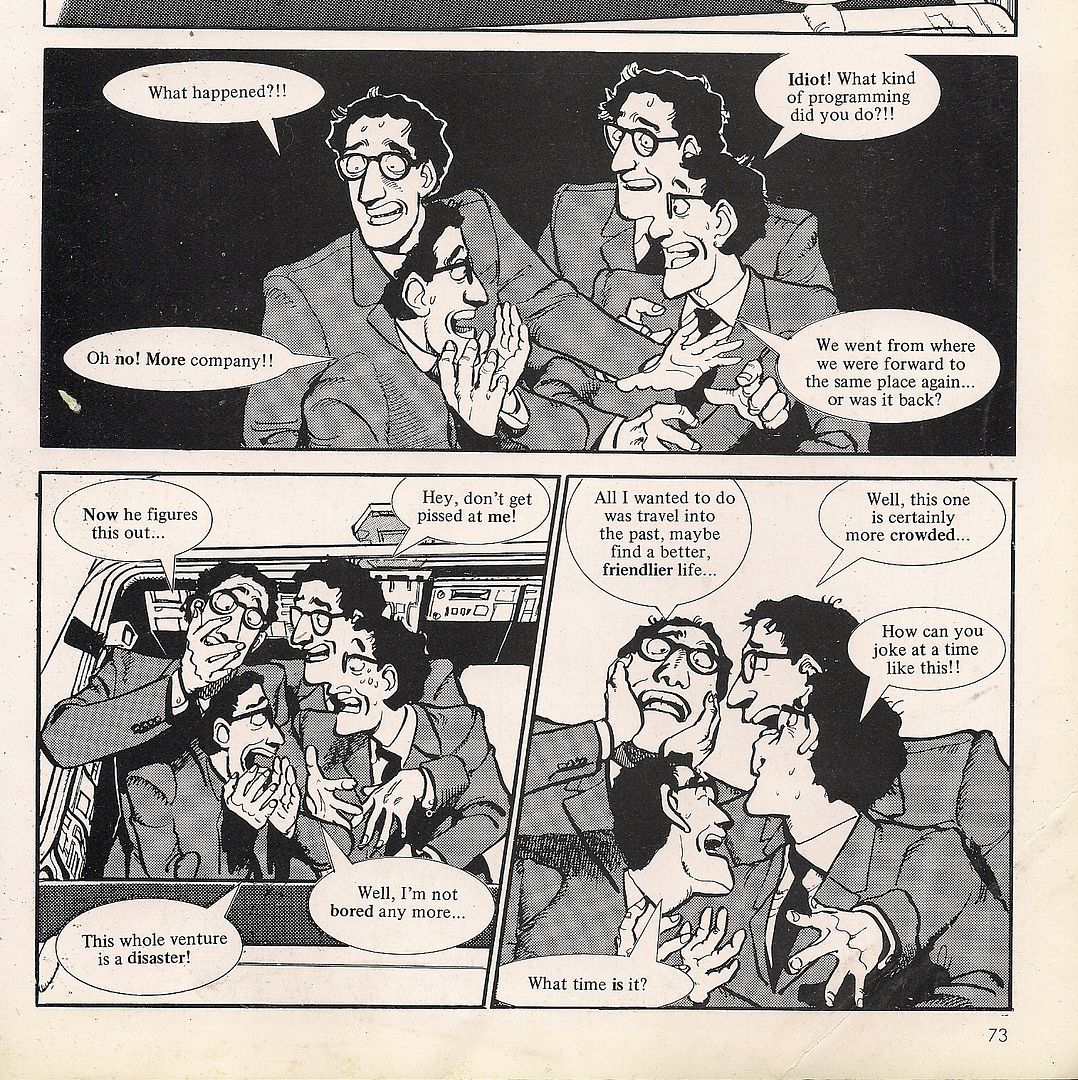
This is the closest Manga came to a segment drawn by a woman: Schizophrenia, by Yôji Fukuyama. That's because Fukuyama was good friends with shōjo manga pioneer Moto Hagio in high school.

Seriously, that's as close as we're gonna get.

On the other hand, the entry does offer a glimpse yet another breed of mangaka still obscure in English translation: the dedicated short form artist. Fukuyama has had numerous collections of short comics published in Japan, with three larger, dreamy projects translated to French and published by Casterman, the longest of them taking up two volumes. Tellingly, the only example of Fukuyama's art I can find in an English edition besides this one is his guest drawings in the French-born artist Frédéric Boilet's 2001 autobiographical romance Yukiko's Spinach (translated in 2003 by Fanfare/Ponent Mon):
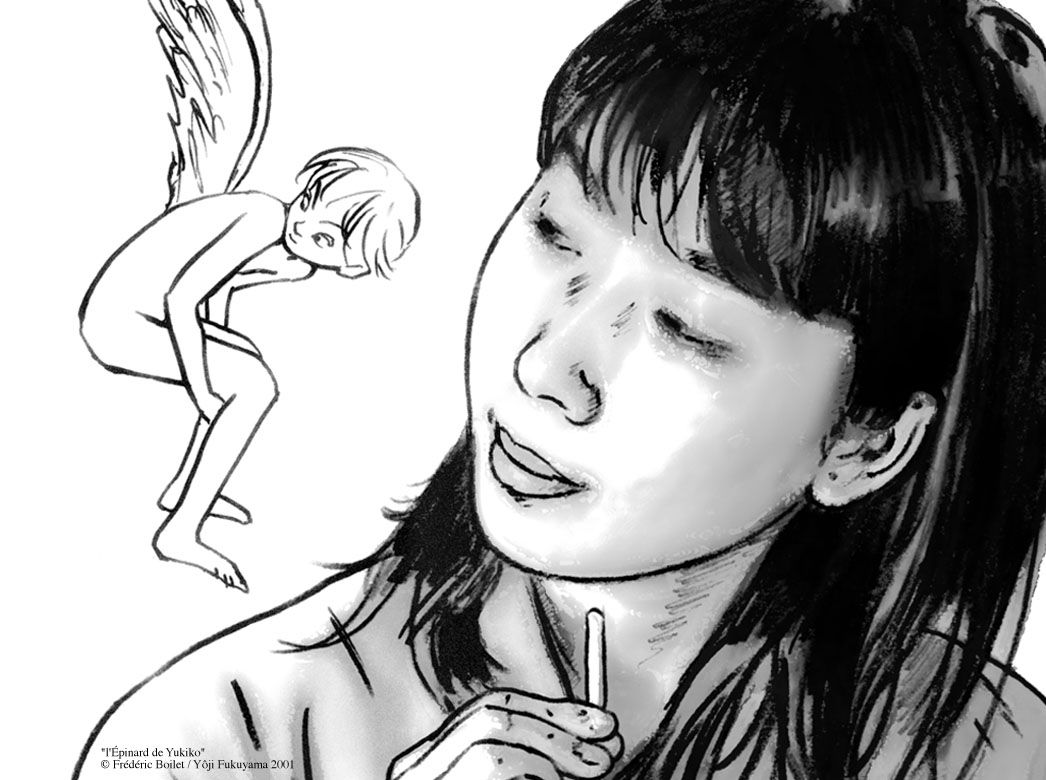
Fukuyama drew the lil' angel. The lovely Japanese woman is, inevitably, Boilet's.

Schizophrenia, meanwhile, is a sort of philosophical sci-fi/comedy thing about a man who builds a time machine to whisk him away to the better world of the past. Unfortunately, his invention only takes him ten minutes into the past, just as he's walking into the room. The two hims then try to activate the machine again, which leaves them only seconds away from where they were before, with their bodies now (then?) fused with the bodies of two more versions of themselves. This continues until the man is a shambling, hideous mass of Him, arms and legs everywhere, at which point they all agree to stay inside and watch television.
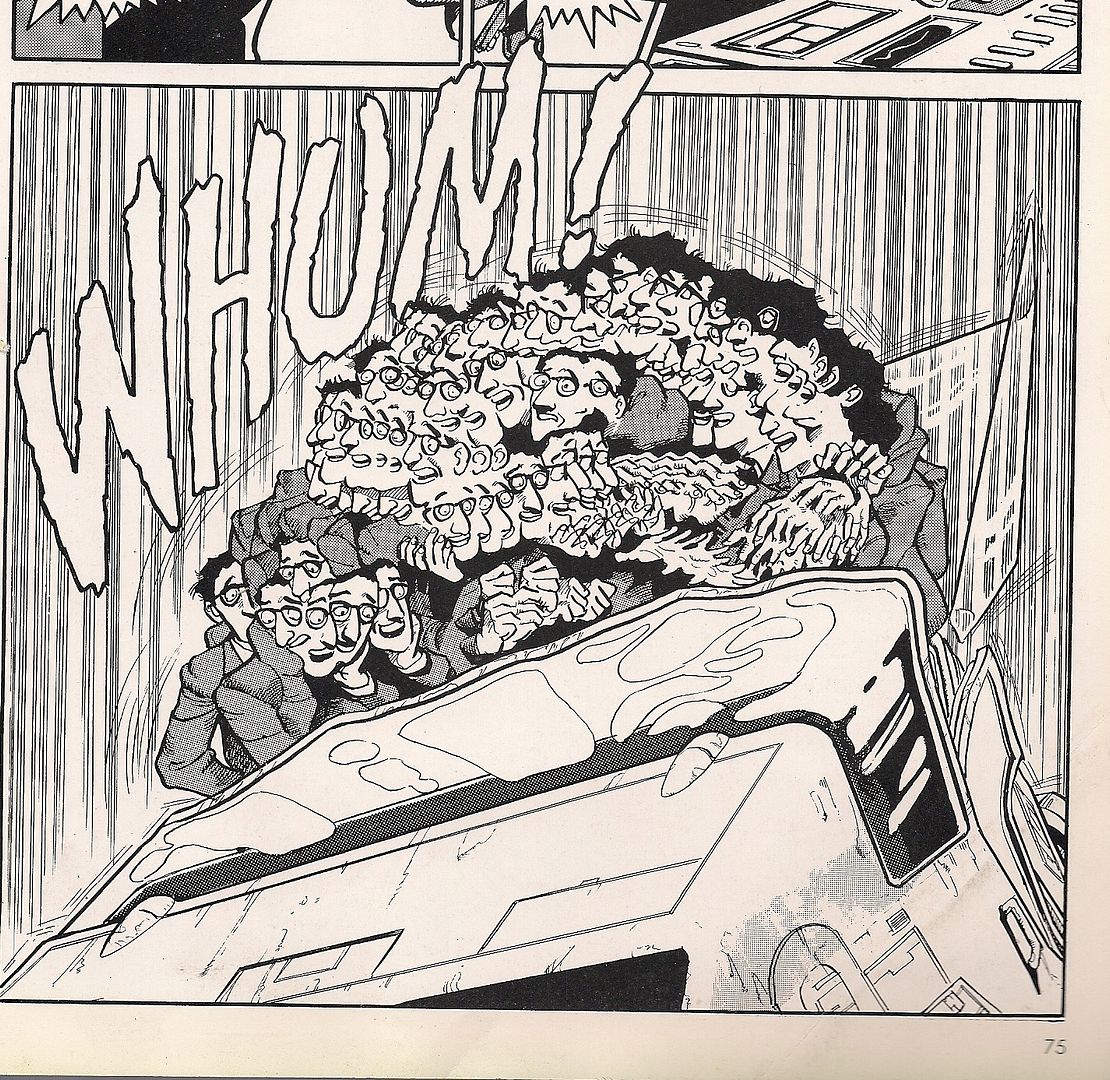
It's a cute (and gross) fable, and oddly precognitive - the doubling motif also appears in one of Fukuyama's recent forays into a different art form, Doorbell, a short anime film he directed in 2007 for the Studio 4°C theatrical anthology project Genius Party. And like all fables, there's a helpful moral: a person can try to change their environment and thereby themself as much as they want, but it's futile. You'll always remain basically the same, if amended by fragmentation to a weird and grotesque degree.

Couldn't that be true of an art form as well? For Manga, where "[n]othing would give us greater pleasure" than to enhance the Western understanding of Japan itself, as per Executive Managing Director Ookawara on the back cover? Maybe as per the unknown desires of Editor X, whom I'll identify soon enough? I mean, we've seen plenty of art so far, but definitely nothing like this:
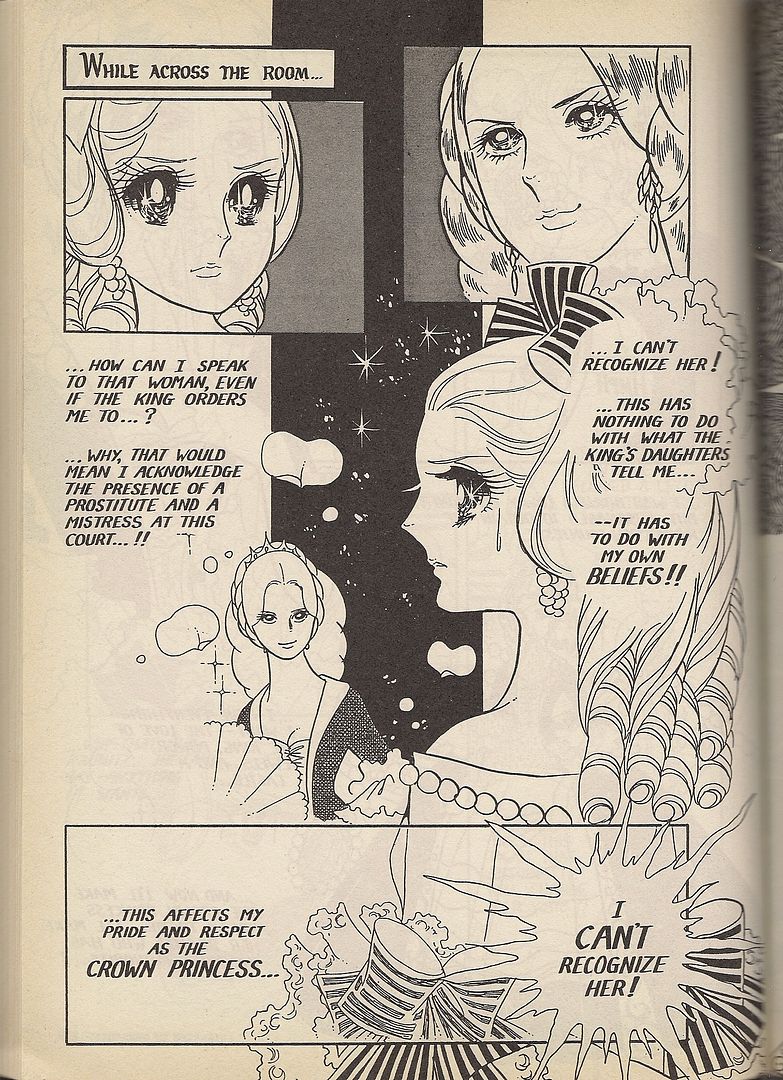
(from The Rose of Versailles, as excerpted in Manga! Manga! The World of Japanese Comics; art by Riyoko Ikeda)

Huge, dewy eyes. Sparkles. Petals. A collage-like page construction. Big ol' close-up of a ribbon at the bottom. That's '70s shōjo manga, comics that grabbed the form by its collar and wrung it loose. It was the work of women, the Year 24 Group, named for the year many of them were born (Shōwa 24 or 1949, giving rise to an alternate North American title, the Magnificent 49ers), a wave of female artists entering the girls' comics scene and forcing its evolution from a staid, often Tezuka-derived style to a dynamic, panel-bursting thing more in line with what 'manga' looks like today on casual glance, ready and willing to accomodate experimental effects and new subject matter. And shit blowing up:
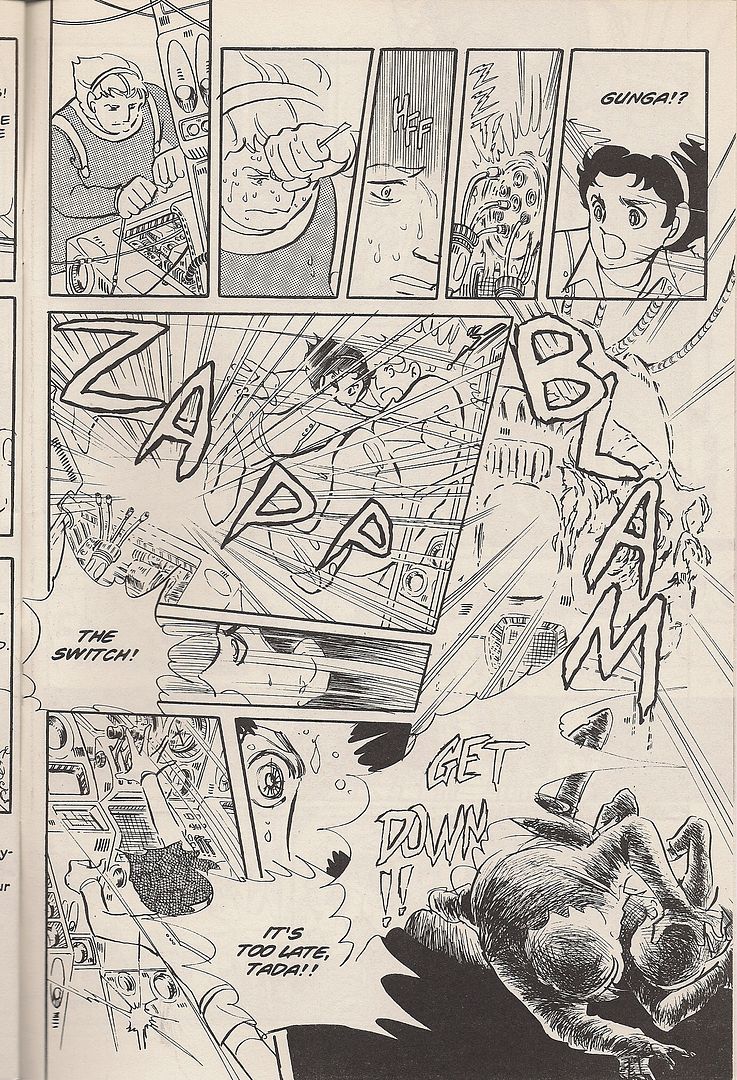
(from They Were Eleven; art by Moto Hagio)

That's from a quintessential shōjo story of the era, Moto Hagio's They Were Eleven, published in 1975 and subsequently adapted to television, stage and screen. I'd say it's the most exciting looking image I've posted so far, and possibly the most confusing. It also looks nothing like any mid-'70s North American comic I can think of, mainstream or underground. It's totally uninhibited - not in the manner of S. Clay Wilson's seething panoramas or Jack Kirby's gesticulating figures, but in how the panel-to-panel storytelling runs screaming down the page, loud and fast so that the unseen activity in between panels registers as just as hyperactive as what's actually drawn. The character art signals its era, yes, but the narrative design is startlingly modern.
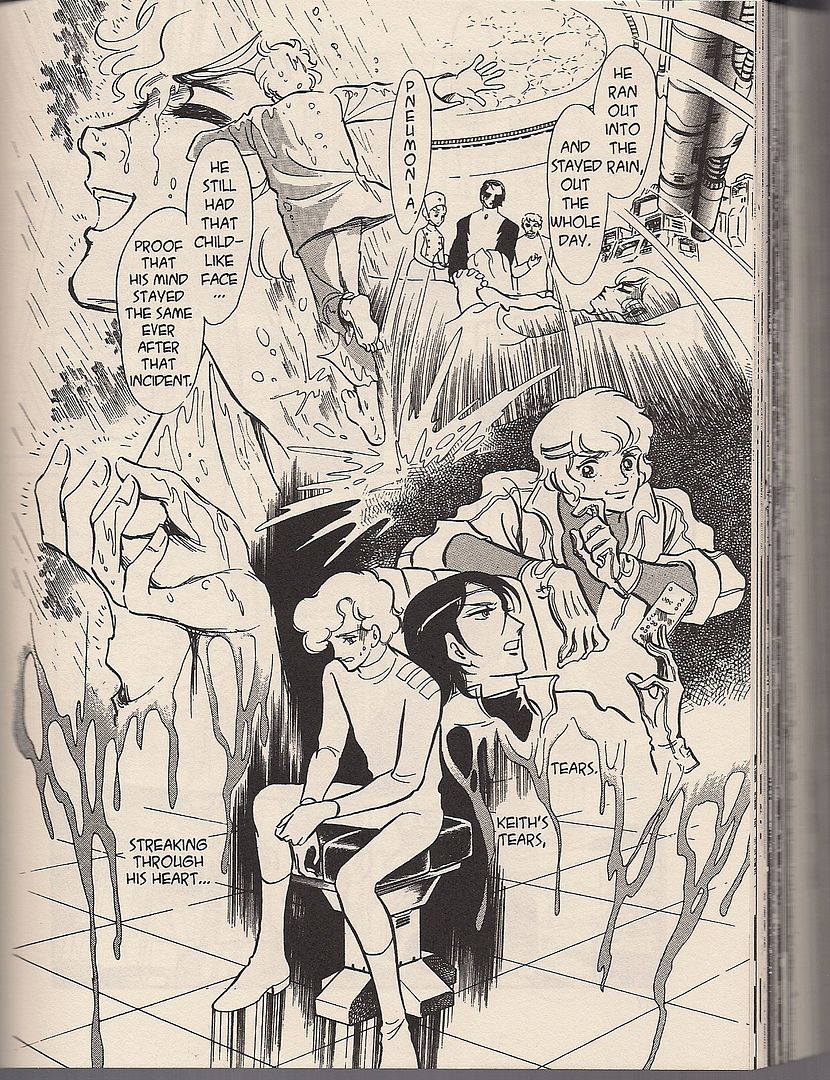
(from Toward the Terra; art by Keiko Takemiya)

None of this is to downplay the efforts of male shōnen artists of the time or the alternative comics talents working in magazines like Garo or really anyone else -- the '70s are often considered a Golden Age for manga all around -- but female artists like Hagio and Riyoko Ikeda and Keiko Takemiya were working toward what amounted to a popular avant-garde, big-selling comics that pressed firmly against what 'comics' were capable of, drafting a new iconography for new layouts that married pulsing fast reading to pages that stood as self-contained expressions of their characters' psychological states while getting the story told.

And that's to say nothing of subject matter, including the mid-'70s development of shōnen-ai, "boys' love," aestheticized same-sex desire which begat the more explicit yaoi of the self-published dōjinshi scene.
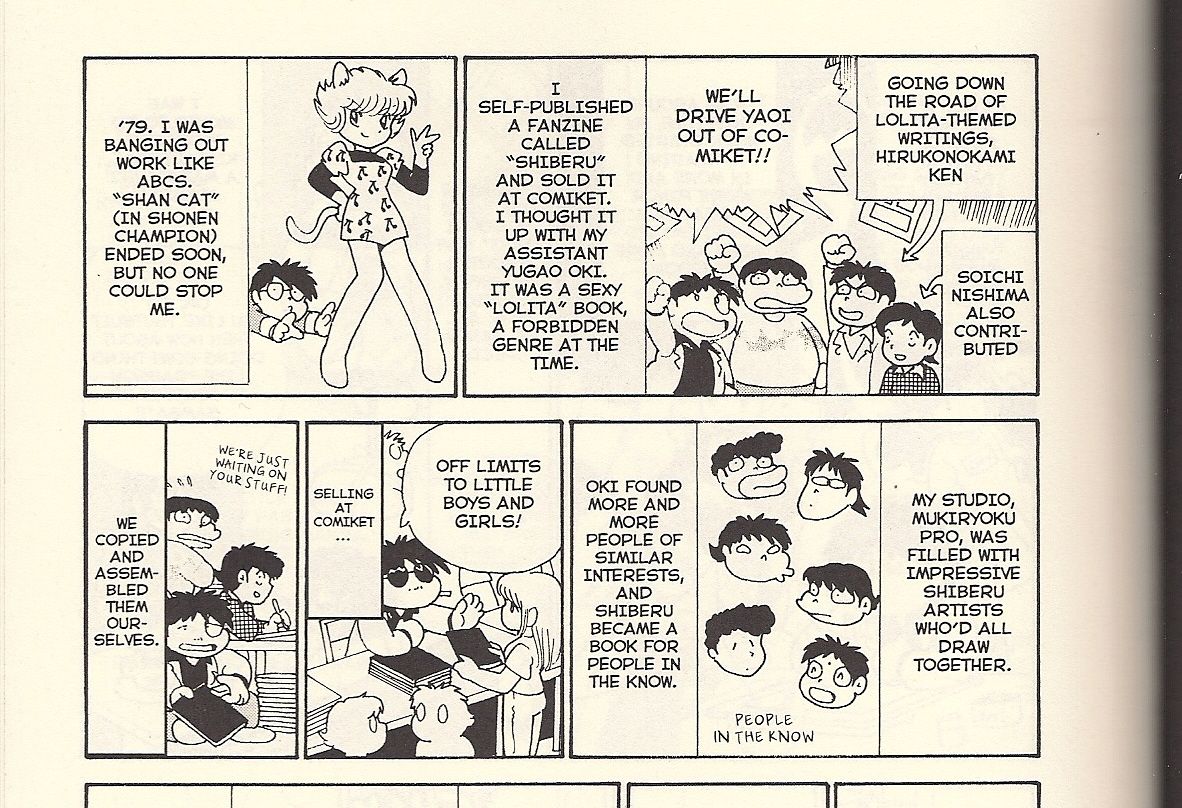
(from Disappearance Diary; art by Hideo Azuma)

As you can see, the heavy female presence in fandom toward the end of the decade was not without opposition. Girls and their fanfic and their slashfic; sometimes I get the feeling that some North American funnybook readers see 'manga' (or anything that looks like it) as the Twilight of world comics due mainly to its visible female readership, or maybe just its feminine aspect, emphasized by the relative absence of women reading a wide swathe of North American comics. Which means more money for woman-targeted manga, which means more poppy shōjo on the shelves; it should be noted that josei manga, aimed at mature women, has had a harder time getting a foothold in North America.

Anyway, it's no surprise then that Manga-the-anthology put its fingers in its ears and shut its eyes to the very presence of female comics artists upon its early '80s release, to say nothing of the influential visual experiments they conducted - the prior decade had not been a Golden Age for North American comics, with the underground scene witnessing a distribution meltdown and neophyte mainstream artists expressing belief that they'd be the final generation of comic book artists. The Direct Market was still young by the time 1980 rolled around, and while woman-targeted, woman-drawn and/or woman-appealing comics existed, they were niche in the niche that comics already were, and good business perhaps suggested that they and their formal tricks were best kept obscured from a foreign anthology's window view unto Japanese culture.

Instead, we got this:
God! An old fashioned space-faring yarn with a gorgeous woman looming over a rogue adventurer and his manly facial hair while he ponders his latest tight spot! I love this vintage pulp story type of comic, and I bet artist Yukinobu Hoshino (credited as Yukinori Hoshino) loves it a hundred times more. In the tradition of fantasy-variants-on-old-stories from comics and magazines past, The Mask of the Red Dwarf Star transposes a Poe classic to the sea of stars, as con man Roscoe finds himself captive on a luxury vessel dedicated to carting rich old folks in cryogenic slumber all over the universe, thawing them out for only the rarest and most novel sights, like an imminent supernova
Hoshino draws in a stately, handsome manner; if Manga was aiming to be an irregular Heavy Metal for Japanese comics this is the entry that sells the notion completely, packed with bleeding rich color art reminiscent of Howard Chaykin's work on Cody Starbuck around the same time, but with an evident 'realist' manga approach to the character designs. There's wit along with the gloss - the story's colors are derived from the seven rooms identified in The Masque of the Red Death, with the red dwarf hanging in the void as illustrated above standing in for the red light bathing the black and final room, the chamber of death presented as icy, lifeless space.

The artist was part of a male manga generation that debuted in the mid-'70s and adopted a Western, often European approach to page design and in-panel detailing; the best known of these artists in North America is probably Akira creator Katsuhiro Otomo, and while I don't know of any direct influence of his on Hoshino's work, his time of the latter's arrival on the scene plugs him in with that faction, although Jason Thompson, in his Manga: The Complete Guide, argues that Hoshino is more in line with an older artist, infamous Crying Freeman/Sanctuary super-realist Ryoichi Ikegami, a Garo alum that blazed a Neal Adams-influenced trail through the post-gekiga/seinen Manga for Men arena for most of the 1970s, with a few memorable layovers in boys' comics like the official '70-71 Spider-Man manga.

Hoshino's visual disposition made him ideal for Manga-the-anthology, and attractive to an early manga-in-English industry that valued artists like Otomo and Ikegami for their Western approach. VIZ published Hoshino's 1984-86 hard sci-fi story suite 2001 Nights as pamphlets in 1990 and 1991, and then as three collected volumes in 1996, while presenting an abridged edition of his 1987 story collection Saber Tiger in 1991 as part of its short-lived Spectrum line of oversized softcover books of heavy-detail art, along with Natsuo Sekikawa's & Jiro Taniguchi's Hotel Harbour View (which is awesome) and Yu Kinutani's Shion: Blade of the Minstrel, (which is not awesome in the slightest, but makes for a great trivia answer).

Later, Dark Horse published Hoshino's 1993-94 manga adaptation of James P. Hogan's The Two Faces of Tomorrow as a 13-issue miniseries in 1997 and 1998, then didn't collect it until almost a decade later in 2006. By that time, Hoshino's type had almost vanished from North American manga publishing, like they were wiped out by a supernova blast as filtered through a ruby crystal into a laser beam aimed at a spacecraft, in the hoary pulp SF tradition.
Hoshino remains active in manga today; he just won an Excellence Prize at the Japan Media Arts Festival last year for his episodic 'manly professor of folklore solves mysteries, maintains mustache' series Munakata Kyōju Ikōroku (Case Records of Professor Munakata), ongoing in some form since 1995, anticipating the release of a twelfth collected volume next month, and currently enjoying its own exhibition at the British Museum until January 3, 2010.

We may yet see more of him in English, though his type of comic doesn't make the kind of money from the target audiences that 'manga' as a live concept embodies these days. You look at his art and it's pretty and skilled, but it embodies the spirit of a dashing space cowboy zipping out of danger with a freshly-rescued hottie at his side, still bound and gagged, regarded with a friendly enough leer.
Aw, don't sweat it babe. He'll cut you loose when he knows you're ready.

IV. WE'RE ALL JUST ANIMALS

And speak of the devil: Katsuhiro Otomo!
Yep, the man himself is among the Manga artists, his entry probably composed while he was working on Domu: A Child's Dream, the esper action epic that honed his skills for the Akira project. Otomo was actually a prolific creator of short, often experimental comics prior to that, though this large body of work is nearly unknown in North America. I can only think of the 1992 Epic one-shot Memories, which presented a short story later adapted to theatrical anime form in a 1995 anthology of the same title (though a 1995 Random House Australia release also titled Memories boasts over 200 pages of Otomo shorts in English for those willing to hunt and pay).
The Watermelon Messiah makes for a tricky-cute seven pages, similar in outlook to Otomo's opening to the anime anthology picture Robot Carnival from 1987, in which the film's title -- literally a clattering, smoking, gigantic ROBOT CARNIVAL -- goes parading through a hapless village and wrecks the place with entertainment or just the promise of such. It's a first world story, anxious about progress at a time where Japan in particular seemed primed to take on the world.

Otomo's story in Manga is more about unity, but just as downbeat: in a series of long vertical panels, a gigantic watermelon zooms through space toward a ruined, ragged civilization of scavengers among fallen skyscrapers. The space melon strikes the ground and splits apart, and a final splash depicts tiny people crawling all over it like ants.
Stripped of our technology, our progress (and our comics industries, no doubt), we're tiny and similar in our helplessness, every color and creed as pathetic as the next under the eye of an uncaring god, to flaunt a Western idea. Japanese comics - taste the sensation!

Here's another trick, a story titled Midsummer Night's Dream, conceived and drawn by Keizo Miyanishi and written in English by Lee Marrs, the project's lone female participant and the only Westerner granted a story credit above the expected English adaptation work. The plot is simple: Hikaru Genji, ice-cold negotiator with a most literary name, stops to admire a Yugao flower while on a journey and finds himself duly confronted with the splitting image of his beloved dead mother, accompanied by a beautiful Lady. Genji hits it off well with the Lady, but their night of passion ends with her disappearance: ah, the women were just spirits in disguise, playing a trick so as to unlock Genji's sensual warmth for his own good! Captions assure us he later hooks up with a neighbor's daughter. THE END.
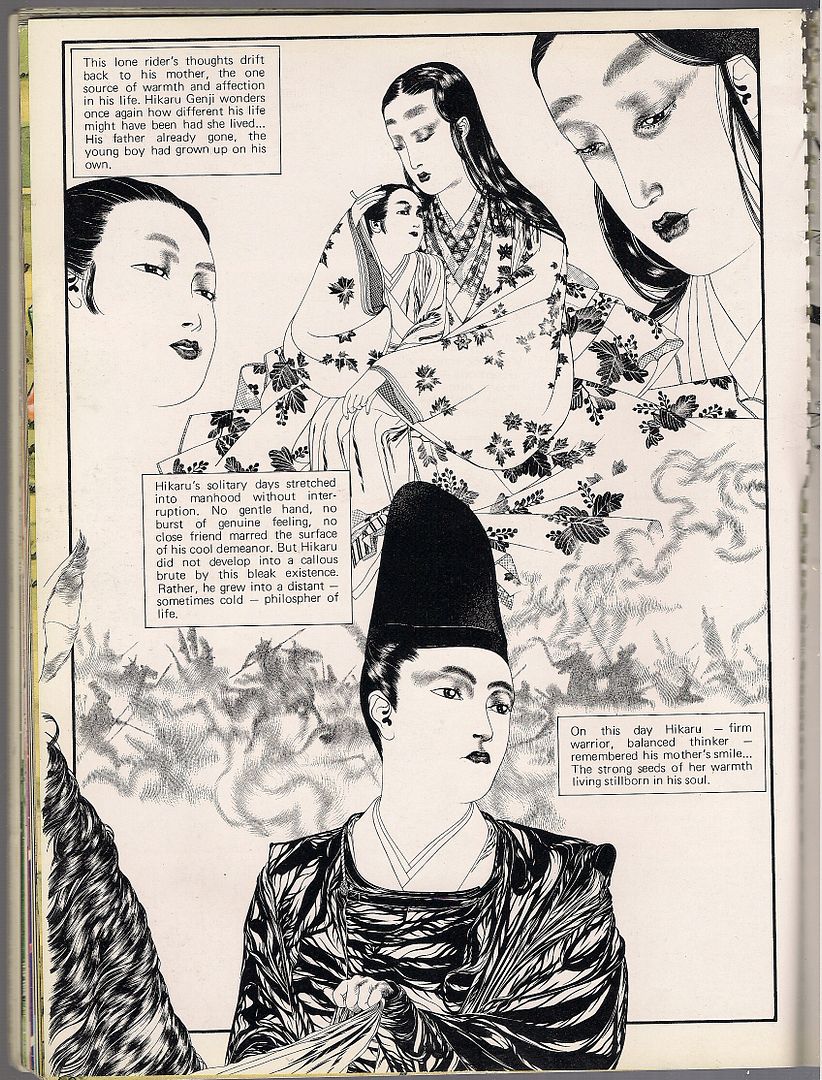
The allusions to Shakespeare and Lady Murasaki are obvious. Mono no aware is absent, replaced by an 'in praise of love' outlook that seems to apply the English drama's faerie-tamper'd romance as a salve to the crueler fates witnessed in The Tale of Genji, where "Yugao" was a perfectly human woman who died from her own encounter with a spirit, sent by another lover of Genji, the Shining Prince.

You can catch some approximation of that Heian beauty in Miyanishi's character art, which seems mildly evocative of Yamato-e narrative painting, a tradition dating back to Murasaki's era. Thus, the primacy of the Japanese half of this mash-up rests in the visual aspect, undercut by Marrs' Western dramatic citations in her story. It doesn't add up to a lot as a comic -- 'Genji as a short story with a happy ending' sounds a bit like a joke about an American version of the tale -- but its give-and-take between literary traditions mirrors some of the struggle between English and Japanese-based comics traditions going on inside the Manga project.

And isn't it striking that we've got another departure from the North American comic style here - once again, as it was with Hiroshi Hirata's work, given an apparent pass by the exotic, easily-identifiable look of the work?
The trick is, Miyanishi's classicism isn't mainstream in manga at all. He's actually an alternative cartoonist, far more underground than anyone else in the book, slated to appear again in English soon as part of Top Shelf's Ax: A Collection of Alternative Manga. But even around the time of Manga, he more prone to images like this, from a 1979 book cover:

He wasn't a prolific alternative cartoonist, however (although Midsummer Night's Dream did later show up in a 1990 collection of his short stories); he seems frankly better known online as mastermind behind the music act Onna, accompanied by images like:
But if you look close at his Manga disguise, you can see untoward detail about the eyes and lips. A Renée French fuzz. A lust beckoning undirected release from tradition. This can go several ways.
There's an issue that crops up sometimes in discussions of manga: whether 'manga' is really 'comics.' Some think not! As you can tell from my free usage of 'manga' and 'Japanese comics' and 'funnybooks' and the like, I'm naturally disposed to thinking otherwise. They're all words and pictures, right? Like how people are all the same, breathing the same air, bleeding the same blood. All ants, all specks, when you pull back enough. Fragile creatures; who has the time for conflict?
Why drive wedges between us? I was raised Catholic, so that's the kind of nerd I am. You can't go in with a lot of preconceptions though, if you want it to work. You can't think of 'comics' as 32-page floppy books in color. Or anything beholden to genre. You must accept that writers don't have to be in charge, that the whole idea of a "comic book writer" might be an anomaly, a sub-specialty in an art-driven storytelling. It doesn't have to be that way, it never has to be; values will compete, opinions may vary, but comics never have to be limited. Anyone of any age can read comics; any subject matter can be approached. You don't even need storytelling, because comics hide a 'fine' art aspect, a gallery art relationship in spite of or energized by its history of mass production, not that comics even need to be mass produced.

Does manga stand for all that? No, god no, but to stand that far from particulars is at heart to prepare yourself to know comics from any angle, to delve with the eye for permutation, energies old, slow or new in a whole cosmos.
God help me, the further I go the less I'm comfortable with that. Sometimes I think maybe manga isn't comics. Moreover, it shouldn't be.
What is comics? What's your history with comics? Should comics exist in the world? If so, as works of art, they have some cultural force, muted or smothered as it may be. Inevitably, this force will be specific to the culture, even if the signal is so weak it only covers the culture of comics publishing.

When the book titled Manga entered the culture of North American comics publishing, it was not in a form representative of the words & pictures called manga. Instead, intentionally or not, it matched the culture of North American comics in the early '80s as best it could: a magazine-sized, Heavy Metal-looking publication full of richly detailed art, sometimes of an authentic but stereotypically "Japanese" flavor. No formal advancement was present beyond what was known to North America. No demographic were pursued beyond the cultural norm. Manga was comics then, because it accepted the terms of the culture.

To call manga 'comics' today, don't we impliedly accept those terms again? Maybe we want to, but let's say we don't - is it wise for a North American comics reader to accept manga as 'comics,' when the terminology suggests the former can only become part of the latter, melding an insurgent popular mainstream into a smaller, older one in a way that flatters received wisdom? I'm talking semiotics here. Manga as manga has a strength that manga as just comics doesn't; in rejecting the aesthetic terms of comics, in suggesting 'comics' become more like 'manga,' don't we preserve and emphasize the progressive aspects of the Japanese form for better, deeper comparison, now that manga has gained the capitalist muscle around here to take a few swings?

Doesn't conflict make things stronger?
The burden there, I think, is not to excerpt so much. I've been going on and on about popular comics and popular manga, but what of the virtue of unpopular things?

In the macro sense, you can view comics as among the least popular iterations of North American pop culture, which arguably puts it in a unique position to offer cultural resistance. Certainly U.S. comics don't export like U.S. film or U.S. television, or fast food or soft drinks; indeed, a symptom of comics' stature is that manga has managed to build its presence as much as it has. Can you imagine Japanese pop music holding an equivalent position in the United States of America? Part of the thrill I get from comics is that it seems so pliable right now, so rich with potential. So under-studied, so unburdened with financial expectation yet so fucking young!

It'd be a mistake to overstate manga's influence in Japanese culture -- there's plenty of trouble in the air with declining circulation and competing forms of entertainment, stretchy pirates notwithstanding -- but it's plain that manga enjoys an enhanced status as a mass entertainment medium. And, as happens with mass media, money has gone in and formulae have gotten tight; the big circulation youth comics have become very editorially guided, their ingredients laid out in order as law, at least when not subject to the whims of reader response surveys maximizing consumer satisfaction.

It's said that there's little in the way of an 'art' comics scene in Japan, though the sheer size of the industry and the breadth of its history assures that Western readers won't be left hungry too soon, if the publishers remain willing and viable. Even then, manga artists seem distinctly less taken with the specifics of the comics form, instead focusing on tone or sensation or shock or drawing; use of the form as a mechanism. The closest I've seen a mangaka get to Asterios Polyp is Shintaro Kago, and his formalist mindfuck comics are both an awesomely extended sick joke and only part of his oeurve anyway.

There always seems to be less fretting about manga in manga, and I wonder if that isn't due to the comparatively smooth evolution it's had across the 20th century; PTA struggles and a lack of highbrow respect, sure, but nothing like the Comics Code Authority or the industry crash of the mid-'90s. Could it be that manga as an industry isn't as hungry for validation as comics, that artists may be hungry but must be content with remaining sort of small, while comics is small enough that the idea of 'literary' comics has materialized prominently in our midst? Is manga the better pop comics? It it best as only pop comics? Can I really say a single worthwhile goddamned thing about a popular culture inaccessible to most of us and in a language I can't even read, half-visible in translation financed by the gaps it fills in my pop culture's shortcomings and soured, biased in that way?

Gah! Catholic angst at its best! Give me something to pluck from the comics cosmos! Some worl manga insight! Just tell me something about my life, funnies! Harrow my soul! Prepare me for death!
It's a march, the perception that is manga in North America. Manga-the-anthology wasn't adept enough to reproduce and it probably didn't influence much of anything, but the conditions it existed in remained present as manga slowly grew. The big three manga publisher Shogakukan shelled out the money to form Viz Media in 1986, teaming with Eclipse Comics the next year to release manga pamphlets: Sanpei Shirato's ninja comic The Legend of Kamui; Kazuya Kudo's & Ryoichi Ikegami's mutant power-like esper serial Mai the Psychic Girl; and Kaoru Shintani's jet fighter action series Area 88, which was actually very much cartooned.

Within, without. The same year Viz was established Canadian-born writer and cartoonist Toren Smith -- who had helped coordinate the Eclipse deal and worked on some of the publisher's early English adaptations -- formed Studio Proteus, a freestanding entity that would acquire licenses from Japan with the approval of a North American comics publisher (usually Dark Horse, as it would pan out) and provide flipped (left-to-right), translated comics for distribution. It'd be totally wrong to say that Studio Proteus only worked on bloody sci-fi and action comics, but I don't think it's off the mark to say that those Katsuhiro Otomo and Masamune Shirow and Hiroaki Samura releases are well-remembered by readers of my age.
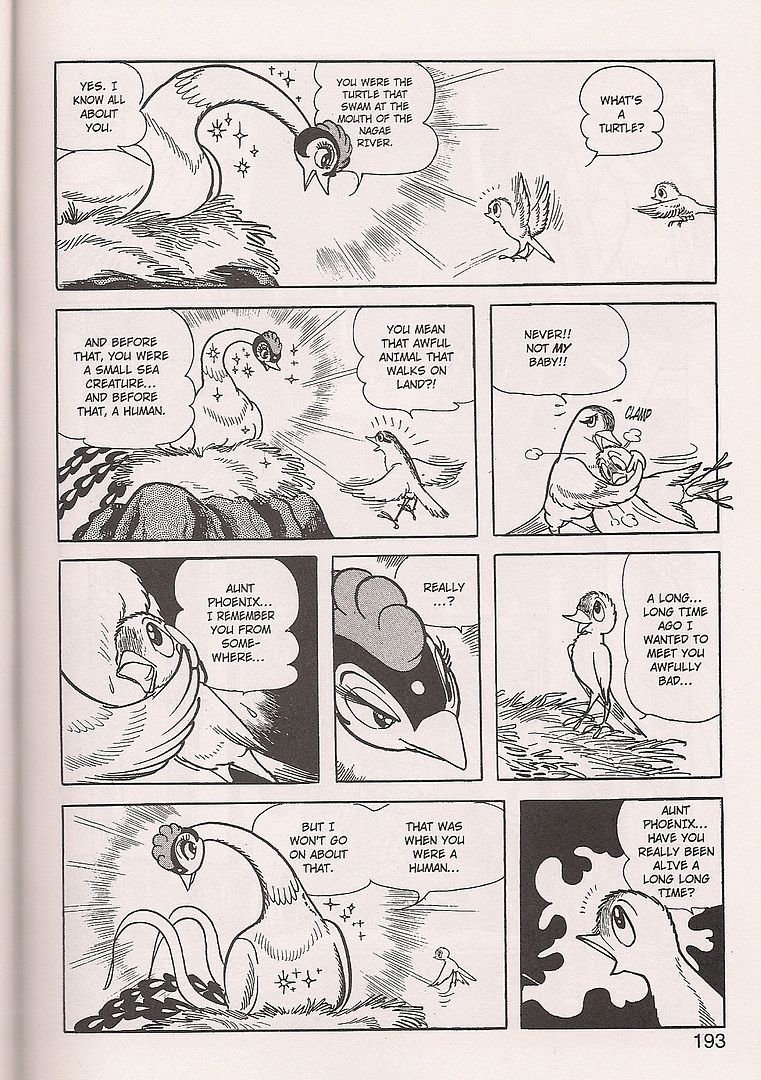
All the while, there was anime, which should not be underestimated as a force in drawing eyes toward manga. It's funny that Japan's animation industry is so male-dominated and increasingly focused on milking every last drop of money out of its harder-than-hardcore otaku base, because anime in the U.S. became an open thing as VHS tapes gave way to Sailor Moon airing on television in the mid-'90s, slowly building more of an audience of girls and women that later bought the Sailor Moon manga from Mixx, which later became Tokyopop, which personified the unflipped, digest paperback manga that made history when the bookstores picked it up.

Every bit of that -- manga for girls, direct-to-bookshelves, right-to-left -- had been tried earlier. But as the 21st century crept forward, manga assumed its new identity, and the old experiments and comic book-friendly standbys didn't always find a place. They were as much manga as anything else, but what manga is had to change.
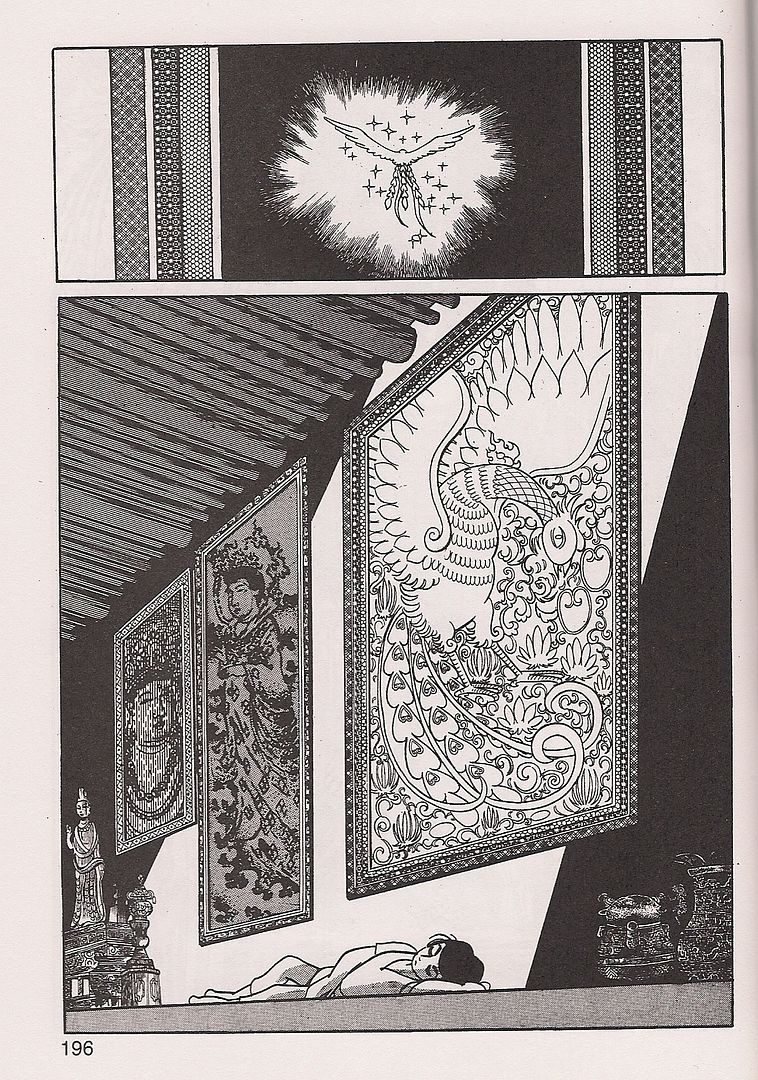
(prior seven images from Phoenix: Karma; art by Osamu Tezuka)

Let me tell you now about the editor of Manga: Masaichi Mukaide, the first mangaka published in English in the Direct Market era.

V. I WAS BORN, BUT...

You'll remember that Mike Friedrich served as Manga's consulting editor. Friedrich's pamphlet-format anthology series Star*Reach, launched in 1974, was a noteworthy 'bridge' comic between the underground stylings of that just-passing era and the genre-hungry territory of a mainstream still hobbled by content restrictions. They called 'em "Ground Level Comics" back then, playing on under-aboveground terminology and presenting themselves as stop #1 in the new comics future.

In his publisher's note at the top of Star*Reach #7, released in 1977, Friedrich highlighted the international flavor of the issue, including a contribution by two talents from Japan: writer Satoshi Hirota and artist "Mukaide," only one word. This was one year prior to the initial English-language release of portions of Keiji Nakazawa's Hiroshima bombing-themed serial Barefoot Gen, leaving only made-in-the-USA oddities like 1931's The Four Immigrants Manga known to me before it. I will admit, however, that the story Hirota & Mukaide created -- The Bushi, six pages -- may not have been published prior to its Star*Reach appearance.
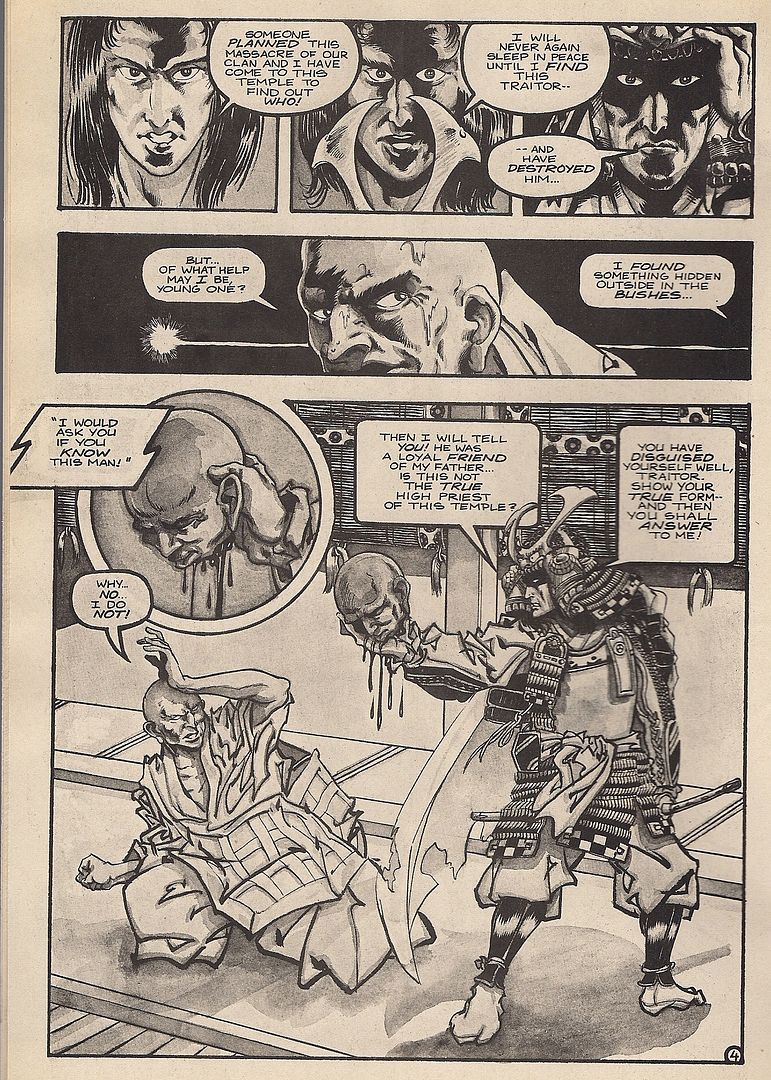
As you can see, Mukaide drew the piece in a very American-looking style, giving me the impression that he might have been a dōjinshi artist or small press guy aiming to break in with U.S. comic books. I can find no record of any Japanese-only comics he drew, nor can I find the slightest mention of writer Hirota working in comics or manga anywhere again. Friedrich is credited with "additional dialogue," hinting that he might have eased the script into English, if that was the language it was initially written in - no translation credit is given.
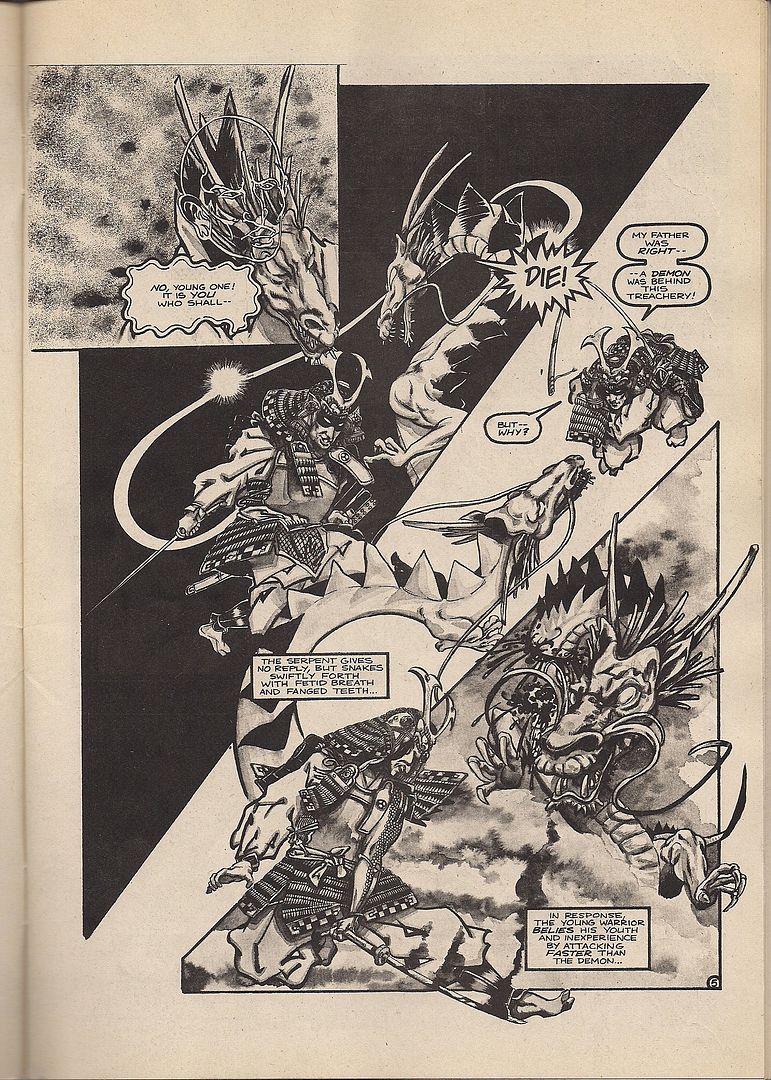
Hopefully some answers will turn up in a letters column somewhere since Mukaide became a minor fixture in Friedrich's comics at the end of the '70s, illustrating stories for the aforementioned Lee Marrs and Steven Grant in issues #15 and #18 of Star*Reach, and showing up in half the six-issue run of sister series Imagine (#3, #4 and #6), working again with Marrs in issue #4 but writing his own work otherwise.

I haven't gotten hold of any of these other comics, just Star*Reach #7. Mukaide's art isn't the kind you stop to notice; you look at his story of a samurai fighting a demon only to pass the test to become a demon himself (ha ha ha ha haaaa!) and you imagine a 1977 comics reader blinking a few times and going "huh, Japan," having maybe seen some televised anime before or communicated with fellow enthusiasts preparing to ramp up first generation fansub operations. You'd have had to physically go to Japan to encounter any other manga at that point.
By the time Mukaide edited Manga his draftsmanship had gotten noticeably better, very design-oriented with stylish use of blank or toned space. His story was titled The Promise, concerning another samurai's encounter with a spirit. Poor Kwairyu is a survivor of a lost war, only looking for a place to rest his war-weary bones for the night, but his companion winds up frozen solid when they enter the home of a pure white woman. She takes pity on Our Man, but warns him that he's as good as dead if he ever tells a soul what he's seen.
This is an old tale, an encounter with a Yuki-onna, a spirit first brought to English in Lafcadio Hearn's 1904 folkloric tome Kwaidan: Stories and Studies of Strange Things, which saw its version of the story adapted to the screen by director Masaki Kobayashi in his 1964 anthology film Kwaidan. I first encountered it as the basis for the Lover's Vow segment in Tales From the Darkside: The Movie, which may not have the same cineaste cachet, but also added gargoyles, so it totally balances out.

It was a poetic choice for Mukaide, suggesting an early meeting of East and West through Hearn's study, charging his editorial duty with metaphor. We can get fancy with this. Kwairyu begins to thrive after his chance meeting with the white woman, as does Mukaide, his writing partner Hirota frozen after their own early encounter with Western comics. Manga was the biggest, most complicated campaign he ran, full of striking forces in effective dress. The end was already drawing near.
Did I forget to define mono no aware earlier? It's a literary concept that came up in study of the Tale of Genji, then grew to become a vital trait of Japanese art in general, like a deep dream image suddenly given words to describe it and thereby made memorable while awake. Put simply, it's the idea that nothing is so lovely as when it is fleeting - an appreciation of the ephemeral qualities of living. A tiny pang, an ache at seasons passing, of romance quieting, of sweet youthful rituals put away, sakura suspended in mid-air, and, most profoundly, the scent of yellowing paper wafting up from an open longbox.

Kwairyu meets a wonderful woman. They marry. She swoons and her breasts are shown for the reader. Mighty Kwairyu comes upon the ruins of that snowy home from years ago. His wife lays nude on a black swipe across the top of a page. Foolish Kwairyu tells her of the spirit, which is of course her. It begins to snow indoors. Time is changing.
I don't know when Manga was published. I don't know where it was sold. I don't know how well it sold. I don't know what happened to Executive Managing Director Tadashi Ookawara. I don't know if I'll ever see half these artists in English again. But they were here. I know what Manga was.
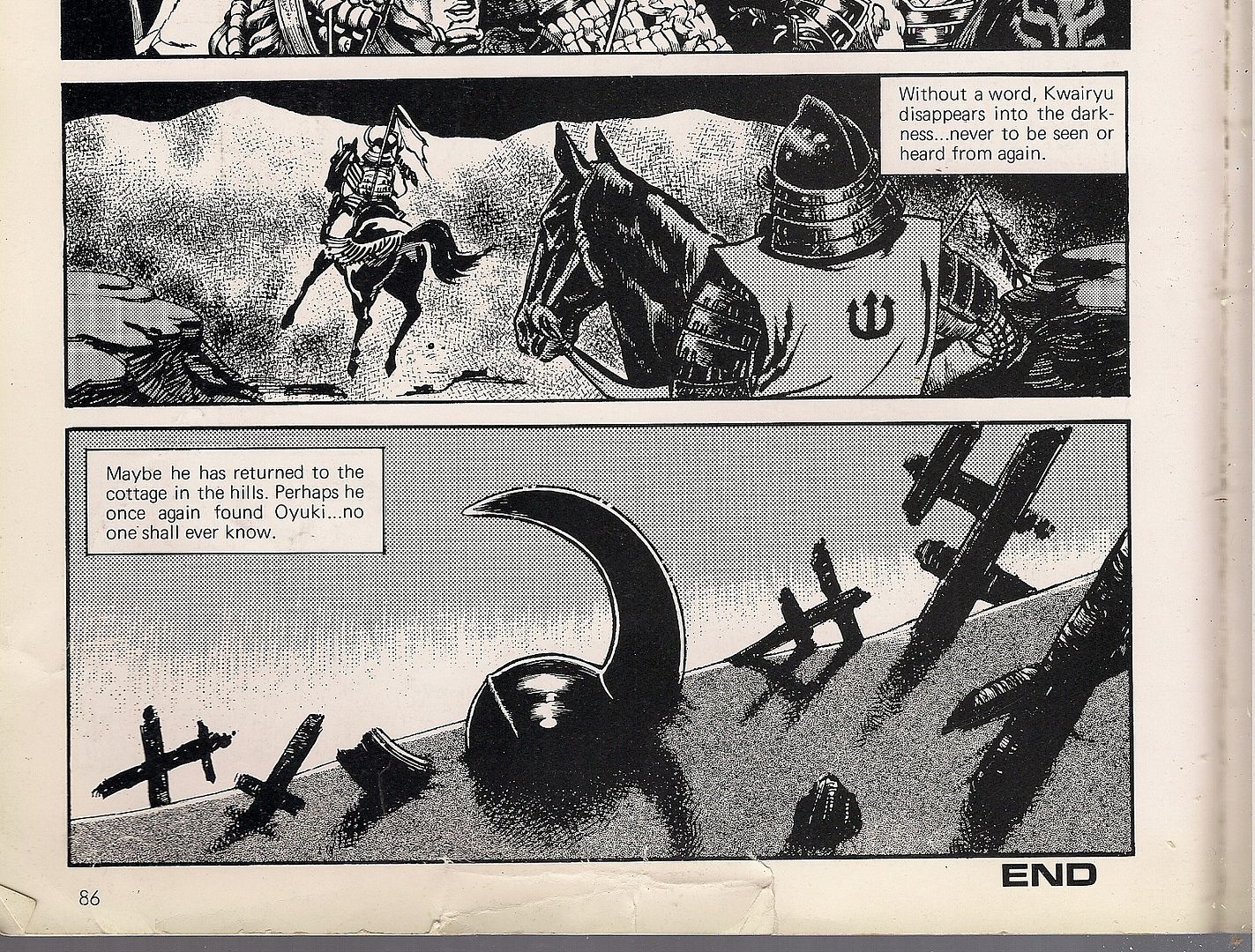
And Masaichi Mukaide, to the best of my knowledge, was never seen in English again.

***

(This post is dedicated to the memory of my beloved personal copy of Manga, which cracked its spine and ceded its glue as I scanned the above images, scattering its pages, boldly giving its life for the proud cause of illustrating internet blog posts here at savagecritic dot com. Our time together was so short, but oh how we burned, you at my bosom, vintage manga comic book. Pie Jesu Domine, dona eis requiem. Amen.)
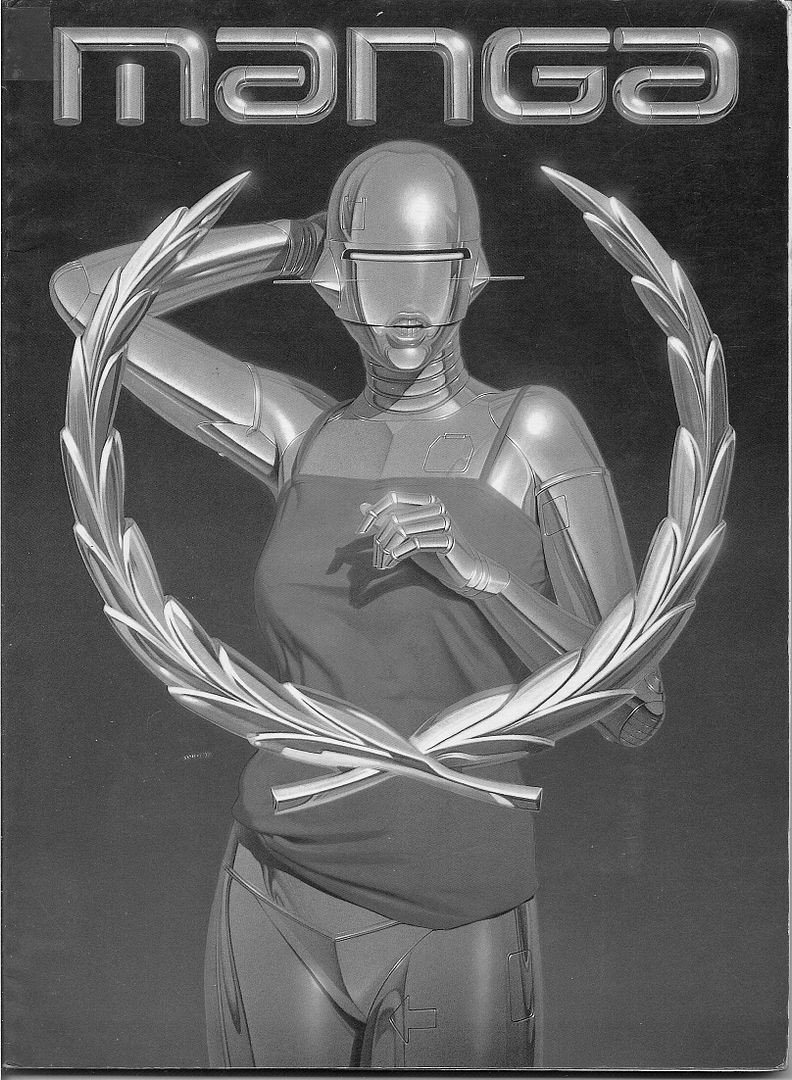
(198X-2009)
Arriving THURSDAY 12/3/2009

Getting down to the last few shipping weeks of the year, but don't forget this week's books arrive on THURSDAY.

1001 ARABIAN NIGHTS ADVENTURES OF SINBAD #10
28 DAYS LATER #4
A VERY ZOMBIE CHRISTMAS
ABSOLUTION #4 (OF 6)
ALIENS #4 (OF 4)
ANITA BLAKE LC EXECUTIONER #2 (OF 5)
ARCHIE DOUBLE DIGEST #204
ATHENA #3
AUTHORITY #17
BARACK THE BARBARIAN #3 (OF 4)
BATMAN CONFIDENTIAL #38
BATMAN THE UNSEEN #5 (OF 5)
BETTY #183
BLACK WIDOW AND MARVEL GIRLS #1 (OF 4)
BLACKEST NIGHT THE FLASH #1 (OF 3)
BLACKEST NIGHT WONDER WOMAN #1 (OF 3)
BOYS #37
CAPTAIN AMERICA THEATER OF WAR PRISONERS OF DUTY
CAPTAIN BLOOD ODYSSEY #2 (OF 5) (NOTE PRICE)
CARTOON NETWORK ACTION PACK #44
CINDERELLA FROM FABLETOWN WITH LOVE #2 (OF 6)
DARK AVENGERS ANNUAL #1
DARK TOWER BATTLE OF JERICHO HILL #1 (OF 5)
DEADPOOL TEAM-UP #898
DINGO #1
DO ANDROIDS DREAM OF ELECTRIC SHEEP #6 (OF 24)
DONALD DUCK AND FRIENDS #348
EMPOWERED ONE SHOT
EXISTENCE 3.0 #1 (OF 4)
FALL OF HULKS ALPHA FOH
GI JOE #12
GLAMOURPUSS #10
GREAT TEN #2 (OF 10)
GREEK STREET #6
GRIMJACK MANX CAT #5
HAUNT #3
HOUSE OF MYSTERY #20
HULK WINTER GUARD ONE-SHOT
INCREDIBLES #3
INVINCIBLE PRESENTS ATOM EVE & REX SPLODE #2 (OF 3)
IRON MAN REQUIEM
IRON MAN VS WHIPLASH #1 (OF 4)
JACK OF FABLES #40
JONAH HEX #50 (NOTE PRICE)
JSA ALL STARS #1
KILL AUDIO #3 (OF 6)
KING CITY #3
KNIGHTS OF THE DINNER TABLE #156
LOBO HIGHWAY TO HELL #2 (OF 2)
LOONEY TUNES #181
MARVELS PROJECT #4 (OF 8)
MICE TEMPLAR DESTINY #5 OEMING CVR
MIGHTY #11
NORTH 40 #6 (OF 6)
NOVA #32
PHANTOM GENERATIONS #6
PSYLOCKE #2 (OF 4)
RED TORNADO #4 (OF 6)
SAVAGE DRAGON #155
SCALPED #33
SECRET HISTORY BOOK 07 (OF 7) (RES)
SIEGE CABAL
SIMPSONS WINTER WINGDING #4
SONIC THE HEDGEHOG #207
SPIN ANGELS #4 (OF 4)
STARR THE SLAYER #4 (OF 4)
STARSTRUCK #4
STRANGE #2 (OF 4)
SUPERGOD #2 (OF 5)
SUPERMAN WORLD OF NEW KRYPTON #10 (OF 12)
SWEET TOOTH #4
SWORD #20
TALISMAN ROAD OF TRIALS #2 CVR A MASSIMO CARNEVALE
TERRY MOORES ECHO #17
THE GOOD THE BAD & THE UGLY #6
THOR #604
TORCH #4 (OF 8)
ULTIMATE COMICS SPIDER-MAN #5
UNCANNY X-MEN #518
WARLORD #9
WHAT IF SECRET INVASION
X-BABIES #3 (OF 4)
X-FORCE ANNUAL #1

Books / Mags / Stuff
365 SAMURAI & FEW BOWLS OF RICE SC
ANNE STEELYARD GARDEN OF EMPTINESS GN VOL 02 (OF 3)
BATMAN THE CAT AND THE BAT TP
BEANWORLD HC VOL 03 REMEMBER HERE
BIONICLE GN VOL 07 REALM OF FEAR
BLACK PANTHER TP DEADLIEST OF SPECIES
BLEACH TP VOL 29
CHRONICLES OF KULL TP VOL 01 KING COMES RIDING
CHRONICLES OF SOLOMON KANE TP VOL 01
COMICS JOURNAL #300
DEAD SHE SAID TP
DEMONS OF SHERWOOD GN
DOCTOR GRORDBORT PRESENTS VICTORY HC
DOCTOR WHO THROUGH TIME AND SPACE TP
DRAWING BETWEEN LINES SHORT DOCUMENTARY JEFFREY BROWN DVD
ESSENTIAL X-FACTOR TP VOL 03
EX MACHINA DELUXE EDITION HC VOL 02
GOATS TP VOL 02 CORNDOG IMPERATIVE
GOOD NEIGHBORS HC VOL 02 KITH
HEAVY METAL JANUARY 2010
ILLUSTRATION MAGAZINE #28
JOJOS BIZARRE ADVENTURE TP VOL 13
KODT BUNDLE OF TROUBLE TP VOL 29
LITTLE LULU TP VOL 21 MISS FEENYS FOLLY & STORIES
MYSPACE DARK HORSE PRESENTS TP VOL 04
NORTH WORLD GN VOL 03
ONE MODEL NATION GN
POPEYE HC VOL 04 PLUNDER ISLAND
RANN THANAGAR HOLY WAR TP VOL 02
SPAWN ORIGINS TP VOL 03
STAR WARS CLONE WARS TP VOL 01 SLAVES OF REPUBLIC
STAR WARS LEGACY TP VOL 07 STORMS
TALES FROM WONDERLAND TP VOL 02
TRANSMETROPOLITAN TP VOL 05 LONELY CITY NEW ED
UNTHINKABLE TP
WOLVERINE WEAPON X 100 PROJECT TP

What looks good to YOU?
-B

Hibbs Returns

I spent almost all of last week sick and in bed -- damn the plague bearing children!

But I owe you some reviews, I think, let's see what I can do, in that Old School format...

BLACKEST NIGHT #5: Really all that one wants out of a big Comics Event (well, or any comic for that matter) is to be surprised a little, to have that "Neat, I didn't see THAT coming!" moment. And this issue of BN certainly gave me that pretty substantially. I also liked that the Rainbow Squad did exactly nothing. I'm going to go with VERY GOOD here, especially given that this is the issue a lot more people are likely to buy because of the GL ring attached to it.

Parenthetically, there's a great deal of talk about "Superhero Decadence", which made me think a lot about some of the issues raised in this article about Soap Operas. It really sounds incredibly similar to me....

CHEW #6: Second arc, and it starts promisingly. I thought the end of arc #1 was a bit telegraphed (I've probably consumed too much fiction over the years to be surprised), but I liked the dynamic set up here, and thought the funny was funny. GOOD.

CREEPY COMICS #2: A much better effort than the first issue (which I thought was, frankly, terrible) -- I didn't exactly LIKE any story in here, but I, at least, didn't HATE them, which is a huge step up. Writing this kind of "Ironic Horror" story is really really difficult, it seems. A solid OK,and let's hope it keeps scaling up.

DETECTIVE COMICS #859: It is almost tiresome how good this is -- how can one keep heaping superlatives on a book month after month? I rather do think this is the best thing DC publishes each month, and it is a stupendous and ballsy project to have in DC's "flagship" title. I even thought Rucka's Lesbian Fascination has extraordinarily well done this issue, comparing it against the dictates (both legal, and moral) of her Army career. I simply can not wait for the Absolute edition of this book, because it is just that good. EXCELLENT.

Sales-wise, for us at least, we're now selling nearly twice as many copies of 'TEC as we are of generic-BATMAN at this point post-relaunch. And something approaching 80% of BATMAN & ROBIN (though that's a function of Tan's art on the latter more than anything else, I think -- there's been a pretty steep drop off between the first arc and #4-6).

GREEN LANTERN #48: Johns is doing a good job "fleshing out" scenes from BN to be full-sized stories in GL, without seeming like padding. That's a neat trick. Now that the Rainbow Squad are all together, I find myself really really enjoying the Orange Lantern characterization. Solidly GOOD.

IMAGE UNITED #1: Jinkies. While I approve, certainly, of "getting the band back together", and I think they're doing a good job with the logistics of having everyone draw their own characters, hrf I think that was pretty sucktastic of a story. It felt more like a circa 1993 Image comic than anything they've published in the last ten years... and that's not really a complement. Robert Kirkman's main contribution, it seems? Pariah. Got to go with AWFUL.

INVINCIBLE IRON MAN #20: Here's where I don't get Marvel's marketing -- this book has two covers. One is exciting and futuristic looking and encapsulates the story, and might even sell some comic books just on its own virtues; while the other one is a too-blown-up version of a (IIRC) house ad, that looks craptastic from being blown up, and blows the "punchline" by having it on the back cover of the book. When retailers say "Really, we'd like to be able to order covers as we want them in our store, please", I think I might point to this as exhibit A -- this decision will almost certainly have me selling FEWER copies of IRON MAN, than more.

Total shame, too -- Fraction is doing astonishing work on this book, writing a futurist with a plan; I can't even imagine how hard it is to write someone who is clearly that much smarter than the rest of us -- and he's doing it completely convincingly. Without a doubt this is my absolute favorite Marvel comic released each month right now, and, hopefully, this arc will keep the quality as high. VERY GOOD.

JUSTICE LEAGUE CRY FOR JUSTICE #5: Its getting better. OK

JUSTICE LEAGUE OF AMERICA #39: This, on the other hand, is as generic of a BN-crossover as one can be. Wow, Vibe AND Steel? I'm scared! AWFUL.

JUSTICE SOCIETY OF AMERICA #33: Since the start of this arc, we've lost over half of our readership for it. And when they split this into two titles next week ("JSA ALL STARS"), I think we're going to lose half of it again. This is a classic case of "What the hell are you thinking?!?!" While I guess I like a DC management who wants to publish many JSA comics more than I liked the DC management who once famously said "No one whatsoever wants to read about these characters" when canceling the Mike Parobeck run, one needs a plan a bit more substantial than "publish a lot of books, maybe someone will want them". This story arc couldn't even be arsed to hint at why all of these characters were attacking, or why they weren't attacking the SSK, all the while rubbing the "Heh, see the A-storyline has NOTHING to do with the B-storyline WHATSOEVER" in the audience's face. Completely AWFUL.

NEW AVENGERS #59: Pretty preposterous that everyone acts that stupid because the plot dictates that they do, and, god, will I be glad when "Dark Reign" is over (and, based on my sales, my customers are even more eager for that then I am), but if one were to ignore all of that, this was a solid enough action-packed issue. OK.

NEW MUTANTS #7: With better art this could have been great. Heck, with backgrounds (instead of just swaths of color) this could have been great. Instead, it's just kind of EH.

POWERS #1: Two years later? Lost a lot of momentum. Not really feeling it anymore, but maybe that will change again if issues come out regularly. OK

SECRET WARRIORS #10: What happened to the premise of the book? You'd especially think that in the run-up to the end game of "Dark Reign" this would actually be about the "Secret Warriors" rather than just one character, but maybe that's me. OK.

SUPERMAN #694: While this felt more like a "Superman" comic than any other recent issue, it's still just a Mon-El comic in somewhat different clothes. Which is fine, I guess, but not what people want from "Superman". Our sales have been really atrocious on this whole line lately. OK.

SUPERMAN SECRET ORIGIN #3: This is closer to what I was hoping for from this project than what we got from the first two issues -- actually adding facts and information and perspective to the legend of the character. I'll go solidly GOOD on this one.

THOR GIANT SIZE FINALE (BY JMS) #1: Dismissing the story he'd been writing up to this point in about 5 pages, the rest putting the Don Blake/Thor status quo back to where it was in 1968... "There's no heart to this" drips from every page. Too bad, this was one of the most exciting Marvel projects in a bit, and now it's been folded awkwardly back into the general Marvel U -- I'm expecting the sales to drop back pretty Darn Quick. EH.

ULTIMATE COMICS AVENGERS #4: Sometimes I wish Millar wasn't as enamored with being as clever as he thinks that he is, and that he was just clever once again. OK.

What did YOU think?

-B

Arriving 11/25/2009

Ugh, I'm very very sick... shouldn't even be ehre, but someone had to do the invoicing and reordering and all of that...

2000 AD PACK OCT 2009
A G SUPER EROTIC ANTHOLOGY #108 (A)
AMAZING SPIDER-MAN #613 GNTLT
ANGEL #27
ARCHIE #603
ARKHAM REBORN #2 (OF 3)
AVENGERS INITIATIVE #30
BATMAN THE BRAVE AND THE BOLD #11
BEASTS OF BURDEN #3 (OF 4)
BETTY & VERONICA DOUBLE DIGEST #176
BILLY BATSON AND THE MAGIC OF SHAZAM #10
BLACKEST NIGHT #5 (OF 8)
BUCK ROGERS #6
CHEW #6
CREEPY COMICS #2
CRIMINAL SINNERS #2
DARK AVENGERS ARES #2 (OF 3)
DARK TOWER FALL OF GILEAD #6 (OF 6)
DARK WOLVERINE #80
DARKNESS #81
DAYS MISSING #4 (OF 5)
DETECTIVE COMICS #859
DEVILS HANDSHAKE
DIE HARD YEAR ONE #3
DOMINO LADY #3
ENDERS SHADOW COMMAND SCHOOL #3 (OF 5)
FANTASTIC FOUR #573
FUTURAMA COMICS #46
GANGES #3
GI JOE ORIGINS #9
GOON (OSW) #33
GOTHAM CITY SIRENS #6
GREEN LANTERN #48 (BLACKEST NIGHT)
GUARDIANS OF GALAXY #20
HALO HELLJUMPER #5 (OF 5)
HERCULES KNIVES OF KUSH #4 (OF 5) A CVR LANGLEY
HERE COME THE LOVEJOYS #3 FATHER FIXATION (A)
HOT MOMS #13 (A)
HULK #17
I AM LEGION #6 (OF 6)
IMAGE UNITED #1 (OF 6)
IMMORTAL WEAPONS #5 (OF 5)
INCREDIBLE HERCULES #138
INVINCIBLE IRON MAN #20
JERICHO SEASON 3 #1 (OF 6) A CVR WEST
JUGHEAD #198
JUGHEAD AND FRIENDS DIGEST #35
JUSTICE LEAGUE CRY FOR JUSTICE #5 (OF 7)
JUSTICE LEAGUE OF AMERICA #39 (BLACKEST NIGHT)
JUSTICE SOCIETY OF AMERICA #33
LAST RESORT #4
LONE RANGER #19
MADAME XANADU #17
MARVEL ADVENTURES SPIDER-MAN #57
MODELS INC #4 (OF 4)
MONSTERS INC LAUGH FACTORY #3
MS MARVEL #47
MUPPET PETER PAN #3
NEW AVENGERS #59
NEW MUTANTS #7 XN
NORTHLANDERS #22
POLITICAL POWER #5 TED KENNEDY
POWERS #1
PROJECT SUPERPOWERS MEET THE BAD GUYS #4 (OF 4)
SECRET WARRIORS #10
SON OF HULK #17
SPARTACUS BLOOD AND SAND #2 (OF 4)
SPIDER-MAN CLONE SAGA #3 (OF 6)
STAR TREK NERO #4
STAR WARS LEGACY #42 DIVIDED LOYALTIES
STARCRAFT #6
SUPERMAN #694
SUPERMAN SECRET ORIGIN #3 (OF 6)
TAROT WITCH OF THE BLACK ROSE #59
TEEN TITANS #77 (BLACKEST NIGHT)
THOR GIANT SIZE FINALE (BY JMS) #1
TICK NEW SERIES #1
ULTIMATE COMICS AVENGERS #4
UNCANNY X-MEN #517
UNCLE SCROOGE #385
UNKNOWN SOLDIER #14
UPTIGHT #3 (O/A)
USAGI YOJIMBO #124
WEB #3
WEB OF SPIDER-MAN #2 GNTLT
WILDCATS #17
WOLVERINE FIRST CLASS #21
WONDER WOMAN #38
WORLDS FINEST #2 (OF 4) CVR B
X-MEN FOREVER #12

Books / Mags / Stuff
ARCHIE NEW LOOK SERIES TP VOL 03 BREAKUP BLUES
ASTONISHING X-MEN TP VOL 05 GHOST BOX
AVENGERS INITIATIVE TP VOL 04 DISASSEMBLED
BERSERK TP VOL 32
BOYS TP VOL 05 HEROGASM
CAPTAIN AMERICA DEATH OF OMNIBUS HC
CHEW TP VOL 01
DARK REIGN ELEKTRA TP
DEAD KINGDOM OF FLIES TP
DEADPOOL CLASSIC TP VOL 03
FLASH VS THE ROGUES TP
HARPE AMERICAS FIRST SERIAL KILLERS GN
HOW TO DRAW & FIGHT ZOMBIES PKT MANGA TP VOL 01
IMMORTAL IRON FIST TP VOL 05 ESCAPE FROM EIGHTH CITY
INCOGNITO TP
JUXTAPOZ VOL 16 #12 DEC 2009
MISS DONT TOUCH ME GN (O/A)
PREVIEWS #255 DECEMBER 2009
PROPER GO WELL HIGH GN
SAGA OF THE SWAMP THING HC BOOK 02
SGT ROCK THE LOST BATTALION HC
SHADE THE CHANGING MAN TP VOL 01 AMERICAN SCREAM NEW PTG (MR
SHADE THE CHANGING MAN TP VOL 02 EDGE OF VISION TP
SPARKY O HARE MASTER ELECTRICIAN GN
TOMARTS ACTION FIGURE DIGEST #182
TRE TARINO GN
TREASURY 20TH CENTURY MURDER SC VOL 02 FAMOUS PLAYERS
WARCRAFT DEATH KNIGHT A WOW ADVENTURE GN
WINTER MEN TP
WIZARD MAGAZINE #219 GOLD CASSADAY X-MEN CVR
X-MEN WORLDS APART TP

What looks good you you?

_b

In Single Issues, In Blackest Night: Green Lantern Corps BN Crossover Issues

I fall behind in a lot of reading, and then I have more to read to catch up. Case in point: I picked up GREEN LANTERN CORPS #42, got about three pages into it, and realized that I had no idea what was going on apart from it tying in with Blackest Night and the plot being essentially "Bad Things Happen On Oa." So I stopped reading, went back and re-read GLC #39-41 first, then #42, straight-through and realized: Hey! This'll make a great trade. Here's the thing, though; I'm conflicted whether or not that makes it a good comic.

Don't get me wrong: Taken as a whole, the four issues so far of Peter Tomasi and Patrick Gleason's "Black Lanterns Bring The Pain And Shit" are one of my favorite things about Blackest Night. There's a lot going on, but enough different threads so that the repetition of "Oh, it's character X meeting someone who's dead from their past" isn't really pushed in your face (Kudos to Tomasi for using his stories in the Tales Of The Corps three-part mini from the start of the event to set a lot of this up, too; suddenly, what seemed like well-done but unnecessary tie-in has a point), and Gleason's art, always been one of the best things about the book, remains kinetic and frenetic enough to suggest the panic and confusion of everything going wrong at once. But almost none of the strengths of the story come through when reading it in singles. The juggling of plot threads, which works so well when reading it all at once, is frustrating, making the story seem more scattered and stuttering than you want it to be, and the forward motion of the plot seems almost impossibly slow. This isn't a complaint about decompression, to resurrect (Hey! Black Lantern Comic Terminology!) that old chestnut, because it's not that each issue feels stretched out or empty, just the opposite - They actually feel too full to be able to go anywhere.

(As an aside, for a second; #42's big ending worked better than I initially thought. When I first read it, I cynically thought, oh, they're just killing off a minor character because it's a crossover. But then I realized that it was a death that had more weight than that other Blackest Night deaths so far, which include arguably bigger names Hawkman, Hawkwoman, Tempest and maybe Firestorm... Kyle's death, despite coming midway through the story, feels like the story's first "real" one, which has to mean something. Well, until he comes back next month, I guess.)

I'm left conflicted. Are these decent comics or not? Well, kind of? If you sit down and read them in one go, then I'd call them Good, but otherwise, they're just Okay. Maybe I should switch to trades and save myself the dilemma.

Arriving 11/18/2009

A fairly low key week.

ADVENTURE COMICS #4 (BLACKEST NIGHT)
AIR #15
AMAZING SPIDER-MAN #612
ANGEL ONLY HUMAN #4 (OF 4)
ARCHIE DIGEST #259
AUTHORITY THE LOST YEAR #3 (OF 12)
AZRAEL #2
BATMAN CONFIDENTIAL #37
BATMAN STREETS OF GOTHAM #6
BATMAN THE UNSEEN #4 (OF 5)
BLACK KNIGHT #1
BRAVE AND THE BOLD #29
CONAN THE CIMMERIAN #16
COWBOY NINJA VIKING #2
CYBERFORCE HUNTER KILLER #3 (OF 5) ROCAFORT CVR A
DARK AVENGERS #11
DARK REIGN LIST AMAZING SPIDER-MAN ONE-SHOT
DEADLOCKE ONE SHOT
DEADPOOL MERC WITH A MOUTH #5
DOMINIC FORTUNE #4 (OF 4)
DR HORRIBLE ONE SHOT (OSW)
FALL OUT TOY WORKS #2 (OF 5)
FAR WEST BADDER MOJO #1 ONE SHOT
FARSCAPE ONGOING #1
FLASH REBIRTH #5 (OF 6)
G-MAN CAPE CRISIS #4 (OF 5)
HELLBLAZER #261
INCREDIBLE HULK #604
INVINCIBLE #68
IRREDEEMABLE #8
JUSTICE SOCIETY OF AMERICA 80 PAGE GIANT #1
KOOKABURRA K #1
MICKEY MOUSE & FRIENDS #297
MIGHTY AVENGERS #31
NOLA #1
NOMAD GIRL WITHOUT A WORLD #3 (OF 4)
OUTSIDERS #24 (BLACKEST NIGHT)
PHONOGRAM 2 #5 (OF 7) SINGLES CLUB
PRESIDENT EVIL #3 EAT PRESS
PUNISHER #11
REALM OF KINGS
REALM OF KINGS INHUMANS #1 (OF 5)
SIMPSONS COMICS #160
SONIC UNIVERSE #10
SPIDER-WOMAN #3
STAND SOUL SURVIVORS #2 (OF 5)
STAR TREK TNG GHOSTS #1
STAR WARS KNIGHTS OLD REPUBLIC #47 DEMON PT 1 (OF 4 )
SUPER FRIENDS #21
SUPERGIRL #47
SUPERMAN BATMAN #66 (BLACKEST NIGHT)
SWORDSMITH ASSASSIN #4
TALISMAN ROAD OF TRIALS #1 CVR A MASSIMO CARNEVALE
TERRY MOORES ECHO #16
THUNDERBOLTS #138
TINY TITANS #22
TMNT #1 FULL COLOR ONE SHOT
TRANSFORMERS ONGOING #1
UNDERGROUND #3 (OF 5)
VICTORIAN UNDEAD #1 (OF 6)
VIGILANTE #12
VIKING #4
WALT DISNEYS COMICS & STORIES #700
WAR MACHINE #11
WOLVERINE ORIGINS #42
WOLVERINE WEAPON X #7
WORLD OF WARCRAFT #25 (NOTE PRICE)
X-MEN LEGACY #229
ZORRO #17

Books / Mags / Stuff
ALIEN LEGION OMNIBUS TP VOL 01
BACK ISSUE #37
BATMAN BATTLE FOR THE COWL HC
BATTLE ROYALE NOVEL 2ND ED
BLACK LIGHTNING YEAR ONE TP
BORGIA HC VOL 03 FLAMES
BUFFY & ANGEL FIGURINE COLL MAG #1 BUFFY
CASPER FRIENDLY GHOST 60TH ANNIV HC
DARK AVENGERS TP VOL 01 ASSEMBLE
DC SUPERHERO FIGURINE COLL MAG #40 MARY MARVEL
DC SUPERHERO FIGURINE COLL MAG #41 GA GREEN LANTERN
DRIVEN BY LEMONS HC
FALL OF CTHULHU TP VOL 06 NEMESIS
GRAPHIC CLASSICS VOL 18 LOUISA MAY ALCOTT
GREEN LANTERN CORPS EMERALD ECLIPSE HC
JSA TP VOL 03 THY KINGDOM COME PART 2
LEES TOY REVIEW #204 NOV 2009
MAD MAGAZINE #502
MIGHTY AVENGERS TP EARTHS MIGHTIEST
NAKED COSMOS DVD & MINI COMIC
NEW AVENGERS TP VOL 11 SEARCH FOR SORCERER SUPREME
OISHINBO VOL 06 JOY OF RICE
PICTURES THAT TICK TP
PLUTO URASAWA X TEZUKA GN VOL 06
PUNISHER DARK REIGN TP
ROBERT BLOCHS LORI GN
SHOWCASE PRESENTS DC COMICS PRESENTS TP VOL 01
TEZUKAS BLACK JACK TP VOL 08
THE NAM TP VOL 01
UNKNOWN HC VOL 01
WAR OF KINGS HC
WASTELAND TP VOL 05 TALES O/T UNINVITED
WOLVERINE ORIGINS TP DARK REIGN
WRITE ENVIRONMENT JOSS WHEDON DVD

What looks good to YOU?

-B

Just Yield Already, Star-Spangled Shield: Graeme on Reborn

CAPTAIN AMERICA REBORN has the odd distinction of being one of the most dull event books in recent memory. I realized that when, less than a day after re-reading the most recent issue (#4, if you're curious), I couldn't remember what had actually happened in it, and felt compelled to re-read the entire thing from the beginning to see what I'd missed. What I'd missed, apparently, was the Summer Blockbusterization of something that didn't need that kind of treatment.

Let me preface this by saying: Brubaker's Cap run in general is, according to our regular SavCritic scale, Very Good bordering on Excellent, with the eighteen-part story that started with Steve Rogers' death being the kind of longform superhero story that people should reminisce about in years to come, when the kids are huddling over their tablet reading devices and complaining about stories that're longer than five pages. But Reborn isn't just separated from the regular run by its faux "event" status and separate series, but by a complete change in pace and storytelling style brought on by superstar artist Bryan Hitch (with inks and what looks, in many cases, more than just inks, from Butch Guice) that... well, feels like it doesn't really belong with what's come before.

Don't get me wrong; Bru keeps the characters' voices consistent, and the overall shape of the story fits with what we've come to expect, but the execution is just off. In interviews, Bru has talked, glowingly and lovingly, about Hitch's artwork for the series, and you can see his adoration for his collaborator in each issue, in the amount of space he gives Hitch/Guice, the number of double page spreads or splash pages for him to show off with. The only problem being that each one of those pages slows the story down even more, making each issue feel even lighter than it already did (A problem when so much of the series is essentially a Cap's Greatest Hits compilation of moments we've already seen).

That feeling of lightness isn't helped by the deja vu that the series has had throughout; we had action set-pieces in the first three issues that didn't feel as if they had any point or impact on the rest of the story at all: BuckyCap has been captured looking for the McGuffin that it turns out we don't need! Oh now he's escaped! Let's go rescue Sharon! Oh no she's not there! They feel soulless, pointless; there to give fans a momentary distraction from the talking heads - because, apparently, if you go to Hank Pym for scientific advice, he sits around for four issues and talks to you, bringing in Reed Richards to talk to you as well when needed - and scenes of Cap lost in time, and excuses for Hitch to draw something exciting and self-consciously awesome. But it doesn't feel right, somehow; like the numerous, superfluous guest stars (Really, the Thunderbolts? Even the Fraction-esque captions couldn't make that sequence seem less out-of-place), it all feels like not only a different series, but a different world from everything that's come before. It's as if the normally tight, thriller genre series that Captain America is has been adapted for the screen by Michael Bay, with all the razzle-dazzle and lack of logic that that implies: Heroes get their asses beat down, for example, for no reason other than to set up another action sequence later where they can escape and be bad-ass.

(It's unsurprising that another issue was added to the run when you realize how much plot the series would have to squeeze into its one remaining issue otherwise; especially when it's taken four issues for the following to take place: Sharon Carter goes to superhero scientists for help, and then gives herself up when Norman Osborn outs her as Cap's assassin. Meanwhile, Osborn also recruits the Red Skull and Doctor Doom to bring Cap's body back from being lost in time, while the superheroes run around ineffectually trying and failing to stop him. I'm sure that could've been done in at least one issue less than it took, and also that it would've been, if Brubaker was in the same frame of mind as he was when writing the regular Cap book.)

In the end, what makes the book feel like a failure for me isn't a sign that it's a bad book at all; it's my dislike/disappointment for the transformation it's made - seemingly intentionally - from one style of book to another, maybe even one audience to another. I preferred, by far, the more writer-led, more tight (and I'm fighting not to say "Smarter," because it's not that Reborn isn't smart, as such, but... but...!) Captain America to the crowd pleaser filled with an amazing number of images of Cap leaping across villains and a double page spread while inner-monologing about being confused and characters who add nothing to the story other than brand names.

For some reason, it feels wrong to say that, like I'm begrudging Bru and/or Cap his success and day in the sun, just like it feels wrong to say that the series for me is Eh. But it's true, nonetheless; maybe Morrissey was right. Maybe we really do hate it when our friends become successful.

From Today, Four Publishers

Batman and Robin #6: Oh yes, I'm feeling like an old-fashioned omnibus review post tonight.

It's entirely possible the above image might just say it all, but I still feel obliged to point out that the image of Batman & Robin to the right is supposed to be what the people in the inset panel to the left are watching on their monitor.

I haven't been quite as upset with penciller Philip Tan's work this storyline as some folks -- his shortcomings are roughly similar to those of Tony Daniel, who didn't attract half as much disapprobation with his Grant Morrison collaborations, despite something like R.I.P. needing a steadier visual approach far worse than this thing -- but there's no denying his awkwardness with visual humor, which also causes some trouble with this issue's much-hyped villain Flamingo. He's a joke character, basically, a flamboyantly-dressed super-glam superkiller ("I was expecting scary, not gay," muses Damian) who nonetheless communicates entirely in grunts and RRRs and cackles - the exclamation point at the end of writer Morrison's three-issue statement on cool and dark characters attempting to muscle out our reformed, uneasy Dynamic Duo.

Tan (with inker Jonathan Glapion) doesn't get much out of this sizzle/steak disconnect - that's more cover artist Frank Quitely's bread 'n butter (given one image, he immediately takes the opportunity to quote Purple Rain). Moreover, portions of the issue seem especially hurried, with some panels approaching Igor Kordey's "famous" issues of New X-Men in tortured posture. Pages seem to fade in and out of a richer, sooty look (and the character art seems to shift a little in style), suggesting that Alex Sinclair may have colored some parts directly from the pencils; the finished work ends up looking vaguely like a Hong Kong action comic with assorted panels painted for effect, but sloppier.

The troubles don't end there, however. One of the better ideas behind Batman and Robin as a series is that it takes the 'everything is canon' approach of Morrison's previous Batman run and applies it to a new Batman & Robin so as to strike out a fresh tone - a kind of fun-bloody romp through oddball villains and skewed team dynamics. The irony, naturally, is that Batman himself needed to be removed from the story in order for "Batman" to get on with forward-looking stories, as opposed to confronting his past all the time.

But Morrison tends to work best with grand summaries of superhero themes, which his doomy Bruce-as-Batman were inclined toward. Now that we're into the new Batman and the new Robin, we get... er, a story about whether Batman is dark enough and how really cruel superhero characters are kinda nasty, which is not only an old superhero concern -- even one of this issue's Batman-specific jokes on the 1-900 Kill Robin fiasco mostly reminded me of Rick Veitch's take in Brat Pack 19 years ago -- but something Morrison has done several times in the past; the struggle between creative forces of wise evolution and corroding grit was central to both Seven Soldiers and Final Crisis, just to name two big ones, and it's almost always been done with more depth and panache than present here. This series, however, keeps trying to be a sleek, fun superhero read, yet it remains so fixated on old themes it seems less light than shallow, as if Morrison was building up a Bat-apocalypse toward a new morning, then didn't quite know where to go once the sun was up.

The fact that the struggle between Dick Grayson and Jason Todd to follow Bruce Wayne fits neatly into this old scheme doesn't make the execution any more interesting; Batman's been around long enough that I'm well aware of how the shape of Bruce Wayne leaves a void that can't be filled. I mostly find myself thinking to Morrison's comments in interviews, about how Gotham City should have the most amazing arts scene in the world and stuff, and how nice it'd been to see those stories. This stuff - it's like build build build to Batman's death, then a new status quo that gets right on to build build build to Batman's return, since that's the implicit focus of a story like this. I know: big-ticket superhero comics in 2009. Maybe there's just nothing else to do. AWFUL.

***

PunisherMAX #1: In which Marvel finally kicks off its proper longform follow-up run to Garth Ennis' fine tenure on the Mature Readers Punisher book. And make no mistake - this may be a relaunch, and yes, it's sporting the silliest alternate spelling of a familiar brand since they started calling the devourer of worlds "Gah Lak Tus" in the Ultimate line, but this absolutely is a sequel to the Ennis run, which is paid all due specific homage via dialogue. So where does writer Jason Aaron take it? It's kind of hard to say; this is more of a prologue issue than anything, full of characters setting things up in between a few obligatory scenes of punishment. Pretty low key, as if it's just the next issue after Ennis left, and thus begging for a direct comparison between the writers' starting points.

Still, it's interesting to see how Aaron tries to set himself apart, despite the able-as-ever presence of artist Steve Dillon, a man not unfamiliar to Ennis' readers. There's no Frank Castle narration, for one thing, which tosses the narrative focus right over to the criminals; Ennis spent a lot of time with the supporting cast too, but he usually planted us inside Frank's head to an extent that everything we'd see almost seemed filtered. Aaron plays a bit with our distance from Frank, depicting him coldly as a torturer, and declining to even show most of this issue's big firefight.

On the other hand, I caught a few worthwhile similarities to Ennis' own debut MAX story, In the Beginning. There a bit more gore than usual, as if the series is again stretching out to enjoy the relative freedom of the Mature Readers designation. There's also an interest in exploring Marvel U characters: Microchip in Ennis' story, the Kingpin in Aaron's. It's mostly a hook to attract readers from the wider pool of Marvel interest, I suspect, and striking in being cast out again for the relaunch, particularly in that the MAX line hasn't actually used that technique all that much in its development. Aaron's take on the Kingpin is a good one so far, acknowledging the absurdity of the Master of All Crime type sitting in a tower by having it exist mostly as an idea for Frank Castle (always the MAX series' most unrealistic man) to pursue over the mundanity of a real, cunning Wilson Fisk in the realistic-save-for-the-Punisher MAX world. Makes sense that it starts out as chit-chat, then! GOOD.

***

Starstruck #3 (of 13): I've written about this series before, at least concerning its prior incarnations as an off-Broadway play, a Heavy Metal serial, a Marvel Graphic Novel, an Epic Comics series and an expanded, b&w Dark Horse series. This is IDW's new release, with Michael Wm. Kaluta's art somewhat reconfigured from the Dark Horse expansion, freshly recolored/colored-for-the-first-time by Lee Moyer. Various Charles Vess-inked back-up strips are included too, some of them previously unseen and some of them straight out of The Rocketeer Adventure Magazine. You'll note that the publisher is also slated to present a recolored edition of The Rocketeer itself pretty soon (colors by Laura Martin), albeit as a collected edition rather than a new pamphlet series.

In some ways, this expanded-and-expanded again Starstruck seems slightly perverse in pamphlet form. Its 14-t0-18-page bites of the 'main' story ensures that the detail-heavy plot moves at a stately pace; this issue is marked by the birth of one of the series' main characters, while another is still a little kid in the back-up material. Even if you didn't already know that Starstruck is an unfinished series -- and that this particular incarnation should approximate the run of the Dark Horse issues, which itself only made just past the start of the Epic issues, roughly 1/3 of the way into the intended megastory -- you'd probably still get the feeling that a lot more space will be demanded for the already pretty damn large cast to play out its space drama.

Yet Starstruck-the-pamphlet still seems oddly right, entirely because it's so nicely conceived (the editor is Scott Dunbier). It's no secret that the series has picked up a reputation for being 'difficult,' and almost everything in these $3.99 comic books seems primed to keep you oriented without holding your hand. Writer Elaine Lee provides new (in-character) introductions focused on the history of the series' universe, and encyclopedia entries keyed to each issue clarify exactly enough of the finer points before launching into additional digressions and odd jokes. Best of all, the story segments make great use of natural break points in Lee's fragmented narrative so you can linger on all those packed-in details. It works well enough that pages now getting their fourth English-language version give up new information, carefully shading Lee's vision of diverse femininity along the fringes of a future with more such peripheral room. VERY GOOD.

***

Hellboy: The Wild Hunt #8 (of 8): Quick quiz, what's Hellboy's main superpower? He's the best listener in the whole damn world!

Aw, that's just a little joke from a compulsive Mignolaverse patron; I buy Hellboy comics like Tucker buys Batman. And I think the going estimate is that Our Man has spent a solid 65-70% of his 44 issues so far listening to folk tales and personal histories and ill omens and such, usually before kicking something's ass. I've always felt that formula grew out of the strong appeal creator Mike Mignola's art had for so many readers - his characters have always looked so fine peeking out from opaque shadows that long stretches of mood-setting seemed workable, and then monsters! and fighting! - he could do that too.

Mignola has since stopped drawing the series (mostly), though his stories have begun pouring out through many Hellboy universe projects, a unique shared-universe situation for the front of Previews in that every book demands a fairly high level of visual quality; granted, having Dave Stewart color almost the whole line and keeping A-level talents like Guy Davis and Richard Corben in the pool is bound to make an impression, but even the smallest of Mignola's series -- and he has a writer's credit on almost everything, with Scott Allie as constant editor -- seem bound by a mandate for technical aptitude that keeps the qualitative average remarkably high. Some of these comics can get bland and formulaic, sure, but shockingly few of them are ever really awful, which stands in sharp contrast to most other genre comics labels around.

The main Hellboy series remains a little bit apart, though, in that it is still primarily a visual spectacle. Oh, there's a plot, characters - shit, I can't even keep track of all the characters anymore, but the funny part is I also never feel like I need to. The Hellboy backstory has gotten almost insanely complicated, but it inevitably winds up offering only more scenic routes to vivid sights and massive fights, not to mention near-comedic levels of portent, which I suppose will climax with something, eventually. As it is it's nearly a meta-commentary on the superhero propensity for perpetual anticipation of Earth-shaking events and bigger, badder threats, always transformed into the largely visual experience that Marvel and DC comics usually can't provide.

So here we've got the end of the new 'present day' Hellboy story, which has even more unique demands for an artist. Corben does a lot of work on Hellboy proper, say, but his past-tense stories allow for him to mostly do his own thing with Hellboy himself kept on-model. Duncan Fegredo, however, Mignola's most direct heir, is doing a genuinely eerie job of capturing Mignola's own cadence, the way he slices our perspective away to skulls on a shelf or a soaring bird; he does the heavy shadows too, but in his own way, and anyhow that was never all Mignola was about - his was a total vision on the page, always scanning the place for evocative images, sequence barely hanging on.

And despite all I've just said, Mignola's also about a bit more than just pretty pictures. This storyline is titled The Wild Hunt, which seems odd at first since the Hunt (for undead giants) ends in issue #2 and the story winds up building to yet more revelations about Hellboy's lineage... on his mom's side! But Mignola pulls a trick - the big unavoidable fight scene with the giants is cut to bits and then scattered through the rest of the story as flashbacks, all the better to hit on what has to rank as the most substantial bit of the title character's development since the 1990s: his realization that he really, truly, deeply enjoys having massive, violent fights, and that violence perhaps inexorably draws out the dark potential of his destiny as a son of Hell.

This is clever, and really kind of ballsy for a series so totally steeped in action as release; casting every ass kicked as one step closer to the throne of pandemonium has a way of signaling finality like nothing else for this series. Mignola then goes on to elaborate by cutting back constantly to the series' ex-elf shrunken giant warthog antagonist Gruagach, a hapless villain first introduced in 1996, doomed to start shit so much bigger than himself, his true origin told in a characteristic-to-the-series folk tale manner smoothed down to two and a half pages and hammer-blunt with fairy story cruelty, then his history with Hellboy summarized as a life-ruining encounter that clearly didn't mean so much to the guy talking with his fists; Hellboy's tough-guy line "Where's that baby?" is repeated so that it takes on a malevolent tone, which is surely the point.

It's true that this literary content probably didn't need eight issues of comics to go through, but the visual content feel like it did. Trees bursting into flame, spirit bodies constantly switching from fleshy to skeletal form, still-amazing page-to-page, panel-to-panel and in-panel contrasts in color - this is Hellboy's identity, and one that seems all the more assertive now that the basic, necessary parts of the plot are as liable for toying as the complicated decoration that is the title character's family saga and list of friends and foes. Who cares which magic sword he's drawn - how's he gonna use it now? Keep listening with your eyes. GOOD.

#23 In An Increasingly Irregular Series: Graeme Lives, Reviews

It's been an insanely long time since I last posted, but let's just chalk that up to being very busy and move on quickly, shall we? Here're some things that I've been reading recently. Some you may even remember!

BATMAN/DOC SAVAGE SPECIAL #1: It's very nice to look at, but very slight. Basically, Doc Savage thinks Batman is up to no good, then then have a fight and he realizes his mistake. Phil Noto's art - always bordering on both the sterile and the overly-pretty - is the best thing about what, otherwise, is a standard Marvel Team-Up plot without much flair from Brian Azzarello's bland script. Eh, and not boding too well for the mini-series spin-off from this.

CINDERELLA: FROM FABLETOWN WITH LOVE #1: A light, but enjoyably so, opener for the latest Fables spin-off, with a quick script and Shawn McManus' art keeping itself under control enough (Am I the only person who finds his tendency to either give characters really long faces, or tiny little squished faces, offputting? I am, aren't I?) for it to feel... well, like an issue of Fables, and not the more smug and somehow less enjoyable Jack Of Fables. Firmly on the high side of Okay, but there's nothing wrong with that.

THE LONE RANGER & TONTO #3: I've gone on about my surprise love for Brett Matthews' revival of this series/character before, but the star of this special issue is easily Vatche Mavlian's art, which is scratchy and old-fashioned (and given lovely colors from Marcelo Pinto), and just pitch perfect for the story this issue. This really continues to be a series that's better than it should be. Very Good.

MODELS INC. #3: I'm continually surprised by the bad reviews I see for this series online. Sure, it's not going to change anyone's world, but I'm beginning to think that I'm somehow finding it funnier than everyone else, which makes me nervous. But even if we can't agree that this is a Good piece of throwaway camp fun, surely we can all agree that Colleen Coover's art in the back-up makes everyone wish she'd been able to draw the whole series?

RUNAWAYS #14: Yes, it's old now, but I just wanted to say "The End... For Now..."? Seriously, Marvel? That is the most unconvincing, quite-clearly-canceling-the-series-in-mid-storyline, bullshit that I have seen in a long time. Here's the clue: When your series ends (or goes on "hiatus" indefinitely, as the official line on this has it), then it probably shouldn't do so with the unexplained reappearance of a long-dead character and another one in critical condition in hospital, while the rest of your leads are going off to live with a brand new character whose motives are, at best, mysterious. Just sayin'. Offering the exact opposite of closure, the addition of "The End... For Now..." at the end of the issue really felt like a smack in the face for readers, an editorial note that translated as, "Hey, actually reading the story and wanting to know what happens next? That's for losers. It's over because we say it's over." It's a shame, because Kathryn Immonen and Sara Pichelli seemed to be going somewhere with this, but unsurprisingly didn't get there in the, what, four issues they were alloted? Crap, and not through any fault of the creators.

STUMPTOWN #1: Not just the best thing to come out last week, but also one of the best things that Greg Rucka has written in a long time. Yes, it's full of Rucka cliches (Lead character Dex, in particular, feels very familiar in that "Self-destructive, chainsmoking tough woman with personal problems who uses humor as a defense but is filled with self-loathing over something that we will inevitably find out three story arcs in" way), but there's a tension and style to the whole thing that just works, particularly given Matthew Southworth's really great, Michael Lark-esque artwork. The book just moves, and leaves you wishing that the next issue was out already, so you could keep getting sucked in. Very Good.

THE UNKNOWN: THE DEVIL MADE FLESH #2: Everything unravels much faster than anticipated, as Catherine proves that she's not as easy to fool as you may have thought, and I'm left wondering where this story is going next. Now that it seems that Doyle was definitely killed last issue, I find myself kind of loving the idea that he's definitely gone, and that Catherine is definitively the star of the show, even with her mysteriously-expanded lifespan (Even though she doesn't know it's been expanded). Good, and like the best mysteries, I'm dying to find out what the hell is actually going on.

WORLD'S FINEST #1: Completely superfluous to either the ongoing Superman or Batman storylines, but not that bad, either, I'm kind of at a loss as to how I feel about it, to be honest. Eh, I guess?

X-MEN FOREVER #10: Now hang on just a minute. What is going on with that last page? Is Claremont setting this up as a "No, really, this is just completely an alternate universe with an alternate history as well?" or a sign of some reality altering plot that will explain some of the other craziness from the series so far? I have no idea, but I'm still enjoying the surreal giddiness of this series... Although I'd prefer that Terry Austen could somehow unlearn a lot of his style, which manages to make every artist he works with into a mess of choppy, uneven lines and almost completely obliterates Paul Smith's smoothness here. Nonetheless, a guilty but high Okay.

Arriving 11/11/2009

Despite the Wednesday holiday, there's still a regular Wednesday shipment this week (well, unless you're in Canada, I think?)

It *looks* like the major work on Divisadero St. is done -- at least we have all of our lanes back open, and most of the neighborhood parking again -- so if you've been avoiding us because of the hassle, come on in!

Here's this week's shipping list...

ACTION COMICS #883
AMAZING SPIDER-MAN #611
ANCHOR #2
ARCHIE & FRIENDS #137
AUTHORITY THE LOST YEAR READER
BATGIRL #4
BATMAN #693
BATMAN AND ROBIN #6
BATMAN DOC SAVAGE SPECIAL #1
BETTY & VERONICA DIGEST #199
BLACK PANTHER 2 #10
BLACK TERROR #5
BLACKBEARD LEGEND OF THE PYRATE KING #2
BOOSTER GOLD #26 (BLACKEST NIGHT)
BPRD 1947 #5 (OF 5)
CABLE #20
CARS RADIATOR SPRINGS #3
CARTOON NETWORK ACTION PACK #43
CHRONICLES OF WORMWOOD LAST BATTLE #2 (OF 6)
CITIZEN REX #5 (OF 6)
COMIC BOOK COMICS #4 (RES)
DAREDEVIL #502
DARK X-MEN #1 (OF 5)
DEADPOOL #17
DMZ #47
DOCTOR WHO ONGOING #5
ENDERS GAME COMMAND SCHOOL #3 (OF 5)
FABLES #90
FEMALE FORCE #9 STEPHENIE MEYER
FRANK FRAZETTAS DARK KINGDOM #2 (OF 4) FRAZETTA CVR A
GHOUL #1
GI JOE MOVIE SNAKE EYES #2
GRAVEL #15
GREEN ARROW BLACK CANARY #26
GREEN LANTERN CORPS #42 (BLACKEST NIGHT)
HELLBOY WILD HUNT #8 (OF 8)
INCREDIBLES #2
JERSEY GODS #9
JON SABLE FREELANCE ASHES OF EDEN #2
JSA VS KOBRA #6 (OF 6)
JUGHEADS DOUBLE DIGEST #155
LOCKE & KEY CROWN OF SHADOWS #1
LUKE CAGE NOIR #4 (OF 4)
MARVEL ADVENTURES SUPER HEROES #17
MODERN WARFARE 2 GHOST 2 COVER A #1 (OF 6)
MUPPET SHOW TREASURE OF PEG LEG WILSON #4 (OF 4)
PUNISHERMAX #1
RAPTURE #5 (OF 6) OEMING CVR
REALM OF KINGS IMPERIAL GUARD #1 (OF 5)
REBELS #10 (BLACKEST NIGHT)
RED HERRING #4 (OF 6)
RED ROBIN #6
RESURRECTION VOL 2 #5
ROBERT E HOWARD THULSA DOOM #3
ROTTEN #5
SCOOBY DOO #150
SHIELD #3
SKY DOLL DOLL FACTORY #1 (OF 2)
STAR WARS CLONE WARS #10 HERO CONFEDERACY PT 1
STAR WARS PURGE SECONDS TO DIE ONE SHOT (OSW)
STORMWATCH PHD #24
STRANGE #1 (OF 4)
STRANGE ADVENTURES OF HP LOVECRAFT #4 (OF 4)
STREET FIGHTER IV #4 (OF 4) A CVR TSANG
SUPERGOD #1 (OF 5)
SWORD #1 (MARVEL)
TANK GIRL SKIDMARKS #1 (OF 4)
THE GOOD THE BAD & THE UGLY #5
TITANS #19
TRACKER #1 (OF 5) ROBERTSON CVR B
TRANSFORMERS CONTINUUM (ONE-SHOT)
UNCANNY X-MEN FIRST CLASS #5 (OF 8)
UNWRITTEN #7
VENGEANCE OF MOON KNIGHT #3
WALKING DEAD #67
WALL-E #0
WITCHBLADE #132 SEJIC CVR A
X-BABIES #2 (OF 4)
X-FORCE #21
X-MEN FOREVER #11

Books / Mags / Stuff
ABSOLUTE JUSTICE HC
ALDANA GN (A)
AMAZING SPIDER-MAN BY JMS ULTIMATE COLLECTION TP BOOK 02
ANGEL AFTER THE FALL TP VOL 02 FIRST NIGHT
AVENGERS X-MEN UTOPIA HC
BATMAN PRIVATE CASEBOOK TP
BORIS VALLEJO & JULIE BELL ULTIMATE COLLECTION SC
DRAW #18
ESSENTIAL MOON KNIGHT TP VOL 03
FARSCAPE UNCHARTED TALES HC VOL 01 DARGOS LAMENT
GIRL GENIUS TP VOL 05 CLOCKWORK PRINCESS (NEW PTG)
GIRL GENIUS TP VOL 06 GOLDEN TRILOBITE 2ND ED
GREEN LANTERN AGENT ORANGE HC
HOT POTATOE HC
INSOMNIA CAFE HC
KODT BUNDLE OF TROUBLE TP VOL 28
LUNA PARK HC
PIM & FRANCIE IN GOLDEN DAYS HC
PROJECT SUPERPOWERS BLACK TERROR TP VOL 01
STAND AMERICAN NIGHTMARES PREM HC
STRANGE SUSPENSE STEVE DITKO ARCHIVES HC VOL 01
SUPERGIRL WHO IS SUPERWOMAN TP
SUPERMAN RED SON DELUXE EDITION HC
SUPERMEN FIRST WAVE OF HEROES (1939-41) GN CURR PTG
TOYFARE #149 HASBRO IRON MAN 2 FIGURE CVR
WASTELAND TP VOL 02 SHADES OF GOD (OCT073719)
X-FACTOR TP VOL 07 TIME AND A HALF
X-FILES TP
X-MEN LEGACY TP SALVAGE
X-MEN MANIFEST DESTINY TP
X-MEN WOLVERINE GAMBIT PREM HC
YEAR OF LOVING DANGEROUSLY HC

What looks good to YOU?

-B