Curse of the Maroon Glove: It strikes Jog on 3/9

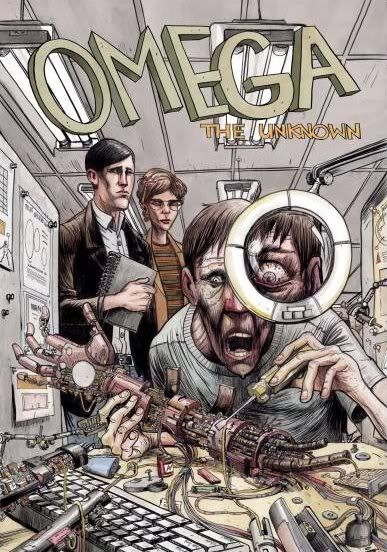
Omega: The Unknown #6 (of 10):

This one's really found its level, I've gotta say. Even when it draws close to being too cute, it has a habit of slowly, cleverly backing away. Hell, it's got a Watcheresque character who doubles as a Harry Naybors-like in-story critic ("The Overthinker," haw), but it somehow comes off as more a playful tribute than anything. This issue kicks off the second half of the series, and brings with it a few new locales and some character development, but what really caught my eye was a shitload of doubling going on.

Some of it is really obvious - in the first three pages, we've got two funereal splash pages, one for boy hero(?) Alex and the other for sly superhero The Mink, each of them helpfully bearing their own tone-setting title. Alex's ("Omega the Unknown, Chapter Six") is straightforward and dispassionate, while Mink's ("The Unparalleled Mink in: Night Hideous") is kitschy and overcooked, seemingly a put-on. Writer Jonathan Lethem ("with" Karl Rusnak) risks overstating some fairly obvious differences between the characters, but the dimension given to both does hold some interest; Alex can't function properly in front of grieving parents without telling lies, while artist Farel Dalrymple (with colorist Paul Hornschemeier) suggests a genuine rage inside Mink, in spite of his rampant playacting for ever-present cameras.

There's also one of those familiar sequences in which the action stops for a few comic-within-the-comic pages, rendered in a simpler style (here by Hornschemeier). I've read enough Alan Moore to kinda never want to see this stuff ever again, but this issue is clever enough to make the contemporary Mink superhero comic pretty moody and sexual -- moreso than the actual story! -- playing up the perceived absurdity of merchandise-ready costumed characters drinking heavily and leaving the bedroom unhappy, while also maybe revealing some things about Mink that the showman himself could never say in public. The fiction is silly for its misplaced maturity, but Lethem (with Rusnak) also positions it as potentially honest in a way that a more detatched, less embarrassing type of 'realism' can't manage.

Feel free to compare it to Alex's double-page splash of robot doodles, a second bit of art reflecting personal concerns. It also brings me back to last issue's neato fight scene, with onlookers trying to identify the participants from what comics they've read, and going so far as to extrapolate their intents. It's an old Marvel trope that the superheroes have their own comic books going, and its nice to see that stuff brought back in a thoughtful way (and it allows for Gary Panter to show up next issue!).

Of course, the nanotech plague is also spreading, which means Mink also gets compared to his own right hand, which has sprouted legs and is already acting far more superheroic than Mink himself, in that it commands the love of nanotech zombie hordes and shows some interest in bulking up for... a future issue. I'm trying to resist getting too far into my reading, since I suspect that a lot of things are going to be kept unclear until the very end (and, honestly, probably beyond), but I wonder if the zombies aren't acting as wicked forces of normalcy, joining Alex, Mink and taciturn Omega (who's kind of Alex's future, naturally) in their oddness? Even the book's world seems very anti-Marvel, with dramatic deaths taking place either off-panel or in an utterly unexciting way... will it face an incursion of action?

Er, anyway, it's has developed into a nice, low-key superhero/weird mystery series. I'm glad a lot of the scenery has shifted to university eccentricity, since Lethem (with Rusnak) seems a lot comfier with that than city high school bullies; a lot of that oppressed nerd material was too arch for me, and its dramatics mixed poorly with the series' tendency for understatement. But this issue is VERY GOOD, and I'm really looking forward to the rest.

Two Long, Two Short: Jeff Looks at Logan #1

It's nice to feel part of something larger, to be connected to others through a similar sensibility or predilection. And so, as I finished the last page of Logan #1 and groaned aloud, there was an element of pleasure in the groan, knowing that there would be others like me who had groaned aloud at the cheapness of the cliffhanger, and it was possible, almost, to imagine my groan joining others already in the air, mingling there in some luminiferous aether of fanboy disgruntlement.

After the jump, the spoiler, some snark, and a dramatic reduction in the hoity-toityness of the post's tone.

So, yes. Logan's in Japan at the end of World War II. He busts out of a prison, befriends an American soldier, tries to be the voice of reason, and then saves the life of a lovely Japanese woman who repays him by bedding him down. And on the last page, we learn this idyllic Japanese area he finds himself in is...Hiroshima.

Now, don't get me wrong. Do I want to see Logan stumbling around all Barefoot Gen, his flesh cooking off him and regrowing while he endures a visual tapestry of horrors? Hells, yes. But while fellow SCer Douglas rightly berates this cliffhanger as cheap, I found my groan came not as much from the cheapness of it, but that Vaughan, student of structure that he is, had found a quick and easy escape hatch to an nearly infinite number of Wolverine storylines which anyone can now exploit. In the interest of making the jobs of wanna-be-Ways and aspiring-Tieris even easier, allow me to extrapolate a few of the next nine hundred Wolverine miniseries:

  • A routine Poutine delivery gone terribly wrong puts Logan in the center of the cauldron of Stalingrad. How will his mutant healing power affect the duel of two master snipers battling for supremacy of the city? 


  • Logan arrives in chaotic Uganda in early 1978 after his longtime wargame-by-correspondence opponent sends several frantic messages; upon further investigation, he discovers the man he thought was his friend (and fellow "Starship Troopers" afficionado) is none other than Idi Amin Dada! Hijinks! 

  • It's Logan and Deadpool competing to find the mythical Brewster's Millions in The Republic of Biafra at just the wrong time. Is Sabretooth involved? 

  • Logan has finally met Ms. Right and her name is Marlo Thomas! Unfortunately for Logan, she has also begun dating the very sexy, very influential politican Henry Kissinger. Who will win her love?

I think you can see where I'm going with this. Taking genuine historical tragedies and JephLoeberizing them so they become another big reveal and yet another way for the story to achieve some sort of impact it hasn't earned is distasteful and, yeah, cheap. It can also be kind of fun, frankly, and probably a legitimate venue of superhero stories from the first time, I dunno, Superboy spanked Benedict Arnold or something.

I mean, I'm just about to start in on the thirteenth volume of a Japanese sniper who, if the books are to be believed, has helped shape the history of the world through little more than his superb marksmanship and well-above-average penis. Why should I care if writers pitching a miniseries can now ransack through our atrocity exhibition in search of that perfect cock for Logan to punch? ("Hey, how about Leopold & Loeb? Two cocks!")

I wish I could tell you. I think maybe it, again, has to do with the cheapness (say what you will about Golgo 13, but it sure seems like they research the shit out of those stories) and maybe it has something to do with mutantkind's own Arthur Fonzarelli. Wolverine is, in my mind, a fascinating metaphor for Western Civilization and the Industrial Revolution as viewed through post-Industrial Revolution eyes: civilization has literally made him a piece of machinery, his sniktastic claws popping with the regularity of a piece of assembly line robotics. He is the little guy made powerful through that glory of industrialization, a regular job in which he's a specialist ("the best he is at what he does," etc., etc.). It's little wonder that Wolverine has ended up tied so closely with Japan, being as they took that industrial template to the next level.

And yet, although I appreciate the bathos and male self-pity that surrounds Logan whenever it's put in a Western civilization blue collar context (sitting in a honky-tonk, staring bitterly into his beer; weeping over his inability to understand his own past, befouled as it is by the arbiters of history), it bugs me that he'll be in Hiroshima, or Laos, or Biafra, suffering as they have suffered. Because although that is the nature of male self-pity--God, why must it always be all about me!--to subsume everything in its quest to bemoan itself, Logan should suffer as we have suffered (and, yeah, I mean, post-industrial, Western Civilization "we") and not as those onto which we have shoveled all our shit (and bombs, and toxins, and crappy snack crackers) have suffered. It rankles a bit.

On the other hand, the art is nice even if the price is a bit steep. I'm going with an above-EH, in a "I pray for my soul" kind of way.


Around the Store in 31 Days: Day Eight

Did I mention that I'm making this up as I go along? I don't have a list books that I'm covering or anything, I'm just wandering in the store each day and coming up with whatever suits my fancy that day.

I'm also trying to (in the end) cover each of the racks in the store -- some racks have 2-5 genres/authors on them (like the Miller/Moore/Morrison/Creating Comics) rack -- if I just do one book in each category as I have them at the store, then I'd be at like 28 books from just that.

Some of them are easier than others. For example, today I think I'm eyeing the "licensed comics" rack, and that's a pretty hard one in a lot of ways -- most licensed comics actually, um, kinda stink.

Generally speaking they don't put "A List talent" on licensed books, though every once in a while they do. On today's installment, they did. Find out what it is, after the jump!

(And just for the record, what I call "licensed" is anything that isn't NATIVELY comics -- something that started as a TV show or novel or movie or that kind of thing)

(We don't put all licensed comics in the licensed section, though -- for example something like HELLRAISER is in the "horror" section, while BUFFY would be on the "Joss Whedon" rack, and so on and so forth)

Anyway, A-list talents, etc....

Pretty much the last people you'd expect to see doing a STAR TREK comic were Chris Claremont and Adam Hughes (!), yet in the early 90s that's exactly what happened on STAR TREK: DEBT OF HONOR.

Set right after ST IV: THE VOYAGE HOME (thus: the best post-TOS period), DEBT OF HONOR is, at the least, the god-damn prettiest STAR TREK comic you've ever seen in your life. That Hughes kid shure can draw!

The book suffers a little bit from Claremont-itis, but there isn't any Psychic Rape at least, so that's a plus. On the other hand, there IS a sizable lift from ALIEN, but at least this is a milieu in which that works reasonably well.

Ugh, I'm crazy today, store's been insanely busy (I started writing this at 10:45 am, and it is now just after 6), and we got our School Assignments for Ben's kindergarten (didn't get even one of the seven schools we wanted, sigh), so, screw it, I'm going to leave it right there. There WON'T be one of these tomorrow (I *need* a day away from thinking about comics this week), but I'm going to try and get two up on Monday...

Sorry this one was so shitty and half-written. I still like the comic...

-B


Jog takes a look at 3/4: Yes, 3/4

BodyWorld:

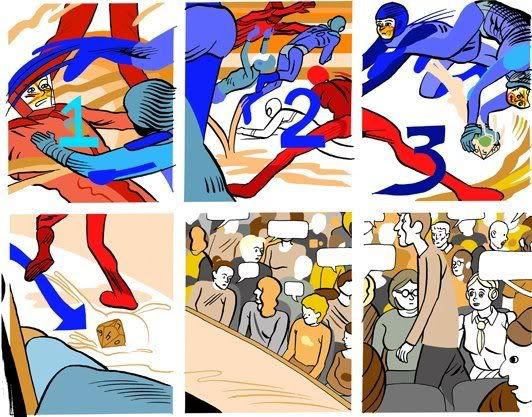
Yeah, there may have been comics released on Wednesday, but I feel the urge to talk about this past Tuesday instead, since it saw the completion of Chapter Two of a VERY GOOD webcomic, Dash Shaw's BodyWorld. If you're an admirer of rampant drug use, sticky sporting events, eye-searing colors, municipalities of the future and extra-sweaty teenage hookups, you'd best be clicking that link forthwith. Now, Shaw isn't a mysterious guy on the comics scene. He's already completed two longform comics projects -- Love Eats Brains: A Zombie Romance (Odd God Press, 2004) and The Mother's Mouth (Alternative Comics, 2006) -- a collection of short stories -- Goddess Head (Teenage Dinosaur Press, 2005) -- plus anthology contributions to MOME and Meathaus, along with an upcoming story in Marvel's alternative comics thingy and various other projects. This summer will bring a 720-page(!!) graphic novel from Fantagraphics, The Bottomless Belly Button. Obviously what he needed was more things to do, so he started a webcomic at the top of this year.

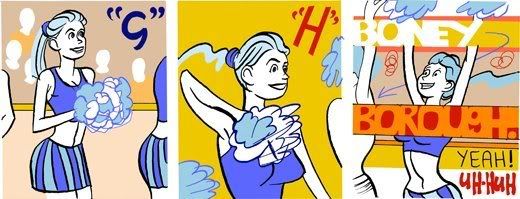
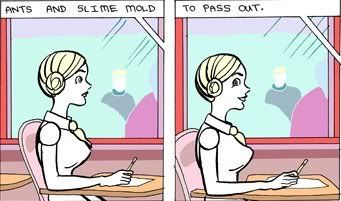
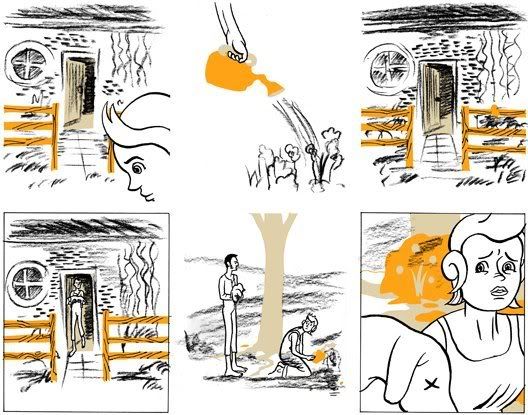
Those who only know of Shaw through the vigorous formalism of some of his earlier works may be surprised by how straightforward a comedic sci-fi soap opera BodyWorld is thus far. The plot more-or-less follows Prof. Paul Panther, a deeply questionable academic who's (allegedly) putting together an encyclopedia of hallucinogenic plants, or at least an updated edition thereof. He's a sorry, abrasive bastard, a romantic nostalgist and very much prone to harming himself. His misadventures take him to futuristic Boney Borough, where strange things are growing out by the local high school, and youth drama seethes inside among a wishes-she-was mature girl, the strapping athletic hero she's seeing, and the obligatory pretty cheerleader.

It's a fast-paced story, charged with Shaw's detail-prone imagination; you'd better believe the beloved local sport of Dieball -- a collision of lacrosse, a live-action tabletop game and a Double Dare physical challenge -- is presented with full gameplay instructions, just as Boney Borough itself is helpfully mapped. There's small mysteries, and odd folks wandering around. I can't say the main cast is thrillingly detailed yet, early in the story as we are, but Prof. Panther is a lot of fun, and the occasional awkwardness of Shaw's dialogue is offset by the ingenuity of his art.

Packed with distinctively outlined character art -- and I love how the older ones are literally sharper or more determinedly molded than his round, simpler youths -- Shaw's 'core' style sets white-heavy foreground elements against outline-free layers of color, sometimes vividly contrasted to affect the mood of a sequence. Arrows and sound effects often fill panels, while large portions of word balloons remain blank, lending a mannered, diagrammatic sensation to these hesitant characters' interactions, although Shaw is careful enough with subtle expression to give them some human dignity.

But this is a pliable world too, prone to launching into bold slashes of movement, bodies contorting with speed against suddenly abstract backgrounds. Note how the burning primary colors of the players below clash with the muted hues of the geometric crowd and their buzz of panel elements.

Meanwhile, one of Prof. Panther's flashbacks might adopt a monochrome, doodled elegance, befitting the cherished fuzziness of even his more painful recollections.

It really is an intuitive setup, smartly complimenting the artist's story - and it's great for emphasizing the body in Shaw's world. Nearly everything these characters do is related to physical sensation -- sports, drugs, climbing, kissing, bleeding -- the only refuge being Prof. Panther's memories, which fail to help him any. Every body is nearly a blank slate, all but demanding the marks and colors and letters of tactile sensation. Shaw has mentioned that psychic phenomena is soon to come to the plot (along with drama at the prom), and it will be something to see how this works in the context of this thought-through world.

Anyway, it's neat. And free. Updates each Tuesday. Go connect.

Number One With A Bullet: Diana Quick-Shoots 5/3

Let's get right in there, shall we? BUFFY THE VAMPIRE SLAYER #12: Here's my $0.02 on The L Thing, from the perspective of a series-long fan. Do I believe Buffy would sleep with a woman? Yes, provided the woman is a Slayer - that was, after all, the subtext of her dynamic with Faith (especially in "Bad Girls"). However, I thought the execution here was a bit problematic for two reasons. Number one, as Chris Sims points out, the whole "post-coital reveal" really is a cliche these days. Number two, and this is something that bothered me a lot during the show's final years, there's no subtext or ambiguity in the Buffyverse anymore. That was a huge pet peeve for me, because the first three seasons were great at being subtle (ie: you never knew exactly what Angelus and Drusilla were up to behind Spike's back, which left your imagination running on overtime), and afterwards everything was in-your-face-with-a-can-of-mace (I'm thinking here of the near-rape in "Seeing Red" to name just one egregious "geez, what happened to my show?" scene). It could've been more interesting to be ambiguous about Buffy and Satsu, to drop teases and hints, rather than pull the old Wile E. Coyote anvil-to-the-head maneuver. I wasn't at all surprised to learn that Drew Goddard wrote that Season 7 episode when Spike's mother goes all Freudian on him, because that's exactly the kind of bluntness (which, in all honesty, could very easily be attributed to sensationalism) we get here. All that said, this is still a VERY GOOD issue, and Goddard deserves kudos for the abundant humor, to say nothing of the main reason I'm enjoying Season 8: new variations on canonical threats. The vampires in this issue are linked to an enemy Buffy's faced before, and that's precisely the sort of internal continuity mixed with innovation that makes the story even more interesting (and I didn't even like that particular enemy when he turned up).

CABLE #1: Cable, as a character, greatly benefited from MESSIAH COMPLEX: if, in earlier appearances, he either drifted around aimlessly or played at being Robo-Jesus, he's now a soldier with a clear mission and a nemesis who thematically parallels his own situation (after all, Bishop is also a soldier with a clear mission). What isn't apparent by the end of the issue is where Duane Swierczynski wants to go from here, big-picture-wise: is this series set in the New Jersey of 2043 we see here? Or will Cable and the baby be jumping through time with Bishop on their heels? It could go either way, and both options have potential (though I think we need a bigger supporting cast, because Cable monologuing as the baby cries could get old very fast), but we're off to a GOOD start. Special props to Ariel Olivetti for that look on Cable's face when he has to change the baby's diaper. Verily, a fate worse than death... and if this baby turns out to be Jean Grey, we can look forward to the inevitable argument where they both scream "I CHANGED YOUR DIAPERS!" at each other.

LOGAN #1: With Y: THE LAST MAN complete, I've been feeling the lack of Brian Vaughan in my monthly readings (don't ask about EX MACHINA). Now, I'm not a Wolverine fan. At all. But there's a handful of writers who can get me to check out anything they do, and Vaughan's one of them. (Carey's another, which no doubt explains why I feel like I've already passed my Wolverine quota for this year.) So imagine my disappointment when LOGAN #1 turned out to be a rather dull comic. Where is Vaughan's trademark unpredictability? Where are the twists and turns? This issue reads like WOLVERINE FOR DUMMIES, a standard (and standardized) fusion of stock tropes I've seen a hundred times already. EH, because I honestly don't care.

Postscript: The second I finished posting this, I saw that Douglas had beaten me to it.


I call the right side!

Let me break their jaws: Douglas's quick takes on 3/5

Pamphlets! Under the cut: LOGAN, NEW FRONTIER and YOUNG LIARS.

LOGAN #1: I realized after I'd bought this issue that it's cover-priced at $3.99, and for that money I expect more than 22 pages of story. And in fact I got more: it's 23 pages of story. (And a glossy cover; so what?) Eduardo Risso's in good form, but I expected much better from Brian K. Vaughan. The story is once again sending Wolverine to Japan (which was a really clever and refreshing idea when Claremont and Miller did it twenty-five years ago--yes, I am of the Paul O'Brien "oh Christ, not Japan again" school), and once again exploring a bit of his adventuring past so deeply forgotten it's never been referred to before. Although I suppose repeating oneself is the risk you run when you've got him appearing in at least half a dozen books a month. Also, Vaughan's cliffhangers tend to be much less cheap than this one. What's the exquisite, pastoral Japanese locale where Wolverine rescues and is bedded by a beautiful young woman in the waning days of World War II? Why, a little town he's never heard of called Hiroshima, of course! Knocked down to Awful for the price gouging.

JUSTICE LEAGUE: THE NEW FRONTIER SPECIAL #1: Effectively a 48-page plug for the direct-to-video animated New Frontier movie, but hell, it's Darwyn Cooke--nine pages of the first story even have his signature at the bottom, distractingly enough. That story doesn't really add much to the original series--Superman and Batman have a misunderstanding and fight, and then Wonder Woman mediates a deal between them--but Cooke's artwork and design sense are the point here. The backup Robin/Kid Flash story is seriously incoherent (having Robin drag-race Wally Wood is a joke I wish someone would explain to me), and the Wonder Woman/Black Canary/Gloria Steinem teamup is just kind of a dopey joke. Good, on the strength of the lead feature's lovely Cooke art.

YOUNG LIARS #1: A new Vertigo ongoing by David Lapham, who spends the better part of his text piece wincing about the fact that he still hasn't finished Stray Bullets yet. So instead of Amy Racecar, we get a different all-id-no-superego antiheroine, Sadie Dawkins, who's come by her personality the Phineas Gage way--she's got a bullet in "the moral and emotional centers of [her] brain." I'm looking forward to hearing what Polite Dissent says about that one. This is apparently Lapham's take on youth culture, and specifically the New York music scene of the moment (the story happens literally yesterday, March 7, 2008), and he's really shaky on that stuff from the top of the very first page, where the credits appear on a cassette tape. Note: that date is 2008, not 1993. The supporting cast are broad but shallow caricatures--an anorexic ex-model called Annie X, an aging trust fund kid ("Daddy refused to pay the co-op. They're kicking me out tomorrow!"), etc. Lapham's stuffed this issue with temporal jumps and cutaways, and he seems to have some kind of master plan for the series. I could be convinced yet, but this is an Awful start.


Around the Store in 31 Days: Day Seven

Look, I made it a whole week!

I like comics that make me laugh. I also like comics that are smart and teach me something new.

Even better when they do both!

More after that ol' jump!

EPICURUS THE SAGE is a clever little book. Set in Ancient Greece, in concerns philosophy, philosophers, and the Greek Gods.

Socrates is a jerk, Plato is a boob, and Epicurus tries to find a reasonable position based upon moderation. Throw in a young Alexander the Great, and quests from Hades and Hera and such like and you've got a pretty rich comic stew.

EPICURUS, by William Messner-Loebs and Sam Kieth was orignally published by Piranha Press, DC's attempt at an "eclectic" imprint in the early 90s. Looking back at it now, they really did produce a great deal of interesting material: GREGORY, BEAUTIFUL STORIES FOR UGLY CHILDREN, I think that both WHY I HATE SATURN and STUCK RUBBER BABY were also Piranha books. Really, a great imprint, and a shame it never went much further.

You're going to have your own opinion of which of Piranha's books were the best (I know many will vote for SATURN or GREGORY), but my heart is with EPICURUS THE SAGE -- its sorta really only in comics that you're going to find a satirical comedy based on Greek Philosophy, and Messner-Loebs turned in some home-runs of scripts that are both whimsical, educational and absolutely hysterical.

It also has some of my favorite bits of Kieth art, where he's doing super-zany big foot cartooning that's also insanely feathered and cross-hatched like a Wrightson drawing.

When Messner-Loebs ran into financial troubles, Wildstorm reissued the previous EPICURUS material (2 OGNs, plus a short story from the FAST FORWARD anthology) in a complete collection, with an all-new story as well. As much as I love charities like the HERO INITIATIVE, I also think its great when publisher's step up and actually bring those suffering creator's work back into print so everyone can enjoy it.

Anyway, this is terrific top-notch stuff, and if you never thought Greek philosophy could be funny stuff, you're in for an amazing treat here.

-B


Around the Store in 31 Days: Day Six

So yesterday I did a "kid's" comic, let's go 180 degrees the other way today, and talk about something that's fully for adults.

With like screwing, and everything.

More after the jump, but if you're a prude, you should probably stop reading here.

Erotic comics are a difficult thing, a lot of the time, because you have to rate them both on how well they tell their story (when, that is, they HAVE one), as well as how "hot" it is. That latter is SUPER subjective.

I think most erotic comics really (no pun intended) suck. Especially these days. There were a couple of years were stuff of pretty decent quality was coming out, that was human-driven (instead of purely fuck-driven), where the art was luscious, etc.

But these days, it seems like erotic comics are largely of the "Rebecca" school, or of the hardcore Japanese erotic (epitomized by A-G SUPER EROTIC ANTHOLOGY) where all women are stupid sluts who once you warm them up they'll happily be humiliated in any number of subhuman and degrading ways, because all they REALLY are is a cunt (and mouth and ass...)

While (I suppose) there can be a few moments of hot fucking within that framework, that doesn't do a whole lot for me. I've even seen increasing elements of this in artists whom I think are incredibly amazing craftsmen, like, say, Milo Manara.

There's very little erotic comics in my personal collection, in fact, I only have two things in there. One of them is Coleen Coover's SMALL FAVORS, the sweet and funny lesbian sex comic, and the other is my actual subject today: Bill Willingham's IRONWOOD.

I've been a Willingham fan for a long time -- heck, I bought my copy of VILLAINS AND VIGILANTES (to tie it back to the gamer-geek post from a few days ago) because of his art. V&V had a module ("Death Duel with the Destroyers") that leads into Willingham's ELEMENTALS series, and ELEMENTALS pretty much led into IRONWOOD... Yes, role-playing games lead directly to pornography.

What I love about IRONWOOD is that is has (*gasp*) an actual STORY, which, sure, is heavy on the fantasy tropes, (and kinda ends awkwardly) but actually moves forward and does stuff.

Plus there's fucking. Always a bonus.

It's funny, it's pretty hot, it has a plot, and my memory of it is that it also has a diversity of sizes and shapes and things going into other things.

And can I tell you, the boy can draw. I wish he'd draw more these days.

So, yeah, that's my pick today: IRONWOOD, the only Sword-and-Sorcery Porno Comedy.

-B


Editurs r gud

Two quick periodical hits, since I'm standing in a pretty empty store today for some reason...

AMAZING SPIDER-MAN #552: I'm just generally opposed to any character introduction where a seemingly normal junkie (Down to yelling "China white, we've got a date!") is able to evade Spider-Man through the streets of Manhattan. that's just sloppy lazy writing.

But what bugs me even more is two editorial lapses which just TORE me out of the comic. First off, on page 8 Spidey tears the ass in his suit. On page 10, the crowd comments about being able to see his ass. Page 9, which has got a fairly clear ass shot? Nothing.

(not that I WANT to see Spidey's ass, just saying)

But the bigger one for me is that "The Freak", takes a drug of some kind that literally makes him puke up his guts, on camera, which then swallow him up making a bloody organic cocoon. It's pretty gross and explicit. Then four pages later "Ox" picks up "the Bookie" and the caption at the bottom of the pages says "And let's cut it there folks, before it gets too gruesome for our all-ages comic!"

Uh, what?

This is the first arc of BND Spidey which I really really hated. Phil Jimenez's art makes things a little better, but there's a few really weird shots, like that one on page 7 where it looks like he's channelling McFarlane, with a leg that can't possibly be where it is. Plus that cover? What's wrong with Pete's arms. All in all, I'll say AWFUL.

UNCANNY X-MEN 496: First off, thank god for a comic set in SF where you don't see the GG bridge in every panel, and there's actually a pretty good representation of a Victorian "Painted Lady". But the "Previous in..." page at the start of the book says that the City has morphed into "a far out version of itself from the summer of '69"

Now, maybe this is splitting hairs, but its my understanding that by '69, the Haight was mostly boarded-up store fronts, and that speed and smack had long replaced weed and acid as the drug of choice. Apparently even by '67 the bloom was off the rose, and it was really like '65 and '66 that SF was "groovy".

'69 was Altamont, right?

Interestingly, the giant Eternal is still standing in Golden Gate park, though (cf: Gaiman's ETERNALS mini)... I never expected to see that referenced again, and I suspect that no one (even Neil) knows how that one resolves...

The rest of the book is fine, if a bit slight, especially coming off the Big Crossover, pretty much the textbook definition of an OK comic book.

DC SPECIAL: RAVEN #1: Other than not liking the comic at all, I really have to comment on the cover blurb "Finally in her own EMO series". O. M. G! AWFUL.

Alright, store is full of people again, I'm out...

What did YOU think?

-B

Around the Store in 31 Days: Day Five

If you're old enough, you might remember when DC comics had a slogan int he UPC box of their Direct Market-shipping comics that said something "DC Comics: They're not just for kids anymore!"

And, in general, the comic book industry has really followed that lead -- comics AREN'T for kids any longer (except for a very small number of titles)

To me this is kind of a shame. When I bring home the new week's books, and plop on the sofa to start reading them, I often have to chase Ben (now four-years old) away when I'm reading something even as supposedly as innocuous as SPIDER-MAN or SUPERMAN, because there's just so much violence and in them.

Unnecessary violence and blood, for that matter.

Some of my favorite fiction is "for kids" -- I can watch WILLY WONKA AND THE CHOCOLATE FACTORY (Gene Wilder version) weekly, if I had to. I love reading Ben books like CHARLOTTE'S WEB or JAMES AND THE GIANT PEACH or our current project of going through the Baum OZ books (man, there's some archaic language in those though -- I find myself "rewriting" them as I read them) -- and I'd say that the best kid's work really needs to have things that appeal to EVERYONE in them.

So today's pick is a GN aimed at kids, but also working very well for adults, too!

More after the jump...

There's a couple of easy and obvious choices for "Kid's" comics. It's hard to go wrong with a BONE or a Carl Bark's UNCLE SCROOGE comic, or even the first incarnations of the "DC Animated" comics (BATMAN ADVENTURES, SUPERMAN ADVENTURES), but I'm going to go with something a smidge more "obscure".

James Robinson & Paul Smith's LEAVE IT TO CHANCE.

The "high concept" of this series can be summed up as "NANCY DREW meets HARRY POTTER", (Well, though Robinson't intro to v1 calls it "NANCY DREW meets KOLCHAK THE NIGHT STALKER", but then, HARRY POTTER started in '98, and the introduction is dated '97) and its just tons of fun.

There's action, suspense, adventure, magic, and even a cute pet dragon, and its both absolutely wonderful for kids AND adults, just like it should be.

LEAVE IT TO CHANCE is one of those books that just doesn't turn very often (in fact, it might be the slowest sellers in our kid's section), but I'll continue to carry it until the day I die because I just like it so much. It is usually my number one suggestion to parent's looking blankly at the kid's section, but they almost always opt for something THEY've previously heard of.

Format might be working against sales, as well -- CHANCE is available in three oversized "European" laminated hardcovers, which makes it look more expensive than it actually is (and compared to a number of "real world" kids books, it's down right cheap)

Either way, the stories are a delight, never talking down to its audience, always crisp and fun, while Paul Smith's artwork is just drop-dead gorgeous.

Comics: They aren't just for adults. Read some LEAVE TO CHANCE and find out!

-B


Around the Store in 31 Days: Day Four

I was going to write about a completely different book this morning, but then I saw the news that DUNGEONS AND DRAGONS co-creator Gary Gygax died on Tuesday morning.

The intersection between comics and games is often a pretty deep one -- our forms of geekness are different, but there's a lot of overlap between the two camps.

Back when I opened Comix Experience in 1989, it was de rigueur for comic book stores to carry gaming material. I opened my stores 4 doors down from San Francisco's best (and, today, only) game store, Gamescape, so that I wouldn't have to touch the things.

It's not that I'm not a gamer (I am -- dude, I was playing D&D when it was those three little booklets in the box), but I had a theory that it was better to do one thing really really well, then two things sorta half-assed.

But there are comics that are ABOUT gaming, and one of them is one of my favorite comics of all.

More after the jump!

KNIGHTS OF THE DINNER TABLE is an odd bird. It's typically (especially in the early days) just 6-8 static clip-art-style shots with lots and lots and lots of dialog.

Its also hysterical.

Some of it is kind of "insider baseball"-funny... a lot of the jokes might get lost on you if you don't game yourself, but I think that, for the most part, the gags are pretty universal if you have even the slightest awareness of gamings tropes.

There's a Rules Lawyer, a ground-down-by-real-life-so-he-needs-to-kill-imaginary-stuff-to-stay-sane hack-and-slasher, a hardcore roleplayer, and a dumb guy who goes along with his friends, plus their long-suffering DM, just playing games for 24 pages a month.

Some of the humor is just the absurdity of people so trapped in their world-view that they don't know how else to deal with things ("OK, coming over the hill, you see a gazebo." "A Gazebo?! What's that?" "I waste it with my crossbow!" "Fireballs coming on line, BA!" "um, guys...?"), and some of it is about mechanics of games, or tropes that gamers all take for granted, but it is pretty uniformly hilarious.

A quick look at the book might make you turn away from the crude "clip art", but the style will quickly grow on you, and sticking with it will give you one of the most consistently funny and whimsical "funny books" on the shelves today.

There are, as of this writing, something like 24 trade paperbacks reprinting the first eighty-something issues. Sadly, most of them seem to be either out-of-print, or at least unavailable from Diamond (and "real" book distributors, like Baker & Taylor simply don't stock them), but the series is currently on it's 136th issue, an astonishing and remarkable achievement by any standard.

I especially recommend the "Bundle of Trouble"s (that's what they call their TPs) around the v4 to 8 range -- they've found their voice by then, and worked out some of the kinks, and the "extra" stories in the backs of the BoT (typically, one reprints 4 issues, with another 30 or so pages of new material) like the "Bagwars" saga are amazing pieces of timing and humor.

Currently the series is a hybrid comics/game magazine -- there's 30-something pages of comics, and another equal amount of RP supplementary material. I almost always stop reading once the comics are done, but I still always feel like I've gotten my money's worth out of each issue.

I guess what I like the best about KoDT is that it is TOTALLY out of the mainstream of comics culture -- it's almost like the "Dev team" (KoDT is created by a team of writers, all switching back and forth each issue) fell backwards into the whole comic thing -- it's totally off the radar of most comics people, and yet its longer running and much much funnier than almost anything else running today.

There's not enough "funny" in the funny books these days, so I'd urge you to try and track down some KNIGHTS OF THE DINNER TABLE today.

Me, I've got to get back to prepping for this week's comics... and rolling a d20 salute to Gary Gygax...

-B


Sometimes, you forget to headline these things...

Was it just me, or was February a strange and full month that just overwhelmed everyone else with stuff? I'm used to January seeming like a hangover from the previous year, but there was something about February this time that seemed to take me by surprise. Those damn leap years, man. They take it out of you.

Reviews of last week's books under the jump, for those who want comics.

BATMAN #674: This is a strange book; you get the idea that Grant Morrison knows roughly where we wants to go with the character, but just can’t quite get there for whatever reason. Ideas that should be big and bright and interesting – the trainee Batmans gone rogue, Bat-Mite showing up – fall flat, as if they’ve been rushed out without being thought through, and without art that boosts their potential by dazzling us into submission. It feels oddly like Morrison’s X-Men run, which had moments of wow and genius but felt more and more bogged down in mental sludge as it went on. Okay, I guess.

CAPTAIN AMERICA #35: Over here, however, Ed Brubaker has used the new Captain America to regain focus on another book that seemed to be getting trapped in itself a little bit too much. I didn’t find the Winter Soldier to be that interesting a character, but there’s something about Bucky’s aspiration to be Steve Rogers – and the fact that he’s kind of digging trying, despite the legacy – that I really enjoy. Weird to see Butch Guice doing such a great Steve Epting impersonation, but you can’t fault a book that has such a stylish rotating art team where you can’t see the joins. Very Good.

CRIMINAL #1: Talking of Brubaker, the return of his noir collaboration with Sean Philips is, very simply, Excellent; the writing doesn’t miss a beat or waste a word, and Philips’ artwork manages to be realistic and appropriately melodramatic all at once. The done-in-one format works surprisingly well, given the previous stories’ sprawl, and while the last story lost me slightly with what felt like overdone cruelty, this short piece gripped me all the way through. Really, really good, and easily PICK OF THE WEEK, as we used to say.

DOCTOR WHO #1: Eh, I suppose? It’s a strange book, which comes close to feeling right in a few places, but then veers off to a more cartoony place (in writing as well as art) that is off for some reason that I can’t quite put my finger on. I didn’t dislike it, but I didn’t really enjoy it that much, either. I’d say that it wasn’t what I expected, but I’m not sure that I could tell you what I expected if you asked.

RASL #1: Getting back to what I said about consistency yesterday – This is pretty much not the subject matter nor the writing that you’d expect from the guy who gave you Bone and last year’s Shazam book, and it’s much the better for it (The art, though, is very Jeff Smith; that’s not a bad thing, mind you). Like some kind of karmic doppelganger to Casanova, the main character here is a dimension-hopping thief lost in an alternate dimension that it’s quite like our own, but the execution is different enough to make it its own book. What’s going to kill it, ultimately, is the schedule; this is a Very Good first issue, but I probably won’t remember enough about it when the second issue comes out in three months.

X-MEN: LEGACY #208: Surprisingly strong, even if I find myself far more interested in the flashback/X-Men Saga scenes than the current-day plot about Xavier’s stolen body or Magneto returning, again. Mike Carey definitely has both a love of, and a feel for, Xavier and the old characters, and John Romita Jr.’s art is beautiful work – with equally beautiful coloring – but I wonder just where this is going, if anywhere. For now, a highly Good first issue of the new run; here’s hoping it keeps it up as we go through the history of the team.

But what did the rest of you think?

Around the Store in 31 Days: Day Three

I'm not the biggest fan of most Japanese manga; largely this is down to the common tropes that comprise the majority of what's been brought over -- the big round eyes and so on.

But there's a handful of pieces of manga work that I think are utterly terrific.

My number one favorite series is after the jump!

I love me some DEATH NOTE.

Part of it is that it is largely unlike any other manga that I've ever read, the other part is is it unlike any Western comics that I have ever read, either.

First of all: there's very little action of any kind. There's plenty of suspense, and plenty of twists and turns, but almost none of it is resolved with "action" -- you're not going to find a lot of car chases or shoot outs or fighting or any of the things that most comics tend to revolve around.

Second: there's a whole lot of interior dialog. I haven't counted or anything, but there are certainly entire chapters which are exclusively, or almost exclusively, told in thought balloons; and, at a guess, nearly half of the comic is just people thinking stuff.

Because DEATH NOTE is about mind games... it is about trying to out-think your opposite number, like a delicate dance on a chessboard, trying to stay three and five moves ahead. There are rules. Lots and lots and lots of rules, and new ones get added each chapter, but never in a way that invalidates the previous ones. Instead they build and spread and grow with the story.

DEATH NOTE is an incredibly tight, thoughtful and suspenseful piece of comics work, and is very much like a bag of potato chips: once you start, you don't want to stop, you want to keep eating and eating and eating, seeing what new twist and turn is coming up next.

Western comics have larger eschewed the notion of thought balloons over the last decade or so (here is an excellent essay by Steven Grant from a few weeks ago [Edit: heh, no that one was from 2005, THIS ONE is from a few weeks ago that I was thinking of. Read both!] on the subject) There's been some small movement to retake the tool, lately, probably most notably Bendis' somewhat strange usage in MIGHTY AVENGERS, so to see a work not only use them extensively, but to utterly rely on them to move the narrative forward is an utter treat.

Above all else DEATH NOTE is smart and clever, and Tsugumi Ohba and Takeshi Obata really do an amazing job of keeping both the characters as well as the audience on it's toes. What's nice is that, even though the book is really about murder and death, there's really very little violence and gore to it. While the books are rated 16+, almost every bit of that is for thoughtcrime (as it were)

There's bits of it which are better and worse than others: the first three volumes are pure comics wonderfulness, it lags out a bit in 4 and 5 (that's the section with the evil corporation, right? I didn't like those parts), and roars back in six, but, even at its worst, the mind games on display are intelligent and utterly clever.

Just because I've wanted to say something about it for weeks, and haven't found a space, let me briefly mention the anime of the same that's airing on Cartoon Network. Do you remember those old Marvel cartoons from the late 60s which were like straight swipes out of Kirby Komics, but they'd animate one arm, or a mouth talking. The DEATH NOTE anime is very much like that -- it's only slightly animated, but it is always moving because they've got the camera moving around the drawing (and it is much better scored) The anime does a reasonably good job of adaptation, but if you've only seen the cartoon, and not read the books, the comparison might be LEAGUE OF EXTRA-ORDINARY GENTLEMEN versus, um, LXG (or as the ads called it: ELL! ECHS! GEE!) -- they're just not the same thing at all.

Anyway, even if you "don't like manga", this might be a series for you -- it is smarter in plot and scope than virtually anything else on the stands.

-B


Arriving 3/5/2008

Here's what Comix Experience is receiving this week -- another solid shipment!

2000 AD #1573
A G SUPER EROTIC ANTHOLOGY #76 (A)
ALL NEW ATOM #21
AMAZING SPIDER-MAN #552
ANITA BLAKE VH GUILTY PLEASURES #9 (OF 12)
ARMY OF DARKNESS #7 LONG ROAD HOME
BETTY & VERONICA DIGEST #182
BOYS #16
BUFFY THE VAMPIRE SLAYER #12
CABLE #1 DWS
CARTOON NETWORK ACTION PACK #23
CASANOVA #12
CLANDESTINE #2 (OF 5)
COMIC BOOK COMICS #1
CORY DOCTOROWS FUTURISTIC TALES HERE AND NOW #6 (OF 6)
COUNTDOWN LORD HAVOK AND THE EXTREMISTS #5 (OF 6)
COUNTDOWN TO ADVENTURE #7 (OF 8)
COUNTDOWN TO FINAL CRISIS 8
DARK TOWER LONG ROAD HOME #1 (OF 5)
DC SPECIAL RAVEN #1 (OF 5)
DEAD SPACE #1 (OF 6)
DETECTIVE COMICS #842
DOCTOR WHO CLASSICS #4
DYNAMO 5 #11
END LEAGUE #2
EXTERMINATORS #27
GREEN LANTERN #28
GRIMM FAIRY TALES #23
HALLOWEEN NIGHTDANCE #2 CUNNINGHAM CVR B
INFINITY INC #7
INVINCIBLE PRESENTS ATOM EVE #2 (OF 2)
JONAH HEX #29
JUSTICE LEAGUE THE NEW FRONTIER SPECIAL
JUSTICE LEAGUE UNLIMITED #43
LOGAN #1 (OF 3)
LOONEY TUNES #160
LORDS OF AVALON SOD #2 (OF 6)
MARVEL ADVENTURES SPIDER-MAN #37
MARVEL SPOTLIGHT HAMILTON MARTIN
MIDNIGHTER #17
MOON KNIGHT #16
NEW BATTLESTAR GALACTICA SEASON ZERO #6
NEW DYNAMIX #1 (OF 5)
NIGHTWING #142
NORTHLANDERS #4
OMEGA UNKNOWN #6 (OF 10)
OVERMAN #4 (OF 5)
PAINKILLER JANE #5
PAX ROMANA #2 (OF 4)
PENANCE RELENTLESS #5 (OF 5)
POWERS #28
PUNISHER WAR JOURNAL #17
RESURRECTION #3
RIDE DIE VALKYRIE #3 (OF 3)
SAVAGE TALES #6
SCALPED #15
SCUD THE DISPOSABLE ASSASSIN #22
STREETS OF GLORY #4 (OF 6)
SUPERGIRL #27
TEEN TITANS YEAR ONE #3 (OF 6)
TERRY MOORES ECHO #1
TRAILER PARK OF TERROR COLOR SP #8
TWELVE #3 (OF 12)
UNCANNY X-MEN #496 DWS
VINYL UNDERGROUND #6
X-FORCE #2 DWS
YOUNG LIARS #1
ZOMBIES VS ROBOTS VS AMAZONS #3 (OF 3)

Books / Mags / Stuff
ARAB IN AMERICA TP
BAREFOOT GEN VOL 5 TP
BAREFOOT GEN VOL 6 TP
BECK MONGOLIAN CHOP SQUAD GN VOL 11 (OF 19)
CABLE CLASSIC TP VOL 01
CHRONICLES OF CONAN TP VOL 14
CLASSIC MARVEL FIGURINE COLL MAG #29 ROGUE
CLASSIC MARVEL FIGURINE COLL MAG #60 SUPER SKRULL
CLASSIC MARVEL FIGURINE COLL MAG #61 SPIDER-WOMAN #61
COLLECTED AND THEN ONE DAY GN VOL 01
FABLES 1001 NIGHTS OF SNOWFALL SC
FORGOTTEN REALMS TP VOL 06 HALFLINGS GEM
GRAPHIC CLASSICS VOL 15 FANTASY CLASSICS
GUMBY TP VOL 01 (RES)
HAWKGIRL HATH SET TP
HAZED GN
HIGHWAYMEN TP
JANES WORLD TP VOL 08
JUSTICE LEAGUE NEW FRONTIER ANIMATED MOVIE REG ED DVD (NET)
JUSTICE LEAGUE NEW FRONTIER ANIMATED MOVIE SPEC ED DVD (NET)
MIXTAPE HC VOL 01 JIM MAHFOOD ART
NARUTO TP VOL 28
PLEASE MISS YURI GN (A)
RED PROPHET TALES OF ALVIN MAKER VOL 1 TP
SIZZLE #37 (A)
STAR TREK YEAR FOUR TP
STAR WARS LEGACY TP VOL 02 SHARDS
STAR WARS REBELLION TP VOL 02 AHAKISTA GAMBIT
SUPERMAN THE MAN OF STEEL TP VOL 06
SWALLOW BOOK FOUR
ULTIMATE POWER HC
UNHUMAN ELEPHANTMEN ART OF LADRONN HC
WONDER WOMAN WHO IS WONDER WOMAN HC (RES)
X-MEN VS APOCALYPSE TP VOL 01 THE TWELVE

What looks good to YOU?

-B

Almost On-Topic: Jeff Talks Briefly About Morpheus, Obama, and Politics.

The only letter I ever had published in a comic book was in Transmetropolitan. I don't remember the issue but I'm pretty sure it's issue #16, above--this cover of Spider as The Statue of Liberty rings some bells. Somewhere, Ellis had written about the '92 election race that was currently underway, and posited a pretty good theory about who gets to be President. (As I recall, the theory is basically, "Whoever wants it the most, gets it." Clinton, Ellis pointed out, wanted the Presidency in a way Bush I didn't.

I wrote back a response suggesting that, in fact, what we were seeing from Bush was petulance--the speed with which we devoured news media had changed, and what had been some very classic re-election gambits had fallen flat because of it. Consequently, Bush was upset and frustrated by having done everything right and still losing. Because I mentioned Hunter S. Thompson's Fear and Loathing on the Campaign Trail '72 of which Ellis is a fan (although is there anyone who reads that book who doesn't become a fan?), and maybe because I laid on the Transmet rah-rah thick at the end (hey, what can I say? I was a fan), Ellis ran the letter.

Last week, getting ready to leave Buenos Aires, I saw this Obama ad that repurposes dialogue from Neil Gaiman's Sandman.

Think these two bits of trivia--my letter in a comic book, and a political ad that takes language from a comic book--justify me writing about the Presidential election on a comic book blog? If not, don't follow me after the jump.

I suppose another connection between Presidential campaigns and comic books--superhero books in particular, I'm thinking--is the true and pressing need for character and continuity: just as Marvel and DC must make turn out dozens of stories a year about Batman or Spider-Man and make sure the heroes remain "in character," so too must the people running presidential campaigns create a "character" out of the running politician with which the public can identify (or at least consistently recognize), and tell dozens of stories about that character from one state to the next, from one puff piece to the next, from one debate to the next.

The stories a political campaign tells about a candidate are either variations on one story or smaller stories that reinforce a larger narrative, and while the details of the narrative may vary, but the point of every political narrative is the same: this politician has earned the right to hold the position they're running for, and their experiences will ensure they will represent the people in doing so. Because the point of the narrative is the same for every person running (and every superhero), the creation of character, the public's attachment to this character, and the degree to which the narrative's details resonate with the current concerns of the public, are what allows politicians (and superheroes) to survive and/or thrive in their respective arenas. These things distinguish them.

Consequently, the first move of the opposition is usually to point out areas of contradiction between the created persona and the actual person, pointing to incidents in the politician's past that do not gibe with the current persona; the opposition uses continuity to back up their condemnation of the politician, similar to the way an outraged fanboy might use continuity to condemn a current handling of a superhero as "out of character." If an opponent can't undermine the created persona, they might attack the candidate's narrative by trying to convince the public that their concerns aren't the concerns the narrative addresses.

My letter to Ellis all those years ago talked about how Bush's petulance stemmed from doing all the work to create a narrative for the upcoming election--that of a successful military commander who had led the country into and through a successful military operation--to no avail whatsoever. Unfortunately for Bush, the period of good will created by a small, successful military operation had been drastically reduced by the influence of CNN and the public's exposure to 24 hour news--the exposure meant a story's hook became stale more quickly, and Bush entered the election with the successful gulf war as "old news," and the troubled economy as what people really cared about.

Bush was also frustrated and petulant because the only successful weapon his campaign had against Bill Clinton--Clinton's infidelity--was checked by Bush's own profligate tendencies: the Democrats had info that strongly suggested Bush had continued, at least through his vice-presidency, to keep a mistress, and so the issue of morality never entered into the '92 election.

Bush had been handicapped by both his own indulgence and a change in the culture he couldn't have predicted. No wonder he seemed resentful, angry and dismissive during the '92 campaign, and no wonder he lost. His re-election narrative held no power, and the conflict between his public persona and his private character had left him unable to attack his opponent.

Now, although I'm an Obama man (with some reluctance) and have very little patience for Hillary Clinton, I find the "I Am Hope" ad more than a little depressing, not least because it highlights for me the degree to which Hillary, like Bush I, has had her narrative derailed.

I couldn't tell you for how long Hillary has been planning her campaign (I'm gonna guess it's been at least since '96) but I can tell you it was pretty obvious what her campaign narrative was going to be: her election to president was going to be a historic achievement--not for her, but for the country. Making her the first woman president would show how far the U.S. had come in gender relations. It was going to be an unavoidable sign of a new day in American politics, and it would imply a centuries long struggle between the genders was if not over, then at least at the beginning of its end. The goal from (let's say) '96 on was to acquire enough practical political experience to check the naysayers who would try to derail this narrative as so much glitter and happy hippie smoke.

However, just as Bush I was unprepared for 24 hour news cycle to erode gulf war good will, Hillary was unprepared for Barack Obama to enter the campaign and, essentially, usurp her narrative. Suddenly everything Hillary would've been saying about her campaign was being said by Obama; the only angle she really had was to fall back on was her practical political experience, and attacking Obama's narrative, suggesting that her narrative, not his, was the one that mattered most to the public.

The "I Am Hope" banner ad suggests how well that's going for her. Throw in her own character failings (from what I can tell, Hillary, like many lawyers, reserves her charm and grace for those she believes to be equals and superiors but isn't nearly as good with those serving under her--Washington is supposedly littered with secret service men who'll complain bitterly she turned them into baggage handlers and errand boys, dismissing their job duties as secondary to the chores she assigned them), and Hillary is now in the role of Choronzon, smug demonlord brought low by the prince of dreams. Considering all the years she expected to be playing the Morpheus role, I find it kinda painful, kinda like the way it's painful to watch the worst kid in acting class (who's of course convinced he's the best) see the casting sheet and realize he's not going to be playing the lead.

The Democratic race for the nomination isn't over yet, but it could be very soon. If it ends with Obama taking the nomination, will Hillary be able to re-craft her persona to make a suitable running mate? Will she be able to mesh her narrative with Obama's?

I wish I could take this entry the extra mile and bring Neil Gaiman's Sandman back into all this, but it's been too long since I last read the series and the books aren't nearby. But isn't Sandman about, among other things, the usurpation of narrative? I'm thinking here of the early arcs in particular where stories are never resolved by Morpheus in the way his enemies intend, and frequently open characters to a new understanding of their place in their universe. In Sandman, the loss of one's intended narrative and the revelation of one's true character is usually a beneficial thing. In presidential campaigns, it frequently is not.

God Gave Rock'n'Roll To You: Graeme gets his ass kicked.

There is, I guess, something to be said for consistency of vision. For example, that’s probably the best thing about KICK-ASS #1, which otherwise could be easily described as “everything you’ve already read by Mark Millar in one comic”. Never mind his by-now-traditional unrealistic dialogue that mistakes unpleasantness and swearing for realism; there’s actual thematic threads in here from his other books, not least of which is Millar’s favorite “watching lead character transcend reality, which is mundane and soul-destroying,” this time managed through the power of self-belief and beating up black guys (Am I the only person who got nervous that the first thing the character did as a superhero was go out, find three black kids and call them “homos”? I can’t tell if I was meant to take that as an example that the main character is a nervous white kid with issues or that the writer was one, to be honest).

It’s definitely the ultimate Mark Millar comic, in the same way that The Invisibles remains the ultimate Grant Morrison comic – Something that sums up, demonstrates and exaggerates all of his writerly fetishes and ticks, but without the self-awareness (or, perhaps, the demonstrated self-awareness) that Morrison brought to his series. It’s almost as if Millar sat down and tried to write some genetically-engineered mutant version of everything he’s done before: Want to see Chosen’s unassuming teen protagonist discover the great things that he’s unwittingly destined for, but for those great things to be laced with Wanted’s self-conscious depressive “grim and gritty realism”? Want to see the random pop-cultural references that made The Ultimates so up-to-the-six-months-ago (Seriously, what was with that “I say that as Buffy fan numero uno” scene? What kid anywhere would call themselves anything “numero uno”?)? Want to see the weird, naïve belief in the power of superheroes from Superman Adventures? It’s all in here! And it all plays together relatively well, but none of it is interesting – It’s all just dully nasty, like Michael Jackson had decided to remake “Fight Club,” but make it about super-heroes; we’ve seen it before and there’s no new here to make us care this time around.

(The art by John Romita Jr. is nice enough, but it’s almost too comic-booky for the story that they seem to want to tell – I can’t really buy into the idea that the beating is anything other than familiar cartoon violence, because it just looks like Peter Parker being beaten up really badly by one of his villains. Again, I don’t know if that’s intentional, or whether that confusion is acting against the idea of the book.)

Overall, though, how you feel about Millar will dictate how you feel about the book. If you love everything he’s done, then chances are you’ll love it. Otherwise, it’s just Eh.

Batman, You're GOOD and OKAY With Me: Jog in Gotham on 2/27

In which we reach nearly the same grade in very different ways, although even when the grade is the same, its never really the same, you know? Batman #674: In which writer Grant Morrison is kind enough to provide an 'explanation issue' for most of what's been going on across his run. Honestly, he maybe goes a bit far with it - I sure could have done without Batman putting together the pieces of The Mystery of the Three Fake Batmen via captions and flashbacks, immediately followed by Commissioner Gordon and a beat cop repeating exactly the same information via dialogue, in case anyone didn't get it the first time around. I shouldn't complain, though - too often for me, this run has seemed less an actual story than Grant Morrison inviting me to flip through his notebooks, after which I think, "gee, this'll be pretty neat once he actually writes it!" For a lot of these chapters, everything about the comic has been interesting except, sadly, for the comic.

Still, there's been some fairly great moments (with one truly front-to-back fine release in #666), and issues like this leave me confident that things may yet gel in the end. There's dramatic build in this one, a little detective puzzling and narrow escaping, and a smart, minimally sketched look at villain Doctor Hurt, an Evil Creator seemingly straight out of Seven Soldiers, who accomplishes much mischief with his paranoia-fueled knockoff Batmen.

At this point, it's not exactly reading deep to see this run as a mirror image of Morrison's work on All Star Superman: the history of each series is marshaled, the prime threats are alternate versions of the main heroes, and hell - both are even going to climax with the title characters facing down death. And the second-most interesting thing about Batman is that Morrison is mostly throwing concerns for serialization and easy access to the wind in order to whip up a big, sloppy History of the Bat around Bruce Wayne's struggle toward the future, bedeviled primarily by The Gun-Toting Batman or A Knightfall-ish Batman But Also Bane, along with a son he never knew about, the result of a storyline he'd seemed to forget about. Aren't they all imaginary stories?

In contrast, All Star Superman is Morrison on his 'best' behavior, matching the goodness and light of Superman with easy-access, one-or-two-issue stories that often follow a template for confrontation and (mostly) peaceable resolution -- to a somewhat dulling effect, recently -- while keeping the narrative squarely on character interactions. It's a vastly less difficult superhero book, and maybe part of that's because Morrison isn't under the shared-universe gun.

Which brings me around to the most interesting about Batman: isn't it something that the out-of-continuity All Star Superman sees its kindly hero always striving to make good with his doppelgangers and bits of history, while the in-continuity Batman has its grittier struggling and bleeding against mostly the same forces, as if the crap from the past might yet rise up and ruin all he's done, transforming him (if only through substitution, a la Damian in #666) into something awful. This wouldn't be the first time Morrison's fretted metaphorically over where the shared-universe characters he works on will go once he's gone -- Seven Soldiers has an element of that, and even a creator-owned project like Seaguy touches on it -- but it's especially striking on such a high-profile book, with such a high-profile contrast running at the same time.

GOOD issue here, hopefully clawing its way up toward something really whole and compelling.

(and meanwhile, on the other side of Gotham...)

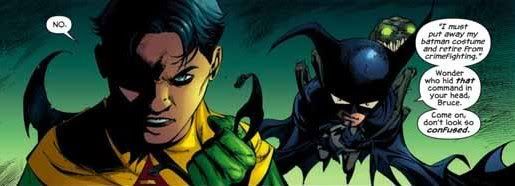
All Star Batman and Robin, the Boy Wonder #9: It's nice to see this series getting past its extra-long setup for a one-off issue; its strengths and weaknesses definitely stand out more clearly in the short form.

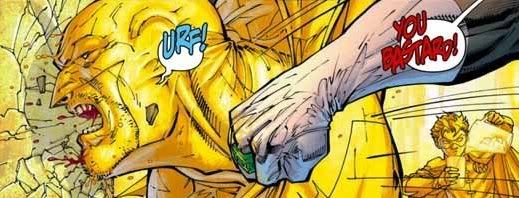
The plot is quite simple: cackling tricksters Batman and Robin(, the Boy Wonder) want to get the rest of the nascent DCU's superheroes off their back, so they confront Green Lantern -- who, by writer Frank Miller's take, is the dumbest, lamest, most ridiculous bag of nonsense ever to wear a superhero costume -- by painting themselves yellow from head to toe and inviting him to a talk in a yellow room, at which point they taunt him while drinking tall glasses of lemonade, eating what look to be corn chips, and reading comics featuring... wait for it... the Yellow Kid. It all goes well until the not-yet Wonderful Boy accidentally crunches Hal's throat, forcing everyone to break character and perform emergency surgery in the Yellow Room.

As usual, Miller's jokes range from corny gags to amusing throwaway lines to characterizations seemingly custom-designed to annoy large portions of the DC comics readership. It's also pretty self-indulgent in a 'writerly' sense, in that pages often groan under reams of words - bubbles, captions, newspaper clippings, etc. I wonder if the creative team has become acutely aware of this, though, since penciller Jim Lee is now detailing sight gags and the like, all in his hewn-from-marble approach with longtime inker Scott Williams. This density of visual information might also double as a way to compensate for the fact that over a third of the issue is splash pages of some type.

Aw, but All Star Batman wouldn't be itself if it wasn't so loud and gregarious, and somewhat nasty - the Dynamic Duo's 'daddy hits me because he loves me' interdependence is extra-queasy, although Miller's portrayal of early superheroes and supervillains trying out personas and playacting their way into legend is getting oddly compelling. OKAY, if you will.

And god, those last five pages where All Star Batman gets serious and Our Heroes cradle each other while shedding manly tears over all they've lost in life... has Miller been reading Kazuo Koike again?!

Around the Store in 31 Days: Day 2

Our second book is one that I hadn't read in nearly 20 years before opening it back up yesterday. The book is extremely well known, but, at a guess, the vast majority of Comix Experience regulars have never read it. It is one of the oldest continually-in-print comics on the American market, too.

More after the jump!

art speigelman's MAUS is a very important book. I mean I know, "duh" and all, but it really is the best known comic in the "real world", having won the Pulitzer; but it's also entirely important as a piece of work, both as a piece of reportage and history, as well as a completely honest piece of autobiography.

Some people complain about the anthropomorphics, but I think the distance they create from the subject is a good and necessary one, because the book is as least as much of a story of Vladek Speigelman of the "now" (although he passes in the middle of the book) as it is of the atrocities of "then".

I had totally forgotten, in the 20 years since I last read MAUS, how much of the book is set in "now" -- it's a comic about the Holocaust, after all, and that's what it is "best known for"; but on this read, it was all the "current" auto-bio that struck me more.

art spiegelman is brutally honest in his relationship with his father and how he perceives him, and what his faults are -- modern Vladek is not portrayed as a wonderful human being in the slightest. He's racist, grasping, penny-pinching, inflexible.

And yet he's a hero. Everyone who survived the concentration camps is, but Vladek is portrayed as nearly super-human in his cleverness, thrift, trust of his fellows, and inventiveness -- he does things and survives situations which are mind-boggling to me, and is portrayed doing it nearly with panache.

Its the dichotomy of those two portrayals, and speigelman's honesty in his conflict about them that makes this one of the most powerful comics of the twentieth century. Had it "just" been about the Holocaust it would still be an important book, because it's important that we never forget the types of atrocity that man can rain on his fellow man, but it's the acknowledgment that even a heroic survivor like Vladek is just as human (good and ill) as the rest of us that's the real heart of the book.

MAUS is an essential book for any store to stock, and for any comics reader to read.

-B


It's true, it's real, it's pretty: Douglas on "Little Nothings: The Curse of the Umbrella"

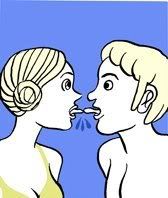
Lewis Trondheim's diary comics are so good I'm actually posting a puke joke here.trondheim

My first exposure to Lewis Trondheim was Mister O, which is one of the funniest things I've ever read--the first time I looked at it, there were at least two or three pages that made me laugh so hard I was lying on the floor gasping--and I've been skimming bits of his enormous catalogue ever since, trying to find something I like as much. (The sequel Mister I wasn't anywhere near as good, and I'm sort of mystified by A.L.I.E.E.E.N.) Most of his hundred-plus books aren't available in English; if you're reading this and you know which of his books are worth seeking out in French, feel free to recommend some stuff in the comments.

Little Nothings is 120 pages' worth of his diary comics, which he posts every few days at his blog, and they're some of the best diary comics I've seen. They don't have the same kind of broad humor as other books of his, but they're perceptive, totally charming, and exquisitely drawn--he draws himself as some kind of bird (and everyone else as animals too, which means that every drawing of a character is a little sight gag). His artwork here is deceptively simple--pen-and-ink line drawings, shaded with watercolors--but the coloring gives a great sense of lighting, and usually underscores the jokes, too. Look at the puke joke again: the splotches of yellow capture the effect of late-night streetlights, direct the eye toward Trondheim and his friends, and quietly recapitulate the gag while they're at it.

What I think I like best about it is Trondheim's attitude toward himself, which is always tricky to negotiate when you're drawing your own immediate experiences and then showing them to the world. He's amused by himself, but not particularly self-important; he's sometimes the butt of his jokes, but there's never really a sense of self-loathing. The root of his humor is his awareness of how his own mind works. It's funny when he sits on a train, watching people run for it, and then bursts into a sweat, wondering "And me? Am I on the train? Did I make it on time?" But it's even funnier when he realizes that he asks himself the same question every time.

A good-sized chunk of the book can be read here, in reverse order, which may make some of Trondheim's running gags confusing. If you can read French (or just like his drawings), his current blog entries are here, and use the weirdest and funniest system for dealing with old entries I've ever encountered. It's definitely low-key--if you want ambition from Trondheim, there's the Dungeon series, which I've yet to read most of--but it's Excellent.


Around the Store in 31 Days: Day One

I have a plan.

With the idea of having as much fresh content on the Savage Critic site as possible, I'm going to ATTEMPT to do a post-a-day for the month of March. These may not appear strictly every 24 hours, but I'm going to try.

I've decided the theme is going to be "31 classic graphic novels", trying to show the range and breadth of comics material that's available to a 21st century comics shop.

Please join me after the jump!

I opened Comix Experience in April of 1989.

There really weren't a lot of graphic novels available back then -- I think there were under twenty items that were in print and perpetually available at that point.

I still have a copy of my first order form that I placed right before opening the store, and on that order form DC offered for the very first time Alan Moore's SAGA OF THE SWAMP THING.

So, let's make that our first book.

It's tempting to say that SWAMP THING revolutionized comics -- certainly, it was the blueprint for Vertigo, and it showed you could do literate comics aimed at adults THAT WOULD SELL -- but what sort of amazes me is that twenty-four years later, the work really still holds up. There is plenty of "good stuff" from even ten years ago that I'll read and think "oh god, I liked this?!?" Not so with SWAMP THING -- this is still the shit.

Moore took a pretty incredibly two-dimensional character ("He's a monster that thinks he's a man!") and not only made it well-rounded and exciting, but built a new and innovative mythology that would last for another 150 issues (as well as 20 and 29 issues, respectively of follow up series), and would go on to influence many books and characters in the DC Universe "proper" (I'd say John Ostrander ran with the concepts the most, both in FIRESTORM and SUICIDE SQUAD), as well as creating a spin-off star in John Constantine whose HELLBLAZER just hit issue #241 this very week.

SWAMP THING showed that commercial comics could be "writerly", where omniscient-narrator captions could build mood and tone, and that they didn't just have to reiterate what was going on with the art (Like, say, the EC comics of the 1950s), but that they could counterpoint and embellish upon what you were seeing. SWAMP THING was also one of the first comics to strongly think in terms of pages, rather than panels, where words and phrases at the bottom of one page would lead you effortlessly into a completely different scene on the next page. That's a very common trick in today's narratives, but in 1984 it was a rare and wondrous thing.

I'm talking a lot about the writing here, but the art is equally wonderful -- Stephen Bissette, John Totleben (and, later Rick Veitch, Stan Woch, Alfredo Alcala, Tom Yeates, Shawn McManus, and others) brought mood and style, creeping horror, and transcendent joy to the page. Whether the subject was insane vegetable gods, demons that fed off and manifested as fear, or simple domestic bliss in the swamps, Moore's collaborators consistently brought their A-Game to the work. Vertigo went on to be known, by and large, as a "writer's imprint", but in these early days the art is at least as important to the bottom line, and it holds up wonderfully against Moore's expressive prose.

Also worthy of note is the lettering by John Costanza and Todd Klein where it is often clear who is talking JUST from the shapes of the speech bubbles. I know this sort of sounds silly in 2008, but it was really transformative in 1984, where very little of that was being done.

I should also single out colorist Tatjana Wood who did WONDERS with the limited color palette they had to work with back then. In particular, issue #56's "My Blue Heaven" (reprinted in SWAMP THING v5: Earth to Earth) which does astonishing things with extraordinarily limited tones.

SWAMP THING, I don't think, gets the respect today that it deserves in terms of the numbers of things it changed and impacted about modern mainstream comics; certainly for Comix Experience it sells just a tiny fraction of better known Moore works like WATCHMEN, V FOR VENDETTA, or LEAGUE OF EXTRAORDINARY GENTLEMEN. Everyone has a hard-on for MIRACLEMAN, but that has an awkward start, and a really rough middle section, while SWAMP THING is nearly home-run after home-run -- even the weakest points of the narrative (the monster-of-the-month nature of "American Gothic", a chunk or two of the Swamp-Thing-In-Space section) show a verve and daring and love of turning things on their head with bold experiments that is missing from most comics today.

Next year is the 25th anniversary of Moore's SWAMP THING, and I really hope that DC does something special to capitalize upon it, and refocus people's eyes on just how good these comics really are. At the least, I'm hoping that an Absolute Edition is possible for these pre-digital comics.

There are six volumes of Moore's SWAMP THING available, comprising his entire epic, as well as three volumes (so far) of Rick Veitch's solo run on the book. Each and every one of them is worth your hard earned money.

-B