Change Their Minds and Change The World! Diana wonders about 2/14

The last time I tackled a Gail Simone book, worlds lived, worlds died and the Savage Critics were never the same. Will lightning strike twice?

Probably not. I thought WONDER WOMAN #17 and "The Circle" were OKAY.

I'll admit that I struggled with that grade - it was either going to be a high OKAY or a low GOOD. The thing is, I liked the premise; it was an interesting twist on the story of Diana's birth, pointing to an aspect of Themysciran life that had never really been dealt with before. And, of course, Alkyone's prediction could have come true very easily, which goes a long way towards making her and the other members of the Royal Guard sympathetic. Their story was compelling... up to a point.

The major problem I had with "The Circle" had to do with pacing, and this has been a issue for me with Simone-written series going back to THE ATOM and WELCOME TO TRANQUILITY: too much happens too quickly, and there's no room for depth or real drama, not when you're fast-forwarding through the story like Dark Helmet in "Spaceballs". This, in my opinion, has plagued Simone's recent output - a failure to allocate enough attention to the varied story elements. If I were to break down "The Circle" in terms of plotlines, this is what emerges:

A) The backstory of Alkyone and the Royal Guard, coupled with their present-day escape and their targeting of Diana.

B) The Nazis invade Themyscira, get whipped by the mother-daughter team-up of Hippolyta and Diana, and are sent packing.

C) Diana befriends gorilla warriors.

D) Etta Candy may or may not be a spy for Diana's boss or something... I didn't really get that sequence (though I don't fault Simone for that - I'm guessing it's a leftover from the Heinberg or Picoult runs?).

Now, the best stories are those which form thematic parallels between the B-plot and A-plot, the better to integrate them towards the climax: we can think here of how FABLES has moved Flycatcher's long-running character arc into the greater Fabletown/Empire conflict as an example. With "The Circle", though, what we get are two separate plotlines which only intersect in the name of contrivance (ie: the Nazis free the Circle), at which point they separate and are resolved separately - the Nazi cleanup has very little to do with the Circle's attack on Diana. As a result, neither develop any real gravitas: had this been the Circle's story, Simone might have been able to flesh out the other three members of the Royal Guard, and bring their conflict with Diana to a much more potent boiling point, dramatically speaking. But there simply aren't enough pages to do that, because you have Nazis and gorillas running about, smacking each other around. And at no point during this four-issue arc does Simone ever convince me that the Nazis and gorillas were needed.

Ultimately, "The Circle" fizzles to a very unsatisfying conclusion: there's something poignant about Alkyone's final realization, but at the same time, I felt that it just wasn't enough, that more could have been done with the Circle and their complex relationships with Hippolyta and Diana. So... OKAY, because I liked the idea and I wanted to see more, but I didn't.

Shootings of Every Style: Jog and two faces of 2/13

The Punisher: Force of Nature:

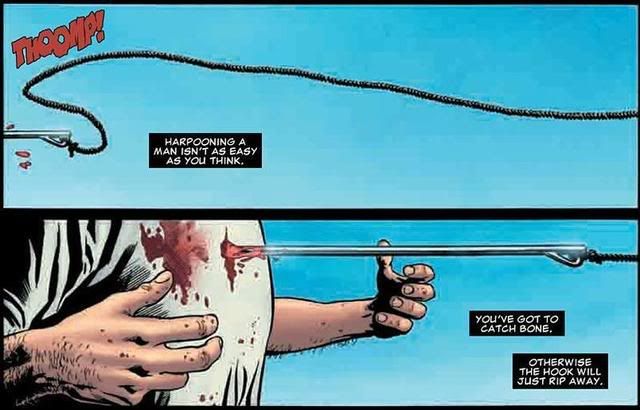
This is a 48-page MAX one-shot (34 without ads), although it's interesting to note that Marvel seems to be drawing a visual distinction between the Ennis-written MAX continuity and separate Explicit Content projects like this (or last year's Annual); the Frank Castle we see here is a bit younger, and decked out in a more costume-like black outfit, although he still seems to be running around in his own discreet modern world. It makes sense not to unnecessarily tie the character down to Ennis' world specifics, if Marvel does intend to continue the series with another writer, although it also brings to my mind the character's implied prayer at the end of the Ennis-written The Punisher: The End, that the next time he's revived he'll be able to avert his own origin; truly, Hell is an ongoing franchise.

The writer here is Duane Swierczynski (soon to head the revived Cable), and his story is exactly the type of stock plot that could have filled a gap in any prior run of the series: Frank is stalking a bunch of villains, but needs to collect some information too, so he observes/antagonizes them with unparalleled cunning until they crack up on each other. I guess the twist is that the seaborne Frank winds up facing down a literal whale in the last four pages while cleaning up his mess, although building the title character up as totally fucking unstoppable for the rest of the issue doesn't allow the finale to register as much more than an odd joke.

Even then, it sort of fits; Swierczynski augments the usual narration with a cheesy, VHS action hero sense of humor, spiked with extra thuggish sadism, and artist Michel Lacombe (with the late Stéphane Peru on colors) gives the character a rattish snarl that suggests even Frank isn't taking his mission very seriously. Granted, that doesn't make such uninspired material any less EH, and I could see a renewed Punisher of this sort getting tired awfully quickly, but we'll have to wait and see. The strength of Ennis' run, after all, was more in accumulation than great single issues.

Punisher War Journal #16:

Meanwhile, back in the Marvel U proper, writer Matt Fraction offers up a sequel of sorts to my favorite story of his 'Frank as supervillian hunter' run, the barroom massacre saga of issue #4, in which gaudily costumed crooks shot the breeze and reveled in absurdity until the cruel, detached 'hero' of the piece burned them all down. It was both a prickly take on contemporary superhero tone, and a clever homage to Mark Gruenwald's famous Bar With No Name story from Captain America; perhaps not coincidentally, Fraction's Punisher would later take up the Cap mantle itself. And while some of Fraction's stories have lapsed into tedium (the Cap one, for instance), his take on the character retains a unique bitterness in its best moments.

This issue sees bar survivor The Gibbon -- no longer terribly gibbonesque due to third-degree burns -- plotting his revenge on Frank, against the wishes of his now-blind now-wife, Princess Python. Again, Fraction spends time building up the camaraderie among cheesy supervillain concepts; the difference here is that the mild villain feels melancholic over not being as hard as the authoritarian bastard of the comic's title, who gets things done like the ultimate stern father ("And behave.") of a childish world. It's not an easy mix, but neither is the worldview Fraction has built.

He's also developed the best-yet superhero forum for Howard Chaykin's divisive latter-day visual style, airy and grizzled and texture-mad, with colors (as always) by Edward Delgado. It's great for presenting conversations between odd-looking people and tense wanderings through city streets - exactly what the script requires. The more off-kilter attributes of the approach seem perfect for filling out the specifics of Fraction's viewpoint, clenched expressions and garish hues and all. The team's going to be sticking around for a bunch of issues, and I'll want to see how they operate as more typical Punisher-centric action inevitably takes over. GOOD for now.

This plastique valentine: Douglas on 2/14

Well, okay, then--the consensus seems to be that reviews of older stuff are perfectly OK here. So... here's some quick notes on this week's books! (Actual graphic novel reviews will be coming soon...) NEW AVENGERS #38 re-teams Brian Michael Bendis and Michael Gaydos, so it's effectively a new issue of Alias, which is just fine with me. This is an all-conversation issue about Jessica Jones and Luke Cage falling out when they land on opposite sides of the registration divide, and... yeah, I admit it: Civil War was a much better idea than I'd have guessed for opening up story possibilities in ongoing series. This is the kind of conversation-based, stage-play-ish story Bendis hasn't done in a while, but the other reasons it works better than most of Bendis's recent Avengers books mostly come down to how good Gaydos is at facial expressions and character-acting: Luke, more exhausted than angry, pointing his fingers and crossing his arms a little less intently than usual; Danny lifting his hands up around his head when he talks about the Leader; Spider-Man hanging upside-down from the ceiling like it's the most comfortable place for him. (And the next issue is "The Truth About Echo," which I'm hoping will explain how a deaf lip-reader can hear somebody with a full-face mask who's facing away from her. Skrullity-skrullity-skrull.) Very Good, although does it bother anybody else that even Luke and Jessica almost never refer to their child as Danielle, but "the baby" or "our baby"?

The first few pages of BOOSTER GOLD #0 are cleverly executed--a callback to a 14-year-old miniseries could fall flat, but actually pretending it's an official tie-in to Zero Hour is pretty funny. (Extra points for the silver fifth color on the cover.) But that's mostly undermined by the extended "flashback" to the 25th century. I know it's hard to imagine what the future's going to look like--40-year-old Legion stories look like 35-year-old photographs of Tokyo--but the idea that Gotham University would be playing a football game against Ohio State in 2462 is like imagining 20th-century versions of 15th-century academies playing highly publicized games of closh. You'd think that Johns and Katz and Jurgens would try to get around that, but instead we get pages on end of locker rooms, sportscasters, Booster's sister in high-heeled boots... it doesn't look like the 25th century, it looks like the '80s with some extra fashion disasters. Eh.

FANTASTIC FOUR #554 seems to be more about demonstrating how impressive and audacious Mark Millar's approach to the series is than actually doing anything impressive or audacious--the magazine-style front cover, for instance, was clever on Trouble, but it doesn't work here. This reads a little like the proposed-but-unmade Fantastic Four movie idea that was floating around a few years ago, which was supposed to be about them as the objects of a cult of celebrity, except that they're all acting like parodies of celebrities, as if Millar's trying to to show how impressively X-Treme everyone is. (As for the music industry making Johnny a millionaire, has Millar been paying attention to newspapers in the last few years?) The "Old West" sequence at the beginning is blatantly tacked onto a story that doesn't seem to have anything to do with it but doesn't have any other action scenes. For that matter, if the Richards family had access to a functioning time machine, the miserable first day of Disneyland might not be the most fun destination. Hitch is using a lot of photo-reference here, it looks like, especially for faces, but that means a lot of the characters don't look quite consistent from panel to panel. (And is the Marvel Boy in the Fantasti-Car meant as some sort of tweak at the Morrison/Jones version?) The best bit of the issue is Hitch's double-page spread of Nu-World at the end--and even that doesn't tell us anything about it, just that it looks like a cross between Pac-Man and the Death Star. (That "nu"-as-in-nu-metal, as opposed to "new," is a good symbol of what's not quite right about this issue: it needs to announce that it's cool, which means it's sort of not.) It's Okay, but I suspect half the fun of this run is going to be finding things to get irritated about, so I'm on the fence about continuing to read it.

21st Century Innovations in Magazine Racket-Busting: Jog is there and here for 2/13

Fantastic Comics #24 (The Next Issue Project #1):

This is the debut of a new, Golden Age-proportioned anthology series from Image. There's no credited editor, but it appears to be spearheaded by Publisher Erik Larsen and PR & Marketing Coordinator Joe Keatinge. It's 64 color pages for $5.99; note the fake markup sticker.

And while the proper, legal title of this issue is Fantastic Comics #24, allowing it to dub itself "the latest comic book Image has ever published," seeing as how issue #23 hit the stands in 1941, you'll probably know it better under its banner title of The Next Issue Project. Simply put, each issue of the project will provide a 'next issue' for some long-dead Golden Age series, with a shifting crew of writers and artists providing new stories for the now-public domain characters that used to be found in each title.

It's a fun idea, and a flexible one; none of the contributors are bound to using any specific style, or setting their work in any particular era, although the book's design does its best to evoke an old-timey feel, with authentic period ads, faux paper yellowing and digital printing 'errors,' plus the same page header numbering style seen in Paul Karasik's recent Fletcher Hanks collection I Shall Destroy All the Civilized Planets. Indeed, Larsen has noted that Keatinge's interest in Hanks' work formed part of the impetus behind getting the project started; ironically, Hanks' own Fantastic creation, Stardust the Super Wizard, all but unknown to most of the comics world just a few years ago, is now undoubtedly the Batman of this book, thanks to the great success of Karasik's collection.

Unfortunately, the Stardust story in here, from my perspective as a fellow Fletcher Hanks reader, is no good.

Written by Keatinge himself with art by Mike & Laura Allred, it's essentially a 'Comics Have Abandoned Their Charming Past, and the Present is Therefore Fucked' kind of parable, albeit toned down into more of a 'Comics Have Abandoned Their Wild Past, and the Present is Therefore Dull.' It's no surprise that the tale is more about what Stardust 'represents' than anything; it's pretty obvious to me that the appeal of Hanks' comics come from his singular approach rather than his concepts, and I suspect it'd be futile to simply run with the character, or attempt to replicate the artist's unique style.
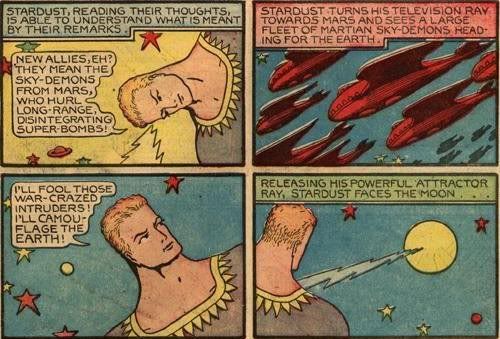
But certainly there's plenty of room to explore the underpinnings of Hanks' works. Actually, the Karasik collection does a bit of this on its own, allowing Hanks' repetitive, blunt force accounts of violent acts met with kaleidoscopic retributive cruelty to stand without comment, so as to attain the force of ritual, then revealing the human pain behind all the ugly/beautiful fun. Karasik's arrangement forces the reader into the position of the eager collector, discovering these strange, early abridgements of the superhero concept for the first time, without the fuss of searching around or paying big bucks. Then, it splashes cold water in the reader's face by revealing just enough background to force a reconsideration of what's just been enjoyed.

That's the book's depth as a text; it takes what's unique about those comics -- crazy reactions, forceful declarations, gnarled forms, bullet-impact action -- and suggests why they came to be. This new story, in contrast, jettisons everything unique about Hanks' work in favor of broad, dull statements about the vitality of old things and the wild 'n crazy ways of the goofy old awesome past; it's not sneering or ironic, but it's hardly interesting or particular.

Keatinge writes in a mixed period-modern style, augmenting dialogue often paraphrased or quoted from the Hanks originals (in one case, a punctuation error is dutifully replicated) with a narrating woman's more traditional, caption-based musings. She knew and loved the gentle (but firm!) Stardust back in the day, but he abandoned the Earth when there was no more crime worth his time. Not a bad concept.
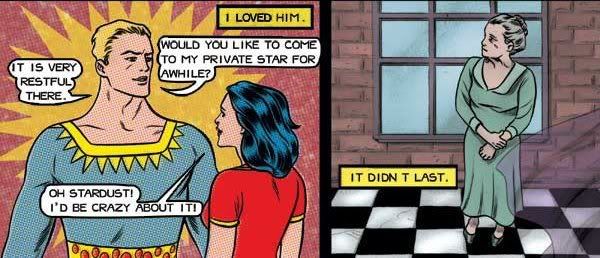
Yet Keatinge plays things out with the most obvious approach one can imagine. Time passes, and humans build anonymous, robotic superheroes to watch over things. They all get fat and lazy and old. Note above that Laura Allred differentiates between past (rulez) and present (droolz) with her coloring approach, while Mike Allred folds Hanks' brawny character art into sleeker, statuesque designs. Fitting, since Stardust -- the one who could not be tamed, readers! -- is coming back to show us all how the superheroing is done, and just maybe freeing the fun ways of yore and bringing (dot) color back to our gloomy world and literally making old people young again, which I guess is the logical conclusion of such super-charged nostalgia. I suspect it's meant to act as a type of manifesto for the project as a whole.

The problem with this SparkNotes Kingdom Come isn't that it fails to take the 'dark' route with Stardust -- after all, part of the beauty of the public domain is that you can subvert aspects of the established work to create new statements -- but that it makes absolutely no use of the original's specifics beyond a generic appreciation of wacky old comics fun. In fact, for all its citation, it doesn't even do an effective job of conveying the wacky old comics fun aspect of Fletcher Hanks, so wistful is the narration and subdued the pace. It seems like a waste of a good appropriation; this could have been any Golden Age character.

Obviously, I'm coming to this as a prior Stardust reader. Your reaction may vary depending on what you take from Hanks' work; needless to say, if your reading of Hanks' work tends toward, say, 'embodies the superhero concept as fascist impulse,' oh boy is this story gonna get sticky for you. And even if you're 100% onboard with the story's point of view, or if you've never heard of Stardust before, I suspect this'll prove a most predictable harangue about how neat the past can be - there's just nothing all that compelling on display.

This does raise an issue for the rest of the book's stories, since most of them deal with characters that are probably lacking even Stardust's limited familiarity; the immediate danger is that tribute will be paid to a lot of forgettable stories via new stories that are quickly forgotten, and most of these new works are, for sure, fast and very slight.

For me, the pieces rose and fell on the energy each artist or team brought to the table. Larsen's own 13-page Samson boasts the artist's typically fine command of fighting-mad dynamics, married to a wonderfully detailed take on Golden Age coloring, even as the goofy 'kid sidekick taken by social services' story dissolves on contact. Jim Rugg and Brian Maruca (of Street Angel) provide six pages of amusing macho antics with Captain Kidd. Tom Scioli (artist of Gødland) has six pages too, taken from a Space Smith serial already in progress; a bit labored with its humor, but sometimes striking. There's a funny, boyish wimmen-hater thread running through several of the stories; girls are trouble and sex is gross (well, not for Captain Kidd)!

But be warned, that's as good as it gets, save for two exceptions.
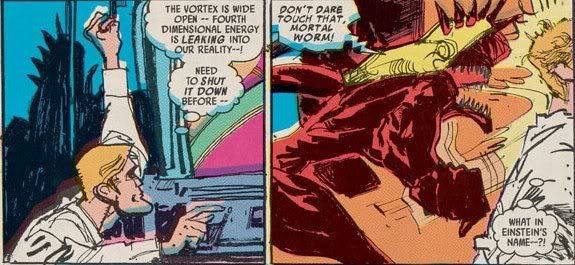
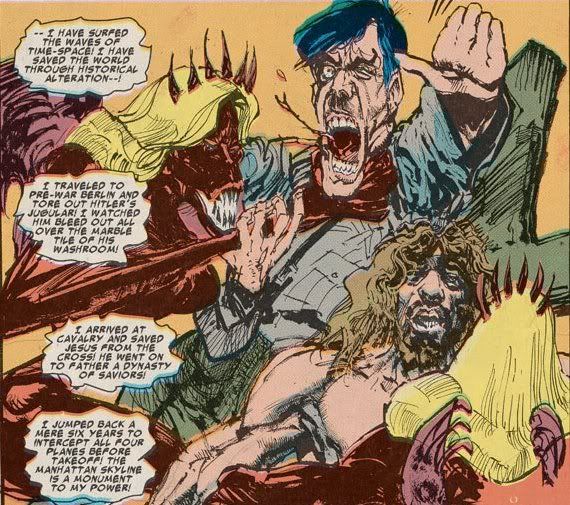
First, there's the six-page Flip Falcon in the Fourth Dimension, written by Joe Casey (writer of Gødland, the new Youngblood, and various other books), with line art by Bill Sienkiewicz and colors by Larsen. It's by far the most extreme of the book's period suggestions, and the only one that registers as something viscerally affecting on its own merits.

Every element comes together, although Sienkiewicz's contribution is what you'll notice first. It's like a fevered, scribbly variant of his New Mutants style, both perfectly clear and wildly idiosyncratic, yet fitting for the time; it appears to inspire Larsen to garish, seeping heights. Casey's script is both a full-scale revamp and a cheesy gag, packing down vortex angels and doomed romance and religion and evolution and moral conflict, all into its tiny allotted space. It's a loud comic, and it makes an impression. Hell, it sells an impression - you'll want to find some old comics just like it, even as you know it's only like itself.
Then, secondly, way at the end of the book, last but in no way least, is Ashley Wood's (you guessed it) six-page piece, executed in his contemporary signature style. Call it a postscript. Or a horselaugh. It's my favorite thing in the book.

What initially seems like a deliberately obtuse update of Sub Saunders -- consisting mostly of black, sound effects-laden panels, murky bodily close-ups and word balloons presented in untranslated German -- ultimately reveals itself to be a giggling little fable of its own, with Saunders fighting off the oblivion of owned obsolescence with a little help from an all-new character that might perhaps bring to mind the hero of a prior Wood-illustrated comic (that Joe Casey wrote) (for some corporation, years ago), but is truly an entirely different thing, yes yes.

An in-joke, to be sure, but just the sort of puckish, brainy thing the book needed to help make things seem merely EH, although the risk of disintegration remains.

Saying Kaddish: The Passing of Steve Gerber.

It's been said by much smarter men than myself (Jules Feiffer and Gerard Jones being but two) that Judaism is perhaps the real secret identity at the heart of the superhero experience--one doesn't have to look much farther than Lieber and Kurtzberg, who built Marvel comics under the pen names of Lee and Kirby, to make a case for it. Of all the many things I've thought about Steve Gerber--and believe me, I've thought about him a lot since learning of his passing earlier today--what sticks with me is that Gerber was the hero without the mask, the guy brave enough to forego the secret identity. I grew up in whiter-than-white Humboldt County and even I could tell that Gerber was Jewish: his stories were always of outsiders (outsiders even by Marvel's standards) and usually focused on defiant, frequently angry, guys who viewed with both bemusement and amusement the world surrounding them. By the time I got to high school and started reading Malamud (a little), Bellow (embarrassingly less), and Roth (a whole shitload), I could see how Gerber and his work belonged as much to their tradition--that of the soulful shit-stirrer--as to Stan's patented mix of soap opera and winking carnival barker.

The term "patented" is almost more than cliched hyperbole, by the way. What makes eulogizing Gerber difficult--and it will be even more difficult when other writers of his generation pass on--is that his most substantial work was done while stylistically imitating someone else. Every writer passing through Marvel in the '70s had to write in Stan's house style and now that styles and mainstream tastes have finally progressed, I find it's a bit of tough sell to convince younger readers--and more than occasionally myself--that there's good writing buried underneath all the labored rhetoric, and the expository diatribes and the "Dear God, no!" melodramas, and those last panel captions that read, "And somewhere, in the distance, comes the gentle weeping...of a clown."

One of Gerber's achievements--and I'm not sure if someone who doesn't know the period can really appreciate what a strange achievement it is--was to develop his own voice while immersed within that of another: within the Stanisms were the Gerberisms, the things you found only in Gerber's work, that held their own spell, bdspoke their own worldview. Cults popped up regularly in Gerber's work; so did supporting characters who would get fed up and leave the story; plots would expand out and then suddenly collapse in. The rich tapesty of the multiverse would unfold but always in the periphery: in the Florida everglades, in the park on a quiet day, over the Cuyahoga River burning at midnight. And at these places, you'd find an angry but decent guy--Richard Rory or Jack Norris or Howard the Duck--aware of his relative powerlessness, frustrated and bitterly amused at that powerlessness. As I said, I recognized that guy in Bellow's Tommy Wilhelm, in Roth's Portnoy and Zuckerman. (With Wilhelm, the recognition was semi-literal: when I read Seize the Day for the first time, my mental picture of Tommy Wilhelm was Colan's interpretation of Howard the Duck as a human man.)

Another Gerberism was the keystone for the idea of superhero as Jewish myth: Superman. At Marvel, Gerber created Wundarr the Aquarian, the superhero who is rocketed to Earth from a dying planet--except Wundarr arrives on Earth full-grown, with the intelligence of a child. With Mary Skrenes, Gerber created Omega The Unknown, a character that riffs equally on Superman and Captain Marvel--Omega is a hero come to Earth with a strange bond to a boy orphan. Later, Gerber went on to do several offbeat Superman projects. My favorite was the final issue of DC Presents where Gerber packed his entire pitch for Superman into one baffling Hail Mary: an insane Mr. Mxyzptlk destroys Argo City such that Metropolis is layered with a fine mist of kryptonite, and Superman, his power reduced, must live in pain and discomfort whenever he's Clark Kent, treading over the kryptonite impacted sidewalks of the city.

In fact, at the heart of Gerber's best work is Superman and Clark Kent: the powerlessness lurking in the heart of the powerful and, equally as important, the power lurking in the heart of the powerless. (After all, it's usually Rory and Norris and Howard who are the tipping point in the battle between good and evil.) Such paradoxes transcended the two scoops of ego gratification and bathetic male self-pity served up in the work of Stan Lee and most of his successors. While far from immune to such weaknesses (Gerber's worst work is like reading Harlan Ellison at his most histrionic), the duality of power-in-powerlessness and powerlessness-in-power which Gerber returned to thematically was a genuine belief in the world, founded on the way he saw it work: cults and corporations collapsed under their own weight; the little guy, though screwed, could still wrest victory from the jaws of defeat if he just kept at it.

I could type another ten thousand words and not get at the power of these and other achievements. (I didn't even start in on that awesome Daredevil storyline where the villain is an intelligent malevolent baboon whose pheromones make every woman his slave and who slugs it out with our hero on the roof of the White House, to say nothing of Starhawk, the first transgender superhero, Angarr The Screamer, the showgirl and the ostrich, KISS, Doctor Bong, etc., etc.) But what I should say is, Steve Gerber kept at it. He kept at it after Cat Yronwode (I believe) wrote an editorial about how his work no longer moved her; he kept at it after Jim Shooter cruelly (and inelegantly) mocked him in the first issue of Secret Wars II; he kept at it after Nevada was unceremoniously dumped, after Hard Time was canceled, after Marvel published Lethem's Omega The Unknown miniseries over Gerber's initial objections. Steve Gerber kept at it six days before he died, working in the middle of the night working on his current assignment, Doctor Fate. I'd like to believe in an afterlife, and Steve Gerber is there, keeping at it, seeing his stories end the way he wanted them to, when he wanted them to. If such an afterlife exists, it would be a world Gerber never spent much time considering, a world he never made--which would bring him, I hope, both bemusement and amusement, even if it meant he was finally the angry outsider no longer. Blessed and praised, glorified and exalted, extolled and honored, adored and lauded be the name of the Holy One, blessed be He, beyond all the blessings and hymns, praises and consolations that are ever spoken in the world; and say, Amen.

Everybody Gets The Cold Sometimes: Graeme returns to do 2/6

This one is for Ian Brill, who complained to me last night that we here at Savage Critics weren't being timely enough any more. It's true; I didn't mean to disappear for a week, but I got both a cold and swamped down with everything else and left you all to wonder just how good the latest issue of "Brand New Day" was, and I apologize for that. On the plus side, it was a slow week...

AMAZING SPIDER-MAN #549: Marc Guggenheim takes over the writing reins on the reboot Spidey and manages to make it even more of a trip in the Way Back Machine. Never mind the return of thought balloon exposition (which, possibly because of my age, worked better for me that caption narration last issue), look at the captions written in fluent 1970s Marvel: "So set your tongue on waggin'"? Really? Nonetheless, it's fun enough, with Sal Larocca's artwork less annoyingly photoreferenced than it was in, say, newuniversal. A high Okay, in other words.

BUFFY THE VAMPIRE SLAYER #11: If only for the fake-out with the itchy neck, Good. Luckily, the rest of the book lives up to that scene, with Whedon and Jeanty managing to do a fine done-in-one that also introduces the new big bad of the season. Buffy as a character is much less annoying without the presence of Sarah Michelle Gellar, as it turns out.

CLANDESTINE #1: More old school from Alan Davis, this book fights it out for the title of "Most Chris Claremont Influenced title" with UNCANNY X-MEN #495. Whereas Davis does his best to create intrigue and tension with his cast of mostly cyphers, there's little here for anyone outside of his impressive art; the story is muddled by trying to cram in too much backstory and not enough plot, with dialogue that is Claremont-esque in the wrong way (too stylized, but without his rhythms). Depending on your feelings about Davis as an artist, you may or may not find it as Eh as I did. Uncanny X-Men, on the other hand, sees Ed Brubaker reaching out to a few Claremont/Byrne era ideas (The image inducer for Nightcrawler? The Savage Land?) but using them in such a way to remind you why the series used to be so awesome. Yeah, the speedy reveal that - hey! The X-Men haven't really broken up at all! They're just on vacation! - made me feel, again, like Messiah Complex's lasting effects were all on the marketing side of the franchise instead of story, but this was still a plain old-fashioned, fun, Good read.

METAL MEN #6: In the running for "densest read on the superhero racks" right now, this book feels completely impenetrable when not read alongside earlier issues for the most part... but when it is read with them, it's wonderful, a rare case of something exceeding the Morrison concepts it was built on. When it's a trade, people will love it; as a serial, it's confusing as all hell. Okay for now, then.

TEEN TITANS: YEAR ONE #2: Back when we did Pick of The Week here, this would easily claim the crown. It's not just Amy Wolfram's scripting, giving each of the characters their own personality in a couple of lines (I love the cowardly Aqualad, for some reason) and letting them react to each other and the situation organically, but Karl Kerschl's truly outstanding artwork, cartoony and kinetic, fits the writing and the characters to a T. Really feeling like an all ages book instead of something written for kids and/or fanboys, this is Very Good and something that more superhero comics should try and take a leaf out've.

Next week: Is it wrong of me to be really, really excited by the prospect of Booster Gold crossing over with Zero Hour? Or the Stan Lee/Jack Kirby "Lost" Fantastic Four? And if it is, do I want to be right?

Arriving 2/13/2008

Back from Texas and the DC RRP (not that you knew I was there), and the cold etc is done. Give me a day or two to catch up and I'll write a few reviews...\

Here's what we're getting this week:

100 BULLETS #88
30 DAYS OF NIGHT BEYOND BARROW #3
AMAZING SPIDER-GIRL #17
AMAZING SPIDER-MAN #550 BND
AMERICAN VIRGIN #23
ARCHIE & FRIENDS #116
ASTRO CITY THE DARK AGE SPECIAL #2 BEAUTIE
ATOMIC ROBO #5 (OF 6)
BAT LASH #3 (OF 6)
BATMAN STRIKES #42
BETTY & VERONICA SPECTACULAR #81
BLACK PANTHER #34
BOOSTER GOLD #0
BPRD 1946 #2 (OF 5)
BRIT #4
CAPTAIN MARVEL #3 (OF 5)
CHEMIST #2
CORY DOCTOROWS FUTURISTIC TALES HERE AND NOW #5 (OF 6)
COUNTDOWN TO FINAL CRISIS 11
DEAD OF NIGHT FEATURING MAN THING #1 (OF 4)
DMZ #28
DOCTOR WHO CLASSICS #3
EVIL DEAD #2 (OF 4)
FANTASTIC FOUR #554
FANTASTIC FOUR LOST ADVENTURE
FOUNDATION #2 (OF 5) (RES)
GEN 13 #17
GHOST RIDER #20
GOON #21
GOTHAM UNDERGROUND #5 (OF 9)
GREEN ARROW BLACK CANARY #5
GREEN LANTERN CORPS #21
GUTWRENCHER #1 (OF 3)
HERO BY NIGHT ONGOING #2
HUNTER #1
IRON MAN ENTER MANDARIN #5 (OF 6)
IRON MAN POWER PACK #4 (OF 4)
JACK STAFF #14
JLA CLASSIFIED #52
JOHN WOOS SEVEN BROTHERS SERIES 2 #5
LEGION OF SUPER HEROES IN THE 31ST CENTURY #11
MARVEL ADVENTURES HULK #8
MARVEL ADVENTURES SPIDER-MAN #36
MARVEL COMICS PRESENTS #6
NECESSARY EVIL #4
NEGATIVE BURN #17
NEW AVENGERS #38 SII
NEW EXILES #2
NEXT ISSUE PROJECT #1 (FANTASTIC COMICS #24)
NOVA ANNUAL #1
PUNISHER FORCE OF NATURE
PUNISHER WAR JOURNAL #16
RAMAYAN 3392 AD RELOADED #4 (RES)
SALVATION RUN #4 (OF 7)
SIMON DARK #5
SNAKED #3 (OF 5)
SONIC THE HEDGEHOG #185
SPIDER-MAN FAMILY #7
ST TNG INTELLIGENCE GATHERING #2 (OF 5)
SUICIDE SQUAD RAISE THE FLAG #6 (OF 8)
SUPERMAN #673
SWORD #5
TALES FROM RIVERDALE DIGEST #27
TALL TALES OF VISHNU SHARMA PANCHATANTRA #2 (OF 5)
TINY TITANS #1
ULTIMATE IRON MAN II #3 (OF 4)
UNCLE SCROOGE #372
WALKING DEAD #46
WALT DISNEYS COMICS & STORIES #687
WARHAMMER 40K BLOOD & THUNDER CVR B #3 (OF 5)
WOLVERINE #62 DWS
WONDER WOMAN #17
X-FACTOR #28 DWS
X-FORCE #1 DWS

Books / Mags / Stuff
4 GIRLFRIENDS GN (A)
ANITA BLAKE VH HC FIRST DEATH
BLADE OF THE IMMORTAL TP VOL 18 SPARROW NET
BLUE EYES GN NEW PTG (A)
CITY OF OTHERS TP
CLANDESTINE CLASSIC PREM HC
CONNOR HAWKE DRAGONS BLOOD TP
CROSSING MIDNIGHT TP VOL 02 A MAP OF MIDNIGHT
DEAD EYES OPEN
DOMINION CONFLICT 1 NO MORE NOISE TP (NEW PTG)
DOOM PATROL ARCHIVES HC VOL 04
EXILES TP VOL 16 STARTING OVER
FALL OF CTHULHU TP VOL 01 FUGUE (RES)
HEAVY METAL MAGAZINE SPRING 2008
HELLBOY NOVEL EMERALD HELL
HEROBEAR AND THE KID TP VOL 01 INHERITANCE (NEW PTG) (O/A)
INDIANA JONES OMNIBUS TP VOL 01
JUSTICE LEAGUE OF AMERICA HC VOL 02 LIGHTNING SAGA
LEES TOY REVIEW #184 FEB 2008
LITTLE NOTHINGS GN VOL 01 CURSE OF THE UMBRELLA
SHOWCASE PRESENTS ENEMY ACE TP VOL 01
SPARROW RICK BERRY
SPIDER MAN TP BACK IN BLACK
SUB-MARINER TP REVOLUTION
TIME MASTERS TP
TOYFARE TRANSFORMERS ANIMATED CVR #128
ULTIMATE SPIDER-MAN HC VOL 09
WITCHBLADE TP VOL 01 WITCH HUNT (DIRECT MARKET ED)
WOLVERINE ORIGINS PREM HC VOL 04 OUR WAR
WOLVERINE TP EVOLUTION

What looks good to YOU?

-B

Post-Superhero Fear Parade: Jog checks in on a 2/6 ongoing

Infinity Inc. #6: I can't say this has been the smoothest-launching series of recent DC history, having debuted to divided reviews, and unfolded through several visual hiccups. The initial penciller/inker was Max Fiumara, of the above cover, who hasn't had the best of luck with DC - he was also involved in the publisher's ill-fated attempt at a new T.H.U.N.D.E.R. Agents series about half a decade back.

Fiumara is an appealing artist, but he's typically at his best in b&w. As such, his original art for this project exhibited some dramatic flair, with a sharp balance between shadow and white. However, Fiumara's lines did not mix especially well with colorist Dom Regan's flare-speckled palette, often washing the visual whole into drabness (comparisons here). Issue #3 then suddenly saw the addition of a second penciller, Travel Foreman, and an inker, Matthew Southworth, the result being a mess. Fiumara then provided pencils only for most of issues #4-5, with Southworth's inks. At the same time, certain plot threads for issues #3-5 were pulled off from the main work and presented as backup stories, with Southworth on pencils, and Stefano Gaudiano on inks. Perhaps some of the jumpy visual pacing of those issues was due to that cordoning, although it could have been a function of Peter Milligan's script.

Funny, though; Milligan's writing on this title, a 52 spinoff filled with mainly new or hazily-defined characters, has proved to be the most 'Peter Milligan' work he's done in a long while, possessed of a thematic outlook that places it at the logical end of a series of prior comics. I've gone into this a little bit before, but more detail will help.

In the beginning, there was Paradax, a superhero project from Milligan and Brendan McCarthy, which ran as a serial in the seminal 1984-85 Eclipse series Strange Days, then moved to a two-issue Vortex series of its own in 1987 (although issue #2 only collected and recolored the Eclipse stuff). It was a light, but subversive thing, presenting the young superhero as a debauched media star who operates for personal gain. That may not seem very subversive -- hell, it was an element of Spider-Man's origin -- except that's it. Paradax learns nothing of moral value, declines to grow as a character, and encounters no lessons about being a 'true' hero. He's vain, promotional, capitalistic, but still navigates McCarthy's surreal landscapes; the story's provocation is that there's nothing wrong with that, a notion that still cuts against the superhero idea today.

Beginning in 2001, Milligan revisited many of the same ideas with Mike Allred in X-Statix (formerly the revised X-Force), which explicitly defined the Marvel mutant superhero team as adored-loathed public idols, as opposed to hated/feared/etc. Despite this poking, it was a more conservative series than Paradax, for any number of possible reasons -- it was much longer, Milligan was older, it was published by Marvel -- seeing its heroes agonize over their state of affairs, struggle against the mechanisms of fame, and ultimately pay the price for their sins, to the extent that anyone 'pays' any 'price' in Marvel superhero comics, where anything is liable to be reversed.

Now comes Infinity Inc., which deals with what I'll call 'post-superheroes.' For all its faults, I don't think the series has gotten quite the credit it deserves as a clever, natural follow-up to the Infinity Inc. segments of 52, which saw Lex Luthor attempt to flood the DCU's 'market' with disposable, overhyped, literally short-lived superhero creations in an effort to undermine the superhero concept in the public eye. The story's execution was disappointing, but its oddball self-criticism of superhero publishing did have some underlying bite.

Milligan's work follows several of those disposable concepts, including Natasha Irons, niece of the superhero Steel, who have lost their powers and are trying to adjust to life away from the spotlight. All of them seek out different forms of therapy, none of which quite address their problems. But then, gradually, they begin to manifest 'secondary mutations' of a sort, an unexpected aftershock of the procedure that gave them their 52 powers. New abilities spring up, this time not merely reflecting their anxieties, but existing wholly because of them. For example, a young man with a fixation on ladies' clothing, who used to have huge claws (all the better for castration anxiety!), develops the ability to transform into a strong, confident young woman. And... er, that's all. They're not always the most useful superpowers.

Longtime Milligan readers will also pick up shades of his 1993 Vertigo superhero project Enigma (with Duncan Fegredo), but it's really all about how these kids are so burned by having been popular superheroes, their very bodies revolt so as to return to that place. They wear no costumes as of yet (even Steel, for the most part, despite DC's best efforts at misleading covers); after all, having a costume to embody aspects of their interior states might imply that they're at lease pretending to have some control over their desires, which they really don't. Their adventures deal exclusively with preventing similar post-superheroes from hurting themselves or others, like a guy whose self-pity sucks the energy right out of others ("Dale isn't a goth vampire creature! He's an existentialist."), eventually causing him to become addicted to suckling on people like him.

I think this is a fine concept, with a lot of potential, although I couldn't blame readers for getting spooked away from the opening storyline; aside from the above-mentioned visual problems, it was a long-winded thing, taking five issues to present the full concept while repeating certain thematic details over and over.

But this issue starts a new storyline, which will only last two issues. The next will last three. The artist for this one is Matt Camp, whose thick outlines and solid blacks seem to have prompted a different approach from colorist Regan, now working in a brighter, somewhat flatter style; the total look is somewhat similar to Jamie McKelvie's and Guy Major's work on Suburban Glamour, to name a recent example.

It's not perfect -- Camp's heavily posed style becomes stiff in the action panels, and his character expressions rarely convey hotter emotion than 'perturbed,' even when someone's jumping out a window -- but it cleanly conveys the non-muscular, understated oddness of the book's concept. The story sees the team struggling with the evil influence of television and video games, or at least a young man who's using them as conduits in a quest to relieve everyone of their desires by forcing them to act 'em out. Beauty queens, nasty parents and questionable medicine all figure in, while Superman and Batman stand around for a page discussing the plot. I expect to see Ultimates 3 sales immediately.

I realize I'm going on a lot about background and stuff here, but that's because I haven't read much about the potential this series has. It's gotten OKAY as of now, but what interests me is that there's a lot of room to expand, now that the series seems to be working through its narrative problems. Give it a look, if you've been reluctant so far.

Useless Information: Graeme finishes off January's haul.

My, this was a busy week in terms of releases, wasn’t it? And that’s not even including the Essentials books that I read this past week (Essential Defenders – The title may be untrue, but I kind of wish that kind of comic was still being done at the big two today), or the history of the WB and UPN that I just finished last night (“Homeboys in Outer Space”? Really, America?). I've also been "grooving" to the leaked new Gnarls Barkley song, which rocks my world several ways to Sunday, and happily finally getting into The Wire on DVD, just to make my media consumption as vast as possible. But I’m not here to talk about other forms of media. This here is comic city.

ACTION COMICS #861: While I’m not the biggest fan of the slightly goofy “Hey! You guys!” Brainiac 5 we get here, I’m still enjoying this entirely nostalgic trip down Legion Lane more than I should. That said, this feels like treading plot water more than the last few issues for some reason, so I’m hoping that next issue sees faster movement and maybe some things exploding or something. Good, though.

BATMAN #673: I’m genuinely depressed by how bored I’m getting with Morrison’s Batman these days. All the ingredients for something good are in this issue – A near death hallucination where Bruce Wayne deals with his guilt issues and also reveals what happened to him during 52? That should be much more interesting than the flatly-illustrated reference-filled Eh-fest that this was.

DEATH OF THE NEW GODS #5 (OF 8): Wait, so it’s the Source that’s been killing all the New Gods? And behind, apparently, every single DC crossover ever? Because it wants to recreate the entire universe because it’s flawed and, by the way, can talk and explains everything to Metron? (Oh, and by the way: spoiler warning)? I’m not sure I buy it, but at the same time, it definitely gives some kind of scope (and, if the Source succeeds, finality) to Final Crisis if it’s true… Oddly Good despite the nature of the reveal.

MIGHTY AVENGERS #8: Still feeling very much like the unsuccessful attempt to do for the Avengers what Grant Morrison’s JLA did years ago, this big scale adventure reads muddled in execution and uncertain in planning – the symbiote takeover of New York is so rushed that any potential sense of it being a big deal is lost; it just seems more like a nuisance than anything else, and who wants to read about that if it’s not fun? Eh.

NEW AVENGERS ANNUAL #2: That said, even a nuisance is better than the feeling of complete unnecessary cashgrab that this book has. After defeating the Hood’s team in the main book, they escape and… get defeated again. Meanwhile, Dr. Strange turns out to be faking his magic and has to quit the team because… well, I’m not quite sure, but it’s probably meant to be shocking (Maybe he’s really a Skrull and this is foreshadowing). Why none of this could be done in the regular monthly – especially considering how meandering this storyarc was in there, and in need of the little meat that this annual provides – I have no idea, but this was rather Crap. Nice cover, though.

SPIDER MAN SWING SHIFT DIRECTORS CUT ONE SHOT: Almost worth it for the Tom Brevoort-written “manifesto” alone. In fact, those five pages are much more interesting than the main event, which is still a nice enough old-school Spidey story that you shouldn’t have to pay $4.99 for. The manifesto, though, illustrates the thinking behind the necessity for the revamp, and if you ignore your feelings on the whole “breaking Peter and Mary Jane up via the devil” thing, it’s hard to disagree with what is said in there… Okay if you’re a behind-the-scenes wonk like me, really.

SPIDER-MAN WITH GREAT POWER #1 (OF 5): This, on the other hand, is a nicely-illustrated but ultimately unfulfilling or affecting story about a timeframe that most people won’t care that much about. For Spider-obsessives, it’s probably absolutely awesome, but for me…? Eh.

SUBURBAN GLAMOUR #3: There seems enough story left over – especially because there’s not that much actual plot this time around – to make me wonder whether next issue’s end of this series will just set up future sequels (which I would welcome, actually)… Even when he’s not really moving events ahead, Jamie McKelvie’s writing shows nice, quiet, character work that’s matched by artwork that just looks so good in color. I have no idea if this is a “hit” or not, but nonetheless, it’s one of the best new books to have come along in a long time. Very Good.

But what, as the saying goes, did you think?

Arriving 2/6/2008

If I can ever shake this cold, I'll post some reviews, but it has it me in its icy grip, and it is all I can do to handle my minimal levels of work... 2000 AD #1569 2000 AD #1570 ABE SAPIEN THE DROWNING #1 (OF 5) ALL NEW ATOM #20 AMAZING SPIDER-MAN #549 BND ANITA BLAKE VH GUILTY PLEASURES #8 (OF 12) ANNIHILATION CONQUEST #4 (OF 6) ARMY OF DARKNESS #6 LONG ROAD HOME BATMAN CONFIDENTIAL #12 BATTLESTAR GALACTICA ORIGINS #2 BETTY & VERONICA DOUBLE DIGEST #158 BOYS #15 BUFFY THE VAMPIRE SLAYER #11 CIRCLE #3 CLANDESTINE #1 (OF 5) COUNTDOWN SPECIAL OMAC COUNTDOWN TO FINAL CRISIS 12 CRAWL SPACE XXXOMBIES #3 CRICKETS #2 (NOTE PRICE) DARKNESS #2 KEOWN CVR A DETECTIVE COMICS #841 DOKTOR SLEEPLESS #5 EXTERMINATORS #26 FABLES #69 FULL CIRKLE II #1 (OF 3) (RES) HALLOWEEN NIGHTDANCE #1 SIENKIEWICZ CVR B INFINITY INC #6 JONAH HEX #28 JUNGLE GIRL PX ED #4 JUSTICE LEAGUE UNLIMITED #42 JUSTICE SOCIETY OF AMERICA #12 LOOKING FOR GROUP #2 LOONEY TUNES #159 LORDS OF AVALON SWORD OF DARKNESS #1 (OF 6) MAINTENANCE #8 MARVEL ILLUSTRATED MOBY DICK #1 (OF 6) MAVIS #5 METAL MEN #6 (OF 8) MIDKNIGHT #2 MIDNIGHTER #16 MOON KNIGHT #15 MS MARVEL #24 NEW AVENGERS POSTER BOOK NIGHTWING #141 NORTHLANDERS #3 OMEGA UNKNOWN #5 (OF 10) OVERMAN #3 (OF 5) PHANTOM #21 REICH #1 SCALPED #14 SCUD THE DISPOSABLE ASSASSIN #21 SILVER SURFER IN THY NAME #4 (OF 4) SPACE DOUBLES #1 SPAWN #175 SPEED RACER CHRONICLES O/T RACER #1 STAR WARS LEGACY #19 STAR WARS REBELLION #11 SUPERGIRL #26 TEEN TITANS YEAR ONE #2 (OF 6) TRUE STORY SWEAR TO GOD IMAGE ED #10 TWELVE #2 (OF 12) UBU BUBU #1 UNCANNY X-MEN #495 DWS VINYL UNDERGROUND #5 WARHAMMER FORGE OF WAR CVR A #5 (OF 6) WASTELAND #14 WILDSTORM REVELATIONS #3 (OF 6) WITCHBLADE #115 SARA PEZZINI CVR A

Books / Mags / Stuff ALL STAR COMPANION VOL 3 TP BAKERS BABIES & KITTENS HC BATMAN FALSE FACES HC CLASSIC MARVEL FIGURINE COLL MAG #28 MR FANTASTIC CLASSIC MARVEL FIGURINE COLL MAG #58 YELLOWJACKET CLASSIC MARVEL FIGURINE COLL MAG #59 LUKE CAGE CONTRABAND GN DIANA PRINCE WONDER WOMAN TP VOL 01 ESSENTIAL AVENGERS TP VOL 06 FALLEN ANGEL TP VOL 04 FIRE AWAY GN FORGOTTEN REALMS HC DARK ELF TRILOGY OMNIBUS FORTEAN TIMES #231 GEEK MONTHLY #11 GRAPHIC LIBRARY GN BESSIE COLEMAN DARING STUNT PILOT GRAPHIC LIBRARY GN BOOKER T WASHINGTON GRAPHIC LIBRARY GN HARRIET TUBMAN & UNDERGROUND RAILROAD GRAPHIC LIBRARY GN JACKIE ROBINSON GRAPHIC LIBRARY GN MARTIN LUTHER KING JR GRAPHIC LIBRARY GN NAT TURNERS SLAVE REBELLION GRAPHIC LIBRARY GN ROSA PARKS MONTGOMERY BUS BOYCOTT GRAPHIC LIBRARY GN WILMA RUDOLPH HORRORWOOD VOL 1 TP I NEVER LIKED YOU SC NEW PTG (RES) INCOGNEGRO HC INVENTION OF HUGO CABRET GN ITS A GOOD LIFE IF YOU DONT WEAKEN TP NEW PTG (RES) JUMPER JUMPSCARS TP LOST OFFICIAL MAGAZINE SPECIAL #15 PX ED MARVEL ADVENTURES IRON MAN TP VOL 02 DIGEST NARUTO OFFICIAL FANBOOK NICOLAS CAGES VOODOO CHILD TP VOL 01 SHADOWPLAY ONE SMALL VOICE TP RED STRING TP VOL 02 ROBIN 13 INCH COLLECTOR FIGURE RUROUNI KENSHIN VIZ BIG ED GN VOL 01 (OF 9) (PP SCALPED TP VOL 02 CASINO BOOGIE SECOND WAVE TP VOL 01 (RES) SLAINE GN WARRIORS DAWN SUPER VILLAIN TEAMUP MODOKS 11 TP SUPERMAN BATMAN SER 5 BALANCED INNER CASE ASST (NET) SUPERMAN CHRONICLES TP VOL 04 THOR VISIONARIES WALT SIMONSON TP VOL 05 ULTIMATE SPIDER-MAN TP VOL 19 DEATH OF THE GOBLIN

What looks good to YOU?

-B

I can hear the grass grow: Graeme gets Green

Okay, am I really the only person who was wondering just where the whole "Alpha Lanterns" thing in GREEN LANTERN #27 was going before it got to the end, and I got completely creeped out by seeing the characters, post-surgery with their faces flipped open to reveal weird robotic anti-Lanterns underneath? I mean, dude. THEIR FACES WERE FLIPPED OPEN. In a Green Lantern comic. What's the world coming to?

Before that point, the storyline seemed to be a strangely-paced version of the usual "our heroes try to catch their breath and reflect" stand-by storyline; there didn't seem to be much happening, and without knowing what the Alpha Lanterns were, the crumbly visuals from last issue didn't really offer much in the directions of interest. Even as we were getting into the what, midway through this issue, it was still pretty ho-hum. Only at the end of the issue, seeing the Green Lanterns having been turned into some weird monstrous cyborg things and realizing just how out there the Guardians are getting, and also far their "We're not afraid, we're just letting fear influence every action we take" stance is going to go, does the story get interesting... It's a shame, because while I can see that Geoff Johns has a plan, the loss of momentum from the Sinestro Corps War storyline to here is both immediately noticeable and worrying.Okay, and that's entirely down to the creepiness of the final page.

I just can't seem to plug myself in: Graeme goes for the ones you've probably read already from 1/30

Speeding through the big time books of the week, partially because I'm pressed for time, and partially because I've already written about two of them over at io9 this week. Yes, that was a plug.

Y: THE LAST MAN #60: While it didn't bring me to tears like it did Diana, I have to admit to being happily surprised by this last issue. Not that I expected it to be bad in any kind of way, but I did expect some kind of last minute reversal or reveal that would cast everything that had come before in a new light, and that idea scared me; not only did I like everything that had come before, but the whole "last minute gotcha" thing would've felt cheap in this series. It wasn't something built on that sort of idea-led/plot-led structure; like all of Brian K. Vaughan's work, it's been the character work and small details that had made the series as good as it was. So, that the final issue turned out to be a series of small, quiet, vignettes with a framing sequence that resolves the entire series in an entirely unresolved, optimistic, manner, came as an unexpected treat. That those vignettes, along with the framing sequence, manage to somehow bring the series to a close that feels right and doesn't shortchange the entire story, makes this last issue a Very Good end to an Excellent series.

STAR WARS: KNIGHTS OF THE OLD REPUBLIC #25: Maybe I'm the only person outside of Dark Horse who feels that a year-long storyline running through all of the Star Wars books is a big deal, but as someone who'd never before read a DH Star Wars comic, I have to admit: I was sucked in pretty quickly by this opening issue. As I said over at io9, it's not just that the issue hits a lot of Star Wars tropes, but that it also feels pretty much like "Jedis do Indiana Jones" at times. John Jackson Miller's writing manages to make this relatively unfamiliar setting (I know Jedis and lightsabers, but everything and everywhere else... Not so much) easy enough and recognizable enough to understand for first-timers, and the art is weirdly similar to a cartoonier Yannick Paquette, which is pretty enough for these eyes. I'm not sure where the overall plot is heading - or even if the quest is going to turn out to be anything more than a McGuffin that threads throughout each series - but right now, it's fun enough that I'm not sure that I care. A high Good.

PROJECT SUPERPOWERS #0: Jesus, can someone invent a time-machine so that Alex Ross can go back in time to when he's actually happy with the superheroes of his youth? Despite this looking like the start of yet another "heroes from the past come back to show these whippersnappers how it's done" story (Hey, it's Kingdom Come! But with public domain characters!), I'd be remiss if I didn't point out that... uh... it's actually surprisingly not that bad. Highly Okay, in fact, and that's with my complete distaste for this type of plot. As much as anything, I liked the McGuffin of Pandora's Box and also the idea that our point of view character is a superhero who was the only one who could save the world, except he was completely wrong and instead screwed everything up. That isn't to say that it isn't going to turn into turgid referential and reverential nostalgia down the road, but for now...? Worth reading.

CAPTAIN AMERICA #34: Dammit, just when I thought I was getting bored of the Cap-less Cap, Brubaker goes and lets the bad guys make their move and Bucky turn out to be a more interesting character now that he's trying to live up to Steve Rogers' memory in a more literal way than before. Mixing pop and politics in a way that'd make Billy Bragg happy, the idea of a corporate undermining of America amuses in a somewhat perverse way, and also gives the new Captain America an enemy that he can't just shoot (or perform fun new shield tricks) to stop... Reading this makes me wish that the whole Skrull Invasion plotline could've been held off for enough time for Brubaker to really play out his grand plan on a larger scale, but I'll take what I can get if what I can get continues to be as Very Good as this. That said, if anyone at Marvel wants to try and talk Brube into taking over the regular Iron Man book, that'd be great.

Tomorrow: What was the creepiest moment in this week's comics? The answer may shock you, as they say.

More Than A Break, Not Quite A Hiatus: Jeff Talks About His February Plans....

My superhero nerd upbringing demands I love this picture: I always feel like if I just squint hard enough I'll see Daredevil and Bullseye (as drawn by Miller & Janson) bounding from one level to the next.

Yes, a judicious use of vacation time from my workplace means that Edi and I are once again in Buenos Aires, Argentina, this time for the month of February. The flight down was long (thanks to a layover in DC going from two hours to five) and mildly arduous, but it's great to be down here, basking in the hot summer air.

So you may not hear from me for the next month, maybe? I may post as I make the rounds of the various comic book shops, and/or if I feel cocky enough to write reviews of books I read before leaving that aren't with me now. But, on the other hand, it seems slightly more likely that the missus and I will be too busy soaking in the sun and porteno culture for me to spend too much time on the blogger interface. So far, the only fun bit of comix knowledge I can relate is that the girl on our flight down had a lovely tattoo on her arm that was a panel from Goodbye, Chunky Rice. Perhaps that's an omen, and I'll find more comix related material down here than I'm planning on.

Anyhoo, I'll be reading, if not posting, and spending my time looking at the rooftops, daydreaming...

These Are The Years That We Have Spent: Diana misses Yorick already, 1/31

Very few moments in comics have had the distinction of making me cry. There was SANDMAN #72, when Nada throws flowers into the river as Dream's funeral boat passes by; Valerie's letter from V FROM VENDETTA; Noah finding the scooter in DEADENDERS #16. And now we have the conclusion of Y: THE LAST MAN - even as I write this, I've got tears in my eyes.

Well... maybe not quite that tearful.

Better.

Anyway, Y. I'd actually been holding out on reading the last arc until yesterday, when I had all six final issues in my hands. I'm glad I did - while Brian Vaughan packed as much dramatic weight as possible into each individual issue, the sheer impact of the last storyline as a whole made it worth the long (long, long, long) wait.

There's really no way I can do justice to Y: THE LAST MAN and what it meant to me as a reader - for five years, it entertained me, shocked me, made me think, made me laugh, and yes, made me cry. It was consistently well-written and well-drawn, it was complex, and right up to the very end, it never opted for the easier storytelling choice: Vaughan always chose the less-traveled, and therefore less-predictable route, and in the end even the reader's perception of the series itself, of what Y: THE LAST MAN is supposedly about, is challenged.

Taking a broader view for a moment, I like to think Y will be remembered as the post-SANDMAN Vertigo flagship - symbolizing, if you will, a shift in trends from literature-based fantasy to a kind of gritty realism that nevertheless speaks truly and pointedly to the human condition. Not to knock PREACHER, or the still-running FABLES (which continues Gaiman's tradition of mixing myth and reality), but Y was different - more real in terms of the world presented and the way people behaved. I love that the hero of the series was just an ordinary guy; I love that there will never be one true answer to the question of the Gendercide; I love that the book took us all over the planet and really explored the possibilities of a world without men, with all the negative and positive and ambiguous implications therein. I love that the finale made me feel like I'd witnessed the end of a saga - that bittersweet sensation of a wonderful journey coming to its inevitable end.

Thank you, Brian and Pia and everyone who worked on this book. Thank you for recognizing that all tales need endings - and for giving us a conclusion that met the very high standards you set for yourselves. Thank you for five years of EXCELLENT stories.

Let's all relax with the smooth flavor of drugs: Jog and a 1/30

Narcopolis #1 (of 4):

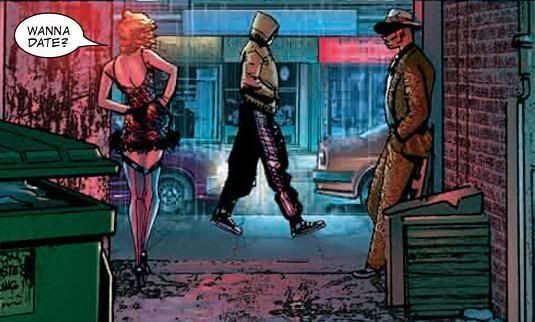
Courtesy of Avatar comes creator/writer Jamie Delano's return to comics after half a decade's absence, and it's a detailed, distanced, fitfully amusing one, its limited success solely the result of enthusiastic flourish.

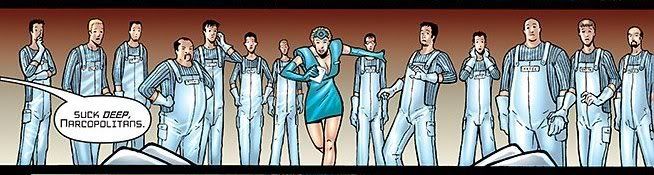
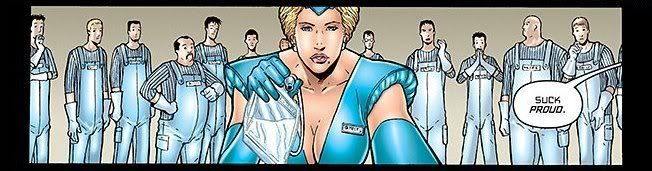
Delano really decorates the hell out of this one's language, positing the friendly ol' future megacity concept as a glowing drug paradise, where the people speak in a sloganized drawl like fleshy adbots - they wish one another SafeDay, spend their SpareCred on SpenDay at LazyLifeLotto, love the corporate-state bosom of MamaDream, oppose the unseen forces of BadEvil and suppress the ContraNarcopolitan urge. Workplace slobs are referred to as "employee heroes," and typical citizen names include Azure Love and Angel Gabble, while other doubleplusgood turns of phrase abound.

But this isn't quite an Orwellian limit on vocabulary/imagination at work; the language of Narcopolis is titular, alliterative and declarative, a poetry of brands and catchphrases poised to transform philosophy into soft drinks, just as emotions can be distilled into handy JooSacs. It's a world of grinning literalism. Opiates: the opiate of the masses.

But believe me when I tell you that occasionally funny scene-setting and decoration is all this first issue has going for it on the literary front; it's as if hanging around so much in Narcopolis' blunt society proved to be a bad influence on Delano, somehow prompting him to concoct the most obvious set of themes and tropes imaginable for the core of this debut issue.

Our hero is a fellow named Gray Neighbor, who's different from the other folks. While working his shift at the bomb factory (yes), he has visions of peaceable Others exploding... all while the narration of the city speaks of Strength and Justice! Why, that's not very just at all. Neighbor also isn't much up for the joocing and funning, preferring to do perverted things like reading books and taking walks, and wondering why the enemy hates his nation. He keeps a pet bird that's big enough to fly, dear readers, but it finds its cage a little too cozy. Might our Neighbor strike at the heart of MamaDream, even as a strange terror attack drives a horde of people cheek-ripping mad?

It's disheartening that bubbling newerspeak of Delano's dialogue gives way to such simple boredom; the story could at least be banal in a way that befits the dystopian mashup of its accoutriments, but it rather suggests a lack of spark underneath the concept at the 1/4 mark. And it doesn't help that Delano's lines aren't quite deft enough to suggest the squirming humanity of his characters, leaving them stranded in style; I'm not saying that distanced emotions can't work in a story like this, oh no, but here they don't have much to work off of beyond obvious messages about the numbing obviousness of bourgeois complacency.

The art (and lettering?) is by newcomer Jeremy Rock, who acquits himself fairly well with a straightforward semi-realistic cartoon style not entirely unlike that of Avatar regular Jacen Burrows, speaking of brands. Granted, I often suspect that much of Avatar's visual identity actually comes from their use of only three or so colorists for all of their books - longtime veteran Greg Waller (recently returned from a period away, I think) does the honors here. EH for right now, hanging on, improbably, by the tip of Delano's tongue. And you'll want to shave a point off if lines like "MagicWord comes, we'll screech BigMouth, scream clean through the DeathStatic IdiotNoise" have you scratching at your eyes - the whole trip's like that, and that's the whole trip.

I need Damage Control to clear out my in-tray: Graeme finishes off last week.

Making it to the finish line just in time...!

ASTONISHING X-MEN #24: This series has become some strange theoretical exercise – when something this slow takes this long to get done, at what point does everyone stop caring at all? In both lateness and terms of decompressed story, this really does seem like a throwback to the Marvel of a few years ago, and the execution of the whole thing makes it seem as if the creators’ enthusiasm didn’t make it through to 2008. Dull and Eh.

COUNTDOWN TO FINAL CRISIS #14: See, I like Evil Dick Superboy (Yeah, yeah, Superman Prime, whatever) pretty much as a character when Geoff Johns is writing him as Fanboy Extreme, but even the sudden, re-write-smelling, addition of him to this series fails to inject that much interest into what’s going on here, because he’s being played as generic omnipotent bad guy, adrift in a sea of generic bad guys fighting with each other. I can’t quite tell how any of this is going to end up tying in with the Final Crisis series, but that doesn’t make me want to read any more of this series; it just makes me want it to be over, already. Crap.

SUPERMAN CONFIDENTIAL #11: Hey, it’s the oft-delayed last part of Darwyn Cooke and Tim Sale’s secret origin of kryptonite storyline! And it’s... not really worth the wait! It’s not really the fault of the creators, because this was clearly meant to be a fairly low-key conclusion that could never stand up to a six-month wait, but at the same time, for the creators involved, this was sadly underwhelming. Maybe it’ll read better in the trade. Eh.

WORLD WAR HULK AFTERSMASH: DAMAGE CONTROL #1: Surprisingly enjoyable, in large part because of the art, which looks as if Steve McNiven and Ariel Olivetti had a particularly cartoony baby, and manages to make this comedy look as if it fits in the current, grimacing, Marvel Universe. Dwayne McDuffie plays the concept relatively straight – well, as straight as it could be, anyway – and it’s still a good concept after all these years. It’s definitely not the kind of thing I’d want to read on a regular basis – too much self-referencing in-jokery is never a good thing - but as a refreshing change from the mighty Marvel sturm-und-drang that’s never ending, it’s a Good thing.

X-MEN #207: And talking of mighty Marvel sturm-und-whatever, I definitely cannot be the only person who feels as if the ending of Messiah Complex not only came from nowhere, but also is exceptionally pointless and sensationalistic if Professor Xavier isn’t actually dead as a result. “Look! He’s been shot! We have to break up the X-Men because his dream is dead!” Wait, why, exactly…? It felt as if, instead of this crossover having any kind of ending that fit the story, it was rewritten at the last minute to set up something else down the line, robbing the crossover of any sense of climax or meaning. Eh, sadly; the rest of the crossover was better.

Next week, of course, is a biggie: New Captain America! Last Y: The Last Man! Big Star Wars crossover! Alex Ross tells us that Golden Age superheroes are the bestest one more time! Can you handle it, Earthlings?

Goodbye, Farewell, Au Revoir

I regret the need to do this, but I'm leaving the Savage Critics. I find that my good intentions of contributing are far outweighed by not having the time available to do the job I should be doing here, which makes me feel guilty. I thank everyone involved, especially the great Brian Hibbs, for including me in the first place. I still feel incredibly honored to be asked, and I'll remain a reader, of course!

Shipping 1/30/2008

Something for everyone this week, I think....

A G SUPER EROTIC ANTHOLOGY #74 (A)
ACTION COMICS #861
ARCHIE DIGEST #241
AVENGERS INITIATIVE #9
BADGER SAVES THE WORLD #2 (OF 5)
BATMAN #673
BETTY & VERONICA #233
BLACK ADAM THE DARK AGE #6 (OF 6)
BLACK SUMMER #5 (OF 7)
CAPTAIN AMERICA #34
CAPTAIN AMERICA CHOSEN #6 (OF 6)
CARTOON NETWORK BLOCK PARTY #41
CONAN #48
COUNTDOWN TO ADVENTURE #6 (OF 8)
COUNTDOWN TO FINAL CRISIS 13
CROSSING MIDNIGHT #15
DAREDEVIL #104
DARK 48 #1
DEATH OF THE NEW GODS #5 (OF 8)
DEVI #17
FANTASTIC FOUR #553
FUTURAMA COMICS #35
GENE SIMMONS ZIPPER #3
GREEN LANTERN #27
HOUSE OF M AVENGERS #4 (OF 5)
INDIA AUTHENTIC #9 KARTIKKEYA
JACK OF FABLES #19
JSA CLASSIFIED #34
JUGHEAD #187
KNIGHTS OF THE DINNER TABLE #135
MADMAN ATOMIC COMICS #6
MARVEL ADVENTURES FANTASTIC FOUR #32
MARVEL SPOTLIGHT ULTIMATES 3
MIGHTY AVENGERS #8
NARCOPOLIS #1 (OF 4)
NEW AVENGERS ANNUAL #2
PROJECT SUPERPOWERS #0
PROOF #4
SALEM #0 (OF 4)
SONIC X #29
SPIDER MAN SWING SHIFT DIRECTORS CUT ONE SHOT
SPIDER-MAN WITH GREAT POWER #1 (OF 5)
SPIRIT #13
STAR WARS DARK TIMES #8
STAR WARS KNIGHTS OF THE OLD REPUBLIC #25
SUBURBAN GLAMOUR #3 (OF 4)
TAROT WITCH OF THE BLACK ROSE #48
TERMINATOR 2 INFINITY #6
TRIALS OF SHAZAM #11 (OF 12)
ULTIMATE SECRETS
ULTIMATE SPIDER-MAN #118
ULTIMATE X-MEN #90
WHAT IF SPIDER-MAN VS WOLVERINE
WITCHBLADE CVR A CHOI & OBACK #114
WORMWOOD CALAMARI RISING #1
X-MEN EMPEROR VULCAN #5 (OF 5)
Y THE LAST MAN #60 (NOTE PRICE)
ZOMBIE SIMON GARTH #3 (OF 4)

Books / Mags / Stuff
AFTERDEAD 1.2 DESERT PEACH CROSSES OVER
AMULET SC VOL 01 STONEKEEPER
BATMAN THE MAN WHO LAUGHS HC
CASANOVA TP VOL 01 LUXURIA
DC ARMORY SER 1 AQUAMAN AF
DC ARMORY SER 1 BATMAN AF
DC ARMORY SER 1 NIGHTWING AF
EL DIABLO TP
FEMME FATALES VOL 17 #1
HOTWIRE COMICS GN VOL 02
ILLUSTRATION MAGAZINE #21
IRAQ GN OPERATION CORPORATE TAKEOVER
KIDS OF LOWER UTOPIA GN VOL 01
KRAZY & IGNATZ 1941 1942 RAGOUT OF RASPBERRIES TP
MANHUNTER TP VOL 04 UNLEASHED
NEW AVENGERS PREM HC ILLUMINATI
NEW AVENGERS TRANSFORMERS TP
OUTSIDERS CHECKMATE CHECKOUT TP
PREVIEWS VOL XVIII #2
SATANIKA HALLOWEEN SPECIAL
STEVE DITKO SPACE WARS SC (O/A)
SULLENGREY TP VOL 01 CEMETERY THINGS
TEMPLAR ARIZONA GN VOL 01 GREAT OUTDOORS
TOMARTS ACTION FIGURE DIGEST #162
UNCANNY X-MEN TP RISE & FALL OF THE SHIAR EMPIRE
WHAT WERE THEY THINKING TP VOL 01 (RES)
WIZARD MAGAZINE #197 FINAL CRISIS JG JONES CVR
X-MEN HC ENDANGERED SPECIES

What looks good to YOU?

-B

Please no gimmicks, she telliing me to chill: Graeme gets Wonder from 1/23.

While I’m talking about things that wowed me in the second issue after an initial disappointment, I’m sure that I should mention Gail Simone’s Wonder Woman – I wasn’t too down with the first issue, which seemed to be trying too hard for my tastes, but the second was exactly what I’d been looking for: An almost effortless tying together of the mythical with the superheroics, and a story that seemed true to the character and that it could only be told with this character. A shame, in that case, that WONDER WOMAN #16 is (like ASM #548) a third part that isn’t quite as good.

A lot of that, sadly, comes from the fill-in art in the middle of the book. Ron Randall is a fine artist, but his strengths aren’t the same as Terry Dodson’s, so seeing him attempt to take on some of Dodson’s chunkiness (and stylistic touches – Check out Etta Candy’s nose when she appears, which is very Dodson), or fail to bring the same heft and power to the fight scenes, makes for an uncomfortable and awkward break, especially when the switch occurs mid-scene and you’re left with the more delicate art for the splash page promise of carnage. The switch takes the reader out of the story, and the switch to that particular artist robs the scene of the dynamism and plain, dumb, oomph that it should bring.

Elsewhere, the story suffers from external pressures that really aren’t its fault; people who read Countdown know the outcome not only of the battle for Paradise Island and also of the issue’s cliffhanger, because we were already told that this story takes place prior to what’s happening in the weekly series. It’s frustrating – and, to be honest, almost moreso when you consider that this threat to the island is more interesting than the one happening in Countdown – because, taken on its own merits and away from the context of the greater DC Universe, this is a good story, and the cliffhanger a great one, considering the recent history between Diana and her mother.

After a first issue that still, upon re-reading, feels too eager to please, Simone has found her footing with the series and the script for this issue is a pretty good slugfest-middle-issue that keeps plot and characterization up there along with the punching Nazis. If you ignore inappropriate artist switching and a lot of the tension gone because of plot spoilers, then it’d be something to tell people to track down and read, if they’d rather their Wonder Woman wasn’t on the cover of Playboy. Even with those things taken into consideration, it’s still rather Good, after all.